Items from 1-3 Oct.
- Trump in Time;
- How AI could worsen a common cognitive trap;
- Trump’s demand for Fox propaganda;
- People with lower cognitive abilities are more likely to endorse Christian Nationalist claims;
- Shaun Tan and the “thin skin of reality”;
- Trump and Republicans seem to think that permanent daylight saving time will literally provide an extra hour of daylight;
- RFK Jr thinks AI will free us from the “tyranny” of medical facts;
- Paul Krugman on MAGA delusions;
- More about Trump, the press, and propaganda;
- Two loonies;
- Trump trying to cheat, and how Project 2025 is succeeding;
- How Pete Hegseth is consolidating his religion inside the military;
- How Disney solved infrastructure problems by planning ahead.
Apparently there’s a new interview with Trump in Time Magazine, and they didn’t sanewash his prose.
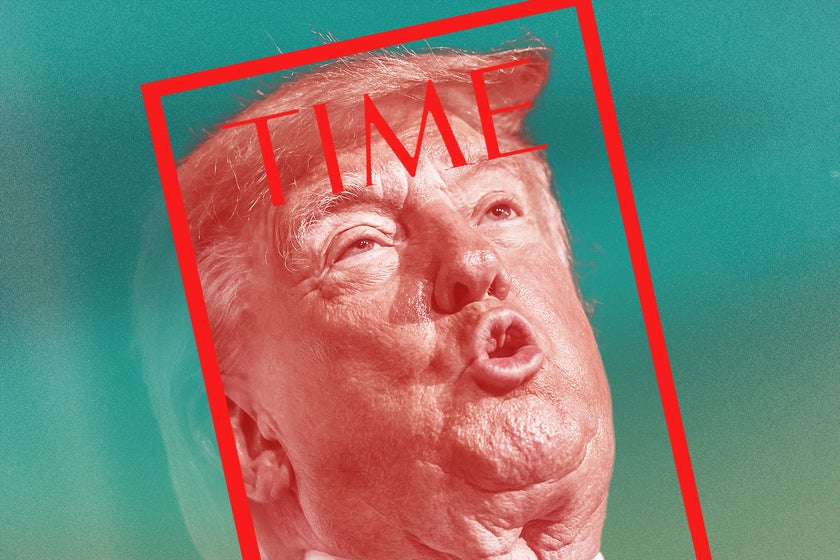
Slate, Ian Prasad Philbrick, yesterday 2 Oct: The Man Is Not Well, subtitled “We just got an unfettered view into the mind of the world’s most powerful person. It’s alarming, to say the least.”
There’s a link here to the transcript, which I haven’t looked at yet.
Donald Trump talks constantly, which makes it a minor miracle that he can still surprise us. But he did Thursday after Time magazine published the full transcript of a 75-minute interview with the president. Conducted this week by correspondent Eric Cortellessa and top editor Sam Jacobs, the 11,000-word interview is in some ways an unremarkable artifact of the president’s usual tics: run-on sentences, bluster, insults, lies. But it also contains moments of confusion, incoherence, and paranoia that look like windows into Trump’s mental state. Far be it from us to diagnose him from afar, but suffice it to say that if any other president—or person—spoke the way Trump does, you’d probably worry about their psychological and perhaps medical well-being.
I’ll just list the subheadings in the Slate piece, as they are numbered.
- Trump immediately gets confused about where he was this week.
- When it comes to Iran, Trump is on another planet.
- He gave an incoherent answer about the future of Gaza.
- His paranoia is reaching mad-king proportions.
- Does Trump know that JFK and LBJ are dead?
And concluding,
The above is just a sampler platter from a long, rambling, grievance-fueled interview with the most powerful person in the world. Much of the ensuing coverage has focused on Trump losing his temper, ripping into the interviewers with lines like “You haven’t asked me one f***ing positive question.” (As the New York Times reports, the president has gotten more publicly profane as he has aged.) It’s easy to become numb to all this; Trump’s incoherence is matched by his ubiquity. But this is the brain responsible for making life-and-death decisions for the rest of us every day. Does anything from this transcript suggest it’s still up to that task?
His fans have to notice eventually, right?
\\\
Science, and epistemology.
The Atlantic, Tania Lombrozo, today 3 Oct: AI Could Worsen a Common Cognitive Trap, subtitled “Almost everyone knows less than they think.”
The thesis in the subtitle is certainly true. Mostly we know where to find out what we need to know. Or, many people don’t care about knowing much of anything. What is the thesis here? How could AI make this situation any worse?
One of humanity’s most remarkable cultural achievements is the division of explanatory labor. When my daughter came down with a fever, I solved the problem by consulting a pediatrician, who shared a likely diagnosis of the flu. Unlike the doctor, I wasn’t able to tell my daughter much about the mechanism by which the flu leads to fever, or exactly why it was so important for her to keep drinking fluids. But the explanation I acquired—roughly “fever because flu”—was what was needed to treat her.
Society runs on this efficient type of information sharing. Just as coordinating specialized skills can streamline the fabrication of products—be it pins or cars or newspapers—coordinating specialized knowledge can facilitate the answering of questions. You can drive a car even if you don’t have the expertise to manufacture one yourself, and I benefited from the pediatrician’s explanation even though his understanding far exceeded my own.
And so on.
Humans’ sense of whom to ask for what is fine-tuned by evolution, culture, and personal experience. Even 3-to-5-year-olds are more likely to say that you should ask a doctor rather than a mechanic about fixing a broken arm, and a mechanic rather than a doctor about fixing a flat tire. As kids mature, they develop an even deeper understanding of expertise.
The author discusses how easily “a contagious sense of understanding” can appear from superficial descriptions of new phenomena. Then:
As information becomes more accessible through AI assistants, chatbots, and other technology, will these illusions of understanding become even more pronounced? Some early evidence suggests that the answer is yes. Several studies have now found that when people have information available to them through the internet, they overestimate how much they themselves know.
With examples. Well, OK. A problem that already exists might be made slightly worse by AI.
The kinds of errors that AI systems make are likely to change as AI develops, and human intuition about AI will probably evolve alongside these changes. As we expand our community of explainers beyond human experts to chatbots and other forms of AI, we create new opportunities for human understanding. But we also introduce an increased potential for illusion and error.
But these are enduring problems with human understanding, which is already very limited. Most people just “know” things without any kind of understanding.
The writer has a book on this topic: Why We Ask Why, subtitled “The Science of Explanation and the Human Drive to Understand”, that comes out Tuesday. Maybe.
\\\
Again, about propaganda. Trump thinks he can create his own reality.

Media Matters, Matt Gertz, 1 Oct 2026: Donald Trump’s insatiable demand for Fox propaganda
President Donald Trump lashed out at Fox News on Wednesday with a lengthy online harangue that made little sense but demonstrates the network’s impossible task in satisfying the president’s demand for pure propaganda.
“Why does FoxNews always put Chuck Schumer, Hakeem Jeffries, Jessica Tarlov, and every Democrat on, saying bad things about the Republican Party and, of course, me?” Trump posted to his Truth Social account at 12:15 pm ET. “I actually think they get more airtime than Pro Republicans. This is why MAGA, and REAL Patriots, will never like Fox! They repeat a completely negative narrative, on and on it goes, and then we get a quick retort.”
Because he’s completely oblivious to how most Americans, and most of the rest of the world, outside his MAGA base, perceive him. Dunning-Kruger.
\\\
Well *of course.* It’s just that the rest of us non-D-K folks are too polite to point this out.

JMG, today 3 Oct 2026: Study Finds That People With Lower Cognitive Abilities Are More Likely To Endorse Christian Nationalist Claims (from PsyPost)
A new study indicates that Americans with lower scores on a vocabulary test commonly used to measure cognitive ability are more likely to endorse Christian nationalist beliefs, even when accounting for their overall level of education. The findings suggest that the appeal of this political and religious ideology relates to underlying cognitive resources rather than just differences in schooling.
Religion is easy; science is hard. Fantasy is easy; reality is hard. This goes again to my notions about the limits of human cognition, and the appeal of tribalism, which humanity seems not able to escape.
\\\
One more. Here’s a take on why the arts are so significant in understanding human nature, and the reality we cannot perceive.

The Guardian, Tim Byrne, yesterday 2 Oct: Shaun Tan: ‘We’re always only seeing a thin skin of reality’, subtitled “One of Australia’s most cherished and awarded picture book illustrators on what makes a good painting, the mechanics of life and the fine line between utopia and dystopia”
Not just in Australia. He’s won a Hugo — and an Oscar. I met Shaun Tan once, at the Worldcon in Melbourne, back in 1999, IIRC, and I have many of his books. I’m taken by that skin of reality quote. Let’s find some more.
“I have this theory that if a painting is really good a five-year-old can still get something out of it,” Tan says. “A good painting should hit you in an emotional way.” Often he will haul one of his kids into the studio to see their reaction to a piece he’s working on. “A bit happy and a bit creepy? Great, that’s what I wanted. You can go now.”
…
The conversation orbits too, back to the question of reality and the thin veil between worlds that exists for all of us. “I have the same problem as everybody else: it’s hard to penetrate the veneer of familiarity. We’re always only seeing a thin skin of reality, which is what an illustration is, just another thin skin. And that’s the world around us, it’s only paper thin.”
Tan’s enduring interest in the mechanics of life (at one point he envisioned becoming a geneticist) has led him to think of reality as “arbitrary. I was very interested, as a young person, in science and quantum physics. It satisfied my suspicion that this is one reality amongst many.”
And this supports my notion about different realms of reality that have different explanations and ‘meanings.’
\\\\\
Items from Friday, 2 Oct.
They’re still on about changing the clocks. But they’re thinking about it wrong, of course.

JMG, today: Demented Man Rages About “Changing The Clocks”
The very name of their bill betrays their misunderstanding of how this all works. And the evidence he cites is backwards.
“Republicans in the Senate have to get moving on what I call the ‘No More Changing of Clocks Act,’ officially known as The Sunshine Protection Act, a ridiculous Clock changing process that takes place twice a year, costs our Country a fortune, is bad for Crime, stress on people, Sports, and just about everything else you can imagine.
…because everyone will be enjoying an EXTRA HOUR OF DAYLIGHT.
But you lose it in the morning. Get it? No of course not.
\\\
They’re deluded about this too.
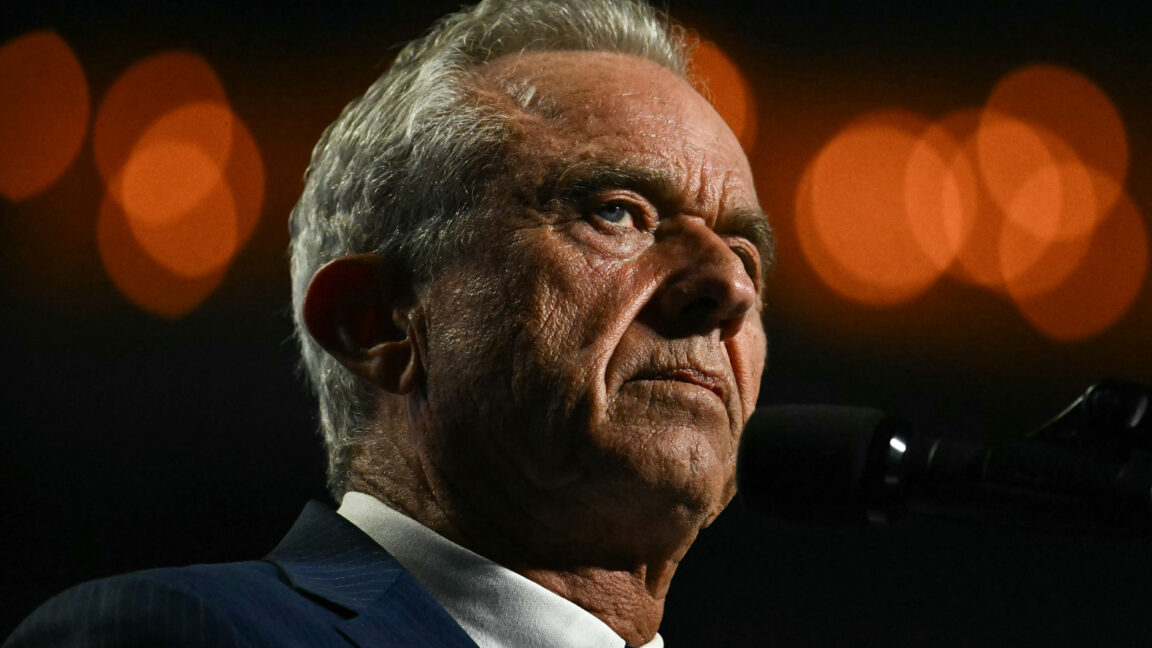
Ars Technica, Beth Mole, 30 Sep 2026: RFK Jr. thinks AI will free us from the “tyranny” of medical facts, expertise, subtitled “AI is far from a perfect resource. But it seems to hallucinate less than Kennedy.”
RFK Jr. and Vance, chatting.
Kennedy boasted that the Trump administration is “making it easy for every American to use AI,” which he claimed would free us from the “medical tyranny” of doctors and health experts. He suggested Americans should start using AI to get second opinions about medical recommendations, saying AI is “better informed than any doctor in the country.” He also suggested that the technology would confirm his misinformation about vaccines and contrarian views on public health guidance.
Doesn’t he understand where AI gets its information? By gleaning the web, and libraries, and medical journals. At best it is/will be a distillation of medical expertise, not a contraindication of it. He think AI will validate his contrary views? He’s delusional.
The writer provides examples, asking about masks and vaccines, asking both ChatGPT and Gemini.
Anyway, AI is not at its best. It still has a record of ‘hallucinating’ sources and manufacturing data. It is almost certainly still more reliable than RFK Jr. and Vance.
\\\
Yet MAGA loyalists live in a world of delusion, believing everything and anything Trump tells them.
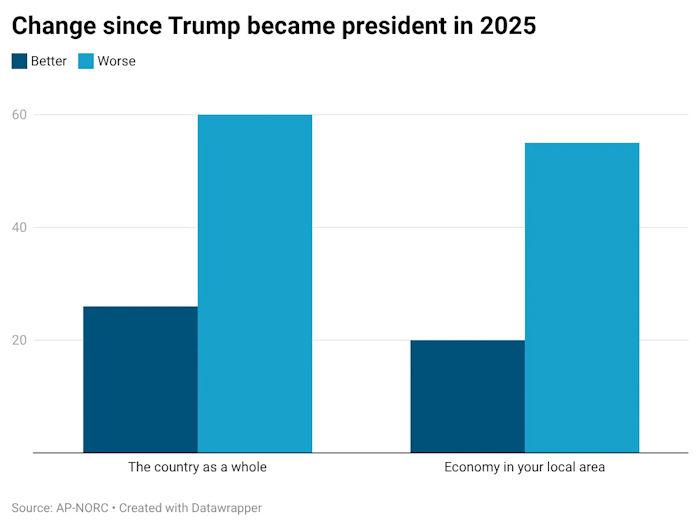
Paul Krugman, today: A “Who You Gonna Believe?” Election, subtitled “If you’re arguing, you’re losing. Trump is arguing.”
(IIRC it was Reagan who said, if you’re arguing, you’re losing.)
Krugman begins by displaying a graphic from current Trump press released that proclaims “Welcome to the Golden Age!”
They’re still doing it! Click on any White House press release and the image above pops up. The tone-deafness is almost surreal. Even if you’re a Trump loyalist who really believes that things are going great in America, surely you have to be aware that this isn’t how most voters see it.
In contrast to actual data, as in the chart shown above.
Voters famously blame whoever is in the White House when fuel prices are high, even though presidents normally have very little influence on these prices. In this case Trump, with his disastrous war of choice in Iran, really does bear full responsibility for high energy prices — and voters know it.
With more charts!
\\
Trump wants to be able to say anything, no matter how at odds with reality, and have the press repeat it, and have his followers believe it.
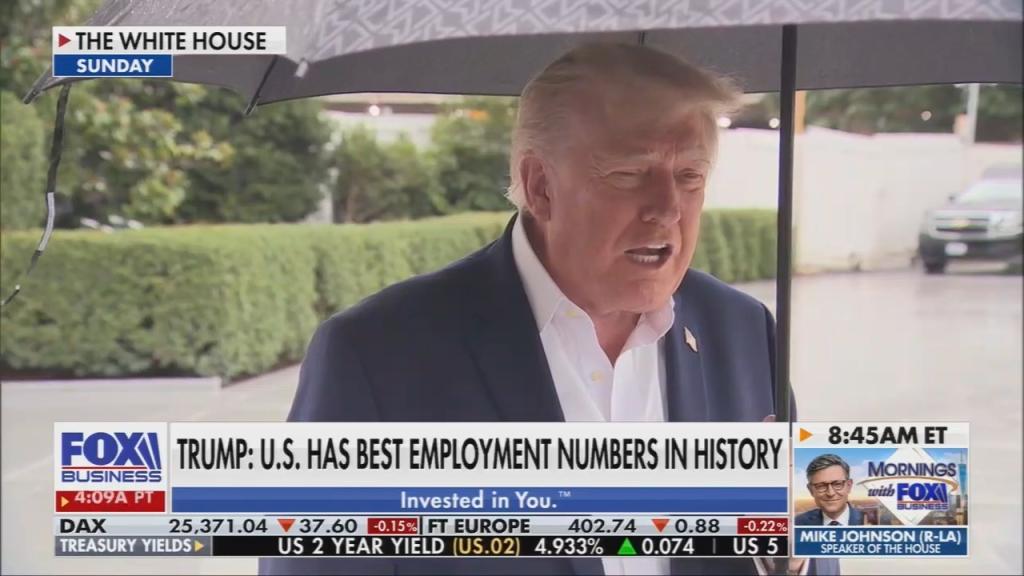
Media Matters, Matt Gertz, 28 Sep 2026: Trump’s press grievances are based in their refusal to do propaganda
The Justice Department sought last week to justify President Donald Trump’s decision to ban three news outlets from the White House by arguing that their reporters had jeopardized national security. But Trump’s own statements show what he actually wants from the press: servile propaganda that parrots what he and his political allies say about his administration.
“‘The United States has the BEST Employment Numbers in HISTORY,’” Trump posted on his Truth Social platform in the 7 a.m. hour Monday morning. Trump attributed the quote to “FoxNews,” then added: “The Fake News Media REFUSES to report this rather significant development, however!!!”
\\\
The Loonies.
- JMG, today: MAGA Prophet Prays For Jesus To “Bind The Steal, Drown Perverted Demonic Satanic Liberal Agenda”
- My first reaction: these people are insane. My second reaction: but his reaction has to be taken into account in any honest recognition of human nature, which is about tribalism and fantasy and not about understanding reality.
- JMG, 28 Sep: GOP Nominee Called For Publicly Executing Obama
- In what universe is he operating in?
\\\\\\\\\\\\
From Thursday, 1 Oct:
This is about those TV ads extolling American virtue (and Trump) that are being paid for with tax dollars.

Slate, Shirin Ali, today 1 Oct: Trump’s Latest Attempt to Cheat in the Midterms Faces Little Blowback
Midterm elections are around the corner, and for months, while strategists have predicted a Democratic sweep, the GOP has been throwing everything and the kitchen sink at its base in hopes of mitigating the anticipated blue wave. This past week, those efforts took the form of a series of television ads, each one featuring President Donald Trump and highlighting his administration’s policies while also warning against unspecified threats of communism. The ads themselves, though, were not the most disturbing thing. The most alarming part of the ads is a small disclaimer at the bottom of the screen: “Paid for by the U.S. government.” It appears that Trump was using our taxpayer dollars to fund his midterm political efforts. Using taxpayer dollars for ads that are clearly political is a blatant violation of federal law, but the unfortunate reality is that there may not be a clear-cut way to actually stop the Trump administration from continuing to air them.
Every day Trump gets away with something new, and his MAGA fans don’t care.
\\\
Stories like this appear in new depth after reading the Huffman book.
Salon, Heather Digby Parton, today 1 Oct: Trump’s failure hides Project 2025 success, subtitled “OMB director Russell Vought is quietly remaking the federal government, and Congress is next”
Huffman specifies how closely Vought and others in the Trump administration align with various Christian nationalist groups, and really would take down American democracy in favor of their fundamentalist Christian faiths.
It seems like a million years ago now, but there was a moment back in 2024, in the heat of that weird presidential campaign, when everyone was talking about the radical blueprint for Donald Trump’s restoration. Project 2025 was so extreme, in fact, that his campaign had Trump disavow it publicly. He usually said that he hadn’t read the plan and didn’t intend to, but at times he went further. In Grand Rapids, Michigan, on July 20, 2024, Trump said, “Like some on the right, severe right, came up with this Project 25 . . . They’re sort of the opposite of the radical left. You have the radical left and the radical right, and they come up — I don’t know what the hell it is, it’s Project 25 . . . and then they read some of the things, and they are extreme, seriously extreme.”
Trump disavowed it then, but hired people who are implementing it.
Project 2025 was a far-right manifesto, filled with the kind of pie-in-the-sky fantasies that denizens of conservative think-tanks had been churning out for decades in the hopes of influencing Republican administrations.
… This effort was largely guided by its co-author, Russell Vought … As a self-described Christian nationalist, he also believed that the U.S. should espouse fundamentalist Christianity, and that the country has no obligation to engage in global initiatives that do not directly benefit its own people.
The essence of tribal selfishness, the policy of conservatives.
\\\
And religious theocracy. The Huffman book show how scary Hegseth’s religious commitments are. More than just white nationalism.

Friendly Atheist, Hemant Mehta, today 1 Oct: Pete Hegseth is centralizing religious power inside the military, subtitled “Hegseth’s explicitly Christian defense of a new Pentagon religious office leaves non-religious service members on dangerous ground”
During a “State of the Force” address in Virginia yesterday, Defense Secretary Pete Hegseth announced the formation of a new “Office of Religious Affairs.” The office would give military chaplains a direct line to him and make sure the needs of religious service members are being met.
While this office is supposed to support service members regardless of their beliefs, Hegseth spoke about it in explicitly Christian terms. And when the official memo announcing the office was released, it only confirmed that the resources were geared almost entirely toward religious programs.
Just imagine the outrage of MAGA folks if a Muslim tried to do this in favor of his religion, and that is how us non-Christians feel about this. Christians seem not to understand the comparison.
\\\
Progress can be made. Some new ideas are good.

Vox, Future Perfect, Sara Herschander, today 1 Oct: Disney World solved a problem that could save America billions every year, subtitled “Our cities are built atop a dangerous obstacle course of cables. The Magic Kingdom found a better way.”
Buried beneath every American city is a mysterious jumble of cables, pipes, and gas lines, entangled like a pair of wired headphones the moment you pull them out of your pocket. Every time a contractor sticks a shovel in the asphalt, they embark on a high-risk excavate-by-dots obstacle course, dodging color-coded clusters of spaghetti-like power lines, gas mains, sewers, and fiber-optic cables. A line of blue spray paint means water. Red means power. Yellow is gas. Orange is telecom.
This is interesting. Our local street seems to be a nexus for utilities over the entire hillside from Route 13 up to Skyline, and so every couple three weeks there’s a utility crew with their spray cans painting different-colored stripes in the street. Presumably to plan their next excavation job.
About 700,000 times a year — that’s once every 47 seconds — something goes wrong.
With examples of how things can go wrong. But the point here is how the Disney properties have done this. It takes advance planning.
Directly beneath the Magic Kingdom is a sprawling network of tunnels. Initially designed to shepherd around Mickey and his friends, the system now also serves as one of the largest utility corridors ever created. Unlike the rest of America, where cables are typically dumped in ditches before being covered with dirt, the electrical lines that power Cinderella’s castle quite literally get the princess treatment.
Alongside water pipes, sewers, and animatronic control systems, these power lines lace the walls and ceilings of the utilidors, meaning they’re protected from weather and changes in the soil. They are also easy to monitor, catalog, and access if something needs fixing. While the cost of building a controlled system like this is much higher upfront than burying directly in the ground, the practice virtually eliminates the risk of accidentally rupturing a gas main or slicing a fiber optic cable during routine maintenance. Once they’re built, they can also drastically reduce costs in the long run because you no longer need to tear up a street every time a utility needs fixing.
Bottom line:
“Obviously, it’s expensive,” said Debra Laefer, a professor of civil and urban engineering at New York University, “but in the long term, it would be hugely cheaper,” especially “in areas where we are digging all the time, there’s a direct business case for moving towards these utilidors.”
This is why it will never be done locally. Conservatives don’t invest in the long-term.
\\