
No wait, three notes about narrative.

Vox, Ian Millhiser, today: Patrick Stewart taught us what good men do with power, subtitled “Great leaders, and great nations, need role models like Jean-Luc Picard.”
When Patrick Stewart, who died on Wednesday, first stepped onto the bridge of the Enterprise in 1987 in his defining role as Captain Jean-Luc Picard, the Berlin Wall still stood. The Soviet Union would not fall until the fourth season of that show, Star Trek: The Next Generation, had already begun. Yet Picard’s generation of Star Trek franchise anticipated both events, portraying a post-Cold War world just as the Cold War was ending. It was the quintessential show for an age of American hegemony.
Despite some of the later series, and movies, Trek of that era did not emphasize space battles.
Yet, while the Federation was a metaphor for an American empire victorious after the Cold War, it was also an idealized vision of the United States. The Enterprise spent far more time rescuing people from environmental catastrophes or shuttling ambassadors to peace negotiations than it did battling aliens in space. Picard flew around the galaxy in a ship packed with enough armaments to destroy entire planets. But he more often used that ship to distribute vaccines.
In its best moments, The Next Generation was a meditation on the just use of power. And Picard, as Enterprise’s captain, was the voice of 1990s liberalism — known as much for his eloquent soliloquies in defense of universal rights as for his tactical prowess as commander of the Federation’s most advanced weapon.
Looking back, it’s easy to see Picard’s liberalism as a vestige of a lost era. The Next Generation showcased a just and highly capable Federation that bears no resemblance whatsoever to the current United States government.
This idealism goes back to Trek TOS, which no doubt formed some of my attitudes about government and society and diversity. Yet, a running theme here is about how the ideals of progressivism easily slide back into authoritarianism. It’s hard to overcome human nature.
Without a strong federal government, humanitarian US institutions like Medicare or Social Security cannot exist. America owes its prosperity to police forces that protect individuals from theft and assault, and to a military that, like Starfleet, secures us against external adversaries.
Star Trek’s core insight is that there will always be powerful institutions, just as there will always be militaries capable of exterminating human life. Anarcho-communist notions of a world without hierarchy or state-sponsored violence are nothing more than fantasies. There are only institutions, which can be led by good or evil individuals.
Serious nit: Here and elsewhere, Picard’s statements are attributed to Stewart. No one mentions the *writers* who created those statements in the first place. “The Measure of a Man,” discussed here, was written by lawyer and science fiction writer Melinda M. Snodgrass.
This can be taken as a note about narrative. People confuse actors with their roles, and don’t realize the actors haven’t actually written those glorious speeches themselves.
\\\
Brief takes.
Speaking of the slide back.
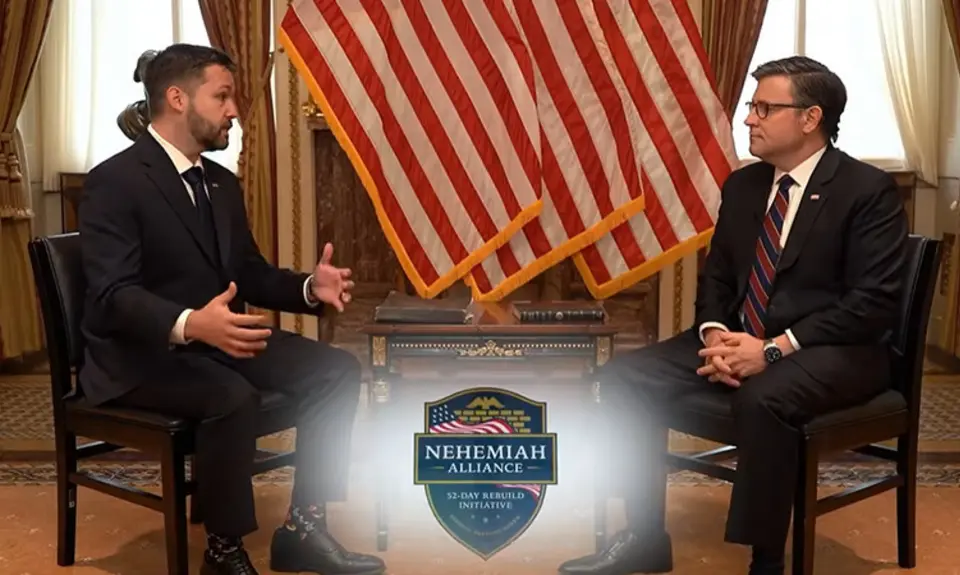
- Right Wing Watch, yesterday: Mike Johnson Set to Address Christian Nationalists’ Pre-Election Rally
- Republicans rant and rave about Sharia law and any politician who might be Muslim, yet do things like this in the name of Christian Nationalism. And don’t see the irony.
- Similarly: JMG, today: Kennedy Defends Claim Arabs Don’t Win Nobel Prizes

- It is to laugh. From the most corrupt and least moral president in history.
- JMG, today: Trump: “Guided By An Unwavering Faith In Jesus, My Admin Is Restoring Moral And Religious Foundations”
- Does anyone but a cultist believe that Trump knows anything about Jesus, let alone understands his morality?
\\\
Serious point, briefly in passing.

- Via File 770, Charlie Jane Anders, yesterday: A.I. Stories in the Age of AI Hype: a Conversation with Ted Chiang
- This is about AI, but I’m noting this comment about writing fiction in general:
“There’s no way to write fiction and guarantee your readers will understand it correctly,” Chiang says. “There is no way you will ever be able to write something so straightforward that Elon Musk will understand it the way that you intend it.” People in tech seem determined to view speculative fiction through the lens of their own certainties, and “you cannot adjust for readers who are arbitrarily bad at reading.”
And this is a second note about narrative. I became conscious of this when I was reviewing for Locus Magazine back in the 1990s. I realized over time, sometimes belatedly, that I did not always understand the point the writer of a story was making. Reviews are written quickly and there is no way to mull over them until insight strikes about a story that might seem confusing or ambiguous. The point of a review, though, is to describe the story sufficiently well to advise another reader whether to read the story or not. Or at least that’s the position I took. There is not one true interpretation of a story, just as there is no one actual story. Every story is in a sense a collaboration between the author, who writes the story well or maybe not so well, and the reader at the time the story is read. The reader, coming back, can see the story in a new light.
A third point about narrative is that narratives don’t have to correspond to reality; usually they don’t. See: Christian Nationalists.