
Subtitled: How Right-Wing Extremism Created a Post-Truth America
(Beacon Press, March 2025, 200pp, including 25pp of acknowledgements, notes, and index)
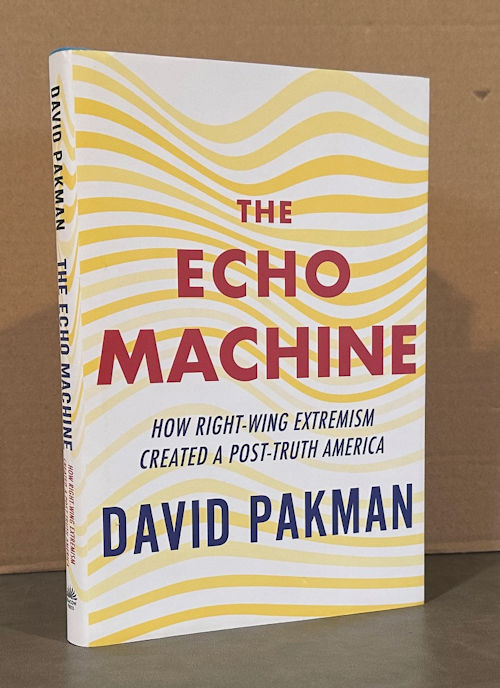
Pakman is a podcaster and YouTuber with frequent posts on Facebook, which is where I started following him. See The David Pakman Show. This is his first book, from early last year. He has another book, just out, called PAY ATTENTION.
Much in this book is familiar, especially the history of the right as a reaction against the era of civil rights and the resistance to science and expertise as the increasing regulatory environment against big business. Passing through critical thinking, and leading to the modern era of social media and media bubbles. It’s a good summary, familiar from Richardson and others, and current, since Pakman is on the air every day reacting to current events, and this book is less than two years old. What’s new here include his basic defense of the left, given the progress in recent centuries, and discusses how countries that are social democracies (not socialist) are among the most prosperous in the world.
Key Points
- He considers how the US became broke, not just in politics, and traces it to the 1950s, when civil rights triggered a reactionary backlash; this is why the 1950s is the “golden era” so many (MAGA) want to return to. This is a familiar narrative, and relates to how conservatives are motivated by fear. The program coalesced under Reagan, and extended through Gingrich to Fox News to anti-intellectualism and then xenophobia with Obama, enabling conspiracy theories, white supremacy, alternative facts, and ignorance as a badge of honor.
- We have access to more information than ever before, but critical thinking and media literacy are crumbling, since such information threatens worldviews on the right. Thus Republicans prefer understanding to be superficial and unexamined, with examples about government spending and law and order, to the Bush, Obama, and Trump eras. Lack of critical thinking is marked by hypocrisy, double standards, and inconsistency. Example: family values, and numerous Republican politicians.
- Author discusses the difference between facts and opinions. The former align with objective reality; the latter do not. Just as in the Middle Ages dogma was prioritized, today’s echo chambers provide areas were opinions are packaged as facts, especially on Fox News, which led to the dismissal of real problems as hoaxes: climate change, vaccines. The Renaissance and Enlightenment led to the spread of knowledge, the rise of industries, scientific discoveries. Yet even the left has issues, with ‘postmodernism’ and the idea that context shapes our understanding of facts.
- The right focuses more on principles and values at the expense of solving problems. (He means superficial principles, i.e. slogans.) Examples of their binary approach: civil rights vs “states’ rights.”
- Author asks, why choose leftism? He defines social democracy as “a form of well-regulated capitalism,” and not the same as socialism. Countries that do this have the highest living standards in the world, and are among the least corrupt. Author answers the right’s two common ways of attacking their success. Other countries with progressive approaches do better. Related problems: money in politics; our flawed election system; climate change; and health care.
- How the right has no policy, only cultural battles and fear-mongering, xenophobia and racism, conspiracy theories. The right lost on policy (e.g. abortion and gay marriage) which is why they’ve abandoned it. This puts the left at a disadvantage, since all the Republicans want is to dismantle the existing government. The left has to point this out, and fight for what the right doesn’t want: education and critical thinking.
- Why does the right keep winning? Examples of gun regulations; people are motivated by emotion and fear-based appeals. The right is good at campaigning, gerrymandering, and raising contrived cultural issues. Further, some parts of the government are fundamentally anti-democratic, e.g. the electoral college.
- How to responsibly consume media: understand epistemology (knowledge, logical fallacies, etc.) and critical thinking. Then media literacy (e.g. who’s paying for those ads?). Then subject matter knowledge (education). Other countries do this better. And do more than just consume the news: get out.
- What else can we do? Become an activist? Examples of what have worked in other nations. Gradual change works better than tearing things down to rebuilt them. Examples from the three periods of progressive achievement in the US. Incrementalism may seem slow, but long-term thinking leads to progress.
Full Notes
Intro: Why I Hate Politics, p1
The part he hates is the part where people are bogged down in fights about facts and opinions, against empirical consensus over climate change, vaccines, etc. Most feedback he gets on his show is uninformed. Which prevents us from making progress to solve problems.
[[ This can be seen as an aspect of how so many are just dumb, or clueless about how the world actually works, i.e. what I’ve been calling reality-illiteracy. ]]
We could solve lots of these problems if we just had the will to. Too many people argue that the problems don’t exist. But we have to engage with the system. To do otherwise would be surrender.
The history of the US has been cycles of activism followed by cycles of cynicism. Examples from history. The Progressive Era of the 19th-20th centuries. Post WWII. Cynicism of Watergate. And the Bush presidencies. Now internet and social media are stymied by echo chambers and misinformation.
It’s difficult to compare the US with other countries in terms of political engagement. It’s lower in the US. Author was born in Argentina.
A key issue in the US is the media landscape, with its echo chambers, etc. Fox News. Disinformation. Fake news. Media literacy is poor. The right wing benefits. There are also matters of mental health, what with smartphones and doomscrolling. Not engaging is not an option. Will try not to be pessimistic, but rather to focus on proposed solutions.
Ch1, How the United States Broke, p9
Not just politics, but also economics, culture, and education. What broke them in the first place? It took place over decades. Relating to the promise of equal opportunity, democracy, rights to life, liberty, and the pursuit of happiness. Now we have income inequality, and the undermining of democratic norms and institutions. It goes back to the beginning of the US, in a sense, but certainly by the mid-1950s. The Civil Rights era. Reactionary elements resisted. This is why the early 50s is the “golden era” that so many want to return to.
This was the civil rights era and led to the Civil Rights Act of 1964. With pushback from White supremacists and people afraid of losing their advantage. Many used Biblical justifications for racial separation, ignoring constitutional principles. Conservatives are motivated by fear. Some trotted out “states’ rights” arguments. These reactions coalesced under Ronald Reagan. They had been unsettled throughout the 1970s, what with Nixon and the Vietnam War. They wanted “traditional values.” Reagan told stories, like the one about the welfare queen. Reagan opposed welfare programs, mental health care, and promoted trickle-down economics that benefited the wealthy. Newt Gingrich came along in 1994. Republicans hated Clinton. Gingrich created a conservative vision, focusing on balancing the budget, crime, prison, policing, and welfare “reform.” Clinton was impeached over Monica Lewinsky. Also, Fox News came on the air in 1996.
Eventually came George W. Bush and his overt celebration of anti-intellectualism. “Common sense.” College education was liberal indoctrination. Scientific consensus was dismissed. Examples of simplistic takes on issues like taxes, abortion, and climate change. Prioritizing simplicity over nuanced understanding, p17.8.
Obama brought out the racism and xenophobia on the right. The birther movement. Conspiracy theories. Racists became more outspoken. White supremacist groups increased. Patriot movements. To them Obama was an “other” and not quite American. Sarah Palin came along, even more anti-intellectual than Bush, paving the way for Donald Trump. Ignorance was a badge of honor. Alternative facts and post-truth. Republicans welcome a know-nothing like Trump, who celebrated gut instincts over nuance of any kind. Details p20. Conspiracy theories, post-truth, sound bites and slogans.
This timeline can be supplemented with several other elements. The Supreme Court became right-wing. Roe v. Wade was overturned. How Republicans obstructed Obama’s nomination of Merrick Garland, in contrast to the rush to confirm Amy Coney Barrett. Principles disregarded. Cases favored big business over rights of individuals. The final layer is the growth of social media, and the decline of education. Echo chambers, filter bubbles, polarization. While Republicans slash education budgets, and remove topics they don’t like from public schools. Misinformation and disinformation. And traditional journalism has declined.
This is how the right wing has eroded foundational values and led us to our current state.
Ch2, What Happened to Critical Thinking?, p25
We have more access to information than at any time before, but critical thinking and media literacy are crumbling, in part because of attacks from the right, since their worldview and policies are threatened by them. They used to be more highly valued in the US. The Age of Enlightenment influenced the founding fathers. The Progressive Era. Some other countries have strong education programs for critical thinking and media literacy. Finland, Singapore. The US is an outlier.
Critical thinking, p26. Using facts to generate conclusions. The right demonizes education as ‘liberal indoctrination,’ and it’s true that Americans who can think critically are less like to fall for the ideas of the right. Example: trickle-down economics. There’s no evidence to support it. MAGAs are proud of not trusting actual experts. Rather, promoting “alternative facts.” An idea that makes no sense. Used in “debates” about climate change.
Election Outcomes, p29. Conspiracy theories about Pizzagate, the wall paid by Mexico, etc.
Policy immobility, p29. The Paris Agreement withdrawal, etc.
Conspiracy Theories, p30. Birtherism. Covid. The 2020 election.
Philosophically, critical thinking is related to epistemology. It’s been crucial throughout history. Without it understanding of issues becomes simplistic. Republicans prefer welders to thinkers. Philosophy is as much about why we believe the things we do, as what. Republicans prefer understanding to be superficial and unexamined. Examples p32.
P33 Government spending, debt, and deficit. Republicans worry about them when Democrats propose programs, but not when the deficit expands under Republican presidents. Their concerns of fiscal responsibility are selective. And such concerns lack perspective and proportion. Americans are confused about debt v. deficit. Republicans always have excuses for their excesses. Details, 35t.
P36 Law and Order. A Republican slogan. Nixon, Agnew, Reagan. Often regarding protestors as criminals. Goldwater. But these concerns were empty. Consider January 6, 2021. Incited by Trump. And excused by many Republicans. Earlier, “lock her up” about Hillary Clinton, over baseless charges. Mark Milley. George Santos. Hunter Biden. Repeated double standards about ‘law and order’. Similar patterns in foreign affairs, e.g. Putin’s invasion of Ukraine. Now Republicans don’t care about international laws. And how Trump loves strongmen around the world. And so on. [[ And since the book was written, Trump’s war with Iran. ]]
P39, The Bush Era and “Unpatriotic” Accusations. Bush said you’re either with us or against us, regarding Iraq. Patriotism meant going to war. Even as the pretext for that war fell apart.
P40, The Obama era: Damned if you do, damned if you don’t. Republicans criticized his use of drones. Whatever Obama did, Republicans criticized it. Regardless of any principles involved.
P40, The Trump Reversal. He promised to keep the US out of new wars, and claimed Hillary Clinton would start World War III. His own foreign policy was unpredictable.
So: hypocrisy, double standards, and inconsistency are markers of a lack of critical thinking. Yet another area: “family values.” Despite the behavior of many prominent Republicans. Trump especially. Despite which, the religious right supported him. Even as Republican policies contradicted many Christian values. Lauren Boebert, Bill O’Reilly, Newt Gingrich, Roy Moore.
Two futures are possible. We continue to the bottom, all the worse with AI deepfakes, and even greater division across the world. Or, re-embrace these disciplines and learn to live in a complex modern world. Put these disciplines back in public schools.
[[ This is all very well, but the root issue here is rote, intuitive tribal thinking, over insight and critical thinking about how people in a society can best get along. Conservatives are always ready to forgive their own; they don’t need to think it through. And they by rote oppose their ‘enemies.’ ]]
[[ Likely both futures will occur: pockets of intelligence, amidst seas of tribal ignorance. ]]
[[ Also, I’m fond of the thesis that religion itself undermines the ability to engage in critical thinking, because with religion you’re told at an early impressionable age what to believe, no matter how implausible such beliefs might seem later in life. ]]
Ch3, What Are Facts?, p45
To ask “what are the facts” implies being able to know what a fact is. What are facts vs opinions? Many on the right seem not to know. And though the right is guilty of fact denialism, the left isn’t blameless, with discussion of postmodernism and equality of opinions. One distinction is between discourse, dialogue, diatribe, and debate, 46m. Sometimes facts aren’t relevant to values. A survey about facts and opinions showed how few people can tell the difference. Examples, 46-7. (But some of these might by untrue ‘facts’)
A fact is something that can be proven true based on objective reality. An opinion cannot be so justified. The Greeks pursued the difference; then in the Middle Ages religious dogma was prioritized. … The digital age provides fertile grounds for opinions to be presented as facts. Echo chambers. Topics are sensationalized. Opinions are packaged as facts, especially on Fox News. (How they do it, 49.2) It can be very effective. And so on. All of this has serious implications.
One problem is that the confusion creates doubt about legitimate facts. The right does this to create ambiguity. This leads to erosion of social cohesion. The dismissal of real problems as hoaxes. Examples follow:
Climate change. Portrayed by the right-wing as just an opinion.
Covid and vaccines. Proposing alternative treatments. Falsehoods about vaccines. Disinformation.
Political objectives: Divert and Deflect, away from other issues, e.g. away from Russian interference in 2016. Rally the Base, offering validation for alternate views. Legitimize Policy Decisions, about the environment, immigrants, climate change. Such issues have been going on for centuries.
P54, Earlier civilizations and the birth of debate. The Greeks. And eastern philosophies. Logic and epistemology.
P54, The Middle Ages: Religion versus Science. Religion dictated what was fact. Copernicus, Galileo gradually shifted things back to evidence.
P55, The Renaissance and Enlightenment. Printing press, 1440, led to massive spread of knowledge. Locke and Voltaire emphasized reason and evidence.
P55, Industrial and Modern Age. The rise of newspapers and journalism. Debates about scientific discoveries.
P56, The Postmodern Era. Suggestions that context shapes our understanding of facts. There are a few elements on the left where opinions mix with facts. Personal narratives are often used by left-leaning movements. Postmodernism had some appeal. The idea of “intersectionality.” These can distract from empirical data. Examples include removing or renaming statues, institutions, etc. Environmental claims without evidence. Gender issues. Ideas about capitalism. The risk of echo chambers is the same. The challenge is to account for both personal narratives and empirical truths.
If misinformation is a disease, education is the vaccine.
[[ Also in is my idea of reality-literacy. Know how the world works at a fundamental, physics/chemistry/biology level, so that some assertions can be dismissed without analysis. But most people are not so literate, especially in matters of scale-blindness. ]]
Ch4, The Cost of Principles Over Problems, p61
There’s a tendency on the right to focus on principles and values at the expense of solving problems. [[ really? It seems they don’t care about principles at all. Unless he means the term in some special way. ]] It’s a way of avoiding complexity. Principles offer simplicity. Examples. A culture of life. It’s my money, I earned it, I should get to keep it. [[ so he means slogans more than nuanced principles ]] Us vs them. These all avoid the complexities of actual society. Parents have the sole right to decide how to raise their children. And so reject public health measures. Against foreign military intervention. Such principles are unchanging.
Right vs left, 64.7. binary approach. Shielding from criticism. Examples of how the right has blocked progress based on their principles.
P65, Civil rights and “states rights”. Climate change and “economic freedom.” Gun control and “second-amendment rights.” Health care vs “individual liberty.”
[[ This is a good summary of conservative arguments, citing simplistic principles, against complex solutions. Thus reversing progress. ]]
The media environment exacerbates all this. Profit motives, hunger for attention. Endless back and forth arguments. Designed to encourage endless engagement. Examples of abstract topics for debate, 70.8. Focusing only on principles doesn’t lead to construction solutions. The real world is complex and messy; insisting that principle be followed without compromise does not work.
Ch5, Why Choose Leftism?, p73
Now we consider successes and repairs. Drawing lessons from the past. We can see how progress is made. Learning from history. Examples of how leftism does not work cite authoritarian regimes instead. There are plenty of leftist movements that have succeeded with benefits. The right wing will deny them. So let’s start by defining leftism.
P74, Social Democracy. This is a form of well-regulated capitalism, to moderate excesses. It retains the market economy. With regulations, a robust welfare state, and redistribution to reduce inequality. Not the same as socialism; some deliberately confuse the two for political reasons. This is what author means by leftism. This is been tried in various countries that lead the globe in high living standards. In particular, Denmark, Norway, and Sweden. Finland and Iceland are sometimes included in this group. They have high living standards, and are among the least corrupt countries in the world. They are not anti-business (think Ikea, Volvo, Nokia). They have expansive welfare system. The right has two common ways of attacking their success.
P77, The Scandinavian/Nordic Capitalism Myth.
One charge is that these countries’ success is due only to their capitalist elements. This ignores their harmony between capitalism and social welfare. The latter makes workers more productive, which helps the economy, which in turn supports the social welfare. Etc.
P78, Social Democracy’s Successes
The second charge is that these countries’ success is due to their racial and cultural homogeneity. As if diversity is a problem for economic success. This is simplistic. There is diversity in the Nordic nations, and they’ve been taking in immigrants in recent decades. Their shared values continue to make their high standards of living possible.
Consider similar examples: Uruguay… Portugal… New Zealand… Germany. With many details. Then the Kerala state in India. Even within countries, regions that adopt progressive approaches do better. [[ That’s sorta what progressive *means* — if it didn’t work better, you would change approach, exactly the thing conservatives would never do. ]] High literacy, critical thinking, creativity. Services.
Now we look at specific meta-issues, which layer on top of political issues.
89, Money in politics. Candidates who raise more money usually win. Campaign finance laws to back to the early 20th century, and were largely overturned in 2010. Now we have PACs and super PACs and dark money.
90, How elections are run. Our election system is flawed. One system is first past the post, or FPTP, where the candidate with the most votes wins, even if not a majority. This allows for spoiler third party candidates and an entrenched two-party system. Sometimes there are run-off systems. Another is PR, proportional representation. Then RCV, ranked-choice voting. Then the Electoral College, which is fundamentally antidemocratic. The reasoning behind it is obsolete. And the primaries. Voter suppression, by the right. Purging voter rolls. Objecting to mail-in voting with accusations of fraud. Gerrymandering. Packing and cracking.
96, Climate Change. Unchecked this could ruin and overrule everything else. Much of the American right refuses to acknowledge that it’s happening. Solutions require global cooperation. Reform ideas exist, but political will is lacking.
98, Health Care. The American system leaves many behind, or leaves them with crushing debt. Some improvements have been made. Among options are universal health care, or single-payer; the expansion of Medicare; various systems as in Canada, Singapore, the UK. Mental health parity, health clinics.
Leftism does not stifle innovation or prosperity. Just look at the social democracies.
Ch6, How to Fight Against a Movement that has no Policy, p102
Ever since Reagan, and especially since Gingrich, the Republican Party has moved away from policy and toward cultural battles and fear-mongering; examples. Focused on personal attacks against the Left. Bush had some policy-based priorities, but they were simplistic ones. Obama allowed the right to abandon policy entire and focus on xenophobia and racism. Leading to Trump. Who had no policy whatsoever, except vague allusions. Tough on China, build the wall, fix trade. By 2020, threats against non-existent socialism and communism and threats against non-white people. And allusions of voter fraud. Some Republican candidates won with completely substance-free campaigns. Rather, conspiracy theories. E.g. about ‘socialism.’ Without understanding what various terms mean. They just know they’re bad. Even as they benefit from what are socialist programs, like Medicare. Accusing Biden of being socialist.
Republicans have become adept at weaponizing social media. Populism is primarily rhetoric. Plus strongman authoritarianism and rejection of experts. In fact, the right has actually lost on policy, which is why they’ve abandoned it. Examples. Health care. Abortion. Gay marriage. Taxes and the wealth gap. Environment and climate change. Gun safety regulations. In all these public opinion is at odds with Republican policy, such as it is.
Ironically, the left is at a disadvantage, because the Republicans want to do nothing anyway, except to dismantle the existing government. Which is what many voters want them to do. Not doing anything is their foundational principle. The solution to this comes in two parts. Point out that Republicans aren’t doing anything realistic. Force them to defend their lack of vision. Highlight the consequences of their inaction. Don’t disengage with the unreachable. And in the long term, promote education and critical thinking. What republicans have fought against. Explain the connection between officials and real-world circumstances. And push critical thinking.
Ch7, Why Does the Right Keep Winning?, p114
Despite the disconnect between public opinion and Republican values, the party remains viable. And keeps winning. And wins by moving to the right. Why? Three components: they’re better at campaigning; they benefit from gerrymandering and urban/rural divide; they float contrived cultural issues to raise money and avoid serious policy discussions. [[ In other words, they appeal to base human nature, which doesn’t involve thinking ]]
Examples. Gun regulations. CRT. People are motivated by emotion, and fear-based appeals. Republicans boil complex issues into simple, emotive narratives. E.g. defund the police. It’s easier for them to gerrymander large rural areas. Urban areas are progressive; rural areas traditional and conservative. Who claim they are the ‘real’ America. Contrived cultural issues include abortion, gay marriage, vaccinations, protestors, transgender rights.
There are also areas of the government that are fundamentally anti-democratic. These include the electoral college, the filibuster, the senate, and voter suppression tactics. These work to the advantage of Republicans. Details. Changing things would require large portions of congress… Minorities obstructing the will of the majority. And actual voter fraud is extremely rare. Smry 127.
Ch8, How To (Responsibly) Consume Media, p128
Media bias. Echo chambers like Facebook and X. Media influence through advertising. Corporate and lobbying influence. Political advertising. Media’s role in elections. Ideas for reform are numerous.
Consider how events become news. Balancing act. Sensational things get priority. We can make an analogy with the food pyramid. The basics are epistemology and critical thinking. Then media literacy. Then topics like history, philosophy, economics, sociology, and psychology. And then news and current events.
The first layer, epistemology and critical thinking, 132b. What is knowledge? What beliefs are justified? Are logical fallacies at play?
Then media literacy, 133. Who created this news item? Is it fair or does it include sensationalism, fear, etc. Who paid for it? What sources were used?
Then subject matter knowledge. In subjects like those listed above, and science, and medicine. E.g., background about Latin America when considering the idea of American intervention there. Take breaks from the news. The world is a complex adaptive system.
Cults and conspiracy theories are attractive because they provide easy, simple explanations. A tragedy was planned. It’s the fault of this group or that group. Author used to interview extremists on his show. They often grew up in chaotic and broken homes. One has to platform responsibly, and not take extremist claims at face value. Examples of how to decide who to platform. Example of author interviewing anti-gay folks. Some of them dispelled after the 2015 scotus decision. The moral issue is the risk of converting viewers to the extremist’s position. Beware the idea of stochastic terrorism—regularly calling out scapegoats until some individual takes action, like killing an abortion doctor. The Jan. 6 Capitol riot was an example.
When doing such interviews it should be clear that the interviewer does not agree with the subject, but can still be polite. Know their talking points. Don’t become emotionally compromised. And beware how such interviews can be edited.
Beyond that, concerning platforms, maintain vigilance. Invest in education and training. Collaborate. Self-reflect. Promote constructive discourse.
In the 21st century the lines are blurred between credible journalism and opinionated and false content. Just as media literacy declined. Following deregulation in the 80s, and repeal of the fairness doctrine. Other countries have done better. They are less susceptible to conspiracy theories, etc. Online media provides more outlets, but also builds echo chambers. Competition promotes sensational stories. And more negative events. Profit motivations. Understanding these is about becoming an informed media consumer.
Strategies for navigating corporate media. Beware of advertisers. Fact check. Understand convenience bias. Set limits on how much time you want to spend on the news. Don’t just keep scrolling.
Finally is the mental health component. Constant exposure to negative news can be stressful. Set a schedule. … Read books. Go on bike rides.
Ch9, What Else Can We Do?
What counts as activism? That’s not just political hobbyism? Very few people actually attend meetings or volunteer for campaigns. Social media companies would just as soon you not. They’re in it to make money.
Political hobbyism is passive, and actually hurts the left more than the right. It doesn’t accomplish anything. The nature of the workplace has changed. It tends to inhibit expression of political views. Most people are concerned about immediate economic issues. Including health insurance that’s tied to employment. All of this has reduced grassroots mobilization by the left. The right is now more often activist in their protests.
How can activists go beyond voting and signing petitions? Suggestions are mass rallies; strategic mass absences from work (e.g. strikes and boycotts); coordinated debt defaults (examples in Argentina, UK); civil disobedience; community organizing for local change (examples include Harvey Milk); economic interventions (South Africa, Cesar Chavez); and so on. More examples.
History shows that gradual change leads to more sustained achievements. Rather than accelerationism: tear it down to build it back up. Author is an incrementalist. It’s true that much remains to be solved. But don’t give in to futility. Improvements do get made, over decades and centuries. Examples of healthcare. Voting no because a proposal doesn’t go far enough (example of Biden’s infrastructure bill) can be dangerous.
There were three major periods of progressive achievement in the US: The Progressive Era (1890s to 1920s); the New Deal Era (1930s); the Civil Rights Era (1950s and 1960s). Many examples from each era.
Incrementalism applies to elections themselves. Examples of primary challenges. Long-term thinking. Compromise as a tactical tool.
Incrementalism does have some issues. Pace of change can be slow. Compromise can empower the opposition. Injustices can be perpetuated. There’s a risk of complacency. Policy goals can be diluted. Minor changes might more easily be reversed. And public perception might be lacking. The last may be the strongest argument against it.
\\