
- Are the classics always conservative?
- NYT speculates on a winning political agenda;
- A personal aside about the shifts in political parties;
- What the Elizabeth Holmes movie says about American gullibility;
- How prayer doesn’t work, yet again.
What would a solid, basic, nonpartisan, ecumenical education consist of? I outlined some ideas five years ago here. But what about culture? Music, literature?
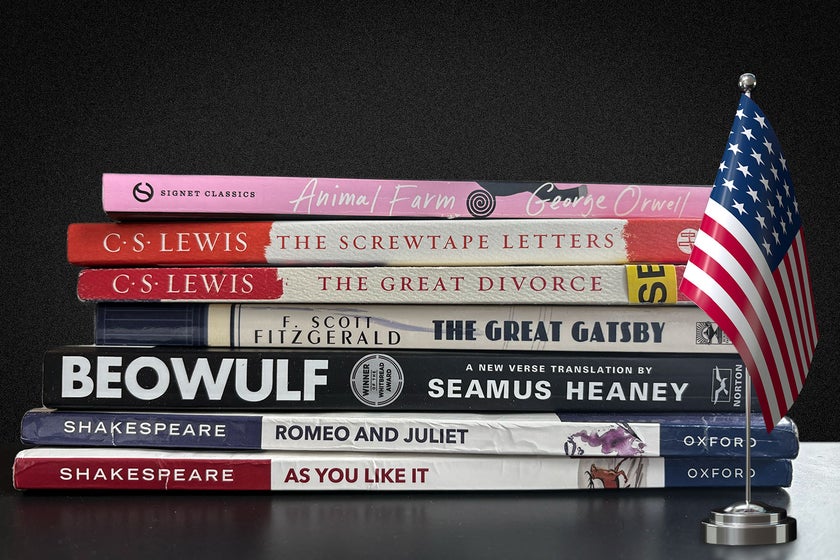
Slate, Rebecca Onion, today: I Want My Daughter to Love Reading and Writing. How Far Would I Go to Get Her There?, subtitled “Christian conservatives are leading the charge on a type of education that, in the right light, looks pretty appealing.”
My first thought is that, of course, conservatives value the classics. Why is that surprising?
Onion assess the current state of things. Then,
This unease has forced me to admit something: Sometimes, every so often, just a tiny little bit, I wish I could consider sending my daughter to a classical school. Classical education, broadly conceived, is on the rise. The Heritage Foundation maintains a database of classical schools, most recently updated in September of last year, that has 895 entries, one-third of which (as the Washington Post reported) “opened or adopted the model” between 2020 and 2024. Many of classical education’s pedagogical practices have been out of fashion in mainstream public schools for years or decades—think recitation, memorization, the diagramming of sentences. Some of these schools adopt ideas from Catholic or elite private education, like the Harkness method, in which a small group of students sits around a round table and discusses material with the help of a teacher facilitator. It was this no-screens, A.I.-proof way of teaching, used at my own private high school, that set me on the path to hopeless lifetime humanities fandom. You can’t do it with a big class, or with students who didn’t do the reading.
And,
There’s one obvious downside: On the ground, classical education is often conservative and Christian. The schools assign household-name Western canon greats—Homer, Dickens, Dostoyevsky—that I’d love my daughter to read one day. More kids having access to great literature and complicated philosophy would sound great if it weren’t for the fact that, although there are educators inside the movement pushing for diversification, it’s these famous, mostly-white-male authors and the constant callbacks to the idea of the Western canon that constitute the movement’s brand.
I’m going to stop quoting here, to step out to the big picture. On the one hand, there are certain classics that everyone might know if only to understand our current culture, which is saturated by references to the Bible, and Homer, and Milton. (Completely different references in other cultures, of course.) On a second hand, conservatives obviously value older works (that happen to represent the values of people like them), and disdain more modern works that acknowledge other kinds of people and other kinds of thinking. A conservative literary agenda looks back to the 18th and 19th centuries, and dismisses the experiments and wider perspectives of the 20th and 21st centuries.
What will be the conservative agenda in two more centuries? Things chance.
Increasingly, modern pop culture is saturated with more and more current references that I do not understand. This is ongoing. Every generation wants to distinguish themselves from the previous ones.
\\\
NYT speculates on a winning combination for American politics.

New York Times, The Editorial Board, today: This Winning Combination Is the Future of American Politics
How did so many Democrats win?
The simplest summary is that they ran as economic populists and cultural moderates.
That combination is consistent with American public opinion, which leans center-left on many economic issues and center-right on many social issues. By taking this approach, candidates were able to present themselves as beholden to neither of the country’s two political parties, both of which remain unpopular. The heterodox combination also has much to recommend it substantively. It meets the moment, after years of disappointing laissez-faire economic policies and a decade of cultural excesses by the progressive left.
It goes on.
\\
A political aside.
I saw a comment somewhere that said many voters who voted Democratic this time didn’t do so because of any change of heart or philosophy, but because they thought the Democrats could solve certain problems that personally bothered them better than the Republicans could (since they haven’t).
But everything shifts. If the far right-wing of Republicans has lost this time, the Republican party will adjust its policies to attract more voters by appealing the middle and dismissing the extremists. This is politics: it goes on and on. There will always be two parties, but their positions always shift over time, to the extent that conservative and progressive positions of a hundred years ago bear no resemblance to those of today.
\\\
I haven’t seen this film, nor am I likely to (unless perhaps it becomes a Best Picture nominee), nor do I understand what kind of documentary this is. (Was Holmes aware she was being filmed?) But I’m interested in the larger issue: why do Americans…

OnlySky, Rick Snedeker, 6 Nov 2026: ‘You Can See Everything’: The slippery slope of post-truth culture, subtitled “From Trump to Theranos, why do Americans so often fall for grifters’ lies?”
The writer says,
As I watched the film, I was thinking about politics and the slippery slope of telling truth apart from lies.
The fact that millions of U.S. voters elected Donald J. Trump, a president of astounding unfitness for national leadership—twice—goes a long way toward explaining why Americans keep getting bamboozled by public and private flim-flam.
The reason is greed, compounded by naiveté and glazed with more than a little stupidity, as always.
The piece is mostly about Holmes and the documentary. Here’s some generalizations near the end, the slide over into the relation between science and religion.
As always, cults of charismatic personality, unhinged from human morality—Hitler, Mau, Lenin, Jim Jones, David Koresh, Donald Trump—can be dangerous. Deluded followers forever make excuses for their dear leaders’ degradations.
In this age of artificial intelligence, deep fakes and a culture that too often glorifies wickedness and mendacity, only the truth—more than ever—will set us free.
We must remind ourselves of the possibility that smooth-talking entrepreneurs like Elizabeth Holmes may not always be uber-creative, neurodivergent geniuses, but sometimes, mere common criminals.
And,
We must remind ourselves of the existential value of truth, that everything isn’t always what it seems, even if refusing to call out the transgressions of mendacious charmers threatens our accumulation of wealth, fame, power or faux inner peace.
It’s why luminaries of science like cosmologist Carl Sagan, physicist Albert Einstein, DNA co-discoverer Francis Crick, physicist Richard Feynman and theoretical physicist Stephen Hawking unanimously agreed on why they couldn’t believe in a supernatural deity.
No empirical evidence. No objective truth.
\\\
It’s sad to keep seeing this. Prayer doesn’t work, people. Grow up. Take responsibility for yourselves and work in the real world. Convince other people your values are worthy. Don’t depend on wishing your values into place.
\\\