- The latest ‘map’ of the universe from the latest space telescope;
- Big Think profiles a book by Steven Strogatz and Alex Townsend about “big math,” and how to understand and influence it;
- Kevin Kelly on AI as “new units of knowledge” and standardization;
- And today’s rumors that the FAA shutdown of flights was due to AI: maybe, maybe not.
The maps have gotten so big they’re barely comprehensible, let alone the territories they correspond to.
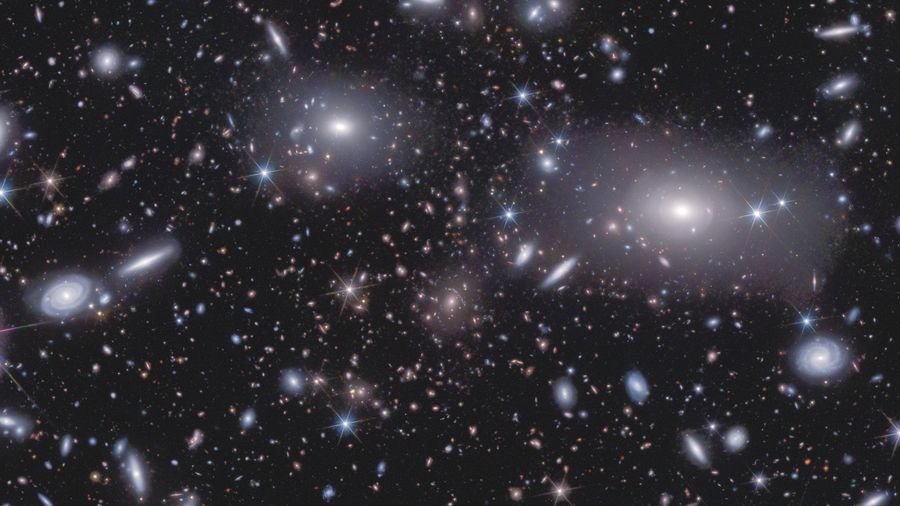
Scientific American, Mary Randolph, today: See the first glimpses of the most ambitious map of the universe yet, subtitled “The images are part of Euclid’s first major data release”
Euclid being the European Space Agency’s (ESA) newest space telescope.
“These are far more than beautiful pictures; today marks a scientific milestone in our study of the cosmos,” said Carole Mundell, the agency’s director of science, in a statement. “This major Euclid data release represents the largest space-based survey of its kind, laying the foundation of future discovery in a new regime for astronomy and demonstrating the excellence of European technology, science and international collaboration.”
Such as?
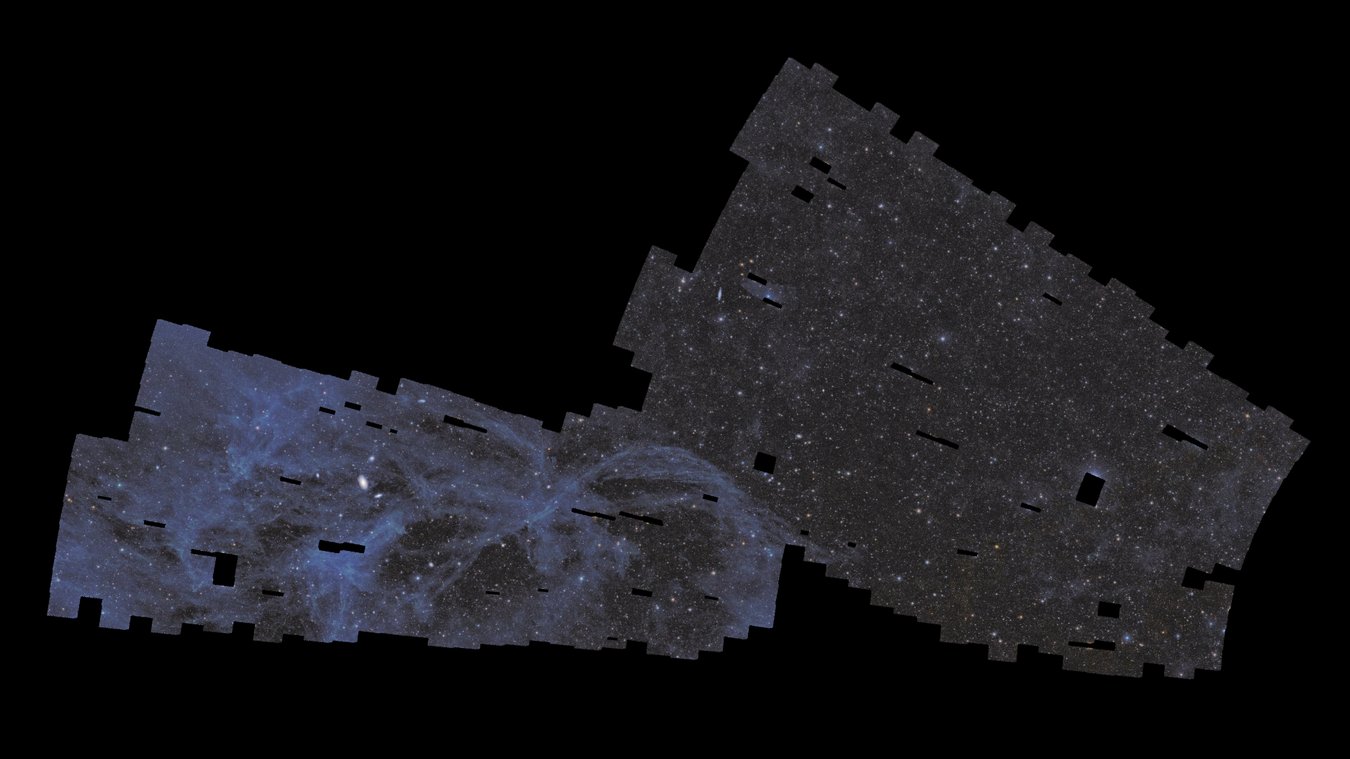
This mosaic forms the basis of what could one day be a full cosmic map. It spans nearly 500 gigapixels in size—equivalent to at least 10,000 high-quality smartphone images. It’s made up of 740 observations and includes more than 900 million galaxies.
Of course, humans can’t begin to have any intuitive idea of what these distances and sizes mean. The lessons from scientific discoveries should humble people. (Yet they don’t.)
\\\
Similarly: we live in a world increasingly beyond the comprehension of most of its residents.

Big Think, Ross Pomeroy, 12 Nov 2026: We built our world on “Big Math.” Now we no longer understand it., subtitled “Mathematicians Steven Strogatz and Alex Townsend explain how ‘Big Math’ came to rule our lives and how we can reclaim control.”
This concerns a book called Big Math: The Hidden Codes That Run Our World, by Steven Strogatz and Alex Townsend. (I would submit that most people everywhere have never understood any kind of math.)
And it concerns the very recent advances in AI.
Clearly, their book’s publication was impeccably timed for the moment, and Strogatz and Townsend have since been publicly grappling with the potential ramifications for their field. Notably, in an article in The New York Times, they fretted that using AI as a solution factory for math problems deprives humans of the insights that arise when mathematicians struggle through mind-boggling problems.
With some perspective.
Townsend and Strogatz are also lamenting the potential loss of a less well-known aspect of mathematics. Contrary to the stereotypes, it’s a remarkably social discipline.
“You see in the media that there are all these lonely people that spend ten years on a problem. This is not the reality of most mathematicians,” Townsend said. “Most math is a collaborative, social activity. It’s a rare few that do their own thing in their office. Most papers have many co-authors with many people collaborating and coming up with ideas. We’d like to keep that in the future.”
What can the ordinary person do? Mathematical literacy.
He noted that Big Math fundamentally underpins more controversial technologies: data centers, surveillance systems, cyberweapons, drones, and military targeting systems. The public, not just technocrats, CEOs, and venture capitalists, must shape regulation of these technologies. Mathematical literacy can help people feel empowered to join the conversation and decisions we need to make, Strogatz said.
Such literacy doesn’t mean excelling at geometry and matrix/matrix multiplication; it means having a basic understanding of Big Math’s reach and effects. Then anyone can take action.
Ask questions: What’s being optimized? Are there feedback loops? What’s missing? Is it interpretable? How uncertain is it?
“Every mathematical invention begins and ends with human choices,” Townsend and Strogatz write. “We might never fully understand the oracles we’ve made, but we can decide what to ask of them, and why. We can remain the conscience behind the code.”
\\\
A perspective from Kevin Kelly.
Kevin Kelly, 9 Nov 2026: New Units of Knowledge
We each have a magic genie that will do whatever we ask of it. So do we still need anything from other people? By the same logic, if everyone else has a magic genie that does whatever they want, why would anyone need something we make?
Another way of saying that is: if the magic genie makes creation abundant, what will become scarce and valuable?
Of course the magic genie is AI. The question of the hour is: if AI serves as a magical personal assistant, or a general partner, for any chore we choose, what happens to our old economic relationships?
Things are changing, or about to change, in ways we cannot anticipate. At the same time, as William Gibson observed, the future is here, it’s just not evenly distributed. Plenty of people will go on with their daily lives completely unaware of how AI is infiltrating daily existence, and influencing the decisions they think they alone are making.
He goes on, with how standardization [[ regulations! ]] make exchanges of ideas possible.
Standardization does not preclude difference and variety, which will become the precious scarcities. Standardization is what makes difference valuable. The standard 26 letters of the alphabet, and our standard dictionary of words, enable the value of weird arrangements of letters and words to be captured by anyone. Just as we humans can produce endless abundant strings of words, but only a few distinct ones are worth paying attention to, our magic genies will endlessly produce movies, software programs, simulations, entire worlds, and we all (agents too) will gravitate to those that are distinctive in some manner.
Which brings us back to the first question. We will still need other people in so far as they can lean into their particular life experiences, and together with their personal genie, generate distinctive magic.
The new artifacts of knowledge will succeed if they can carry those distinctions in a standardized way, the way 26 identical letters, the same for everyone, carry every distinct thing ever written.
\\\
Current events. Flights were grounded yesterday. Today, rumors flied on Facebook. Here’s an example.
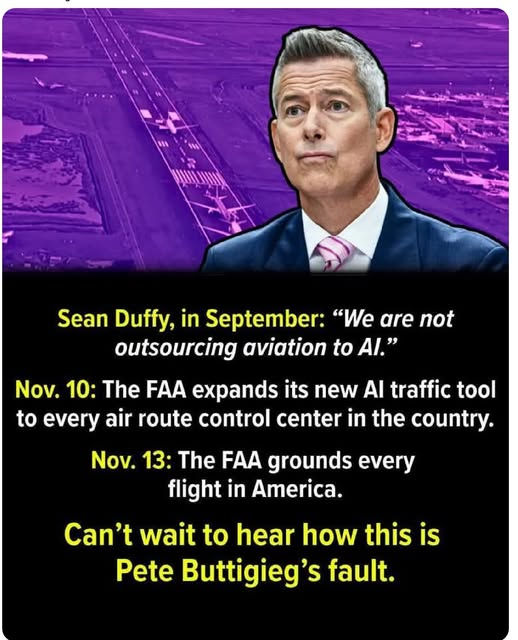
And of course, the current administration *has* blamed the previous administration — especially Biden and Buttigieg — for the failure, despite this administration’s having cut hundreds of jobs from the FAA, and being in charge of the government for two years now.
But correlation is not causation, and we shouldn’t jump to conclusions. (Despite my predilection to blame the incompetence of the current administration for everything. It’s always a safe bet.)

The Atlantic, Juliette Kayyem, yesterday: Of Course Americans Blamed the Ground Stop on AI, subtitled “When anything can go wrong, speculation flourishes.”
For many hours, the Federal Aviation Administration did not explain why it issued a national ground stop in the United States this afternoon. The agency described the cause only as a “telecommunications outage” and cited “extraordinary circumstances,” but failed to say more. So speculation abounded: Was the problem connected with the onboarding of a new AI route-selection system this week? Is it somehow related to the Microsoft Outlook outage this week? Or is the cause some antiquated telecommunications system that just finally gave up trying?
Because human psychology jumps to conclusions, even though they might be wrong. Snake in the grass. Better safe than sorry. Being wrong, in most cases, doesn’t matter.
In the absence of solid information from trusted authorities, people interpret crises through the prism of their preexisting concerns. When the aviation system shut down, many Americans’ minds went to DOGE cuts, cyberattacks by hostile foreign actors, recent reports of renegade AI. A safety planner’s job is to envision the full range of possible threats and assess how likely each one is to occur. Even before recent advances in artificial intelligence, the list of factors that could jeopardize commercial aviation was already long: terrorism, extreme weather, staffing strains, the decay of outdated communications networks, and more. AI could theoretically help the aviation system manage risks and disruptions, but it also adds many more variables that could go wrong.
Yet it may take a while for everything to become known.
\\
Listening to the soundtrack of Fargo, by Carter Burwell. Can’t find a clean video on YouTube.
Let’s try this one. The music is ominous, and foreboding, in an intriguing way. But it’s only the opening movement… no, it advances to subsequent tracks.