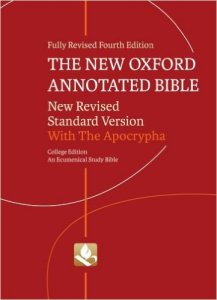
 This past month I’ve resumed my close reading of the Bible. I began last year, reading overviews of the Old Testament before reading the New Testament itself closely, taking notes on personal reactions, and reading commentaries and noting salient points from them. The sources I’m using were described in this first post on the topic, from March 2016 (other posts from 2016 can be found under the ‘Reviews’ menu item, above), and which can be quickly summarized and linked thus:
(I have other relevant volumes as well, including an “Illustrated Family Bible”, a volume for non-Christians that attempts to explain “Christian Mythology”, R. Crumb’s graphic novel version of “Genesis”, and a fascinating recent book that identifies an evolutionary subtext of the Bible. Trying to get as many different perspectives as possible.)
As I said in this post, I am “reading as a non-believer, inclined to skepticism, often to simple bemusement. The history of the world of supernatural claims is too broad to take any of them, even one that has inspired millions of adherents throughout history, seriously without any kind of thinking about their likely origin, and all the psychological and historical factors that went into their composition.”
It occurs to me now that there are two perhaps more primary reasons to study this now—
First, as Ehrman writes at the beginning of his Chapter One,
The Bible is the most commonly purchased, widely read, and deeply cherished book in the history of Western civilization. It is also the most widely misunderstood, misinterpreted, and misused.
There is repeated evidence that believers are no more likely to be familiar with the Bible, even vaguely, let alone to have read it, than nonbelievers. (Especially active nonbelievers who have reason to be nonbelievers; thus an Asimov quote, Properly read, the Bible is the most potent force for atheism ever conceived.)
Second, to become familiar with this cultural landmark and confront for myself, firsthand, this supposed fount of supernatural wisdom that provides, for many people, all the answers to the purpose of life and the origin of the universe. As other skeptics – Asimov, Coyne, Shermer – have done before me, I’ve set out to read my way through the Bible, reacting to what it says at face value, while at the same time consulting references and commentaries, from both believers and skeptics, for insight into subtexts and cultural assumptions.
One of the most striking conclusions I reached in what I read last year, is how thin is the so-called ‘evidence’ in the Biblical texts for supernatural claims that have become the foundation of thousands of Christian sects over two thousand years. The whole notion of Mary as a virgin, for example, seems to be based on one gospel writer’s dubious citation of an OT prophet, whose own story about a young woman used a term for her that might have meant virgin but just as likely merely meant a young woman. The gospel writer chose the meaning that suited his purpose, to make his story all the more remarkable; and from such a slender thread, has millennia of veneration followed.
But let’s move on. The OT is another kettle of fish, compared to the NT; far more ancient texts, and many variant texts edited together over hundreds of years, a situation apparently beyond dispute among scholars of the Bible, for decades in detail and centuries as a notion, yet a situation likely completely unknown to the vast majority of ordinary ‘believers’, who follow their religious community without any thorough, or even general, knowledge of their holy book.
I’ve started to read Genesis from the beginning, and will expand my earlier posts on what I read in 2016 with additional comments. Some general stipulations:
- Oxford’s introduction to the Pentateuch, and to Genesis in particular, outlines the current understanding of where these books came from. In general terms: they were composed over many centuries, initially as oral traditions. These layers of different authors have been identified and teased apart beginning 300 years ago, and have become established scholarship over the past century. Oxford points out that the structure of Genesis moves from primeval history of the world (drawing from creation myths of older Mesopotamian cultures) to ancestral history of the storytellers, and acknowledges the dissonance between its creation stories and the modern understanding of the earth and universe and discovered by scientific inquiry in recent centuries.
- All modern sources acknowledge four strands of composition: the J text, composed 10th century bce, in which ‘Yahweh’ or Lord is used; the E text, for Elohim, the name given God, and composed sometime after Solomon; the P text, Priestly, composed in the 6th century bce, during the Babylonian exile; and Deuteronomy in particular, composed sometimes in the 7th century bce.
- The most obvious evidence for multiple authors of different texts that were later integrated into a single book are the various doublets and contradictions – two stories of creations, told one after the other; two stories of the flood, intertwined so as to avoid the impression of two separate floods; details in rival accounts that don’t match.
- The ‘redaction’ of these various accounts was apparently conducted sometime in the 6th century bce, during the Babylonian exile.
Following are my annotations and comment by specific verse, much through Chapter 5 already posted, but now expanded a bit, then continued.
The two creations
- 1:1, the traditional “In the beginning God created…” is more usually translated, these days, as “In the beginning when God created” or even “began to create”.
- 1:2, note that before “let there be light”, there were waters (over which “a wind from God swept over the face of”). Thus, something existed before God got creation going, it seems. Why is this not generally acknowledged or understood, while everyone who thinks for the universe to exist, something or someone, thus God, must have gotten it going? This passage seems to undermine every claim that for the world to exist, God must have caused it. Oxford spells this out in a footnote, p11: “the text does not describe creation out of nothing… Instead, the story emphasizes how God creates order from a watery chaos.” So even Biblical literalists might ask, where did the watery chaos come from? Not God.
- 1:6, and so we live in a dome with waters above and waters below. Do Biblical literalists really believe this?
- 1:9, with the waters under the sky gathered in one place. One can imagine the limited view of the world of those who told these myths, who might know that the sea was over in that direction (e.g. west) and have no knowledge of any other seas or oceans, let alone the true immensity of the planet.
- 1:16, “God made the two great lights—the greater light to rule the day and the lesser light to rule the night—and the stars”. This might be plausible if the moon were actually in the sky all night; but of course, on average it’s only in the sky at night half the time. (This reminds me of how often filmmakers depict the moon, for whatever phase its shown in, in the wrong place in the sky. I seem to recall E.T. as sinning in this regard, though I haven’t seen the film in ages.)
- 1:16, and at the end of this verse, almost as an afterthought, “and the stars”. Incidentally. Presumably meaning the unimaginably vast universe that we have, in recent centuries, detected to exist; a mere footnote to the creation of the human abode.
- 1:17, this claims the sun, moon, and stars are “set…in the dome of the sky to give light upon the earth.” Then why do billions of stars and galaxies exist that are not visible to the naked eye?
- 1:21, “So God created the great sea monsters…” Sea monsters? KJV says “great whales”. You have to wonder what experience with large sea creatures the tellers of these myths had.
- 1:24, “And God said, ‘Let the earth bring forth living creatures of every kind: cattle and creeping things…’” Curious how first on the list is cattle, an animal surely of prime importance to the herders who composed these stories, rather than, say, elephants or giraffes or lions, surely more impressive animals to anyone familiar with the entire globe as we now know it.
- 1:26, “Then God said, ‘Let us make humankind in our image, according to our likeness…” The devout are pleased to think of themselves as the image of the creator of the entire universe (with arms and legs and everything else, presumably). A cat deity would presumably resemble a cat. (Cf. Jerry Coyne’s ‘ceiling cat’, and the poem by Yeats I quoted here.)
- But a second point about 1:26 is that the phrase “Let us make man in our image” (KJV) or “Let us make humankind in our image” (NRSV) is that the two different words there are translations of the Hebrew word adam -! That is, the first man being called Adam wasn’t necessarily a name given to him, but a generic word for man, or mankind. Looking carefully through the early chapters of Genesis, there is a point at which the first man is referred to as Adam, a proper name, without comment, a rather slippery elision.
- 1:27, in this first version of creation, male and female are created simultaneously.
- 1:28, “Be fruitful and multiply, and fill the earth and subdue it; and have dominion…” A useful policy for any group in competition for survival with other groups, or with nature itself. The part about dominion and subduing alas justifies many people’s attitudes that are leading to the extermination of a large proportion of other species inhabiting the planet. (Cf Kolbert’s The Sixth Extinction)
- 2:4, Here begins the second version of creation. The first one was about the seven days, in which on the fifth day God created humankind of both sexes—“male and female he created them” (1:27). The second version of creation involves shaping the first man out of mud, creating the female from his rib, and planting them in the garden of Eden. The first creation refers to the deity as “God”; the second refers to the deity as “Lord God”; these are the two separate accounts written by different people and stitched together much later, without much concern for consistency.
- 2:9, And in the garden were two trees. An extremely potent metaphor: one is a tree of life, one is a tree of knowledge, and the latter is forbidden. Asimov spends several pages speculating on the identity of the four rivers flowing out of Eden. Two are obvious, two obscure.
- 2:17, God promises they will die if they eat of the tree of knowledge of good and evil. Later they do, and God does not kill them, thus breaking his promise. Anyway, why create something, place it in plain view, then forbid it? If a human parent did this to a child, he’d be regarded as sadistic.
- 2:19, In this version animals are created as potential ‘companions’ for man/adam, and man/adam names them all. It would be churlish to point out the number of species on the planet as we now understand, and the obvious implausibility of these passages that presume man/adam can inspect and name them all. Yet, there are people who believe the Bible literally true.
- 2:22, woman made from the rib of the man. Miller, annotator of his Skeptical Annotated Bible (SAB), points out that 16th century anatomist Vesalius shocked the faithful by pointing out that women really do have the same number of ribs as men.
- 2:24, “Therefore a man leaves his father and his mother and clings to his wife, and they become one flesh.” Wait, what, what? At this point, the sudden discussion of father and mother and how a man “clings to his wife”, seems premature and out of context, since so far in this narrative there’s only one man and one woman. Hmm.
- Ch3, Asimov points out how the story of the talking serpent, a talking animal, is one of only two such incidents in the Bible (the other is a story about Balaam’s ass), is quite un-Biblical, more likely a vestige of a more primitive nature myth. (Asimov p31.7)
- 3.8, the Lord God is “walking in the garden” and so the man and his wife “hid themselves”. This is oddly anthropomorphic on the first point, and beggars God’s omniscience on the second. This entire parable is perhaps related to early humanity’s concern about agriculture, which might have been thought a kind of slavery (to the land) compared to the freedom of hunter-gathering. (Asimov p32). Thus, for eating fruit from the tree, the man [not yet named Adam in NRSV until 4:25] is cursed to work the ground and eat the plants of the field (3:17-18). But note that God blames first the serpent, and then the women, before getting around to the man.
- 3:22, the two trees represent wisdom and eternal life, two things the ancients must have realized were unobtainable. Why? Um, because God forbid them.
- 3:24, “He drove out the man; and at the east of the garden of Eden he placed the cherubim…” But not the woman? More to the point, the first man and woman are driven from the garden, and barred from going back. So, did this garden still exist? Did any of the ancients try to find it again? Where would it have been?
Cain, Abel, other people, other gods?
- Ch4, Oxford notes that the name Cain derives from the Hebrew word for create, while Abel is the same word translated as “vanity” in Ecclesiastes. On the agricultural theme, it is Cain, tiller of the ground, who is jealous of his brother the sheepherder. Asimov, p33, says Cain is taken to mean “smith”, since metal-working was important in early civilization. (And a smith is a kind of creator.) More generally, the story here can be seen to represent the tension the came with the agricultural revolution; the freedom of the nomadic herders gave way to the stress of being stuck in one place.
- 4:7, “sin is lurking at the door”; what is this supposed to mean? An evil witch ready to sweep in and overcome the righteous? Oxford notes this is the first mention of sin in the Bible.
- 4:15, the Lord puts a “mark on Cain” before sending him a way, a handful of words that have inspired long traditions of racism. (The Mormon church, in particular, long prohibited blacks to be priests, because the mark of Cain was taken to mean black skin.)
- 4:14, “and anyone who meets me may kill me”. Even before 4:17 following, this implies there are other people around. Where did they come from, if all humanity descended from Adam and Eve, beginning with Cain and Abel?
- 4:17, “Cain knew his wife”, a famous phrase about which it is completely fair to ask, where did she come from? The answer perhaps is that the context (of the second creation story) implies the Garden and the area where Cain and Abel lived was imagined to be the creation of one particular god, suggesting other tribes in other lands (such as Nod) had their own gods. The polytheistic theme is also suggested by the use of plural pronouns by the deity.
- 4:17… Cain presumably remains a nomad; it is his son who builds a city. Asimov, p34, compares notions of farming vs roaming to the 19th century ideal of being a cowboy.
- Ch5, the descendants of Adam listed here (from the priestly source) do not match those listed in Ch4 (from the Yahwistic source)…of course!
- 5:3 and other verses: not only are the long lives of these generations implausible, so is how old all the men were before they had their first sons. Except that such exaggerations were common in the myths of other cultures at the time, I haven’t seen any good explanation or suggestion for such inflated numbers. Asimov, p36: “These ages were legendary, reflecting parts of earlier Babylonian tales picked up the Jews during the Exile…” And, as Asimov goes on to explain, these figures were used by some to deduce the time since creation: the Jews, in the Middle Ages, figured it to be 3761 B.C.; Bishop Ussher, in 1654, figured it to be 4004 B.C. Oxford makes the same comments about how the ages reflect similar Babylonian lists.
- 5:24, “Enoch walked with God…”, a mysterious phrase which inspired several books of ‘religious fiction’, so to speak, about Enoch’s past and future, written from 20 bc to 50 bc (Asimov p37b).
- 5:29, “bring us relief from our work and from the toil of our hands”; more agonizing about the difficulties of farming.
- 6:4, the famous KJV phrase “there were giants in the earth” becomes in NRSV “The Nephilim were on the earth in those days…” because no one really knew what the writers meant. Asimov later speculates that more advanced tribes, with taller or thicker walls barricading their towns, might have so impressed newcomers, that the latter might have imagined the builders to be truly impressive in many ways, such as being giants.
The flood, the ark, Gilgamesh
- The story of the flood and Noah resembles, of course, flood stories from other Mesopotamian cultures, with the difference here the emphasis on God unmaking the world because of the wickedness of mankind. Yet, if God had wanted to destroy the Earth and start over, why all this bother? Why not just another wind sweeping over the waters and start from scratch? Instead, the story as it stands seems obviously a kind of ex post facto explanation for an actual natural disaster, much the same way some religious people today blame, for example, hurricanes on gays, or whoever else they don’t like.
- Gilgamesh is the best known early legend that also involved a flood; it was only discovered in 1872. I have a couple versions and will be reading them shortly.
- Passing thought: taking the story at face value, how is it that only Noah and his immediate family are the only righteous people in the entire world? What about Noah’s ancestors, were any of them still alive? Well, no…. look at those genealogies and ages. If you map them out along a timeline [I happen to have such a timeline, which I assume accurately plots the numbers from the Bible], it turns out they had all already died… even Methuselah, who, coincidentally, died *immediately before* the flood hit – so the timeline claims, in tiny print. Maybe it’s not so much that only Noah’s family were righteous; it’s that no one else on earth was of the right blood, so to speak. Because the OT is all about how the earth is given over by God to one particular family, and the tribes they founded. (Why couldn’t God handle managing everyone else? Why prioritize one family line? Or is it because all those other folks were the creation of rival gods? Cf. the 1st Commandment.)
- Chs 6-9, it need hardly be said that the story of Noah and his ark is implausible on any number of counts, e.g., there’s not enough water in the world to literally cover all the mountains (or even the ones around Mesopotamia); there are far more species of animals in the world that could have been accommodated on such a boat, and anyway what did they eat for 40 days, or was it 150 days (7:24)? And so on.
- 8:13 and 8:14, one example of how two early account of the flood were later edited together, not very well, leaving numerous inconsistencies and contradictions.
- Even on its own terms, what is the point? 8:21, the Lord realizes humankind is still evil! (If God is omniscient, why couldn’t he fix that?) Furthermore, 8:20, as the animals exit the ark, Noah builds an altar and promptly slaughters some of them! You’d think having made the effort to keep them alive, God and Noah wouldn’t be so casual about making them dead. Ah, but God “smells the pleasing odor”, hmm.
- 7:11, Asimov speculates that an inspiration for the various flood legends was the plausibility of a tidal wave that swept up the Persian Gulf (perhaps triggered by a meteor!?). To people at the time whose entire world was a relatively small river area, it might well have seemed a flood of the entire world.
- Asimov also points out that Ararat was a region at the time, not a particular mountain.
- 8:22, so God comes to peace with wicked humanity, so to speak, and immediately promises…to restore the cycle of the seasons, “summer and winter, day and night, shall not cease.” This underscores the worldview of the time, the agricultural life.
- Ch9, God hands down new rules to Noah and his sons, and makes a covenant with a ‘bow’ (rainbow). Then follows an odd story in 9:20 to 9:27, in which Noah gets drunk, one of his sons, Ham, sees his father naked, and when Noah wakens he curses not Ham, but Ham’s son Canaan, to be a slave. None of the commentaries has much of an explanation for why this story should make sense…except to justify later attitudes against the Canaanites.
Tower of Babel
- Ch11 tells about the tower of Babel, claiming 11:1 “Now the whole earth had one language and the same words”, despite mentions in Ch10, several times, of different descendants and tribes of Noah who, e.g., 10:5, “are the descendants of Japheth, in their lands, with their own language, by their families, in their nations”. Again, we have a just-so story legend in this tower of Babel story, nothing like plausible history. Also 10:20, 10:31.
- The point of the story being, in a childlike way, to explain the diversity of languages; in a more general way, to warn against ambition and the search for knowledge – a religious tradition that continues to this day, as fundamentalist creeds of all stripes strive to protect their offspring from secular knowledge. (Don’t learn too much about the real world, lest doubt affect your literal belief in fantastic legends.)
Abram and Egypt
- 11:10, another long chronology that somewhat resembles Ch10, though it’s notable in Ch11 how the first-named child, presumably the eldest, is always male. Was it that females simply didn’t count? Also notable is how the ridiculously implausible long ages gradually temper, becoming almost believable, though still not believable is how long they lived before they had children.
- 11:26 to 11:27 is another switchover from a Priestly to a non-Priestly narrative, thus the repetition.
- Ch12, Again, is it foolish to wonder at this point, why the LORD prefers this one family? Here he is promising Abram and his “kindred” the lands that he shows – never mind the Canaanites already there (12:6). Isn’t this *obviously* an ex post facto justification for a land grab by an ambitious tribe who eventually prevailed, and could therefore claim divine providence?
- Asimov, about Chapter 12, provides some background about Ur, from which Abram originally left – its success as a port diminished as the delta of the Tigris and the Euphrates filled with silt. Thus Abram moved on, settling eventually in the far west, bringing with him the various Babylonian myths that we see versions of here in Genesis. Canaan had already been occupied, since 4000 BC.
- 12:10-:17, “Now there was a famine in the land”. No sooner does God promise Abram [later Abraham] the land of the Canaanites, than does a drought strike and Abram and wife flee to Egypt. Afraid he might be killed for his beautiful wife Sarai [later Sarah] he presents her as his sister. And so Pharaoh [Asimov notes this is a general term for the office, like today saying ‘the White House’ to mean the administration and not some specific president] takes her as his wife. For which the LORD afflicts plagues on Pharaoh. Does this make sense? Why doesn’t the LORD afflict Abram for lying? Anyway, the text doesn’t explain how Pharaoh understands how the plagues were due to Abram’s lie. What, given the setup, was Abram’s alternative? To be killed? Anyway, Pharaoh banishes them.
- So, in retrospect, what was the intrusion of the rather brief Babel story all about? Because, apparently, the focus on the tower conflicted with God’s command to fill the Earth, while the subsequent blessing of Abram and his family is the advancement of that command.
- 12:16, a typically casual reference to “male and female slaves”; Biblical morality.
- Ch13, Wealthy Abram splits from Lot, and in :14 the LORD again promises Abram the land in every direction he can see. What about the people already there? (:7, both Canaanites and Perizzites.) Why doesn’t God care about them? Again, the implication that people of this time were essentially polytheistic – each tribe had its own god – explains much, including the need for the 1st commandment.
- Asimov, p61ff, outlines the history of Egypt; Abram arrives during the ‘Middle Kingdom’.
- Ch14 describes battles and Lot’s capture and Abram’s rescue of Lot. Asimov, p72, discusses the tradition that some of the tribes involved were giants, like the Nephilim earlier, and why such folklore was common.
- 14:14, a famous anachronism is the citation of Dan, for a place that did not become named Dan for hundreds of years after the events here took place (and hundreds of years after a presumed historical Moses could have written Genesis); it was a key bit of evidence for Thomas Paine, as I noted last year.
- Ch15, another covenant (involving animal sacrifice of course) and, :19, a long list of nations to be displaced by Abram’s descendants. One can only imagine what those nations’ oral histories might have contained.
- :20 About the Hittites in particular, Asimov, p77, discusses that it was only discovered in 1906 that they established a substantial empire, for some hundred years; but the height of their power came during the years Abram was in Egyptian bondage, roughly 1750-1200 bce, and so the Bible is unaware of that history.
Abram and Ishmael
- Ch16, despite contemporary standards of traditional marriage, it was apparently quite acceptable for a man whose wife was barren to take her slave-girl and bear children by her instead. So since Sarai can’t conceive Abram takes Hagar, an Egyptian slave-girl, and has a son, Ishmael. There being bad blood between Sarai and Hagar, the latter flees temporarily, but returns with an angelic promise to have many offspring. (First appearance of an angel?) About :2, Oxford notes that “ancient surrogate motherhood customs” allowed such arrangements.
- Oxford has an interesting long footnote that outlines a ‘chiasm’ in the Abraham story, a pattern of events in which the early themes are resumed, in reverse order, after a central event. In this case the Hagar-Ishmael story is the center of the chiasm, after which comes another covenant (about circumcision), another hospitality story, another wife-sister story, etc. It’s fascinating to imagine that the oral tradition of reciting the lives of the ancestors, told over and over again, gradually took shape to emphasize such narrative patterns, to make the story both more easily remembered, and more compelling to listeners. Though at the same time, likely less accurate to what actually happened.
- :7 vs. :13, not an angel, apparently, but actually the Lord.
- Asimov notes how this part of the story backgrounds the establishment of the Ishmaelite tribes; later, the Muslims adapted these stories and embroidered them to establish themselves as descendants of Abram and Ishmael, both of whom are taken to have been buried in Mecca.
- Ch17, a story that parallels Ch15, about a different covenant, this one about circumcision, and the Lord changes Abram’s name to Abraham. As Asimov explains, p80, circumcision was an ancient practice, for reasons unknown, and was not particularly important to the early Jews until the Babylonian exile, when it became a mark of distinction and was especially enforced. Since this was also the time the OT was put into its final form, Genesis was edited to stress the point.
- :15 Sarai is renamed Sarah. God promises Abraham, now 99, and Sarah, now 90, another son (Abraham laughs at this), and though Ishmael will prosper, God’s covenant will apply only to this new son, Isaac. (why? Because history is told by the winners?)
- :23-:27, and so they all get circumcised, in one day.
- Ch18, the Lord appears to Abraham in the guise of three men, in a hospitality incident (to foreshadow the Sodom story, perhaps); Oxford notes “the motif of secretly divine visitors is widespread in folklore”.
- :17-19, the Lord debates with himself. (If ever there was a passage about whether it is fair to wonder, how did the author of this book know that this happened? Who was the witness? – it is this one.)
Sodom and Gomorrah
- :22-33, at length, Abraham bargains with the Lord about how many righteous men would prevent the destruction, based on some kind of hearsay “outcry” (in :20) of Sodom.
- Ch19, the familiar story of the destruction of Sodom: two angels come to the city, where Lot lives, and are welcomed by Lot. But all of the men of the city (:4) demand that the guests be sent out, so that, the men say, “we may know them”. Lot, incredibly, offers his supposedly virgin daughters instead (he says they “have not known a man” but a few verses later refers to his sons-in-law), and is refused; the angels set about destroying the city, while the merciful Lord allows Lot and his family to escape.
- Except that Lot’s wife, told not to look back, looks back, and is turned into a pillar of salt. (Why?)
- Because, as Oxford notes, of the preponderance of salt formations around the Dead Sea. The oral teller of this tale could point to them as ‘evidence’ of the tale. Asimov, p82, speculates the natural disaster might explain the descriptions of destruction, suggesting that the entire story was an ex post factor ‘explanation’ for the disaster, much the same way modern Christians blame hurricanes on the gays. The Sodom story would be the first!
- Some modern Christian apologists, some of them gay, try to explain the Sodom story as one about hospitality, not the “wickedness” (:7) of men eager to know other men. Surely it fits into the pattern of these chapters as one about hospitality, but reading this now, the theme of the wicked intent of the men of Sodom seems pretty clear as well. Still, there’s no trace of a clue as to why *all* the men of this one city were so wicked; that is, not the slightest plausible justification for this story as any kind of real event, rather than a superstitious morality play.
- :30 And then (!) Lot’s daughters, apparently thinking they are the last people left alive on Earth, and there being no other man around, both contrive to sleep with their father, in order to produce another generation. Biblical morality, again. Their subsequent sons (always sons) become ancestors of the Moabite and Ben-ammi tribes, in another just-so tale of ancient ancestry.
- Asimov, furthermore, speculates that whatever catastrophe this was that destroyed the two cities flooded the until-then dry southern portion of the Dead Sea, submerging the locations of Sodom and Gomorrah, leaving only Zoar, the place Lot flees to, dry.
Abraham and Isaac
- Ch20 is a rewrite of Ch12, with Abraham traveling and describing his wife as his sister, to avoid being killed himself. They even fool the same king, Abimelech, again. In :12 Abraham claims his wife is in fact his half-sister; Oxford wonders if this is true, or merely an excuse.
- Ch21, Sarah has child Isaac. Though at the end of Ch17, when all the men were getting circumscribed, the older son Ishmael was 13 years old, here he is described as a child, as he and his mother are sent away.
- In :15, Hagar is ready to let Ishmael die, until God intervenes, pointing out a nearby well. Asimov points out the significance of wells in this time and area, and how this area, Beersheeba, is about the furthest south a well might have been dug.
- :34, another anachronism, as Asimov (and others) p85 points out: the Philistines did not live in that area for another five centuries—right about the time Genesis was reduced to writing.
- Ch22, in which God famously tests Abraham, demanding that he sacrifice his precious son Isaac. On its face it seems cruel, even perverse, yet of course believers have rationalized the story throughout history.
- :12 Only when Abraham is about to make the sacrifice does God admit, “now I know that you fear God, since you have not withheld your son…”. Isn’t God omniscient? Why this cruel test?
- :17 is notable, along with several later almost identical verses, for God’s promise to “make your offspring as numerous as the stars of heaven and as the sand that is on the seashore. And your offspring shall possess the gate of their enemies…” Which, even granting poetic license, has conspicuously failed to happen; the Jews remain an often reviled minority to the rest of the world.
Enough for now. Will finish rest of book, and review the various commentaries and versions noted above, over the next few weeks.