Links and Comments: World maps; religions as movies; movie physics; flat-earthers; Trump and his followers; webs v walls; wrong about the future; negativity bias

Catching up.

Washington Post: Six maps that will make you rethink the world.

I’ve always been fascinated by these sort of ‘alternate history’ maps. Khanna is the author of the new book “Connectography: Mapping the Future of Global Civilization,” in which he argues that the arc of global history is undeniably bending toward integration. Instead of the boundaries that separate sovereign nations, the lines that we should put on our maps are the high-speed railways, broadband cables and shipping routes that connect us, he says. And instead of focusing on nation-states, we should focus on the dozens of mega-cities that house most of the world’s people and economic growth.

\\

From a Facebook post by Adam-Troy Castro (where he links to someone else’s photo), about the world’s major religions:

Think of it like a movie. The Torah is the first one, and the New Testament is the sequel. Then the Qu’ran comes out and it retcons like the last one never happened. There’s still Jesus, but he’s not the main character anymore, and the Messiah hasn’t shown up yet.

Jews like the first movie, but ignore the sequels. Christians think you need to watch the first two, but the third movie doesn’t count, Muslims think the third one was the best, and Mormons liked the second one so much that they started writing fanfiction that doesn’t fit with ANY of the series canon.

It’s all fiction. Well, crude history, optimized to advantage whatever tribe is telling the story.

Retcon, of course, is an abbreviation for “Retroactive continuity”, in which TV or movie series establish

\\

This is a ‘clickbait’ site, annoying for all the ads and pages you need to click through, but which has many valid points.

CAN’T HAPPEN: 33 Scientifically Implausible Things That Movies Still Want You To Believe

These examples partly illustrate ‘intuitive physics’ but also illustrate why almost all sf movies are nonsense –- they’re appealing to how we think the world works, not how it actually does.

\\

This is revealing about how human nature and intuition works:

Meet the People Who Believe the Earth Is Flat

Their reasons are often personal insights that somehow override the rational understanding they might get from others. (I went up in a balloon and the horizon was still flat!) Some are religious. And commitments to vast conspiracy theories are pervasive.

“I want them to know that NASA and all the astronauts and all of NASA are liars,” Patrice said.

Because, you know, they perpetuate the fraud that the Earth isn’t flat.

\\

Trump doesn’t read; neither, I suspect do many of his supporters, being relatively uneducated.

The New Yorker: The Donald Trump–Roger Ailes Nexus

Nevertheless, Trump, who admits that he reads almost nothing and gets his information from “the shows,” adopted Fox rhetoric, Fox fury, and Fox standards of truth and falsehood, all with a dollop of Trumpian nativist flair. The Republican Convention in Cleveland last week was like a four-day-long Fox-fest, full of fearmongering, demagoguery, xenophobia, third-rate show biz, pandering, and raw anger.

More: Donald Trump’s Ghostwriter Tells All.

\\

A genuinely useful insight from Thomas L. Friedman, in New York Times: Web People vs. Wall People. It’s not about Democrats vs. Republicans; it’s about those who would build walls vs. those who understand the world is necessarily becoming more interconnected.

…the instinct of Web People is to embrace the change in the pace of change and focus on empowering more people to be able to compete and collaborate in a world without walls. In particular, Web People understand that in times of rapid change, open systems are always more flexible, resilient and propulsive; they offer the chance to feel and respond first to change. So Web People favor more trade expansion, along the lines of the Trans-Pacific Partnership, and more managed immigration that attracts the most energetic and smartest minds, and more vehicles for lifelong learning.

While the wall people, afraid of change, want to cower within their walls and shut out the outside world.

\\

A review several weeks ago Chuck Klosterman’s BUT WHAT IF WE’RE WRONG?, by Jim Holt: The Good, the True, the Beautiful and Chuck Klosterman

I bought the book and have skimmed it, and while many details seem interesting, it’s point would be obvious to anyone who intellectual mindset has been honed by science fiction: *of course* much of what we presume will be true in the future, won’t. The reviewer’s summary:

1. We are not special. We are neither at the twilight of an era nor at the dawn of a new one.
2. The future will resemble the past.
3. Reality will always turn out to be bigger than we think it is.
4. Nine-tenths of everything is crap. (“Sturgeon’s law”)

\\

Adam Lee On Human Negativity Bias.

Why are so many people, despite clear evidence of relative peace and well-being in the world – compared to any past era – so inclined to believe we’re on the brink of social and political collapse? Statistics show crime rates have decreased, as have poverty, child mortality, and illiteracy.

(I said before this is partly a common misunderstanding of how the news media works; if the world were entirely peaceful except for one traffic accident, that one accident would dominate the “news cycle” for days, and rabble-rousing politicians would demand investigations into the corrupt auto industry and accuse the current administration of gross negligence, if not conspiracy to bring down the nation, and a certain segment of the population would become greatly alarmed a convinced the end of times was upon us.)

Lee:

The question, then, is why so few people realize this. Year after year, surveys show that most people believe, inaccurately, that crime is increasing. (The violent crime rate in the U.S. has plunged in the last several decades.) Even people who’ve personally lived through far more violent times often suffer from this illusion.

This is negativity bias, the human tendency to pay more attention to bad news than to good. It manifests in all kinds of ways, not just beliefs about crime rates: for instance, most people are far more sensitive to a potential loss than a larger potential gain. We overrate the odds of stock-market crashes and terrorist attacks.

Posted in Uncategorized | Comments Off on Links and Comments: World maps; religions as movies; movie physics; flat-earthers; Trump and his followers; webs v walls; wrong about the future; negativity bias

522+135+6

I completed The Witness’ Challenge yesterday, after some 50 tries over this past week. Following over 600 other puzzles on the Witness island to solve the primary game, which can be done at leisure, the Challenge is a timed set of randomly-generated puzzles, 14 puzzles to solve in 7 minutes, while music by Grieg plays, ending with “In the Hall of the Mountain King” for mounting tension as time threatens to run out before finishing. Because the puzzles are randomly generated, no online solution site serves as a guide — rather, you have to develop an instinctive response to the various kinds of puzzles already seen in order to solve new ones quickly. My strategy was to bail, reset the timer and start over from the beginning, anytime any puzzle took too long to solve. Even so, some 50 tries before getting all the way through.

One reason for this strategy is that the puzzles are a sequence, where you need to solve one in order to activate the next one. If you solve a puzzle incorrectly, it deactivates — goes black — and you have to return to the previous puzzle and re-solve it to reactivate the puzzle you missed — and in that case the reactivated puzzle is *different*. Sometimes you fail deliberately and go back a step, to get a new hopefully simpler puzzle to replace one that’s not immediately obvious.

As in the entire Witness game, variations of puzzle presentation come regularly. In the middle sequence of the Challenge there are four puzzles that activate in random order. In the next sequence there are two sets of three puzzles where two of the three are impossible to solve, and much of the problem here is about deciding, as quickly as possible, which one can be solved at all. And since the puzzles are all randomly generated, sometimes they’re very simple, sometimes unusually complex, even though each puzzle in the sequence is of the same type. Ironically, the very last two puzzles, wrapped around columns, don’t deactivate if you solve incorrectly, and for their type are relatively simple… at least that’s my impression from the three or four times I’ve gotten that far.

Alas, Challenge aside, I am still one puzzle short of the total possible in the entire game, which is 523+135+6, for various categories of puzzles; my score is 522+135+6, and I have no idea, despite having examined a couple online guides to easily-overlooked optional puzzles, what I missed.

But I need to step away from the computer-as-game-device and get some work done… (at least for a couple weeks until Obduction arrives — this is unprecedented for me, there being two new compelling games in one year!)

The article here at Kotaku.com includes a video showing the writer’s attempt — he doesn’t quite finish.

Wrestling With The Witness’ Most Difficult, Divisive Puzzle

Here’s another walk-through on a PS4, where you can pause the machine and solve puzzles offline from screenshots, which isn’t possible on a PC. He does finish.

I did it on a PC.

Posted in Games | Comments Off on 522+135+6

You Will Love This One

It’s been a while since I’ve posted a favorite song.

These are times that come
Only once in your life
Or twice if you’re lucky

Posted in Music | Comments Off on You Will Love This One

The Witness

I’ve been silent on this blog for three weeks now, mostly because I’ve been preoccupied by a computer video game called The Witness [Wikipedia]. I posted about this on Facebook on July 19th, and will reproduce that post, lightly edited, here, with some follow-up, below.

From Facebook:

I have been a big fan of the Myst games, beginning back in 1994 or so when I first played that first game (thanks, Larry); it was followed by four sequels, with a side project called Uru (which I think was best of them all), which debuted in 2003 and expanded online in 2007, while the final two Myst games were released in 2004 and 2005.

I’m otherwise not a gamer. No interest in first-person shooter games, which seem to dominate the industry. I’ve checked out half a dozen or so different games over the past decade that I thought might be similar to Myst, but they were either lame, or defeated my PC’s graphics card, and not interesting enough to bother upgrading, to be worth finishing. (While for the Myst games, I do recall buying a new PC back in 1997 or so, a huge HP desktop tower (with, checking my records, a Pentium II 233, 48 meg ram, 56K modem, and 17” monitor), specifically so that I could play the second Myst game, Riven.)

Earlier this year I heard about a new puzzle game called The Witness, which I purchased and have been preoccupied by. It has hundreds of clever puzzles, arranged from basic to increasingly complex, situated on a desolate island environment that evokes the Myst games. In particular there is an implicit, science-fictional, setting — around this island are dozens of people frozen into stone statues, some holding weapons, some looking up into the sky. As you work your way through the game, solving ever-more difficult puzzles, the motive, my motive, was to discover what happened to this island? What happened to these people?

On the one hand, having ‘finished’ the game today [July 19th] (with, I’ll admit, some hints from one of the many walk-through sites for the game; life is short), I’m disappointed to discover that the end game involves no back story. No explanation for the stone statues and what happened to the island or why, for that matter, the game is called “The Witness”.

On the other hand… the game involves a number of ‘Easter egg’ audio recordings and videos that address various topics about.. epistemology. How we know what we know. Speeches by Jacob Bronowski, Richard Feynman. A couple are eerily reminiscent of the themes of Sean Carroll’s recent book — how there are hierarchies of meaning.

Exploring today some of the many websites that address the meaning of this game, I think there are still things to explore. It’s not a simple puzzle game, and was not intended to be. In particular, there is a huge ‘meta’ aspect to the game — many of the puzzles, which don’t however as far as I can tell involve the solution to any ultimate solutions — involve identifying patterns in the landscape around you, which can be seen as the same kind of pattern puzzles that do solve the game. (These involve the several obelisks scattered around the island.)

Yet having finished the game as far as it can be finished in terms of any solution or backstory… I’m not sure I’ll bother continue. There are many more environmental puzzles I haven’t found, but it doesn’t seem like they matter.

The purpose of the game, it seems, is that solving puzzles doesn’t matter; it’s, indirectly, about how our perception and understanding of the world is not about merely solving puzzles. OK.

\\

Update today.

These games immerse you into worlds from which it is difficult to emerge. Which is to say, I’ve spent more than another week exploring this game, finding the various ‘environmental’ puzzles — paths like those on the puzzle boards which appear in the landscape around you — and frankly following a couple walkthrough websites. (In particular, this one turns up first in Google search, and does seem to be the best and most complete, compared to lower-ranking sites I’ve checked. And I’ve watched this compelling speedrun by YouTube’s FearfulFerret (who seems to live in Arizona), who traces every ‘line’ in the game over some three hours, though that includes a 58 minute wait for one puzzle that required gradual movement in a video showing an eclipse. (During which time, at midnight, he runs out for a burger.)

I am to the point of diminishing returns, and — the need to get back to a more productive daily life. (FearfulFerret apparently lives in his bedroom, in his parents’ house. Of course.)

But meanwhile — meanwhile! — there is news of a new game from the creators of Myst, called Obduction, due for release in August. I had thought that puzzle games like the Myst games were passe, but perhaps not; the previews of this are intriguing.

I’ve long wondered why a puzzle game hasn’t been developed that is explicitly science-fictional, based e.g. about waking up on a spaceship, in flight, without knowledge of how it began or where it’s going, who the passengers are, and so on. This is a common literary SF theme — recently, Alastair Reynolds’ SLOW BULLETS — but if there’s ever been a game like this, I’ve missed it.

Posted in Games | Comments Off on The Witness

Links and Comments: Academia, Creationists, Christians and Trump, Plait on the GOP, Evil, Victims

From Slate, more on the theme of Why Are There So Few Conservatives in Academia?

There are three big reasons that conservatives are hard to find in university faculties: intellectual consistency, anti-science trends by conservatives, and social pressure.

On the second point:

Another issue is that Republicans have been increasingly anti-science, hounding federal funding agencies looking for “fraud” and “waste” and pursuing witch hunts against climate scientists. That deeply offends intellectuals both at a philosophical level and at a practical level, since we depend on state and federal funding.

\\

Also in Slate, Why Christian Creationists Hate Evolution but Muslim Creationists Don’t Care.

Because it’s not about the science, is my gloss; it’s about the need to reinforce tribal identity, even if that means (in the case of Christians more so than Muslims) the flat-out denial of science — that is, the acknowledgement and understanding of the apparent evidence of the real world.

What is it that drives Christian creationists to keep publicly contesting evolution and to react so cruelly to people who don’t believe? Recent research suggests that this fight is about identity.

“Our identities are formed by what we do and who we distinguish ourselves from,” said Jeffrey Guhin, a sociologist and professor at UCLA who has studied creationists. Guhin thinks that a determining factor in whether a creationist will actively promote his belief stems from how emotionally connected his belief in creationism is to his identity.

Vocal creationism is part of how some Christian creationists reinforce their sense of self and create a social hierarchy that allows them to make sense of the world, he posits.

The difference involves how the two groups, evangelical Christians and Muslims, define themselves in terms of boundaries.

Boundaries are how societies define their differences with outside groups. Their inverse are practices, which are the similarities between members of the group. “For evangelicals the key boundary and key practice was reading the Bible literally,” said Guhin, and creationism is a literal interpretation of the book of Genesis. This is why opposition to evolution is important to Christian creationists. It’s how they police who is in and who is out.

In the Muslim schools, there were different important practices and boundaries, including prayer and gender roles. “The key practice for the Muslims was prayer, what they do, Salah, five times a day,” Guhin said. “The key demarcation from the outside world was gender performance, like how we interact with people of the opposite sex.”

\\

Christian Crackpot Phil Robertson Blames Murder Rate on Gays.

\\

Salon: Trump, torture and religion: Why the Christian Right has flocked to the GOP nominee by Heather Digby Parton.

I have long wondered why serious Christians would support a man who openly endorses torture, war crimes and cruel and unusual punishment. It seems counter-intuitive since the most famous torture victim in world history is Jesus Christ. But a Washington Post/ABC poll from 2014 showed American evangelical Christians are more supportive of torture than those who are not religious. …

But then certain Christian Right leaders have demonstrated a violent streak that may explain their willingness to jump on board the torture train. Take James Dobson himself who was known for many years as an expert on child rearing. His book “The Strong Willed Child” featured a chilling story of animal cruelty.

Because the key feature of fundamentalists is authoritarianism, the certainty of knowing good from evil and the willingness to impose that distinction on others.

\\

And my favorite astronomer, Phil Plait: The GOP’s Denial of Science Primed Them for the Illogic of Trump.

This circles back to why there aren’t so many conservatives in academia; they are not interested in reality so much as dogma. Plait:

An interesting if infuriating article in New Republic very clearly lays out how the GOP has spent decades paving the road for Trump by attacking the science that goes against their prejudicial ideology. I strongly urge you to read it, but one section jumped out at me in particular:

There’s another factor at work here: The anti-intellectualism that has been a mainstay of the conservative movement for decades also makes its members easy marks. After all, if you are taught to believe that the reigning scientific consensuses on evolution and climate change are lies, then you will lack the elementary logical skills that will set your alarm bells ringing when you hear a flim-flam artist like Trump. The Republican “war on science” is also a war on the intellectual habits needed to detect lies.

Yes, precisely. This is exactly what I have been saying for years now. When we erode away at people’s ability to reason their way through a situation, then unreason will rule. And not just abut scientific topics, but any topics. We see nonsense passed off as fact all the time by politicians, including attacks by Rep. Lamar Smith, R-Texas, on theNational Oceanic and Atmospheric Administration, claims by Sen. Ted Cruz, R-Texas, that there’s been a pause in global warming, the GOP attacks on Planned Parenthood, and more. People will still believe what these politicians say, long, long after the claims have been shown to be completely false.

\\

On to perhaps more sophisticated philosophical issues, though the common theme is that conservatives tend to respond to these with simplistic, black and white thinking, despite evidence that these are mental biases that do not correspond with the evidence of reality.

New York Times op ed: How Should We Respond to ‘Evil’?, by Steven Paulikas.

My off-hand reaction to the question, before even reading the essay:

The obvious observation is that “evil” depends on your point of view. The “radical Islamists” consider the loose, liberal West evil, not *merely* because it violates rules from their holy book – no one ever goes to violence because of something from their holy book that does not appeal, in some deep instinctive sense, to what they emotionally perceive to be a violation of the proper way reality should run. Anti-abortionists are not swayed by biological evidence of the vast gap in developmental complexity between embryos and children; they are driven by tribal motivations to expand and reproduce at all costs [certainly a useful evolutionary adaptation!], and the simplicity of a binary definition of the beginning of human ‘life’. Racists are not swayed by evidence of common humanity; they are driven by instinctive resistance to different, potentially threatening, tribes. Gun rights advocates are not swayed by evidence that fewer available firearms results in a society with fewer accidental and impulsive killings and murders; they are driven by some combination of paranoid fear of the unknown and the ‘other’, and the need to enforce authoritarian order; if not that, then why are they not as passionate about all the *other* rights in the Bill of Rights? (Like the ACLU is.)

But to the essay: it involves a conversation between Stephen Colbert and Bill O’Reilly, where the latter blithely identifies evil with people he doesn’t like. Paulikas’ thesis — he’s an Episcopal priest and rector at a church in Brooklyn — is:

Recent history and philosophy have taught that violence is the surest outcome of blithely ascribing the quality of evil to another. At best, this process may supplant the thing we brand evil for a time, but the notion that evil can be “destroyed” is an ethical version of a fool’s errand. We have an opportunity now to reassess the politics of evil and to consider responses to it that would mitigate rather than amplify human suffering.

\\

An earlier NYT Sunday Review essay, by Laura Niemi and Liane Young: Who Blames the Victim?.

Conservatives and authoritarians tend to blame the victims; this fits in very well with the psychology outlined in Jonathan Haidt’s The Righteous Mind.

Yet this is not just a matter of differing opinions or points of view. There is plenty of evidence about individual cases that show that people down on their luck, or victims of crimes, and entirely victims of circumstances. The tendency to blame them for their problems (aside from being un-Christian), is an *error*, one that David McRaney describes as the “fundamental attribution error” — that people’s behavior is a reflection of their personality, rather than their circumstances — and one explored in the recent book by Robert H. Frank, Success and Luck: Good Fortune and the Myth of Meritocracy (which I blogged about here).

The essay confirms these earlier studies:

In a recent series of studies, we found that the critical factor lies in a particular set of moral values. Our findings, published on Thursday in the Personality and Social Psychology Bulletin, show that the more strongly you privilege loyalty, obedience and purity — as opposed to values such as care and fairness — the more likely you are to blame the victim.

Where the two sets of personality traits match Haidt’s characterizations of conservatives vs. liberals.

Posted in Conservative Resistance, Culture, Morality, Politics, Religion | Comments Off on Links and Comments: Academia, Creationists, Christians and Trump, Plait on the GOP, Evil, Victims

15 Ways of Buying a Book, Part 1

A few weeks ago I reminisced about Growing Up with Books, the books in my childhood house provided by my parents for us children, or that they had kept from their own childhood. (My parents were not readers themselves, as adults, but they were conscientious about providing books for their children.) Now I’ll reflect on how I acquired books of my own, beginning around age 10, and the many ways the methodology of acquiring books (and magazines) changed over subsequent years and decades.

Way #1:

The first books of my own, that I bought with my own money and at my own selection, were purchased through a classroom Scholastic Books catalog, in the 6th grade, that is, in 1966-1967. My family lived in Reseda, California, and I attended Vanalden Elementary School, a few blocks from our home. The school was a set of bungalows, separate structures holding two classrooms each, raised off the ground with a crawl-space below and a short set of steps up to the classroom door. A few times a year, pamphlet catalogs were passed out to all the students, listing a selection of titles and prices. We would take the catalogs home, consult with our parents, then return order forms to class with appropriate payment. The books cost 35 or 50 cents each. They were typically special Scholastic editions, short little paperbacks the size of old Ace Doubles, or larger thinner paperbacks for nonfiction. Everyone’s orders would be consolidated into a single order for the classroom, mailed in, and three or four weeks later, a big box would arrive in class and the selections eagerly distributed. (You can imagine: the box would have three copies of this book; five of these; one of this…)

Always being rather obsessive about keeping lists, I have maintained detailed purchase (and reading) records since I was 15 years old (on sheets of paper, later copied to logbooks, later copied to databases), and at some point reconstructed such lists from before that age. So I know exactly which books I bought when.

The three I remember from this 6th grade classroom source, and still have, are Martin Gardner’s Science Puzzlers, Isaac Asimov’s Environments Out There, and Howard Pease’ Mystery at Thunderbolt House. The Gardner likely reflected my interest in puzzles from that Things to Make and Things to Do volume I’ve described in that earlier post; the Asimov, a thin book about the solar system, from my recently discovered interest in astronomy. (My first interest in astronomy was seeing a stack of textbooks, called A Dipper Full of Stars, in a cabinet in my 6th grade classroom, and asking to borrow one. I’ve alluded to this in previous posts.)

I don’t know what attracted me to the Pease, but it became an enduring favorite, a novel I still reread every decade or so, a nominally YA mystery novel about San Francisco, book collecting, and the 1906 earthquake. What’s not to like?

There were a couple others: a thin YA science fiction novel, called The Forgotten Door, by Alexander Key, a story about a mysterious boy who falls to Earth from another dimension. And more significantly, a Bantam paperback edition of Fantastic Voyage, Isaac Asimov’s novelization of the film. (This wasn’t a special Scholastic edition, but the actual Bantam edition, though specially printed without a price.) I suppose I chose that for the Asimov connection (to his astronomical book), since I hadn’t read any of his fiction before, or indeed any proper SF novel before, not counting Alexander Key.

Yet the Asimov was a curious choice because I hadn’t seen the movie. Why would I pick a book based on a movie I hadn’t seen, instead of whatever independent titles may have been available? Just because it was by an author I already knew, I think. Ironically the next few SF books I acquired – that is, among the very first SF books I acquired – also had some kind of TV or film connection. I say ironically, not just because they were sometimes books based on shows I hadn’t seen, but because I quickly moved to strictly literary books by numerous prominent SF authors, and never developed a taste for tie-in books of any kind, i.e. novelizations or spin-off books set in the Star Trek or any other universe. (The sole exception was that I followed all the James Blish Star Trek collections until their end, but that was principally because, at that time, there was no other way to capture documentation of the Trek episodes, which I was obsessed with for several years in my teens and early 20s.)

(Aside: how did I buy anything with my own money? Because I got an ‘allowance’, a weekly payment from my father for doing chores around the house, mowing the lawn, setting the dinner table, taking out the trash. I don’t remember what it was — 50 cents a week, perhaps, at first, gradually increasing to the heady sum of $1 a week?)

Way #2:

In seventh grade, 1967-1968, now at a Junior High School (Sequoia, in Reseda), the process was different. This time the school held a ‘book fair’ once or twice a semester, in the school gymnasium, which doubled as a cafeteria, with tables that folded into the walls. For the book fair the tables would be pulled down, and stacks of paperbacks would be set out, and students allowed in to browse. We would make our selections and pay for them on the spot, no need to wait weeks for an order to be filled. I bought at least three books at one such fair – the first Star Trek collection, by James Blish; The Time Tunnel, by Murray Leinster; and Flying Saucers—Serious Business, by Frank Edwards. These were actual publishers’ editions, not specially printed, and cost from $.50 to $.75.

By this time Star Trek must have been on a year, and was into its second season. Since I had never been to any bookstore, I was unaware of this book by Blish until seeing it at this fair. What I have is not the first printing, but the 5th printing, of a book originally released in January 1967, which must have been eight or nine months before. It was the first of a dozen collections of adaptations of Star Trek scripts into short stories, and as far as I know was unprecedented, in that other books related to TV series were ‘ties’ or ‘tie-ins’, that is, original stories written in the context of the series, but not directly adapted from scripts. These include the Murray Leinster Time Tunnel novel that (again) I think I bought before ever seeing the series, and a Lost in Space novel from the same period that I didn’t look at until much later (and never did read). Blish, then a serious writer in his own right for a couple decades already, was never given much credit for his Star Trek adaptations, which everyone assumed were written simply for the money, yet which I came to appreciate as relatively sophisticated in the earliest couple three books. But that’s a subject I’ll take up another time.

I don’t know why I bought a book about flying saucers, but it was the first I read of several on a subject that preoccupied me for a year or two in my middle teenage years, until the protocols of credulity, and Isaac Asimov, set in. Another subject for later.

Way #3

The third phase began with the family move to Illinois, in early 1968, where we initially landed in a small, Bradburyesque town called Cambridge, where both my parents had grown up. (This wasn’t coincidence; my father procured a job near Chicago so he could be near his dying mother, in Cambridge, a two or three hours’ drive west of the city. The family stayed in Cambridge, at my grandfather’s house, until the school year finished out, while my father went ahead to suburban Chicago for his job, and to look for a house.)

I didn’t perceive any resemblance to Bradbury until later; when we arrived in Cambridge I hadn’t read him. Cambridge was a small town, population 2000, that was nevertheless a county seat, and so it had a town square with a white courthouse in the middle, along with picturesque streets lined with family homes and churches, and a town library, full of ancient National Geographics. A railroad cut through town at an angle, and late at night freight trains would chug slowly through, shaking my grandfather’s house at the northwest corner of town, which stood barely 100 feet from the tracks.

Cambridge had (has, I daresay) one shopping street with one market, Wayne’s (where my Uncle Stanley was the butcher), and one drug store, Swan’s, that had a soda fountain counter in the middle. Both stores had wire racks displaying paperbacks, the kind of four-sided racks that spin. Such things I had never seen before. It was at Wayne’s, in April 1968, that I discovered the second Star Trek collection by Blish, and a substantial nonfiction book, The Making of Star Trek, by Stephen Whitfield. I read and reread the latter book obsessively. Also, a couple more books by Frank Edwards, and Arthur C. Clarke’s novel 2001: A Space Odyssey – which again, to carry on the irony, was a novel version of a film I hadn’t seen. (This first edition of Whitfield, September 1968, cost a full $.95.)

Way #4

We settled that summer in Glen Ellyn, a suburb of Chicago near my father’s job. That fall I attended 8th grade at Glen Crest Junior High School. In this school we had ‘home rooms’, which in my case doubled with my English class. Once a month or so a large book cart was wheeled into the room during home room, filled with stacks of paperbacks from which we could browse and purchase. Here I bought my first couple Ray Bradbury books, a couple collections of Twilight Zone stories by Rod Serling (again—a show I hadn’t seen at that time), and a number of other books, nonfiction and plays mostly, whose unifying theme was that they were all Bantam Pathfinder editions, with semi-uniform designs that included a framed front cover layout. (See this post, and scroll down, too see an image of the Bantam Pathfinder edition of Inherit the Wind, that I acquired later, in 1970, as a school text.)

My predilection for Bantam Pathfinder editions was an early indicator of a more general personality quirk of mine—a sort of brand loyalty, or a preference for regularities and known providers—a quirk which, much later in my life, I can’t help but see as an indication of some very mild autistic component in my personality. (I’ll explore this subject later, but later manifestations would include my propensity for compiling lists, including sfadb.com.) I don’t recall if some of those books bought in 8th grade might have been teacher recommendations, by my rather stern 8th grade home room/English teacher, or if I bought so many Bantam Pathfinders because the selection was limited to certain publishers… or more likely, once having a couple, I was attracted to other books with matching formats. Thus: Bradbury’s Dandelion Wine, Asimov’s Pebble in the Sky, Forester’s Sink the Bismarck!, Gibson’s play The Miracle Worker, John Hersey’s Hiroshima, the play The Sound of Music, Walter Lord’s A Night to Remember (about the Titanic), two Rod Serling Twilight Zone collections, Steinbeck’s The Pearl, Wibberly’s The Mouse that Roared, Wells’ The Time Machine – all Bantam Pathfinder editions (and all paperbacks that were very slender, compared to anything you would buy today; they all ran $.50 or $.60). My early discovery of Bradbury may be due as much to one of his books being in a Bantam Pathfinder edition, as anything else.

Way #5

Stage five was the discovery of actual bookstores, if quirky bookstores. Our home in Glen Ellyn, a suburb west and well outside of Chicago, was an area of towns and subdivisions interspersed with woods, parks, and undeveloped areas. Just two or three miles east of us, on Butterfield Road, was a shopping mall called Yorktown. (It’s still there: http://www.yorktowncenter.com/.) It wasn’t my first experience of a shopping mall; Topanga Plaza had opened in 1964 a few miles west of our home in Reseda in California, but I have no records of buying any books there. Yorktown had three bookstores: Walden’s, Printer’s Ink, and Yorktown News. The distinguishing, quirky feature of the second and third of those is that they sold only paperbacks. (And perhaps magazines, but I wasn’t paying attention to magazines at that time. Likely they did, and so were in effect, glorified indoor newsstands.) Moreover, Printer’s Ink, upstairs, was arranged *by publisher*, while Yorktown News, downstairs, was arranged by genre. Thus my nascent predilection for particular publishers or imprints was reinforced by Printer’s Ink, where I would check out the Bantam and Ballantine sections first, or exclusively.

At Printer’s Ink I bought Ballantine’s set of 5 books by Arthur C. Clarke, in March 1969—Childhood’s End, Earthlight, Expedition to Earth, Reach for Tomorrow, and Tales from the White Hart—with matching white covers of illustrations of various spacecraft obviously derived from the spaceships in 2001. (The Childhood’s End cover is shown in this post.) My Clarke anchor had been 2001, and my interest in space in general was prominent enough by that time that I’d been given a 1st-edition hardcover copy of his nonfiction book The Promise of Space (probably for Christmas 1968); and so the availability of five of his other books (in matching covers!) was my link to Ballantine. The Clarke books from Ballantine cost a uniform $.75 each.

And at Walden’s, also in March 1969, after having read Dandelion Wine and The Martian Chronicles (the latter in a Bantam, though not Pathfinder, edition), I bought every other Ray Bradbury book I could find at Printer’s Ink and Walden’s: The Golden Apples of the Sun, The Illustrated Man, The Machineries of Joy, A Medicine for Melancholy, R Is for Rocket (this one *was* a Bantam Pathfinder edition), Something Wicked This Way Comes, and anthology Timeless Stories for Today and Tomorrow (the one of these I confess I’ve never completely read, and wonder if it wasn’t ghost-edited). These were all $.60 or $.75 each.

Three months later, in June: Ballantine editions of Bradbury’s Fahrenheit 451 and The October Country.

There was a second, more upscale mall, an open-air mall called Oakbrook, farther east than Yorktown, that had one bookstore, which may have been a Brentano’s; it’s long gone. We didn’t visit that mall very often, but I did buy the October 1969 Ballantine first edition of Pohl’s The Age of the Pussyfoot there.

And, meanwhile, via occasional weekend trips to Cambridge, and those wire racks at Wayne’s Super Value: a Ballantine paperback by Robert Silverberg, called Dimension 13; my first Silverberg.

Way #6

Next, the Science Fiction Book Club. I don’t recall how I first heard of it; ads for it were common in the SF magazines, but I hadn’t seen or bought any of the magazines at that time. (Possibly there was an ad for SFBC in Boy’s Life, the boy scouting magazine I got at the time.) I had bought the first Asimov Foundation novel, in an (alien!) Avon edition (but with a cool, geometric cover), and perhaps I was allured by the offer by SFBC of three free books for joining, one of which that I chose was the one-volume edition of Asimov’s Foundation Trilogy.

I also chose Clarke’s 2001, even though I already had a paperback copy, and Fred Hoyle’s October the First is Too Late, likely because another recent gift had been his big 1962 hardcover tome Astronomy.

The way the book club, all book clubs, worked, and perhaps still work, is by approval. SFBC would send you a pamphlet once a month describing their two main selections for the month upcoming. There was a card for you to fill out and return if you didn’t want either or both books; otherwise, they would send you both books. (There were also several alternate selections you could order instead of, or in addition to, the two default main selections.) I’m sure there must have been occasions when I neglected to fill out the card, and so got books I hadn’t necessarily wanted, but at this remove I don’t remember which they might have been. Books I got in the fall of 1969 from SFBC: Asimov’s I, Robot; PKD’s UBIK, Wollheim & Carr’s World Best Science Fiction 1969, Silverberg’s The Time Hoppers. Others, in 1970: Bradbury’s I Sing the Body Electric (then a brand new book, unlike the other Bradbury books I’d bought paperback editions of), Silverberg’s Downward to the Earth, Spinrad’s The Last Hurrah of the Golden Horde, and Edmund Cooper’s Sea Horse in the Sky.

It’s important to understand that the SFBC editions were not the publishers’ editions sold at a discount for being in the club; they were separately printed, cheaply produced editions, on cheaper paper and with lighter hardcover boards, and printed at a uniform size. There was no price printed in the upper corner of the front dust jacket flap, as on a publisher’s first edition, but instead the words “Book Club Edition” in the lower corner of that flap. (You still see club books in used bookstores with that lower corner flap cut off, as if the seller is pretending they are a legitimate first editions.) The cost of a typical book when I joined in August 1969 was $1.49, with some larger books more (e.g. Dangerous Visions, $2.49).

Thus book club editions cost less than the publishers’ first editions (which in those days ran $4.95 or $5.95), but more than paperbacks (still running $.75 or $.95). Also, a book club edition would be available near-simultaneously with the publisher’s first edition, while the eventual paperback reprint of a hardcover wouldn’t be available, typically, for a year. So book club editions were a good compromise of quality, price, and availability, as long as you weren’t so collector-minded to care about having actual first editions (as eventually I came to be).

On the other hand, SFBC offered occasional collector value, in two ways. They would regularly publish omnibus editions of two or three titles, not available in any other edition under one cover (as with Asimov’s Foundation Trilogy); and once in a while they would publish a club hardcover of a book whose first edition was a paperback, so that the only available hardcover was the club edition. (Examples that come to mind are Robert Silverberg’s Downward to the Earth, and several volumes of Wollheim & Carr’s, and later Wollheim’s solo, Year’s Best Science Fiction annual anthologies.) There was a way to tell which club editions were based on paperback originals: the title page of the club edition would say “Nelson Doubleday, Inc.”, whereas a club edition of a title published in hardcover by Doubleday itself would say “Doubleday & Company, Inc.” (because, you see, the SFBC was owned by Doubleday). And once in a while, an example being the Silverberg title just mentioned, the club edition would *precede* the original publisher’s own paperback edition, so that the club edition would be in fact the true first edition.

I kept up membership in the SFBC for well over a decade, long past the point where I had sufficient funds to buy first edition hardcovers, as I began doing in 1973, just for those two collector issues.

Book club prices rose, of course, over the years. From $1.49 in 1969, by 1975 the standard price was $1.98, in 1978 $2.49, in 1982 $3.98. I still have the stack of pamphlets from SFBC, beginning in August 1969, and running through March 1985.

Way #7

Stage seven (which parallels stages five and six, of course) would be the pharmacies and markets where I saw the SF magazines, and started buying them in the Fall of 1970, while still living in Illinois. The first SF magazine issue I bought was the September 1970 issue of Analog. I bought the October issues of both Analog and F&SF the next month. The third major magazine at that time, Galaxy, I started buying with its May/June 1971 issue. Magazine issues in this era were $.60 or $.75 each.

What strikes me about discovering these magazines is that they were for sale in drug stores (pharmacies), markets, and perhaps liquor stores that had newsracks, but I don’t recall seeing them or buying them in those Yorktown mall bookstores. The venues were thus separate for those two types of publications: the book shops for books, the stores with newsracks for the magazines.

The one drug store I recall in particular was a Jewel, in a shopping center at Roosevelt Rd and Park Blvd, north of us in Glen Ellyn proper. I was 15 years old, not yet driving, riding a school bus to school on weekdays; and so to visit any of these bookstores or drug stores, I’d have to arrange to accompany my mother on her weekend errands. (The family had just one car, which my father of course drove to work on weekdays, so my mother did all the grocery shopping and other errands on weekends.)

This stage lasted only six or eight months, because early in the summer of 1971, the family moved back to California.
Posted in Personal history | Comments Off on 15 Ways of Buying a Book, Part 1

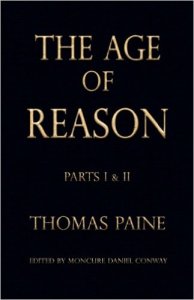
Thomas Paine, THE AGE OF REASON (1796)

Thomas Paine was one of the Founding Fathers of the United States, author of Common Sense in 1776, which inspired the American revolution, and Rights of Man in 1791, which defended the French Revolution.

He’s one of those Founding Fathers that Christian partisans like to believe intended to create a Christian nation. On the contrary, I’ve discovered, Paine also wrote, late in his life and partly in prison, The Age of Reason, published in parts from 1794 to 1807, about which Wikipedia has a long article, which is a passionate denouncement of Christianity. In it Paine defends his deistic belief – that the obvious magnificence of the universe indicates a creator God – but ridicules the Bible on numerous grounds, and rejects all formal creeds. The book was controversial (for its tone as much as for its arguments) and drew many angry critiques, though as the 19th century advanced, many of his ideas took hold, and were reflected, for example, in the writings of Mark Twain.

From my contemporary perspective, the book says a great many very obvious things about the implausibility of many parts of the Bible, and how and why they came to be written without actually being the word of some celestial being. What strikes me most about the book is not its arguments, which by now are familiar from many sources, but its timing — that is, it was easy, even two centuries ago, for a diligent person to perceive all those implausibilities through a close reading and comparison of the various Biblical texts. These texts have always been there in plain view, in millions of copies in millions of households. That the absurdities and historical oddities of the anthology of texts that comprise the Bible aren’t more widely appreciated and understood would be, I think, due to the facts that casual believers never read the entire Bible, but rather selectively read and cherry-quote certain passages directed to them by serious believers, and serious believers (including the clergy) are motivated to ignore or explain away its problems in order to preserve the status quo. There is no motive in religion, as there is in science, to undermine established assumptions with new evidence or reasoning.

I bought a print copy of Paine’s book a few weeks ago, without realizing until I finished that it includes only the first and second parts. The entire text is online, of course — here, for example – and I see that Part III is an exhaustive examination of all the citations, in the New Testament gospels, to passages from the Old Testament that are implied to be prophecies about Jesus Christ, from which Paine concludes,

The practice which the writers of those books employ is not more false than it is absurd. They state some trilling case of the person they call Jesus Christ, and then cut out a sentence from some passage of the Old Testament and call it a prophecy of that case. But when the words thus cut out are restored to the place they are taken from, and read with the words before and after them, they give the lie to the New Testament.

I’ll not post all my detailed notes about the book, as I’ve been doing with the NT books, but will try instead to summarize Paine’s key points.

  • First, Paine was not an atheist; he was a deist, finding evidence for god in the vastness of the universe. (That is, the so-called “argument from design.”) In fact, he was *offended* that the incoherence and implausibility of the Bible should detract from what he believed was the true god.
  • He finds many parallels between Christian faith and Greek or “heathen” mythology. (For example: the centrality of Rome; how the pantheon of Christian saints resembles the pantheon of Greek gods.)
  • He repeatedly notes how the supposed “word of God” was decided *by vote* centuries after the various texts were written down.
  • He repeatedly observes, and is offended by, how the OT is full of “obscene stories, the voluptuous debaucheries, the cruel and torturous executions, the unrelenting vindictiveness…”
  • He finds the NT not “a history of the life of Jesus Christ, but only detached anecdotes of him”. He finds the notion of Jesus coming to Earth to die by crucifixion incoherent; why instead not suffer by staying alive? — “everything in this strange system is the reverse of what it pretends to be.”
  • He observes that the teaching of Greek and Latin in schools is maintained mostly to distract from the teaching of science that would undermine “Christian absurdities”; moreover, it’s the persecution of scientists by the Church that led to the “long interregnum of science” between the Greeks and his present day. The visible breadth of the stars undermines the “solitary and strange conceit” that ours is the only world; he calls this a pious fraud and charges the church with persecuting science because they knew all of this.
  • He examines the methods of “Mystery, Miracle, and Prophecy” as the ways by which the church carries out this fraud, to imply to believers that religious faith is not easily understood, while asking why such implausible tactics would be necessary to any true religion.
  • The second part of the book examines the OT and NT systematically, examining the implausibilities and horrors: the evidence that the Pentateuch was not written by Moses; the savagery and treachery of the Jews toward other peoples; the dicey chronologies; and the famous passage in Isaiah, used by Matthew as prophetic justification for the virginity of Mary, about which 1) the word used by Isaiah didn’t necessarily mean virgin at all; 2) the passage in Isaiah concerned a prophecy (of something to happen very soon) that didn’t actually come true (!).
  • About the traditional story of Jesus:

    The story, taking it as it is told, is blasphemously obscene. It gives an account of a young woman engaged to be married, and while under this engagement she is, to speak plain language, debauched by a ghost, under the impious pretence (Luke, chap. i., ver. 35), that “the Holy Ghost shall come upon thee, and the power of the Highest shall overshadow thee.” Notwithstanding which, Joseph afterward marries her, cohabits with her as his wife, and in his turn rivals the ghost. This is putting the story into intelligible language, and when told in this manner, there is not a priest but must be ashamed to own it.

  • He compares the Jesus story to Greek myths, and concludes “that the Christian faith is built upon the heathen Mythology.” He compares the discrepant genealogies of Jesus. He makes common sense observations about how the story of Mary being a virgin could possibly be known (as I’ve often wondered, who was the witness? How did this story get passed down?). Thus, “Were any girl that is now with child to say, and even swear it, that she was gotten with child by a ghost, and that an angel told her so, would she be believed? Certainly she would not.”
  • And the story of Herod, told only in Mark. And so on and on. Matthew claimed that when the crucifixion occurred, there was an earthquake and the saints rose out of their graves; a story told in no other gospel. Who were these saints, Paine wonders, and how did no one else notice these ancients wandering around, what, naked? Clothed? (Where did the clothes come from?) What happened to these saints later? (Of course, we now understand, even fellow eyewitnesses tell slightly different stories. Presumably most believers dismiss discrepancies among the gospels on those grounds. Memory is fallible. But Paine points out obvious fabulous events that no eyewitness, or reporter, could possibly have overlooked.)
  • One final quote, in which Paine defends his own faith against what he sees as the absurdity of Christianity:

    All the knowledge man has of science and of machinery, by the aid of which his existence is rendered comfortable upon earth, and without which he would be scarcely distinguishable in appearance and condition from a common animal, comes from the great machine and structure of the universe. The constant and unwearied observations of our ancestors upon the movements and revolutions of the heavenly bodies, in what are supposed to have been the early ages of the world, have brought this knowledge upon earth. It is not Moses and the prophets, nor Jesus Christ, nor his apostles, that have done it. The Almighty is the great mechanic of the creation; the first philosopher and original teacher of all science. Let us, then, learn to reverence our master, and let us not forget the labors of our ancestors.

Posted in Bible, Book Notes | Comments Off on Thomas Paine, THE AGE OF REASON (1796)

Links and Comments: Friedman on historical change, why evangelicals like Trump, Paulos on math and biography, Gawande on science, the case against reality

Today in NYT, Thomas L. Friedman: Another Age of Discovery. Friedman lets Ian Goldin, co-author of a book about the lessons we can draw from the period of 1450 to 1550, i.e. a period of extraordinary change. Then: Gutenberg undermined the Catholic Church’s monopoly on knowledge; science undermined humanity’s place as the center of the universe. Public leaders and institutions failed to keep up; people felt worse off (though they were better off than any time in history, as people are now). Populists won elections, reactionary laws were passed, intellectuals intimidated–the “Bonfire of the Vanities”. And, with the advent of cannons and gunpowder, walls stopped working.

Now, like then, “this is the best moment in history to be alive” — human health, literacy, aggregate wealth and education are flourishing — and “there are more scientists alive today than in all previous generations.”

And, yet many people feel worse off.

Because, as in the Renaissance, key anchors in people’s lives — like the workplace and community — are being fundamentally dislocated. The pace of technological change is outstripping the average person’s ability to adapt. Now, like then, said Goldin, “sizable parts of the population found their skills were no longer needed, or they lived in places left behind, so inequality grew.” At the same time, “new planetary scale systems of commerce and information exchange led to immense improvements in choices and accelerating innovations which made some people fabulously rich.”

\\

Alternet: Valerie Tarico on Why So Many Evangelicals Find Donald Trump Irresistible

A puzzle because Trump isn’t much like Jesus. Tarico suggests it’s because “Trump is a lot like a different Bible character—one who also is the polar opposite of Jesus in many ways, but whom young believers are nevertheless taught to worship and praise. I’m talking about the character of Jehovah; Yahweh as some people call him; the Great I Am; the LORD God of the Old Testament…”

Her points: He’s all powerful, and wants us to know it; He’s an insatiable attention-seeker; He’s mean; He’s racist and prejudiced; He demeans women; He’s bellicose and vindictive; His statements contradict facts and each other; He’s wildly rich, and promises to make you rich too if you follow him.

(I take this as a teensy-bit tongue-in-cheek. People don’t like Trump because he resembles the vindictive God of the OT; people like Trump because, like the God of the OT, they both appeal to authoritarian personalities.)

\\

The CSI site has a feature excerpt from John Allen Paulos’ A Numerate Life, a book published earlier this year that is a semi-autobiographical look at how mathematics informs daily experience, and biographies. The excerpt posted appears to be sections of at least a couple different chapters. A couple samples:

To vary the examples a bit, consider the museum guard who claimed that a dinosaur on exhibit was 70,000,009 years old. Asked how he knew that, he said that he had been told it was 70,000,000 years old when he’d been hired nine years before. The precision would be laughable, but shouldn’t we find it almost as laughable when someone claims to be relating someone else’s verbatim (precise) conversations as well as their dates, locations, and contexts?
…
One proto-Bayesian, the empiricist Scottish philosopher David Hume, underlined the importance of considering the probability of supporting evidence when he questioned the authority of religious hearsay: one shouldn’t trust the supposed evidence for a miracle, he argued, unless it would be even more miraculous if the report were untrue. In ancient times, biographies of saints and kings were replete with miracles. Contemporary biographies are devoid of miracles but still contain too many exploits and adventures that seem considerably less likely than their nonoccurrence. It’s the same impulse, but attenuated.

\\

Now collecting a number of pages I’ve “saved” on Facebook the past few weeks.

The New Yorker, Atul Gawande, The Mistrust of Science, his commencement speech at CalTech, June 10th.

If this place has done its job—and I suspect it has—you’re all scientists now. Sorry, English and history graduates, even you are, too. Science is not a major or a career. It is a commitment to a systematic way of thinking, an allegiance to a way of building knowledge and explaining the universe through testing and factual observation. The thing is, that isn’t a normal way of thinking. It is unnatural and counterintuitive. It has to be learned. Scientific explanation stands in contrast to the wisdom of divinity and experience and common sense. Common sense once told us that the sun moves across the sky and that being out in the cold produced colds. But a scientific mind recognized that these intuitions were only hypotheses. They had to be tested.

A beautiful, crisp summary of how science works, why some people resist it, and what to do about it.

\\

Vox: Watch 6,000 years of people moving to cities

And, Kottke.org: What would happen if all humans disappeared?. (The theme of Alan Weismann’s book The World Without Us.)

And, a Carl Sagan quote about science.

\\

Two by Valerie Tarico, at Salon: The 12 worst ideas religion has unleashed on the world (chosen people, heretics, holy war, blasphemy, glorified suffering, genital mutilation, blood sacrifice, hell, karma, eternal life, male ownership of female fertility, bibliolatry (book worship)).

And 5 reasons to suspect that Jesus never existed (no secular evidence; early NT writers seemed ignorant of Jesus’ life, later ‘discovered’ by other writers; the NT stories aren’t first-hand accounts; the gospels contradict each other; depictions of the historical Jesus vary widely).

\\

And finally for now, an essay from the April issue of Atlantic, The Case Against Reality, by Amanda Gefter, subtitled “A professor of cognitive science argues that the world is nothing like the one we experience through our senses.” This expands upon my own provisional conclusion that our minds are optimized for survival, even if they skew our perception of reality.

The world presented to us by our perceptions is nothing like reality. What’s more, [Hoffman] says, we have evolution itself to thank for this magnificent illusion, as it maximizes evolutionary fitness by driving truth to extinction.

Science, and in a speculative Bayesian way science fiction, are techniques for detecting actual reality.

Posted in Atheism, Culture, Mathematics, Science | Comments Off on Links and Comments: Friedman on historical change, why evangelicals like Trump, Paulos on math and biography, Gawande on science, the case against reality

Reading In and Around the Bible: Three More NT Epistles; Revelation

Final post of notes about my first reading of the New Testament.

List of previous posts:
Intro and sources used (Oxford’s edition of the New Revised Standard Version, the King James Version via Steve Wells’ Skeptic’s Annotated Bible, Stephen M. Miller’s Complete Guide to the Bible, Isaac Asimov’s Asimov’s Guide to the Bible); Matthew; Mark; Luke; John; Acts; Paul #1: 1 Thessalonians, 2 Thessalonians, Galatians; Paul #2: 1 and 2 Corinthians; Romans; Paul #3: Colossians, Ephesians, 1 and 2 Timothy; Hebrews, James.

(Also, before finishing these notes on the NT, I’ve wrapped around to do close readings of the OT: Genesis #1; Genesis #2)

1 Peter is just 5 full pages in NRSV. Miller, in his Complete Guide, spends 6 pages discussing it. (Virtually every guide and commentary I’ve seen on the Bible dwells far more on the NT than on the OT. Well, those by Christians, obviously.) The theme here is that suffering should be welcomed, and will be repaid in heaven; and more about the imminent return of Jesus.

  • 1 Peter 1:18-19, earlier epistle writers may have been distancing themselves from OT blood rituals, but not Peter: “You know that you were ransomed… but with the precious blood of Christ, like that of a lamb without defect or blemish.” (It was always important to sacrifice only non-blemished animals.)
  • 1:24, and this is true because of selectively quoting Isaiah: “All flesh is like grass…” (cf. a Simak novel)
  • 2:18, “Slaves, accept the authority of your masters with all deference, not only those who are kind and gentle but also those who are harsh.” Just a couple hours ago I was listening to Fresh Air, with Terry Gross, interviewing historian Wendy Warren about the slave trade of the early New England colonists, and how slavery was taken for granted and justified by the Bible. (Social progress proceeds *despite* religious believers who adhere to ancient, antique, texts.)
  • 3:7, “Husbands, in the same way, show consideration for your wives in your life together, paying honor to the woman as the weaker sex…”
  • 5:13, Asimov points out that the reference to Babylon is not literal, but a metaphor for Rome.

The next book, 2 Peter, is taken to be written not by the apostle Peter nor by the author of 1 Peter, but given that name by some anonymous writer to give it a kind of authority. Oxford: “Such pseudepigraphical attribution is frequent in the Bible and in other ancient literatures.” (p2132). Its structure, on the contrary, is very close to Jude. This is only 4 pages in NRSV.

  • 2 Peter 1:20-21, “First of all you must understand this, that no prophecy of scripture is a matter of one’s own interpretation, because no prophecy ever came by human will, but men and women moved by the Holy Spirit spoke from God.” The writer clearly would like this to be true, so that no one would question his or scriptural authority – but (as Thomas Paine shows) a great many, perhaps most, of the citations of OT prophecy in the NT are twisted or taken out of context to some degree. Prophecy is, the evidence shows, very much a matter of interpretation.
  • 3:8, So why hasn’t the second coming happened? “But do not ignore this one fact, beloved, that with the Lord one day is like a thousand years, and a thousand years are like one day.” Say what? Is this to say nothing in scripture can be taken at face value? (And how does the writer know this?) This is very much like Alice in Wonderland, where (someone else’s) words mean whatever the present writer wants them to mean.
  • 3:10-13, how the world will end in fire, leading to “new heavens and a new earth, where righteousness is at home”. One can see how the compilers of the NT, a couple hundred years after this letter was written, wanted to retain this message, that don’t worry, the second coming will come eventually. Unfortunately, this is one of those passages some Christians like to cite to justify pillaging the Earth and taking no action against climate change—because this earth is expendable and will be replaced by a new one! (Here is where Biblical belief is actually dangerous not just to believers, but to the rest of us.)
  • 3:16, Referring to Paul’s writings, “There are some things in them hard to understand, which the ignorant and unstable twist to their own destruction, as they do the other scriptures.” If you point out the parts that are incredible, you’re unstable and doomed to destruction. (Don’t think, just believe!)

The three John epistles are taken by have been written by the author of the fourth gospel. They’re all very short, all hitting familiar notes of the antichrist coming at any moment, the warnings against false prophets, and the entreaties to love one another.

  • 1 John 2:18, “Children, it is the last hour! As you have heard that antichrist is coming, so now many antichrists have come. From this we know that it is the last hour.”
  • 2:22, what then is an antichrist? “Who is the liar but the one who denies that Jesus is the Christ? This is the antichrist, the one who denies the Father and the Son”.
  • So… all nonbelievers are antichrists; despite which, what John claims therefore follows in 2:18 was not true (the world didn’t end).
  • 5:19, “We know that we are God’s children, and that the whole world lies under the power of the evil one.” God is on our side [says every rival faction in history]; the others are wicked.

I don’t have any specific notes on 2 John, 3 John, or Jude. They’re all quite short.

Finally we come to Revelation, a controversial book that many church leaders rejected. It’s a symbolic, sadistic, fever dream by a zealot who relishes the destruction of all non-believers – Rome in particular. It reads like a bad fantasy novel, and its themes are completely at odds with the relatively gentle, merciful Jesus of the gospels. It’s absurd and incredible all the way through, so I took only very selected notes.

Coincidentally, as I was reading this book five or six weeks ago, David Brin published a post on his blog called The Politics of Religion (wryly noting that by that time “All of the Republican
candidates who claimed to have been chosen by God have now dropped out.”), with a section about how Jesus was “hijacked by John of Patmos”, i.e., the author of Revelation.

The core illness separating the now-dominant fundamentalist movement from Red Letter Christians swirls around the screed where latter-day thumpers go, to stoke their rancor — the Book of Revelation (BoR). 

Barely added to the early Christian canon, over strenuous objection by the era’s top sages, and despised by later scholars, such as Martin Luther, this froth of cackling sadism is diametrically opposite — at every level of morality, compassion and intent — to the homilies of Jesus. 

Those who express hand-rubbing yearnings for the world to tumble into armageddon, as soon as possible — in the BoR’s forecast bloodbath for all-but-a-very-few — thus disqualify themselves from any say over the use of our nuclear stockpile, which was designed by scientific geniuses to end major war, not to end the world. 

…

The Book of Revelation is a Rorschach test, exposing those who yearn for an insane deity, not the Creator of Maxwell’s Equations and a gorgeous, galaxy-rich 14 billion year ongoing-bang, and the refractive laws that give us rainbows… as well as the gifts of Beethoven and Schweitzer and liberty and tolerance and the joyful ambitions that fill a child’s heart.

For all that, what Revelation certainly does is provide a dramatic conclusion to the sequence of increasingly dull NT books, and I suspect that was in part why it was included.

Just a few specific notes:

  • Asimov, p535, details how the significance of the number 7 derives not so much from Jewish creation myths, as earlier Babylonian astrology.
  • Revelation 13:18, the number of the beast “is six hundred sixty-six”. Asimov, p555, explains the numerological origin of this number, how Roman numerals were aligned to the letters of the name of some particular villain the writer of Revelation was impugning. A leading candidate was Nero, but depending on how his name was spelled out, the letters added up to either 616 or 666, and early copies of Revelation had the 616. Asimov thinks Nero was an unlikely target, however, being likely already dead 25 years when this book was written. In any event, the number 666 was appealing for its missing the magical 7 not once, but three times.
  • Author relishes the destruction of Rome, 19:3, “…the smoke goes up from her forever and ever.” (Of course, Rome was not destroyed as imagined, and ironically remains today the center of the Christian church.) (Also, there’s a Tiptree title here.)
  • 20:3, Satan is consigned to a pit for a thousand years, “After that he must be let out for a little while.” Huh? Asimov, p555, explains this as a bit of mystical symmetry involving the seven days and how each day is like 1000 years. Whatever.
  • 21:1-2, the “new heaven and new earth”, after the first ones passed away, is a “new Jerusalem, coming down out of heaven from God…” It’s all about Jerusalem, the whole world.
  • 21:12, and this new city “has a great, high wall with twelve gates…” Why are there gates at all? This is a new, perfect world! Failure of imagination.
  • 21:16, Moreover, “The city lies foursquare, its length the same as its width; and he measured the city with his rod, fifteen hundred miles; its length and width and height are equal.” An enormous *cube*, 1500 miles on a side! (KJV translates the number as 12,000 furlongs on a side; NRSV notes the measurements are multiples of 12 and are symbolic.)
  • 22:20 as elsewhere, “Surely I am coming soon”.

Asimov ends his 1969 volume thusly:

And with that assurance—still unfulfilled nearly two thousand years later—the New Testament ends.

Posted in Bible | Comments Off on Reading In and Around the Bible: Three More NT Epistles; Revelation

Reading In and Around the Bible: Hebrews, James

Next set of Biblical commentary. See Part 1 about sources used — NRSV, Asimov, Miller, KJV via Wells.

List of previous posts:
Intro and sources used (Oxford’s edition of the New Revised Standard Version, the King James Version via Wells’ Skeptical Annotated Bible, Stephen M. Miller’s Complete Guide to the Bible, Isaac Asimov’s Asimov’s Guide to the Bible); Matthew; Mark; Luke; John; Acts; Paul #1: 1 Thessalonians, 2 Thessalonians, Galatians; Paul #2: 1 and 2 Corinthians; Romans; Paul #3: Colossians, Ephesians, 1 and 2 Timothy

Hebrews

This letter was not attributed to Paul until the end of the 2nd century, according to Oxford; modern scholars tend to regard it as anonymous. It does not begin with Paul introducing himself, as do his other epistles; and as both Oxford and Asimov discuss, stylistic differences between this and earlier epistles argue against it being written by Paul. Still, those who argued it *was* written by Paul succeeded in getting this book into the NT canon, in the 4th century. Thus it is taken, by believers, to have equivalent authority as every other book in the Bible.

  • Like Paul’s epistles, this is another sermon, and the opening chapters strike me as a lot of specious ‘reasoning’ based on the *absence* of detail in Genesis to deduce something about Jesus, an argument keying off the supposed resurrection as the justification for eternal life. I suppose this might some powerful sense to the illiterate listeners of this sermon who never had any occasion to read copies of the ancient scrolls to study for themselves.
  • 2:6, famous line, “What is man, that thou art mindful of him?” in KJV; “What are human beings that you are mind of them” in NRSV. Asimov used “That Thou Art Mindful of Him” as a title for one of his stories, in fact.
  • 8:7, the writer is obsessed with dismissing the “first covenant” in favor of the new; “For if that first covenant had been faultless, there would have been no need to look for a second one.”
  • 8:13, and this verse, “In speaking of ‘a new covenant,’ he has made the first one obsolete.” (Miller sees this as the central point of the book.)
  • Two points: first, 8:13 is the kind of verse one would quote to deny that OT proscriptions still apply. (Though as I recall Jesus said the opposite—but the gospel where he supposedly said that hadn’t been written down yet, and so wasn’t handy to constrain the writer of Hebrews.) If you want to excuse Biblical pronouncements against homosexuality, or about the stoning of disobedient children, just cite Hebrews 8:13, to dismiss everything in the OT. If you want to cite Biblical pronouncements against homosexuality, or…. (well nothing else comes to mind; homosexuality seems to be a preoccupation among fundamentalists)… then ignore Hebrews 8:13 and cite Leviticus.
  • Second, presumably the Muslims and the Mormons think they have good reasons for overturning, or at least amending, the testimony of the NT. If the witness of the apostles and the revelations of Paul and others are convincing to a modern person, why aren’t the justifications for the Qur’an and the Book of Mormon? (Answer: because people don’t actually think about these things. They follow the teachings of their tribe — their community, their family. And there is no reason to disrespect their reason for doing so. Unless you are some kind of scientist, obsessed with tracking down the actual truth of reality.)
  • Ch9, this writer, like many in the OT, is obsessed with blood sacrifice, e.g. 9:22.
  • 9:28, “Christ… will appear a second time”. Still waiting.
  • 10:4, “For it is impossible for the blood of bulls and goats to take away sins.” The writer here is stating that a basic principle of the OT is invalid. What is his authority to say so? Why would these rules have changed? One wonders to what extent, and when, did the various religions move away from blood rituals to more symbolic kinds of sacrifice; i.e., how did the ancient religions need to ameliorate their more barbaric practices to accommodate a gradually more civilized world? Because otherwise those religions would not have survived, in a more civlized world. (Natural selection!)
  • 11:1, famous line, KJV: “Now faith is the substance of things hoped for, the evidence of things not seen.” The explanation for this sentiment is the first phrase, and its evocation of what we now understand as self-serving human nature; its undermining is the second, which implies that *anything* not seen can be the basis for any kind of faith. See Jerry Coyne’s Faith Versus Fact to spell this out.
  • 12:7, “Endure trails for the sake of discipline. God is treating you as children; for what child is there whom a parent does not discipline?” The analogy of God to a stern father laid bare. (See Sagan’s book, lecture 7, summarized here.) This was the best these ancients could imagine about the nature and purpose of the universe, at that time, that it’s all about fathers and disobedient children.
  • 13:2, “Do not neglect to show hospitality to strangers, for by doing that some have entertained angels without knowing it.” Only be nice to people in case they are angels. Is that what Jesus counseled?
  • On this point as on many, many others – the Bible is an anthology of texts from various authors with various agendas directed to various audiences, that obviously do not agree with each other on many, many points. The more I read the Bible, and listen to preachers and politicians cite particular verses, the more I think anyone citing any Bible verse to support some position, is being disingenuous; it’s the well-known issue of cherry-picking verses to support whatever one wants to believe, or support.
  • 13:9, “Do not be carried away by all kinds of strange teachings…” Like Paul, this author warns his audience listening to any lessons or sermon from anyone else. Don’t think, just believe!

James

A short, controversial book, whose theme is that faith without deeds is useless. (2:20)

There are a couple famous James in the Bible, and no one really knows who wrote this book, if either of them did.

  • 1:19, “You must understand this, my beloved: let everyone be quick to listen, slow to speak, slow to anger…” Good advice.
  • 2:17, “So faith by itself, if it has no works, is dead.” Key point.
  • 4:13ff, “Come now, you who say, ‘Today or tomorrow we will go to such and such a town and spend a year there, doing business and making money.’ Yet you do not even know what tomorrow will bring.” That is, if you are so presumptuous to make any kind of plans, 4:16, “you boast in your arrogance; all such boasting is evil.” Really?? (I’m trying again to think why this book is regarded by so many as a fount of wisdom. Because most of its followers have not actually read it, I suspect.)
  • 4:14, “…What is your life? For you are a mist that appears for a little while and then vanishes.” Wells in SAB alludes this to “All we are is dust in the wind”.
  • 5:15, “The prayer of faith will save the sick, and the Lord will raise them up; and anyone who has committed sins will be forgiven.” There are people to this day who let their children die because they pray rather than seek medical attention. This would be a key reason why the Bible is an evil [edit] incoherent and obsolete book — to the extent that it counsels believers about how to live and survive.
Posted in Bible | Comments Off on Reading In and Around the Bible: Hebrews, James