
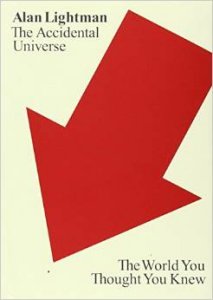
Alan Lightman, The Accidental Universe

Alan Lightman’s THE ACCIDENTAL UNIVERSE (2014) is a short book of seven essays, most previously published, on various ways the universe is not obviously what it appears to be, or is at odds with what humans might prefer. (Lightman is both a scientist and a novelist, and has served both at Harvard and MIT.) As he says in the preface (p. x),

We often invent what isn’t there. Or ignore what is. Why try to impose order, both in our minds and in our conceptions of external reality. We try to connect. We try to find truth. We dream and we hope. And underneath all of these strivings, we are haunted by the suspicion that what we see and understand of the world is only a tiny piece of the whole.

The first, title, essay concerns how the history of science has can “be viewed as the recasting of phenomena that were once accepted as ‘givens’ as phenomena that can now be understood in terms of fundamental causes and principles.” The goal was a ‘Theory of Everything’, in which all the known forces and particles could be ‘explained’ in terms of a small number of basic principles, and perhaps a few arbitrary values (like the weight of the electron).

This ideal may be unreachable; ideas of string theory and inflation imply ideas of a ‘multiverse’, an infinite number of universes, perhaps each with different sets of physical laws. We just happen to live in one that has physical laws suitable for the existence of stars, and life. Other universes would not. That means in a sense ours is ‘accidental’, not necessary in terms of some fundamental principles that drives our set of physical laws.

“The Temporary Universe” has a touching passage about how the author watches the marriage of his daughter and wish she could have remained 10 years old, or 20, forever. (p23b). Humans long for permanence, despite the evidence of the universe that everything passes. “To my mind, it is one of the profound contradictions of human existence that we long for immortality, indeed fervently believe that something must be unchanging and permanent, when all of the evidence in nature argues against us. I certainly have such a longing. Either I am delusional, or nature is incomplete.” (p34.2)

“The Spiritual Universe” is the author’s attempt to understand how both science and religion can coexist in so many minds. He concludes that science, with its central doctrine that all properties and events in the physical universe are governed by laws, is consistent with the religious idea of a God who is unrestricted by such laws (and has a purpose and will, and so on), as long as God stepped to the sidelines once the universe began.

Yet some scientists apparently reject that central doctrine, believing in a God who does continue to intervene in the world–Francis Collins, Ian Hutchinson, Owen Gingerich.

Author stipulates that he himself is an atheist, but understands that we take some things on faith: what is right or wrong, why certain artworks affect us the way they do. [[ I think this is a very loose use of the word ‘faith’ compared to how most people use the word… ]]

He goes on to discuss kinds of scientific knowledge, and kinds of religious knowledge. The former are subject to rational analysis; the latter are matters of personal experience. We need both, he says; both share a sense of wonder. [[ But he’s sidestepping the issue of religious claims to knowledge about the world that are inconsistent with scientific observations… a key theme of Jerry Coyne’s new book and therefore why religion and science are not really compatible. ]]

“The Symmetrical Universe” wonders why we are so attracted to symmetries — perfect roundness, and symmetry of a six-sided snowflake. Symmetry is highly prized as a guidance in physical theories. He supposes that we crave order amidst a chaotic existence… as long as it’s not boring, which is why we also often prefer a slight bit of asymmetry.

“The Gargantuan Universe” concerns how our conception of the size of the universe has gotten so much larger in recent centuries. The size of the Earth was deduced in the 3rd century BC; the size of the solar system and stars, not til nearly two millennia later. We no longer believe that heavenly objects, or living objects, are made of some different kind of matter than everything else. “Science has vastly expanded the scale of our cosmos, but our emotional reality is still limited by what we can touch with our bodies in the time span of our lives.” p99.8 As Kepler identifies more and more Earth-like planets, we can calculate, even being very generous, what fraction of the universe might be alive: an infinitesimal amount (p101t). If the universe was ‘created’, it seems life was an afterthought.

“The Lawful Universe” begins with the Greek notion of atoms, and how Lucretious used the idea as a defense against the idea of the capriciousness of the gods. Yet God remained a viable hypothesis even until Newton’s time; Newton imagined that God was necessary to keep the planets in their courses. Later, Laplace dismissed that hypothesis.

Scientists remain deeply committed to the lawfulness of the universe, with the example of how, when the discovery of beta particles in the early 20th century seemed to violate the conservation of energy, Pauli had the audacity to propose an as-yet-undiscovered particle, a neutrino, to balance the books (rather than abandoned the idea of the conservation of energy). The neutrino was finally observed in 1956.

Finally “The Disembodied Universe” describes Foucault’s demonstration that the Earth really does rotate — something no one can see or feel, except indirectly.

Since Foucault, more and more of what we know about the universe is undetected and undetectable by our bodies. What we see with our eyes, what we hear with our ears, what we feel with our fingertips, is only a tiny sliver of reality. Little by little, using artificial devices, we have uncovered a hidden reality. It is often a reality that violates common sense. It is often a reality strange to our bodies. It is a reality that forces us to re-examine our most basic concepts of how the world works. And it is a reality that discounts the present moment and our immediate experience of the world.

Maxwell’s equations implied ‘invisible’ light, demonstrated by Hertz’ radio wave apparatus. Einstein overturned conventional ideas about time. And quantum physics revealed that matter can be both particles and waves at the same time.

The irony, says the author, is that as science has revealed more of nature than we were aware of, its consequences in technology (cell phones, etc) have separated us from the nature we have access to; we become self-involved, our experience of nature mediated through our devices. People in a nature preserve staring at their phones; a dinner with 25-year-olds, ditto. Just as the author seems to going into get-off-my-lawn! mode, he admits that this is an old story; cultures have long rebelled against changes in the relationship of humans and nature. And there will always be pockets that rebel, becoming disconnected from the human world, and the natural world, in different measures.

Posted in Book Notes, Cosmology, Philosophy, Science | Comments Off on Alan Lightman, The Accidental Universe

The Human Impact on Earth; About Book Culling

A nice Slate photo gallery, a couple days ago, which is not unrelated to the issue of the Sixth Extinction:

Gorgeous, Stunning Satellite Images of the Human Impact on Earth.

I especially recommend watching the video linked at the end, about how astronauts, from Apollo to the Space Station, have had their perspectives expanded by seeing the Earth from space.

Personal angle: I was certain I had a copy of the the book by Frank White alluded to, The Overview Effect, somewhere in my stacks. But I have not been able to find it, even after reorganizing my garage last Friday to sort all the books that haven’t been able to fit into our current house. I’m sure I did have a copy, but I suspect I must have culled it in one of my periodic library reductions. Again and again, I have learned, whenever I cull my collection and dispose of books I think I will never need to see again — something always turns up, something I realize retroactively I am desperate to look at. (I am tempted now to order an expensive copy of The Overview Effect via any number of websites, because I now realize its theme informs my grand provisional narratives…)

Posted in Evolution | Comments Off on The Human Impact on Earth; About Book Culling

The Sixth Extinction and the Pope’s Encyclical

Weekend Facebook post, amended:

The Sixth Extinction: Curious this topic is in the news suddenly, all over the past couple days, since the idea has been recognized for years and the latest Pulitzer Prize winning nonfiction book, by Elizabeth Kolbert, was on precisely this subject. Coincidentally, I read that book a couple weeks ago and will post a summary and comments about it on my blog shortly. The current trigger that all the news is about a new report from an American Association for the Advancement of Science site, http://advances.sciencemag.org/content/1/5/e1400253, which summarizes:

The oft-repeated claim that Earth’s biota is entering a sixth “mass extinction” depends on clearly demonstrating that current extinction rates are far above the “background” rates prevailing in the five previous mass extinctions. Earlier estimates of extinction rates have been criticized for using assumptions that might overestimate the severity of the extinction crisis. We assess, using extremely conservative assumptions, whether human activities are causing a mass extinction.

As the Time article indicates, “this paper hardly breaks ground in its premise…. What differs, here, are the criteria; the scientists estimated very conservatively when it came to how many species have recently gone extinct, and still found that conservative estimate showing the likelihood of an environmental cataclysm.”

Here’s another post about this at Slate: The Earth’s Sixth Mass Extinction is Here—and Humans are to Blame

There’s a tie here with the recent Pope environmental encyclical and criticism of it on the grounds that it dismisses a primary cause: the exploding [in the contest of Earth’s history] population of the human race.

http://time.com/3929419/scientists-sixth-extinction/

http://www.amazon.com/Sixth-Extinction-Unnatural-His…/…/0805092994/

Some realists/rationalists/scientists welcome the Pope’s stance on accepting climate change, while being troubled by his sidestepping of one of the principal causes: the every-expanding population of humanity. (Of course, the Catholic Church’s stance on abortion to birth control has the underlying motivation of *increasing the human tribe*. Be fruitful and multiply! If only the Church would acknowledge that we humans are smart enough to perceive that this advice cannot continue forever, or we will fill up the planet, destroy all other life on the planet, and doom our species.)

Here’s Lawrence M. Krauss at Scientific American:

Ideology Subsumes Empiricism in Pope’s Climate Encyclical

One can argue until one is blue in the face that God has a preordained plan for every zygote, but the simple fact is that if one is seriously worried about the environment on a global scale population is a problem. A population of 10 billion by 2050 will likely be unsustainable at a level in which all humans have adequate food, water, medicine and security.

Posted in Culture, Evolution, Religion | Comments Off on The Sixth Extinction and the Pope’s Encyclical

Bible System Updates

From The New Yorker, last November: Bible System Updates

VERSION 1.0: Original release. Heavens, Earth, formless void.

And so on.

1.6 “Sodom and Gomorrah” N.S.F.W. glitch identified and removed. Bible now free of “Homosexuality” virus.

And then

VERSION 2.0: “New Testament” expansion pack. Adds Jesus features.

And so on and so on.

VERSION 6.0: Homosexuality-compatible. Homosexual colors added back (sea-foam green, fire-engine red).

6.1 Eve now known as Steve.

6.2 “Original Sin” glitch fixed; basic human goodness implied.

And finally,

6.12 “God” feature removed entirely. Replaced with “The Cloud.”

Posted in Religion | Comments Off on Bible System Updates

Narrativium and Lies-to-children

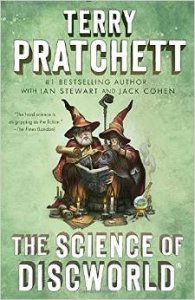
I was looking at the third volume in this series, published in the US last week (the publisher, Penguin Random House/Anchor, has kindly been sending me copies), and realized the book wasn’t at all what I’d thought at first glance – i.e. not about justifying the ‘science’ of the Discworld universe, as the title might suggest (the way a book like THE SCIENCE OF STAR TREK might try to do) – but something quite different and much more interesting. I read a few pages of that and then went back to read the first volume, end of last week.

[I confess I have not read any Discworld novel. I need to catch up.]

What these books do (a fourth is due in the US later this year) is *contrast* how the fantasy universe of Discworld works, with the reality of how our own universe works, on two basic points: in Discworld, magic works, and things happen for reasons, i.e. because of narrative imperative. Discworld has ‘narrativium’ p10. Our real world doesn’t have narrativium, though the concept is fundamental to how humans *think* about that world, p11.

The book’s structure alternates fictional chapters (3 or 4 pages each) of a story in which the wizards of Discworld have accidentally created what they call Roundworld, i.e. our own Earth, inside a container that’s infinite on the inside (and thus encompassing our entire universe), with nonfiction passages (8 or 10 pages each) that expound upon the points raised by the story. As the wizards advance the arrow of time to watch Roundworld develop, they are concerned by how things seem to develop without magic and without narrativium – just by virtue of the ‘rules’ or ‘laws’ built into it. As the wizards puzzle things out in the fiction chapters, the nonfiction chapters [presumably by Stewart and Cohen at least mostly] explain what they don’t understand.

So the book is a primer on current scientific thinking about the origins of the universe, physical theories of everything, the formation of our planet, the history of life on earth, the evolution of dinosaurs and ultimately of humans, told in a straightforward, insightful and occasionally cheeky, occasionally profound, manner.

Will not summarize entire book, but will note several insightful points. [Page references are to the Anchor trade paperback edition, where p12t means top of page 12 (m=middle, b=bottom), and p18.3 means 3/10 of the way down page 18.]

P12t: Many important questions of science are not about how the universe actually is, but about what would happen if the universe were different.

P33.3: regarding deep mysteries like consciousness: “A scientist wants plausible answers to such questions, not just an excuse to stop thinking about them.” (Contrasting, of course, the religious and ID proponents who would say God did it, end of story.)

P37m, authors use the idea of a space elevator as a recurring metaphor for e.g. various evolutionary developments: the initial expense of the elevator would be enormous, but once it’s done, and you can balance the cost of moving things up with the energy of things coming down, it’s relatively free.

P41 We have ‘magic’ in our world to the extent we are surrounding by technology that we don’t personally understand; cf. Clarke’s law. But TV, e.g., is magic to everyone who uses it *now*.

P43 Education is a special kind of magic that humans use to pass ideas from one generation to the next. But early explanations to children have to be simple: “lies-to-children”. Most basic science is lies-to-children; only later do some learn the more complex ideas. Examples p44, and footnote comment: students arrive at university confidant they know nearly everything, and leave years later certain they know practically nothing. (I see Lie-to-children has its own Wikipedia entry!)

P52, discussion of human concepts of beginnings and becomings, but the universe may not actually work to those ideas. E.g., our best idea about the beginning of the universe, per Hawking, is that it *didn’t* begin, any more than there’s a place further north than the north pole. But we need creation myths, p58b, that appeal to our sense that things must have beginnings.

P59 In contrast some things about are becomings, with no clear boundary from one stage to the next – e.g. abortions, or gender identity between male and female.

P88.3 Science is common sense *applied to evidence*.

P103-104, description of a computer program called Langston’s Ant, which produces very simple results for a while, then chaotic results, and then emergent order, all resulting from the same simple rule. (The point is, a single simple “theory of everything” wouldn’t ‘explain’ in any obvious way the emergent order that might result from it.)

P185 How humans ‘reify’ ideas by supposing corresponding ‘things’ must exist in the real world. Bravery? Cowardice? Space? Debt?

P188:

Concepts like gods, truth, and soul appear to exist only in so far as humans consider them to do so … But they work some magic for us. They add narrativium to our culture. They bring pain, hope, despair, and comfort. They wind up our elastic. Good or bad, they’ve made us into people.

P219 Amidst some explanation of how DNA works, i.e. it’s not a blueprint, but a series of instructions that have been cobbled together by natural selection because they work, not because they make any kind of obvious sense. (One of many reasons there is rarely a single gene for any particular characteristic.) The comparison is an engineer who ‘evolved’ electronic circuits using a sort of genetic algorithm, repeating attempts each generation by selecting those that were closest to the desired answer. Amazingly, after some 4100 generations a perfect solution was found—which used only 32 of the 100 available logic cells.

P274, in a chapter about probability and statistics, with details about how ‘coincidences’ happen all the time, and so on, and stressing that apparent remarkable incidents are often the result of selective reporting.

Humans add narrativium to their world. They insist in interpreting the universe as if it’s telling a story. This leads them to focus on facts that fit the story, while ignoring those that don’t. But we mustn’t let coincidence, the clump, choose the sample space – when we do that, we’re ignoring the surrounding space of near-coincidences.

P307 Discussion of ‘Deccan Traps’, something I hadn’t heard of before – huge geological deposits of lava that are apparently the consequence of meteor strikes *on the other side of the planet*, strikes which generated shockwaves that converged half way round the world and triggered volcanic events.

P335, nice concept of “Grandfather” as a unit of time for discussion evolutionary periods among recent eras: a Grandfather is 50 years. Thus, Christ lived 40 Grandfathers ago. On this scale, humans diverged from chimps some 140,000 Grandfathers ago. (While simulations have shown that an entire eye can evolve in a mere 8000 Grandfathers, p336.)

P338-9 discussion of how brains are recursive and involve neural networks… How the invention of the nest was crucial to human culture, since humans spend so much time and energy rearing their children. And oh, how high sex drives seem related to intelligence… 😉 About those Bonobos.

P348 Humans compliment their intelligence with ‘extelligence’, all the external influences, culture and otherwise, that affect the brain and the mind.

P351 The context for the evolution of the mind is being among lots of other minds.

Each culture has devised a technique for putting into the minds of the next generation what it is that will make them put it into the minds of the next generations after that – a recursive system that keeps the culture going. Lies-to-children often feature prominently.

And:

We are running into problems doing this today, because old-style tribal cultures, even national cultures, are becoming intermingled with an international culture. This leads to clashes between what used to be separate cultures, triggering their breakdown…

P355 Authors cite a concept from Samuel R. Delany’s 1966 novel Empire Star (which I read years ago), about simplex vs complex vs multiplex:

Simplex minds have a single-world view and know exactly what everyone ought to do. Complex minds recognize the existence of different world views. Multiplex ones wonder how useful a specific world view actually is in a world of conflicting paradigms, but find a way to operate despite that.

And p356 last para:

We are having to cope with multiplexity. We’re grappling with the problem right now: it’s why global politics has suddenly become a lot more complicated than it used to be. Answers are in short supply, but one things seems clear: rigid cultural fundamentalism isn’t going to get us anywhere.

—

The second to last nonfiction chapter considers the idea that, in the long term (they’ve just reviewed the history of our planet, with its mass extinctions, after all), a planet is not a safe place to be. Where might we go? Back to the idea of the space elevator; Mars; generation ships.

The final chapter acknowledges that this book isn’t called the “Religion of Discworld”… but this is “explained to the hilt” in the second book. They advise, “All religions are true, for a given value of ‘truth’.” P378.

And they ponder what it might mean if there we never do encounter intelligent life, and our world is all there is.

This is our Discworld. In its little cup of spacetime, humanity has invented gods,* philosophies, ethical systems, politics, an unfeasible number of ice-cream flavours and even more esoteric things like ‘natural justice’ and ‘boredom’.

With the footnote: *We apologize to any real gods.”

Posted in Book Notes, Children, Evolution, Narrative | Comments Off on Narrativium and Lies-to-children

Links and Comments: Jerry Coyne; Max Planck; Creationism and Education; Human history and progress; and others

Finished reading Jerry Coyne’s new book Faith Vs. Fact, subtitled “Why Science and Religion Are Incompatible”, which I took extensive notes on that at some point I will summarize here on my blog. Meanwhile, Coyne did a Q&A with National Geographic, In Age of Science, Is Religion ‘Harmful Superstition’?, from which I will quote his key claim in his book:

In a nutshell, why are religion and science incompatible?

They’re incompatible first of all, because they both compete to find truths about the universe. There are some fundamental truths about the universe that believers have to accept in order to be religious. Many Muslims see the Koran as literally true. To question any of that is to bring a death sentence on yourself. The reason why people are so concerned with harmonizing science and religion, as opposed to, say, science and architecture, or science and baseball, is because science and religion are competitors in the field of esoteric truths about the cosmos.

But we use different methods to ascertain what’s true. Science has an exquisitely refined series of methods honed over 500 years to find out what’s real and what’s false. Richard Feynman  gave the best definition of science I ever heard, “It’s a way to keep you from fooling yourself, because you’re the easiest person to fool.” Religion doesn’t have a methodology to weed out what’s false. In fact, it’s a way of fooling yourself. They have authority, revelation, dogma, and indoctrination as their methods and no way of proving their tenets false.

There are thousands and thousands of religions and all of them make incompatible claims about the universe. The reason that that’s the case is because they don’t have any way of testing those claims.

The book is a distillation of the themes of Coyne’s website (he doesn’t like it being called a blog… though it is), and of several important themes of my Provisional Conclusions.

\\

And now a linkdump of items of collected over the past two weeks but which I’ve not had time to post until now. (A scratchy, coughy, sneezy cold has interfered this past week.)

Slate: Louisiana is teaching Creationism: The Bible v. the Constitution

File this under Conservative Resistance

And for that matter this one, not to mention advice from Rick Santorum about not getting an education at a university.

Jehovah’s Witness Leader to Crowd: Only Visit JW-Approved Websites or You’ll Be At “Spiritual Risk”

Cut off the outside world, lest your beliefs would wither in the daylight of reality.

\\

Nice piece about changing one’s mind, and how Max Planck was able to do this throughout his life.

Slate: Genius Move: Max Planck, the unlikely founder of quantum physics, knew how to change his mind.

We live in an age—perhaps the age—of confirmation bias. And given a turbulent sea of information, who can blame us for latching onto the familiar while looking away from anything jarring or mismatched? We yearn for the comforts of our main tribe, be that tribe political, religious, scientific, or economic. If that’s a failing, it is probably a hominid design flaw, far beyond evolutionary recall at this point.

Planck is the one who said “A new scientific truth does not triumph by convincing its opponents and making them see the light, but rather because its opponents eventually die and a new generation grows up that is familiar with it.” This also applies to social standards, too, of course.

\\

A five minute video about how we live in the greatest time in human history (because Industrial Revolution and modern technology).

Vox: 5 minutes that prove we’re living through the greatest time in human history

On the other hand, here’s philosopher John Gray:

Vice: John Gray Says Human Progress Is a Myth

His point is all apparent ‘progress’ could easily be swept away. I agree; see my Provisional Conclusions.

\\

New York Times op-ed by Molly Worthen: Wanted: A Theology of Atheism.

I’m not entirely on board with this; like many religious writers, this writer assumes that the accouterments of routine religious faith are somehow necessary for mental and social health, even if redirected to something non-supernatural. Typical lack of imagination, or myopia.

\\

One more from NYT: Timothy Egan on The Arrogance of Jeb Bush

You simply cannot be a leader of the Republican Party without appearing to know less than a fifth grader about earth science. …

“And for the people to say the science is decided on, this is just really arrogant, to be honest with you,” said Bush. “It’s this intellectual arrogance that now you can’t have a conversation about it even.”

[The opinion writer asks:] Is it arrogant to say that smoking causes lung cancer? That you shouldn’t text and drive? That the American diet and lifestyle cause Type 2 diabetes, which is killing people? There is some wiggle room in each of those assertions. But you test them at your peril. Since when did prudence become a vice in a family whose presidential patriarch was guided by what “wouldn’t be prudent”?

\\

Nice summary of plans to build huge new telescopes: Vox: These giant telescopes are going to change astronomy.

Unfortunately, the ones in Hawaii are being held up by locals who feel such telescopes would desecrate their holy grounds.

\\

Two more interesting items from Vox.

Steven Pinker explains how capitalism is killing war

A gloss on Pinker’s 2011 book The Better Angels of Our Nature, which argues that human violence has greatly reduced in recent centuries, that humanity is becoming more peaceful.

[ My own aside, not a thought in this article or anywhere else: so then, what is fueling the anger in the US about threats to the 2nd amendment to stock up arms, and the attendant paranoia that the Obama administration is about to take away all their guns? (Which conspicuously has not happened.) I suspect this is an issue apart from the trend of actual violence, which Pinker addresses. ]

One more, without comment: Game of Thrones is secretly all about climate change

\\

Finally, a cartoon that is spot-on about how most people assume their religion from their environment, and if they think about it at all, somehow don’t realize how very lucky they were to grow up in an area where the one true religion was revealed.

The Outsider Test for the Right Faith

Posted in Book Notes, Psychology, Religion, Science | Comments Off on Links and Comments: Jerry Coyne; Max Planck; Creationism and Education; Human history and progress; and others

Links and Comments: Modern Physics; Evolution and Strangers; Coming out in totalitarian societies; Elizabeth Kolbert on Mars

Sunday’s New York Times has a “Gray Matter” essay on A Crisis at the Edge of Physics by Adam Frank and Marcelo Gleiser* is about whether the empirical method — validating theories via predictions and evidence — does not work for some modern scientific ‘theories’. Or perhaps those ‘theories’ don’t count as proper theories. The prime examples are string theory and supersymmetry, as the next steps beyond the standard model (which does not unify all four basic forces). If high-order ‘theories’ can solve this unification mathematically, but cannot be validated through any kind of evidence, what’s the point? The authors compare these ideas to Ptolemy’s epicycles, which similarly ‘explained’ the orbits of the planets without any kind of evidence, but were accepted for 1500 years. The resolution to this quandary may come with upgrades to the Large Hadron Collider, which potentially might discover the predicted supersymmetric particles.

*Gleiser is author of a recent book The Island of Knowledge: The LImits of Science and the Search for Meaning, which I have in my to-read stack, and seems to be about this issue in many manifestations. There are also books like Jim Baggott’s Farewell to Reality: How Modern Physics Has Betrayed the Search for Scientific Truth, which claims science has already gone off the rails on these issues.

\\

And an interesting op-ed in Sunday’s LA Times by Robert Sapolsky [a biology professor at Stanford], The evolution of encountering, and embracing, strangers. (Beware the annoying ads that block the page for 15 seconds.)

For nearly all of human history, people lived in small hunter-gatherer bands, with some flow of individuals between neighboring bands that regularly encountered one another. In other words, your life was spent among people you knew.

But as has been explored by sociologists and psychologists, once humans developed proto-cities with thousands of inhabitants, starting around 9,000 years ago, something unprecedented occurred: We began to spend a lot of time around people we didn’t know very well at all.

Generosity and cooperation are common in small groups where everyone knows each other, but plummet when dealing with anonymous strangers. Thus…

…it is only when societies get large enough that people in them regularly encounter strangers that “Big Gods” emerge — deities who are concerned with human morality and who punish our transgressions. The gods of hunter-gatherers generally couldn’t care less whether we’ve been naughty or nice.

The point of his essay is that, upon seeing his son’s graduation from high school, he realizes the people in modern societies regularly *break* close social ties in order to move on — to move off to different cities, start a fresh life. It’s a process never experienced by our ancient ancestors.

\\

Heartbreaking story in NYT, North Korean Defector Opens Up About Long-Held Secret: His Homosexuality, about a man who defected from North Korea for reasons he wasn’t even aware of, except that he knew he felt no sexual attraction to his wife. Because he grew up

in the totalitarian North, where the government maintains that homosexuality does not exist because people there live with a “sound mentality and good morals.”

It wasn’t until he defected to South Korea that he understood that there was even the concept of homosexuality — though even in that country the topic is taboo.

And an analogous story also in NYT (and reproduced in the San Francisco Chronicle, and no doubt other subscribers), about transgender: Transgender Children’s Books Fill a Void and Break a Taboo.

Sam Martin was browsing in a Boston record store 23 years ago when an unusual photography book caught his eye. Mr. Martin flipped through its pages, which featured portraits and interviews with women who had become men, and started to cry.

“I thought, ‘Oh, my God, I’m not the only one,’ ” said Mr. Martin, 43, who started transitioning to male from female after he bought the book. “When I was growing up, I never saw people like me in movies or books.”

There is a range of human experience and perception that totalitarian societies, and religious conservatives in democratic societies, seek to suppress and deny — for what can only be characterized as socialistic reasons. Reproduce and multiply, for the good of society, for the good of the race. But it’s the arc of history, especially now in the internet age, and as the human race’s survival is relatively more assured than it was a century ago or a millenium ago, that these forces will give way to reality, to acknowledging the common humanity of such sexual minorities, and other minorities that have previously been marginalized over human history.

\\

Nice essay by Elizabeth Kolbert*, in the June 1 New Yorker, about Project Exodus: What’s behind the dream of colonizing Mars?

Nice essay that contrasts the practical difficulties of getting to Mars with the fantasies about getting there, and the potential consequences if we do.

“Humans carry biomes with us, outside and inside,” he writes. NASA insists that Mars landers be sterilized, but “we can’t sterilize ourselves.” If people ever do get to the red planet—an event that Conway, now forty-nine, says he considers “unlikely” in his lifetime—they’ll immediately wreck the place, just by showing up: “Scientists want a pristine Mars, uncontaminated by Earth.” If people start rejiggering the atmosphere and thawing the regolith, so much the worse.

“The Mars scientists want to study won’t exist anymore,” Conway writes. “Some other Mars will.”

With some discussion of Chris Impey’s new book Beyond: Our Future in Space, another book on my to-read stack.

*Kolbert is the author of The Sixth Extinction, winner of the Pulitzer prize and at least one other literary award IIRC as best science book of 2014; I read it on my plane flights a week ago and will write it up and summarize it here in the next week or so.

Posted in Evolution, Physics, Science, The Gays | Comments Off on Links and Comments: Modern Physics; Evolution and Strangers; Coming out in totalitarian societies; Elizabeth Kolbert on Mars

Upon Returning from a Wedding

I’ve tweaked a few passages in my Provisional Conclusions today, in light of attending a family wedding in a socially conservative state and observing first-hand a community that obviously thrives in the context of a traditional religious narrative.

What my thesis (my Provisional Conclusions) has to ‘explain’ is how apparently intelligent people can maintain such loyalty to [such obviously arbitrary and historically contingent] narratives of ideology and religion, and the sense of their special understanding of the will of God, despite the obvious facts that the universe doesn’t care and every other group of humanity feels just as confidant of their own superiority.

Part of the solution may be this: there’s no survival advantage in recognizing ‘reality’; those ideological and religious beliefs really do promote survival and perpetuation of the species.

So what I mean by ‘active consciousness’ (in my Provisional Conclusions) is a kind of maturity, an understanding of the protocols of survival and the need for those narratives, with an attendant understanding that those narratives are just stories we tell ourselves to get through the night, or through a life – that the universe outside the parameters of human existence operates by very different rules. It’s analogous to growing up and understanding where babies really come from, that the circumstances that created your life were largely arbitrary and circumstantial, and that your own town or sports team isn’t *really* the greatest one in the whole world. Even if you pretend they are, as everyone around you similarly pretends, as a matter of social cohesiveness (and a kind of group survival strategy).

Another part of the solution is understanding why it doesn’t matter to most people that most others in the world follow *different* narratives, i.e. different religions. *As long as they have a story to live by*, perhaps even to submit to, something that gives their life ‘meaning’, i.e. a narrative context that gives purpose to day to day life and the cycles of the generations – then that’s OK. In a sense it’s like speaking different languages. Relatively few people are insistent about their own languages being superior to all others, just as relatively few are much concerned about people subscribing to other religions. (Those who decline to follow a religion, however – those are the ones that bother people. How can they not subscribe to a narrative? They are loose cannons, unpredictable and nonconformist.)

It’s the people we call scientists and philosophers, mostly, who currently have this ‘active consciousness’ of understanding the reality of the universe as a thing above and beyond the protocols of human existence. This does not make them cold or inhuman; they are just as likely to have families and to love their children, to appreciate art and music and nature, as anyone else – just not, of course, in the context of a religious narrative that places themselves or their tribe as the center of all existence, the profoundly narcissistic idea that they are the reason the universe was created.

On the contrary; scientists will tell you there is great, deep gratification to appreciating the workings of the universe, to appreciating the context in which humanity exists, appreciating that humanity is a *consequence* (if not an inevitable one) of the operations of our enormous, ancient, cold, indifferent universe. This appreciation is all the more profound because it’s *true*, based on everything humanity has perceived and understood about the universe in which we live – in contrast to the self-flattering religious myths, tales imagined by ancient tribes who thought the world was flat, that most people live by.

It would be nice to think that the human race will gradually mature along these lines, as education expands and the religious tribes who resist such education are marginalized, but there’s little current evidence this might happen any time soon; on the contrary. The so-called ‘end of history’ described at the end of the 20th century (notably by Francis Fukuyama, who claimed that the liberal democracies and free market capitalism would spread around the world, and that would be that) was trounced by 9/11.

In the long run, however, I’m optimistic, and so is most science fiction. The arcs of social and technological history have had setbacks – but after every setback, humanity keeps moving forward, in a two steps back, five steps forward fashion. How science fiction writers have thought about these things is what I might explore, as I develop this blog and perhaps write a book around the framework of my Provisional Conclusions.

Posted in Culture, Evolution, Narrative, Religion, Science | Comments Off on Upon Returning from a Wedding

Links and Comments: About religious parents shielding their children from reality

More about the Duggars’ insular worldview.

Gawker: Tell Your Duggar Tales: Did Michelle Duggar Get a Gay Crew Member Fired?

The family kept their children so sealed from exposure to the outside world that their ideas about big cities like LA or New York were caricatures, and the TV crew filming them was instructed to be very careful not to “taint their version of the world”. (And the gay member of the film crew, who mentioned the fact matter-of-factly, was removed from the crew.)

During this time, the Duggars had very limited exposure to what they called the “outside world” and so most of the crew members being from larger cities, we were all very surprised at how very little they knew or understood about places like New York, Los Angeles, and London. All of their perceptions of these places were the most exaggerated stereotype caricatures as if their only source of news was from locally produced religious cartoons from the 1980s. As in, LA is full of surfer dudes and Valley girls, and everyone in New York talks and walks like John Travolta in Saturday Night Fever, walks in packs carrying switchblades, spray paints graffiti at every turn, with the only safe haven oddly being the mighty Trump Tower. Yes, Trump Tower was Jim Bob’s go-to when talking anecdotally about the elegance of lavish and luxurious places. … They didn’t own a television or had an Internet connection at that time, so, really, next to second hand church gossip, the local newspaper was really their only link to anything outside of Arkansas. The producers of the show had instructed crew members to not ever engage in conversation on our own with Jim Bob or Michelle in fears that we may either say something normal that they would find objectionable or that they would say something to where we’d react funny because we weren’t used to their level of “unwordliness” I think it was put.

Many other links, (e.g. Jezebel, The Duggars Aren’t Just a Family, They’re a Cult and The Atlantic: All Unhappy Families: The Downfall of the Duggars, but the point is made.

Conservative Resistance:
“religious inculcation of children, and the shielding of them from outside influences that would threaten their parents’ worldview”

\\

The Atlantic: Which Contemporary Habits Will Be Most Unthinkable 100 Years From Now?

Answers include burning fossil fuels, driving, having a lawn. And Daniel Dennett suggests:

Unsupervised homeschooling. When we come to recognize that willfully misinforming a child—or keeping a child illiterate, innumerate, and uninformed—is as evil as sexual abuse, we will forbid parents to treat their children as possessions whom they may indoctrinate as they please. They may teach their children any religious creed they like, but only if they also teach the uncontroversial facts about the world’s religions so their children can make an informed choice when they grow up.

\\

Slate: Were You There? As a creationist kid, I was determined not to learn about evolution.

So can religious students understand evolution even when they think it conflicts with their beliefs? In my own experience, as a case study for a creationist learning about evolution, the answer is no. Rissler has it right.

What I learned at home and church was like a fog that the most basic principles of biology could barely cut through. In science class, details got lost in the mist.

During one of Wortman’s lectures on natural selection—involving different types of bacteria—I was doodling. Normally an attentive student, I deliberately tuned out of the class. The subject made me uncomfortable because the process of new species coming about via natural selection directly contradicted what my church and parents taught me about the origins of life. From one corner of my page of sparse notes, a cartoonish rendering of Wortman peered at me from behind oversized spectacles. Abandoning the portrait, I traced angular shapes that fit together like puzzle pieces and circled them with flowers and vines. Then Wortman caught me.

“What, do you think you know this already?” Wortman asked indignantly, leaning on my student desk where my incriminating notebook lay. “Could you take the test right now?”

I was mortified.

(Of course, this “were you there” question was likely not asked in history classes about the Civil War. But then, perhaps the entire universe was created 100 years ago, just before any of us were born, or perhaps 2 minutes ago, complete with all our memories of a past.)

Posted in Conservative Resistance, Evolution, Human Progress, Morality | Comments Off on Links and Comments: About religious parents shielding their children from reality

How Science Works, Concerning that Retracted Gay Marriage Survey, and the Ironies

New York Times op-ed: What’s Behind Big Science Frauds?

Other links:

SFGate: Study retracted: 20 minutes actually CAN’T change a homophobe’s mind

The New Yorker, Maria Konnikova: How a Gay-Marriage Study Went Wrong

This concerns a report from a few weeks ago that I blogged about here — Links and Comments: Politics and Ideology; About Changing One’s Mind — concerning a series of in-person interviews with people about subjects including gay marriage. The results indicated that when the interviews were themselves gay, and had personal stories to tell, the interviewees often changed their minds, with lasting results. Somehow the personal connection made a difference. (The study included other topics, such as abortion, where the interviews had themselves had abortions, and explained the circumstances that led them to such a difficult decision.)

Now, suddenly, the lead author of that report has asked to retract its conclusion, because apparently the grad student who did the research cannot produce his evidence. Perhaps he faked it? Or something more complicated? That grad student plans a formal reply by the end of the month.

But this is how science works. Yes, scientists are people too, they are given toward mental biases such as confirmation bias, and there is huge pressure on grad students to produce results worthy of publication in prestigious journals.

But the fakers will be found out, whether they were deliberate or subconscious; that’s how science works. Results must be validated and reproduced. If not they will be corrected or withdrawn, as has happened here. For now.

(In contrast, when was the last time some religious pundit — insert any of dozens of names here — declared that he’d made a mistake, and his previous condemnation of this or that group was in error? Rather, see the current news about Mike Huckabee defending the Duggars. He has very different standards for those on his side and those on his other.)

Ironies:

In my earlier post I noted how this result challenged my provisional conclusion that most people simply cannot change their minds about anything. (Scientists supposedly are willing to, when evidence and studies shift, but even they sometimes have difficulty due to the psychological biases we are all given to.) This new development retracts the challenge to that conclusion.

And yet — here’s this huge political results in which a popular vote in Ireland has approved same-sex marriage (e.g. CNN), a circumstance unthinkable a decade or two ago.

What happened? Is it because people *change their minds*??

Or, perhaps, the march of history, the arcs of progress, depend on the old folks dying off and the younger generation, with a wider experience of the world and a great understanding of that world, take over?

Posted in MInd, Psychology, Science, The Gays | Comments Off on How Science Works, Concerning that Retracted Gay Marriage Survey, and the Ironies