Ann Druyan on Cosmos

Salon’s film critic Andrew O’Hehir interviews the actual creator and author of the recent Cosmos TV series– not Neil deGrasse Tyson, who was just the on-screen host, but Carl Sagan’s widow Ann Druyan.

“Why is God telling me to stop asking questions?”: Meet the woman behind Neil deGrasse Tyson’s “Cosmos”

I particularly appreciated this Q&A:

You’ve been pretty outspoken over the years about your views of religious myth and its relationship to science. You’ve talked at times about the desire to reclaim some of the sense of mystery or daring or even spirituality that could hypothetically be associated with science. Is this show to be considered as part of that struggle, as an attempt to recapture the mystery and power of science in the public imagination?

That’s beautifully said. And you know, I could speak to that. Yes, I mean, what always has surprised me personally is that the revelations about nature and the universe that science has presented to us are not just, you know, more likely to be better approximations of natural reality than we’ve gotten from any other source, but they’re also way more spiritually satisfying than anything we’ve ever been able to make up. You know, our interpretations of nature that are not rooted in nature at all and that are anthropocentric are kind of the infantile idealized visions of us as the center of the universe. As the children of a very disappointed father. [Laughter.]

You know, that stuff just leaves me cold. I’m sorry; it doesn’t really do anything for me. But the idea, you know, that we are, in my view, a species in search of fulfillment is something very real. And we used to get it from theory, you know, that we were literally special. That we were created apart from all of nature. We can’t get that anymore once you understand a mountain of evidence from DNA and many other independent causalities, which seems to create our oneness with all of life. I think we’re being brave. We’re looking at reality as it really is, we’re being brave enough and grown-up enough to know how tiny we truly are. “Cosmos,” in the original and in this incarnation, is intended to teach and familiarize the broadest possible audience with some of the insights and methods of science and some of its heroes, but also to make you feel what science is telling us. Personally, I think that’s important. We’re embracing these challenges that can only be solved through science. We’re looking at the universe and trying to understand how it’s put together, and you can’t see that without science. There’s only one way to see that.

Posted in Cosmology, Religion | Comments Off on Ann Druyan on Cosmos

Science Fiction and the perception of a greater truth

Here’s a passage from an early 1960s science fiction story, a story later incorporated into a novel, about a young man who works as a yardboy in a small town in a pre-industrial society near the “Katskil border”. One morning he gets up early enough to watch the sun rise.

For the first time that I can remember, I wanted to know, Where does it come from, the sun? What happens over there when it’s set afire every morning? Why should God go to all that trouble to keep us warm?

Understand, at that time I had no learning at all. I’d scarcely heard of books except to know they were forbidden to all but the priests because they’d had something to do with the Sin of Man. I figured Old Jon was the smartest man in the world because he could keep accounts with the bead-board that hung in the taproom. I believed, as the Amran Church teaches everyone to believe, that the earth is a body of land three thousand miles square, once a garden and perfect, with God and the angels walking freely among men, until the time almost four hundred years ago when men sinned and spoiled everything; so now we’re working out the penance until Abraham, the Spokesman of God, who died on the Wheel at Nuber in the year 37, returns to judge His people, saving the few elect and sending the rest to fry forever in the caverns of Hell. And on all sides of that lump of land spread the everlasting seas all the way to the rim of world. The Book of Abraham, said the teacher-priests, doesn’t tell how far away the rim is, because that’s one of things God does not wish men to know.

The author is Edgar Pangborn, and this 1961 story, “The Golden Horn”, was incorporated into his 1964 novel Davy, which I read decades ago, though I’ve just reread this story this past week. If the reader of this novel can’t guess from “Katskil” and similar references, it’s not set in the past, but in the future. It’s one of the better novels on the fairly common SF theme in the ’50s and ’60s about… what would happen after the apocalypse? Meaning, then, the likely nuclear war between the US and the Soviet Union. What kind of society would the survivors rebuild? What would they think about their past? A recurrent thread in such stories was the idea of an official church, or at least an official dogma, to explain to ordinary people where they came from and why they’re here. Often, of course, with proscriptions about questions not to ask, in order to maintain the sovereignty of the church, and social order.

The novel, as I vaguely recall, is about the main character Davy leaving his small town to see what the world is really like. (I’ll have to reread the complete novel soon.) And discovering, of course, it’s not at all like what his church said.

The lesson for any prescient reader is obvious. And the theme occurred in SF not just in post-apocalypse settings, but in outer-space settings as well, e.g. Robert A. Heinlein’s novella “Universe” and Harlan Ellison’s aborted “Phoenix without Ashes” TV series, both about residents of enclosed societies, with traditions to discourage freethinkers, who eventually discover that they are passengers on “generation” starships that will not arrive at their destinations for centuries, and who have lost all memory of their original missions.

The insight of these authors, and the lessons for readers, obviously, is, you must be willing to step outside of your society’s assumptions and comfort zones in order to learn the truth about your existence and reason for being. Whatever you think your society’s truth is, the real truth is likely far grander.

Posted in science fiction | Comments Off on Science Fiction and the perception of a greater truth

Links, Quotes, Comments: 20 June

A post today by Amanda Marcotte, on both Salon and Alternet–

Salon: Reason vs. the right: Have conservatives abandoned science and rationality?
Alternet: Have Conservatives Abandoned Rationality, Skepticism and Truth?

The possibility that rationality itself has become a partisan issue is disquieting to many who prefer to believe that “both sides” have topics that they are irrational about and irrationality is evenly distributed among all political stripes. That may have been true in the past, but increasingly, Americans are rearranging their political views and their views on empiricism so that liberals are putting much more of an emphasis on rationality. Indeed, many of the irrational notions floating out there that are assumed to be “liberal” are, in fact, becoming more associated with the right as this reshuffling takes place.

…

The recent reboot of the show Cosmos on Fox further demonstrated how partisan the very idea of science and empiricism has become. The show, which features astrophysicist Neil deGrasse Tyson taking over the host role from the original’s Carl Sagan, was aggressive in defending science, curiosity, and following the evidence from people who would rather rely on faith or authority, but it took no partisan positions. Nonetheless, it was immediately understood by Americans both left and right as a “liberal” show, merely for its strong insistence that facts should not be ignored in favor of wishful thinking.

Even though the show was hosted on the Fox network channel, Fox News, the conservative cable channel, did not hold back in the slightest from attacking Tyson for perceived liberalism. In a shockingly racist segment, host Greg Gutfeld and guest Gavin McInnes dogged relentlessly on Tyson, insinuating that he can’t really be an astrophysicist and making fun of “white liberals” for being enthusiastic about Tyson and his work. It only grew uglier with McInnes claiming that Tyson deserved to be mistreated based on his race when he was young because he “fit the profile” by having “a huge afro.”

Is this a surprise? The political right is dominated by the religious, who are, virtually by definition, irrational.


And about the National Organization for Marriage (NOM) — meaning, organization against gay marriage — which held a rally in Washington DC this week. Which attracted… hundreds.

Think Progress: Religion Motivates The Few Participants In National Anti-Gay Marriage Rally

Of course it does. I’m not sure there’s one cogent or accurate statement in this article. They are all misinformation, religious bigotry, or childish squeamishness.

At Slate, J. Bryan Lowder has a mildly sarcastic take.

Four of the five stages of grief—denial, anger, bargaining, and depression—were on full display today at the March for Marriage, a rally outside the U.S. Capitol organized by the National Organization for Marriage and other co-sponsors.

…

Former Sen. Rick Santorum offered a particularly frothy mix of rhetoric on this point, suggesting that, “first and foremost in this movement, we have to reclaim marriage for what it is. Marriage is the union of a man and a woman for the purpose of making two people as one—a unity—and secondly, to have and raise children. No other union can accomplish those two purposes.” Those who have happily co-parented a child after an accidental pregnancy will be surprised to learn that their arrangement is impossible, but then their existence was not the only one to be denied entirely at the March for Marriage.

…

And at another point, Bishop Harry Jackson noted, in what seemed to be an unwitting moment of lucidity, that this conflict represented “one group trying to impose their issue, their agenda, on another group of Americans. That’s not right and that’s not fair.”

The irony of the last paragraph.


A great political cartoon by David Horsey. There is a significant segment of the US population who reflexively reacts to any accomplishment by the Obama administration in this way. Anything, no matter how good, must be bad, if done by Obama. Scroll down to see the cartoon.

GOP criticism of Khattala’s capture hits level of pure silliness


And two great posts at io9 this week.

10 Pseudo-Science Theories We’d Like to See Retired Forever

Including the vaccinations and autism hoax, homeopathy, intelligent design, and… “toxins”.

Here is a scientific definition for a toxin: It’s a poisonous substance produced by living cells, especially one that, when introduced into a new body, spurs the creation of antibodies. That’s a toxin. That’s what it is, where it’s made, and what it does.

Here is a definition for a “toxin”: It’s a mysterious bad thing that’s in all the stuff I don’t like. I don’t know what it actually looks like, or its chemical composition. I don’t know exactly how it’s produced. I don’t know the precise process it sets off in the body. I only know that it definitely, definitely causes the awful thing that I always thought would, and indeed should, happen to people doing stuff I don’t like.

We need to step on the idea of “toxins.” We need to step on it until it’s dead. We’re not going stop people from blasting woo at us any time we eat anything that’s not kale or live anywhere that’s not the windswept peak of a mountain, but with concerted effort, we can at least make them sound ridiculous when they do it. I think the new term for toxins should be “evil pixie dust.”

And: 10 Scientific Ideas That Scientists Wish You Would Stop Misusing

Proof. Theory. Natural. Survival of the Fittest. Organic.

Posted in Culture, Evolution, Lunacy, Religion | Comments Off on Links, Quotes, Comments: 20 June

Mahler 6

When I was 18 or 19, still living at home while commuting to college at UCLA, I had a tiny clock radio in my bedroom, which was my only source of music aside from the Tijuana Brass LPs playing in the living room. In May 1974 the public radio station KPFK broadcast a “Mahlerthon”, a many-hour anthology of tracks from the symphonies and other works of Austrian composer Gustav Mahler, arranged and introduced by William Malloch (RIP). . It was a revelation. I had never heard music like this, and bonded to his music immediately.

The closest Google link I can find is this, with what seems to be a transcript of the show, beginning about half-way down.

Just now I am watching/listening to a Bernard Haitink performance of the Symphony #6. It’s fascinating watching the performers close-up. You always wonder, do they *feel* this music? Or is it just a job for them?

The conductors, of course, do *feel* the music. That’s their job. And trying to translate that feeling to the performers.

And of course, the final moment of this symphony is stunning. Though perhaps not so much in this live performance, or at least not in an audio performance where you can’t turn up the volume. (Between YouTube and my PC, my audio volume does not go up very high.)

https://www.youtube.com/watch?v=Zvfh_mjPLlQ

I think I’ve only heard two Mahler symphonies live. One was during an early trip to Europe; a performance of the 5th symphony, at Albert Hall, in London. Years later, a performance by the LA Philharmonic of the Symphony #9, with its incredibly moving finale, that alternates between hymn and mysticism, and finally fades to almost nothing, with a subtly inverted motif, to signal the final, resigned, conclusion.

Posted in Music | Comments Off on Mahler 6

Ann Druyan on Cosmos

Salon: Interview by film critic Andrew O’Hehir of Comos writer and executive producer Ann Druyan. Neil deGrasse Tyson was the visible host, but he didn’t write the show; Druyan, the widow of Carl Sagan, did.

You’ve been pretty outspoken over the years about your views of religious myth and its relationship to science. You’ve talked at times about the desire to reclaim some of the sense of mystery or daring or even spirituality that could hypothetically be associated with science. Is this show to be considered as part of that struggle, as an attempt to recapture the mystery and power of science in the public imagination?

That’s beautifully said. And you know, I could speak to that. Yes, I mean, what always has surprised me personally is that the revelations about nature and the universe that science has presented to us are not just, you know, more likely to be better approximations of natural reality than we’ve gotten from any other source, but they’re also way more spiritually satisfying than anything we’ve ever been able to make up. You know, our interpretations of nature that are not rooted in nature at all and that are anthropocentric are kind of the infantile idealized visions of us as the center of the universe. As the children of a very disappointed father. [Laughter.]

Infantile, yes.

I’m fascinated by the reference to Druyan’s

brilliant rereading of the story of the Garden of Eden, which she sees as the story of humanity’s escape from “a maximum-security prison with 24-hour surveillance.” Adam and Eve’s capital offense is that they seek knowledge and ask questions, precisely the qualities that define the human species. At least in that story, God appears to demand a subservient and doctrinaire incuriosity, and many of his followers continue to insist on that path to this day.

And am not sure where her exegesis was published, but I’ll try to track it down.

Posted in Cosmology, Culture | Comments Off on Ann Druyan on Cosmos

Links and Quotes, mid-June

Preoccupied with writing up book notes this past week (and other things), I have a bunch of linked articles to note without making any of them separate posts.

From last Monday, two interesting op-eds in the New York Times.

Charles M. Blow: Religious Constriction. About the recent Gallup survey that indicates that 42% of Americans still believe “God created humans in their present form 10,000 years ago”. And how Republicans pander to them. Blow concludes,

Religious fundamentalism at the expense of basic scientific facts threatens to obscure America’s beacon of light with a bank of fog.

And the ever-prescient Paul Krugman explores Interests, Ideology and Climate. He wonders if resistance of the evidence of climate change is simply a matter of vested interests (i.e. the coal industry, et al). No, he concludes,

Well, think about global warming from the point of view of someone who grew up taking Ayn Rand seriously, believing that the untrammeled pursuit of self-interest is always good and that government is always the problem, never the solution. Along come some scientists declaring that unrestricted pursuit of self-interest will destroy the world, and that government intervention is the only answer. It doesn’t matter how market-friendly you make the proposed intervention; this is a direct challenge to the libertarian worldview.

And the natural reaction is denial — angry denial. Read or watch any extended debate over climate policy and you’ll be struck by the venom, the sheer rage, of the denialists.

The fact that climate concerns rest on scientific consensus makes things even worse, because it plays into the anti-intellectualism that has always been a powerful force in American life, mainly on the right. It’s not really surprising that so many right-wing politicians and pundits quickly turned to conspiracy theories, to accusations that thousands of researchers around the world were colluding in a gigantic hoax whose real purpose was to justify a big-government power grab. After all, right-wingers never liked or trusted scientists in the first place.


From Slate, Politics and Your DNA. How abortion absolutionists misunderstand biology.

We can hope that our legislative, judicial, and executive governmental branches will learn enough biology so that they do not even consider legislation that makes little sense. Understanding what embryos are and how they develop is not just a theoretical matter—being inaccurate has consequences. Knowing the biology will not tell us how to act or what is right and good, but it will inform decisions so that they are not inconsistent with biological reality.


Jerry Coyne notes an essay by A.C. Grayling, The Secular and the Sacred.

This is the chief reason why allowing the major religions to jostle against one another in the public domain is extremely undesirable. The solution is to make the public domain wholly secular, leaving religion to the personal sphere, as a matter of private conviction and practice only. Society should be blind to religion both in the sense that it lets people believe and behave as they wish provided they do no harm to others, and in the sense that it acts as if religions do not exist, with public affairs being straightforwardly secular in character. The constitution of the USA provides exactly this, though the religious lobby is always trying to breach it, for example with prayers in schools. George W. Bush’s granting of public funds for ‘faith-based initiatives’ actually does so.


Alternet: Why Does the Right Embrace Ignorance as a Virtue?.

As liberalism has increasingly been aligned with the values of empiricism and reason, the incentives for conservatives to reject empiricism and reason multiply. To be a “conservative” increasingly means taking a contemptuous view of reality. 


Slate, June 14th: Lev Grossman on Daughter Pressure, subtitled, “Fatherhood ruined my life plan — and made me the writer I am.”

I’ve started to think that the business of making new people is actually pretty important—important enough to go on a life plan, even. Because otherwise where would new people come from?


Salon, Solving the Genesis equation: Biblical creation as explained by modern science, an excerpt from a new book by British biologist Steve Jones, a book subtitled “The Bible Interpreted through Modern Science”


Christian Love.

Christian Pastor: If Your Child is Gay, “You Don’t Have a Meal with Them”


Via Gregory Benford on Facebook, this post on Centauri Dreams, a site about deep space exploration: Cultural Evolution: The View from Deep Space, quoting one Mark Lupisella:

If the universe didn’t have value and morality prior, it does now. If it didn’t have meaning and purpose prior, it may now. If it didn’t have intentional creativity prior, it does now. We may be a very small part of the universe that arose by chance, but nevertheless, strictly speaking, the universe now contains morality and a kind of intentional creativity it may not have had prior to the emergence of cultural beings like us. We cultural beings, in some nontrivial sense, make the universe a moral and increasingly creative entity, however limited that contribution may be for now. Increasingly, human culture is expanding its circle of creativity and moral consideration. Perhaps interstellar travel can help expand a circle of moral creativity to the whole of the universe.


And this Wired.com intro to a new episode of podcast Geek’s Guide to the Galaxy quotes physicist Lawrence Krauss and SF authors Tobias Buckell, on science denial, and James Morrow, on Proof of Heaven and Heaven Is for Real:

How does God feel about the fact that his cover has been blown? How does he feel about this unequivocal proof? Because there’s not one syllable of doubt in either [book]. Here God has been messing with our heads for thousands and thousands of years. You know, he’s been hiding himself, declining to answer our prayers—at least not doing so reliably—declining to intervene at Auschwitz or Hiroshima. Suddenly the game is up and God has been unequivocally unmasked. Did he really want this to play out in that fashion? I mean, did he really want the ultimate revelation to take the form of a New York Times bestseller?

Posted in Cosmology, Culture, Quote at Length, Religion, Science | Comments Off on Links and Quotes, mid-June

Notes on Adam Lee

A final set of book notes for the moment, this one the fourth of several books about atheism, humanism, and why people believe what they do (which last item is my central concern). Adam Lee is a blogger who writes the blog Daylight Atheism in the Atheist Channel of the vast Patheos website. In his book of the same title, Daylight Atheism, he’s not ‘angry’ like Greta Christina, but he’s frank and unapologetic; his theme is that not believing in any religion is nothing to be ashamed of, and it’s time for those of us who think that way to “step out our closets and into the daylight” (p13).


The structure of his book is similar to A.C. Grayling’s The God Argument; the first half explains why religious faith is a nonstarter; the second half explores the benefits of free thought and honest engagement with the world.

Though the book’s themes are similar to those in the past couple I noted here, Lee of course offers distinct perspectives. Here’s one right away: in chapter one, he compares religion to fossil fuel. Just as our 21st century technology is still based on an 18th century economy based on fossil fuels — which are becoming a lethal threat to our climate — so do the fossilized dogmas of religion, contaminated with tribalism, hate, and fanaticism, threaten the future of human culture. Nice metaphor.

As other authors have done, Lee spells out the evil that religion brings to the world: Islam and 9/11; Christian fundamentalism intent on remaking society into their own theocratic image (and if not here, then in Nigeria, Uganda). He explores the relative ignorance of the Christian devout of their own Bible, noting the many passages in that book that describe what most modern people would call atrocities. “These stories send a moral message about a deity who’s petty, insecure, malicious, short-tempered, violent and cruel.”

Is the New Testament better? It was Jesus who introduced the idea of Hell, an eternal punishment, far worse than any punishment in the Old Testament.

And the argument from evil. Why terrible things happen, and the rationalizations the devout muster.

The second half of the book describes life without superstition; the values available to atheists not constrained by holy books. He addresses the stereotypes about what most people think about atheists.

And he describes his concept of a morality independent of religion and derived from our existence as a social species. He calls this “universal utilitarianism”, a slight variation on the utilitarian idea of seeking to produce the greatest good for the great number of people. His definition, which he then explores, is, “Always minimize both actual and potential suffering; always maximize both actual and potential happiness.” [A theme which dovetails into Sam Harris’ The Moral Landscape, which I’ll get to eventually.]


If I have a couple slight reservations about this book, one is that the book is self-published, and I can’t see anywhere what Lee does for a living, or what academic credentials he might have, aside from writing this book, and his blog, and being a speaker at various events. Perhaps these days this is an unfair comment in these days when, occasionally, self-published books are as good as any others.

My second reservation is that, actually, Lee’s site Daylight Atheism has better essays than any of the chapters in this book, which perhaps try to summarize too many points in too little space. Lee’s site is a wealth of resources, especially in his essays, which I suspect in toto far exceed the length of this book. And in his ongoing blog, he addresses current social issues of day, for example, recently, the misogyny of the Santa Barbara shooter a few weeks ago, and the latest discovery about the atrocities committed by the Catholic church in Ireland.

But overall, this is a fine book that covers issues of interest, especially, I would think, to any of my devout readers who don’t understand why everyone doesn’t accept the obvious truth of their faith. A nice complement to A.C. Grayling’s book.

Posted in Atheism, Book Notes | Comments Off on Notes on Adam Lee

Notes on Peter Boghossian

Peter Boghossian’s book has an aggressive title, A Manual for Creating Atheists, though it is in no way as ‘angry’ as Greta Christina’s book, discussed last time. Boghossian is a faculty member in Portland State University’s philosophy department, and his modus operandi is Socratic dialogue in the service of what he calls “street epistemology”. This means that every chance he has, he engages in a conversation with people he meets on the street, in the supermarket, in prisons (he does this outreach thing), and so on, about what they believe and why.

He doesn’t challenge people about “evidence” for what they believe; in fact, his first rule of engagement is: avoid facts. Don’t discuss evidence. The people you engage are not used to thinking based on evidence. It’s not about changing beliefs, but about changing how people form beliefs.

And he distinguishes between faith and religion. Religion is a social institution with many admirable qualities – the social community of churches, the recognition of life milestones. He wants to focus on faith, which he defines as “pretending to know things you don’t know”.

He gives numerous examples of what he calls “interventions” – those conversations he strikes up with people about what they believe and why. My takeaway from these is that most people acquire faith and religion without thinking about it in any deep way – they accept whatever the conventional wisdom of their local community is, or the parameters of particular beliefs, without any awareness of their religion’s past, or why their traditions may be historically suspect. Over and over again, his “interventions” do (or sometimes do not) simply instill a shadow of a doubt. A young lady is sorry the author won’t be “saved” by Jesus. He asks, if you had some reason to think Jesus was a myth, does that mean you are a bad person? Pause.

Boghossian, like many of the writers of these books, has a chapter devoted to “anti-apologetics” – supplying reasonable responses to the typical challenges from believers about the need for faith and the supposed illegitimacy of science.

There is one chapter, chapter 8, on a topic that I’ve not seen in any similar books and makes this book worth reading. He examines the culture of “academic leftism”, and traces the history of liberalism, from John Locke in the 17th century, though the 19th century’s social liberalism, to the academic liberalism of the 20th century. Multiculturalism, the acceptance of other cultures and cultural practices, has spilled over into rote acceptance of all points of view about systems of knowing the world, as if faith in the Koran and the scientific method are just two equally valid ways of knowing the world. This has translated into an academic taboo from criticizing any cultural process or practice; such criticism is tantamount to hate speech.

But this means that faith becomes immune to criticism; that academics are robbed of the opportunity to make moral and epistemic judgments. The result is that students are left without a capacity for critical rationality – and, ironically, believing they’re better people as a result for suspending judgment on irrational ways of thinking about the world.

The author, obviously, thinks this is a tragic situation that needs correcting. Academics should support what works, and point out to their students the ways of thinking that don’t.

I agree obviously; and on his terms, I am a classical/social liberal, but not a leftist.

Coincidentally, David Brin just a few days ago posted on his blog A Thumbnail Political Bestiary, which distinguishes between liberal, libertarian, leftist, and rightist, which I’ll have to read more closely before commenting.

Posted in Atheism, Book Notes, Culture, Religion | Comments Off on Notes on Peter Boghossian

Notes on Greta Christina

As a follow-up to the last post, I’ve read three other books in the past several months about the theist/rationalist divide. Here are some note and comments, one at a time. (The other two, to follow, are books by Adam Lee and Peter Boghossian.)

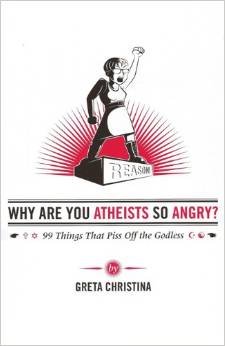
The most aggressive of these three books is Greta Christina’s Why Are You Atheists So Angry?, subtitled, “99 things that piss off the godless”. Her opening chapter is a litany of these 99 things, from which I’ve captured a representative sample (with a couple editorial highlights):

Atheists are mistrusted for public office and denied certain positions; how priests and parents terrorize children; at priests who rape children; that the Catholics have protected them; at 9/11; at Jerry Falwell blaming it on the gays and the ACLU; at circumcision; the protocols of the elders of Zion; at honor killings; parents who use faith healing; belief in creationism – because they embrace a lie that contradicts the evidence; battles against evolution in schools; the author’s wife Ingrid’s grandparents; bigotry against LGBT people; Mormons who ‘lie for the lord’; girls told to be submissive; modesty patrols; the holocaust, and blaming it on atheists; the caste system in India; Galileo; the church opposing condoms in Africa; making abortion illegal; abstinence-only sex ed; glorifying faith with no good evidence; accusing atheists of being arrogant; the idea that the enormous universe was made just for humans (and then accuse atheists of being arrogant); that religious people often don’t know the tenants of their own religion; that Christians claim to be victims; policy based on ancient religious texts; never questioning one’s religious beliefs; the Magdalene laundries in Ireland [related to the Philomena story]; exorcism; justification for slavery; revisionist history; Salman Rushdie; Quiverfull families; scientology practices; “I feel it in my heart” (#83); the double standard in attributing good to God and bad to ‘mysterious ways’; the self-centered pettiness of most prayer; the idea that religious faith is a virtue, and to reject reality, or that it doesn’t matter whether their beliefs are really true; at believers who reject *other* beliefs and imply they alone are doing it right; including treating some things in the Bible as not literal (how do they know?); at the hatred expressed toward atheists (e.g. on her blog); at people asking why she’s angry.

Following chapters acknowledge questions she anticipates, e.g.

    • Your anger is just hurting yourself
    • Your anger is just hurting your cause
    • Atheism is just another religion…
    • Just because religion has done some harm doesn’t mean it’s mistaken
    • All religion isn’t like that. You’re not being fair….
    • All believers aren’t like that. That’s not the true faith.
    • How can you be so hateful? …
    • People need religion…
    • Why do you care what other people believe? …
    • What about all the good things religion has done?
    • You wouldn’t be so angry if you just accepted Jesus Christ as your personal savior
    • If you’re so angry, what are you doing about it?

The author of course provides cogent responses to these naïve questions.

The next few chapters address why the author thinks various soft forms of religion – moderate and progressive; new age; spiritual but not religious; ecumenicalism and interfaith – are just as problematical. Because they all promote reliance on some kind of faith, as opposed to dealing with the actual, real world.

Chapter 8 lists the author’s “top ten reasons I don’t believe in God”

  1. The consistent replacement of supernatural explanations of the world with natural ones.
  2. The inconsistency of world religions
  3. The weakness of religious arguments, explanations, and apologetics
  4. The increasing diminishment of God
  5. The fact that religion runs in families
  6. The physical causes of everything we think of as a soul
  7. The complete failure of any sort of supernatural phenomenon to stand up to rigorous testing
  8. The slipperiness of religious and spiritual beliefs
  9. The failure of religion to improve or clarify over time
  10. The complete lack of solid evidence for God’s existence

The final chapters address atheist activism. Does trying to argue people out of religion ever work? Well, yes, it does, and she provides evidence from email responses to various atheist authors from their readers.

The strategy that works? Discussing the absurdity of beliefs; the immorality of them; their diversity; the similarity of myths; that science as a better explanation; realizing that non-belief is an option; realizing that religious apologists are cherry-picking; how cognitive biases support religion. And so on.

One of the next books to discuss, by Peter Boghossian, extends this theme: it’s called A Manual for Creating Atheists.

Posted in Atheism | Comments Off on Notes on Greta Christina

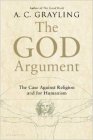
Notes on A.C. Grayling: The Case Against Religion and for Humanism


A.C. Grayling is a British philosopher whose 2013 book The God Argument: The Case Against Religion and for Humanism, is a clear and concise summary of why religion is best abandoned and why humanism (as he describes it) is a preferable alternative. (I mentioned before that the book’s title is a bit crude…I suspect imposed by his publisher.) His book is thus somewhat in contrast to the famous or infamous titles by Richard Dawkins, Christopher Hitchens, and others, that are aggressively anti-religion; Grayling, rather like Sam Harris’ more recent book The Moral Landscape (which I also have read recently, and will blog about), is discussing religion mostly as the basis for a case that an alternative is more reasonable, more realistic, and more humane.

Grayling’s book comprises two tasks:

  • To deal with what religious apologists say in defending religion
  • To show that there is a beautiful and life-enhancing alternative outlook… based on the best, most generous, most sympathetic understanding of human reality.

I quoted his first paragraph a while back.

To put matters at their simplest, the major reason for the continuance of religious faith in a world which might otherwise have long moved beyond it, is indoctrination of children before they reach the age of reason, together with all or some combination of social pressure to confirm, social reinforcement of religious institutions and traditions, emotion, and (it has to be said) ignorance — of science, of psychology, of history in general, and of the history and actual doctrines of religions themselves.

The first half of the book is about religion, and summarizes, in clear and beautiful prose, all the various arguments – many of them obvious to those of us who’ve read these arguments many times before, but perhaps unfamiliar to those faithful who don’t realize why anyone would question their faith – about why religion is a nonstarter. To summarize these arguments:

Faith means beliefs held independently of any testable evidence, or even in the face of counter-evidence—the latter often regarded as a virtue. The central faith of religions is the existence of a supernatural, divine being, and the consequent need for worship and praise, submission and obedience. Also, typically, that this being is the universe’s creator, ruler, and moral law-giver. Beyond that details are vague; religious apologists resort to vagueness about mysteries the human mind cannot comprehend.

Most people assume that the word ‘god’ refers to something that can be believed in, worshiped; that explains the origin of the universe; that lays down rules for behavior. That different religions make different claims about their god or gods is evidence they are man-made… but religious people think this insight applies to other religions, not their own.

Atheists reject the various myths of the Greeks, Babylonians, etc., and then add that they regard Christianity and Islam as similar myths. It’s just one more god to stop believing in.

The first half of Grayling’s book addresses debates about theism, secularism, and morality; basic issues about rationality; about agnosticism, atheism, and proof; and then addresses the classic philosophical arguments for the existence of a god, and discusses how philosophers and scientists over the ages have dismissed them. Arguments by design, by definition. Cosmological arguments. Pascal’s wager.

(He makes a crucial point that I’ve made here on my blog, but is not generally appreciated: even if one of these classical arguments were valid, it would say nothing about which of the many gods humans have imagined corresponds with the presumably-proved creator. Why isn’t the creator by first cause Zeus? A similar argument reveals the narcissism of many Christian apologists (Craig, Plantinga, et al) who think morality or the human sense of awe necessarily implicates the reality of *their* idea of God, i.e. the Christian one. What about the majority of humanity that is not Christian? Are they immoral, or lacking a sense of awe? This does not pass the reality-check test.)

Grayling goes on about creationism and intelligent design, which merely push the idea of origins back one step (who created God? Claiming God is the exception from needing a cause is special pleading).

He concludes Part I (page 127)

The cumulative case against religion shows it to be a hangover from the infancy of modern humanity, persistent and enduring because of the vested interests of religious organizations, proselytisation of children, complicity of temporal powers requiring the social and moral policing that religion offers, and human psychology itself. Yet even a cursory overview of history tells us that it is one of the most destructive forces plaguing humanity.

While the first half of this book treads ground many other books before have covered, the second half focuses on the positive: the case for humanism. Grayling distinguishes between three debates:

  • theism vs atheism, which is about metaphysics, what does or does not exist;
  • secularism, which is about the place of religion in the public square; and
  • the source of morality; from divine command, or human realities?

The secular position is that religions are entitled to exist, but deserve no privileged place in society; there should be no “respect due to faith”, since religions “derive ultimately from the superstitions of illiterate herdsmen living several thousands of years ago” (p135.5) (discussed again p238)

Humanism is the ethical outlook that says each individual is responsible for choosing his or her values and goals, is responsible for living considerately of others.

Humanism is above all about living thoughtfully and intelligently, about rising to the demand to be informed, alert and responsive, about being able to make a sound case for a choice of values and goals, and about integrity in living according to the former and determination in seeking to achieve the latter.

p138b. Like being a good guest at a dinner party.

Grayling lists two fundamental premises of humanism:

  • First, there are no supernatural agencies in the universe.
  • Second, our ethics must be drawn from the nature and circumstances of human experience.

A key requirement of Humanism is that individuals should think for themselves… it has no metaphysics. It is not about ‘faith’ in reason or science; science is open to challenge and refutation, faith is not.

Grayling examines the history of Humanism and boils it down to the criteria for living good lives. They are:

  • Life seems meaningful or purposeful
  • They are lived in relationships with others
  • They are lives of activity
  • They are marked by honesty and authenticity
  • They manifest autonomy
  • The experience of living them is rich or satisfying
  • They have integrity
  • Life seems meaningful or purposeful
  • They are lived in relationships with others
  • They are lives of activity

There is no single ‘meaning of life’. It is what you make it. Loving someone, raising children, succeeding in one’s field are common themes. Conventional values are not always bad, but need to be honestly examined, with those no longer suitable being abandoned.

(An aside mentions an aspect of religious history I had not appreciated: that New Testament ethics were for people who thought they lived in the last weeks or months of history (p156b), thus instructions to give away all your property, turn the other cheek to your enemies, and so on. Of course, 2000 years later, there are still people who think they live in the end times, apparently never having learned the lesson of history and failed prophecies.)

He discusses the difference between ethics and morality, and notes that certain human needs are basic to everyone; thus morality is an objective matter, concerning common themes across societies. (Cue here to Sam Harris’ The Moral Landscape, which I’ve read, which addresses these issues, and which I’ll blog about soon.) Morality concerns matters such as marriage, divorce, sexual behavior, abortion, euthanasia, drugs.

For the humanist it matters to ask this: if interest in and concern for one’s fellows is a reason for being moral, what relevance does the existence of a deity have? Why cannot we accept that we are prompted to the ethical life by these natural human feelings? The existence of a god adds nothing, other than as an invisible policeman who sees what we do always and everywhere, even when alone in the dark, and who rewards and punishes accordingly. Such an addition to ethical thought is hardly an enrichment, since among the under-pinnings to the moral life they offer are threats – of fear, of exclusion, even of violent sufferings: which are, among other things, exactly what the moral life seeks to liberate us from. These threats characterize the state of mankind under religion for most of history; liberation from them, and therefore from religion, is a desideratum of humanist morality. (p242t)

There is a beautiful, poetic final chapter, from which I will only quote excerpts, beginning p255:

The fact is persistently overlooked that those who are not religious have available to them a rich ethical outlook, all the richer indeed for being the result of reflection as opposed to conditioning or tradition. Its roots lie in rational consideration of what humankind’s cumulative experience teaches; and that is a great harvest of insight.

And, discussing a wide variety of belief systems (astrology, feng shui, religion, etc):

But with the exception of the individuals who promote these systems when they should know better, humanism is not against the majority who subscribe to them, for it recognizes that they were brought up in them as children, or turn to them out of need, or adhere to them hopefully (and some, too often, unthinkingly). These are fellow human beings, and humanists profoundly wish them well; which means too that they wish them to be free, to think for themselves, to see the world through clear eyes. If only, says the humanist, they would have a better knowledge of history! If only they would see what their own leaders think of the simple version of the faiths they adhere to, substituting such sophistry in its place! For whereas the ordinary believer has somewhat misty and incomplete notions of the religions they subscribe to, their theologians deploy such a labyrinthine, sophisticated and complex approach, that some go so far as to claim that a god does not have to exist to be the focus of the faith.

And, echoing Neil deGrasse Tyson:

Having the intellectual courage to live with open-endedness and uncertainty, trusting to reason and experiment to gain us increments of understanding, having the integrity to base one’s views on rigorous and testable foundations, and being committed to changing one’s mind when show to be wrong, are the marks of honest minds.

If I were to recommend one book to believers who have doubts, or to believers who simply want to understand why nonbelievers cannot accept what they feel to be the obvious truth of their faith, it would be this one. (Rather than the books by Hitchens, Dawkins, et al.)

Posted in Atheism, Book Notes, Humanism, Philosophy | Comments Off on Notes on A.C. Grayling: The Case Against Religion and for Humanism