(UK: Serpent’s Tail, June 2026, 198pp)
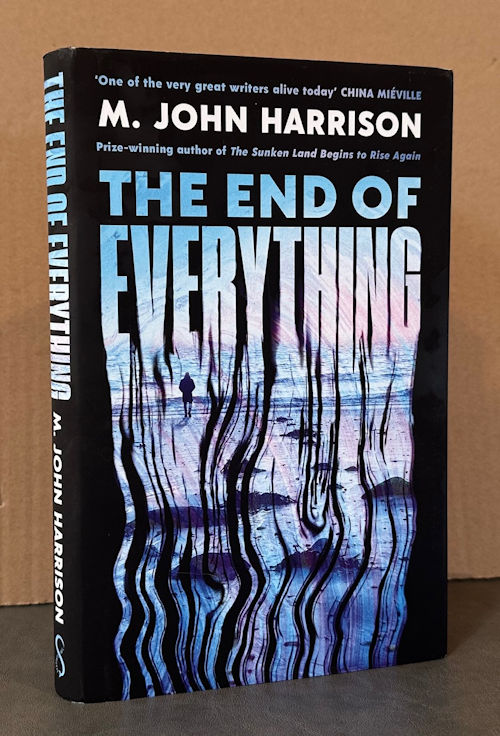
This post is adapted and expanded from comments I made a week ago about this novel winning the Booker Prize in Britain. The win was something of a surprise, since the book is nominally a science fiction novel, and since Harrison, now 81, is the oldest writer ever to have won the Booker.
But it’s in no way a conventional science fiction novel. It’s strange and surrealistic, set in some indeterminate future, in Britain, in the aftermath of an invasion, of some kind, by aliens calls the iGhetti. Civilization seems to have collapsed; the population is minimal; Europe seems to have gone missing. It focuses on two people: Phillip Tennant, who lives along the mostly deserted Kent coastline in southeast UK, where alien ‘artefacts’ wash up every day, which he hopes to find and sell; and his aunt, Marnie, who lives in a house apparently underneath the wing of a crashed airliner.
Phillip does find an ‘artefact,’ one which reconfigures and gradually grows in a human-like being that can speak intelligently. Meanwhile inexplicable things happen: a neighbor boy pranks Marnie by peeing on her from the roof. She retaliates by cutting his leg open to let him bleed out. The neighbors complain, but only as if it was simply not her place. A few pages later, Phillip finds several men slicing up an artefact and eating it. He calmly shoots them each in the base of the skull. (Both early in the book, so these are not crucial spoilers.)
There are no conventional ‘explanations’ for why these events happen. And that’s the tone for the book. A lot of strange things happen, without conventional explanations. (The conventional science fiction reader would guess: were this boy and those men some kind of alien invaders? As in Invasion of the Body Snatchers? Who therefore deserved to be killed? But there’s no validation for that thesis.)
There’s much speculation about the nature of the alien invaders, mostly in conventional science fiction terms. But Harrison makes it clear (see interview excerpts below) that that’s not the point.
This may be what attracted the literary judges to this book. It’s ambiguous in the way that literary critics appreciate.
And yet, there is a long tradition in science fiction of attempting to describe inscrutable aliens, or inscrutable states of reality. That reality has changed is what Harrison calls “the end of everything.” This is a fine addition to that tradition. That this book won the Booker suggests that literary critics, who have for decades dismissed science fiction (and fantasy) from serious literary consideration, have suddenly discovered something they had not realized existed.
From File 770, over a week ago:

The Guardian, yesterday: Does M John Harrison’s Booker win mean science fiction is finally accepted by a ‘snobby’ literary establishment?, subtitled “Kazuo Ishiguro, Jeff VanderMeer, Olivia Laing and other writers weigh in on the publishing world’s genre wars”
As M John Harrison was announced as the Booker prize winner on Monday evening, the 81-year-old looked gobsmacked. Decades into his career, and long overlooked by the mainstream literary establishment, he had just won a prize that has never before rewarded a writer known for science fiction, with a decidedly fantastical book.
His fans, many leading authors among them, are thrilled. “For decades it was a standard – and correct – nerd whine to point out that sentence for sentence, book for book, Harrison was one of the greatest writers out there, full stop, but that ‘mainstream’ prizes never reflected that,” says China Miéville, who last week won the Goldsmiths prize with his 1,200-page speculative novel The Rouse. Back in 2002, Miéville wrote that Harrison not having won a Booker by that point proved “the bankruptcy and back-slapping generic snobbery of the literary establishment”. Now, he says: “I am so delighted, for Harrison, and for fiction.”
There is no reason to think that writers of science fiction or fantasy are any less skilled than writers of mainstream novels. Except that it was obviously true decades ago when science fiction emerged in cheap ‘pulp’ magazines. And was retained as literary critics and standard-bearers of ‘literature’ had very specific ideas about what kinds of stories constituted ‘literature.’ As with everything, these standards change.
\
And then Harrison did this interview:

The Observer, 10 Nov 2026: M John Harrison: ‘No true science fiction fan would enjoy this book’
Subtitled: “The 81-year-old author on why his 2026 Booker prize-winning novel The End of Everything refuses rationale, his passion for rock climbing, and the thrill of writing”
This is significant because Harrison himself has a very specific idea of what readers of science fiction expect.
The End of Everything is full of unanswered questions. How did it begin?
That has always fascinated me as a philosophical problem: the impossibility of knowing what you don’t know. First contact with aliens would involve that exact cloud of unknowing. You would not know what their motives were. You wouldn’t know if they had a concept of motive. You wouldn’t even know if they knew that you were there – and they would be in the same position. Those are the underpinnings of the book.
Yes, exactly. He goes on to criticize “world-building,” usually considered one of the greatest accomplishments a writer of science fiction can do. He thinks it’s a distraction.
I’m not against what’s known as building a world, and I’m perfectly aware that realistic mainstream mimetic fiction is just as much world-built – and has to be for it to work at all – as sci-fi or fantasy. What I object to is the overexplanation of everything in the text and the settings overcoming the narrative and anything else – the mood, the vibe, all the human interest disappears in this desperate effort to make a world come to life in front of you by adding more and more information.
And then what he thinks about science fiction readers.
But I can assure you that there isn’t a true science fiction reader in Great Britain who would enjoy this book. They won’t because it refuses closure. It refuses rationale. It refuses to pretend that it’s real. I hate the struggle towards building a world that the reader can immerse in because I think it’s cheating. It’s not fair to the reader. Readers are vulnerable to that kind of thing. I would rather that they engaged with something a bit more like life.
Here is a writer of science fiction who doesn’t understand the range of what science fiction readers read for. There are plenty of science fiction readers who are comfortable with ambiguity, the weird, the unknown. Well, maybe not plenty, but at least a few. Like scientists, who never claim they know everything, and are always looking forward to new discoveries. We know we don’t understand everything, but we’re fascinated by the unknown, and we keep searching.