
Links and Comments: Conservative Susceptibility to Lies; Contempt for Science; Existential Threats

» Slate: Why Are Conservatives More Susceptible to Believing Lies?. Subtitle: “An interplay between how all humans think and how conservatives tend to act might actually explain a lot about our current moment.”

Longish article about how conservatives are more given to believing “fake news” or alternative facts — that Obama is a Muslim, that Trump’s inauguration crowds were bigger than Obama even when looking right at comparative photos, that Hillary Clinton was involved in a pizza parlor sex trafficking ring — than liberals are. “The left is certainly not immune to credulity (most commonly about the safety of vaccines, GMO foods, and fracking), but the right seems to specialize in it.”

And then goes on to explore why. It’s not a matter of stupidity or education. It’s partly that the right specializes in manufacturing fake news, going back to how the business interests of the tobacco industry downplayed evidence of linkage to cancer. But ultimately it’s about psychology — and here we are deep into Haidt territory (my comment; the article doesn’t mention him):

But, the gullibility of many on the right seems to have deeper roots even than this. That may be because at the most basic level, conservatives and liberals seem to hold different beliefs about what constitutes “truth.” Finding facts and pursuing evidence and trusting science is part of liberal ideology itself. For many conservatives, faith and intuition and trust in revealed truth appear as equally valid sources of truth.

And

Psychologists have repeatedly reported that self-described conservatives tend to place a higher value than those to their left on deference to tradition and authority. They are more likely to value stability, conformity, and order, and have more difficulty tolerating novelty and ambiguity and uncertainty. They are more sensitive than liberals to information suggesting the possibility of danger than to information suggesting benefits. And they are more moralistic and more likely to repress unconscious drives towards unconventional sexuality.

Fairness and kindness place lower on the list of moral priorities for conservatives than for liberals. Conservatives show a stronger preference for higher status groups, are more accepting of inequality and injustice, and are less empathic (at least towards those outside their immediate family). As one Tea Party member told University of California sociologist Arlie Hochschild, “People think we are not good people if we don’t feel sorry for blacks and immigrants and Syrian refugees. But I am a good person and I don’t feel sorry for them.”

“Conservatives’ greater acceptance of hierarchy and trust in authority may lead to greater faith that what the president says must be true.”

(You can fool some of the people all of the time, is my take.)

And so on. This issue blurs together with the latest example of our current president’s horrible choices for cabinet and other leadership positions — mostly people chosen to dismantle the institutions they are in charge of, as if our president is actually a clever foreign infiltrator bent on destroying our country.

Amanda Marcotte: Trump’s terrible NASA nominee and the GOP attack on science. Subtitle: Jim Bridenstine, Trump’s choice to head NASA, is only the latest symptom of Republican contempt for science.

He’s a climate-change denier with no science or engineering background at all; he was a business major and has an MBA, and held an administrative position at a Tulsa Planetarium.

This pattern strongly indicates that Trump holds science itself in contempt. (The fact that actual science requires education and expertise probably makes him feel stupid, which he notoriously dislikes.) Trump clearly sees these scientific positions as opportunities to reward his supporters with paychecks, titles and offices, not as jobs important to America’s future that need to be filled with qualified people.

\\

And there was a segment on today’s Science Friday radio program about the Paris Agreement about climate change deniers — their arguments are never about the science, but about supposed conspiracy theories and the unwillingness to sacrifice short-term advantages for long-term survival [another flaw in human cognition built into us by evolution, where long-term effects were out of anyone’s control] — or more simply, resentment at the idea the government can tell them what to do.

The US Will Be The Only Country Not In The Paris Agreement. Now What?

\\

All of this boils down to the varying ways individual humans perceive and understand the world. Per Haidt (review of his book here and in two later posts), I’d rather not designate traits of conservatives or liberals, but rather understand the range of human psychological attitudes, which can vary along five or six axes. They all exist for reasons of genetic diversity — in different situations throughout humanity’s evolutionary history, one or another attitude has been best at any one time for the species’ survival. The world would not be a better place if everyone were like me, or like you; it takes a range. That is, one understands that people who have certain attitudes along those five or six axes as exhibiting traits that Americans currently identify as conservative, and others as liberal. They are all equally valid ways of expressing human nature.

But they are not equally valid ways of dealing with the real world, or with long-term threats. Human nature has been refined by evolution for survival in a particular kind of world, and not as an accurate perception of reality. And now the world is changing, in ways that bring human nature into conflict with reality — the reality of a world undergoing a climate change that could spell the extinction of the species, in the worst case. The denial of that evidence could really have dire consequences. It’s fine to think as I have that everyone can believe whatever they want to believe, that in some sense it doesn’t matter, because they still perform the quotidian activities of living their lives and raising families and carrying on the next generation. But it does matter if those beliefs don’t take into account existential threats.

Over human history, in fact, many cultures have died before. There’s a Jared Diamond book about this — COLLAPSE, which Wikipedia summarizes here. I’ve browsed it but not read it thoroughly, but a glance at the detailed Table of Contents reveals themes all-too-familiar from discussions of conservative thinking, the values of the religious, and the activities of the current administration… “Failure to anticipate; Failure to perceive; Rational bad behavior; Disastrous values…”

Posted in Conservative Resistance, Culture, Species Reset | Comments Off on Links and Comments: Conservative Susceptibility to Lies; Contempt for Science; Existential Threats

A Very Short Book by A.C. Grayling

A.C. Grayling, AGAINST ALL GODS (2007), subtitled “Six Polemics on Religion and an Essay on Kindness”

I saw this referenced from Tim Crane’s book that I mentioned a couple posts ago, and ordered it without realizing that it’s very short, almost incidental, especially compared with Grayling’s later, much more substantial, book THE GOD ARGUMENT [terrible title] (reviewed here). But I wrote it up anyway. And it does have one striking idea, about the apparent resurgence of religious activity in the past couple decades, described in chapter 7 below. As usual, my personal comments are [in brackets]; otherwise I’m just summarizing the text.

– – –

These are very short chapters, the entire book comprising just 64 pages. The author alludes to the essays having been published as journalism, presumably columns in a newspaper or magazine, but doesn’t say where; and oddly, there are repetitious passages across several.

1, Intro summarizes the questions to be discussed. Admits discussions are brief, and refers to 2 other books and 5 collections of essays that expand on these ideas.

2, Are Religions Respectable?

Not any more so than any other special interest group. 16.0: “To believe something in the face of evidence and against reason – to believe something by faith – is ignoble, irresponsible and ignorant, and merits the opposite of respect.” He suggests religious beliefs be confined to the private sphere, like sexual proclivities.

3, Can an Atheist be a Fundamentalist?

Well, what would a non-fundamentalist atheist be? Someone who believed that gods exist only part of the time, etc? Christians forget how their religion has changed over time; it constantly reinvents itself, with examples p25, and how far from the teachings of Jesus many modern religions operate. Author charges religions with inculcating children in their ‘intellectual infancy’ in order to survive, and challenges them to wait for children to become adults, before presenting them with the many religious options.

Author doesn’t care for the term atheist (we don’t speak of a-fairyists for people who no longer believe in fairies, as many did in the 19th century, p28); he prefers naturalist, while religious people would be supernaturalists.

Nor is atheism a religion. It is not because it is not premised on belief in supernatural agencies. It is a philosophy or theory, in that “it proportions what it accepts to the evidence for accepting it, knows what would refute it, and stands ready to revise itself in light of new evidence.” P30. There have been no wars over rival theories of astrophysics, as there have between rival religious movements.

4, Re Secularist, Humanist, Atheist

Secular means desiring the separation of Church and State. Religious organizations should welcome the idea, lest one religion take over the state and suppress rival religions.

Humanism means that the best ethical system derives from an understanding of human nature and the human condition in the real world.

And atheism refers to people who do not share the supernatural beliefs of the religious.

Of course, everyone religious is also an atheist about other religions, though it’s not appreciated how arbitrary [or contingent on circumstances] it was for Christians to latch onto the tale of Jesus, rather than any of the many similar tales of that era, p35. Why not a religion around Spartacus? [with gospels written decades later to amplify dicey testimony of miraculous events surrounding his life…]

The issues are not about whether supernatural beliefs are true or false; it’s about whether one is rational or irrational. Example of rain, umbrellas, the world, and whether a deity is benevolent or not.

5, The Corrosion of Reason

About the 30% of people who believe in creationism or intelligent design (in the UK at the time). University standards have fallen as ‘polytechnics’ have been allowed to call themselves universities. [this is a UK thing, I assume]. To some extent ‘political correctness’ plays into this, as any manner of alternate beliefs and superstitions are accorded respect, leading to the detriment of valuing evidence and reason.

Example of, again, why the Jesus story is true and the similar stories of Zeus and his earthly paramours are myths.

Would an invented religion about gnomes be granted political recognition?

Nor do Stalinism and Nazism show that secular arrangements are worse; these are, like religions, ideologies, which are happy to oppress when given the chance. P46: “But give them the levers of power and they are the Taliban, the Inquisitions, the Stasi.”

6, Only Connect

Three items in the news: one about how evolution produces new systems by adapting existing structures to new purposes; one about the discovery of 375m year old fossils; a third about the discovery of an ancient ‘gospel of Judas.’

And how Michael Behe claims ‘irreducible complexity’, which author finds absurd; it explains one [not yet understood] mystery by introducing the existence of a far greater one. As Karl Popper said: a theory which explains everything explains nothing. [that is, God] A theory must specify what counter-evidence would refute it. [because God works in mysterious ways and thus no disaster or evil in the world can discredit the notion]

7, The Death Throes of Religion

Author considers three recent commentaries that claim a resurgence in religion; author differs. (He describes one of these about how the US has become a de facto theocracy: “the home of faith-based politics, faith-based science (creationism), faith-based medicine (‘pro-life’), faith-based foreign policy (conducting jihad for American/Baptist values) and faith-based attacks on civil liberties.”

On the contrary author sees religion waning, and the evidence cited by others as reactions to provocation. It began with the Muslim world becoming aware of the western world, which disdained its values, and then emboldened by the Afghan victory over Soviet Russia, to take up arms against the west; this in turn prompted other religious groups to demand their share of attention. And so they make gains here and there, even as surveys show devotion to traditional religions decreasing and eroding.

–example: p56, “Yes, over half the population claim vaguely to believe in Something, which includes feng shui and crystals, but they are functionally secularist and would be horrified if asked to live according to the letter of (say) Christian morality: giving all one’s possessions to the poor, taking no thought for the morrow, and so impracticably forth.”

8, The Alternative: Humanism

The alternative is humanism, a rich ethical tradition derived from the roots of Western philosophy. Humanists aspire to respect their fellow human beings, to give them the advantage of good light; to understand human nature and human circumstances through art and literature, history and philosophy, science, personal experience and reflection, and so on; but not superstition or ignorance. Humanists are humbler than the religious with their certainties of faith. “All the enquiries that human intelligence conducts into enlarging knowledge make progress always at the expense of generating new questions. Having the intellectual courage to live with this open-endedness and uncertainty, trusting to reason and experiment to gain us increments of understanding, having the absolute integrity to base one’s theories on rigorous and testable foundations, and being committed to changing one’s mind when shown to be wrong, are the marks of honest minds.” (p63)

Words I looked up:
Emetic, 17.1, causing vomiting
Votaries, 17.6, people who’ve made vows of dedication to religious service
Tu quoque, 31.7 https://en.wikipedia.org/wiki/Tu_quoque “an informal logical fallacy that intends to discredit the opponent’s argument by asserting the opponent’s failure to act consistently in accordance with its conclusion(s).”
Inspissate 31.7, thicken or congeal
Latitudinarian 32.5, showing no preference among religious creeds or forms of worship

Posted in Atheism, Religion | Comments Off on A Very Short Book by A.C. Grayling

Sfadb progress toward ultimate Top 100 Lists

Over the past two weeks I’ve made much progress on the next stage of my sfadb.com site — the compiling of all awards references and citations references into overall scores and rankings. One product of this effort will be Top 100 lists of SF novels, and fantasy/horror novels: ultimate lists based on data crunching of thousands of awards records and citation records. (These aren’t actually my primary goals; I’m more interested in developing some cool timelines, of these top 100s spread across the decades, and more elaborated timelines of top ranked books and short fiction within each calendar year.)

These are concepts I’ve had in mind for nearly 20 years… though they began as ideas about short fiction, to expand the crude rankings of reprint statistics of stories in anthologies, with data about awards. (Bill Contento’s Locus Index on the one hand, and Aurel Guillemette’s 1993 book on the other hand.)

Almost two years ago, in January 2016 (https://www.markrkelly.com/Blog/2016/01/25/syllabuses-and-sfadb-com-rankings/), I described how my approach would be similar to the Open Syllabus Explorer project, that compiled the syllabuses of thousands of colleges to see which titles were most mentioned. As I’ve worked my own project, I’ve decided to dismiss the fourth step I described then: I will not adjust the highest rankings in my ranking to 100%, but will instead display the actual rankings, by percent, of actual scores (or points) against possible scores (or points), given the year any particular book was published — and, as it’s developed, the awards or citation sources that any particular book was actually eligible for.

And I’ll actually display a tickertape of abbreviated links, for each title, of all potential scorers and actual scorers. If some top ranked title, say, DUNE, gets only a combined percent score of 75%, then what were the 25% others who didn’t award or cite it? You will be able to see.

The process of developing these rankings has involved quite a bit of back and forth about the significance of ordering steps, about compiling points, adjusting them against potential points, and so on. One firm decision I’ve made is that the universe of books to be ranked must be divided by genre. Science Fiction vs. Fantasy/Horror. Mostly this is because the many awards and references for citations are heavily weighted to SF. To rank every book against all sources of awards and citations that I’ve compiled, would place very few fantasy/horror novels in any combined top 100. It makes much more sense to consider the genres as two separate realms. So far, I’ve worked steps for ranking SF titles first. I’m thinking perhaps that the F/H titles might be scaled in some sense so that a merge of all genres would make sense. And similarly, eventually, for short fiction. (I have in mind, eventually, producing pages of rankings for individual authors, that would merge book and short fictions rankings, to indicate for each author what are their truly best regarded works, of any length.)

Making much progress, as I’ve said, and this progress entails new insights about the process and what it means, almost daily. It helps to take long walks in the woods. Over the past two days I’ve developed steps for integrating ‘series’ titles into the overall rankings — most prominently, The Foundation Trilogy, and The Book of the New Sun. These are working out; examination of the results are intuitively correct — but I need to make sure they are statistacally correct, given the mass of data I am crunching.

As of today, the process for integrating the thousands of awards records and citation records I’ve compiled over the past 20 years, into a set of definitive top 100 lists, is as follows.

1 tallying raw counts of number of awards, number of citation sources
2 weighing total points from awards and sources, where points are weighted by significance of source
3 scoping separating sf and fantasy; not scoring many books against awards they’re not eligible for
4 scaling compute maximum possible points by genre and category
5 merging merging multiple book records into a single series record, and allocating actual and possible points appropriately
6 scoring calculate percentage of actual points to possible points
7 ranking sort records in descending order by score
8 tracking expanding records to examine which sources do and don’t contribute to every point total, for output onto the site

I think I can finish final rankings of SF and F/H books within another couple weeks, certainly by the end of this year. But doing the same for short fiction is a separate task, for next year.

Posted in science fiction, Website Issues | Comments Off on Sfadb progress toward ultimate Top 100 Lists

Pinker and Crane: Quotes and Comments about Faith and Religion

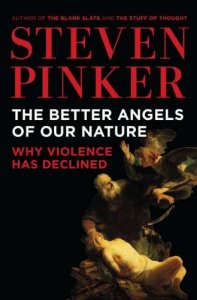
Still working my way, slowly, through Steven Pinker’s THE BETTER ANGELS OF OUR NATURE. In Chapter 4, The Humanitarian Revolution, he discusses various kinds of violence over human history, beginning with human sacrifice, and then to violence “against blasphemers, heretics, and apostates”. I found this paragraph striking and typed it out. (page 149)

People become wedded to their beliefs, because the validity of those beliefs reflects on their competence, commends them as authorities, and rationalizes their mandate to lead. Challenge a person’s beliefs, and you challenge his dignity, standing, and power. And when those beliefs are based on nothing but faith, they are chronically fragile. No one gets upset about the beliefs that rocks fall down as opposed to up, because all sane people can see it with their own eyes. Not so for the belief that babies are born with original sin or that God exists in three persons or that Ali was the second-most divinely inspired man after Muhammed. When people organize their lives around these beliefs, and then learn of other people who seem to be doing just fine without them – or worse, who credibly rebut then – they are in danger of looking like fools. Since one cannot defend a belief based on faith by persuading skeptics it is true, the faithful are apt to react to unbelief with rage, and may try to eliminate that affront to everything that makes their lives meaningful.

“Since one cannot defend a belief based on faith by persuading skeptics it is true, the faithful are apt to react to unbelief with rage, and may try to eliminate that affront to everything that makes their lives meaningful.”

\\

I just acquired a new book by Tim Crane, THE MEANING OF BELIEF, about which I blogged a week ago about a New York Times Book Review review. The book is petite, smaller than a standard hardcover, with under 200 pages of text. The prose is carefully worded, as written by a philosopher, careful to define his terms and qualify his claims. Crane’s stance is that he doesn’t dispute the issues discussed by the ‘New Atheists’ — Sam Harris, Richard Dawkins, Daniel Dennett, Christopher Hitchens, as well as A.C. Grayling — but wants to understand, even if the cosmological claims of religions are easily dismissed, why and how religion forms such a fundamental part of the human experience. So I am on his side; my discussions in this blog, about books by E.O. Wilson and Jonathan Haidt and many others, are more to try to understand the human experience, than to dismiss religious claims (which is easy). My theme is the disconnect between human nature, human perception of the universe, how those are understood as protocols for human survival, in a natural selection sense; and what is actually real about the universe, that vast universe we can barely perceive and which is so much more vast than anything imagined by the ancients.

So… here’s Tim Crane’s definition of religion. He waffles for a few pages before realizing he has to define his central term in some sense, before he can write a book about it. Page 6:

Religion, as I am using the word, is a systematic and practical attempt by human beings to find meaning in the world and their place in it, in terms of their relationship to something transcendent. This description has four essential elements: first, religion is systematic; second, it is practical; third, it is an attempt to find meaning; and fourth, it appeals to the transcendent.

He goes on to expand on each of these elements, in this first chapter, and in later chapters.

Posted in Book Notes, Quote at Length, Religion | Comments Off on Pinker and Crane: Quotes and Comments about Faith and Religion

Links and Comments: Fake News and the Narrative Bias

Tuesday’s New York Times Science Section has an article by Benedict Carey called How Fiction Becomes Fact on Social Media (it was posted several days ago online). Among the endless stories about fake news and books about the human mental bias towards understanding everything as *narrative*, this one combines these themes with close examination about how (deliberately promoted) fake news on social media spreads so readily.

Yet the psychology behind social media platforms — the dynamics that make them such powerful vectors of misinformation in the first place — is at least as important, experts say, especially for those who think they’re immune to being duped. For all the suspicions about social media companies’ motives and ethics, it is the interaction of the technology with our common, often subconscious psychological biases that makes so many of us vulnerable to misinformation, and this has largely escaped notice.

and:

For one, the common wisdom that these rumors gain circulation because most people conduct their digital lives in echo chambers or “information cocoons” is exaggerated, Dr. Nyhan said.

In a forthcoming paper, Dr. Nyhan and colleagues review the relevant research, including analyses of partisan online news sites and Nielsen data, and find the opposite. Most people are more omnivorous than presumed; they are not confined in warm bubbles containing only agreeable outrage.

But they don’t have to be for fake news to spread fast, research also suggests. Social media algorithms function at one level like evolutionary selection: Most lies and false rumors go nowhere, but the rare ones with appealing urban-myth “mutations” find psychological traction, then go viral.

Psychological traction — that is, the appeal to the narrative bias, that there must be some hidden order to the world, that your side is right and that the other side is irredeemably evil, and so on. Thus the appeal of conspiracy theories; social media exacerbates them through repetition.

Over time, for many people, it is that false initial connection that stays the strongest, not the retractions or corrections: “Was Obama a Muslim? I seem to remember that….”

In a recent analysis of the biases that help spread misinformation, Dr. Seifert and co-authors named this and several other automatic cognitive connections that can buttress false information.

Another is repetition: Merely seeing a news headline multiple times in a news feed makes it seem more credible before it is ever read carefully, even if it’s a fake item being whipped around by friends as a joke.

Posted in Narrative | Comments Off on Links and Comments: Fake News and the Narrative Bias

Links and Comments: Philip Pullman meets Matthew Hutson

There was a big profile of Philip Pullman in the New York Times Magazine a couple weeks ago– Philip Pullman Returns to His Fantasy World — on the occasion of the first book in his new trilogy that parallels his acclaimed His Dark Materials trilogy published from 1995 to 2000.

I was struck by this passage, not about by the discipline of writing three pages a day, but for the superstitious rituals Pullman indulges in — this from an author who’s an atheist and whose His Dark Materials trilogy was famously anti-religion…

Every day from roughly 10 until 1, Pullman sits at his desk in a monkish study at the top of the house and produces three pages, longhand. He has written three pages a day ever since he started writing. Habit, he is fond of saying, has written far more books than talent. The ritual is sacred. As is the space. “Nobody’s photographed this, and nobody will ever photograph this,” he told me, both fierce and faintly amused by the severity of his own rule. “I’m superstitious about that, very superstitious about that.”

Arranged on the desk are various objects of mystical significance. “I write more easily, more comfortably, with less anxiety if I’ve got my various magic bits on the table,” he said. The magic bits consist of a piece of scientific apparatus used in the search for dark matter, a magnifying glass and his “special pen.” Pullman has three special pens — Montblanc ballpoints — one in his study, one in his bag and one on the table downstairs for letter writing and signing books that people bring to his door (“which sometimes happens”). There is special paper, too: “I started ‘His Dark Materials’ on the sort of paper you could get 30 years ago, A4, narrow-lined, with two holes. Then they started making paper with four holes, and I discovered I couldn’t write on that.” He acknowledged with a brief apologetic glance the lunacy of this statement. “This is what I did that’s even more bonkers. I had to finish ‘The Amber Spyglass,’ and I could only get four-hole paper, so I got some four-hole paper and some of those little white stickers and solemnly put them over the holes.” Eventually, he found a Canadian supplier selling his preferred, two-holed paper. “I’ve got enough for 10,000 years, I think.”

Pullman likes to inhabit such contradictions: a man who doesn’t believe in God but does believe in magic. One of his favorite books is “The Secret Commonwealth,” by a 17th-century Scottish minister, Robert Kirk, that explores life beyond empirical reach. Fairies, witches, ghosts. Does he really believe in these things? “When I’m writing about them, yes,” he said. “It’s not naïve, but the sort of answer it requires is one of the Keats type. The negative-capability type. Both believing and not believing. Skeptical about everything but credulous about everything, too.” He gets the kind of kick out of unreality that could be dismissed as childlike if it hadn’t molded his imagination. “I like the irrational, I like ghosts,” he said. “They help me to write.”

This is a perfect example of the attitude captured by Matthew Hutson’s 2012 book The 7 Laws of Magical Thinking, subtitled “How Irrational Beliefs Keep Us Happy, Healthy, and Sane.” Hutson’s thesis is that we can understand how the human mind is given to various beliefs that, with our emperical, logical hats on, we understand are irrational, i.e. not real — but how nevertheless if we indulge indirectly in some of those beliefs, they make us happier and more productive and less stressed. This works because our minds are not computers that can be entirely disciplined by logic; our minds have evolved over millennia to make us efficient at surviving in the natural world in which we need to get along with our fellow humans, and perceive that world in a way that encourages us to behave in ways that lead to reproductive success.

So: you are not a single mind. You can understand that, to take a trivial example, the piano that John Lennon composed “Imagine” on isn’t really different from any other piano — it doesn’t retain any kind of ‘essence’ of John Lennon from his having played it — but if it is awesome to you to go out of your way to be in its presence, go for it. You will be happier. (This is the first of dozens of examples in Hutson’s book.) Pullman’s mystical objects are another example. You are many minds. If your logical rational mind needs to assuage its magical-thinking counterpart of its doubts, that logical rational mind might well be more productive.

The chapter headings of Hutson’s book are an all-time hits list of categories of human mental biases, or ‘magical thinking’, about things that are objectively not true:

1, Objects Carry Essences: Cooties, Contagion, and Historicity
2, Symbols Have Power: Spells, Ceremonies, and the Law of Similarity
3, Actions Have Distant Consequences: Using Superstition to Make Luck Work for You
4, The Mind Knows No Bounds: Psychokinesis, ESP, and Transcendence
5, The Soul Lives On: Death is Not the End of Us
6, The World Is Alive: Animals, Objects, and Gods are People, Too
7, Everything Happens for a Reason: You’ve Got a Date with Destiny

Posted in Atheism, MInd | Comments Off on Links and Comments: Philip Pullman meets Matthew Hutson

Links and Comments: Reviews of Books about Religion and Science

NY Times: “Ivory Tower” column review of three university press books on religion: Unknown Unknowns: Three Inquiries Into Religion, by James Ryerson.

The most interesting of the three seems to be the first, Tim Crane’s THE MEANING OF BELIEF: Religion From an Atheist’s Point of View (Harvard University, $24.95).

Crane proposes to paint a more accurate picture of religion for his fellow unbelievers. Religion is an immense, sprawling and variegated affair. Any attempt to define it, however comprehensive, will omit some aspects, and most attempts to define it, however crude, will capture something. The name of the game is what you see as central. Crane resists the notion, common to combative atheists, that the core of religion is an archaic cosmology (beliefs about things like the origin of the universe and supernatural agents) grafted onto a moral code. If you conceive of religion this way, as bad science plus arbitrary injunctions, of course you will think it should be replaced by good science and rational ethics.

For Crane, the religious worldview is better understood as the combination of two attitudes. First: a sense of the transcendent, of an unseen moral order to the universe, often known as God. Second: an identification with a community that tries to “make sense of the world” by attempting to bring its members into alignment with this moral order through a tradition of narratives and rituals. Crane concedes there is a cosmology here; a belief in the transcendent is “a claim about the universe.” He also grants that religion, like science, is trying to explain things. But the kind of explanation and the kind of cosmology offered by religion, which does not “expect all aspects of the world to be intelligible,” are nothing like those of science, which strives to eliminate mystery.

Of course there are zealots who do take “archaic cosmology” seriously and cannot be swayed by modern evidence; they are in part suspect to the bias that ancient authorities (scripture writers, founding fathers) contained some kind of wisdom that can never be recaptured or challenged. (They are like children, or patriots, who forever believe their home town team, and their home town, are the bestest ever.) But I’m sympathetic to the view that, for some people at least, religious isn’t about archaic cosmology, but about that sense of community and shared values.

\\

From the week before, in the NY Times Book Review, Marilynne Robinson, a midwest novelist known for deeply felt family portraits saturated by religious sensibility (e.g. Gilead) reviews a nonfiction book by Stephen Greenblatt called The Rise and Fall of Adam and Even, a cultural history of that iconic couple. Online the review is called The Truth and Fiction of Adam and Eve; in print it was “Almost Paradise: A cultural history that traces the path of the first man and woman.”

I’ve glanced through Greenblatt’s book, and he admits he is not a believer in a literal Adam and Eve, and Robinson takes issue with this.

There is, however, a complicating factor here, having to do with the question of truth. Greenblatt, an English professor at Harvard University and author of the National Book Award-winning “The Swerve,” frames his inquiry in terms of truth or fiction. For him truth means plausibility, and by that measure the story of Adam and Eve is no more than a miracle of storytelling. But science tells us that Homo sapiens does indeed roughly share a single lineage, in some sense a common origin, just as ancient Genesis says it does. In the Hebrew Bible the word adam often means all humankind, mortals. Greenblatt never seems to consider why the myth might have felt so true to those who found their religious and humanist values affirmed by it — and their own deepest intuitions, which science has partly borne out. It is interesting that those who claim to defend the creation narrative from rationalist critiques ignore the fact that its deepest moral implications, a profound human bond and likeness, have been scientifically demonstrated.

Nonsense. This reminds me of the many Biblical apologists who perceive any scientific discovery that they can match to any passage in the Bible, no matter how brief or how weirdly interpreted, to claim that science proves the Bible. Robinson is a better writer than those apologists, but her reasoning is just as flawed.

\\

From NYTBR a month ago, a short review by Christopher Chabris of four books about decision making, including Andrew Shtulman’s SCIENCEBLIND: Why Our Intuitive Theories About the World Are So Often Wrong

You’ve probably heard that we only use 10 percent of our brains. You might also know that this is a famous or even infamous scientific myth — no more than a scientific urban legend. But why do so many people believe it when the experts don’t? It’s one of many instances in which people resist scientific understandings in favor of imprecise, inaccurate, or just plain wrong theories about how nature works.

The problem — as Shtulman, a developmental psychologist, cogently explains — is that new knowledge doesn’t erase old misconceptions the way a software upgrade deletes the previous code. Instead, different theories coexist within our minds, and compete to explain the world. We may have been taught about plate tectonics and biological evolution, but we still sometimes act as though the earth and its occupants have always been the way they are now, and thus will stay that way in the future.

This appeals to my whole notion of ‘intuitive science’ which in turn explains why scientific accuracy in most movies, and even some literary SF, is egregiously wrong. Because our sense of the how the world works is based on our experience, over our entire evolutionary history, which how that world works within one tiny slice of experience, and it doesn’t translate to, say, outer space.

Posted in Religion, Science | Comments Off on Links and Comments: Reviews of Books about Religion and Science

Links and Comments: An Abortion Thought-Experiment, and Conservative Thinking

Salon: The Twitter thought experiment that exposes “pro-life” hypocrisy. Subtitle: “Comedian and sci-fi writer Patrick Tomlinson on the dangerous question that abortion foes refuse to answer”

Last Monday, a tweetstorm eviscerating abortion foes went viral. Science fiction writer and comedian Patrick Tomlinson introduced it this way:

Whenever abortion comes up, I have a question I’ve been asking for ten years now of the “Life begins at Conception” crowd. In ten years, no one has EVER answered it honestly.

The question is as follows: Would you save one 5-year-old child from a burning building, or save 1,000 embryos. The point: No one actually thinks that embryos are the same as living children. But an entire movement is based on lying about it, and using that lie to manipulate people, in order to control women like slaves.

The balance of the Salon article consists of an interview Tomlinson (whose work in SF I am not familiar with), from which I noticed a couple passages in particular. First, Tomlinson claims he never got a straight answer to his thought-experiment — but he did get personal attacks against him:

If no anti-choicer could answer the question Tomlinson posed, they could still respond — with everything from death threats to a DDOS attack on his website. Which only proved his point: They can’t handle the truth. And they desperately need to protect the lie, as if their very lives depended on it.

(The more interesting questions is: why do some people “desperately need to protect the lie”? I think I know; it’s been a theme in this blog.)

And, discussing the classic conservative movement,

The intellectual foundations of the movement is described by people like Edmund Burke or Oakeshott. They conceived of conservatism as a counterweight to the utopian impulses of the left. Progressives in England at the time — which is where both those men originated — were very much about legislating away human vice. They were like, we can fix all the problems of humanity through the power of government. The conservative movement had its intellectual roots as a pushback against that impulse, saying, “No, we have to base this on facts. We have to base this on logic and evidence. We have to base this on real-world examples, and we have to adapt policies to human nature, instead of assuming human nature can be adapted by policy.” And that’s what I say when I say I’m a conservative, which is what the word meant for more than 100 years, before it was co-opted by the extreme religious right in our country.

I was just reading about Burke in the Steven Pinker book I’ve been reading; Pinker contrasts the values of the Enlightenment with Burke’s “tragic view of human nature,”

In that vision, human beings are permanently saddled with limitations of knowledge, wisdom, and virtue. People are selfish and shortsighted, and if they are left to their own devices, they will plunge into a Hobbesian war of all against all. …

And so on. (Pinker p184) Pinker goes on to reflect how extreme visions of human nature — “a Tragic visions that is resigned to its flaws, and a Utopian vision that denies it exists — define the great divide between right-wing and left-wing political ideologies.” (p186)

This recalls one of the earliest sea changes in my own life’s thought — how in the 1970s it was widely thought, especially by those promoting various civil rights movements, that there was no psychological or mental difference between men and women. Give boys and girls equivalent experiences and toys, and they will not grow up into familiar masculine and feminine stereotypes. That turned out simply not to be true, as I learned beginning with E.O. Wilson’s ON HUMAN NATURE; there are in fact differences between the sexes, differences which moreover are entirely understandable via evolutionary psychology and the taking into account of the differing reproductive strategies of males and females.

The long-term problem with the conservative movement, it seems to me, is by clinging to its perception of an essentially flawed human nature, it does nothing to overcome base tribalism and hostility toward others, and a supernatural perception of the world which is objectively false. The better understanding of human nature is, again, an inescapable conflict and see-saw balance between individual, ‘selfish’ desires, the result of individual natural selection, and altruistic desires that are the result of group selection, as Wilson describes in recent books; and the innate variability of human mental perception that manifests itself in the range of personality types along the axes of Haidt’s moral foundation theory (cf.). These insights tie in nicely with Pinker’s ongoing (as I read) description of the ‘Civilizing Process’ and the ‘Humanitarian Revolution’, in which the former desires are gradually tempered by the latter, as groups of human gather and co-depend on larger and larger groups. The rule of law (‘Leviathan’ Pinker calls it) is part of it, but so is the increased empathy of individuals necessary to get along in a large community of people different from oneself. (This is one reason why everything Trump is doing is wrong. The future harmony of the world, the avoidance of nuclear war and the stewardship of the planet, does depend on international political alliances, trade agreements, and scientifically-based revision of our industrial and technological policies.)

Back to Tomlinson:

The attacks are meant to silence and intimidate, in order to preserve the status quo of the conversation and the underlying power dynamic. The nominal right wing has long positioned itself as the true arbiter of absolute morality, patriotism, fiscal responsibility, respect for the troops, defenders of life, liberty, yada yada. It lets them set the parameters and tone of public debate.

Never mind that in literally every instance, their claims to ethical and moral authority are laughably false. “Conservatives” are responsible for installing a Russian traitor in the White House, exploding the deficit under Bush II (which Obama cut by a trillion dollars, with a T) and refusing funding for the VA to handle the surge in wounded veterans that resulted from their wars of choice. They have relentlessly attacked the gains we’ve made in health care coverage and the uninsured rate with the ACA, and on and on.

With many examples around every corner:

https://www.vox.com/2017/10/22/16516184/trump-tax-reform
https://www.salon.com/2017/10/22/dumb-and-dumber-trumps-foreign-policy-repeats-decades-of-american-mistakes/
http://www.patheos.com/blogs/friendlyatheist/2017/10/21/trump-administration-pushes-abstinence-and-rhythm-method-over-contraception/

Conservatives, it seems to me, are people who refuse to learn, or benefit from others’ experience. They just *know* what should be so.

Posted in Conservative Resistance, Culture | Comments Off on Links and Comments: An Abortion Thought-Experiment, and Conservative Thinking

Steven Pinker’s THE BETTER ANGELS OF OUR NATURE, Chapters 2 and 3.

More on Steven Pinker’s magisterial 2011 book, The Better Angels of Our Nature: Why Violence Has Declined — one of the best books of the 21st century, surely — that takes a long-range view of human history to show that the human condition, over millennia and especially in recent centuries and decades, has vastly improved in terms of the reduced likelihood of any person dying of violence, and thus the betterment of the human condition.

(Earlier posts on this book here and here)

A bit more on Chapter 1: A Foreign Country

  • The medieval knights – like those in Camelot – were set in the 6th century, via stories written in the 11th to 13th. The stories recount extreme violence every few pages – skulls split, decapitations, etc. etc. Lancelot was regarded as a ‘gentleman’ for never killing a knight who begged for mercy.
  • The realm of early modern Europe, its kings and queens, includes beheaded queens and other murders among family members, as recounted in Shakespeare. Grimm’s fairy tales include at least three stepmothers who attempt to murder their children. Punch and Judy were a famous puppet act, featuring infanticide and murder. Even Mother Goose, in the 17th and 18th centuries, features traumatic violence of a sort that wouldn’t be tolerated today.
  • ‘Honor’ later involved duels, as that of Alexander Hamilton, who died in one. Dueling is an example of a behavior that persisted for centuries, before abruptly vanishing, and becoming subject to ridicule, p23t.
  • In the 20th century we’ve seen a decline in martial culture – e.g. the flaunting of public works of military men, the naming of subway stops for military battles, etc. In contrast, modern memorials to wars more often list names of the victims.
  • Even nuclear weapons were glamorized in the 1950s, via names like ‘bikini’ and the design of toys and cafes. Everyday force was common – men engaging in fistfights; Truman threatening a critic with a black eye; Charles Atlas ads. [[ and Star Trek!! In the 1960s, patterned after TV Westerns of the time, with stories that routinely included fistfights, a feature IIRC absent from TNG just two decades later. ]]
  • 1950s TV featured spousal abuse; ads implied it; a song in (the very famous stage musical) The Fantasticks was all about rape.
  • Children were spanked, now rare.
  • P28-29, author imagines a speech given in 1976 that promised a peaceful future – in which he would likely not be believed.

TL;DR summary of detailed notes below:

Chapter 2: Pinker describes the “Pacification Process,” in which the violence that arose in the human species (comparing how violence is carried out by chimps) was mostly deployed for strategic reasons: competition with other tribes; as a means of discouraging attack by others; and to promote individual and tribal glory, which is a means of demonstrating ‘credibility,’ i.e. the promise of effective response to attacks.

Hobbes’ solution was the “Leviathan,” the idea of a government of some sort that has a monopoly on the use of force. And this is more or less what happened, the Leviathan brought about by the historical forces of growing population and the agricultural revolution.

Chapter 3: And then, the “Civilizing Process”: Evidence shows violence in cities is lower than in rural areas, that the trend toward urbanization and cosmopolitan life encouraged decreased violence. Pinker describes medieval life, etiquette manuals, how primitive cultures of honor gave way to culture of dignity, from the 11th to 18th centuries, as people adopted greater self-control and empathy and in order to live together and larger and larger groups.

There have been aberrations, like World War II. And violence is still more common among lower classes (who feel themselves out of touch with the local ‘Leviathan’ or government) and in remote areas or the world.

And then Pinker explores why violence increased in the 1960s, and then decreased again the 1990s, with some startling insights into the red vs. blue state divide in the US, and why the apparently coarse culture in contemporary US is a sign of progress, not social decay.

\\

Detailed notes with quotes:

Chapter 2, The Pacification Process

  • Hobbes and Darwin both provided insights into the origins of violence.
  • Darwin’s theory has (since his day) been extended with genetics and game theory, e.g. Dawkins characterization of animals as ‘survival machines.’ His analysis indicates however bloody animals may attack each other, it’s for strategic reasons, p33t – only when it would benefit them.
  • Hobbes, in contrast, supposed that it was inherent in man to quarrel, for three reasons: competition; diffidence [i.e. fear of being attacked]; and glory. We understand today why wives would be subject to competition, because of different investments of men v women. The idea of glory, or honor, is best thought of as ‘credibility’ p34.8. The security trap is solved via deterrence, e.g. MAD during the Cold War. We also understand now how “a major design feature in human nature, self-serving biases, can make each side believe that its own violence was an act of justified retaliation while the other’s was an act of unprovoked aggression.” P34b. (later, p46.5 characterizes these three reasons as gain, safety, and credible deterrence.)
  • But Hobbes wrote of anarchy; his solution was ‘Leviathan,’ a government of some sort that has a monopoly on the use of force. Law is better than war; see diagram 35b.
  • In contrast to Hobbes was Rousseau who thought primitive savages innocent and gentle.
  • The debate between the two viewpoints became political in the 20th century, with liberal ideals preferring Rousseau. But neither had any evidence. We can do better, by examining rates of violence in societies that live under a Leviathan, and those that live in anarchy.
  • P36, Violence in human ancestors
  • We can start by examining chimps, with whom we share a common ancestor. Jane Goodall observed how gangs of chimps attack each other, especially isolated males; kill others’ offspring, and so on p37-40
  • Our own species is about 200,000 yrs old, behaviorally modern for 75,000 yrs, and only for the past 10,000 yrs has lived in “stratified societies numbering in the millions, eat foods cultivated by agriculture, and are governed by states” p40b. But that 10K boundary marks only the earliest societies that farmed; some areas took much longer. Nor are societies only hunter-gatherer, or agricultural; many are a blend. True states didn’t appear until 5,000 years later.
  • It was long thought that nonstate societies were ferocious barbarians. Evidence shows same kinds of raids and battles that chimps engage in; plenty tales of savagery, to p56, even cannibalism. Three reasons; most commonly for vengeance, as deterrence against other attacks.
  • Rates of violence: it’s important to discuss how rates of violence in a population are significant, not absolute numbers. Then follow several pages of charts and discussion, e.g. p49, showing very high rates among prehistoric sites, and contemporary hunter-gathers, and very low ones in modern centuries.
  • P56, so was Hobbes right? In part. Even in such states, life is peaceful most of the time.
  • Why did our ancestors leave Eden? 57m. It might not have been a choice: growing population required agriculture, even if early settlements (as in the Bible) involved “totalistic ideologies and brutal punishments” p57.8
  • And complex societies are more likely toward other problems… p58.3: “People were less likely to become victims of homicide or casualties of war, but they were now under the thumbs of tyrants, clerics, and kleptocrats…”

Ch3, The Civilizing Process

  • Author tells anecdote about growing up, and how he never understood the rule about not using one’s knife to scoop peas onto one’s fork.
  • Now he understands, due to the work of Norbert Elias, who published a book in 1939 called The Civilizing Process (from which chapter title is taken).
  • Later, in 1981, someone plotted historical rates of homicide in Europe, from 1200 to 2000 – figure on p60 – showing great declines, by close to a factor of 100. Despite stereotypes about the idyllic past…
  • Further data confirms the trend, and in other European regions. It seems that urbanization made life safe – not more dangerous! Quote p64b:
    • “Is it your conviction that small-town life, centered on church, tradition, and fear of God, is our best bulwark against murder and mayhem? Well, think again. As Europe became more urban, cosmopolitan, commercial, industrialized, and secular, it got safer and safer.”
  • Back to Elias—he started by analyzing 15th-century drawings of medieval life (p65,66)—showing various depravities and acts of violence, as seen through the eyes of a knight.
  • Knights of that time were what we would today call warlords. Quotes from Barbara Tuchman (from her popular book on the 14th century), with examples of violent games and the routine idea of cutting noses off.
  • Tuchman and others note how the temperament of medieval people was childlike, impulsive, uninhibited.
  • Elias also examine etiquette manuals, e.g. long lists of rules about bathroom issues, manners at the dinner table, and so on –p69ff – issues we expect 3-year-olds to understand today; but these were written for adults!
  • They were all about: control your appetites; delay gratification; consider the sensibilities of others; don’t act like a peasant; distance yourself from your animal nature. (p71t)
  • They were about shame—not hygiene, which wasn’t then understood in modern terms.
  • There are remnants of these changes in the language; there were rules about using knives, not displaying them too casually; even taboos about their use—including a rule about pushing food around. Aha! P72.5
  • So Elias’ theory is that, over a span of centuries from the 11th to the 18th, a culture of honor gave way to a culture of dignity; people became socialized at younger ages. Two trends: self-control; and empathy.
  • Critics of Elias note that all societies have ‘standards of propriety’… and Elias conceded that there “is no zero point”, i.e. there was no baseline with no standards at all.
  • Elias proposed two ‘triggers’ for this change. First, the consolidation of a genuine ‘Leviathan’, i.e. centralized monarchies after centuries of feudal baronies and fiefs. Monarchs discouraged fighting among the knights, because they caused losses. Homicide became a state matter. Fealty to monarchies entailed courtly manners; courtesy. Thus those etiquette guides. And the military revolution, with the invention of gunpowder, and the necessity of state to support expensive technologies.
  • Second, economic revolution, hobbled by Christian resistance to commerce, that money was evil etc., p75b. Thus the Jews become the moneylenders! And business developed positive-sum games; the trading of surpluses; keying off evolutionary psychological insights about sympathy, trust, gratitude, guilt, anger, p76m.
  • Thereby came divisions of labor; a network of transportation; and idea of money, to replace barter. [[ need to compare Harari, whose notion is that money was one of the key ideologies (he even calls them religions – i.e. an agreed-upon shared belief that something that didn’t physically exist, nevertheless existed ]]. All of this summarized as ‘gentle commerce.’
  • In a sense both of these – Leviathan, and gentle commerce – were part of a single organic process; and here Pinker explicitly cites Robert Wright’s Nonzero, p78.6
  • Elias’ theory made a prediction that turned out to be true: that rates of violence did drop, over that period.
  • So what about World War II? Well, that was different; it wasn’t a retreat to feudalism or anything of the sort.
  • Pinker acknowledges libertarian skeptics who point out how norms of cooperation develop anyway, e.g. with example of the sailors in Moby-Dick. Author points out that even these live with the ‘shadow’ of Leviathan – another example of ranchers in northern California. Minor disputes would be solved by their culture of honor; yet serious disputes would accede to governmental oversight.
  • There are two rule-proving exceptions to this trend of decreasing violence over history: lower classes, and isolated areas of the world.
  • Violence was once common among aristocrats (e.g. Romeo & Juliet opening) but is now virtually zero. Violence still persists among lower classes, but mostly as a pursuit of justice, as a reaction against insults, unfaithful partners, etc., feeling themselves stateless out of reach of legitimate government.
  • Second, the civilizing process began in western Europe and spread outward; mountainous regions, e.g. Scotland and Ireland, remained violent longer. We don’t have comprehensive data about trends in much of the world; WHO data p88. But recall anecdotes about how the Chinese don’t allow knives at the dinner table at all – food is cut into bite sized pieces in the kitchen (of course!) – suggesting a similar pattern of increased etiquette that paralleled a gradual decline of violence.
  • And violence rises in former colonies as they go independent (and government oversight loosens or withdraws).
  • P91 What about the US? Why is violence in the US so high compared to Europe? It’s not just the effect of having more guns; US is more violent even when the effects of gun are taken away (i.e. violence due to knives, etc. etc.)
  • The answer is that the US is really three counties. Violence is higher in southern states, in part due to the legacy of the civil war, and the origin of immigrants – many Scots and Irish settled the South. Violence is higher among blacks, because they are more likely lower class.
  • In a sense democracy came too early to the US, with its 2nd amendment established before civilizing effects had taken place. Thus the South developed a culture of honor—promises of personal retribution for disputes, rather than an appeal to law. Recall Daniel Boone, Davy Crockett, the Hatfields and the McCoys. Southern states give a person wide latitude to kill in defense of property, have fewer gun restrictions, etc., 99b. Yet is there an exogenous cause? Again, the Scots and Irish were herders, and herders around the world depend on this kind of culture of honor to protect their assets.
  • Then there’s the American West, p102, with its cowboys, miners, and so on. Here the reason was the preponderance of men, who with the alternatives of beings ‘cads’ vs. ‘dads’, more often acted the former. The west was tamed by the eventual influx of women, and temperance movements to restrain alcohol. The marriage effect is well-known among sociologists as a civilizing effect on men. P106
  • Here Pinker summarizes with a cogent conclusion of these trends to explain the current blue vs. red state divide in the US:

“An appreciation of the Civilizing Process in the American West and rural South helps to make sense of the American political landscape today. Many northern and coastal intellectuals are puzzled by the culture of their red state compatriots, with their embrace of guns, capital punishment, small government, evangelical Christianity, “family values,” and sexual propriety. Their opposite numbers are just as baffled by the blue staters’ timidity toward criminals and foreign enemies, their trust in government, their intellectualized secularism, and their tolerance of licentiousness. This so-called culture war, I suspect, is the product of a history in which white America took two different paths to civilization. The North is an extension of Europe and continued the court- and commerce-driven Civilizing Process that had been gathering momentum since the Middle Ages. The South and West preserved the culture of honor that sprang up in the anarchic parts of the growing country, balanced by their own civilizing forces of churches, families, and temperance.”

  • Then what happened in the 1960s? Both the US and Europe, rates of violence went up; murder rates per 100,000 from 4 in 1957 to 10.2 in 1980, and 72 among blacks. The trend was depicted in popular culture, with TV and movies focused on urban violence. Conservatives won elections by being “tough on crime.”
  • Various solutions have been proposed. Partly it was an effect of baby boomers, a growth in the population of young people, especially in proportion to older people. Also their connection in an age of TV (when everyone watched the same three networks) and the transistor radio, a shared culture brought about a feeling of solidarity among that generation. And increased democracy brought about an ‘informalizing process’ 109b, affecting dress and manners.
  • Also, the ‘establishment’ became blotted with moral stains: the threat of nuclear war, poverty, mistreatment of native Americans, the Vietnam war, the oppression of women and homosexuals.
  • These currents pushed back against elements of the ‘civilizing tide’—self-control relaxed, so that “if it feels good, do it”; and the idea of interdependency eroded, thus the “rolling stone”, and “tune in, turn on, drop out” and many similar notions in song lyrics and movie scenes.
  • Along with these, reaction against the ideal of marriage and family life, which became Ozzie and Harriet corny. Hippies flaunted standards of cleanliness and continence. They threw away their watches; no one cared what time it was. Rock musicians smashed guitars on stage, events that at times spilled over into interpersonal violence.
  • So: were the reactionaries who vilified rock music right?
  • Not exactly. There were other trends. Criminal justice relaxed, and elites found Marxism fashionable to the point of excusing some kinds of violent protest. Law enforcement retreated; people abandoned city centers for the suburbs. And the sexual revolution left young men without the responsibilities of marriage and family.


  • And then in the 1990s the trend in violence reversed, returning to 1950s level, and even below. No one predicted it, and still there is no simple explanation.
  • One idea, promoted by the authors of Freakonomics, was that availability of abortions in the ‘70s led to the non-births of unwanted children, who otherwise might have grown up lawless. But studies, and actual data, don’t support the theory. (E.g. the women who do have abortions are more likely to plan for the future; those who don’t are more likely to have children who don’t and who are the irresponsible ones more likely to commit violence.)
  • Rather, there were two areas of causes. First, ‘Leviathan’ became more effective; second, the civilizing process was restored.
  • First: incarceration rates increased, perhaps more than it should have, but this removed from the general population those most likely to commit violence. (Canada didn’t, and their violence rate declined too, so this is only part of the explanation.)
  • And police forces expanded, aligned with the popular ‘broken windows’ theory that encourages good behavior if minor problems around neighborhoods are addressed. Experiments support it. [[ This recalls such mental biases as the anchoring effect, and priming. ]]
  • Second, norms changed. Some of the radical ideas of the ‘60s lost their appeal. Civil rights movements made law and order a progressive movement, not just a reactionary one.
  • And some communities organized women and church groups to break up gangs and encourage good behavior, e.g. in Boston.
  • And a change in punishment strategy made it not so random and more predictable, in ways that appeal to our psychology, 126.7.
  • And there were prominent rallies, the Million Man March and Promise Keepers, which may have had positive effects despite their “unsavory streaks of ethnocentrism, sexism, and religious fundamentalism…”
  • Pop culture, it’s notable, is still decadent – violence in movies, in video games, pornography, is as common as ever. The difference is now people treat it ironically, post-modernly. People indulge in counter-culture looks without adopting unconventional lifestyles.
  • This might be a sort of ‘third nature’, following the first two; we consciously reflect on cultural norms to decide which are worth adhering to, and which have outlived their usefulness. Further, we can *afford* to indulge in ‘decadent’ behavior – swearing, very casual dress – because those things are no longer true indicators of cultural decay.

This last point is startling. It’s commonly thought that contemporary culture is coarse and degraded, in that profanity is more commonplace (even in staid print publications) and fashion is sloppy and lascivious, compared to say the 1950s. Pinker suggests how the opposite is true; I’ll quote in detail, from p128:

If our first nature consists of the evolved motives that govern life in a state of nature, and our second nature consists of the ingrained habits of a civilized society, then our third nature consists of a conscious reflection on these habits, in which we evaluate which aspects of a culture’s norms are worth adhering to and which have outlived their usefulness. Centuries ago our ancestors may have had to squelch all signs of spontaneity and individuality in order to civilize themselves, but now that norms of nonviolence are entrenched, we can let up on particular inhibitions that may be obsolete. In this way of thinking, the fact that women show a lot of skin or that men curse in public is not a sign of cultural decay. On the contrary, it’s a sign that they live in a society that is so civilized that they don’t have to fear being harassed or assaulted in response. As the novelist Robert Howard put it, “Civilized men are more discourteous than savages because they know they can be impolite without having their skulls split.” [And, recalling the anecdote at the beginning the chapter, Pinker concludes] Maybe the time has come when I can use a knife to push peas onto my fork.

(And yes, he’s quoting Conan author Robert E. Howard – see https://en.wikiquote.org/wiki/Robert_E._Howard.)

Posted in Steven Pinker | Comments Off on Steven Pinker’s THE BETTER ANGELS OF OUR NATURE, Chapters 2 and 3.

Silverberg: All Sadnesses Flow to the Sea

The planet cleanses itself. That is the important thing to remember, at moments when we become too pleased with ourselves. The healing process is a natural and inevitable one. The action of the wind and the rain, the ebbing and flowing of the tides, the vigorous rivers flushing out the choked and stinking lakes—these are all natural rhythms, all healthy manifestations of universal harmony. Of course, we are here too. …

This is the opening of a short story by Robert Silverberg, “The Wind and the Rain,” first published in 1973. The early 70s was an era when Silverberg was becoming more experimental with his fiction, both in the way he challenged and subverted some standard science fictional assumptions, and in the way he employed unconventional narrative techniques (some directly inspired from non-sf writers of the time, like Robert Coover).

There’s not so much a traditional beginning-middle-end story here as a gradual revelation of the situation. The narrator is a member of a ‘reclamation team,’ apparently humans from another world who have returned to this ancestral home of humanity, to clean it of the pollutions that destroyed its ecosystem — —“If we were not here at all, the planet would repair itself anyway within twenty to fifty million years. It is estimated that our presence cuts that time down by somewhat more than half.” (Shades of Foundation!)

They inject chemicals into a large river. They don’t have to know what they’re doing; they just follow instructions. They visit Tokyo, and plant trees. They write a poem – a thesaurus section for the word ‘destruction’ – and toss the poem into the river.

They visit Richland, Washington, and admire the ‘comic solution’ of placing nuclear waste near an earthquake fault, where the estimate of safe storage is only a century or so.

In Uruguay, a small village has been preserved under a dome, the dead inhabitants frozen in their positions.

In California, they consider the historical irony of trying to deal with the loss of otters, that used to eat sea urchins, which now unchecked cause the kelp to die; and how treatments for each symptom made the others worse.

They will have to pry up the concrete and metal encasing the planet. (Shades of Trantor!)

The inhabitants used to wear breathing suits. Theological speculation: if created by God, why did God let the planet be ruined? Perhaps the ruined planet is a self-contained artistic achievement.

Is what they do pointless, turning this ruin into just another world? The planet will heal anyway.

Rumors of a live earthman turn up a robot on a Tibetan plateau. They dissect it.

The story ends:

“The wind. The rain. The tides. All sadnesses flow to the sea.”

As Silverberg notes, in his introduction to this story in his COLLECTED STORIES VOLUME 3, the alarm about ecological damage to the planet — which goes back centuries, perhaps — is sometimes misplaced. It’s not about damage to the planet. Indeed, the planet has undergone wild swings of climate change in the past. There have been huge extinction events. The planet recovers. But not most of the species who have ever lived. The damage humans are inflicting — again, that Sixth Extinction — won’t kill the planet, but it might well kill the human race.

I reread a bunch of Silverberg collections, beginning with the earliest, right about a year ago, up through those early ’70s collections, and took many notes. This past week I’ve resumed that attention, rereading a few I read last year but didn’t take notes on, and plan to post a kind of reading log. Let’s see how that goes.

Posted in Robert Silverberg | Comments Off on Silverberg: All Sadnesses Flow to the Sea