Sean Carroll, THE BIG PICTURE

Sean Carroll’s THE BIG PICTURE: On the Origins of Life, Meaning, and the Universe Itself, just published May 10th, is an ambitious, wide-ranging book not so much about cosmology (Carroll’s specialty at CalTech), as about the perspective we gain through cosmology and science in how we view our world and our place in it. Briefly, it’s about how to understand the universe and ourselves in purely materialistic, non-supernatural, terms, and how that’s OK.

The book is divided into six sections — Cosmos, Understanding, Essence, Complexity, Thinking, and Caring — and among those a total of 50 chapters, in about 430 pages of text (so the chapters are relatively short).

The first part defines Carroll’s idea of ‘poetic naturalism’, by which he means that while the world can be understood in purely naturalistic terms, we can use different kinds of ‘stories’ to describe the world at different levels of complexity. He summarizes these on page 20:

Naturalism:

  1. There is only one world, the natural world.
  2. The world evolves according to unbroken patterns, the laws of nature.
  3. The only reliable way of learning about the world is by observing it.

Poetic naturalism:

  1. There are many ways of talking about the world.
  2. All good ways of talking must be consistent with one another and with the world.
  3. Our purposes in the moment determine the best way of talking.

The implications of this approach are straightforward. Yes, everything ultimately boils down to physics, but it makes little sense to speak of biological systems, for example, in terms of general relatively, quantum mechanics, and the Higgs boson. This strategy lets him, for example, discuss the notion of free will, which commentators in recent years (e.g. Sam Harris) almost gleefully like to claim does not exist in the intuitive sense most people share. Maybe so, Carroll says, but those insights are academic; there are still useful reasons to entertain the notion of free will when it comes to discussing human decisions and responsibilities.

I don’t think I’ll outline the entire book the way I often do in this blog, because the author has already done it for me, on *his* blog. But I will add a few words of description for each section.

  • Big Picture Part One: Cosmos. About the nature of reality, the ideas of naturalism and poetic naturalism, entropy and time’s arrow.
  • Big Picture Part Two: Understanding. How we learn about the world, Bayes’ theorm and updating credences, beliefs and doubts, different levels of complexity as ’emergences’, the idea of ‘planets of belief’, ideas of God and the divine, how different we’d expect the world to be if there *were* a God. [Note 1]
  • Big Picture Part Three: Essence. How what we know about the laws of physics rules out the possibility of psychic powers; about quantum mechanics and the Core theory (with, in an appendix, a deconstruction of what he calls The World of Everyday Experience, In One Equation, recently completed by the confirmation of the existence of the Higgs boson); constraints on whatever unknown physics remains to be discovered; the origin of the universe and the cosmological argument [about which Carroll has debated William Lane Craig]; why we can dismiss astrology, and… life after death.
  • Big Picture Part Four: Complexity. How complexity arises in the interplay between entropy and emergence; what life is, and about ATP, and whether metabolism or replication came first; evolution and lack of ‘purpose’ or goal; the fine-tuning argument for god and alternative explanations. [Note 2]
  • Big Picture Part Five: Thinking. About consciousness, Kahneman’s two modes of thinking, the idea that awareness brings about the ability to imagine alternatives [I see a pointer to SF here!]; mental biases; AI consciousness (with example from Heinlein’s Mistress); the mind-body problem; Chalmers’ philosophical zombie [as Robert J. Sawyer imagined in his latest novel]; and free will.
  • Big Picture Part Six: Caring. About morality, and how it cannot be derived from science or pure reason, and how anyway to find meaning in life. [Much like Dan Barker‘s notion; Carroll even quotes Rick Warren as Barker does.] Ending with a list of “Ten Considerations”, things to keep in mind while deciding how we want to live. And how the average human life span consists of three billion heartbeats.

Note 1: Carroll wonders, for example, whether evil, or the absence of evil, would affect the argument for the existence of God, in a Bayesian way. Moreover, it’s easy to imagine other worlds that would better support theism, p147.6: a world where miracles happen frequently; in which all religious traditions around the world come up with the same doctrines; a world in which the world is small, just Earth and the stars above; a world in which religious texts provided nonintuitive scientific information; a world in which humans were apart from the biology of all other creatures; a world in which souls obviously survived after death and communicated with living; a world of the just.

And here is how such ideas inform the thesis of my own contemplated book about science fiction and its intersection with science and naturalism: science fiction supplies grist for the Bayesian mill. Science fiction supplies endless examples of how the universe might be, or could be, different, that undermine the assumptions most people make about the nature of the reality and the presumptions that humans (and the American way of life!) are ordained by some god.

Note 2: Carroll asks, what did theism actually predict about the nature of the universe? A Hebrew dome, a patch of land surrounded by water.

On a related point, the fine-tuning argument keys off the supposed suitability of the universe to support life. This argument would be more persuasive if the universe really were just a patch of land surrounded by a dome of water. In fact, the universe is enormous, really really enormous, and only the most infinitismal portion of it, so far as we can tell, is suitable for life.

—

I’ll go ahead and list his ‘Ten Considerations’, with (glosses) and [a comment or two of my own].

  1. Life isn’t forever. (And that’s what makes it special; eternity would be boring.)
  2. Desire is built into life. (From desire comes caring, and our potential to choose to make the world a better place.)
  3. What matters is what matters to people. (The universe doesn’t care. But we care about it, and ourselves.)
  4. We can always do better. p422b:


    We nevertheless make progress, both at understanding the world and at living within it. It may seem strange to claim the existence of moral progress when there isn’t even an objective standard of morality, but that’s exactly what we find in human history. Progress comes, not from new discoveries in an imaginary science of morality, but from being more honest and rigorous with ourselves…

  5. It pays to listen. (Don’t ignore whatever wisdom might be found in the ancient religions, just because their ontology is obsolete.)
  6. There is no natural way to be. (We are unavoidably ‘natural’, but nature is not a guide.)
  7. It takes all kinds. This insight is new to me, p424b:


    Much of what has been written about the quest to lead a meaningful life has been produced by people who (1) enjoy thinking deeply and carefully about such things, and (2) enjoy writing down what they have thought about. Consequently, we see certain kinds of virtues celebrated: imagination, variety, passion, artistic expression. .. But a fulfilled life might alternatively be characterized by reliability, obedience, honor, contentment… The right way to live for one person might not suit someone else.

    [Of course of course, different strokes for different folks –but it’s striking to realize that the values of people who write about values are the values of writers…]

  8. The universe is in our hands. (At one level we’re all just physics and chemistry, but at another level we’re capable of reflection and making decisions about how to behave.)


    We won’t be able to stave off the heat death of the universe, but we can alter bodies, transform our planet, and someday spread life through the galaxy.

  9. We can do better than happiness. (Is a pill to be perfectly happy the ideal goal? Life is a process, and perhaps a life is better characterized by its achievements than how happy it was.)
  10. Reality guides us. (Beware mental biases that aren’t true but make you happy. It takes effort, but it’s worth it.) 427e:


    We have aspirations that reach higher than happiness. We’ve learned so much about the scope and workings of the universe, and about how to live together and find meaning and purpose in our lives, precisely because we are ultimately unwilling to take comforting illusions as final answers.

The final chapter of the book recounts the author’s childhood churchgoing experience (mine was very similar) and a couple key incidents that triggered his doubt. (Mine were similarly incidental, yet crucial.) Why he prefers wonder over awe. How the universe is intelligible.

And in the final pages, beginning 431.7:

Poetic naturalism offers a rich and rewarding way to apprehend the world, but it’s a philosophy that calls for a bit of fortitude, a willingness to discard what isn’t working…

Facing up to reality can make us feel the need for some existential therapy. We are floating in a purposeless cosmos, confronting the inevitability of death, wondering what any of it means. But we’re only adrift if we choose to be. Humanity is graduating into adulthood, leaving behind the comfortable protocols of its childhood upbringing and being forced to fend for itself. It’s intimidating and wearying, but the victories are all the more sweet.

In summary, this is a book with many familiar ideas from my reading of other books, but which is valuable for assembling them all into one place, and placing them into a coherent, even inspiring, framework, about a non-supernatural understanding of the universe our species lives in. The future of humanity, if we survive, is to acknowledge the reality of our universe, giving up primitive, childish myths that privilege one tribe over another. As an overview of many ideas in a naturalistic framework, as a capture of the best thinking by one of the best science writers on the planet, this is a top shelf book, and highly recommended.
Posted in Atheism, Evolution, Heinlein, Human Progress, Meaning, Morality, Philosophy, Physics, Provisional Conclusions, Religion, Ten Commandments | Comments Off on Sean Carroll, THE BIG PICTURE

Personal History: The Radio at Sunset

I am spending time again exploring my early family history, and my early personal history, as I started about two years ago, before my partner and I began the lengthy process of packing up in SoCal, moving to a new home, and unpacking, and settling, here in Oakland. The last part was here, but more pertinent is part 2, about living in Apple Valley.

Here is one of my earliest memories, from when I was less than 10. In Apple Valley, in the early ’60s, there was one local radio station, KAVR. Every evening, at sunset, they would close their broadcast by playing a recording of the Lord’s Prayer, sung in a magnificent baritone. Today, via Google and YouTube, I have found what that recording must have been: an iconic recording by one John Charles Thomas.

While the sun sets, as the afternoon winds die down, over the desert landscape.

Posted in Personal history | Comments Off on Personal History: The Radio at Sunset

Reading In and Around the Bible: Genesis, part 1

I finished up the New Testament a couple weeks ago, and have notes and comments on those latter epistles, and Revelation. I then circled back to the beginning, to read Genesis itself, rather than merely comments about it, and since it’s fresher in my mind, and arguably more important than the latter books of the NT, I’ll post comments about Genesis now, before catching up on the NT.

Also, I’ve been reading Thomas Paine’s THE AGE OF REASON; more about that later.

Genesis:

  • 1:1, the traditional “In the beginning God created…” is more usually translated, these days as “In the beginning when God created” or even “began to create”.
  • 1:2, note that before “let there be light”, there were waters (over which “a wind from God swept over the face of”). Thus, something existed before God got creation going, it seems. Why is this not generally acknowledged or understood, while everyone who thinks for the universe to exist, something or someone, thus God, must have gotten it going? This passage seems to undermine every claim that for the world to exist, God must have caused it. This passage explicitly describes a world of water before God began his creation.
  • 1:6, and so we live in a dome with waters above and waters below.
  • 1:9, with the waters gathered in one place. One can imagine the limited view of the world of those who told these myths, who might know that the sea was over in that direction (e.g. west) and have no knowledge of any other seas or oceans, let alone the true immensity of the planet.
  • 1:16, “God made the two great lights—the greater light to rule the day and the lesser light to rule the night—and the stars”. This might be plausible if the moon were actually in the sky all night; but of course, on average it’s only in the sky at night half the time. (This reminds me of how often filmmakers depict the moon, for whatever phase its shown in, in the wrong place in the sky. I seem to recall E.T. as sinning in this regard, but I haven’t seen the film in ages.)
  • 1:21, “So God created the great sea monsters…” Sea monsters? KJV says “great whales”. You have to wonder what experience with large sea creatures the tellers of these myths had.
  • 1:26, “Then God said, ‘Let us make humankind in our image, according to our likeness…” People are pleased to think of themselves as the image of the creator of the entire universe (with arms and legs and everything else, presumably). A cat deity would presumably resemble a cat. (Cf. Jerry Coyne’s ‘ceiling cat’, and the poem by Yeats I quoted here.)
  • But a second point about 1:26 is that the phrase “Let us make man in our image” (KJV) or “Let us make humankind in our image” (NRSV) is that the two different words there are translations of the Hebrew word adam -! That is, the first man being called Adam wasn’t necessarily a name given to him, but a generic word for man, or mankind. Looking carefully through the early chapters of Genesis, there is a point at which the first man is referred to as Adam, a proper name, without comment, a rather slippery elision.
  • 1:28, “Be fruitful and multiply, and fill the earth and subdue it; and have dominion…” A useful policy for any group in competition for survival with other groups, or with nature itself. The part about dominion and subduing alas justifies many people’s attitudes that are leading to the extermination of a large proportion of other species inhabiting the planet. (Cf Kolbert’s The Sixth Extinction)
  • 2:4, Here begins the second version of creation. The first one was about the seven days, in which on the fifth day God created humankind of both sexes—“male and female he created them” (1:27). The second version of creation involves shaping the first man out of mud, creating the female from his rib, and planting them in the garden of Eden. Here I pause for some general discussion.

It’s well established by now, well-known by all scholars of the Bible, that the early books of the Bible, perhaps most of the Old Testament, is a collage of writings by different authors over hundreds of years, written hundreds or even thousands of years after the events they purport to record, edited together sometime in the 6th or 5th century BCE. (Cf Who Wrote the Bible?, but Friedman’s 1980s thesis is reflected by Asimov’s volumes and by the Oxford annotators of their NRSV and even by believer Miller.) Moses did not write the Pentateuch. In particular, without going into detail, the Genesis we have is composed of two or more distinct sources, later edited together, sometimes bluntly, sometimes more subtly. The blunt example is the two creations, one after the other; a subtler example is the story of Noah, in which two accounts are knitted together in sequence (to avoid the impression of two separate floods), yet resulting in repetitive and sometimes contradictory passages in the course of that story.

Why would the compilers of these ancient texts preserve multiple such obviously contradictory accounts? Why not settle on one? That had some kind of internal consistency?

Here’s my original thought, something I’ve not read among any of the commentators I’ve been reading (Oxford, Asimov, Miller, and lately Thomas Paine), but which I can’t help think has been noticed by them: differing traditional accounts of ancient myths and legends were edited together by priestly leaders of a church at a time when most of their followers *could not read*, and copies of these accounts, as scrolls, were rare and available only through church leaders. The differing versions were compiled together in part as a resource for those priests – priests who of course were motivated to preserve and grow the church – as a resource to be used as needed. They could do this without concern that some curious civilian might read the scriptures on their own and notice the contradictory semi-repetition. On the contrary, like any preacher throughout history, a priestly leader could select the passage for sermonizing that suited the moment. The scriptures were, and are, an anthology.

Wasn’t the Protestant Reformation, in the 16th century, in part about the (Catholic) Church’s resistance to the idea of printing up copies of the Bible (via Guternberg’s printing press, in the 15th century), and the translation of the Bible into native languages? Was not the Church perhaps alarmed by the idea of letting the Bible into the hand of ordinary people, rather than filtered through the lessons of priests?

Ironically – this is a huge irony – the free availability of scholarly understanding of the Bible seems to have not made a whit of difference, despite the fears of the Church at that time, to followers of Christianity, here in the 21st century. That there is abundant evidence that the Bible was cobbled together from multiple sources, that Moses did not literally write the first five books of the ‘Old Testament’, that the ‘New Testament’ gospels were written by anonymous sources and later attributed the authors we designate them by, that the contents of the NT were decided by vote by church leaders in the 3rd century to omit those ‘gospels’ that did not support a more-or-less consistent story … makes no difference to the average Christian. Religion is about community and shared values – a kind of groupthink, is my thought, that is more important than any kind of intellectual integrity about truth or reality. (While science is the reverse.)

Posted in Bible, Culture, Religion | Comments Off on Reading In and Around the Bible: Genesis, part 1

Links and Comments: The Literary Canon and the Bible; Americans Compared to the Rest of the World; Rush

Slate, last week: The Canon Is Sexist, Racist, Colonialist, and Totally Gross. Yes, You Have to Read It Anyway, by Katy Waldman. Specifically discussing the curriculum at Yale, in New Haven, Connecticut.

This addresses the efforts for some decades now to expand English major college curricula to include multicultural voices, as opposed to the standard lists of works by “dead white men” — Shakespeare, Chaucer, Milton, Wordsworth, Eliot. The writer’s point is in the title, with some defense of particular writers, e.g. Shakespeare.

My first thought on reading this is, that to the extent that our American culture is derived from centuries or even millennia of European history, it’s inescapable that our literary history is dominated by ‘white men’, who of course by now are dead. (Presumably literary culture and curricula in other countries are quite different.) It is only in the past century or two that American culture (the Slate article is about Yale) has been greatly influenced by non-white people. And I have no problem with curricula that might expand to include non-white and worldwide voices, in addition to those voices who were prominent at the time of America’s founding.

But my second thought is that I have exactly the same reaction about the Bible, which I’ve been working my way through (for the first time in my life). I truly think the world would be a better place if scrubbed clean of this ancient artifact of violent, primitive times and transparently childish myths, but if your job (as an English major, or as a student of culture or history) is to understand where the present came from, you can’t avoid examining what happened in the past.

\\

Alternet: Compared to Rest of World Americans Are Delusional, Prudish, Selfish Religious Nuts: Study

Yet another study that invites one to wonder what Americans mean when they think their country is the greatest in the world.

… if all the world’s a stage, America is a prime player: a rich, loud, attention-seeking celebrity not fully deserving of its starring role, often putting in a critically reviled performance and tending toward histrionics that threaten to ruin the show for everybody else. (Also, embarrassingly, possibly the last to know that its career as top biller is in rapid decline.) To the outside onlooker, American culture—I’m consolidating an infinitely layered thing to save time and space—is contradictory and bizarre, hypocritical and self-congratulatory. Its national character is a textbook study in narcissistic tendencies coupled with crushing insecurity issues.

Examples:

  • America is in the middle of the pack, right at the global median, about the importance of religion in people’s lives. (Poor African and south Asian countries rank highest; wealthy European and Asian countries rank lowest.)
  • The US has the highest teen pregnancy rate among wealthy countries. (Due no doubt to religious objections in the US to sex education and birth control.)
  • On the theme of luck and Robert H. Frank’s book, recently mentioned, the US, among advanced nations, disagrees most with the idea that success is determined by outside forces. That is, Americans are more likely to believe in self-determination, that the wealthy deserve their lot in life, that they built it.
  • Americans believe in the freedom to pursue life’s goals without interference, over society’s role to guarantee that nobody is in need, by a wide margin over other European nations. (Irony, as the article notes: “Red states, the poorest and neediest in the country, are the recipients of the most federal dollars. Those conservative sections of the country vote overwhelmingly for politicians who want to cut Medicare and Social Security or who believe we should increase the retirement age…”) WWJD?
  • In contrast to these obvious trends, the US is almost at the top of the list of nations who would allow citizens to criticize their governments.

\\

Finally, in case you need a reason to discredit anything Rush Limbaugh might ever have to say, and ignore him forever more:

Rush Limbaugh: Evolution is False Because That Cincinnati Zoo Gorilla Never Turned Into a Human

Posted in Culture, Religion | Comments Off on Links and Comments: The Literary Canon and the Bible; Americans Compared to the Rest of the World; Rush

Equus, part 1

From Peter Shaffer’s play Equus, written in 1973 and later adapted into a film directed by Sidney Lumet, starring Richard Burton and Peter Firth. Burton played a psychiatrist investigating a young man played by Firth, who had inexplicably attacked and blinded six horses in a stable where he worked. (Based loosely on a real event.)

I saw the film in 1979, a couple years after its release, and its theme and some key scenes resonated with my perceptions at that time, and deeply informed my thinking, for its theme and investigation into how random events in people’s lives influence their worldviews. Key quote, by Burton’s psychiatrist:

A child is born into a world of phenomena all equal in their power to enslave. It sniffs—it sucks—it strokes its eyes over the whole uncountable range. Suddenly one strikes. Why? Moments snap together like magnets forged in a chain of shackles. Why? I can trace them, I can even with time pull them apart again. But why at the start were they ever magnetized at all. Why those particular moments of experience and no others, I do not know! And nor does ANY BODY ELSE!

And if *I* don’t know, if I can *never* know, what am I doing here? I don’t mean clinically doing, or socially doing, but fundamentally. These whys, these questions, are fundamental. Yet they have no place in a consulting room. So then do I? Do any of us?

Richard Burton’s reading of this in the film is passionate and moving, and he deserved the Oscar that year. (He lost to Richard Dreyfuss in the relatively light-hearted and inconsequential The Goodbye Girl.)

I’ll have more to say about this play’s and film’s themes, in future posts.

Posted in Uncategorized | Comments Off on Equus, part 1

Links and Comments: Luck; Facebook and social bubbles; being openly secular

One author with a new book currently making the circuit of talk shows and newspaper op-ed pages is Robert H. Frank, whose book is Success and Luck: Good Fortune and the Myth of Meritocracy, and who turned up on KQED’s Forum program last month. His piece from last Sunday’s NYT summarizes his thesis: Are You Successful? If So, You’ve Already Won the Lottery.

Chance events play a much larger role in life than many people once imagined.

Most of us have no difficulty recognizing luck when it’s on conspicuous display, as when someone wins the lottery. But randomness often plays out in subtle ways, and it’s easy to construct narratives that portray success as having been inevitable. Those stories are almost invariably misleading, however, a simple fact that has surprising implications for public policy.

He goes on with examples — the Mona Lisa; the date of one’s birth; even the first letter of one’s last name — and goes on to the implications of these ideas to public policy.

This notion is analogous to President Obama’s observation some time back that success in, say, building a factory, depends on the public infrastructure that the factory owner himself didn’t build. Conservatives resented that observation, and they resent Frank’s ideas as well. Just this morning is Meghan Daum’s column in the LA Times, Why the right hides from its own good luck. Apparently Obama made some comments along these lines in a commencement speech at Howard University. Daum:

Nonetheless, conservative critics, with their highly trained noses for cherry-pickable quotes from a president they abhor, sniffed out offense anyway.

“Progressives by definition,” Mike Huckabee began on his blog, “must believe that the wealthy and successful among us have ‘won life’s lottery’ and are ‘fortunate’ to be where they are.” The Weekly Standard excerpted 400 words of the 5,000-word speech and slapped it with a troll-baity headline and subhead that repeated Obama’s line: “Pet peeve of mine: people who have been successful and don’t realize they’re lucky.”

…

In a new book, “Success and Luck: Good Fortune and the Myth of Meritocracy,” economist Robert H. Frank does his level best to disabuse the bootstraps crowd of at least some of their Horatio Alger fantasies. Allowing (as any reasonable person would) that “success is extremely difficult to achieve without hard work,” Frank suggests that we are all nonetheless at the mercy of accidents of timing and twists of fate. These range from big factors (being born in a prosperous country) to the barely perceptible (being born in a month that allows you to enroll earlier in a youth sport, thereby gaining an advantage of more practice and coaching than others in your age group).

The flip side of this disbelief in luck is the belief that *un*successful people aren’t merely unlucky, but to blame for their fate. (McRaney identifies this as a specific bias.) Thus conservatives undermine the social infrastructure. WWJD?

\\

Frank Bruni, How Facebook Warps Our Worlds.

The recurrent theme of cultural bubbles, and how Facebook reinforces them, citing Jonathan Haidt about social media and the internet:

They’re not so much agents as accomplices, new tools for ancient impulses, part of “a long sequence of technological innovations that enable us to do what we want,” noted the social psychologist Jonathan Haidt, who wrote the 2012 best seller “The Righteous Mind,” when we spoke last week.

Last para:

But that’s not about a lopsided news feed. It’s not about some sorcerer’s algorithm. It’s about a tribalism that has existed for as long as humankind has and is now rooted in the fertile soil of the Internet, which is coaxing it toward a full and insidious flower.

(The issue about the supposed anti-conservative bias in Facebook’s trending topics might be explained by the tendency of conservatives to more often cite unsubstantiated sources…the way Donald Trump cites National Enquirer, as if it’s a legitimate source for news.)

\\

And in the San Francisco Chronicle a couple weeks ago appeared Entertainer John Davidson: Why I’m openly secular.

I’d never heard of John Davidson, but apparently he’s been a TV game show host, among other things, and his ‘coming out’ as secular seems to be a big deal for himself and many others. I note it as an example of very basic observations about why some people find faith unnecessary and commonly-held religious beliefs not just unconvincing but repulsive.

If people believe that the Bible is a book of facts and not myths, then they are a danger to me and my loved ones, because the Bible, if taken literally, says people should kill anyone who does not agree with their faith (Deuteronomy 13), that women must submit to men, that slavery should be accepted, that homosexuality is wrong and that the end of the world is imminent. And, if people advocate for prayer instead of modern medicine, they are a drain on our health care emergency centers, not to mention a danger to themselves and their own children.
…
It is clear to me that the world would be more sane if all religions, all primitive superstitions, were abandoned. We are not capable of knowing all the mysteries of life. But science and the empirical method of discovery are the “candle in the dark.” Blind faith cannot be allowed to win out over rational thought.

As children, we were told that the Easter Bunny, Jack Frost, Mother Nature, Santa Claus and God were real. We owe it to our children, when they come of age, to explain that these were all imaginary friends.

Posted in Conservative Resistance, Culture, Religion | Comments Off on Links and Comments: Luck; Facebook and social bubbles; being openly secular

Links and Comments: Innovation, Optimism, Conspiracy Theories, and Liberals

Four items from the New York Times, Sunday before last.

Neil Irwin: What Was the Greatest Era for Innovation? A Brief Guided Tour.

What strikes me about this is not so much which era was greatest, as how much things have changed in only a century or so. In 1870, for instance,

People lit their houses with candles and whale oil, and heated them with wood or coal-burning stoves that kept homes unevenly heated and smelling of smoke.
…
They ate pork. Lots and lots of pork — 131 pounds of it per person per year in 1870 (that number was half as much by 1929 and is around 55 pounds today). Unlike other meat-producing animals, pigs could live almost anywhere and could survive largely on food scraps. Their meat, easily salted or smoked, could be preserved in an era without refrigeration.
…
Most rural adults had two sets of work clothes, both made at home, and better-off families had a nicer set of clothing for church or social outings. There was not much in the way of consumer goods, and department stores were in their infancy, just starting to appear in large cities.

Instead of a toilet, you used a chamber pot or an open window in the city, an outhouse with an open pit underneath in the country. Modern toilets were an invention that was in its earliest phases during the decade of the 1870s. Big cities had sewers for both rainwater and human waste, but they flowed into rivers unfiltered.

The online version has a lot of huge photographs that weren’t with the print article.

\\

Not unrelated to the previous item, here’s Gregg Easterbook: When Did Optimism Become Uncool?

Even in any kind of ‘utopia’, I imagine, people will find things to complain about, and politicians — especially the conservative ones — will feed on those complaints and stoke peoples’ fears. Sometimes you need to step back and gain a little perspective.

The country is, on the whole, in the best shape it’s ever been in. So what explains all the bad vibes?

Social media and cable news, which highlight scare stories and overstate anger, bear part of the blame. So does the long-running decline in respect for the clergy, the news media, the courts and other institutions. The Republican Party’s strange insistence on disparaging the United States doesn’t help, either.

The perspective:

Job growth has been strong for five years, with unemployment now below where it was for most of the 1990s, a period some extol as the “good old days.” The American economy is No. 1 by a huge margin, larger than Nos. 2 and 3 (China and Japan) combined. Americans are seven times as productive, per capita, as Chinese citizens. The dollar is the currency the world craves — which means other countries perceive America’s long-term prospects as very good.

Pollution, discrimination, crime and most diseases are in an extended decline; living standards, longevity and education levels continue to rise. The American military is not only the world’s strongest, it is the strongest ever. The United States leads the world in science and engineering, in business innovation, in every aspect of creativity, including the arts. Terrorism is a serious concern, but in the last 15 years, even taking into account Sept. 11, an American is five times more likely to be hit by lightning than to be killed by a terrorist.

(Conservatives are always discovering new things to panic about, and religious conservatives seem ever anxious to detect the imminent end of the world. Currently they’re alarmed by transgendered people, who, like gays, have always been with us.)

\\

George Johnson on conspiracy theorists: Why We Keep Dreaming of Little Green Men

Prompted by Hillary Clinton’s interest in UFOs and Area 51.

It’s easy to get carried away, your reptilian brain fueling your cybernetic cerebrum, as click, click, click, you feel the pieces snapping together. The followers of Lyndon LaRouche, the world-class conspiracy theorist who runs periodically for president, propound a cracked and erudite worldview that has included conspirators like Aristotle, John Maynard Keynes, Werner Heisenberg and Timothy Leary — all linked through an internal logic that makes, for its believers, a scary kind of sense.

To me the appeal of conspiracy theories is evidence of the narrative bias of the human mind — the need to have everything, including things that are really random, make sense, in the way humans impose sense on the world.

\\

And Neil Gross, Why Are the Highly Educated So Liberal?

I’ve discussed this topic before, but let’s just see what the writer says…

What explains the consolidation of the highly educated into a liberal bloc? The growing number of women with advanced degrees is part of it, as well-educated women tend to be especially left-leaning. Equally important is the Republican Party’s move to the right since the 1980s — at odds with the social liberalism that has long characterized the well educated — alongside the perception that conservatives are anti-intellectual, hostile to science and at war with the university.
…
It is probably right that something like a culture of critical discourse can be found in the workplaces and households and in the publications read by Americans who have attended graduate or professional school. The challenge for the Democrats moving forward will be to develop appeals to voters that resonate not just with this important constituency, but also with other crucial groups in the Democratic coalition. Some of the draw of Donald Trump for white working-class male voters, for example, is that he does not speak in a culture of critical discourse. Indeed, he mocks that culture, tapping into class resentments.

Gross has written a whole book on this subject… Why Are Professors Liberal and Why Do Conservatives Care?

Posted in Culture, Human Progress, Politics | Comments Off on Links and Comments: Innovation, Optimism, Conspiracy Theories, and Liberals

Dan Barker on Meaning without Divine Dictates, and the Slave Mentality

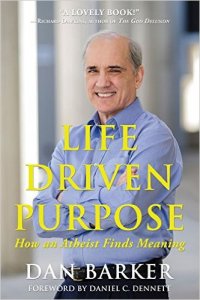
Dan Barker’s Life Driven Purpose (Pitchstone, April 2015), is much more cheerful than Lindsay’s book just reviewed. It’s an explicit response to religious superstar Rick Warren, and his ‘purpose-driven life’, in which everything about your life is in service to God — none of it is yours, beyond the trivial details of, well, everything about your life. Because your life isn’t about you, it’s about Jesus.

The subtitle of Barker’s book is “How an Atheist Finds Meaning” and so it echoes a number of other books, basically boiling down to: you find meaning in your interactions with other human beings, and not in some mythology about some god figure in the sky.

Barker uses some striking rhetorical flourishes. In Chapter 1, he describes a hypothetical man on a roof shouting at passers-by about how he has sent his son down in a basement to be tortured, in order to convince that passer-by that he, the man on the roof, should be worshipped.

All your have to do is come up here on my porch and thank my bleeding son for what he did for you. Tell him you love him. We’ll forgive your arrogance. Give us a big hug, and come into my housse, and we’ll live up in the attic [[ by which he means heaven, of course ]] together, and you can spend an eternity of gratitude telling me How Great I Am, while your ingrate friends and relatives are screaming down in the basement.

Which captures the incoherence of Christian theology, in my view, as I’ve mentioned before. Such beliefs and theologies are not coherent; they serve evolutionary, survival motivations for tribal cohesion, mostly.

What especially struck me about this book is the analogy of religious subservience, and Christian theology in particular, to the slave-mentality, which is something I’ve thought for years. The idea that there is a god who needs both to be *worshiped* and *feared* is like the slave who both fears his master yet nevertheless praises him, no matter what happens, no matter how harshly he is treated — because it could have been worse! Hurricanes, tornadoes? The survivors praise God for their survival, but never criticize him for their travails. (The nonsurvivors are dead, of course, and have no say.)

Barker, p27.5:

Asking, “If there is no God, what is the purpose of life?” is like asking, “If there is no Master, whose slave will I be?”

The theme of the book is that there is no purpose *of* life — but much purpose *in* life, which one can find for oneself; a purpose that might find you. This is great news: you can create your own purpose. Purpose comes from solving problems. Author describes a job he had as a programmer, and dealing with bugs; how that “state of uncertainty” can always be overcome, sometimes by avoiding the problem, simplifying the system. (This echoes my own comments about how programming and computer science are so ultimately fulfilling, because *any* problem can eventually be solved.)

A striking portion of this book is in the early chapters where Barker cites Paul of the New Testament epistles — which I’ve just been reading, coincidentally. Paul mentions how people are “empty pots” who are only fulfilled through the presence of Jesus. Barker’s characterization: “If you think your purpose must come from outside yourself, you are a lifeless implement or a slave to another mind.” p22.8

Barker’s Chapter 3 is about “Religious Color Blindness”, in which he attempts to characterize the believer’s mind: as binary, or polarized, unable to see shades of gray, and authoritarian. Thus concepts of sexuality, geology, evolution, language, abortion, there are no gray zones, no nuances, nothing to be interpreted — everything is right or wrong, black or white, and only their opinions on the matter are correct.

Chatper 4 is about the “deepity” question (i.e. it suggests it is about a genuine subject when it may just be the wrong question) of why there is something rather than nothing. The standard religious answers beg the question, or appeal to the god of the gaps — whatever we don’t currently completely understand must be due to God — which of course is continually shrinking. I like his comment about how Bertrand Russell and others dismiss the ontological argument (a perfect being must necessarily exist) as basically a matter of bad grammar is to apply the same argument to any other perfect thing we can imagine (e.g. a perfect island, observed Anselm).

The final chapter returns to the book’s main theme: there is meaning *in* life rather than *of* life. To find meaning in life, learn something, or create something.

Posted in Atheism, Meaning | Comments Off on Dan Barker on Meaning without Divine Dictates, and the Slave Mentality

James A. Lindsay on the Obsolescence of Theism

Two posts today, both about slender trade paperbacks of the genre that includes, earlier reviewed, John Loftus’s THE OUTSIDER TEST FOR FAITH (review) and titles by Greta Christina, Adam Lee, and Peter Boghossian (links to those reviews in that review): books published by Prometheus, or Pitchstone, or occasionally self-published, that appeal to the niche crowd of readers focused on atheism and related matters. For me to focus on such books might suggest that my convictions — er, provisional conclusions — are wavering, or need defending, but neither is the case. Rather, much like theism itself (a subject that consists of endless commentaries about itself, and in defense of any input from the actual real world), the ideas around atheism and what meaning in life means, without supernatural dictates, consists of interplay between various thinkers, as well as — quite unlike theism — reaction to continued new understanding about the real world.


James Lindsay’s Everybody Is Wrong About God (Pitchstone, Dec. 2015), came to my attention, IIRC, via an Amazon suggestion, and the title was certainly provocative. Wrong how? Glancing through the notes for each chapter [there is no index, or bibliography] was encouraging — Lindsay has read his Jonathan Haidt, his Sam Harris; which is what I mean by thinkers in dialogue with other thinkers.

One key theme is in the back cover description: “theism has been so thoroughly and utterly discredited — philosophically, sociologically, and scientifically — that it no longer warrants serious consideration”.

And this certainly strikes a chord. No matter how many believers there might be among the general population, the concept of ‘theism’ plays no part in any intellectual enterprise of mankind — not since Laplace’s famous if perhaps apocryphal “I have no need of that hypothesis”. No course study at university in physics or biology or cosmology, or any topic that studies the natural world, makes the slightest accommodation to concepts from theism. (Though I recall a biology class I took at UCLA where the instructor apologized in advance to any topics that might offend any student’s religious sensibilities.) As far as the scientific and technology advancement of mankind is the issue, theism is irrelevant.

And, of course, where theism is relevant, it is only among many communities of mutually contradictory belief systems.

Lindsay’s premise is in part that, since theism is mythology, atheism is senseless; we should stop using the term, change the conversation.

Lindsay makes the disctinction between “God” — the idea, or cluster of ideas, that people think of when they use the word, and God, the literal supernatural being. By “God” most people mean a set of moral values, which is why the idea of atheism repels them, and makes them distrust atheists. He spends a substantial portion of the book exploring these moral attributes of “God”, where different ideas are like different settings on a mixer board, where the master volume knob is ‘transcendence’, which for some is turned all the way up, equating with faith, that which cannot be questioned.

The second half of the book concerns how to shift to a post-theistic world. Key suggestions: Maintain secularism. Improve society so that religious belief drops [as evidence has shown that religious belief drops in prosperous nations]. Undermine faith via street epistemology (cf. Boghossian), the outsider test for faith (Loftus), and satire.

Make ‘atheism’ not a thing, and avoid squabbling between atheist groups. Support humanist groups. Ignore religious apologists, and don’t ‘promote atheism’.

And then: fill the religion gap. Promote humanism. For purpose: Find fulfilling work, focus on the here and the now, make other people happy, cope with the reality of death. (Which leads to Dan Barker’s book, next.)

Go post-theistic: promote education — especially on the internet — on such topics as comparative religion, ethics, logic, critical thinking, civics. (Trying to change school/universities is too political and slow to change.)

[[ My thought here is that much of this is simply the result, in the long long run, of the interconnectedness of groups around the world who were previously isolated, coming into contact; leading to panic and paranoia of those frightening of change or whose insupportable worldviews are challenged. ]]

At the end, I endorse the author’s position: when discussing humanity’s understanding of its place in the universe, and its potential futures, theism — all religious ideas– can be ignored (except in the context, perhaps, of how humanity might divide and destroy itself). Yet I have to say that the book, at only 240 pages, is repetitious and long-winded. The issues aren’t that complicated. I was hoping for a crisp suggestion of how non-theistic thinkers might describe themselves without using the word ‘atheist’; his answer is basically, just don’t bring up the topic. (Which suggests the analogy to stamp collectors — those who are not don’t feel the need to describe themselves as ‘non-stamp-collectors’, and the same dismissal should apply to people who are not believers, theists.)

(Update–next post about Dan Barker’s Life Driven Purpose, tomorrow.)

Posted in Atheism, Religion | Comments Off on James A. Lindsay on the Obsolescence of Theism

Ehrman, JESUS BEFORE THE GOSPELS: Memories, Stories, and the Gospels

I’ve read eight or ten books in recent weeks that I haven’t yet blogged about here (including three SF novels), but I plan to catch up. First, mentioned earlier as remarkably coincidental considering my recent Bible reading, is a new book by Bart D. Ehrman, a prolific Bible scholar with several books that seem to deconstruct, if not actually discredit, common Biblical narratives — books with titles like Jesus, Interrupted: Revealing the Hidden Contradictions in the Bible (And Why We Don’t Know About Them) and Misquoting Jesus: The Story Behind Who Changed the Bible and Why. Without having read those, my guess is, from what I have read by him, he’s engaging in close reading of the Bible in various translations, of contemporary manuscripts that didn’t make it into the Bible, and so on, to bolster his thesis that, while Jesus was likely a real person in history, he didn’t believe himself to be a Messiah, and it was only later storytellers, apostles, and the church, who made him so.

With this new book, just published in March, Ehrman seems to have discovered a new tool (tempting to say ‘toy’) he can use to explore the Bible and deduce which parts are fancy and which might have basis in fact. His new tool is one familiar to skeptics and psychologists and anyone who understands that ancient history needs to be taken with at least a grain of salt: the fallibility of memory. As is commonly known, the New Testament gospels were written decades after the events that are supposed to describe, so one necessarily wonders, how accurate were those accounts, given that they were told orally across those decades, even if originally based on supposed witnesses to the resurrection? And how is it that, even after decades of presumably being able to compare notes, did the four gospels turn out so differently, with many portions similar but other incidents, like the virgin birth, completely absent from some? (Paul the writer of NT epistles never mentions the virgin birth, hmm.)

While I found this book very interesting, it was also annoying: Ehrman uses his new idea to a fault, shoehorning anything he can into the idea of flawed “memories”, in many cases where I think what he means is how stories, told and retold over generations, succumb to motivations of the human bias toward *narrative*, never mind whether these are matters of any kind of *memory*. He conflates all these matters into that one idea.

He acknowledges this, p11.7, “We all know from personal experience how much news stories get changed in the retelling…”, but then goes on to discuss these issues as matters of memory.

A fascinating aspect of this book (which I presume he’s covered in other books) is his discussion of those other manuscripts that didn’t make it into the official Bible (when it was finalized in, when, the 300s?) E.g. a Proto-Gospel of James; an Infancy Gospel of Thomas (addressing Jesus’ life from ages 5-12); the Gospel of Thomas discovered in 1945, with a collection of 114 sayings. He treats these as rival “memories” when, it seems to me, these are rival *stories*, versions of stories told and retold over decades, then finally selected or discarded for consistency or usefulness by the church officials who finalized the NT.

To give the book credit, Ehrman does explore the plausibility of whether stories can be transmitted orally across generations, with evidence of such modern day practices that do not, in fact, maintain story integrity; how eyewitness testimony (even if you believe the first story-tellers) has been shown not to be accurate in most cases; and then the contemporary study of memory, and how it is often unreliable.

Also interesting: how long it took for the four canonical gospels to be finalized, and given names — not until 185 AD/CE, and only four were chosen, out of all those available, on numerological grounds!

And Ehrman examines several specific stories from the gospels to suggest how implausible they are on their face — e.g. Jesus’ commotion in the temple market, in a temple that was *huge* and not so easily disrupted; about the descriptions of the trial before Pilate, that shift gradually to absolve him and place the blame on the Jews; how Jesus could possibly have told his Sermon on the Mount to such a large crowd, outside on a hill (with no megaphone), and who took notes? — but discusses why the stories might have later been told the way they were. (Again, not about *memory* per se.) And he notes, as I’ve mentioned in my posts about reading the NT, even if these stories are true, who witnessed them?, that they would later be told to the gospel writers.

He cites interesting examples of modern day primitive tribes who tell oral stories, and how their stories are told differently depending on context, the audience, and so on. Which is to say — they have entirely different ideas of ‘tradition’ than we do.

There’s more, more about divergences among the gospels, and the gospels that didn’t make it in to the NT, including disputes about whether Jesus was human, whether there were two gods, etc. etc., and how it wasn’t until the Council of Nicea, in 325 (!), that the ‘church’ settled on a proper theological stance amidst all these competing ideas. Or as Ehrman would say, ‘memories.’

My general reaction is that all this elaborates what I’ve assumed is obvious, to anyone who thinks about the matter at all (and not blinkered by childhood inculcation and thus unable to think critically): that ancient holy books cannot be counted on to be accurate histories, accurate accounts of the truth of the history of the world, let alone reliable accounts about miraculous events that happen to privilege the tribe or cult promoting these accounts, on any number of grounds. They are fascinating in an archaeological sense, as remnants of primitive humanity, and reveal more about human psychology than they do anything about actual history or the nature of the real world.

Posted in Bible, Religion | Comments Off on Ehrman, JESUS BEFORE THE GOSPELS: Memories, Stories, and the Gospels