
Link and Comment: Language Creationists?

Vox is an interesting relatively new site that I discovered a couple months ago; one of the editors/principal writers is Matthew Yglesias, who left Slate to help create this site, with Ezra Klein. One thing I admire about the site is the way it uses the format of the web to create pieces that would be impractical to print — a general principle I kept in mind when I first developed Locus Online, and explained at length in a couple of early blog posts – IIRC I described three principles: immediacy, that you can post things right away, and more frequently than you can do in a print publication, even a daily one; accumulativeness, that compilations of data can be continuously updated, as with indexes and encyclopedia, rendering print editions of those things obsolete (Wikipedia! Sfadb.com!); and something else, which is probably now so obvious to everyone I don’t recall it offhand. I’ll look it up.

So here’s a cool Vox post, a set of maps that describe the history of the English language, how changes in the language spread, where changes happened, and so on.

25 Maps that Explain English

This triggers a thought I’ve had that I don’t think I’ve mentioned here: I wonder if there are language creationists?

Who believe that existing languages were ‘created’ (maybe last Tuesday?) as they exist today, who dismiss evidence of historical relationships (e.g. the many European languages derived from Latin) as atheistic malarkey, and so on? After all, *were you there?* Ken Ham would make his phony distinction between real science and historical science, since conclusions about the historical development of languages would rely on indirect evidence about things that happened when no one living today was alive.

I’m guessing not, because the guttural resistance to the evidence of biological evolution has to do some peoples’ need to feel special, chosen by God, apart from mere animals, despite all the massive evidence otherwise. The same factors don’t come into play with languages.

But I am seriously curious to what extent evolution of languages is analogous to biological natural selection; I haven’t seen this spelled out anywhere, so am speculating here myself. Languages become distinct through geographic isolation; they become distinct [as do species] when they are mutually unintelligible [cannot interbreed]; and so on. And languages keep changing, especially by the creation of new slang by groups precisely in order to demarcate themselves from other groups and from the broader population, with such new words sometimes filtering outward anyway [I saw some article recently on this very subject, that ‘gangs’ and various subcultures invent slang precisely to help distinguish those who are in-group from everyone else… but of course can’t find the article just now.] …. Just as random genetic changes in populations provide the grist for natural selection…

Follow-on: 16mar15: Yes I know about the Biblical parable about the Tower of Babel. But do Biblical literalists therefore think that languages have not changed since then? Surely the Tower of Babel was thousands of years ago…

And another aside I’ll explore sometime: languages change constantly, especially at the in-group level, where gangs or esoteric societies adopt new usages for common words *precisely* because new meanings are needed, or simply to enforce the designation of who is in-group and who is out-group. Some of these changes filter out in common society, some don’t. But no language remains static.

Posted in Culture, Evolution | Comments Off on Link and Comment: Language Creationists?

Link and Comment: the Fed

I read three daily newspapers now — the New York Times and the San Francisco Chronicle, which I have delivered by paper to my home in Oakland — and still the Los Angeles Times, via a web browser subscription that my partner maintains for his family in SoCal. (Coverage of the arts and the movie industry is primary there.)

Obviously, I don’t read every word in every paper. (Does anyone?) I skim. I read the first few words of each article, to get an idea of what’s going on in the world, or scan it to get the idea of the piece and see if it fits into my interests.

Here’s one from Sunday’s New York Times Magazine, on a subject that wasn’t obviously relevant to me, but which was fascinating, and eventually, quite relevant to my current worldview…

Adam Davidson: In Greenbacks We Trust

It’s about the Federal Reserve, what is it, how it came to be (the San Francisco earthquake!), how much influence it has over the world. The writer discusses how the 2008 financial collapse challenged his faith in the bedrock of this system.

For me and many others who watch the markets, the collapse was not just a horrible financial and economic disaster. It was also a psychological and existential blow. It brought on a painful recognition that there is nothing truly solid at the center of our economic lives. There are only the stories we tell one another, the promises we make, the shared views we have about the future. It’s something like the challenge so many writers faced in the late 19th and early 20th centuries, when they confronted a world without a knowable God providing absolute structure. Or the work by Einstein and Heisenberg that shattered the predictable world of Newton and showed that there will always be uncertainty, that there are fundamental limits to our understanding.

Posted in Economics, Links | Comments Off on Link and Comment: the Fed

Links and Comments: Star Trek and Humanism; John Cleese

A couple more links noticed in recent days, before I lose or forget them; my daily routine, as we settle and unpack in our new home in Oakland, will be a while getting back to have time for more considered comments.

Slate appeals to Quora to ask, What Is the Philosophical Perspective of Star Trek?. The answer is, Humanism (considering primarily the original series, and how this philosophy changed in the later series).

This is fascinating to me because, while I was obsessive about Star Trek from its original broadcast years (beginning when I was 11), and then especially during syndicated reruns in the early ’70s, I stopped watching the various incarnations of the show once ‘Next Generation’ finished, and haven’t thought about it much in the past couple decades; while my interest in more fundamental philosophical issues, science vs religion and concepts like humanism, has only emerged, or crystallized, in the past decade. So to see these concepts retroactively applied to experiences of my adolescence and young-adulthood is almost revelatory.

Humanism? Well, yes. You didn’t see Trek appealing to religion or gods much, except to debunk them. (I know the Original Series episodes well enough to remember one (“Balance of Terror”) with a couple scenes in a non-denominational chapel, about the closest Trek got to recognizing formal religion; and another (“Who Mourns for Adonais?”) in which the Enterprise encounters a superior alien being whose compatriots had visited Earth centuries before and been taken for the Greek gods… and in this episode, IIRC, Kirk comments that they no longer believe in “gods”; “we find the one quite sufficient”. So while undermining primitive concepts of gods (who were actually alien beings), there were some token nods to conventional monotheistic religious belief.

The Slate essay comments that Gene Roddenberry wanted to envision a future in which humanity had actually improved, in the sense that they had overcome religious superstitions and the cultural conflicts that are typical of most wars and conflicts around the world to this day.

Through Star Trek he wanted to show a future where we had grown up and were reaching our potential. This view provided the optimism and inspiration that cemented the show into the hearts of so many viewers. But it made it a challenging show for the writers and actors. Roddenberry’s view that we would be better people in the time of Star Trek in effect changed human nature and removed many of the natural sources of conflict for the stories the shows told.

Thinking back, I was not explicitly aware of this policy, except to have read some accounts from script-writers (e.g. Harlan Ellison), who resented the policy that prohibited conflicts among crew members (in his original draft of “The City on the Edge of Forever”).

But I suppose, in retrospect, the idealistic nature of Star Trek must have influenced my early thinking, and the undermining (as so much of science fiction has done) of conventional religious belief, the casual assumptions that one’s own culture is the center of all existence.

\\

Via today’s Morning Heresy post, a quote from the autobiography of John Cleese (the Monty Python guy):

Yes, I know it’s easy to make fun of the organised churches, but has it occurred to anyone to wonder why it’s so easy? … All the vital questions have been dumped in favour of half-baked, po-faced rituals which are basically a form of middle-class rain dance.

Posted in Humanism, Personal history, Philosophy, Religion | Comments Off on Links and Comments: Star Trek and Humanism; John Cleese

Links and Comments: Oliver Sacks; A Pious American against Trains; Offending Religion

Another link-dump, for now, i.e. some links and quick comments, without the more considered comments I might do under normal circumstances… after another busy week of moving-in and unpacking.

The great author Oliver Sacks has this moving NYT op-ed about how he deals with the fact that he has terminal cancer, without resort to fantasies of heaven’s eternal reward.

I cannot pretend I am without fear. But my predominant feeling is one of gratitude. I have loved and been loved; I have been given much and I have given something in return; I have read and traveled and thought and written. I have had an intercourse with the world, the special intercourse of writers and readers.

Above all, I have been a sentient being, a thinking animal, on this beautiful planet, and that in itself has been an enormous privilege and adventure.

\\\

In every era there are people who welcome change and advance, and those who resist it (usually on religious grounds). He’s a precious example: In 1830, One Pious American Railed Against Trains and Their Breakneck 20-MPH Speeds

I go for beasts of burthen [sic]: it is more primitive and scriptural, and suits a moral and religious people better.

\\\

A few commentators are willing to call a spade and spade, inlcuding Jeffrey Tayler at The Atlantic and Salon:

We must offend religion more: Islam, Christianity and our tolerance for ancient myths, harmful ideas.

Not in this piece, but somewhere else that I read: the reason you publish cartoons offensive to Muslims is because if you don’t, you are *submitting* to their fundamentalist worldview. Fundamentalist Muslims do not have license to control what everyone else finds humorous or offensive. No one should be forced to submit to anyone else’s worldview. Live your own lives however you want to, but don’t force others to submit to yours.

Posted in Culture, Religion | Comments Off on Links and Comments: Oliver Sacks; A Pious American against Trains; Offending Religion

Boyhood

I need to say something about the film Boyhood, before it does, or more likely does not (given the current prognosticators), win the Oscar for Best Picture on Sunday. I didn’t see it in the theater, but watched the DVD when it came out in January, and have watched it at least three times through, and various pieces more times than that.

It’s a film that has affected me in a way no other film has done, ever, except (in an extremely different sense) 2001: A Space Odyssey.

Because it strikes me at a very particular stage of my life, a stage when one thinks back to consider what might have been, the things that didn’t seem the least plausible, given my circumstances and age, but which recently has seemed possible after all. Though not practical, given that we’ve cashed out various reserves to finance our move to the Bay Area.

So Boyhood is for me a vicarious experience about raising a son, which I wish I could have done. As the years grow old, the regrets grow stronger.

Posted in Children, Films, Personal history | Comments Off on Boyhood

Links and Comments: Quotes; GOP and Evolution; Skeptics; Oklahoma history

During a busy week, this is a quick post to capture various quotes and links I’ve found in the past few days. Resources.

Quote: Charles Bukowski: “The problem with the world is that the intelligent people are full of doubts, while the stupid ones are full of confidence.”

//

Quote: H.G. Wells: Civilization is in a race between education and catastrophe.

//

Salon: GOP still party of stupid: Scott Walker, Fox News and why 2016 hopefuls must appease wingnut base on evolution

Again, the key word should not be ‘believe’, but ‘accept’. Or ‘understand’. I have another quote about the latter. Quote from this:

After all, it’s not really religion that holds the GOP base together, it’s a sense of victimization. And this thesis weaves a number of important strands into a colorful if ahistorical tapestry.

//

On the definition of ‘skeptic’; there’s a recent pushback among science-folks about the use of this word by those they would describe as science *deniers*. ‘Skeptic’ has a specific meaning, that is very much within the tradition of real science.

Ross Pomeroy at RealClearScience:

A true skeptic never dismisses an idea out of hand. A true skeptic is willing to be wrong, and recognizes an echelon of evidence that will change their mindset. And most importantly, a true skeptic doesn’t only question the beliefs of others, he also questions his own. Because skepticism isn’t just about doubting things you disagree with, it’s about keeping yourself honest, open, thoughtful, and true. 

//

Much in the news in the past couple days is about the Oklahoma legislature voting to ban AP courses in history… because the real history of the US involves so many episodes that question our country’s presumed exceptionalism. Narrative is so much more important than reality! Think Progress.

Posted in Culture, Religion, Science | Comments Off on Links and Comments: Quotes; GOP and Evolution; Skeptics; Oklahoma history

Once Again: Turn Away

Via AZ Lyrics, the last verse [updated per comment below]

Turn, turn away
From the weight of your own words
It’s magic for the devil
And betray the lack of change
Once you have spoken
Turn away

[Update 18feb15: listening to the song again, I think the lyric is “from the weight of your own words”… not “of your own past”, as AZ Lyrics has posted. This actually makes even more sense, and I’ve edited this post accordingly.]

From the weight of your own words: it’s magic, for the devil.

It’s perhaps too easy to interpret pop song lyrics to whatever mindset you currently inhabit — but listening to this song again, and again, I’m thinking of the Brian Williams scandal, and more generally, about how human memory is not reliable, as has been demonstrated in so many ways — how depending on that “weight of your own words” can come back and bite you; “magic for the devil”, so to speak.

Of course, as a blogger with an unknown, likely infinitesimal, readership, I also appreciate the lyrics of the first verse:

Turn, turn away
From the sound of your own voice
Calling no one, just a silence

But I do have a project in mind, following the outline of my provisional conclusions, and once that is done, like anyone writing a book, all you can do once finished is to let it loose, sit back and receive feedback, or not. Turn away.

Posted in MInd, Music, Narrative | Comments Off on Once Again: Turn Away

Links and Comments: Still Climbing

The New Yorker, Adam Gopnik, Obama and the Cruaders. Parsing faith, fanaticsm , liberalism, pluralism.

Bad acts may rise from good causes: faith may never be the enemy; fanaticism is always the enemy. But faith has always been the first seedbed of fanaticism. That’s why, when people commit acts of horrible cruelty for political purposes, we say that they’ve made a “religion” out of their politics, or have succumbed to a mad ideological dogma. Fanaticism is the belief that a single faith or ideology contains all the truth of the world, and that others should at best be tolerated. Liberalism is the belief that toleration is not enough, that an active, affirmative pluralism is essential to social sanity. Pluralism is the essence of liberalism—including the possibility of self-reproach for things that liberalism has done badly. America is not responsible for My Lai only to the degree that America renounces the self-righteous “exceptionalism” that put those murders in motion and then prevented those who caused them from being blamed. Excessive scruples—liberal guilt—are as sure a sign of sanity as excessive sanctimony is a sign of the opposite.

The President’s point turned out to be not just exactly right but profoundly right: no group holds the historical moral high ground, and no one ever will. But this is not because a moral high ground doesn’t exist. It’s because we’re all still climbing.

Posted in Morality, Religion | Comments Off on Links and Comments: Still Climbing

Links and Comments: Robert Wright on Brian Williams; Obama on Christianity; Children of Gay Parents; Republicans and evolution

Robert Wright — author of among other books The Moral Animal (1994), one of the best books I’ve read about how evolutionary psychology affects human culture and relationships — offers his perspective, in New Republic, on how Brian Williams Is Being Punished for Something Every Human Does.

Why would human brains be so fallible? The best guess is that, from the point of view of the brain’s creator, natural selection, unreliable memory is a feature, not a bug. 

The foundational premise of evolutionary psychology is that the human brain was designed, first and foremost, to get our ancestors’ genes into subsequent generations. During our evolutionary past, high social status could help do that. Believably telling stories that connect you to important people or underscore your daring can elevate your social status. And the best way to believably tell those stories is to believe them yourself. So genes for this kind of self-deception could in theory flourish via natural selection.

With more about confirmation bias, the nature of journalism, and what makes a good story.

One thing that runs scary foreigners a close second as an attention getter is a scandal involving someone famous. And if that someone famous is “lying,” that makes for a better story than if he’s just being human. It is, as we say in journalism, a story that’s too good to check.

—

Alternet: Amanda Marcotte on 5 Right-Wing Freak-Outs Over the President’s Completely Accurate Comments on Christianity.

This echoes my occasional comments that some Christians, supposedly beholden to a commandment about not bearing false witness, are happy to misrepresent facts when it suits their purposes.

The irony is that the conservative reaction to Obama’s speech proves his point, that Christians are capable of “terrible deeds in the name of Christ.” We are seeing this happening before our eyes as one Christian after another commits the terrible deeds of lying and slander, all in supposed defense of their religion. One after another, they openly and aggressively say untrue things and level false accusations, even though their faith supposedly forbids bearing false witness. And they do it, as Obama says wrong-headed people often do, by invoking religion as justification. If they really want to show that Christians are good and honorable people, they should start by choosing to act like it, instead rushing to tell lies to smear a man who was simply telling the truth.

—

On a similar note, there’s another ‘study’ this week about the children of gay and lesbian parents, sponsored by an anti-gay Catholic (whose bias should therefore discredit it immediately), that purports to show that those children have more ’emotional problems’ than children of straight parents. The problem, as with the widely-discredited Regnerus study, is that the study conflates children of gay parents with children of broken families, i.e. divorces.

Nathaniel Frank at Slate summarizes What We Know—Really—About Lesbian and Gay Parenting in which he compiles results of dozens of such studies at What We Know. 71 studies show no adverse effects on children; 4 do, all with methodological problems, like this latest one and Regnerus.

As our collection makes clear, and as the American Sociological Association concluded in its 2013 brief to the Supreme Court, the consensus of serious scholars on the matter is overwhelming. And the handful of researchers purporting to show harms from gay parenting are not brave Galileo-like outliers speaking truth to groupthink; they are ideological opponents of gay equality who are part of an orchestrated campaign to influence the Supreme Court with scare stories and bogus scholarship.

(Reality check: *why* would children growing up with two men or two women suffer emotionally? Because of rigid male vs female personality types? I don’t think so; the range of male personalities, and the range of female personalities, surely overlaps. If the critics of gay parents took their argument seriously, they would be campaigning just as stridently against *single* parents. Which they are not.)

—

There have been several stories today about a survey of potential Republican candidates for President and what the think about evolution. Here’s Salon’s summary, which shows that the candidates generally range from “I’m not a scientist” to “Hell no”.

But here’s a nuanced take on what this all means by Jamelle Bouie at Slate: Don’t Ask Scott Walker About Evolution.

Bottom line:

Which is to say that when a politician answers a question about evolution, they aren’t defending or rejecting science as much as they’re sending a message: I am one of you, and this is how you know.

Thus does the need to identify with a social group or tribe trump evidence, logic, and reality. (One of my Provisional Conclusions…)

Posted in Culture, Evolution, Psychology, Religion, The Gays | Comments Off on Links and Comments: Robert Wright on Brian Williams; Obama on Christianity; Children of Gay Parents; Republicans and evolution

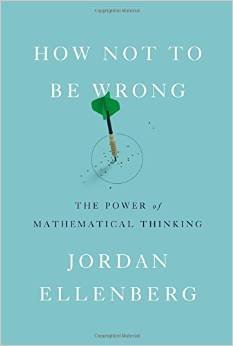
Jordan Ellenberg, How Not to Be Wrong, Post 2

Subtitled: The Power of Mathematical Thinking.

Second post (first post here) about this fascinating book, an examination of several basic principles (linearity, inference, expectation, regression, and existence) and how they apply to every-day, real world situations, situations that are often misunderstood by ordinary “common sense”. The author, a one-time child genius, is a professor of mathematics at the University of Wisconsin-Madison, and has written for Slate, Wired, and other publications, including an occasional column for Slate.

This second of five parts is about Inference. I’ll try to condense my notes more than I did so in my last post.

Examples include Hebrew scholars who examined the Torah for “equidistant letter sequences” to see if the names of classical rabbis, and their birth and death dates, could be found closer to one another than could be expected by chance. They found significant results! (This led to the ’90s bestseller The Bible Code.) Eventually the flaws in their methodology were uncovered: there are many ways to characterize the names of ancient rabbis, and the one they happened to choose just happened to show results. Other ways did not.

And a classic tale about letters from a Boston stockbroker, who week after week sends you predictions that come true. Invest with him? Of course; he must be a genius!. But what you don’t know is that he started with 1024 letters, and only replied each week to those whose predictions to them came true. By the tenth week, he’s left with 10. You never know about his failed predictions.

Improbable things happen a lot — in large enough samples.

Similarly, scientific studies that probe huge data sets often find significant results — because they have so much data to examine. A spoof paper about an MRI of dead fish. “The more chances you give yourself to be surprised, the higher your threshold for surprise had better be.” Relying too much on ‘significance’ can have unintended consequences: example of a warning about a certain contraceptive pill in Britain, that resulted in tens of thousands of women to stop taking it, resulting in more births (and abortions!) the following year, even though the magnitude of the risk would have affected only a single woman, at most.

If you run enough experiments about anything, even e.g. “harupsicy”, making predictions based on sheep entrails, you will find success, based on the statistical threshold of p-value being 1 in 20, some of the time. If you publish only those success stories — without ever validating them through repeated studies — your theory seems validated.

This is a real issue in biomedical research, and the pressure on academics to publish or perish. In the past couple years there have been meta-studies that have revealed that only small portions of such published studies were replicated. Does this call into question the scientific method? No; it means many of those studies saw results that were actually noise in the data. Solutions? Use ‘confidence intervals’; understand that evidence is not about determining ‘truth’, but about making decisions about what to do next, i.e., do further studies.

And another, adopted by one publication in 2013, is to guarantee a certain number of ‘replication reports’ before they are even done, and publish the results either way.

Final chapter in this section: “Are You There, God? It’s Me, Bayesian Inference”.

Big Data can’t solve everything; no matter how much data you compile, there’s a hard limit about predictions in chaotic situations, e.g. weather predictions (two weeks seems to be the limit) and Netflix recommendations.

The author uses the idea of how the FBI might use Facebook posts to identify potential terrorists to introduce Bayesian inference — a way of deciding how much you believe something after you see the evidence, based on how much you believed it to begin with. This is in fact how people tend to think about things, all the time, because we all have notions about what things are true or not without having personally examined the evidence.

And we change our beliefs based on a combination of prior beliefs, and new evidence, leading to posterior beliefs.

The author applies this to the creation of the universe. He charts the likelihood of humanity existing vs the existence of God. The flaw in this take is that it doesn’t take into account other options: maybe there are many gods, or maybe our existence is a simulation inside some ultracomputer that exists within a larger reality. The question is, given those various assumptions, how likely would it then to be for humanity to exist?

The likeliest, in this analysis, is that we are sims. Second, multiple gods. He cheekily advises how to teach creationism in schools, concluding, “There are even some people who believe that one single God created the universe, but that hypothesis should be considered less strongly supported than the alternatives.”

But his real conclusion is that the type of thinking means we’ve reached a limit to quantitative thinking.

This is not quite half-way through the book.

Posted in Book Notes, Culture, Economics, Mathematics, Science, Thinking | Comments Off on Jordan Ellenberg, How Not to Be Wrong, Post 2