
Links and Comments: Michael Shermer, Science and God, Religion vs Education, Your soul

Michael Shermer’s new book

As mentioned a couple posts ago, Michael Shermer has a new book out this week (I got my copy yesterday), The Moral Arc: How Science and Reason Lead Humanity toward Truth, Justice, and Freedom, which addresses a theme of one of my ‘provisional conclusions’ about the arc of human history, expanding social and moral acceptance, and progress; but no doubt covers much more, which is why I’ll be interested to read it.

So Shermer is publicizing his book in various places; he was a guest on an LA NPR station’s weekday talk show Air Talk last Monday; and he had an op-ed, The influence of science and reason on moral progress in the LA Times the same day. (And today, as I post this, he had an interview with the Bay Area NPR station, KQED: Michael Shermer on How Science and Reason Shape Morality.)

Excerpt:

To what should we attribute this moral progress? Understandably, most people point to religion as the primary driver, given its long association with all matters moral. But the evidence shows that most of the moral development of the last several centuries has been the result of secular forces, and that the most important of these are reason and science, which emerged from the Enlightenment.
…
Over time, we have expanded the moral sphere of who we consider a member of our community worthy of respect, dignity and equal treatment. We’re still working at it, but it is only a matter of time before all are included.

And the other day I came across an interview with Shermer on Sam Harris’ blog, which addresses themes of the new book.

Harris: What role has religion played in our moral progress?

Shermer: I like to paraphrase Winston Churchill in his description of Americans: You can always count on religions to do the right thing…after they’ve tried everything else. It’s true that the abolition of slavery was championed by Quakers and Mennonites, that the civil rights movement was led by a Baptist preacher named Martin Luther King Jr., and that gay rights and same-sex marriage were backed early on by some Episcopalian ministers. But these are the exceptions, and for the most part people who opposed abolition, civil rights, and gay marriage were (and still are, in the latter case) their fellow Christians. In my debates with Dinesh D’Souza, he holds up William Wilberforce—the British abolitionist—as an example of how religion drives moral progress. But when I looked into that history a bit more carefully, it turns out that Wilberforce’s opponents in Parliament were all his fellow Christians, who justified slavery with religious and Bible-based arguments. (Plus, as I note in my book, “Wilberforce’s religious motives were complicated by his pushy and overzealous moralizing about virtually every aspect of life, and his great passion seemed to be to worry incessantly about what other people were doing, especially if what they were doing involved pleasure, excess, and ‘the torrent of profaneness that every day makes more rapid advances.’”)

The gay rights revolution we’re undergoing right now is a case study in how rights revolutions come about, because we can see who supports it and who opposes it: The vast majority of conservative and fundamentalist Christians have opposed (and still do oppose) same-sex marriage and equal rights for gays, whereas secularists and non-religious people support the movement; and those religious people who do endorse same-sex marriage are members of the most liberal and the least dogmatic sects.

So, while I acknowledge that many religious people do much good work in the world, manning soup kitchens and providing aid to the poor and disaster relief to those in temporary need, religions overall have lagged behind the moral arc, sometimes for an embarrassingly long time.

Science and God

No, the former isn’t proving the latter. In The New Yorker, Lawrence M. Krauss (an actual scientist) responds to a recent Wall Street Journal article titled “Science Increasingly Makes the Case for God” by one Eric Metaxas (a writer and TV host and not a scientist). The WSJ article took various observations from astrobiology, and the so-called ‘fine-tuning’ of universal physical constants, as evidence that the universe must have been rigged (by ‘God’ of course) to enable humanity’s existence. Krauss takes his arguments apart, e.g.

In fact, one of the most severe apparent fine tunings often referred to by creationists like Metaxas is that of the so-called cosmological constant, the energy of empty space that has recently been discovered to be causing the expansion of the universe to accelerate over time. It remains one of the biggest mysteries in physics, as it appears to be over a hundred and twenty orders of magnitude smaller than our theories suggest it could be. And if it were as large as the theories suggest it should be, then galaxies, stars, and planets would never have formed.

Is this a clear example of design? Of course not. If it were zero, which would be “natural” from a theoretical perspective, the universe would in fact be more hospitable to life. If the cosmological constant were different, perhaps vastly different kinds of life might have arisen. Moreover, arguing that God exists because many cosmic mysteries remain is intellectually lazy in the extreme. The more we understand the universe, the more remarkable it appears to be. Exploring how this remarkable diversity can arise by potentially simple laws has been one of the most successful, and intellectually beautiful, efforts in human history.

Religion vs Education

Here’s another news item that supports one of my provisional conclusions, #7, in which I mention that resistance to greater understanding of the real world exists because religious and ideological groups consider them threats to their group’s narratives… from political isolation to religious inculcation.

Here’s a scary example: Jehovah’s Witness Leader Rants Against Higher Education, Saying It’ll Lead to “Spiritual Disaster”.

Rather than sending kids to secular universities, Morris advises parents to encourage their kids to learn a trade like carpentry. There’s nothing wrong with learning a skill like that, of course, but to demonize knowledge that might contradict one’s silly beliefs is one of the obvious problems with religion. To people like Morris, ignorance is bliss and fact-based education is kryptonite.

Your soul

On another topic, Salon has an excerpt from a new book by Julien Musolino called The Soul Fallacy: What Science Shows We Gain from Letting Go of Our Soul Beliefs. That is, the mind is the brain; there is no ethereal, incorporeal “soul” that exists independently from the the functioning of the brain.

This is not news; it’s been an apparent conclusion of neurobiological studies for decades. What’s remarkable is I’ve never seen it spelled out so bluntly in a popular media essay. (Also, it makes an initial point by describing an obscure SF story. And it quotes Lawrence Krauss.)

Posted in Atheism, Culture, Evolution, Morality, Religion, science fiction | Comments Off on Links and Comments: Michael Shermer, Science and God, Religion vs Education, Your soul

10 Provisional Conclusions about Life, the Universe, and Everything, subject, of course, to revision based on evidence

Inspired by my post last night about A Secular Ten Non-Commandments, and the book’s invitation to generate one’s own set of beliefs, I sat down today to write out my own response… not of *commandments* (who am I, or anyone, to command anyone else to do anything?), or even of “beliefs” – because a ‘belief’ is a commitment to a proposition about reality that is immune from further evidence or discussion. No; instead, I have written up a set of “provisional conclusions” about life, the universe, and everything, based on my experience in life and reading about science and faith and religion, honestly trying to understand the various viewpoints and their bases for their claims, and what I’ve concluded to be true, as far as I can perceive.

All my posts on this blog, or most of them anyway, fit into this context of these provisional conclusions, on these ten points.

  1. All supernatural phenomena – including gods, ghosts, angels, demons, devils, spirits, souls, telepathy, telekinesis, precognition, faeries, elves, and so on, as well as religious concepts such as heaven, hell, prophets, messiahs, chosen people, sin, karma, and reincarnation – are projections of human behavior and human motivations onto an indifferent, inanimate universe. They are not real, except as concepts in the minds of their adherents.

  2. The actual universe is vast in size, age, and scale, in ways barely comprehensible, even intellectually, to human beings. Most human beings are both unaware of this vastness, and of the minute portion of this vastness that human existence spans.
  3. The human species’ understanding of itself and the world has been honed by natural selection to maximize the perpetuation of the species, including the incentive to prioritize one’s own social group over others, in ways that are not necessarily optimized for perceiving and understanding the real world. Thus, many things people believe about themselves, and about the world, have turned out to be false upon rigorous examination. Increasingly, ‘common sense’ turns out to mislead more often than not.

    At the same time, the ways in which humans have expressed their perception of the world, through art, music, story-telling, architecture, cuisine, and so on, have generated vastly rich cultures, many of them throughout history independent of one another, that have enhanced and continue to enhance human existence, and to fulfill countless lives — even while nevertheless being constrained to the tiny slices of perception that human existence is constrained to.
  4. Traditions, including the religious deference to holy books and the political allegiance to ideological states, provide narratives about the meaning of human life that function to strengthen families and social groups small and large, from tribes to nations, at least to the extent that these narratives do not directly conflict with the real world in a way that impacts human survival. (For example, understanding of evolution or the vastness of the universe doesn’t matter much to everyday life, but disbelief in modern medicine, such as the efficacy of vaccines or of blood transfusions, might well lead to premature death. Communities committed to denying these propositions are at a disadvantage, in the long run.) Thus, most people find these narratives far more important than evidence about the real world; and these narratives are so powerful, their adherents *cannot change their minds* about their implications, even in the face of explicit evidence to the contrary.

    These narratives, that emphasize the superiority of one’s social group over all others, are manifest in human psychology, religions, patriotism, and competitions including sports. And they tend to be the most important things in most people’s lives, in ways that cannot be easily dismissed. Even when you suspect that those who adhere to such narratives are smart enough to understand that it’s not about the claim that other narratives are untrue; it’s about the utility of such narratives to unify a social group, a community, that strengthens social bonds and promotes the happiness, and survival, of the group.

    This preference for narrative explains many things, from the interpretation of near-death hallucinations to the shouting down of critics of historical and science fiction movies who point out factual errors: “It’s just a story!” – because story is so much more important than reality.

    And, for that matter, to the interpretation of any single life, which for many people is about having children and raising them to adulthood, after which, all things considered, the end of life is not such a bad thing, considering it has to happen eventually anyway. As long as the story of raising the next generation has been completed, the end is almost fitting.
  5. An arc of human history has been a gradual shift between allegiance to immediate social groups to larger social groups that include more and more people previously demonized as ‘the other’. That is, the recognition of the common humanity of former slaves, of women, of other ‘racial’ and ethnic groups, of sexual minorities, and even of those who adhere to minority narratives.

    This shift has been an historical tension between those who would ‘progress’, expand options and expand the parameters of the social group, and those who resist any change that might disadvantage them and those most like themselves. The former are typically described as ‘liberals’; the latter, as ‘conservatives’. That the trend of human history has nevertheless been progressive, such that conservatives in any era accept propositions that would have been unthinkable a generation or two before, suggests that conservatives do change over time, but only 50 years or so behind the liberals. Thus conservatism is relative.

    And thus, ‘progress’, the expansion of options, and the gradual rejection of practices of ancient human cultures once common but now considered barbaric (slavery, sacrifice of children to appease the gods, etc.) is generally a liberal project, modulated by conservative resistance. The balance of progress vs conservative resistance worked out to minimize the impact on individual lives, but over the past few centuries, the pace of change has been rapid enough that it is apparent even within individual lives (thus the emergence of science fiction), and the change over the past several generations has been astonishing.
  6. Another arc of human history has been toward a greater understanding of the real world, and the subsequent benefits of that understanding through manipulation of that world through science and technology. Thus our species now dominates the planet in a way unprecedented in history.
  7. Resistance to these historic trends is driven by subconscious, evolutionary-grounded desires to maintain social cohesion among one’s group against threats that might undermine the group’s religious or ideological narrative. Such resistance ranges from political isolation (e.g. North Korea) to religious inculcation of children by parents around the world. Daily evidence of such resistance is provided by numerous right-wing, religious fundamentalist pundits.
  8. Thus another trend of human history is the persistence of conflict between different religious and ideological groups, as they inevitably come into contact with one other and their competing narratives, and their need to feel superior, which are quickly seen to be mutually inconsistent. Resistance and tribal loyalty will always endure, but the stakes, over time, will gradually, necessarily, reduce in scope; thus, e.g., political parties in the US do not demonize each other as heathens who deserve death, as tribal groups around the world, over previous millennia, have typically done. While there will always be conflict between the educated and the naive — elites vs common folk — since naive human motivations exhibit base human nature, and lack of education is the basic human condition, unless addressed, the points of political contention in future decades and centuries will become more and more issues of cultural taste.
  9. The benefits of these trends will be the expanding potential for humanity to explore and comprehend the universe in a way that vastly supersedes the priorities of mere human existence. In this sense, the sum of human awareness will be a consciousness of the universe that extends beyond the survival protocols of a single species.

    Science fiction, at its best, explores the many ways this might happen; it is a heuristic for understanding why any one person’s experience of the world, or perception of reality, is not necessarily the only possible one, let alone the best.
  10. In the event of any kind of species ‘reset’ – e.g. a worldwide catastrophe that reduces human survivors to the state of primitive humankind of thousands of years ago, or of a small group of humans stranded out of contact with civilization – all progress described in the previous items would vanish, and humankind would be left only with the evolutionary motivations given toward tribalism, the value of narratives over evidence, and the susceptibility toward supernatural perceptions, that preceded them – i.e., baseline human nature.

    Eventually, such a rebooted segment of humanity would create a new culture, would create new religions, new art, new music, new literature — all unlike any specific religions or art or culture that preceded them, but all of them reflecting the priorities of human nature. The science that would eventually emerge would, however, be like ours; it cannot help but be, since it would be a rigorously tested perception of the reality of the universe.

    The plausibility of such catastrophes, especially given the relatively rapid ascent of our species in recent centuries, might well explain the Fermi paradox – why we have detected no similar sentient races on the planets of other suns.

I will be refining this post and will eventually post it as a ‘page’ linkable from the top menu bar of my blog. This is my worldview.

[revised 2Feb15]

Posted in Culture, Evolution, Humanism, Morality, Philosophy, Religion, Science, Ten Commandments | Comments Off on 10 Provisional Conclusions about Life, the Universe, and Everything, subject, of course, to revision based on evidence

A Secular Ten Non-Commandments

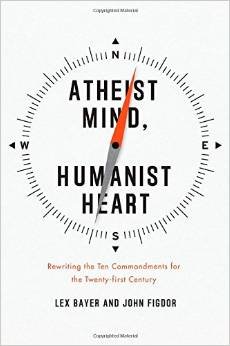
I started this book before the holidays, but what with the holidays and since then attention to the buying of one house and the selling of another, only just finished it a couple days ago, though it’s rather short. This is the latest attempt, of quite a few in recent years, to take a more rational, reality-based approach the idea of establishing principles for living, to replace the antiquated, tribal, religious rules, or ‘commandments’, enshrined in religious texts.

Or to approach it another way, this is a book, like Phil Zuckerman’s Living the Secular Life, which I reviewed here, that explores not why it’s not reasonable to believe in gods, but to explore how one characterizes morality and constructive principles for living, without the threats of divine punishment typically looming over the traditional commandments.

The authors of this book are two young guys, one a Silicon Valley CEO who studied religion at Stanford, the other a humanist chaplain at Stanford with a divinity degree from Harvard. They both look about 25.

Their approach is philosophical, even mathematical, in its initial question, How can I justify any of my beliefs?, and in their start with an initial set of ‘assumptions’, like mathematical postulates, that they take as given, and from which they will derive further principles. (These assumptions are the first three; the full list is below.) A second characteristic of their approach is to call their conclusions *not* commandments, but rather non-commandments; rules or principles for living, but not any kind of divine laws.

They go on to explore the idea of the scientific method (the fourth non-commandment), and then how to draw conclusions about the unknown — Ockham’s razor, probabilities, and a thought experiment about being in a white room with a sphere apparently floating in the air, and being asked questions about your confidence about the explanation about that sphere. And then they address the various ideas about whether a god exists; if so, why should it be the Christian god; if so, is this God omniscient, omnipotent, and omni-benevolent? The lack of observable evidence for god; the various arguments for god, all of them lacking. And so the logical conclusion (the fifth non-commandment): There is no God.

From there the book turns from what is true about the world to how one should live one’s life. The basic observation is that people behave in ways to make themselves happy, in whatever ways they conceive happiness to be. (Even if happiness means killing others to appease their notion of a god, or sacrificing their present life for the presumed happiness of an afterlife.) They explore the idea of a single universal moral truth, and reject it.

And they come up with this definition of morality: “We act morally when the happiness of others makes us happy”. I like that definition quite a lot.

Their final non-commandment may be the most crucial: “All our beliefs are subject to change in the face of new evidence, including these”.

So here are their ten non-commandments for the twenty-first century:

  1. The world is real, and our desire to understand the world is the basis for belief.
  2. We can perceive the world only through our human senses.
  3. We use rational thought and language as tools for undernstanding the world.
  4. All truth is proportional to the evidence.
  5. There is no God.
  6. We all strive to live a happy life. We pursue things that make us happy and avoid things that do not.
  7. There is no universal moral truth. Our experiences and preferences shape our sense of how to behave.
  8. We act morally when the happiness of others makes us happy.
  9. We benefit from living in, and supporting, an ethical society.
  10. All beliefs are subject to change in the face of new evidence, including these.

The book has its own website, http://www.atheistmindhumanistheart.com/, from which the authors conducted a crowd-sourcing ‘ReThink’ prize in December to compile a second set of ‘ten commandments for the 21st century’, selected by a panel of judges from entries by anyone.

The page for this winners is annotated by explanation of why each item is justified.

  1. Be open minded and be willing to alter your beliefs with new evidence.
  2. Strive to understand what is most likely to be true, not to believe what you wish to be true.
  3. The scientific method is the most reliable way of understanding the natural world.
  4. Every person has the right to control over their body.
  5. God is not necessary to be a good person or to live a full and meaningful life.
  6. Be mindful of the consequences of all your actions and recognise that you must take responsibility for them.
  7. Treat others as you would want them to treat you and can reasonably expect them to want to be treated. Think about their perspective.
  8. We have the responsibility to consider others including future generations.
  9. There is no one right way to live.
  10. Leave the world a better place than you found it.

Number 7 is of course our familiar Golden Rule, which as I’ve pointed out is a general formulation of half of the original Ten Commandmants.

At some point I will spend some time consolidating these and many others, at least as resource links on my blog, but for now let me summarize another very good set of alternative ten commanded, by Daylight Atheism blogger Adam Lee, at The New Ten Commandments.

  1. Do not do to others what you would not want them to do to you.
  2. In all things, strive to cause no harm.
  3. Treat your fellow human beings, your fellow living things, and the world in general with love, honesty, faithfulness and respect.
  4. Do not overlook evil or shrink from administering justice, but always be ready to forgive wrongdoing freely admitted and honestly regretted.
  5. Live life with a sense of joy and wonder.
  6. Always seek to be learning something new.
  7. Test all things; always check your ideas against the facts, and be ready to discard even a cherished belief if it does not conform to them.
  8. Never seek to censor or cut yourself off from dissent; always respect the right of others to disagree with you.
  9. Form independent opinions on the basis of your own reason and experience; do not allow yourself to be led blindly by others.
  10. Question everything.

All of these more comprehensive, mature, and respectable than the Biblical ten.

Posted in Culture, Morality, Philosophy, Religion, Ten Commandments | Comments Off on A Secular Ten Non-Commandments

Narrative as Reality; or, Reality as Narrative

For tonight, Paul Krugman’s NYT column from a couple days ago: Hating Good Government

Evidence doesn’t matter for the “debate” over climate policy, where I put scare quotes around “debate” because, given the obvious irrelevance of logic and evidence, it’s not really a debate in any normal sense. And this situation is by no means unique. Indeed, at this point it’s hard to think of a major policy dispute where facts actually do matter; it’s unshakable dogma, across the board. And the real question is why.

Krugman notes, crucially, that the resistance to things like climate science, vaccines, ‘supply-side’ economics, and Obamacare, are aligned among certain population groups — despite any amount of evidence. (My bold follows)

And the list goes on. On issues that range from monetary policy to the control of infectious disease, a big chunk of America’s body politic holds views that are completely at odds with, and completely unmovable by, actual experience. And no matter the issue, it’s the same chunk. If you’ve gotten involved in any of these debates, you know that these people aren’t happy warriors; they’re red-faced angry, with special rage directed at know-it-alls who snootily point out that the facts don’t support their position.

Why is this so? Well, Krugman offers a first-level explanation:

Well, it strikes me that the immovable position in each of these cases is bound up with rejecting any role for government that serves the public interest. If you don’t want the government to impose controls or fees on polluters, you want to deny that there is any reason to limit emissions. If you don’t want the combination of regulation, mandates and subsidies that is needed to extend coverage to the uninsured, you want to deny that expanding coverage is even possible. And claims about the magical powers of tax cuts are often little more than a mask for the real agenda of crippling government by starving it of revenue.

But I think there is a second-level explanation, that Krugman only partly suggests:

…the fact is that we’re living in a political era in which facts don’t matter.

My take, and increasingly my theme here: facts don’t matter; narrative matters. This isn’t just about politics; it’s a crucial element about human nature, an aspect of human nature that must be recognized before one can break out of the limits of human perception and try to understand what might be real beyond the limitations of our species’ perception. People live their lives according narratives about their place in the world, their place in their community as opposed to the big scary wider world, that is all about their position in their community, and their resistance to any larger narrative that might threaten that position.

The biggest, most successful narratives, over the course of human history are, of course, the religions. Because they are narratives that place their adherents as primary players. Narratives about the world, the universe, in which those adherents are the stars — it’s all about them. These narratives, needless to say, have no necessary correspondence with the real world — that enormous universe in which our tiny world is but an infinitesimal fragment. Evidence about the real world is the providence of science, a kind of self-checking thinking that faith and religion resists.

The trouble with the world, of course, is that there are so many conflicting narratives, all of them without any relative basis in real world of scientific evidence, that their various adherents are driven to tribal conflict with peoples who ascribe to conflicting narratives.

How will these conflicts work themselves out? Will they? They might not; they might spark some ‘nuclear’ conflict that could end the world. (Thus one explanation for the Fermi Paradox.) Or, more optimistically, as the world becomes more interconnected, as cultural evolution has shown in the past decade or two– exposures to other ideas — this will erode religious dogmas, and relax resistance to other faiths, and then to more reality-based ideas about human-kinds existence in our vast, ancient, cosmos.

Posted in Cosmology, Culture, Evolution, Philosophy, Religion, Thinking | Comments Off on Narrative as Reality; or, Reality as Narrative

Links and Quotes: Michael Shermer, Ian McEwan

Salon has an excerpt from Michael Shermer’s forthcoming book, The Moral Arc: How Science and Reason Lead Humanity toward Truth, Justice, and Freedom (Henry Holt, January 20th).

Today, of course, most Jews, Christians, and Muslims believe that moral principles are universal and apply to everyone, but this is because they have inculcated into their moral thinking the modern Enlightenment goal of broadening and redefining the parameters of moral consideration. But by their nature the world’s religions are tribal and xenophobic, serving to regulate moral rules within the community but not seeking to embrace humanity outside their circle. Religion, by definition, forms an identity of those like us, in sharp distinction from those not us, those heathens, those unbelievers. Most religions were pulled into the modern Enlightenment with their fingernails dug into the past. Change in religious beliefs and practices, when it happens at all, is slow and cumbersome, and it is almost always in response to the church or its leaders facing outside political or cultural forces.

Of course will read this book and report.

Also today, a lovely post, a short essay, by the fine novelist Ian McEwan on the topic of Free Speech, both on Facebook (link) and on his home page.

It begins thus:

A world city like Paris, London or New York contains ten million or more people within an area no larger than the average American cattle ranch. If the citizenry were all of one religion, one race, one world view, the issue of free speech might never arise. In the conditions of modernity however, a city may contain within a couple of acres every race on earth, every imaginable religious, political and existential world view. Those who believe their sacred texts are the literal word of God may live a stone’s throw from those who are not even atheists: the question of supernatural authority does not even come up, any more than the existence of extinct religions, of Thoth, Frigg or Apollo does for everyone else. From their various temples religions daily blaspheme in each other’s faces. Is Jesus the son of God? Not if you’re a Muslim. Is Mohammed God’s last messenger on earth? Not if you’re a Christian. Is the universe best explained or explored in the terms of physics-based godless cosmology? Not if you’re a Muslim or a Christian.

Posted in Culture, Morality, Religion | Comments Off on Links and Quotes: Michael Shermer, Ian McEwan

Links and Comments: Bruni on ‘religious liberty’; love vs hate; godless kids do just fine; Biblical law; anti-science senators; Pinker on Shakespeare; io9 resources

Catching up: From a week ago Sunday’s New York Times, Frank Bruni, Your God and My Dignity.

He captures better than I can the response to Jeb Bush’s demand to (as Michelangelo Signorile put it) ‘Respect’ My Opposition to Your Civil Rights Because ‘Religious Liberty’ — concerning same-sex marriage and religious scruples.

About why the existence of people who are unlike Christian Biblical fundamentalists, their mere existence, is not a threat to their religious liberty. Unlike vice versa. Gays are not threatening to shut down Christian churches. But Christians are happy to denigrate gays, especially Christian politicians.

Several likely [Republican] candidates — Ted Cruz, Rick Santorum, Mike Huckabee — get a special gleam in their eyes when they’re denigrating gays, and Huckabee has perfected a stew of homophobia and puerility, on display in a new book of his that sounds like a collection of recipes by Paula Deen expressly for the N.R.A.: “God, Guns, Grits and Gravy.”

…

Christian fundamentalists in this country are practiced at claiming marginalization and oppression. “They’re always saying they’re kept out of the public square, and that’s baloney,” said Marci Hamilton, a constitutional law expert and the author of “God vs. the Gavel.” “They’re all over the public square.”

—

Interesting sideline: COLORADO: Wingnut Files Discrimination Complaint Against Pro-Gay Bakery

Some of the right-wing outrage in recent months has involved incidents in which bakeries, run by God-fearing Christians, have refused to bake cakes for the weddings of same-sex couples, on the grounds that their religious beliefs condemn same-sex couples. This kind of discrimination has not held up against the law, but here’s a curious reversal: someone went to a gay-run bakery in Denver and ordered a cake with numerous anti-gay slurs, and the bakery refused — though it did offer to bake the cake and provide an icing bag so the buyer could write those slurs himself. The bakery got hit with a discrimination complaint.

I’m thinking that legally, the two cases might be equivalent. But morally? (Does anyone have a moral sense here, or do Christians have no moral sense aside from what they read, very selectively, from Leviticus?) The Christians who disapproved of a wedding cake for a gay couple were against love. The Denver bakery who refused to make a cake covered with gay slurs was against hate. Those are not moral equivalents.

—

An op-ed from Thursday’s LA Times, by Phil Zuckerman, ‘Godless’ kids turn out just fine, nicely summarizes the theme of his recent book Living the Secular Life, which I read closely and blogged about here.

Far from being dysfunctional, nihilistic and rudderless without the security and rectitude of religion, secular households provide a sound and solid foundation for children … For secular people, morality is predicated on one simple principle: empathetic reciprocity, widely known as the Golden Rule. Treating other people as you would like to be treated. It is an ancient, universal ethical imperative. And it requires no supernatural beliefs.

I saw something today about how some religious folks point to North Korea as an examplar of an atheistic society. On the contrary; per the Washington Post, North Korea begins brainwashing children in cult of the Kims as early as kindergarten. Which is to say, North Korea is an ideologically driven culture that shields its citizens from outside points of view; it’s a cult of veneration of its leaders. Not unlike Orthodox Jews and Christian parents who home-school their children, in order to shield them from outside views.

On the contrary, as Zuckerman points out, the relatively atheistic societies in the world, those in Scandinavia, have the highest standards of living:

Democratic countries with the lowest levels of religious faith and participation today — such as Sweden, Denmark, Japan, Belgium and New Zealand — have among the lowest violent crime rates in the world and enjoy remarkably high levels of societal well-being. If secular people couldn’t raise well-functioning, moral children, then a preponderance of them in a given society would spell societal disaster. Yet quite the opposite is the case.

—

Alternet and Salon’s Valerie Tarico notes:

If the Bible were law, most people you know would qualify for the death penalty. The same can be said of the Quran.  The same can be said of the Torah. Believers who claim that Islam or Christianity or Judaism is a religion of peace are speaking a half-truth—and a naive falsehood.

—

At Slate, astronomer Phil Plait considers that Yup, a Climate Change Denier Will Oversee NASA. What Could Possibly Go Wrong?

He’s refering to Republican Senator Ted Cruz.

“The GOP controls both sides of Congress, and is also the arguably the most anti-scientific group of politicians this country has seen in decades.”

—

And, via Andrew Sullivan’s The Dish, Steven Pinker identifies a passage from Shakespeare that presages modern psychological thinking about our limited understanding of the real world: that a man is “most ignorant of what he’s most assured”.

—

Finally, two resources; io9’s George Dvorsky has two posts recently, 8 Logical Fallacies That Fuel Anti-Science Sentiments and The 7 Most Intriguing Philosophical Arguments for the Existence of God, that explore familiar philosophical arguments in a casual way amenable to the 99.99% of the population who’ve never particularly thought about these issues before, and who succumb to the local mores and religions of their communities without thinking about them in any particular way.

—

(The broader news, e.g. about the Supreme Court agreeing to hear several cases involving state-sanctions against same sex marriage, which might portend a striking down of all such laws, just as all such laws about mixed-race marriage were struck down 50 years ago, is so widely reported I don’t need to comment.)

Posted in Culture, Lunacy, Religion, The Gays | Comments Off on Links and Comments: Bruni on ‘religious liberty’; love vs hate; godless kids do just fine; Biblical law; anti-science senators; Pinker on Shakespeare; io9 resources

Packing Books

I have begun packing my books, in anticipation of our move from LA to the Bay Area. We are in the final week of escrow on a new home in the Oakland Hills (about 5 miles south of the Locus House) and, while our home in LA has not yet sold, once escrow closes up north, I will pack up the cat and aquarium fish and coffee maker and my computer and few basic pieces of furniture, as much as I can cram into the back of our Subaru, and relocate there. I’ll be there while painters and carpet people redecorate for two or three weeks, until I come back to LA to meet the movers who will empty out our LA house and move all our stuff to Oakland.

In anticipation of the actual move, I have begun packing up my books. The movers would do it — the moving costs are covered by relocation — but I don’t quite trust movers to handle books (and magazines, some 60 years old or more, the 1950s F&SFs and Galaxys) as carefully as I would, and pack them as carefully as I can do myself. Plus, the process of taking them off the shelves, arranging them into boxes, is as much an extended meandering visit into memory lane as anything else I could do in such relatively short time.

The handling and preserving of all these books begs the question, why keep them? Collectors do; far many more casual readers do not. When someone comes into your home and asks, “Have you read all these books?”, you know they are not a reader. No, of course not. A library is — for those who don’t understand my point — a bit like a combination of a photo album and a pantry. Many books you keep because you have read them, they are physical manifestations of experiences in your life, some profound and life-changing; others you keep because you bought them intending to read them someday, and even now you still hope to find the time, even though you know intellectually (do the numbers) that will never get to all of them in your life. But the unread books are like all the other possibilities of life: identified but as yet unlived potential experiences.

In the past few months, anticipating this move, I have, in fact, culled my shelves of several dozen boxes of books, books that as I perused my shelves I realized I will likely never read, considering how many other more interesting books I might read instead, given the years I have left to read, and I have sold those off to used bookstores, or failing their interest, donated them to Good Will. I’ve done another round of both in the past two days.

Still, the movers will move whatever I have left, and I am packing them myself.

I think I might leave a couple bookcases of books for them to pack, just to see how they do it.

My boxes: every box is different. I have 150 U-Haul book boxes in my attic, kept from one or two previous moves, taken down in the past few days. Tape up the bottom. Typically hardcovers go in upright, in two facing rows across both ends; a few hardcovers or paperbacks fill the gap in between. Carefully rearrange depending on size, so the gaps can be filled without cramming, but also without loose space where the books would jostle against each other and scuff the covers. The space on top can be flat hardcovers, or flat paperbacks, in various arrangements depending on titles at hand. Titles do not have to be kept in exact order from the bookshelves; part of the fun will be unpacking and sorting them out at the far end. Fill as close to the top as possible, so boxes do not collapse from the weight of other boxes on top. Before closing, crumble packing paper in between the gaps; the closed box, when shaken, should evidence no jostling or movement at all. The complete consort of books and packing solid in place together.

I have 28 bookcases in my main office/library; I started packing today with books from the tallest ones, and the first two took about an hour each, about five boxes each. So 28 hours, 140 boxes, at most. That’s how I’ll be spending this next week. And there are 10 more bookcases (most double-shelved) of anthologies and back-issue magazines in another room downstairs… I will need more boxes, which the moving company will provide.

Posted in Personal history | Comments Off on Packing Books

Passages by Benford

I’ve been belatedly catching up on 2014 short fiction in the past two or three weeks, moreso than I’ve done in the past two or three years; not enough to in time contribute substantially to the Locus Recommended Reading List, but enough to read a bunch of stories I like well enough to nominate for this year’s Theodore Sturgeon Award. (I and who knows how many others are invited each year to submit ranked nominations, which are then processed in some way and judged by the award’s official panel of judges.)

I may post a round-up of those stories I nominated, but for now I’ll note one in particular, a story by Gregory Benford, “Lady with Fox”, published late in 2014 in the anthology Carbide Tipped Pens, edited by Ben Bova and Eric Choi (published by Tor).

The story concerns a researcher in neural networks, in a place called Biopolis, where the reigning new technology is “Konning”, as in konn-ecting; a kind of neural *connection* that happens between two people, enabling them to perceive each others’ thoughts and dreams, but only while both of them are asleep.

The researcher meets a new lady in town, an elegant woman with an enhanced pet dog, or fox, who turns out to be an expert in konning. He’s attracted to her, and his intellectual interest in konning is inextricable from his romantic interest in her, as is his rivalry and jealousy with a fellow researcher.

Benford is famously the most literary and poetic of all the hard SF writers, if perhaps consciously so, going all the way back to early novels like AGAINST INFINITY (1983), modeled after a Faulkner novella, and THE STARS IN SHROUD, (1978) a stylistic rewrite of an earlier novel, DEEPER THAN THE DARKNESS (1970). Through the years he’s produced many of the finest SF novels of all time, including TIMESCAPE (1980) and the later Galactic Center sequence of five novels beginning with IN THE OCEAN OF NIGHT (1977).

Like many steady authors his output has varied over the years, and decades, and the work he’s done lately is not much noticed, in terms of awards attention. (I said something similar about the work of James Tiptree, Jr., after her death, but cannot at the moment find that post. Newer authors get more attention, as perhaps they should.) (At the same time, my increasingly sporadic reading attention and review activity, even about authors I’ve admired for decades and would like to keep promoting attention to, is not helping this problem, I suppose.)

This story, “Lady with Fox”, is as idea-rich, thought-provoking, and precisely written as ever. This is why I read science fiction. Here’s a passage that evokes Marvin Minsky’s THE SOCIETY OF MIND (1986), his theory that the mind is composed of many semi-independent functions running simultaneously, at different levels of conscious and unconscious thought:

I used to agree with the great Minsky that it was degrading or insulting to say that somebody is a good person or has a soul. I felt that each person has built this incredibly complex structure, spent a lifetime doing it. We try to map and understand that. If you attribute such majestic structure to a magical pearl in the middle of an oyster that makes you good, that is trivializing a person. That keeps you from thinking of what’s really happening.

And the final paragraphs of the story, in which the researcher recollects that elegant women with her fox:

We know we will die and evolution gives us countless ways that make it happen.

Desires can kill you, too… Desire can kill the very good and very gentle and the very brave impartially. If you are none of these you can be sure they can bring you down as well, but there will be no special hurry. So in our pursuit of knowledge we scamper after those desires, much like her fox.

—

I read that story maybe three days ago; then, coincidentally, the new issue of The New York Review of Science Fiction, which I perused yesterday for the site’s periodicals page, had a letter from Benford about an earlier review of a book by Peter Watts. I’ll copy the entire letter here, with my bold emphasis.

In his review of Peter Watts’s Beyond the Rift (NYRSF 314), Joe Sanders quotes a James Nicoll remark that “Whenever I find my will to live becoming too strong, I read Peter Watts.” A telling jibe, but Joe catches the right angle of reply: Watts has so many ideas, it’s no surprise that many do make humans seem an odd side note. But in this he’s echoing a theme of hard sf little noted: proper appreciation of the implications of science do indeed de-center us.

That’s one of hard sf’s major points and why it can be (and often is) ecological in the largest sense. There’s a frequent criticism of hard sf and generally expansionist, interplanetary, etc. sf: “triumphantalist.” The charge is seldom unpacked. It seems to mean we will go forth and conquer all; i.e., a kind of conceptual imperialism. Watts shows this criticism to be wrong: science does not belittle us or make our efforts seem futile though it does cast us in the larger perspective. Bringing life and intelligence to the dead matter of the solar system, for example, is not polluting: it’s liberating. Watts shows this in enormously entertaining ways.

This of course appeals to one of my themes on this blog: how science fiction serves as a set of philosophical thought-experiments about how life, or existence, might be different, an exercise that inevitably, as science itself does, chip away at humankind’s tendency to think of itself as the center and reason of all being.

—

P.S. My other Sturgeon nominations were stories by Ian McDonald, Cory Doctorow, Nancy Kress, Ken Liu, Timons Esaias, Robert Reed… and one more. Not all of them authors who have the lengthy track record of Gregory Benford.

Posted in Science, science fiction, Short Fiction | Comments Off on Passages by Benford

Hero (Boyhood)

Posted in Films, Music | Comments Off on Hero (Boyhood)

Sean Carroll on the afterlife, life, death, happiness, and our place in the universe

Today chanced upon this video speech by physicist Sean Carroll, on his blog, upon his winning an Emperor Has No Clothes Award, from the Freedom From Religion Foundation — won previously by everyone from Ursula K. Le Guin to Dan Savage to Jerry Coyne to Andy Rooney to Jesse Ventura.

Early on he addresses the popular reports, in books like Proof of Heaven, about life after death. Can there be life after death? No. Why?

  • The mind is the brain
  • The brain is made of atoms
  • We know how atoms work
  • [thus, given everything we know about physics] There’s no way for “you” to persist after death

We know the laws of physics that are relevant to the atoms in your bodies well enough to know that there’s no way for the ‘information’ in your brain to survive death. [Intimidating equation at 9:15]

We don’t know all the laws of physics, of course; physics is not done. But we know there can’t be any new laws of physics that affects the atoms in your brain that we could not have detected by now. So: life after death? Two options:

  1. Some ill-defined metaphysical substance, not subject to the known laws of physics, interacts with the atoms of our brains in ways that have thus far eluded every controlled experiment ever performed in the history of science,
  2.  
    Or,

  3. People hallucinate when they’re nearly dead.

The most interesting part is about 22 minutes in, where he explains how the arc of the universe, driven by the second law of thermodynamics, results in an intermediate ‘mixing’, i.e. complexity, with consequences that include the existence of life.

So the right answer to the creationists is that, not only is it *allowed*, by the second law of thermodynamics, that complex structures like living beings arose here on Earth, but the reason complex structure like living beings arose here on Earth *is because of* the second law of thermodynamics. We are parasitic upon the increase of entropy in the universe. We are little surfers riding a wave of entropy, and so we will eventually scuttle up on shore, and it will just be empty space forever.

He illustrates with three glasses: first a glass with a layer of cream sitting atop a layer of coffee; the third glass shows them completely mixed (after a time), and the middle glass shows the intermediate state, with the complex intermingling representing the current state of the universe, with high complexity and intermediate entropy.

And he talks about death. Where do you ‘go’ after death? You don’t go anywhere; life is not an energy, or force; it is a chemical reaction. The end of life is like putting out a candle; the energy doesn’t go anywhere – the reaction stops.

The afterlife is a false consolation; heaven is a bad idea. Wisdom from poets and songwriters. Because in heaven, nothing ever happens; it’s boring. Julian Barnes’ novel A History of the World in 10 ½ Chapters; in the last chapter the hero can choose whatever he wants to happen: play golf, have sex, have breakfast. For hundreds of years. He gets bored. Everyone has the option of truly dying. How many take that option? Everyone.

It’s a mistake to think that there’s some way of life that will last forever. Even *happiness* is a bad idea; the nature of life is *movement*; there’s no perfect state of being that will last forever.

What do we have instead?

“The universe is made of stories, not of atoms” – Muriel Rukeyser.

We are not about our atoms, we’re about the story of our lives. A story with a beginning, and middle… and an end.

Yes, death is serious, because life matters. Because:

The life we have right now is not a dress-rehearsal; it is the only performance we get to give.

And finally,

The universe can be overwhelming. We are very very small, we are a tiny part of the universe, but we are a remarkable part. We are just collections of atoms, but we are collections of atoms that have attained the ability to think about ourselves, to reflect about the world that we live in, and to write our own stories. Our lives will not last forever, and that is what makes them matter so much.

Some interesting Q&A too.

Posted in Cosmology, Evolution, Philosophy, Physics, Religion | Comments Off on Sean Carroll on the afterlife, life, death, happiness, and our place in the universe