
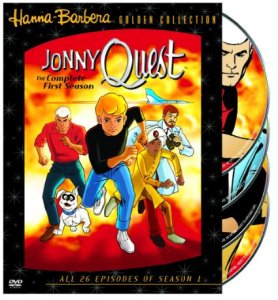
Jonny Quest Rewatch

Speaking of rewatches of favorite childhood shows, I have in fact finished a ‘rewatch’ of one of my earliest favorite TV shows, the 1964 animated series ‘Jonny Quest’, via a DVD set I bought some years ago and haven’t watched until now, over the past three weeks. The show was broadcast from 1964 to 1965, lasting only one season of 26 episodes, in the same era as Bewitched, Gilligan’s Island, The Addams Family, Voyage to the Bottom of the Sea, and Flipper. In retrospect, this may have been the earliest show I saw that had science-fictional elements, a year before Lost in Space (which I only discovered about half-way through its first season) and two years before Star Trek. Somewhat like those shows, JQ has developed a long-lasting fan base, and relative immortality via DVD (and a few episodes on YouTube).

Yes, this was an animated series, thus relatively a kids’ show, but it was far more sophisticated than other animated series up until then, deliberately produced to be more realistic, in terms of characters and settings and premises, than the other animated shows of the time (Flintstones and The Jetsons).

The series was based on earlier comics books and radio series, such as Terry and the Pirates. After watching the DVD series, this past week, I discovered this remarkably sophisticated documentary about the show on YouTube, 2 hours long though broken into three parts. It provides a lot of background and context about the show that I didn’t appreciate until discovering it this week. The show’s heritage was earlier comics and radio series by Alex Toth and Doug Wildey; the studio heads William Hanna and Joseph Barbera – Hanna/Barbera – hired Wildey to create a show based on the long-running radio series Jack Armstrong: The All American Boy — and was sketched into animation in scenes still shown in the end credits of Jonny Quest (that are not from any JQ episode). The producers changed their minds, and asked Wildey to create a new show with new characters. His creation was called “The Sage of Chip Balloo” – before the producers changed the kid’s name to Jonny Quest.

So: the show is about Jonny Quest, his father Dr. Benton Quest, a world-renowned scientist, Quest’s pilot and bodyguard “Race” Bannon, and their ‘adopted son’ Hadji, an Indian boy who saved Dr. Quest’s life while visiting Calcutta. The episodes involve various investigations by Dr. Quest, who seems to have a new scientific specialty each week (sonic waves one week, lasers another, sea fish another, a rare mineral to support the space program on another) or who is challenged by alerts from old friends (a colleague who is captured by jungle natives) or threats from comic-book character Dr. Zin (via a robot spy, etc.)

The show had an international quality. The Quest team was based at Palm Key, an imaginary island off Florida, but each week’s episode took them to any number of places around the world, via their various high-tech jets. That was another key theme: the inclusion of various high-tech, for the 1960s, gadgets. Lasers, VTOL jets, personal video communicators.

There were a few science fiction and fantasy elements — anti-gravity, a robot spy, a true yeti, a true mummy, not to mention Hadji’s various magic tricks (“sim, sim, sala bim!”) — but just as often the plots involved various nefarious bad guys, evil geniuses or nonspecific representatives of various foreign governments, with no fantastic elements.

A key point about all these old TV shows (including LIS and Trek!) is this: the makers of those shows assumed they were making disposable goods, to be seen once and forgotten, like (in the words of one of the people in this JQ documentary) using a Kleenex and throwing it away. The TV era of the 1960s was long before video-casette recorders (VCRs) and DVD players, let alone YouTube; I suspect young people today don’t appreciate how transient was the TV work of half a century ago. The creators of TV shows of that era would have been amazed to think that their work would survive 50 years and be subject of analyses and documentaries. Which, among other things, is why we later viewers need to give them some slack about errors and inconsistencies. They did a pretty good job, all things considered.

Another personal point: Like LIS and Trek, and any number of other shows that affected me in my 1960s childhood: I didn’t necessarily see all the episodes of any of these shows when first broadcast. I saw most of them in syndicated reruns in later years, in the 1970s and beyond. But when syndicated, episodes were trimmed by local broadcasters, to allow for more commercial time. Which means that, even of my favorite shows (Trek), I’m not sure I’ve actually ever seen every scene of every episode. I’m fairly sure this is true for *every* show I watched from that era… which gives me some incentive to do some deliberate re-watches of those shows, via DVDs, now that I have the time to do so.

Back to JQ: The documentary also reveals that the DVD that I just watched has incorrect credits for most episodes – which credits indicate that one William D. Hamilton wrote all the episodes but the very first one, which would have been an amazing feat! But in fact there were many writers, including Walter Black, Joanna Lee, Charles Hoffman, and others. (Though Hamilton did in fact write quite a few.)

The documentary includes some interviews, with the likes of Brad Bird, expressing their appreciation for the show. Among many incidental facts discussed is the music of Hoyt Curtin, the voice work of Vic Perrin (the “control voice” of The Outer Limits, and a guest in episode of Trek, and the voice of numerous JQ villains), and the idea of “planned animation” that made weekly animated series possible.

The documentary identifies fan favorite episodes, but I will conclude with my own take on the coolest episodes: “The Robot Spy”; “Turu the Terrible”; “The Invisible Monster” (“paint it!”); “Shadow of the Condor”; and “The House of Seven Gargoyles”.


Posted in Personal history, TV Sci Fi | Comments Off on Jonny Quest Rewatch

Lost in Space, Season 4

While sorting through a couple old file cabinets today, deciding what I should keep and what I can toss, I came across a file that I must have discovered some 30 years ago, when I was obsessed with rewatching childhood favorite TV shows, back in an era before DVDs or Netflix or even VCRs. I recall the film/TV library at UCLA… is that where I found this? Don’t recall, can’t be sure. In any case, this seems to be a set of TV Guide-like descriptions for a potential fourth season of the TV series Lost in Space — which, obviously, was never produced. Judging from the recurrent themes and the simplistic episode titles, this does have a certain air of authenticity. But I cannot vouch for this, other than to reproduce here something I came across, somehow somewhere, 30 years ago.

#1, “Vaults of Infinity”
While the crew of the Jupiter 2 decide to begin using the still unopened auditorium in the lower levels of their ship, Dr. Smith discovers a vast weapons vault and seizes control. The Robinsons hide out in the gymnasium, while the Jupiter 2 plunges uncontrollably toward a black planet.

#2, “Planet of No Return”
Everything is black on the black planet – including a ferocious monster threatening our heroic travelers. Smith tries to steal the J2 while the Robinsons are out on an excursion in the Chariot, but is captured by the black monster.

#3, “Space Monster”
When the J2 escapes the black planet, they are astounded to see the black monster leap into space after them! Meanwhile, Smith tries altering the course of the J2 for Earth, but instead turns the ship directly into the jaws of the dreaded beast!

#4, “Guts In Space”
Still trapped within the dreaded space creature, the Robinsons form a daring plan to escape – but the plan requires Smith to perform a heroic maneuver in the gymnasium. Will Smith have the courage to do it?

#5, “Space Fight”
Still trapped in the space monster, the Robinsons become desperate when the creature engages in a fight with another such creature. Will they survive??

#6, “Jupiter, Jupiter”
The Robinsons discover an exact duplicate of their ship floating abandoned in space. Who built it and why? Little do they know it’s an evil plot to steal the real J2!

#7, “Planet in Space”
The Robinsons crash on a dangerous planet due to break up in 10 hours. Dr. Smith hinders repair efforts when he becomes intoxicated by local fauna.

#8, “The Lost Planet Earth”
Star fixes indicate the J2 has arrived near our solar system, but instead of Earth they find a similar, but different, planet inhabited by a hostile race of androids. Did they conquer the real Earth, or are the Robinsons’ star charts fouled up?

#9, “Repairs in Space”
The robot is captured by an alien spacecraft in need of mechanical expertise to repair their star drive. While there, the aliens reprogram him to wreak havoc aboard the J2. Then the aliens offer to repair the J2 – for a price!

#10, “Music of the Planets”
The Robinsons land on a planet during a music festival, the prize of which is free passage to anywhere in the galaxy. Dr. Smith and the Robot begin tuning up, but when Will wins the biped semifinals, Smith resorts to scheming to accomplish his goal.

#11, “The Mysterious Cave”
Smith finds a strange coat in a cave full of ancient alien relics which transforms him into an alien leader, searching for his long forgotten followers.

#12, “Attack of Dimensions”
A meteor storm produces a strange earthquake which jolts the J2 into a strange dimension – then another, then another. Monsters from each cling to the ship to battle it, and their counterparts from other dimensions.

#13, “The Hollow Planet”
The Robinsons discover a hollow planet, but once inside, the opening seals and leaves them trapped! They discover another ship inside, ready to begin a deadly cat and mouse game.

#14, “Rock Creatures of Graniton”
The J2 crashes onto the planet Graniton, and is met by the hideous rock creatures, who demand they leave immediately – or be crushed to death.

#15, “Space Race”
Dr. Smith enters the J2 in an intergalactic space race, and is faced with stiff penalties if the worn-out J-2 doesn’t meet minimum time requirements. When the race gets underway, evil alien sabotage begins.

#16, “Magnet Planet”
The J2 is drawn irresistibly toward the planet Magniton, and must negotiate with the evil creatures there for release – until the robot steps in, and is captured.

#17, “The Big Space Roundup”
The Robinsons are captured by an intergalactic cowboy who is herding a herd of space cattle to roundup. As payment for frightening some of his space cattle, he demands that Smith or Will capture the renegade, legendary Lost Cow of Arcturus.

#18, “Space Fog”
A mysterious fog in space transports the J2 from one magical planet to another, until they are hopelessly lost – but suddenly Earth appears before them. Can they reach Earth before the deadly fog sucks them back in?

#19, “The Galactic Witch”
A strange sorceress casts a spell on the J2, and despite full supplies ready to reach Earth, they can’t escape their planet! Unless Smith can make a deal – trade the Robinson family for the Jupiter 2.

#20, “Hijackers of Space”
The J2 is boarded by a mysterious alien who holds a gun at Dr. Smith’s head and demands to be taken to Aldebaran. But when they arrive, another alien kills the first and demands to be taken to the Aderan galaxy, or he’ll shoot Will!

#21, “Robot King”
A planet run by robots offer the Robinson’s robot a chance to be their ruler—but first he must renounced all ties with his human builders.

#22, “War with the Wonder Planet”
The Robinsons land on an idyllic, beautiful planet inhabited by a peaceful civilization, but then war breaks out with another planet and our heroes are caught in the middle of it. When Judy and Don are captured by the enemy – hideous monsters – John must face a decision: help negotiate or continue to destroy.

#23, “Creature in Space”
As the Robinsons leave their latest planet, they discover that a hideous monster has sneaked aboard and hidden itself in the greenhouse. As the Robinsons hunt the deadly beast, Smith discovers that it wants to take over the ship and return to Earth, and becomes its accomplice.

#24, “Feast in Space”
The Jupiter 2 visits the Intergalactic Culinary Guild, where the family samples the tastiest dishes in all of space – until one of the chefs decides for his next dish he needs…. Dr. Smith.

#25, “Slime Planet”
The Jupiter 2 lands on a planet covered with slime and electric shocks. As their ship is slowly sinking into the green goo, the Robinsons race to make their ship ready for liftoff – until Smith accidentally opens the door and the slime floods inside.

#26, “Shadows in Space”
The Jupiter 2 passes through a dark region of space which turns everyone grumpy and quarrelsome –even the robot, whose crying rusts his gears.

#27, “Space Cake”
A special birthday party for Penny is disrupted when cosmic rays from a nearby comet storm affect the ship’s course – and turn the cake into a glowing, living being.

#28, “Magenta Monster”
The dreaded creature is held capture by a passing space traveler – until Smith lets it escape, endangering the lives of Will and Penny and bringing his captors’ wrath – the space traveler turns the rest of the Robinsons into formless ghosts.

#29, “Planet of the Space Police”
The Jupiter 2 is captured by an intergalactic space patrol ship, which carries it to their planet. The Robinsons don’t know if they are suspects or merely witnesses – until Smith is discovered trying to bribe an official for passage back to Earth.

I’ve discovered a similar set of descriptions for a hitherto unknown Season 4 of Star Trek, which perhaps I might post as well.

Posted in Personal history, TV Sci Fi | Comments Off on Lost in Space, Season 4

Sean Carroll on Everything

The physicist Sean Carroll has a new book coming out next May that I’m looking forward to: The Big Picture: On the Origins of Life, Meaning, and the Universe Itself.

Carroll blogs about it here, with an outline.

A key Carroll post is this one about The World of Everyday Experience, In One Equation:

Longtime readers know I feel strongly that it should be more widely appreciated that the laws underlying the physics of everyday life are completely understood. (If you need more convincing: here, here, here.)

…

This theory is correct in its domain of applicability. It’s one of the proudest intellectual accomplishments we human beings can boast of. Many people resist the implication that this theory is good enough to account for the physics underlying phenomena such as life, or consciousness. They could, in principle, be right, of course; but the only way that could happen is if our understanding of quantum field theory is completely wrong. When deciding between “life and the brain are complicated and I don’t understand them yet, but if we work harder I think we can do it” and “I understand consciousness well enough to conclude that it can’t possibly be explained within known physics,” it’s an easy choice for me.

And to see a style of his thinking, see A Compilation of Sean Carroll’s Best Arguments and Comebacks (A 15-minute video.)

Posted in Philosophy, Physics, Science | Comments Off on Sean Carroll on Everything

The Martian, the movie

(posted Sunday, 4 Oct 2015, on Facebook)

Saw The Martian today (*after* reading and posting Gary Westfahl’s review this morning — and also after reading Andy Weir’s novel a couple months ago) and I think it’s a prime example of a terrific film made from a mediocre book. The book, as I said, was formula suspense: something bad happens every 30 pages that you know our hero will overcome, because he’s the hero and has to survive. This is poor form for a novel, but a standard formula for Hollywood movies, and given the realistic depiction of the space mission and the Martian landscape, and the fine acting by all concerned, it made for riveting, frequently moving film. Kudos for the positive depiction of problem-solving and resolve, in contrast villain-formulas of so many Hollywood pics, even about space travel; for the interesting casting (following from the book) and a bit of character development (not in the book) of a couple key minor players; and for the almost uniformly plausible depictions of the space ships, their movements, the launches, the movements of people in space, and so on — nothing offhand as egregiously wrong as a couple key points in Gravity. (Acknowledging the frequently observed flaw that the thin Martian atmosphere would not whip up the storm that threatened to topple over the launch vehicle in the first place.) The 3D was impressive, though at times made everything look like toy models of landscapes, ships, even people, though I assume everything was filmed live, including the rovers crawling through the deserts of Jordan.

I still don’t find the Hermes’ captain’s obsession with ’70s music at all plausible, for reasons discussed in my review of the novel.

Finally: I appreciate the take in Gary Westfahl’s review that detects the irony between the positive view of NASA’s mission, and the unexamined assumption of the story that the whole point is to get the stranded astronaut *off* Mars. No thought about the challenges of staying, of settling — unlike any number of SF literary works. The film gives a positive spin to this, in the final scenes (not in the novel) that depict the launching of the next mission to Mars. In Gary’s review, and in Kim Stanley Robinson’s novel AURORA, and no doubt other places, there does seems to be a gradual realization within in the SF community that the visions of human colonization of planets and the expansion of humanity into the universe, will be much more difficult than those fictions have imagined… if possible, at all.

Posted in Movies | Comments Off on The Martian, the movie

Lying with Phony Graphs

If the anti-abortion anti-Planned Parenthood folks had a case, you’d think they wouldn’t need to lie with transparently inept graphs that misrepresent the actual data. Scroll down on this link to see an actual chart, legitimately scaled, showing the services provided by Planned Parenthood, of which abortions are the least of them, by a factor of 10, in contrast to STI/STD testing, contraception, and cancer screening.

There’s a video of Planned Parenthood president Cecile Richards reacting to this graph, which she had not seen before, and despite Dan Savage’s commentary here, she doesn’t respond strongly enough — a 5 second examination of this chart, which shows, at the right side, two data points upside down: the one for abortions, at 327K, above the the one for cancer screenings, at 935K, would indicate that this picture is completely invalid as a chart of actual data.

It’s hard not to think that this is yet another example of the intellectual incompetence of the right.

Vox: Whatever you think of Planned Parenthood, this is a terrible and dishonest chart

As Friendly Atheist comments,

If you’re a pro-life politician who wants to use that information to make Planned Parenthood look evil, what do you do? Easy. You just have to assume your base isn’t intelligent enough to look into the details of whatever you show them. It worked with the recent anti-Planned Parenthood videos, after all.

Posted in Conservative Resistance, Culture, Mathematics | Comments Off on Lying with Phony Graphs

Lawrence M. Krauss on Ben Carson

He says it better than I can (and of course with more authority).

Ben Carson’s Scientific Ignorance

It is hard to find a single detailed claim in his diatribe that is physically sensible or that reflects accurate knowledge about science. His central claim—that the second law of thermodynamics rules out order forming in the universe after the Big Bang—is a frequent misstatement made by creationists who want to appear scientifically literate. In reality, it is completely false.

…

When Carson says that scientists rely on “probability theory” to explain how multiple Big Bangs, taking place over “billions of years,” have resulted in our “perfectly ordered” universe, he’s profoundly misstating the theory of the Big Bang. (In fact, he seems to have gotten his ignorant arguments confused—his metaphor about a hurricane creating a 747 in a junkyard is often used to deride evolution, to which it is equally inapplicable.)

…

It is one thing to simply assert that you don’t choose to believe the science, in spite of a mountain of data supporting it. It’s another to mask your ignorance in such a disingenuous way, by using pseudo-scientific, emotion-laden arguments and trading on your professional credentials. Surely this quality, which reflects either self-delusion or, worse still, a willingness to intentionally deceive others, is of great concern when someone is vying for control of the nuclear red button.

Last week, when he was confronted, during a speech at Cedarville University, about his failure to understand basic and fundamental scientific concepts, Carson responded, “I’m not going to denigrate you because of your faith, and you shouldn’t denigrate me for mine.” What Carson doesn’t seem to recognize is that there is a fundamental difference between facts and faith. An inability to separate religious beliefs from an assessment of physical reality runs counter to the very basis of our society—the separation of church and state.

This is yet another example where one might easily conclude that conservatives, who are amenable to these kinds of arguments from incredulity (or from ignorance), are simply not very bright. Or, that Carson is appealing to a least-informed/intelligent base.

Jerry Coyne responds to the Krauss essay here.

Carson continues to insist, as do many religionists, that science, like religion, is simply a form of faith. I’ve picked the meat off that canard before, both in Slate and in Faith versus Fact, and we needn’t belabor it here. What’s funny about that argument is that it boils down to this claim by believers: “See! Science is just as bad as religion!” If they truly were equivalent, theology would have made as much progress in understanding God as science has in understanding the universe. But the score is zero for the former and a gazillion for the latter.

Posted in Conservative Resistance, Politics | Comments Off on Lawrence M. Krauss on Ben Carson

The Atlantic on trigger warnings; Kareem Abdul-Jabbar on the war on reason

I mentioned a while back the cover story on The Atlantic magazine’s September issue, The Coddling of the American Mind, by Greg Lukianoff and Jonathan Haidt. (Haidt is the author of the book The Righteous Mind: Why Good People Are Divided by Politics and Religion.) The essay is about the increased pervasiveness of “trigger warnings” on college campuses – advance notices to students about subjects to be discussed, e.g. incidents in novels involving sexual misconduct or racism, so that students can steel themselves as necessary, or at worst case, excuse themselves to avoid any possibility of being offended.

The editorial blurbs for this article characterize it as being a new kind of “political correctness”, but I don’t think that’s quite accurate. PC is most often cited by those who are annoyed they would get flack for offending or denigrating others, as if ordinary civility toward others, and polite nonaggression toward other points of view, amounted to a kind of socially imposed proper way to think, in Orwellian or Soviet terms. (Ironically, of course, those who resist “political correctness” are those most apt to claim exemption from criticism on the grounds of “sincerely held religious beliefs”.)

The issue at hand is something different. Yes, there are cases of women (or men) who have in fact been sexually assaulted, who find any allusion to such topics upsetting. But more often the demand for these “trigger warnings” seems to me a kind of “conservative resistance” to any ideas that might challenge the orthodoxies of these students, who are presumably in university to learn, but who wish to be shielded from anything that be contrary to their faithful worldview. At the extreme, it’s about the faithful who think it a crime for them to be offended – e.g. incidents by Muslims against Salman Rushdie or Charlie Hebdo.

But the article makes many interesting points, a few of which I’ll sample here.

The co-authors acknowledge:

There’s a saying common in education circles: Don’t teach students what to think; teach them how to think. The idea goes back at least as far as Socrates. Today, what we call the Socratic method is a way of teaching that fosters critical thinking, in part by encouraging students to question their own unexamined beliefs, as well as the received wisdom of those around them. Such questioning sometimes leads to discomfort, and even to anger, on the way to understanding.

But vindictive protectiveness teaches students to think in a very different way. It prepares them poorly for professional life, which often demands intellectual engagement with people and ideas one might find uncongenial or wrong. The harm may be more immediate, too. A campus culture devoted to policing speech and punishing speakers is likely to engender patterns of thought that are surprisingly similar to those long identified by cognitive behavioral therapists as causes of depression and anxiety. The new protectiveness may be teaching students to think pathologically.

And then they discuss changes in recent culture: how childhood has changed; how schools have become more conscious of safety; how culture has become more politically polarized.

So it’s not hard to imagine why students arriving on campus today might be more desirous of protection and more hostile toward ideological opponents than in generations past. This hostility, and the self-righteousness fueled by strong partisan emotions, can be expected to add force to any moral crusade. A principle of moral psychology is that “morality binds and blinds.” Part of what we do when we make moral judgments is express allegiance to a team. But that can interfere with our ability to think critically. Acknowledging that the other side’s viewpoint has any merit is risky—your teammates may see you as a traitor.

They discuss the “thinking cure”.

The goal is to minimize distorted thinking and see the world more accurately. You start by learning the names of the dozen or so most common cognitive distortions (such as overgeneralizing, discounting positives, and emotional reasoning; see the list at the bottom of this article). … The parallel to formal education is clear: cognitive behavioral therapy teaches good critical-thinking skills, the sort that educators have striven for so long to impart. By almost any definition, critical thinking requires grounding one’s beliefs in evidence rather than in emotion or desire, and learning how to search for and evaluate evidence that might contradict one’s initial hypothesis.

This is a very long article from which I will quote only a couple more key points and conclusions.

What are we doing to our students if we encourage them to develop extra-thin skin in the years just before they leave the cocoon of adult protection and enter the workforce? Would they not be better prepared to flourish if we taught them to question their own emotional reactions, and to give people the benefit of the doubt?

And they recommend:

Universities should also officially and strongly discourage trigger warnings. They should endorse the American Association of University Professors’ report on these warnings, which notes, “The presumption that students need to be protected rather than challenged in a classroom is at once infantilizing and anti-intellectual.” Professors should be free to use trigger warnings if they choose to do so, but by explicitly discouraging the practice, universities would help fortify the faculty against student requests for such warnings.

Not mentioned in the article, but obvious to me, is that the ultimate example of universities who shield their students from upsetting ideas are the religious colleges.

/\/\/\/\

On a related note, the October 5th issue of Time Magazine has a “viewpoint” essay about the “war on reason” by none of than Kareem Abdul-Jabbar: Ignorance Vs. Reason in the War on Education. (The title in print is “American Students — and politicians — need to stop waging war on reason”.)

The ideas are familiar enough, but are notable coming from someone you wouldn’t think especially aligned with political debate or ideological issues. But his comments are spot on, and dovetail with the Atlantic essay detailed above.

The attack on education isn’t on training our youth for whatever careers they choose, it’s on teaching them to think logically in order to form opinions based on facts rather than on familial and social influences. This part of one’s education is about finding out who you are. It’s about becoming a happier person. It’s about being a responsible citizen. If you end up with all the same opinions you had before, then at least you can be confident that they are good ones because you’ve fairly examined all the options, not because you were too lazy or scared to question them. But you—all of us—need the process. Otherwise, you’re basically a zombie who wants to eat brains because you don’t want anyone else to think either.

Thus,

That means this is a war on reason. And the generals leading the attack are mostly conservative politicians and pundits who have characterized our greatest thinkers as “elitists” who look down on everyone else. Uber-conservative William F. Buckley once said that he’d rather entrust the government to the first 2,000 people in the Boston phone book than to the faculty of Harvard University (he graduated from Yale). That’s a great sound bite that many would applaud as the triumph of street-level common sense over the egghead experts who are often viewed as impractical and removed, as if they didn’t share experiences in love and grief and raising children and paying mortgages.

And he identifies the biological and cultural culprits.

We seem hardwired to discard information that contradicts our beliefs. We have the Internet, the single most powerful information source and educational tool ever invented, but many of us use it only to confirm conclusions we didn’t arrive at through examining evidence. We go only to sites that agree with our position in order to arm ourselves with snippets that we can use as ammunition against those who disagree with us.

“The joy of college is arguing with others who are equally passionate and informed but disagree. It develops empathy for others and humility in yourself because you now will look upon your opponents not as evil idiots but as good people who want the same thing as you: a safe, loving, moral community.”

If you don’t want to read the books and develop the skills, don’t take the class. Don’t attend the college. Spend the rest of your life huddled among those who agree with you. But know that that is not thinking—it’s sleeping.

Of course this “war on reason” is fought by the ideological and religious because they know that if reason were accounted for and evidence acknowledged, their ideologies, beliefs, and faiths would be undermined.

Posted in Conservative Resistance, Culture, Morality, Provisional Conclusions, Psychology, Religion | Comments Off on The Atlantic on trigger warnings; Kareem Abdul-Jabbar on the war on reason

Politics: Religion vs. Rationality

Jeffrey Tayler’s latest weekly essay at Salon, this past Sunday, can be keyed to my earlier posts about Ben Carson. Make them shut up about God: The right-wing’s religious delusions are killing us — and them.

It focuses on the second Republican debate, and how journalists defer to religious pieties.

Interviewers should be hounding faith-flaunting candidates with hard-hitting questions, as they would on any other subject of import. They should disregard faith-based assertions and demand justification on evidentiary grounds. Politicians should be made uncomfortable for ignoring the worldview and concerns of rationalists.

Sample questions to be put to pietistic contenders for the White House: What makes you believe in God? Do you hear voices? See visions? Do you believe God answers your prayers? If so, please provide objective evidence. Why is, say, the Bible or the Torah better than the Quran? Does not the eternal hellfire the supposedly merciful Jesus promised sinners epitomize Constitutionally prohibited cruel and unusual punishment? If you consider the Bible a reliable guide for your personal life, may I ask if would you slaughter your child on God’s command (as Abraham was prepared to do)? Would you stone your daughter to death for not being a virgin on her wedding night? If not, why not? What scriptural authority can you cite for following your “Holy Book” in some cases, but not in others?

I admire that Tayler is out there saying this, which many of us think. It’s a mark of progress that such things can be said in a public forum without the masses ganging up to torch the offices of Salon or the home of Jeffrey Tayler. (Actually, I doubt that many who would be offended are reading Salon. They are too busy reading their own websites, the ones that reinforce their own beliefs.)

*Of course* journalists defer to religious pieties, because they are held by the vast majority of their viewers. It would be pretty to think that political debates could be determined on rational grounds – but, to the extent rationality conflicts with those pieties, I don’t see it happening any time soon.

Posted in Religion | Comments Off on Politics: Religion vs. Rationality

Evolution and the Teenaged Brain

From The New Yorker, August 31st, a review/essay by Elizabeth Kolbert on two books about the teenaged brain, The Terrible Teens. Many interesting points.

Every adult has gone through adolescence, and studies have shown that if you ask people to look back on their lives they will disproportionately recall experiences they had between the ages of ten and twenty-five. (This phenomenon is called the “reminiscence bump.”)

Why do teens engage in dangerous behavior like drinking games?

And what goes for drinking games also goes for hooking up with strangers, jumping from high places into shallow pools, and steering a car with your knees. At moments of extreme exasperation, parents may think that there’s something wrong with their teen-agers’ brains. Which, according to recent books on adolescence, there is.

Proximate cause:

According to Steinberg, adults spend their lives with wads of cotton in their metaphorical noses. Adolescents, by contrast, are designed to sniff out treats at a hundred paces. During childhood, the nucleus accumbens, which is sometimes called the “pleasure center,” grows. It reaches its maximum extent in the teen-age brain; then it starts to shrink. This enlargement of the pleasure center occurs in concert with other sensation-enhancing changes. As kids enter puberty, their brains sprout more dopamine receptors. Dopamine, a neurotransmitter, plays many roles in the human nervous system, the sexiest of which is signalling enjoyment.

“Nothing—whether it’s being with your friends, having sex, licking an ice-cream cone, zipping along in a convertible on a warm summer evening, hearing your favorite music—will ever feel as good as it did when you were a teenager,” Steinberg observes. And this, in turn, explains why adolescents do so many stupid things. It’s not that they are any worse than their elders at assessing danger. It’s just that the potential rewards seem—and, from a neurological standpoint, genuinely are—way, way greater. “The notion that adolescents take risks because they don’t know any better is ludicrous,” Steinberg writes.

Ultimate cause:

Steinberg explains the situation as the product of an evolutionary mismatch. To find mates, our primate ancestors had to venture outside their natal groups. The reward for taking chances in dangerous terrain was sex followed by reproduction, while the cost of sensibly staying at home was genetic oblivion. Adolescents in 2015 can find partners by swiping right on Tinder; nevertheless, they retain the neurophysiology of apes (and, to a certain extent, mice). Teen-agers are, in this sense, still swinging through the rain forest, even when they’re speeding along in a Tundra. They’re programmed to take crazy risks, so that’s what they do.

And then the impact of what this means for contemporary society, in which, as in so many things, our evolutionary honed behavior is at a mismatch with our current environment.

“If we were genuinely concerned about improving adolescents’ health, raising the driving age would be the single most important policy change we could make,” Steinberg writes. He favors a minimum age of eighteen.

Much the same logic applies to drinking, smoking, and doing drugs. Each year, the U.S. spends hundreds of millions of dollars on public-service campaigns designed to alert adolescents to the perils of such dissipations. Hundreds of millions—perhaps billions—more are spent reiterating this message in high-school health classes. The results have been, to put it kindly, underwhelming.

And

Many recent innovations—cars, Ecstasy, iPhones, S.U.V.s, thirty racks, semi-automatic weapons—exacerbate the mismatch between teen-agers’ brains and their environment. Adolescents today face temptations that teens of earlier eras, not to mention primates or rodents, couldn’t have dreamed of. In a sense, they live in a world in which all the water bottles are spiked. And so, as Jensen and Steinberg observe, they run into trouble time and time again.

But perhaps, it occurred to me the other day after one of my twins nearly plowed into a mailbox, to look at the problem this way is to peer through the wrong end of the MRI machine. Yes, adolescents in the twenty-first century pose a great risk to others and, statistically speaking, an even greater risk to themselves. But this is largely because other terrifying risks—scarlet fever, diphtheria, starvation, smallpox, plague—have receded. Adolescence evolved over a vast expanse of time when survival at any age was a crapshoot. If the hazards are new, so, too, is the safety. Which is why I will keep telling my kids scary stories and why they will continue to ignore them.

One of many examples about how modern human behavior seems irrational or counter-productive, but which can be understood by contrasting the environment in which human brains evolved to the modern world. (The other big one is why so many people are obese: sweets were rare in our evolutionary past, but valuable, and so humans evolved to crave them; now that sweets are plentiful, the craving has not diminished…)

Posted in Children, Evolution | Comments Off on Evolution and the Teenaged Brain

Oliver Sacks on SF

There are many reasons why I might have mentioned Oliver Sacks here before, which somehow escaped me, but here’s one from a couple weeks ago. From The New Yorker, Sept 14th, a piece by Atul Gawande remembering the late Oliver Sacks. Last paragraph:

Sacks had asked me whether I’d read Forster’s “The Machine Stops.” I hadn’t, but his letter prompted me to, and I see why he was so drawn to it. It’s about a world in which individuals live isolated in cells, fearful of self-reliance and direct experience, dependent on plate screens, instant messages, and the ministrations of an all-competent Machine. Yet there is also a boy who, like Sacks, saw what was missing. The boy tells his mother, “The Machine is much, but it is not everything. I see something like you in this plate, but I do not see you. I hear something like you through this telephone, but I do not hear you. That is why I want you to come. Pay me a visit, so that we can meet face to face, and talk about the hopes that are in my mind.”

Posted in science fiction | Comments Off on Oliver Sacks on SF