Donald Prothero on science illiteracy, the Dunning-Kruger effect

Another interesting blogger I’ve run across is Donald Prothero, author of a recent book called Reality Check: How Science Deniers Threaten Our Future, and a contributor to Skepticblog.

This post reads like an introduction to the theme of that book. The US thinks of itself as the #1 superpower in the world, with a monopoly on scientific achievement. But others were #1 in science in past centuries and millennia — the Greeks before Rome, the Arabs from roughly 800-1100 A.D., the Soviet Union in the mid-20th century. They were undone by Roman conquerors, Muslim religious extremism, and Soviet allegiance to ideology (Lysenkoism). And there are similar ominous trends in the US.

…the Bush Administration actively interfered with legitimate scientists, rewriting reports by federal scientists that disagree with their right-wing ideology, encouraging fringe scientists to testify as legitimate equals with well-regarded scientists in order to cancel out their politically inconvenient message, and generally ignoring the conclusions of scientists who don’t agree with them. As we saw in previous posts, the House “Science” Committees are run by creationists and climate deniers. The current Republican House majority asks global warming deniers and other fringe scientists to testify in front of Congress, and passes bills denying obvious scientific facts. Stem-cell research in the United States has been set back compared to that in other countries, as our best scientists go to countries with less political oppression.

On another topic, here he is on The Dunning-Kruger Effect, which says that

ignorant or unskilled people tend to overestimate their level of competence and expertise, while those who are truly expert sometimes underestimate their true level of expertise

Or as he quotes Bertrand Russell,

The trouble with the world is that the stupid are cocksure and the intelligent are full of doubt.

It seems to be a common effect lately, what with

non-experts trying to shout down people with expertise, or demagogues using the label of “elitism” to push their policies as they ridicule the experts who challenge them

He gives examples: Deepak Chopra, creationists like Duane Gish, the Bush administration, purveyors of quack medicine, climate change deniers, and the author of Conservapedia — about whom Prothero has this post in which said author tries to discredit Einstein and relativity by… quoting Bible verses.

Posted in Science | Comments Off on Donald Prothero on science illiteracy, the Dunning-Kruger effect

Plinks: Steven Pinker, Carl Zimmer, Anti-Intellect, History Chart, Weigel on Card

A collection of quotes from what I thought were interesting articles and posts and tweets, over the past week or more (I should post more often). (And actually, I’m saving a few for later posts.) Perhaps I will call posts like this Plinks — Personal links, and in analogy with the Blinks I do on Locus Online.

*

The most important item recently is this provocative essay by Steven Pinker about the tension between science and the humanities — and those who accuse science of ‘scientism’.

http://www.newrepublic.com/article/114127/science-not-enemy-humanities

(I know the eyes glaze over long quoted paragraphs. But I wouldn’t do this if I didn’t think these long paragraphs were worth reading.)

The moral worldview of any scientifically literate person — one who is not blinkered by fundamentalism — requires a radical break from religious conceptions of meaning and value.

To begin with, the findings of science entail that the belief systems of all the world’s traditional religions and cultures—their theories of the origins of life, humans, and societies—are factually mistaken. We know, but our ancestors did not, that humans be4long to a single species of African primate that developed agriculture, government, and writing late in its history. We know that our species is a tiny twig of a genealogical tree that embraces all living things and that emerged from prebiotic chemicals almost four billion years ago. We know that we live on a planet that revolves around one of a hundred billion stars in our galaxy, which is one of a hundred billion galaxies in a 13.8-billion-year-old universe, possibly one of a vast number of universes. We know that our intuitions about space, time, matter, and causation are incommensurable with the nature of reality on scales that are very large and very small. We know that the laws governing the physical world (including accidents, disease, and other misfortunes) have no goals that pertain to human well-being. There is no such thing as fate, providence, karma, spells, curses, augury, divine retribution, or answered prayers—though the discrepancy between the laws of probability and the workings of cognition may explain why people believe there are. And we know that we did not always know these things, that the beloved convictions of every time and culture may be decisively falsified, doubtless including some we hold today.

And:

The phenomena we experience may be explained by principles that are more general than the phenomena themselves. These principles may in turn be explained by more fundamental principles, and so on. In making sense of our world, there should be few occasions in which we are forced to concede “It just is” or “It’s magic” or “Because I said so.”

*

Carl Zimmer, at National Geographic, takes on evolution denialists who keep changing the terms of what evidence they would acknowledge…

http://phenomena.nationalgeographic.com/2013/08/16/experimental-evolution-and-the-false-solace-of-theyre-still-bacteria/

Re: Darwin:

He pointed out, for instance, that natural selection was a logical — even inescapable — fact of life. Individuals varied in their traits. Some of those variations influenced how many offspring they had. And those traits could also be passed down to offspring. Under such conditions, natural selection just happens.

This captures a point not generally appreciated — never mind all the evidence or disputations thereof. The principles of natural selection only require what he describes, and it’s inevitable — which is why the principles apply not only to biological history, but in many other arenas, and why it’s been called perhaps the single greatest idea of all time.

*

The Anti-Intellect Blog on Facebook
https://www.facebook.com/pages/The-Anti-Intellect-Blog/346440785368116?ref=stream&hc_location=stream

Belief or disbelief in god is not about intelligence, though that factors. It’s about the serviceability of myths. Who needs them and why. Belief in god also has a lot to do with ignorance and indoctrination. A person is not necessarily dumb because they believe in god or intelligent because they do not. Some “smart” people believe in god. Some “dumb” people do not. The problem with belief in god is that it is a human idea, subject to whim. Or at least that is one of the problems. There’s also no evidence to back up the claim, but people love believing things without evidence.

Whoever this guy is, he seems to tweet constantly, about religious, gay, and feminist issues, and he has a book of essays coming out next February, under this alias. (Which alias is obviously some kind of irony.)

*

These I already posted on Facebook:

Cool chart:

http://www.slate.com/blogs/the_vault/2013/08/12/the_1931_histomap_the_entire_history_of_the_world_distilled_into_a_single.html

A 1931 chart of human history since 2000 BC. It’s remarkable for how slender the two centuries of the United States is, against 4000 years of history — not to mention the millions and billions of years of Earth history before that.

*

David Weigel of Slate comments about Orson Scott Card’s “fascinating political paranoia” — in a long column Card presents as a “thought experiment” about “how American democracy ends”.
http://www.slate.com/blogs/weigel/2013/08/14/orson_scott_card_worries_about_obama_turning_urban_gangs_into_his_personal.html

Card:
Obama is, by character and preference, a dictator. He hates the very idea of compromise; he demonizes his critics and despises even his own toadies in the liberal press. He circumvented Congress as soon as he got into office by appointing “czars” who didn’t need Senate approval. His own party hasn’t passed a budget ever in the Senate.

In other words, Obama already acts as if the Constitution were just for show. Like Augustus, he pretends to govern within its framework, but in fact he treats it with contempt.

To which Weigel responds:
Here on Earth, Obama has actually signed off on a series of compromises that fell short of what he demanded—the health care law, the debt limit increases — and he’s only the latest president to appoint a series of advisers who are termed “czars.”

Weigel goes on. I can’t bring myself to read the entire Card piece.

Posted in Commonplace Book, Quote at Length, Science, Thinking | Comments Off on Plinks: Steven Pinker, Carl Zimmer, Anti-Intellect, History Chart, Weigel on Card

Review of Lauren Beukes’ The Shining Girls


Having just posted Gary K. Wolfe’s Locus review of The Shining Girls by Lauren Beukes, it’s timely for me to spend a few minutes adding my own reaction.

To summarize very briefly (since you can read Gary’s summary right there), the novel is about a serial killer, Harper Curtis, in Chicago who occupies a run-down house (‘The House‘) in a deserted part of the city. The house enables him to move back in forth in time — from 1931 to 1993, at least — and inside the house is a room with names of women on the wall. These are the ‘shining girls‘ that Curtis becomes compelled to seek out and murder. The novel alternates, roughly, between Curtis and a young woman, Kirby Mazrachi, who, unbeknownst to Curtis, survived one of his attacks. Kirby subsequently takes a job as an intern at the Chicago Sun Times to try to track him down.

As in any serial killer novel, I suppose, some descriptions of violence are pretty brutal. But Beukes can write tenderly and movingly too, in passages like this, in which she describes the consequences of one victim’s murder:

Her father will never recover. His weight drops away until he becomes a wan parody of the loud and opinionated estate agent who would pick a fight at the barbecue about the game. He loses all interest in selling houses. He tapers off mid-sales pitch, looking at the blank spaces on the wall between the perfect family portraits or worse, at the grouting between the tiles of the en-suite bathroom. He learns to fake it, to clamp the sadness down. At home, he starts cooking. He teaches himself French cuisine. But all food tastes bland to him.

Gary’s review sort of gives away what I might have thought would be a spoiler. No, not whether the bad guy is caught at the end — rather, what’s up with this House, why *these* girls and not others, say. But I’ll continue under the link…

[ show/hide spoiler discussion ]

It’s not a spoiler partly because of the comparison of this book to Audrey Niffenegger’s The Time Traveler’s Wife. Which is to say: there is no explanation for the time travel in this book, any more than there was in that one. It just is. No explanation for why those girls and not others. They just are, they’re victims.

However…. as Gary did not mention in his review… there are suggestions of a Heinleinian “By His Bootstraps” closed loop of causality. The first hint I saw was on page 188 — Curtis gives an old woman the same coat he takes from her later in time (but earlier in the book) — the coat in which he found the key to the House. And then at the very end, when Curtis has been vanquished, a by-passer finds the key that he has dropped, and uses it to enter the house — and this is Bartek, who Curtis earlier/later killed when *he* found the house. So.

Does this ‘explain’ anything, or is it just a bit of cleverness? I think these are nods to readers who might recognize such allusions — as Gary mentioned, Beukes is apparently genre-savvy — but aren’t actually intended as explanations in the Heinleinian sense, or any science fictional sense. So I guess the point is, and Gary’s point in his review is, that devices like time travel are so taken for granted in popular culture that they don’t need ‘explanation’ or justification anymore.

Unless you’re expecting hard-headed rational science fiction, which this book obviously isn’t. The result instead is, here we have a time travel novel that is not, as most time travel novels are, science fiction.

Posted in Reviews | Comments Off on Review of Lauren Beukes’ The Shining Girls

Stories, Narratives, Facts

Salon has an excerpt from a new book by David McRaney, You Are Now Less Dumb. I think I’ll quote from the excerpt, just because (at the moment) I can.

The people who came before you invented science because your natural way of understanding and explaining what you experience is terrible. When you believe in something, you rarely seek out evidence to the contrary to see how it matches up with your assumptions. That’s the source of urban legends, folklore, superstitions, and all the rest. Skepticism is not your strong suit. In the background, while you crochet and golf and browse cat videos, people using science are fighting against your stupidity. No other human enterprise is fighting as hard, or at least not fighting and winning.

When you have zero evidence, every assumption is basically equal. You prefer to see causes rather than effects, signals in the noise, patterns in the randomness. You prefer easy-to-understand stories, and thus turn everything in life into a narrative so that complicated problems become easy. Scientists work to remove the narrative, to boil it away, leaving behind only the raw facts. Those data sit there naked and exposed so they can be reflected upon and rearranged by each new visitor.

Posted in Quote at Length, Science | Comments Off on Stories, Narratives, Facts

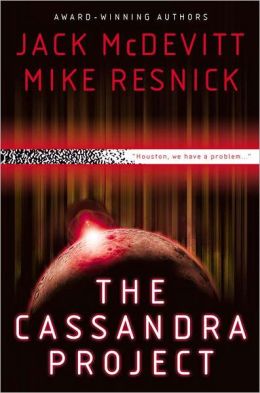
Review of McDevitt & Resnick’s The Cassandra Project

Jack McDevitt and Mike Resnick’s The Cassandra Project (2012) is set in 2019 at a time when NASA funding is being cut and many worry that NASA may be disbanded altogether.

It begins with a routine release of old records from the 1960s that includes voice recordings from an early Apollo mission in which a LEM pilot is heard saying “approaching launch point” and Houston replying “go for launch”. Reporters pounce — does this mean someone landed on the moon before Apollo 11?

The central character is Jerry Culpepper, NASA public affairs director, who’s caught unprepared for this sudden controversy. Worse, circumstantial evidence keeps mounting to support the idea of an earlier landing [it’s clever how the authors deftly avoid naming by number those earlier missions; they never say Apollo 9 or Apollo 10], even as officials, all the way to the president, dismiss the idea.
Continue reading →

Posted in Reviews | Comments Off on Review of McDevitt & Resnick’s The Cassandra Project

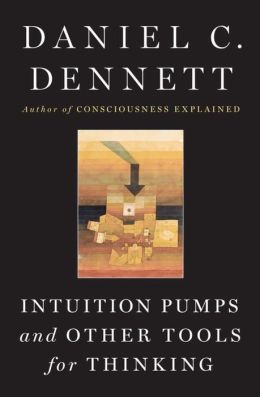
Notes on Daniel Dennett, 1

I plan to post various kinds of responses to books I’ve read or am reading; some will be reviews, some will be notes with comments. This entry is one of the latter. (Note this only covers the first 60 pages or so of a 400+p book.)

Daniel Dennett is a well-known philosopher (Wikipedia) who’s applied his thinking to cutting edge issues of science – evolution, consciousness, free will — and has written numerous tomes on these subjects and others.  This book is something of a hodgepodge, but a useful one. It starts by describing various thinking tools, including ‘intuition pumps’, and then applies those tools to issues of meaning, mind, and free will. Some of the ‘tools’ are negative ones, to be avoided, since they are most often used to mislead and deflect critical thinking. Thus this book is of interest to me not just for its application to those studies, but as a compilation of thinking tools that can be applied in any area of daily life.

Following is a summary, with occasional comments by me in [brackets].

Continue reading →

Posted in Book Notes, Philosophy, Thinking | Comments Off on Notes on Daniel Dennett, 1

Twitter So Far

So I created a Twitter account a couple weeks ago, initially to track someone posting comments about Locus Online, but mostly just to come up to speed with this form of online social media, as a publisher of an [online] website myself. Yes, I’m a couple years behind the times; but I try not to be *more* than a couple years behind the times.

I’ve quickly ‘followed’ over the past couple weeks some 300 fellow tweeters, and have been followed by 69 folks currently.

Comment 1: At least half of those 69 are folks I’ve never heard of, and have no idea why they would have seen my account and chosen to follow me. [This is not that much different than Facebook, where I have some 260 friends whom I’ve approved, and at least another 200 friend requests that I’ve ignored, since I have no idea who they are.]

Comment 2: I have a correspondent, a contributor to Locus Online, say about Twitter, “It’s responsible for the ongoing downfall of our civilization. I pity the necessity for you to follow it.” Obviously he is not on Twitter.

Comment 3: I think Twitter is like being in a convention party room, with dozens of people standing around holding conversations, and being able to follow all those conversations at once, more or less. It’s fun to follow, but if you walk out of the room to go elsewhere, you will miss these conversations, just as ignoring Twitter for a while means you will miss analogous tweets. I.e., you’re not necessarily missing anything important. You can’t follow everyone all the time. Life is short.

Comment 4: The best thing about Twitter is that you can follow folks who don’t need to approve you as ‘friends’, as on Facebook; thus I can follow Barack Obama, Ricky Gervias, and Wil Wheaton. And discover, through re-tweets (RT), fascinating, provocative people like @Anti_Intellect.

I think I’ve figured out how to embed Twitter posts in a blog post like this. Here are a couple examples that struck me in the past couple days (posting these mostly to see if these work).

Posted in Personal history | Comments Off on Twitter So Far

Today’s Pet Peeve

Folks who pronounce the T in often. Even some very intelligent folks. But do they also do so in listen or moisten, words with similar derivations? They do not. Lose the T, please.

Posted in Pet Peeves | Comments Off on Today’s Pet Peeve

Today’s favorite song – Moby

Posted in Music | Comments Off on Today’s favorite song – Moby

Cory Doctorow on Father’s Day, and Scientific Method

Popular Mechanics: What My Father Taught Me: Cory Doctorow

My dad was really good at making me think everything through. The scientific method is a totally counterintuitive thing because it begins by saying: You can’t trust your memory or your senses. You have to measure things empirically and write them down because otherwise everything you remember and everything you know is colored by your biases and experiences and hopes and aspirations. And essentially your brain lies to you all the time. This is a very hard thing to get a 5-year-old to understand.

Posted in Commonplace Book, Quote at Length, Science | Comments Off on Cory Doctorow on Father’s Day, and Scientific Method