Stephen King, REVIVAL

I enjoy Stephen King’s novels, but he writes too many of them (one or two every year) for me to keep up with all of them, and so I tend to get to only every third or fourth book, whenever the book’s theme appears at least vaguely science-fictional (the last one I read was 11/22/63), or some other aspect of the book seems interesting. I decided to read Revival because a key plot point — hardly a spoiler, it’s alluded to in the front flap description — involves a small-town minister’s ‘deconversion’ from faith following a family accident. I was curious how this would play out fictionally, since I’m always fascinated by how people (not just religious people) justify their beliefs or unbeliefs.

The story is narrated by Jamie Morton, beginning in 1962 when he’s 6 years old [and thus very close to my own age], and then forward across the decades to the present year. In 1962 Rev. Charles Jacobs, a new, young, minister comes to Jamie’s small Maine town of Harlow, with a beautiful wife and charming kid and a hobbiest obsession with electricity. A couple years later tragedy befalls, as alluded to, which leads to Jacobs’ delivery of what becomes known in town lore as the “Terrible Sermon”. Jacobs stands before his congregation and recites a litany of other senseless accidents (which challenge the idea of a loving, benevolent God) and then draws a series of conclusions (familiar to those of us who never found religious claims particularly plausible in the first place), e.g., he describes the many branches of Christianity — Catholics, Episcopalians, Methodists, Baptists, and on and on — and then says (p71m):

“Here in Harlow, w’ere all on party lines, and it seems to me that religion is the biggest party line of them all. Think how the lines to heaven must get jammed on Sunday mornings! And do you know what I find fascinating? Each and every church dedicated to Christ’s teaching thinks it’s the only one that actually has a private line to the Almighty. And good gosh, I haven’t even mentioned the Muslims, or the Jews, or the theosophists, or the Buddhists, or those who worship America itself just as fervently as, for eight or a dozen nightmare years, the Germans worshipped Hitler.”

Members of the congregation begin to walk out. Jamie, our narrator, narrates (p72.2):

My mother was sobbing audibly, but I didn’t look around at her. I couldn’t. I was frozen in place. By horror, yes, of course. I was only nine. But there was also a wild, inchoate exultation, a feeling that at last someone was telling me the exact unvarnished truth.

Jacobs goes on, and concludes (p73.3, 74.3):

“But as I stood in the back room of Peabody’s [the funeral parlor] and looked down at the mangled remains of my boy, who wanted to go to Disneyland much more than he wanted to go to heaven, I had a revelation. Religion is the theological equivalent of a quick-buck insurance scam, where you pay in your premium year after year, and then, when you need the benefits you paid for so–pardon the pun–so religiously, you discovery the company that took your money does not, in fact, exist.”

…

“Just one more thing. We came from a mystery and it’s to a mystery we go. Maybe there’s something there, but I’m betting it’s not God as any church understands Him. Look at the babble of conflicting beliefs and you’ll know that. They cancel each other out and leave nothing. If you want the truth, a power greater than yourselves, look to the lightning — a billion volts in each strike, a hundred thousand amperes of current, and temperatures of fifty thousand degrees Fahrenheit. There’s a higher power in that, I grant you. But here, in this building? No. Believe what you want, but I tell you this: behind Saint Paul’s darkened glass, there is nothing but a lie.”

After which Jacobs walks out, and shortly the church deacons fire him, and Jacobs leaves town forever….almost. As the last-quoted passage suggests, the “Terrible Sermon” is a motivator for what Jacobs does over subsequent decades; the book isn’t about the validity of religious faith, it’s about the obsession of one person who’s lost his faith to pursue, via his obsession with electricity, a particular goal, and how his path, and the narrator Jamie’s path, come together again and again over the years.

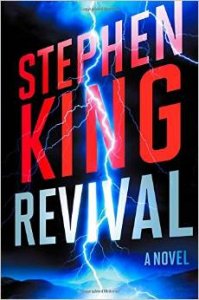
Over those years, Jamie joins rock bands, becomes a druggie, encounters Jacobs and is cured of his addition to heroin via “secret electricity”, gets a job at a music studio in Colorado, attends a family reunion, and finds himself eventually drawn into Jacobs’ employ; Jacobs, meanwhile, uses his electrical apparatus (which he used to apparently cure Jamie’s brother of a lost voice, early on), goes from carnival sideshow event, to revival preacher who cures people’s ailments, with millions of followers, eventually to wealthy recluse back near Jamie’s hometown. And so the two characters come together at the end, with a Grand Guignol climax involving lightning strikes (see book cover) and Jacobs’ obsession with the fate — in light of his loss of faith — of his wife and son.

Here’s what I like about Stephen King books, no matter what the subject. King has an ironclad grip on American culture and its people: he understands how all kinds of people think and interact, as if he’s been everywhere and seen everything; he evokes times and places with specific references to places and product names in ways that underscore his authority as a storyteller [yet which might prove problematic for future readers who don’t recognize such references], again, as if he’s been there and done that. And there’s always a complexity to his characters with emotional repercussions. In this book, the protocols of small town life; a charming family reunion in which Jamie’s grand-niece takes to him; a heartbreaking coda concerning one of Jamie’s family members…

Let me quote a couple more passages. This one, p373m, out of context, by narrator Jamie:

At the heart of every established religion is one sacred mystery that supports belief and induces fidelity, even to the point of martyrdom. Did he [Jacobs] want to know what lay beyond death’s door? Yes. But what he wanted more — I believe this with all my heart — was to violate that mystery. To drag it into the light and hold it up, screaming Here it is! What all your crusades and murder in the name of God were for! Here it is, and how do you like it?

Another, p270m, in which Jamie has challenged Jacobs’ role as a faith healer. Jacobs says

“They don’t deserve the truth. You called them rubes, and how right you are. They have set aside what brains they have — and many of them have quite a lot — and put their faith in that gigantic and fraudulent insurance company called religion. It promises them an eternity of joy in the next life if they live according to the rules in this one, and many of them try, but even that’s not enough. When the pain comes, they want miracles. To them I’m nothing but a witch doctor who touches them with magic rings instead of shaking a bone rattle over them.”

To which narrator Jamie thinks,

My researches with Bree had convinced me that Fox Mulder was right about one thing: the truth is out there, and anyone in our current age, where almost everyone is living in a glass house, can find it with a computer and an Internet connection.

At the risk of closing this review on a discordant note, I appreciate this last sentiment. In one sense, it’s true: the internet provides information and knowledge on absolutely everything. But what King’s characters don’t note is that most people don’t care — at most they’re only interested in finding other like-minded ‘truths’ out there on the Internet that correspond with their own. This is a whole ‘nother subject.

So final note: Jacobs’ obsession with “secret electricity” is attributed to his research into various “forbidden books” by the Catholic Church, including especially De Vermis Mysteriis, “supposedly the bases of H.P. Lovecraft’s fictional grimoire, called The Necronomicon” (p336t). In the novel, Jamie verifies all this on Google. But of course, this is a novel; it’s fiction. Wikipedia: De Vermis Mysteriis was in fact the invention of author Robert Bloch, later best-known for the novel Psycho, basis for the Alfred Hitchcock film. But which did inspire H.P. Lovecraft.
Posted in Book Notes, Religion | Comments Off on Stephen King, REVIVAL

Links and Comments: Biblical Literalism; the Manhattan Option; the excessive optimism of 2001; Neil de Grasse Tyson explains everything

Adam Lee: So Wrong For So Long: On Liberal Biblical Reinterpretation

Lee discusses the cognitive dissonance of those who espouse progressive social views while maintaining fealty to their Biblical-based religions. They rely on relativistic interpretation of scripture, as if the words of the Bible don’t actually mean what people for most of two millennia have thought they meant.

If God wants LGBT people to be given equal rights, why didn’t he say so thousands of years ago? Why is that something he revealed only in the modern era – say, within the last forty years – ensuring that they were objects of hate, harassment and persecution for centuries before that? Why did he allow that injustice to continue for so long before finally delivering the revelation that would gradually end it? Whether you believe that the anti-gay verses in the Bible were God’s word but have been misinterpreted all along, or whether you believe God never had anything to do with them but that they were put there by fallible humans, the problem holds either way.

The same thing could be said about slavery, or the inequality of women, or racial segregation, or anti-Semitism, or any of the countless other evils that were justified in their day by citing holy books and the will of God.

Adam Lee also explores the idea of The Manhattan Option, a follow-up to the “Benedict Option”, in which Christians withdraw from wider society into their own, insular communities. [Though isn’t this mostly true in practice in most small towns throughout the ‘heartland’, especially in the South? is my thought.] The “Manhattan Option” is

a defiant pledge to engage in civil disobedience against any law that transgressed their “religious conscience”. While the Manhattan Declaration pays lip service to the idea of helping the poor or ending oppression as religious duties, the two causes it treats as paramount are, of course, banning abortion and ending gay marriage.

(One more example of one of my PvCs.)

\\

Re: film, science fiction, the future.

This article at The Space Review, 1997, 2001, 1999: a science fiction calendar from the Apollo era makes the likely valid criticism of the canonical SF film 2001: A Space Odyssey was wildly over-optimistic, even for 1968, about its vision of huge orbiting space stations and cavernous landing pads on the Moon. With additional discussion of Lost in Space (a childhood favorite of mine) and Space: 1999 (which I never watched after the first episode, which took place on a Moon base “on the dark side of the moon”).

I have a small stack of books about past visions of the future, which in retrospect range from wildly optimistic (like the vision of 2001) to ludicrously implausible. This article might go with those.

\\

Physicist Sean Carroll responds to an io9 post by George Dvorsky, asking Why is the Universe So Damn Big?.

Whenever we seem surprised or confused about some aspect of the universe, it’s because we have some pre-existing expectation for what it “should” be like, or what a “natural” universe might be. But the universe doesn’t have a purpose, and there’s nothing more natural than Nature itself — so what we’re really trying to do is figure out what our expectations should be.

The universe is big on human scales, but that doesn’t mean very much. It’s not surprising that humans are small compared to the universe, but big compared to atoms. That feature does have an obvious anthropic explanation — complex structures can only form on in-between scales, not at the very largest or very smallest sizes. Given that living organisms are going to be complex, it’s no surprise that we find ourselves at an in-between size compared to the universe and compared to elementary particles.

File this under: why human perception is not necessarily an accurate guide to reality.

\\

Here is a video by Neil de Grasse Tyson that explains everything in the universe [as we currently understand it] in under 8 minutes.

Watch Neil deGrasse Tyson explain literally everything in the universe in under 8 minutes

This dovetails with the previous post — naive human ideas about how the universe should exist, according to human values. Anyone interested in reality, outside the tribal narratives that drive their evolutionary survival, should be curious about this.

File this under: the universe is large; human perception is not necessarily etc., especially on the point of the vast scale of the universe compared to what humans comfortably perceive.

I like this quote at the end:

“We’ve been empowered by the universe to figure itself out.”

Posted in Conservative Resistance, MInd, Religion, Science, science fiction, Space | Comments Off on Links and Comments: Biblical Literalism; the Manhattan Option; the excessive optimism of 2001; Neil de Grasse Tyson explains everything

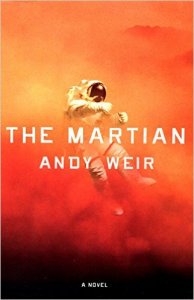
Andy Weir, THE MARTIAN

I don’t have a lot to say about Andy Weir’s THE MARTIAN, which I finally picked up because 1) it’s popular, having been on bestseller lists for months, and 2) Ridley Scott’s film version arrives on October 2nd (which Gary Westfahl will review for Locus Online). The book is much like the film Gravity — a series of disasters and survival challenges that you know our hero will overcome because he’s the hero and has to survive by the end (or else, in each case, there wouldn’t be the Hollywood movie). It might well make a brilliant, tension-filled, extravagantly staged Hollywood film. But as a novel…it’s boring. There are a couple unexpected plot twists, but little suspense given the set-up. The plot is about our stranded hero on Mars facing one challenge after another, every 30 pages or so, and of course he overcomes them all. It’s a great book for techies into endless details of jury-rigging broken-down spacecraft, or setting up chemical conditions to grow potatoes in Martian soil. I’ll be fascinated to see how that plays out in the film. The book grates in two ways: the character’s persistent wise-acre attitude, no matter what the circumstances; and the book’s obsession with 1970s pop culture, as if all the astronauts involved were born in the ’60s [as I’m guessing the author was, of course], rather than, presumably, about now. It’s easy to imagine these issues disappearing in the film.

Posted in Book Notes, science fiction | Comments Off on Andy Weir, THE MARTIAN

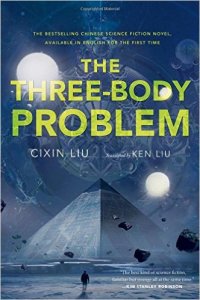
Cixin Liu, THE THREE-BODY PROBLEM

The Three-Body Problem, by Chinese author Cixin Liu and translated by American author Ken Liu (himself winner of numerous awards), is one of the more acclaimed novels of 2014, especially because it’s the first prominent Chinese novel to have been translated into English, and it’s been published by the leading American publisher of SF, Tor, in a handsome package with a Stephan Martiniere cover illustration, and back cover blurbs by David Brin, Kim Stanley Robinson, Mike Resnick, and others. It’s made its way onto the final ballot for the Hugo, Nebula, and John W. Campbell Awards.

It’s a first-contact story that begins during the Chinese Cultural Revolution of the 1960s. Chinese officials of the time are aware of “American Imperialist and Soviet Revisionist” SETI efforts, and want to get their own cultural word in to any potential alien contactees. The story follows the daughter of a scientist murdered by Red Guard mobs, who later makes a discovery about the solar enhancement of radio waves, and inadvertently broadcasts humanity’s presence to the galaxy at large.

Consequences over following decades involve a signal from alien “Trisolarians”, a signal that triggers various reactions among the Chinese population. Those who support the contact, for one reason or another, seek out fellow sympathizers via a sophisticated computer game called “Three Body”, that involves successive risings and fallings of civilizations on a planet dealing with alternating “chaotic” and “stable” eras that are the effect of three suns in their sky. An early revelation in the book is about the identity of that three-star system… (You have one guess.)

I have issues both with the storytelling, and the scientific concepts. I found the storytelling frequently clunky, or glib. Sample line of prose, from a high-level government official about an outrageously risky plan: “To ensure the survival of Trisolarian civilization, we must take this risk.” (p369) Does anyone really talk like that? And characters occasionally speak for the sake of informing other characters what they think about them. These are techniques reminiscent of early-20th century pulp SF.

Thematically, as the I read my way through the book, it reminded me so much as any western SF author as of A.E. van Vogt, who famously deliberately introduced one new outrageous idea every few hundred words, just to keep things interesting and unexpected. I admit I haven’t read AEVV in decades, but Cixin Liu develops various ideas of modern physics and cosmology that are plausibly familiar (and perhaps impress some of the cover blurb authors), but which strike me, again, as glib: e.g. (– spoiler alert –) how the “Trisolarians” (a term for the aliens that recalls ’50s sci-fi movies) “unpack a proton” into various dimensions and embed a vast computer inside, shoot the proton to Earth, and thereby take over human particle accelerators and even individual humans’ direct perception of the cosmic background radiation (!)… to trick scientists into despair and death.

Here we get to two central premises of the book that I don’t buy. First, that physicists, confronted with results from new high-powered particle accelerators that are inconsistent and seemingly random, conclude that physics is a lie and life is not worth living and commit suicide — Boom, just like that. It’s a crisis at Chinese government levels that brings in the main point-of-view character, Wang Miao, a researcher in nanomaterials. This is one of two plot motivators.

I reject the idea that scientists would kill themselves (and write cryptic suicide notes) just because they get perplexing experimental results. There’s an Isaac Asimov quote — here it is [everything’s on the internet!] — about how “Eureka!” is not the most significant thing a scientist can say, but rather, “That’s funny…”. Scientists *love* a puzzle; that’s how science advances. Is there a single example in history of a scientist who committed suicide over perplexing experimental results? On the contrary, there are scientists who spend their entire lives trying to resolve discordant results, and die without reaching a resolution… e.g. Einstein. They do not give up and commit suicide.

Second, that for that reason, or various other reasons involving bitter life circumstances (e.g. the unrepetance of surviving Red Guards) and hopeless futures (examples range from the reading of Rachel Carson’s Silent Spring in light of the deforestation projects of the Chinese government in the 1960s, to the recognition in later decades of the great ‘sixth’ extinction that humanity is bringing about), this book supposes that — *spoiler alert * — there would be significant factions among the population who are so eager to bring about the end of the human race they *invite* alien invaders to wipe us out, and conspire to encourage them to do so.

Again, really? There are any number of people who right now recognize humanity’s negative impact on Earth’s biosphere, the planet’s “sixth extinction” (I just reviewed Elizabeth Kolbert’s THE SIXTH EXTINCTION here on my blog, on that point) without advocating humanity’s death.

I do give the book a credit about the contingencies of communicating across interstellar distances. Following the initial communication between Earth and “Trisolaria”, the latter civilization realizes that due to the time involved in their plan to invade and settle Earth, the civilization on Earth might well advance, considering the accelerated progress of human science and technology over recent centuries, to the point that they could easily defeat the invaders. And so the “Trisolarians” (ugh) decide to hobble the advance of science on Earth, creating distrust in science and the appearance of apparent “miracles” that would discredit science. Which explains numerous plot events earlier in the novel; thus that bit about that magical proton that can, apparently, do anything.

I wish I found this novel more interesting, and plausible, because I must suppose that English language SF is constrained by cultural assumptions in ways we English language natives do not realize. Other cultures, considering ideas about alien contact, might well have different takes. There is some of that in this book, but not enough, I’m thinking just now, to inspire me to read the second volume of this trilogy.

Posted in Book Notes, science fiction | Comments Off on Cixin Liu, THE THREE-BODY PROBLEM

Follow-up thought about KSR’s AURORA

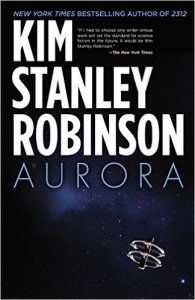
One more thought about Kim Stanley Robinson’s AURORA: I don’t *necessarily* agree with or endorse KSR’s conclusions in this book. Which is to say, human history shows a long pattern of inventing things or implementing things that the previous generation thought was impossible, or impossibly impractical. I think AURORA is valuable for its calling to attention the realistic difficulties of interstellar colonization via generation starships, and thus it’s a worthwhile book for challenging those easy assumptions of so much SF. That’s one reason science fiction is valuable: it challenges our assumptions about what is necessarily true, including the assumptions of science fiction.

Posted in Book Notes, science fiction | Comments Off on Follow-up thought about KSR’s AURORA

Kim Stanley Robinson, AURORA

I began reading Kim Stanley Robinson’s AURORA on the Sunday before last, in the afternoon, and later that evening realized that I had the answer to an ‘elevator conversation’ question — actually a dinner conversation question with some in-laws — about who my favorite SF writer is. Kim Stanley Robinson. I don’t think there’s anyone who (of those writers currently active, I should disclaim) better combines the rigouressness of hard SF with the poetry of descriptions of the universe with effective fictional protocols of plot and character better than KSR.

Here’s what I posted on Facebook on July 17:

Finished Kim Stanley Robinson’s AURORA today — an amazing book, for its scientific integrity and versatility and verisimilitude, for the familiar KSR passions of prose about geology and orbital mechanics and beaches, for its affecting characters, including a ship AI that ponders about narrative and decisions and consciousness and love; for its plot that keeps you guessing from chapter to chapter until the very end about what kind of book this is — where is it going?? — and ultimately for its reaching a conclusion that challenges standard science-fictional assumptions about… but to say any more would be to give away too much. It’s that last, challenging SF’s common assumptions, that makes this an important, and very worthwhile, book.

The book is about a generation starship sent from Earth to settle one or another of the planets around Tau Ceti, a trip that is taking some 170 years. The novel opens near the end of the trip, as the ship begins decelerating toward its destination. The characters are 14-year-old Freya, her father Badim, a mellow doctor, and her mother Devi, a brilliant ship’s engineer, always managing to fix problems throughout the ship, who is angry to some degree all the time. Over the course of the book, Freya remains the central character, as she ages several decades.

The ship reaches one of the planets around Tau Ceti, but subsequent events can’t be discussed without major spoilers. Let me just say that up until about page 150 the book seemed like it might be recapitualating the author’s Mars novels, i.e, relating the difficulties of settlers adjusting and/or terraforming a new planet. But plot happens, and keeps happening in unexpected ways all the way until the end of the novel, where it, as I suggested, reaches a conclusion about the whole plausibility of how mankind “cannot live in the cradle forever” — a famous quote the novel mocks — that challenges a central assumption of science fiction’s vision of mankind’s future in the universe beyond the Earth.

Along the way we have the author’s characteristic insights and details. My favorite, early in the book, concerns one of the couple dozen biomes, all modeled after various ecosystems of Earth, with native animals to preserve maximum biodiversity for the settling of a new planet. The whole population of the ship is only some 2100, with thus only a few hundred residents in each biome. In the biome modeled after Labrador, a tribe of yurt people raise their children without any knowledge they are actually on a ship — until puberty, when they undergo an initiation, put in a spacesuit, taken outside the ship blindfolded, and then shown the ship and the stars — an event some of them find traumatic, but a policy which many of them, nevertheless, endorse by staying in the tribe and raising their own children the same way. (p61-62) Wow.

Plot issues aside, there are several thematic ideas that pervade the novel:

  • The notion that maintaining a society inside the closed universe of such a ship amounts to being, to some, a “fascist prison” (whereas living on our very much larger starship Earth is different…? is the long-term implication), with a backstory (about *another ship*) that suggests infighting about issues like reproductive freedom in this enclosed society cannot be solved without an overruling authority…
  • Several times events are understood as consequences of cognitive errors, like ‘ease of representation’ (p70), probability blindness, overconfidence, and anchoring (p75b), and others, as if these are common everyday knowledge. Are they? Or is it because these are ideas I’ve read about in recent years, and I’m committing confirmation bias myself?
  • We understand part way through the book that the story is being related by the ship’s AI, who has been given instruction by Devi about how to compose a meaningful narrative — how to use metaphors, or perhaps analogies [there’s a passage that seems to echo the thesis of that fat Douglas Hofstadter book about analogies that I glanced through at the bookstore recently], ideas about diegesis and narratology. Again, this is a kind of cognitive bias that I’m recently familiar with through books by David McRaney, and which informs one of my Provisional Conclusions.
  • At the same time, there are ideas I noted that I was *not* familiar with, but which turn out to be real (not something the author made up), e.g., the Winograd Schema, a successor to the familiar Turing Test.

Asides:

  • There’s a passage late in the book (p373) about how the current settlers on Mars realize it will take some 40,000 years (!) to truly terraform the planet. Heh — KSR acknowledges that his assumptions in his 1990s Mars trilogy were optimistic at best, or perhaps have been overtaken by new knowledge about the planet since he wrote those books.
  • And: in the depiction of Earth near the end of the book, the assumption is that sea levels have risen some 24 meters (!) — due to “processes” that began in the 21st century; KSR does not use any obvious contemporary terms like “climate change” or “global warming”.
  • And, finally, again near the end of the book, some discussion of how people are committed to ideas that are resistant to evidence and new events: p418m:

“People have ideas. They live in their ideas, do you understand? And those ideas, whatever they heppen to be, make all the difference.”

“But there’s more than ideas,” she protests. “This world.” She gestures at the fading sunset. “It’s not just our ideas.”

“For some people it is. They don’t have anything else, maybe, so they give everything they have to ideas.”

This is a book about human ideas, or ideals, overtaken by the experience of the real world.

Posted in Book Notes, Narrative, Science, science fiction | Comments Off on Kim Stanley Robinson, AURORA

Links and Comments: Arc of Social History; Academic Freedom

Just a couple recent items for today.

NYT: A March Toward Acceptance When Civil Rights Is the Topic. (This was the in-print title; the title at the link is different.)

The arc of history. If these charts went further back, I’d expect similar trends about interracial marriage (in the 1960s), women’s suffrage (a century ago), and slavery (150 years ago). Religious conservatives of those times resisted those advances, of course.

\\

If academic freedom doesn’t lead to correct conclusions, make those pesky academics sign statements of faith that they cannot reach conclusions based on their investigations of the real world that contradict the best thinking of our ancient desert sheep-herding ancestors, who thought the world was flat. (Or at least, don’t tell the *children*!)

Professor Resigns from Christian College After It Mandates Acceptance of Young Earth Creationism.

Which refers to earlier article If Faculty Members Don’t Accept Young Earth Creationism, This Christian College May Fire Them, from which:

Not all Christian schools require you to preach Creationism like Bryan is about to, but college should be a place where students are made to think critically about their beliefs. Bryan administrators are telling these faculty members not to challenge them at all — the Bible says it so there’s no room to question it. It’s the opposite of preparing them for the real world. Instead, Bryan College is billing itself as the place to go if you want to remain in a Christian Bubble for life.

Posted in Uncategorized | Comments Off on Links and Comments: Arc of Social History; Academic Freedom

The Irish Need Not Apply

» New York Times, Timothy Egan: Not Like Us

Donald Trump is attracting quite a following with his comments about Mexican immigrants:

When Mexico sends its people, they’re not sending their best. They’re not sending you. They’re not sending you. They’re sending people that have lots of problems, and they’re bringing those problems with us. They’re bringing drugs. They’re bringing crime. They’re rapists. And some, I assume, are good people.

(And Ted Cruz endorses him!)

This NYT Op-Ed by Timothy Egan reminds us of history. Before the Mexicans, there were the Chinese, and before them… as Egan describes,

They were criminals — thugs and thieves — a single ethnic group that filled the jails of big cities. “Scum unloaded on American wharves,” one speaker in Philadelphia said of them. Dirty, filthy, foreign. As for their children, they were “utterly ignorant of a place such as school,” The New York Herald reported.

The Irish, in the 1850s. (Hello! My name is Mark Kelly, with a family line aligned to Ireland and the Isle of Man.) Anyone remember from their history books, The Irish need not apply?

Every era has its immigrants to demonize, and there is always a (lower) class of American society eager to demonize the outsiders. Trump is tapping into the Republican base enthusiastic to do so. He will win his base, and lose in any larger election.

Posted in Culture, Human Progress, Morality, Social Progress | Comments Off on The Irish Need Not Apply

Links and Comments: Steven Weinberg; Trek vs Wars; How the world is getting better; Undermining the Bible

Here’s a archival essay by Steven Weinberg, whose new book I just reviewed in previous post: A Designer Universe?. This is the essay in which Weinberg wrote this oft-quoted passage (though usually only its final line, here bolded):

Where religion did make a difference, it was more in support of slavery than in opposition to it. Arguments from scripture were used in Parliament to defend the slave trade. Frederick Douglass told in his Narrative how his condition as a slave became worse when his master underwent a religious conversion that allowed him to justify slavery as the punishment of the children of Ham. Mark Twain described his mother as a genuinely good person, whose soft heart pitied even Satan, but who had no doubt about the legitimacy of slavery, because in years of living in antebellum Missouri she had never heard any sermon opposing slavery, but only countless sermons preaching that slavery was God’s will. With or without religion, good people can behave well and bad people can do evil; but for good people to do evil — that takes religion.

\\

Slate has a nice summary of the virtues of Star Trek vs. Star Wars, though the writer especially likes one of the later ST series that I never watched more than an episode or two of: Deep Space Nine. Perhaps it’s not too late to catch up.

\\

Vox: The world is getting better all the time, in 11 maps and charts.

Journalism doesn’t have a liberal bias so much as it has a bias to the extraordinary, as I’ve mentioned here: if there were only one murder in the entire world on a given day, that would be the lead news on all the news sites, perpetuating the idea that there is violence in the world.

\\

And the on general theme of stepping back .. stepping back … from one’s cultural assumptions, taking a look at those cultural assumptions as if one had not grown up with them, seeing them in an objective view: well,

Southern Skeptic.com: God is a Terrible Writer.

About how if the Bible were really the word of God, it should have been so much better, on ten points. Among them: it would be consistent; it would have *specific, verifiable prophecies*; it would contain knowledge that humans of the era in which the Bible was written couldn’t possibly have known; and — this is a point I haven’t seen suggested before — it would “have beautiful, heart-rending poetry and stories” to outmatch any human author. Which it clearly does not. The author provides examples.

If you’re a Christian, I don’t expect this post to change your mind. When a belief gets drilled into your head everyday for years, it can take years to get it out again. But can you at least have a little sympathy for us atheists? Can you see how the Bible seems like nothing more than a collection of writings by religious fanatics? You have no trouble dismissing the Koran or the Vedas or the Book of Shadows, and rightly so. But it is for the same reasons that we dismiss the Bible.

\\

All of these items will be categorized into my philosophical scheme…eventually.

Posted in Narrative, Physics, Religion | Comments Off on Links and Comments: Steven Weinberg; Trek vs Wars; How the world is getting better; Undermining the Bible

Steven Weinberg, TO EXPLAIN THE WORLD

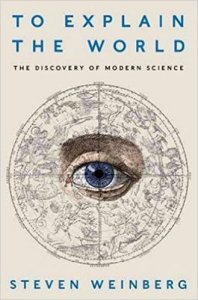
Steven Weinberg is a Nobel Prize-winning physicist who is best known (I gather) as a leading proponent of the idea that progress in physics will ultimately lead to a small set of fundamental principles that explain everything — i.e. the concept of ‘reductionism’. (An idea that is common but that is not shared by everyone.) His famous early books were The First Three Minutes (1977) and Dreams of a Final Theory (1993), both books I have, but read so long ago I don’t have any summaries at hand.

This new book is not so much about the history of science, as about the history of how the idea of science emerged over the past three millennia. Nevertheless it does provide a history of science, at least of physical science (astronomy and physics) from the Greeks through Newton, and so there are many familiar stories and ideas here. But Weinberg recounts these historical events with attention to what those people were thinking about at the time, and how their ideas relate to the modern concept of science. (He explains in his preface why he talks about the “discovery” of science rather than the “invention”.)

Thus: the early Greeks, familiar from basic courses in science and philosophy. Thales, who thought the world was composed of water. Anaximander, who settled on air. Xenophanes: earth. And Heraclitus: fire. The idea of four elements, water air earth and fire, came from Empodocles, in the mid-400s BC. Then came Democritus, with his idea that all matter was composed of tiny indivisible particles called ‘atoms’…

Weinberg’s point is that these propositions were essentially poetical. No one of that era thought to defend these ideas against any kind of real world experience, let alone experiment. (There was nothing in those days like the modern idea of performing experiments to test hypotheses.) Zeno claimed, famously, that motion is impossible, because of his eponymous paradox — but he didn’t bother to explain why motion does in fact happen.

This is the theme that extends through the book: that the tentative ideas we retroactively identify as early ‘science’ were in fact modes of thought quite unlike our modern, rigorous idea of the scientific method. As the author puts it, “The progress of science has been largely a matter of discovering what questions should be asked.” (p29.7), and “This progress [of science] has been something objective, not just an evolution of fashion. … It was never fruitful to ask what motions are natural, or what is the purpose of this or that physical phenomenon.” (p29.9) The point is how difficult it was for someone even as intelligent as Aristotle to learn about nature; “Nothing about the practice of modern science is obvious to someone who has never seen it done.”

There wasn’t much distinction between ‘science’ and ‘philosophy’ for thousands of years. A running theme in the book is the distinction between the mathematicians and astronomers, on the one hand, who developed elaborate schemes to predict the positions of the planets, the lengths of the seasons, and so on — these adhered to Plato and Ptolemy and latter’s ‘epicycles’ — and the philosophers and physicians, allegiant to Aristotle and his teleology and, incidentally, astrology. The latter group liked to think of themselves as concerned about true reality, treating the methods of the former group as tricks for the sake of accuracy, but not, you know, *real*. This split persisted for nearly 2000 years, until Copernicus.

And so the book follows developments in ‘science’ and ‘philosophy’ over the millennia, during which there was little distinction between astronomy and astrology, chemistry and alchemy (it wasn’t until the 19th century that the goals of alchemy were proven impossible; before that, it was not an illegitimate goal).

The book provides useful historical overview, including a summary of the many Arabic scientists who preserved the Greek thinkers, and who made advances of their own, while Christian Europe wallowed in the Dark Ages, for a thousand years. (The Arabic influence on modern thought shows up in our words for algebra and algorithm, as well as many of our common star names.)

In Europe, Thomas Aquinas tried to fuse Aristotle with Christianity, and had his books, and Aristotle’s, banned by the Catholic Church.

Finally in the 15th and 16th centuries came Copernicus, Tycho, Kepler, and Galileo. Copernicus’ idea that the sun is the center [of the universe, he assumed] dramatically eliminated the complexities of the Ptolemaic system, at the expense of demoting Earth to just another planet [the first of many demotions of mankind from the center of everything], with, of course, attendant religious condemnation. Tycho, famous for his observation of a ‘new star’ [nova] in Cassiopeia, thus disproving Aristotle’s contention that the heavens are perfect and unchangeable (so much of Aristotle was later proven wrong), nevertheless resisted Copernicus, and tried to recast his system with the unmoving Earth back at the center.

Johannes Kepler came along and combined Copernican theory with the notion, derived from Plato, that the five regular polyhedrons (cube, octohedron, etc.) should somehow fit between the orbits of the planets. This strikes me as an extreme example of thinking that something pretty must necessarily be true, and Weinberg notes that this tendency still exists, and how Kepler’s conclusion was somewhat reasonable considering that he assumed the solar system was the entire universe… with the analogy that modern cosmologists resist the idea of a multiverse because of the assumption that our observable universe is the only one that exists…

And then Galileo, who studied falling bodies, who acquired a ‘spyglass’ and refined it, and with it saw the outer universe beyond what the naked eye could perceive for the first time in human history: the mountains on the moon, the many more stars than are evident by that naked eye, that the planets are globes — and some, like Jupiter, have moons orbiting them — and some, at least Venus, has phases like the moon does; and that there are spots on the sun [yet again refuting the ancient idea that the heavens are perfect and unchanging]. These observations were published in 1610. Religious authorities objected because his observations contradicted passages in scripture (and they refused to look through his telescope), and in 1616 the church banned his books. His books remained banned until 1835, and it wasn’t until 1979 that the Pope admitted that the church had been wrong.

True experiments began with Galileo, then Christiaan Huygens, Torricelli, and Blaise Pascal, Robert Boyle.

Weinberg considers Francis Bacon and Rene Descartes, often regarded as key figures of the scientific revolution, overrated. Bacon stressed that science must have practical value — a position echoed by modern politicians who ridicule (and try to de-fund) pure scientific research for its own sake. (The notorious case in the US, likely hopefully forgotten, was Wisconson senator William Proxmire.) And Descartes, famously skeptical even of human senses (thus his famous claim that the only thing he could be sure about was “I think, therefore I am”.) His own scientific work was mostly wrong — his ideas about the soul, the nature of light, of ‘God’ — though he did make contributions in analytic geometry (Cartesian coordinates!) that enabled him to write algebraic equations and solve systems of multiple equations. He partly solved how rainbows work. Yet his books were also banned by the church. Weinberg makes the point that both Bacon’s and Decartes’ claims to rule or prescribe how science should work… were misguided. Were not useful, in the long run.

With Isaac Newton, born 1642, we get the climax of the scientific revolution. (Newton was an odd fellow; he never travelled much, and perhaps never had sexual relations with anyone in his entire life.) He invented calculus [with competition from Leibniz; eventually they were both acknowledged], and he applied the idea to his insight that the same force that drops an apple to the ground is the reason the Moon orbits the Earth — he united the celestial and the terrestrial. His book Principia, in 1687, was the model of a scientific work, beginning with definitions (of what we now call mass, momentum, etc.), a statement of conclusions, i.e. ‘laws’, his famous three laws; and then an exploration of those laws’ corollaires and consequences, all the way to explaining, once and for all, the solar system, and how the planets move around the sun. His notion that ‘gravity’ exists without any ’cause’ upset the religious folk, of course. Yet — even Newton figured that ‘God’ must have a hand in guiding the planets on their tracks, or else why wouldn’t the solar system eventually degenerate? (This is not a bad question — modern astronomers have concluded that the solar system may in fact be chaotic, over millions of years; and this [my added thought, not something Weinberg wrote] might explain the occasional weird orbits of some of the planets in our system.)

What strikes me in this historical account is how the early ‘scientists’ were driven by what can be seen in retrospective as biases of the human mind. The early Greeks, Plato especially, were committed to the idea that the heavens were ‘perfect’, that therefore the planets *must* be moving in perfectly circular orbits, since the circle is the perfect shape, and moving in perfectly steady motions. This assumption hobbled the human comprehension of reality for two millennia — until the realization, by Copernicus and Kepler and Newton, that perhaps the planets were moving not in circles but in ellipses… a betrayal of human assumptions about perfection, but which led a better comprehension about what is real.

This is a lesson to be kept constantly in mind. The contrast between what humans presume must be true, based on subjective experience, compared to what, on the basis of evidence and experimentation, turns out to be true. PvC: the difference between perception and reality.

Another nice quote:

p44b:

It is not that the modern scientist makes a decision from the start that there are no supernatural persons. That happens to be my view, but there are good scientists who are seriously religious. Rather, the idea is to see how far one can go without supposed supernatural intervention. Only in this way can we do science, because once one invokes the supernatural, anything can be explained, and no explanation can be verified. This is why the ‘intelligent design’ ideology being promoted today is not science–it is rather the abdication of science.

Posted in Book Notes, Science | Comments Off on Steven Weinberg, TO EXPLAIN THE WORLD