
This page lists nonfiction books recently read or posted. See drop-downs for lists of All Books, Best Books, and books by category.
 Pinker, Steven. 2011. The Better Angels of Our Nature: Why Violence Has Declined. Viking. *****
An expansive book that, in detailing how violence has greatly declined over millennia and especially in recent centuries and decades, tells the history of the human race, and how forces we would now call progressive have led to the improvement of the human condition. The book covers big trends of history (transition to agriculture, the age of reason and the enlightenment, etc.), our five inner demons (violence, dominance, revenge, sadism, ideology), our four better angels (empathy, self-control, moral sense, and reason), and five historical forces (Leviathan; commerce; feminization; cosmopolitanism; and the escalator of reason) that have brought about the modern world. The post link below links several initial posts, most of them with summaries of individual chapters and lengthy detailed notes. A magesterial book, one of the best books ever for understanding the modern human condition and how humanity has gotten here. (post) (Read Aug 2018)
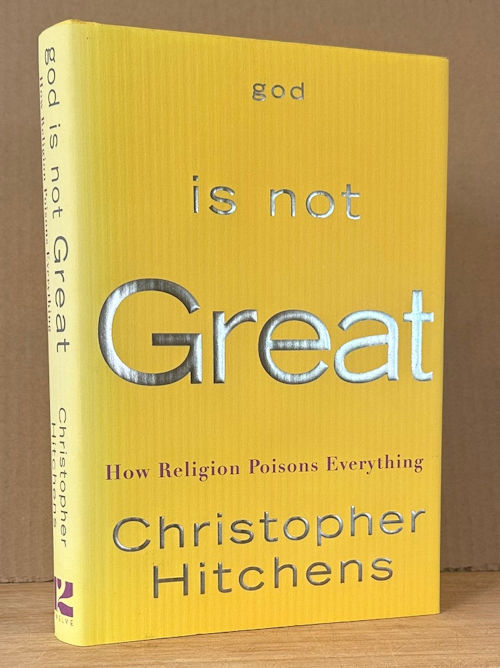 Hitchens, Christopher. 2007. god is not Great: How Religion Poisons Everything. Twelve. ****
Hitchens was an erudite “public intellectual” who wrote and spoke on many topics, and here his life-long simmering irritation with the crazy things religious people say they believe comes to a head. This is the least polite of the four books by the “new athiests” of the mid 2000s, and he’s blunt about spelling out all the things he rolls his eyes at, mixing such examples with personal anecdotes and examples from history. (Critics of the book nitpick his history without addressing its main themes.) He begins with epiphanies from childhood, then summarizes his four irreducible objections to religious faith: it misrepresents the origins of man and the cosmos; it combines a maximum of servility with a maximum of solipsis; it results and causes sexual repression; and it is ultimately grounded on wish-thinking. Religion is man-made, he concludes, and will never die out but: it poisons everything. Chapters discuss how religion killls, is inimical to health, how its metaphysical claims are false, how arguments from design don’t work, how if the Old Testament is a nightmare, the New Testament is worse, how the various faiths have borrowed from each other, and how its beginnings were corrupt. Religions don’t make people behave better, that it may be child abuse, the comparisons with atheist regimes like Stalin’s and Hitler’s are off-point, and concludes by calling for a new Enlightenment, “the study of mankind, of science and literature that enable us to know ourselves and our world.” (post) (Read May 2007)
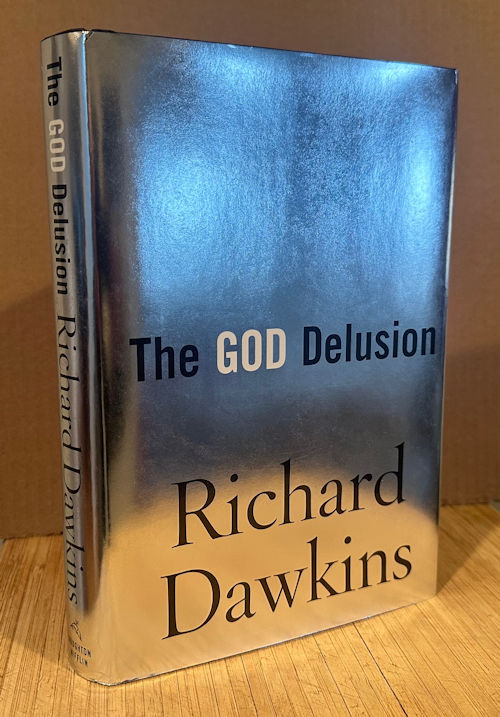 Dawkins, Richard. 2006. The God Delusion. Houghton Mifflin. ****
Straightforward to the point of bluntness and pugnacity, Dawkins covers familiar issues such as the arguments for God’s existence (weak or implausible) and extends the theme along four “conscious-raising aspirations”: that you don’t have to remain stuck in your childhood religion and should in fact aspire think for yourself and be an atheist; that the power of “cranes” such as natural selection provide a natural understanding of the cosmos; the dangers of childhood indoctrination and such phrases as “Catholic child”; and finally why there should be pride in being an atheist. Individual chapters cover the awe and wonder available in the real universe; the reasons why there is almost certainly no God; what religion is “good” for if anything; how morals do not derive from scriptures; and whether religion fills a “gap” in the brain. The post link here has links to five earlier page with very detailed notes on all these subjects. (post) (Read Reread Aug 2022)
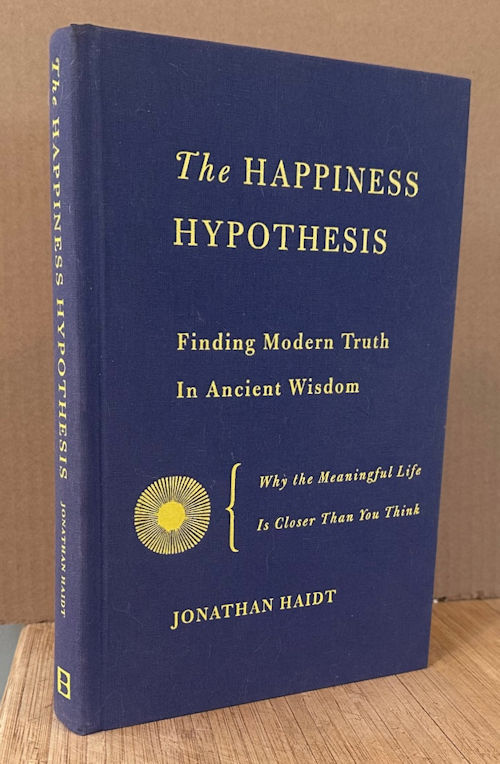 Haidt, Jonathan. 2006. The Happiness Hypothesis: Finding Modern Truth in Ancient Wisdom. Basic Books. *** 1/2
Haidt surveys ten “great ideas” discovered by the world’s civilizations about how to live and how to be happy, and considers them in light of current scientific understanding. For instance, it’s long been supposed that the mind is split in some fashion, e.g. mind vs. body; now we know it’s split in four ways: mind vs. body, left vs. right, new vs. old, and controlled vs. automatic. Other topics consider traditional notions of the golden rule, how happiness comes from within, how what doesn’t kill you makes you strong, and the meaning of life. Most of the traditional notions have turned out too simplistic. A modern understanding of happiness isn’t to abandon all attachments, it’s to realize that comes from within, but is also affected by outside circumstances we can control and biological set points we can’t control. Further, we’re happier making progress toward goals than actually achieving them. Meaning of life? There is no “for” purpose; meaning derives from your personality, your relationships, and your work, from which purpose and meaning emerge. The book’s themes aren’t always crisp, or even consistent, partly because it’s about happiness, not identifying what’s actually true about reality. The post link here links for four earlier pages of chapter by chapter summaries and comments. (post) (Read 2018, 2021)
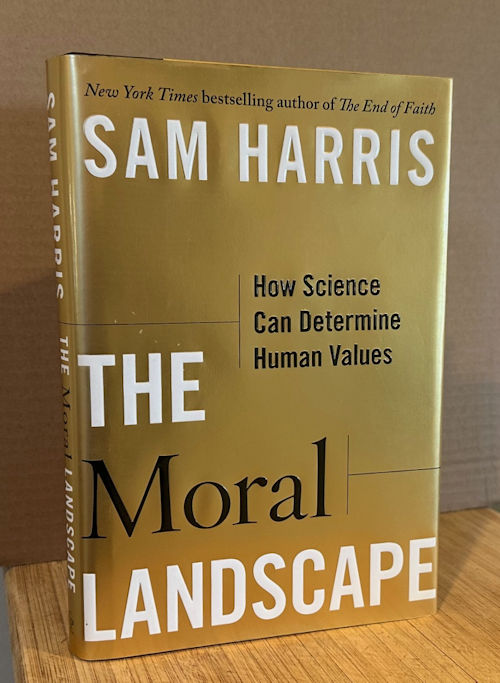 Harris, Sam. 2010. The Moral Landscape: How Science Can Determine Human Values. Free Press. *** 1/2
Harris rejects the nostrum that science can tell us nothing about morality, describing a utilitarian policy maximize happiness, or well-being, in a society. That said, he’s not using “science,” in terms of collecting data, formulating and testing hypotheses, and so on, as he is applying reason to arrive at a consistent policy, avoiding the contradictory and incorrect claims that religions make about the nature of reality. His core idea is a physical landscape with peaks and valleys, areas of all-being and suffering respectively. There may be no one best peak — no one correct morality — but there are degrees of well-being that are easily distinguishable. Chapters discuss how moral truth is not subjective; how ideas of good and evil, or right and wrong, are ideas that characterize the well-being of people, and that have derived for evolutionary reasons. About beliefs and cognitive biases and how political conservatism is correlated with dogmatism, inflexibility, etc., and anti-correlated with cognitive complexity and social stability. About religion has declined in most developed societies (except the US) and how religion relies of intuitive sense while brain science has shown the doctrines of religion to be implausible. And finally: there is moral progress in the human race, and reasoning about it is better than relying on religion, “that great engine of ignorance and bigotry.” (post) (Read Reread Jul 2022)
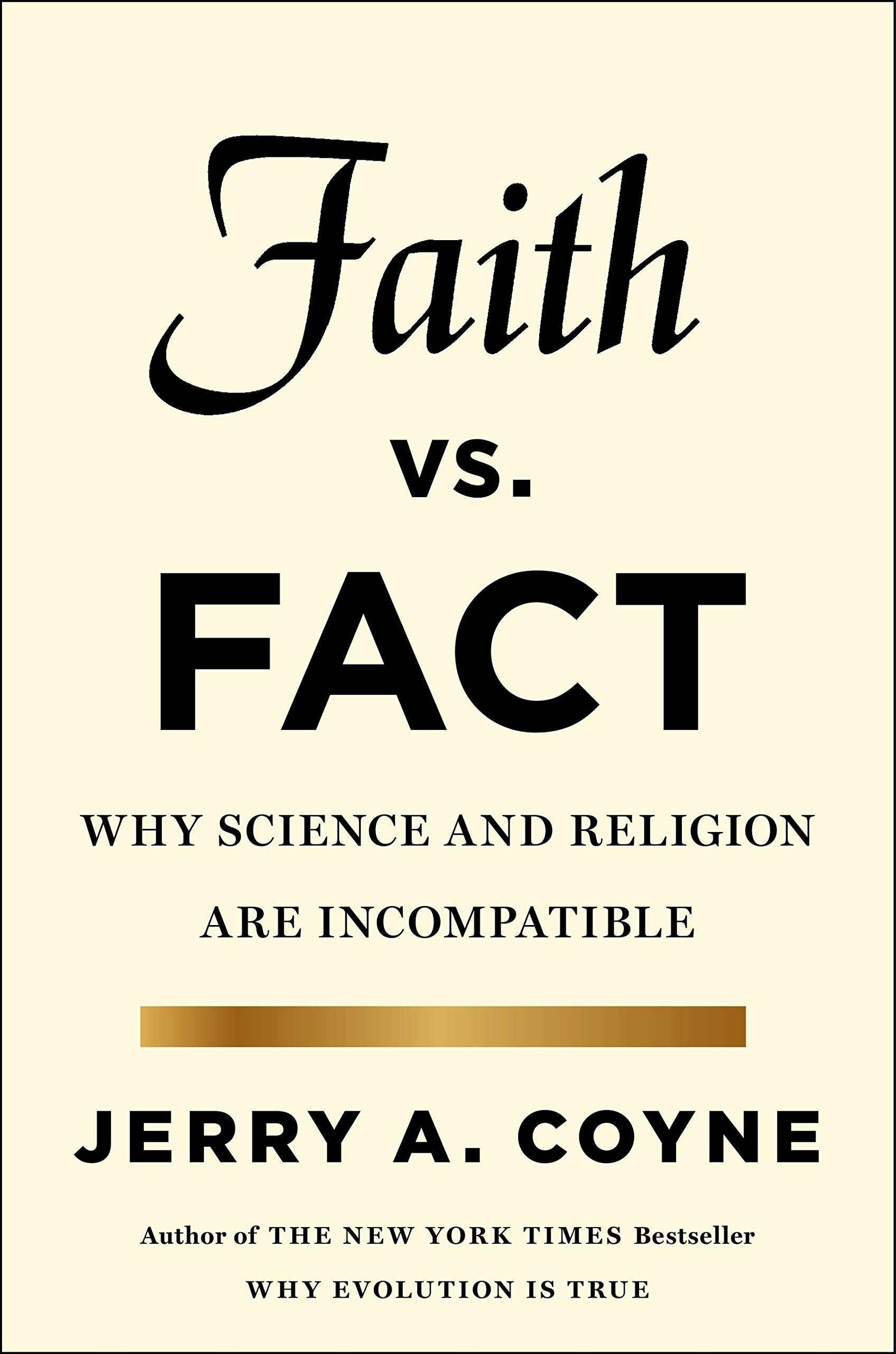 Coyne, Jerry A.. 2015. Faith vs. Fact: Why Science and Religion Are Incompatible. Viking. ****
Science is effective for discovering what is true about the world, while faith is not. Coyne patiently belabors this point by describing how science works and how religion cannot withstand even basic questions, like How do you know? And What makes you so sure your faith is right and all the others are wrong? Such questions matter. Coyne considers what science is, what religion is, and how they’re incompatible in terms of method, outcome, and philosophy, and therefore explains why “accommodationism” fails. He considers arguments from faith against science, and explains why they are invalid. And finally considers why this all matters — it matters because reliance on faith can lead to harm, as with child abuse, suppression of research and vaccination, and denial of climate change and numerous scientific conclusions. Also, largely nonreligious nations in Europe thrive. Religion should listen to science, especially about what science has learned about religion. Religion is to science as superstition is to reason. There are five long posts, ending with the one linked here, each containing a summary and then longer raw notes. (post) (Read Jun 2015)
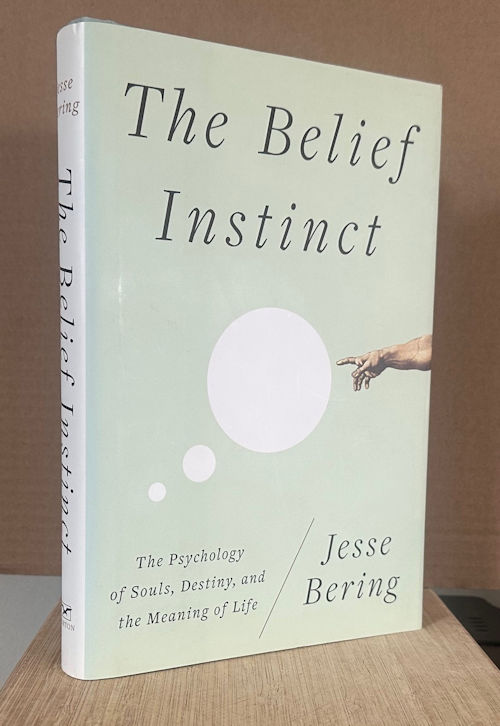 Bering, Jesse. 2011. The Belief Instinct: The Psychology of Souls, Destiny, and the Meaning of Life. Norton. ****
Bering follows the books by the “new atheists” in the 2000s with a study of *why* people form beliefs about souls and supernatural beings in the first place. Answers come from cognitive psychology and clinical experiments with children. A key idea is the “theory of mind” that children eventually form as they realize that other people have minds of their own. Questions about purpose, destiny, and the meaning of life are due to the acting up of this theory of mind. Thus we see signs everywhere, like God’s intent in a hurricane. (And people without theory-of-mind sympathies, like some autistics, are actually better at perceiving the world as it actually is.) Similar analyses consider the afterlife and the human propensity to ask “why?” about every catastrophe, as if everything happens due to some hidden reason. Author concludes that God is an adaptive illusion, a part of human nature that is never likely to go away. Still, that some of us can see around this illusion is a significant turning point in human history, allowing us to appreciate ourselves for what we really are. (post) (Read Sep 2013)
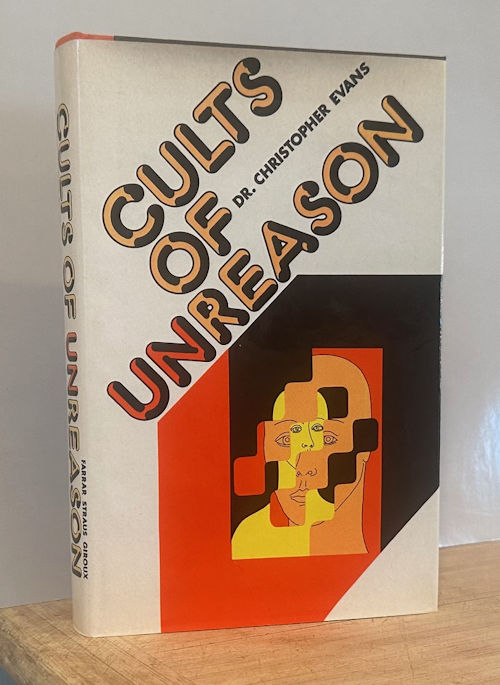 Evans, Christopher. 1974. Cults of Unreason. Farrar, Straus and Giroux. ***
The British computer scientist and psychologist (not to be confused with several others named Christopher Evans) addresses various pseudo-scientific movements that were popular in the 1950s and 60s and 70s. First, and taking nearly half the book, is Scientology and its founder L. Ron Hubbard and his earlier “invention” of Dianetics. Hubbard was a pulp science fiction writer and, ironically, his ideas initially gained traction through the credulousness of one of the leading science fiction magazine editors of the ’50s, John W. Campbell Jr. The second part is about flying saucers, recounting much familiar material. Third is about “black boxes,” devices with inputs and outputs and nothing in between, which were claimed to detect “vibrations” of various ailments. Their purveyors made lots of money. Fourth is about the “Mystic East” and the attraction in the ’70s of yoga, karma, mystical powers, and reincarnation. Notably, Evans finds some amount of sympathy for each group; he understands their motives. Those motives are no different than those behind similar frauds of the 18th century, or perhaps even the ancient religions. (post) (Read Reread May 2025)
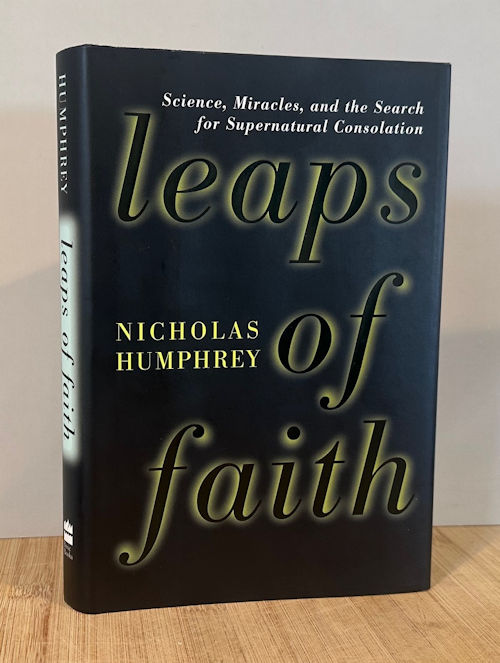 Humphrey, Nicholas. 1996. Leaps of Faith: Science, Miracles, and the Search for Supernatural Consolation. Basic. *** 1/2
The British neuropsychologist has an interesting take on the attraction, in the 20th century, of paranormal phenomena, including psychokinesis and extra-sensory perception: it’s driven by the need to replace the comforts of traditional religious beliefs, which have been discredited by science. Thus the paranormal ‘project’ has been to discredit science, the materialist view of the world. But the project has failed. Evidence is too scattershot; paranormal effects seem only to work in shows, and are never used in daily life. So why does the public still believe? A mixture of personal experience, external authority, and a priori reasoning. There are logical reasons why these explanations fail. Further (as Isaac Asimov explained years ago) the existence of such paranormal phenomena would undermine the very forces that brought about our species. (post) (Read Reread May 2025)
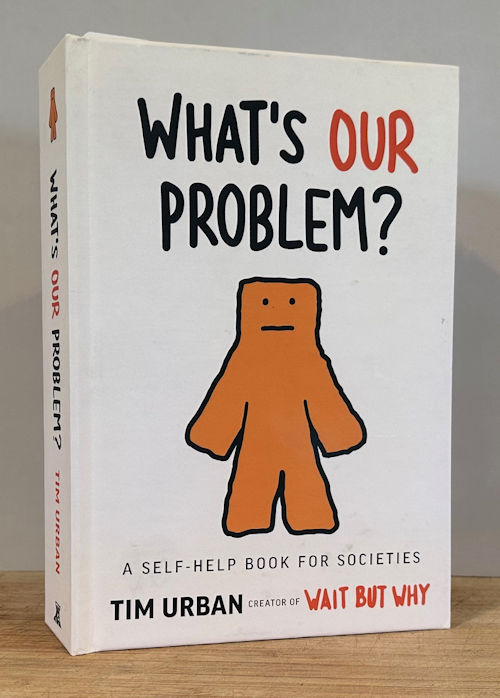 Urban, Tim. 2024. What’s Our Problem?: A Self-Help Book for Societies. Wait But Why. ***
Enormous self-published book, heavily illustrated, by a popular blogger who’s read lots of books and formulated his own takes on ideas of many experts (Haidt, Kahneman, Greene, Lakoff). He identifies the “problem” as being how technology is exponential and how it’s quickly exceeded our abililty to keep up. The reason is his distinction between the “primitive mind” of instinctive human nature and the “higher mind” that can think outside itself and get wiser with experience. The tug of war between these two minds is a ladder with rungs for thinking like a scientist, like a sports fan, like an attorney, and like a zealot. (Have only read this far, the first chapter.) (post) (Read Apr 2025)
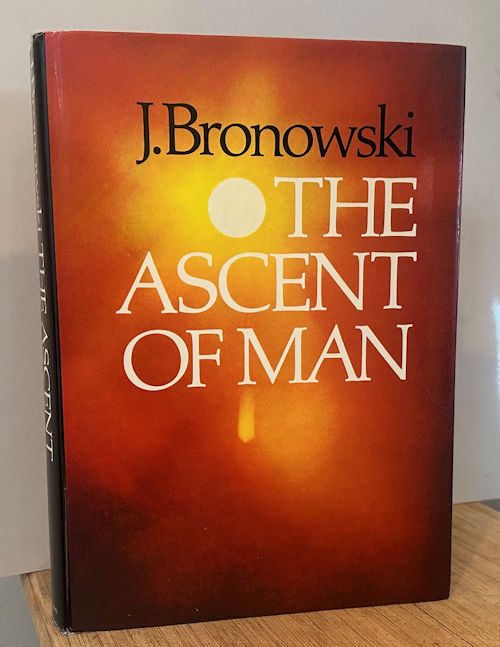 Bronowski, J.. 1973. The Ascent of Man. Little, Brown. *** 1/2
Like Carl Sagan’s COSMOS this book is a companion to a TV documentary series, one hosted by the author and shown on PBS in the early 1970s. It’s substantial and heavily-illustrated, covering everything from the evolution of “man” in Africa, through agriculture, structures built of rock, alchemy and minerals and atom, mathematics and early cosmological theories, astronomy and the church backlash against Galileo, Newton and Einstein and gravity and relativity, the Industrial Revolution’s factories and machines and canals, the discovery of evolution and that the world is not static, the discovery of the elements and the development of modern physics, concepts of uncertainty and how science is open to error and the possibility that we might be wrong, genetics and the discovering of DNA, and finally the modern understanding of man as both social and solitary, artistic and scientific, and how our modern culture must be aware of our origins and not be beholden to ancient morals or beliefs, lest some other culture take our place. The book’s flaw from a 2025 perspective is that some of the science, especially about human evolution, is out-of-date. Still, the final chapter is prescient both in its understanding of society and human nature (anticipating Wilson, Pinker, and others), and its concern that the modern US, by retreating from that understanding, may be handing the world to some other culture. (post) (Read May 2025)
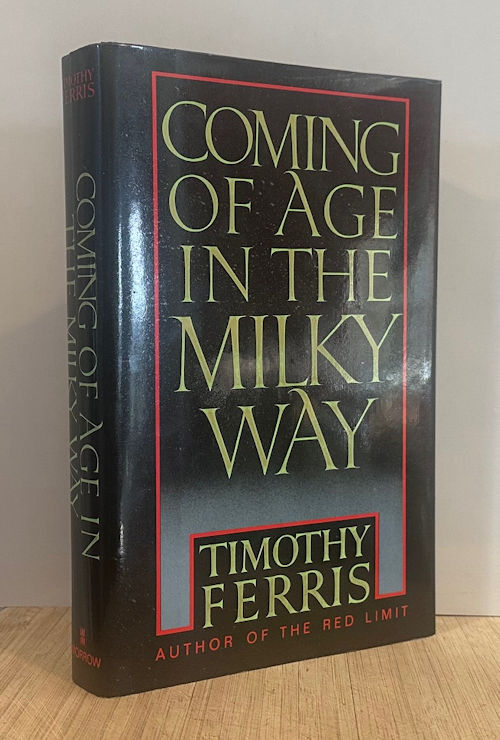 Ferris, Timothy. 1988. Coming of Age in the Milky Way. Morrow. ****
This book describes how, through science, our species has come to understand our current estimates of the dimensions of time and space. There’s emphasis both on the techniques that revealed this understanding, and on key individuals who made this discoveries. Beginning with how the ancients thought that the stars were only just out of reach of the top of their ziggurats. By the time of the Greeks, their Earth-centered universe might have been fifty million miles in radius. Romans conquered the Greeks and their science; Christians had no interest in science. But Islam did. Marco Polo’s exploration of the Earth culminated with Columns, who to his dying day thought he’d reached India. Copernicus, Tycho, Kepler, Galileo, Newton. By the 18th century the proportions of the solar system were known, but not the actual distances. Then came triangulation and parallax, that when applied to stars revealed their distances to be in the light years. Nebulae, galaxies, Einstein and relativity. Maxwell and field. The size and shape of space, its expansion and closure. The second part of the book goes into similar great detail about time, from the evidence from rocks, natural selection, and what powers to stars. And the third section is about discoveries in quantum mechanics, particle physics, cosmology, and the origin of the universe. Ending with thoughts about how all this knowledge marks a “coming of age” of our species on the cosmic stage — and how this knowledge has always been resisted and suppressed by religious authorities. We may never understand everything, but at least we’re aware of our ignorance, and know that there is always still more to know. Note the book is 40 years old and so of course doesn’t discuss many modern topics. (post) (Read Mar 2025)
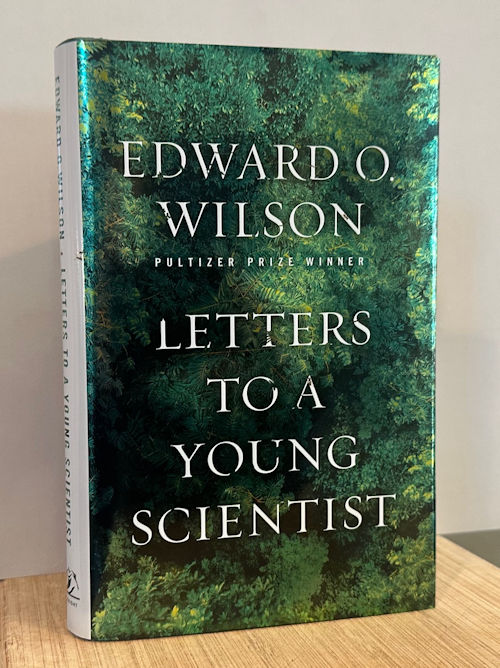 Wilson, Edward O.. 2013. Letters to a Young Scientist. Liveright. ** 1/2
A short, later Wilson book, mixing some genuine advice to people entering science, personal anecdotes, and discussions of science, with themes repeated from earlier books. He advises students to follow their passion, to not drift through life; to not worry much about math, which you can learn if you need to; to look for fields of study that are sparsely inhabited. He defines science and the scientific method and his ideas of consilience. Then his life in science: starting a career, travels, finding a specialty. Then theory and the big picture: science as universal knowledge; making theories and theories in the real world. Finally: truth and ethics, in dealing with other scientists, giving proper credit, admitting mistakes. (post) (Read Mar 2025)
 Mooney, Chris. 2005. The Republican War on Science. Basic. ***
Journalist Mooney’s first book examines where Republican hostility to science came from. In a nutshell, it began in the late 1950s with its incursion into religious and business interests. Thus the antipathy toward regulations. The book is basically a litany of bad behavior, especially in the George W. Bush administration, e.g. Bush’s inaccurate claim about the number of existing stem-cell lines. In general, conservatism resists change, while the dynamism of science is a constant onslaught on old orthodoxies. Conservatives resort to various rhetorical tactics to try to undermine science, as in their term “sound science,” their repetition of “just a theory,” suppression of scientific reports, targeting individual scientists, rigging the process, misrepresenting results, magnifying uncertainty (“more research is needed”), relying on fringe “experts,” ginning up contrary “science,” and dressing up values in scientific clothing. Examples run from Reagan and Gingrich, to Bush, to paranoid distrust of intellectuals, to made-up controversies driven by religious motivations. The author, back in 2005, recommended dismantling legal standards for “sound science,” the Data Quality Act, and the notion of “peer review” linked to it. Journalists should resist the notion of “balanced” accounts that ignore overwhelming consensus, e.g. on climate change. And, overall, resist political gains by the modern Right. (2025 comment: these problems have only gotten much worse in the past 20 years.) (post) (Read Mar 2025)
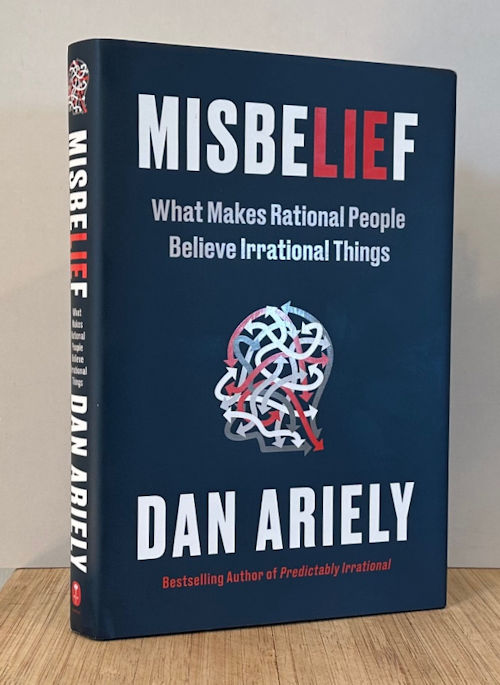 Ariely, Dan. 2023. Misbelief: What Makes Rational People Believe Irrational Things. Harper. ***
This book focuses on the process of how people form false beliefs, which can include conspiracy theories but which Ariely prefers to call “misbeliefs.” It was inspired by accusations of Ariely himself being part of a conspiracy theory involving the Covid pandemic, due, he discovered, to dicey selectively edited videos seen by people who then tried to expose a supposed fraud. Then the book goes deeper into the steps by which misbeliefs form, with a key point that it often starts out in situations of stress and uncertainty. Followed by the need to identify a villain in order to regain control of the world, and to reduce that complex, ambiguous world into a simple, comforting story. And social media now makes it easy to find communities of like-believers, even at the expense of losing family and friends. (post) (Read Oct 2023)
 Tyson, Neil deGrasse, & Walker, Lindsey Nyx. 2023. To Infinity and Beyond: A Journey of Cosmic Discovery. National Geographic. ** 1/2
A history and tour of exploration beyond the Earth, from flying in the atmosphere, passing by the sun and the planets, layers of the atmosphere and when space begins, then the age and size of the universe and ideas of worldlines, time travel, hyperspace, black holes, and warp drives. Heavy, and heavily-illustrated, the book’s coauthor is a producer and writer at StarTalk, Tyson’s podcast. The book is a routine tour through familiar topics, but it includes one of Tyson’s hobby-horses, his attention to physics in movies and TV shows. In this book we get asides about the implausibilites (and occasionally plausibilities) in Ad Astra, Top Gun: Maverick, Mission to Mars, Intersteller, and many others. (post) (Read Feb 2025)
 Nichols, Tom. 2021. Our Own Worst Enemy: The Assault from Within on Modern Democracy. Oxford. *** 1/2
Nichols’ counter-intuitive thesis is that, despite what “everybody says,” these are not the worst times ever, rather in many ways we’ve never had it so good. So what’s the problem? We’re losing because we won; despite our success people *feel* miserable because they give in to their base instincts. [[ I would characterize this as human nature refined in an ancestral environment that is ill-at-ease in the modern one. ]] He explores these ideas along three lines: peace, affluence, and technological progress. He contrasts a small Italian village in which everyone mistrusts one another with the civil responsibilities required by those in a democracy. Americans have become overgrown children, angry at things they don’t understand and bad at assessing risk. Many see flaws in the system as something that justifies throwing the entire system out. Globalization has not ruined everything; that feeling arises from short memories, from rising expectations, immediate gratification, and little accountability. And our hyper-connected world allows crackpot ideas to spread, undermining the patience and perspective that liberal democracy required. Recommendations: people should become better citizens, e.g. read a reputable newspaper and turn off social media. Beware the reassurance of the pack and the safety of the herd; grapple with the ambiguities and consequences of freedom. He finishes by contemplating three nightmare scenarios and worries most about one in which insiders take control of the government because voters can’t produce coherent demands, life will go on, and people won’t care that elections are meaningless. (post) (Read Feb 2025)
 Newitz, Annalee. 2024. Stories Are Weapons: Psychological Warfare and the American Mind. Norton. ***
This is about psychological warfare in the US, which means deliberately spinning the truth or telling alternative narratives for political purposes. It goes back long before social media, but came to the fore in advertising and wartime propaganda. A surprise of the book is that one of the key players in these “psyops” was one Paul Linebarger, now best known for his mid-century science fiction published under the pseudonym Cordwainer Smith. Other psyops included the mythmaking by the US government to encourage westward expansion, in the 18th and 18th centuries, and more recently how Steven Bannon, and then the Russians, targeted those with fascist tendencies with slogans like “drain the swamp” and “make America great again.” Culture war issues have included Charles Murray’s attempt to link IQ and economic fates, Joe McCarthy and Anita Bryant’s moral panic over homosexuals since the 1950s, and Fredric Wertham’s war against comics that anticipated today’s battles over “wokeness.” Finally there are ideas for disarmament. Rediscover actual history, with an example of a tribe in Oregon once declared to be extinct. Fight propaganda online, with suggestions for regulating social media. And how the public library is a metaphor for a rejuvenated public sphere. (post) (Read Dec 2024)
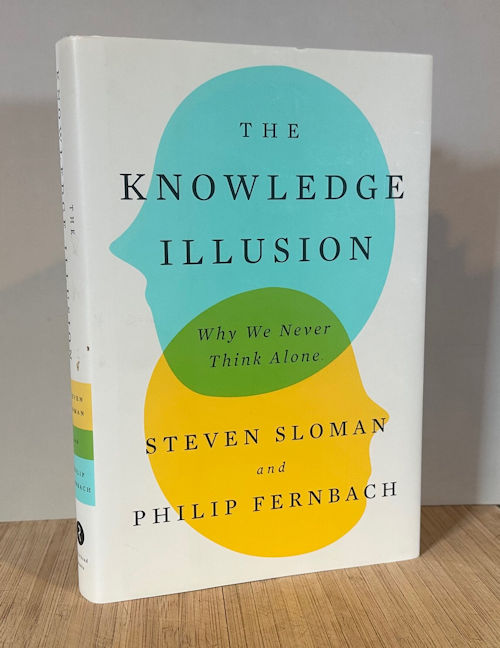 Sloman, Steven, & Fernbach, Philip. 2017. The Knowledge Illusion: Why We Never Think Alone. Riverhead. *** 1/2
We live in a complex world, no one can know everything, and we depend on the knowledge of others. (I recall that Heinlein quote decrying specialists; he was wrong.) The three big themes here are ignorance, the illusion of understanding, and the community of knowledge. People overestimate how much they know, and we don’t actually remember much detail because the brain didn’t evolve to retain information; that information is mostly out there in the world itself, easily retrievable. We think in terms of cause and effect, but our na ve understanding of physics doesn’t correspond to reality. Hunting was a communal exercise, and in the modern world too we rely on experts to build everything around us. Technology extends thought by expanding knowledge held in the world. Opposition to science comes from lack of understanding, and also social pressures that inhibit people from changing their minds when new information comes available. In politics, the less informed people are, the stronger their opinions; they resort to ‘sacred values’ to avoid thinking about practical consequences. Being smart isn’t about IQ, but more about the degree one contributes to group success; it also involves activities, trust in the institutions and principles of science. Yet most people don’t want too much information; they prefer to rely on community beliefs of how things work. There will always be ignorance, and illusions; the latter may be necessary for the development of human civilization. Intelligence resides in the community, and our society has come far because most people cooperate most of the time. (post) (Read Feb 2025)
 O’Connor, Cailin, & Weatherall, James Owen. 2018. The Misinformation Age: How False Beliefs Spread. Yale. ***
Not quite what I expected, but interesting nonetheless. A key point, already well-known, is that people form beliefs based on information from others, and acquiring false beliefs isn’t a matter of psychology or intelligence, but rather to various social factors. The running thread is how even scientists can form and perpetutate false beliefs, given the same social factors, and the way information passes from individual to individual and group to group. This is illustrated with social network diagrams (example shown). More than most people realize, these networks also go wrong when propagandists (typically for big business) work to undermind them, by manipulating evidence or selectively distributing it. The authors’ most provocative idea is a reimagining of democracy. The problem is that most people who vote have no idea what they are talking about; this is a “vulgar democracy.” What’s needed is an idea from Philip Kitcher: a “well-ordered science” to navigate between vulgar democracy and technocracy, in which decisions about issues of science are made by representative citizens able to understand and communcate those issues. This ideal situation may be utopian, and impractical, but it’s important at least “to abandon the notion of a popular vote as the proper way to adjudicate issues that require expert knowledge.” (post) (Read Jan 2025)
 Lilla, Mark. 2024. Ignorance and Bliss: On Wanting Not to Know. Farrar, Straus and Giroux. ***
Framed by a parable of Plato’s cave, this is a philosophical consideration of the motivations for various flavors of ignorance: evasion, taboo, emptiness, innocence, and nostalgia. Evasion is about avoiding self-knowledge, including knowledge about the world, in favor of received false opinions in which people have an emotional stake. Taboos include prohibitions against acquiring knowledge about the world that would undermine faith. Emptiness is about uncertainty, which leads people to oracles and prophets, the more illiterate the better, with the history of Paul, who despised culture and preferred willful ignorance, and the many later prophets. Innocence is about the belief that newborns are blank slates, who moral purity must be protected until they are adults; thus the Hollywood clich that children are wiser than adults, and thus Bowderization of books, gated communities, home schools. And nostalgia (the theme most pertinent to modern politicis) is about the longing for a simpler, happier world of the past, and the shedding of toxic knowledge about the world and themselves; and the flip idea that some nostalgiac people flee into the future, looking to an apocalypse or a rebirth. Nostalgia is a will to ignorance, a rejection of a present that is always found wanting. Lilla concludes by contrasting the openness to experience we like to think we possess, with the fact that many look away from the world, and retreat to the cave. (post) (Read Jan 2025)
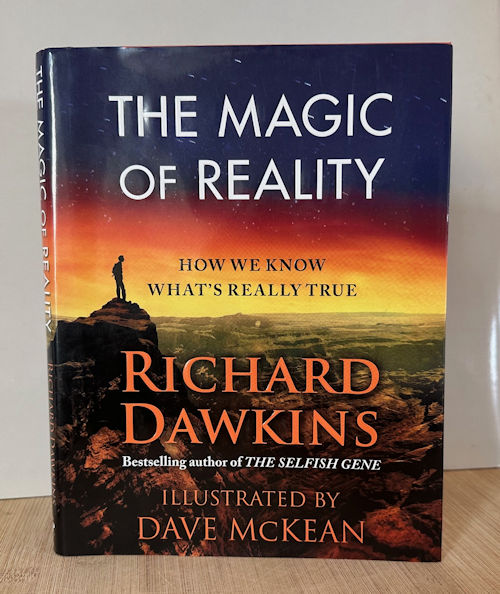 Dawkins, Richard. 2011. The Magic of Reality: How We Know What s Really True. Free Press. *** 1/2
With many illustrations by Dave McKean, this is a book, suitable for young adult readers, with three essential ideas: that *how* we know something is as interesting as what we know; that there have always been myths about what people have imagined to be true; and that reality is more interesting, more magical in a poetic sense, than all those myths. After an opening chapter about what reality is and what magic is, there are nine chapters on particular topics: the first person; different kinds of animals; what things are made of; why there are seasons; the sun; a rainbow; how everything began; whether we’re alone; and earthquakes. Almost every chapter opens with a selection of myths from around the world that were intended to answer these questions; the myths range from those of the Tasmanians to the Norse to the Hebrews. Two final chapters are more philosophical. Why do bad things happen? Because there is no natural justice; the universe doesn’t care what we want; everything does not happen for a reason. Finally, what is a miracle? Stories about turning water into wine, or Mohamed flying off on a winged horse, are due to rumor, coincidence, and snow-balling stories. Humans are programmed to see faces of other humans, and so we see them everywhere. Hume had a way to think about miracles: believe in them only if their falsehood would be even more miracles. There are many things science cannot explain, but that doesn’t mean that they won’t. Resorting to the supernatural is simply giving up, and not trying to understand. (post) (Read 2011; Feb 2025)
 Kolbert, Elizabeth. 2024. H Is for Hope: Climate Change from A to Z. Ten Speed Press. ** 1/2
A book of 26 short essays, one for each letter of the alphabet, with illustrations by Wesley Allsbrook, covering climate change history and illues. Arrehnius was the Swedish scientist who constructed the first climate change model. There are visits with industries battling fossil fuel dependence, e.g. one making electric airplanes, another green concrete. Hope, Objections, Republicans, Xenophobia. Ending with a tour of Hoover Dam, where tour guides don’t want to talk about why the level of the water is so low. Despite the title, the author ends “Climate change isn t a problem that can be solved by summoning the ‘will.’ It isn t a problem that can be ‘fixed’ or ‘conquered,’ thought these words are often used. It isn t going to have a happy ending, or a win-win ending, or, on a human timescale, any ending at all.” (post) (Read Jan 2025)
 Richardson, Heather Cox. 2023. Democracy Awakening: Notes on the State of America. Viking. ****
Historian Richardson, now best known for her daily news commentaries at Letters from an American, looks back over the past century of American history to explain how we got to the point where someone like Trump could be elected president. Her style is straightforward and equanimous, matter-of-fact without being overly partisan, and she’s good at boiling down long histories and complex ideas into bite-sized chunks. Thus her definition of fascism: the idea that some people are better than others, and deserve to rule. A key historical thread is what she called the “liberal consensus” that emerged after World War II among both Democrats and Republicans: the idea that government was to regulate business, provide a basic social safety net, and invest in infrastructure. The first part of book is about conservative opposition to this, especially among racists in the south; the Ku Klux Klan; the glorification of the American cowboy; and intellectuals like William F. Buckley rejecting Enlightenment principles in favor of his religion. The second part is about the ascendance of Trump up to the “Big Lie” that the 2020 election was stolen from him. And the third part reviews principles of the Enlightenment, the founding of America, and considers what we can do to reclaim America from the authoritarians and autocrats. America is not based on land or religion or race, she emphasized, but on the concept of human equality. (post 1; post 2; post 3.) (Read Aug 2024)
 Haidt, Jonathan. 2024. The Anxious Generation: How the Great Rewiring of Childhood Is Causing an Epidemic of Mental Illness. Penguin. ***
Expanding on a theme from Haidt & Lukianoff’s THE CODDLING OF THE AMERICAN MIND, Haidt here focuses on smartphones and social media and their deleterious effects. How is this worse than any past moral panics against new technology, from radio and TV and comic books and video games, and for that matter scrolls in ancient Greece? Well, he has data. There’s been a rise in teenage anxiety, depression, self-harming, and suicide among Gen Z beginning around 2010. He revisits the decline of play-based childhood, and the rise of phone-based childhood, how girls are more affected by social media than boys, and at the end has suggestions for “collective actions” for healthier childhoods: relax laws that over-protect children in the real world; schools should encourage more free play and recess. Parents should be gardeners, not carpenters. Delay introducing phones, instead find part-time jobs, tech-free camps, or take a gap year. I remain skeptical — it sounds like a variation of the conservative screed that life was better in the old days — but he does have data about actual harm. (post) (Read Dec 2024)
 Beauchamp, Zack. 2024. The Reactionary Spirit: How America’s Most Insidious Political Tradition Swept the World. PublicAffairs. ** 1/2
Has democracy been a nice experiment that’s become unsustainable? Beauchamp considers democracy to be an upending of traditional hierarchies; the reactionary spirit is anti-democratic, seeking to restore those tribal hierarchies. (This basic division echoes ideas of several other writers covered here: Lakoff, Greene, Urban, Richardson.) He meets a CPAC attendee who unapologetically calls for the return of segregation. He talks with Milo Yiannopoulos. He examines several countries in detail, including Hungary, Israel, and India. He discusses Nietzsche, who attacked both democracy and Christianity. But at the end, the author is optimistic. This book is fine as a description of current events, but lacks any depth to try to explain *why* these things are happening (much less explore the evolutionary basis for these different political attitudes). (post) (Read Dec 2024)
 Adair, Bill. 2024. Beyond the Big Lie: The Epidemic of Political Lying, Why Republicans Do It More, and How It Could Burn Down Our Democracy. Atria Books. ***
The founder of PolitiFact describes varieties of lies, a “Lying Hall of Fame” (from Big Tobacco to Donald Trump), and how people fall for lies (e.g. that the 2020 election was stolen), with running accounts of several victims. Of key interest is how Adair, though he’d dissembled about it for fear of seeming biased, admits that (of course) Republicans lie more than Democrats, and other fact checkers observe the same thing. He consults various officials and journalists to speculate why this is so. Republicans want to win at all costs, without caring deeply about issues; Democrats are too wonky, too concerned about getting things right, while Republicans rely on pithy sound bites; and (as I’ve speculated myself) because Republicans see themselves in an epic struggle for the soul of America, and so a little lying isn’t so bad. With examples, some my own. Further: conservatives predictably claim PolitiFact is biased, without providing any examples of Democratic howlers that it missed. Finally: how can we stop the lying? Clearly fact-checking doesn’t have much impact. So: Ask the politicians. Keep score. Invite them to pledge not to lie. Track misinformation as data. (post) (Read Dec 2024)
 Lakoff, George. 2008. The Political Mind: Why You Can’t Understand 21st-Century American Politics with an 18th-Century Brain. Viking. ***
Lakoff, a UC Berkeley prof, applies ideas familiar from the psychologists — principally that humans don’t think rationally, as many used to think — to make the point that Enlightenment ideas of reason are obsolete and untrue. He characterizes politics as being about conservatives and progressive, where he describes the former as being mostly concerned with obedience, responsibility, and discipline, and the letter as bieing driven by empathy to create a government whose responsibilities are protection and empowerment. These are useful take-aways, but there’s no evolutionary perspective here that might explain why these two styles of thinking came to exist, or how those Enlightenment ideas aren’t *wrong*, exactly, just idealistic and requiring conscious work. And there are flaws: he’s read Steven Pinker, but misunderstands and dismisses evolution; and he gets too bogged down in details of neurons and framing and so on. Still, worthy for the book’s strictly political perspectives. (post) (Read Jan 2025)