
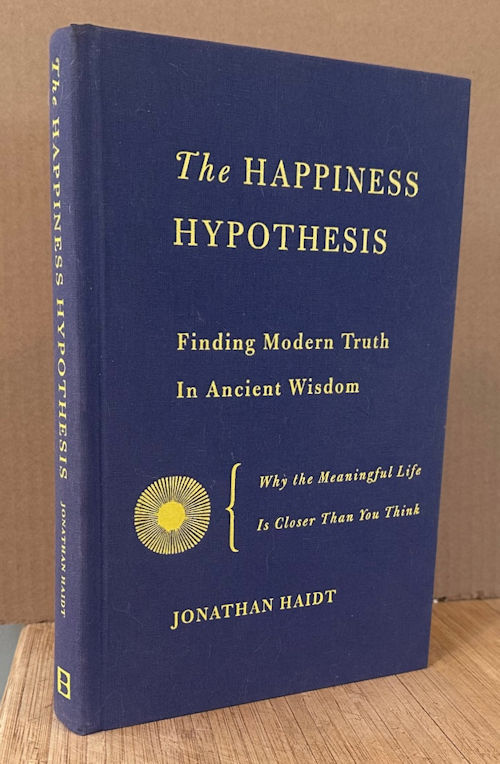
Subtitled “Finding Modern Truth in Ancient Wisdom”
With second subtitle “Why the Meaningful Life is Closer than You Think”
(Basic Books, 2006, xiii + 297pp, including 54pp acknowledgements, notes, references, and index. Hardcover with no dust jacket.)
\
Ch10, Happiness Comes from Between
Quotes from the Upanishads and by Willa Cather
Author recalls quotes in his high school year book. He had been through a sort of existential crisis, assumed there was no meaning to life, and everything could just as well end. Then realized, embrace the possibilities! He pursued philosophy, then psychology. Eventually discovered that “psychology and related sciences have revealed so much about human nature that an answer is now possible. In fact, we’ve known most of the answer for a hundred years, and many of the remaining pieces have fallen into place over the last ten.” (writing in 2006)
What Was the Question?
“What is the meaning of life?” is the Holy Question of philosophy. Silly answers reveal that we want the question to have a certain kind of answer. What kind will satisfy?
But the question has two or three senses. One, what does “life” mean; two, what does “life” stand for? These are both dead ends. The third is a plea for making sense of things, asking guidance for how to live one’s life. Our lives are lived in the midst of a story where we haven’t seen the beginning, nor will see the end; like seeing only the middle of a movie. [[ I like this idea. ]]
This third meaning, about purpose, has two types of answers. One is about believing in a god/spirit/intelligence that created you for some purpose. The other is accepting that everything just happened by the laws of nature, and people weren’t created ‘for’ any reason. Religion, and science, offer these different answers.
The sub-question is about the purpose *within* life: what should I do to live a fulfilling, meaningful life? This is a separate question, and the one the author is prepared to answer.
Love and Work. Humans aren’t like computers; they’re more like plants, that recover given the right conditions. What conditions? Recall the happiness formula. What one does is a big part. Humans, and monkeys, like to *make things happen*, be busy, move stuff around, achieve a kind of competence, what has been called ‘effectance’ — this is why we get more pleasure from making progress, than from finishing a goal.
Yet modern work is often deadening – as Marx critiqued. For some, work is just a job; for others, a career; for others, a calling. And any kind of job can be followed by any approach. The key to finding a calling is knowing your strengths, get the connections right. And find ‘vital engagement’. Example of a girl who loved horses; examples of genetics, a vital field, and journalism, a field damaged by market forces.
And ‘cross-level coherence’ aligns the three levels of physical objects, minds, and societies. These have long been subjects of different fields, but more recently fields like psychology and neuroscience and sociology are merging. This synthesis suggests that “people gain a sense of meaning when their lives cohere across the three levels of their existence.” This can be seen in the Indian rituals, in which they become visceral. Religions in general create such coherence; that may be the reason religions were designed.
God Gives Us Hives.
Morality and religion occur across all human cultures. Darwin tried to explain morality via group selection, but it was realized that the so-called ‘free-rider’ problem undermined altruism. Computer models in the ‘60s suggested that kin altruism and reciprocal altruism solved this problem, and so group selection became ‘illegal’.
But things have changed; humans really do live in groups and people play roles within cultures, much as ants and termites do in theirs. And so the realization has come that both individual and group selection may be at play – author cites David Sloan Wilson’s book DARWIN’S CATHEDRAL. A co-evolution has taken place. And so, p235t: “Human nature is a complex mix of preparations for extreme selfishness and extreme altruism. Which side of our nature we express depends on culture and context.” And, “We are also part bee.”
Harmony and Purpose.
The mystical experience is a kind of ‘off’ button for the self; how repetitious movements dampen self-awareness and evokes a feeling of group belonging. [[ As I’ve said many times, in different terms. ]]
The Meaning of Life.
And so: the meaning of life, p238. It’s understanding what kind of creature we are. You have to get your conditions right and then wait. Find a coherence among your personality, your relationships, your work. “If you get these relationships right, a sense of purpose and meaning will emerge.”
Ch11, Conclusion: On Balance
Quotes by Heraclitus (“All things come into being by conflict of opposites”) and William Blake
Yin and yang: life is about conflict, and balance. There is no evil; nearly all people are morally motivated, and no one culture, no one personality type, has all the answers. And so, for liberals and conservatives, the place to look for wisdom is with your opponents: they understand some things better than you do. We must draw on wisdom that is balanced, and choose directions in life that lead to satisfaction, happiness, and a sense of meaning.
\\\
It’s Friday afternoon as I’m posting this, and I won’t have time until next week to review these summaries, consolidate them, and post some general conclusions.
First, the comments I wrote when I finished my first read of this book in 2018:
>>
So the end of this journey is realization of what we have already read in EO Wilson: human nature, and society, and conflicting political viewpoints, are a result of the interaction of individual selection (selfishness) and group selection (altruism, though only within one’s group).
Haidt’s other main point is that happiness comes from an alignment with one’s culture—that matters more than the realization (for example) that many rituals are empty of content, exist only as rituals, and that there isn’t actually a god to be appease to.
Thus my ongoing theme: humans are healthier living a delusion, than accurately perceiving reality. Yet there will always be a minority who do see through the delusions of ritual and religion. And they keep it to themselves, or discuss it only amongst themselves, even as all the evidence about reality is available to everyone. It’s just that most people are too busy getting on with their lives, as members of a human society, to care.
<<
Do I still think this? Mostly, but I need to reflect, and don’t have the time right now. It’s important to keep in mind that Haidt is pursing happiness and meaning, and these are quite distinct from an honest acknowledgement of reality. I’ll get back to this next week.