
- Trump worries about “civilizational erasure” but only in a white supremacist sense;
- And contrasting his motives with those described by Pinker that brought about modern civilization;
- Heather Cox Richardson describes the retreat from the global stage;
- Bryan Walsh at Vox on zero-sum thinking, suggesting that growth is the answer;
- Connie Willis quotes John Pavlovitz, who has a post about empaths and sociopaths.
The essence of conservative fear of change. Yet things always change.

NY Times, 5 Dec 2025: Trump Administration Says Europe Faces ‘Civilizational Erasure’, subtitled “America’s goal should be ‘to help Europe correct its current trajectory,’ the administration said in its new National Security Strategy.”
The Trump administration said on Friday that Europe was facing the “stark prospect of civilizational erasure” and pledged that the United States would support like-minded “patriotic” parties across the continent to prevent a future in which “certain NATO members will become majority non-European.”
The grim assessment of Europe’s future was released overnight as part of an annual update to the United States’ national security strategy around the world.
Without naming them directly, the document says the United States should be “cultivating resistance” across Europe by supporting political parties that fight against migration and promote nationalism. That describes several right-wing populist parties like Reform U.K. in Britain and the Alternative for Germany, known as the AfD, which has been classified as an extremist party by German intelligence services.
“In everything we do, we are putting America First,” Mr. Trump wrote in a foreword to the document, which he called a “road map to ensure that America remains the greatest and most successful nation in human history.”
Now, I just finished summarizing a long book by Steven Pinker, THE BETTER ANGELS OF OUR NATURE, which ostensibly is an explanation of why violence has decreased throughout human history, but more broadly examines how the modern world arose: through the expansion of empathy, of self-control, of an innate moral sense, and of reason (including science); which in turn were triggered by certain exogenous causes: geographical and social mobility, open societies, an objective study of history, and books, including the moral quandaries to be found in fiction.
Trump’s xenophobic “American First” works against these forces, as most conservative policies do. They don’t want an open society, they are not empathetic but rather selfish (or even sociopathic; see item below), they don’t want objective study (they want religion), they don’t want books that threaten what they see as the verities of life, which are actually merely the traditions of their own family or community.
Nor have Americans been particularly concerned about the “civilizational erasure” of the natives whom the early European settlers killed or displaced. The concerns we hear today are those of white supremacists, in a variation of the “replacement theory” fears.
Anyway, there is no one “civilization” in America or Europe. Thinking such means your scope is very limited, and/or simplistic. Civilization changes all the time. To worry about it is basic MAGA yearning for an ideal past that never existed (Pinker makes this point too); to selfishly think that the world of your fond childhood memories is what should be preserved and imposed upon everyone. Naivete. And/or xenophobia.
\\\
Again, America is retreating from the global stage it once led.
Heather Cox Richardson, December 5, 2025
Concerning a strategy document just released.
After a brief introduction touting what it claims are the administration’s great successes, the document begins by announcing the U.S. will back away from the global engagements that underpin the rules-based international order that the World War II Allies put in place after that war to prevent another world war. The authors of the document claim that the system of institutions like the United Nations, alliances like the North Atlantic Treaty Organization, and free trade between nations that established a series of rules for foreign engagement and a web of shared interests around the globe has been bad for the U.S. because it undermined “the character of our nation.”
Their vision of “our country’s inherent greatness and decency,” requires “the restoration and reinvigoration of American spiritual and cultural health,” “an America that cherishes its past glories and its heroes, and that looks forward to a new golden age,” and “growing numbers of strong, traditional families that raise healthy children.”
Compare with the points of Pinker’s book. The obsession with the mythic past. The withdrawal from interaction with the rest of the world.
To achieve their white supremacist country, the document’s authors insist they will not permit “transnational and international organizations [or] foreign powers or entities” to undermine U.S. sovereignty. To that end, they reject immigration as well as “the disastrous ‘climate change’ and ‘Net Zero’ ideologies that have so greatly harmed Europe, threatened the United States, and subsidize our adversaries.”
And of course, they are irrational, anti-science morons for dismissing the evidence of climate change as some kind of plot to overthrow American greatness.
Heather goes on in some details, with sources.
\\\
In contrast, and aligning with Pinker.

Vox, Bryan Walsh, 6 Dec 2025: Breaking free of zero-sum thinking will make America a wealthier country, subtitled “The affordability crisis is a growth crisis.”
With the example of New York City, and its competition for apartments.
The essential fact of life here is that more people want to live in New York than there are homes that we allow to exist. New Yorkers talk about the competition for apartments — or for slots in decent schools or tables at decent restaurants or virtually anything save tickets to your friend’s improv show — as if it is a Hobbesian war of all against all.
It’s not just New York. Once you start looking for that intuition, you see it everywhere. In arguments about immigration (“they’re taking our jobs”), housing (“we’re full”), college admissions, culture war skirmishes over who gets “replaced” and who gets “canceled,” the underlying picture is the same: If some group advances, someone else has to lose.
Social scientists have a name for this: zero-sum thinking, which is the belief that when one individual or group gains, it’s usually coming at the expense of others. There’s growing evidence that this mindset is now one of the quiet engines of political conflict in the US.
The writer points out that zero-sum thinking was valid throughout most of human history. (And Trump, having dealt with real estate in Manhattan, has a zero-sum game mindset.) Until the past century or so.
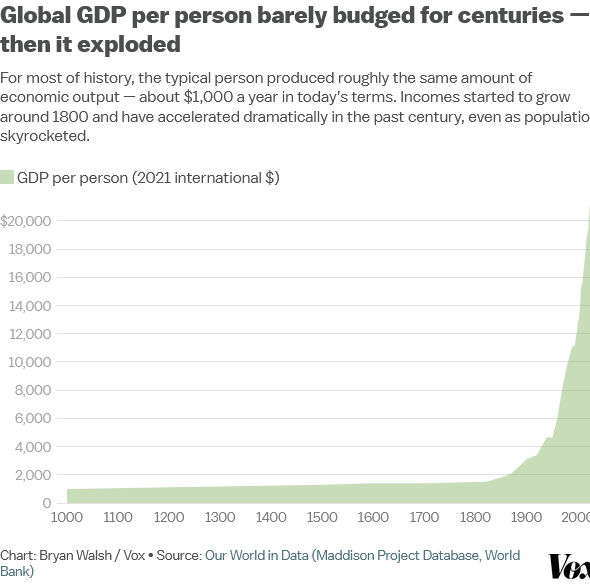
Anthropologist George Foster argued that many peasant communities were organized around an “image of limited good”: land, wealth, status, even good luck were assumed to exist in fixed amounts, so any gain for one person was understood as a loss for someone else. The last two centuries of industrialization and technological innovation broke that logic; for the first time in history, large societies could become much richer over time, and most people’s material standard of living could rise together.
This, of course, aligns with Pinker’s analysis.
Yet the article ends with a solution: growth.
Right now — as you will read again and again and again — America is in the grip of an affordability crisis. Putting aside the fact that our idea of what we should be able to “afford” has inflated along with prices and wages over the years, there’s no doubt that the anger is very real, and that whichever party can best seize on the issue stands to win next November.
But again. As savvy as this piece is, it betrays a limited scope. Growth cannot go on forever, or even for very long, if it’s destroying the planet. (Cue the Klein/Thompson book ABUNDANCE, sitting on my shelf waiting to be read… How do they avoid this problem?)
\\\
Connie Willis’ post today, Hegseth: “Your Wish is Our Command”, has this comment at the very end:
Best comment of the day, from John Pavlovitz: “Every time the pendulum has swung wildly toward barbarism in a society, it has invariably come back with even great opposing force to bend the arc of the moral universe back toward justice again. And history tells us that, despite the story in our heads or the one that comes through the partisan propaganda that we’re continually saturated by, our brutal national nightmare is likely in its final hours.”
Who is John Pavlovitz? A name I’ve probably seen before. He has his own Substack: A Beautiful Mess. According to Wikipedia he’s “an American former youth pastor and author, known for his social and political writings from a liberal Christian perspective.” Glancing across his substack, I see this.

John Pavlovitz, 5 Dec 2025: Empaths, Sociopaths, and Why America’s Divide Isn’t About Politics Anymore
He’s using different terms, but he’s describing the same kind of moral split I’ve been pondering between the right and the left. It’s not about “political ideologies.”
The prevailing narrative of the last decade is that America has been fractured by political ideologies, bunkered down in disagreement on what path will most serve the common good. This is a dangerous fiction we need to discard once and for all.
The dividing lines in America have nothing to do with party affiliation anymore.
Just open up your phone, eavesdrop at the checkout line, or talk to your neighbor, and you’ll see the lines along which we now find ourselves:
One side celebrates people being abducted from the street without due process or just cause.
One side rejoices in strangers having food taken away from them without knowing a single one of their stories.
One side applauds the bombing of boats in foreign waters with zero knowledge of who is killed.
With more examples.
And none of this is about politics; it’s about when faced with the suffering and injustice in our path, whether we will default to compassion or to cruelty.
America’s present divide reveals the orientation of hearts as we move through the world, the story we tell ourselves about other people, and what we want our lives to be marked by.
Will we be bleeding heart empaths who err on the side of love toward all our neighbors, or callous, fuck your feelings sociopaths who rejoice in the pain of others because we’ve dehumanized them to the point that their lives are worthless to us?
Will we see empathy as our highest calling as human beings, or as a character flaw needing to be discarded?
And so on, challenging the idea that “all opinions are valid”.
And his post today: If Hell Exists, It Will Be Filled With Congressional Republicans, subtitled “Growing up in the Church, I believed in Hell.”