
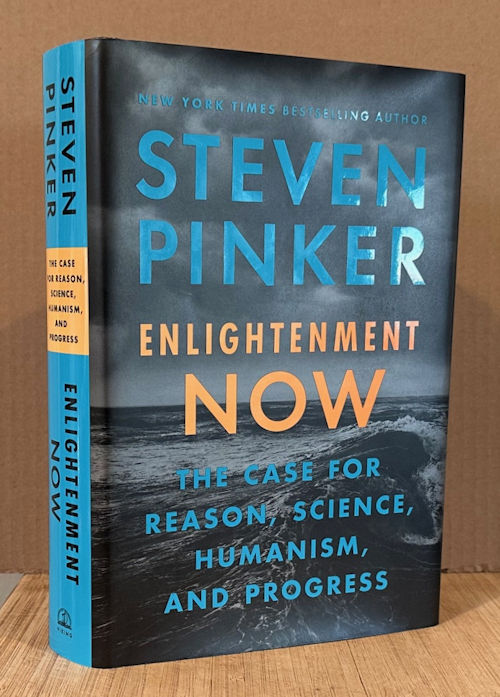
Subtitled “The Case for Reason, Science, Humanism, and Progress”
(Viking, Feb. 2018, xix+556pp, including 102pp of notes, references, and index.)
The first three chapters of this book are crisp summaries of themes shared with two or three dozen other books I’ve read and posted about here; this book is at the center of a Venn diagram of all of them. Basic ideas of reason and science, of humanism and morality; how the human mind’s ancient legacy is ill-suited for the modern world; the expansion of the circle of empathy for others; the later ideas of evolution, entropy, and information; how life and evolution are possible in zones of order despite long-term entropy; the intuitive and simplistic thinking that derives from our ancient biases, including motivated reasoning; how people would rather think they are right than know what is true; how rules and norms emerged to allow true beliefs to emerge. And then why challenges to Enlightenment values emerged, from the Romantic movement with Rousseau, to religious faith and nationalism, to notions that civilization is in decline or is merely boring compared to the glories of the past.
As with other Pinker books, he lays out his theses in the early chapters, then explores how they play out across a range of aspect of modern life — life, health, wealth, the environment, safety, terrorism, and on and on — in the balance of the book. These three chapters cover less than 10% of the book’s text.
\
Part I: Enlightenment
The author is sometimes asked: why should I live? His answer, p3: you have the potential to flourish; you can appreciate the world; you can perpetuate life in turn; you can contribute to the welfare of others, improving the human condition and continuing progress.
The Enlightenment idea that we can apply reason and sympathy to enhance human flourishing may see trite… but it is not. These ideas of reason, science, humanism, and progress need a defense. We take so much for granted…. P5.3:
The ideals of the Enlightenment are products of human reason, but they always struggle with other strands of human nature: loyalty to tribe, deference to authority, magical thinking, the blaming of misfortune on evildoers. The second decade of the 21st century has seen the rise of political movements that depict their countries as being pulled into a hellish dystopia by malign factions that can be resisted only by a strong leader who wrenches the country backward to make it “great again.” These movements have been abetted by a narrative shared by many of their fiercest opponents, in which the institutions of modernity have failed and every aspect of life is in deepening crisis—the two sides in macabre agreement that wrecking those institutions will make the world a better place. Harder to find is a positive vision that sees the world’s problems against a background of progress that it seeks to build upon by solving those problems in their turn.
The West is shy of its values; the Islamic State is not. This book restates the ideals of the Enlightenment in 21st century terms, including lots of data that shows the Enlightenment has *worked*–perhaps the greatest story seldom told. And these ideals are stirring, inspiring, and noble – a reason to live.
Ch1, Dare to Understand! P7, 8p
What is enlightenment? Goes back to Kant, p7: “One age cannot conclude a pact that would prevent succeeding ages from extending their insights, increasing their knowledge, and purging their errors. That would be a crime against human nature, whose proper destiny lies precisely in such progress.”
There are four themes of the Enlightenment: reason, science, humanism, and progress.
Reason is nonnegotiable; you can’t argue anything without appealing to reasoned arguments. That doesn’t mean humans are inherently rational; it means we need to be aware of our irrational passions and foibles, 9t, and overcome them.
Science is the refining of reason to understand the natural world. The educated Englishman of 1600 believed a long list of crazy things (p9m: witches, werewolves, magicians, unicorns, etc etc.). The Middle Ages had a kind of “collective paranoia” about the external forces that supposedly controlled the world, 9-10t. The escape from such ignorance and superstition includes understanding ourselves; the Enlightenment thinkers anticipated modern ideas of cognitive psychology.
Humanism is about applying a secular foundation for morality, a result that privileges individuals whatever their gender, race, etc. Our sentiment of sympathy allows us to expand the circle to those previously oppressed; thus the abolition of slavery and cruel punishment.
Thus progress, overcoming ignorance and expanding the circle of sympathy. This is not some mystical force or destiny, and it does not deny the existence of a human nature that must be overcome.
Enlightenment values led to the understanding of prosperity, how markets work, that exchange improves society. Another idea is peace.
At the same time, there were critical ideas the Enlightenment thinkers knew nothing of–
Ch2, Entro, Evo, Info (p15, 14p)
These ideas are entropy, evolution, and information.
Entropy, or disorder, emerged from 19th century physics, and is captured in the 2nd Law of Thermodynamics. Applies to everyday life: Things fall apart, etc.
Gives example of C.P. Snow, how educated Britons knew nothing of the 2nd law, p17.
Despite entropy, processes of self-organization create zones of order, 18t, given that energy is poured into the system.
Thus evolution, which explains not just patterns in the world, but the functional design of the living world. The eye; the ear. Explained by Darwin and Wallace in 1859, who made the supposed divine designer unnecessary. Creationists misunderstand the 2nd law.
And then information. The 20th century discovery of neural networks; understanding how brains world; how rules for living in the world form. Another idea: cybernetics, or feedback, or control, which explains how physical systems seem to act as if they had a goal.
Historically, there was a so-called ‘Axial Age’ around 500 BCE, when several cultures switched from systems of ritual and sacrifice to systems of philosophical and religious belief that promoted selflessness and promised spiritual transcendence – 23.7. The trigger seems to have been the ability to capture more energy, allowing larger cities, a reorientation of priorities to long-term harmony. 23b. The Industrial Revolution, later, released a gusher of usable energy, and lifted the default state of humanity out of poverty.
These three concepts offer some wisdom. One, misfortunes may be no one’s fault. The universe is not saturated with purpose; everything does not happen for a reason. People have goals, but the workings of nature do not. And poverty is the default state of humankind; it’s wealth that needs to be explained.
Another: evolution has left us with cognitive, emotional, and moral faculties adapted to an archaic environment, not to thriving in a modern one, 25b. People are by nature illiterate and innumerate; they think things have hidden essences; they think prayers and curses work; they underestimate the prevalence of coincidence; they generalize from individual experience and are prone to stereotype; they think in black and white. They are not so much intuitive scientists, as intuitive lawyers and politicians, marshaling evidence that confirms their convictions and dismissing that which doesn’t, p26.
And human moral sense demonizes others, seeks scapegoats; etc.
Yet we can transcend these limitations: we can abstract; we can combine ideas with recursive power. P27. Ideas can be shared, to a network of thinkers. The desire to be right can conflict with the desire to know the truth; so communities set up rules that allow true beliefs to emerge, p27b; “Add in the rule that you should allow the world to show you whether your beliefs are true or false, and we can call the rules science.” 27b.
And the wisdom of crowds can elevate our moral sentiments. Page 28:
So for all the flaws in human nature, it contains the seeds of its own improvement, as long as it comes up with norms and institutions that channel parochial interests into universal benefits. Among those norms are free speech, nonviolence, cooperation, cosmopolitanism, human rights, and an acknowledgement of human fallibility, and among the institutions are science, education, media, democratic government, international organizations, and markets. Not coincidentally, these were the major brainchildren of the Enlightenment.
Ch3, Counter-Enlightenments (p29, 8p)
Why should the ideals of the Enlightenment need defense? Because they do.
Recall that the Enlightenment was followed by a counter-Enlightenment: the Romantic movement. Rousseau and others, p30… humans are part of organic goal; heroic struggle is the greatest good, not solving problems; violence is inherent in nature. Baudelaire: the priest, the warrior, the poet; to know, to kill, to create.
Other alternatives. Religious faith, which often elevates some moral good above the well-being of human beings; valuing souls above lives; resisting science, 30b.
Another: nationalism and its variations, the idea that people are expendable cells in some superorganism: clan, tribe, ethnic group, religion, race, class, or nation.
Mostly conservative causes, though defenders on both sides. Is it true that religion won’t die? (see Ch 23). The left defers to the ecosystem. Political ideologies are secular religions, 32.6.
Two more counter-E movements. One is the idea that modern civilization is in decline and on the verge of collapse. One form worries about our Promethean dabbling with technology. 33t, ch19. Another idea is that modernity has made life too safe and boring, a consumerist wilderness, 33m; hollow men; Ch 17,18; True liberation is to be found in the heroic, the will to power – Nietzsche (final Ch).
A final alternative condemns the embrace of science – C.P. Snow’s Second Culture. Cites response to Snow, p34, in which “coming to terms with great literature” is morally superior to “raising the standard of living”… And then there’s ‘scientism’, p34b, the idea that science robs life of its enchantment, or does more harm than good.
The idea of progress sticks firmly in the craw of so many. The daily news offers evidence that the world is a vale of tears. So has the Enlightenment worked? The next chapters appraise human progress since the Enlightenment.
\\





