
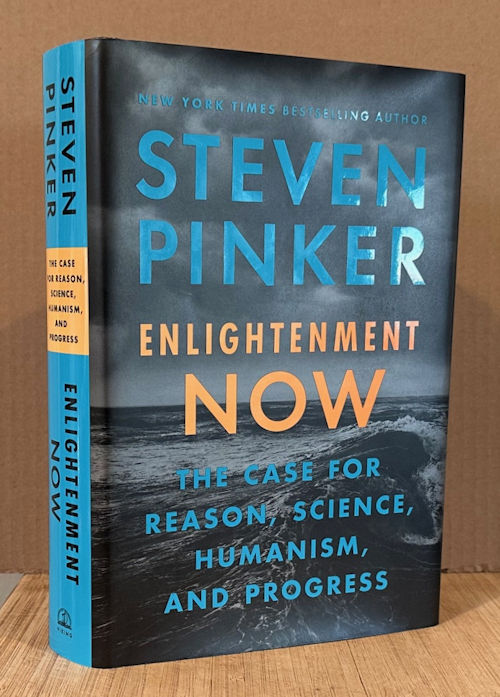
Subtitled “The Case for Reason, Science, Humanism, and Progress”
(Viking, Feb. 2018, xix+556pp, including 102pp of notes, references, and index.)
Here are the remaining ten chapters in the long middle section of the book that focuses on Progress. Some of these update topics from BETTER ANGELS, and remind of us to take statistical approaches to safety, terrorism, and so on. Beware headlines; look at the data. Overall, liberal values are spreading around the world. The chapter on Knowledge has two great quotes about the value of education and the awareness of one’s place in the world. Two chapters consider, if things have gotten so much better, why aren’t we happier? And concludes that the evidence we’re unhappy is unpersuasive, and the reason we’re not happier is due to humanity’s gradual maturity in an ever-more complex world. A chapter on existential threats finds most such risks unlikely. And a chapter on the future of progress worries about two threats: economic stagnation, and the rise of authoritarian populism, on the latter point specifically addressing the danger Trump represents to all the good news from the previous chapters. Recommendations: rely on the resilience of the American system; recognize that Trump voters are of the lower classes with low educations, who are older and more religious. So avoid polarizing rhetoric, and fix the election system. There will always be setbacks, but there’s a dialectic that nevertheless moves us forward.
*
Ch11, Peace, p156
There are some updates to be made, 7 years after the previous book. The trends continue. Yes there is still news that makes things look bad; but this is “historical amnesia and the availability bias” 160.6. We see nations preparing less for war; spending has decreased. [[ except for Trump, who wants *everyone* to spend more on defense. ]]
How did this happen? 162.6. Review what made it possible: the Enlightenment; the gentle commerce; democracy; thus the Long Peace. And the idea that war is illegal. It’s no longer a noble thing to do. Values have changed. In the 19th-century counter-Enlightenment, war was thought to build character and so on, 165m. The decline of ideologies. Perhaps war is just another obstacle for enlightened species to overcome.. 166.6
Ch12, Safety, p167
Humans are fragile and still die of snakebites and accidents. Still human ingenuity has made this the safest time in history.
Let’s begin with homicide. Not only has violence decreased – p169-172 – but we’ve discovered ways to treat the symptoms – never mind supposed root causes. Begin with law enforcement. Target groups of young men, 173.6. Make justice swift and efficient, 174t. Focused deterrence. Apply cognitive therapy—remove temptations to control impetuousness, 175m. Reduce contraband. Things that don’t work, 176t: slum clearance, gun buy-backs, three-strike sentencing, etc.
Author has been skeptical of the notion that human life has become more ‘precious’, but rethought this, while looking to buy a new car, and discovering the falling motor vehicle death rates, p177. Cars have gotten safer, attitudes about drunk driving have changed, etc. And pedestrian deaths have dropped as well. And plane deaths, 180.
Other matters: how everyday dangers in life were high in previous centuries, p181. Deaths from poisons is the one trend that is increasing, 182, but these include drug overdoses.
There is nostalgia for factories, but they were dangerous places. Occupational deaths have fallen again, p187, as have deaths by natural disasters, and lightning strikes, 188, 189.
Ch13, Terrorism, p191
We may be living at the safest time in history, but ‘progressophobes’ worry about terrorism. This is an illusion. The numbers are tiny, at least in the West, table 13-1. And definitions of what constitutes terrorism vary. The numbers are higher for right-wing extremists in the US than for Islamic terror groups, 194b.
The impression is by-product of the media, and the availability heuristic. Terrorism isn’t about inflicting harm; it’s theater, designed to attract publicity. And they virtually never succeed in their cause. The awareness of terrorism is, ironically, a mark of how safe society has become otherwise, with its lack of interstate wars, 197. The worst effect is our overreaction to it. Countermeasures include not naming the perpetrators. And realize that all these groups fade away over time.
Ch14, Democracy, p199
Summary of patterns of government. Chaos is deadlier than tyranny; democracy tries to thread the needle. Three waves of democracy. But are we backsliding? 207 “Progress has a way of covering its track. As our moral standards rise over the years, we become alert to harms that would have gone unnoticed in the past.”
As of 2015, 103 democracies in the world, compared to 31 in 1971 and 52 in 1989, p203. Fukuyama. Even China and Russia allow more freedoms than ever before, 203b.
Yet these democracies don’t meet the idealistic descriptions of civics classes; most voters are shallow, uninformed on issues.
The strength of democracies is the freedom to complain, and to dismiss bad leadership without bloodshed. Thus various international rights agreements, 207.
Ch15, Equal Rights, p214
Progress has a way of erasing its track; we’ve made much progress in America, but we forget it when faced with new challenges, and scandal headlines, and the reality of a world where Trump won the election, 215.
So: beware the headlines. Look at the data. Police shootings have decreased; racist, sexist, and homophobic opinions have decreased, p216. These are liberal trends. Google searches reveal what people really think, but even these (for the topic at hand) have decreased, and are mostly from older, less-educated people—the ones who elected Trump. 219t: “Trump’s success, like that of right-wing populists in other Western countries, is better understood as the mobilization of an aggrieved and shrinking demographic in a polarized political landscape than as the sudden reversal of a century-long movement toward equal rights.”
We also see progress in the reduction of hate crimes over 20 years, and of rape and domestic violence, p220-221. These seem to be pushed by the tide of modernity, as people in a cosmopolitan society get along with one another, 221t. Even the backlash shifts, with certain ideas falling out of the pool of thinkable options; thus no one is calling for Jim Crow, ending women’s suffrage, or recriminalizing homosexuality, 221b [[ well some fringe MAGA folks do ]]
These changes are occurring worldwide, as women’s rights expand and fewer countries criminalize homosexuality, p223.
Is there then a moral arc? A study shows the shift to ‘emancipative values’ as societies become more secure, 224m. Data show liberal values spreading, in all parts of the world, compared to say 50 years ago. And these correlate with prosperity and education, p228.
Children too are safer than before, 229; abuse is less, corporal punishment declined, child labor reduced. (note 230.6, how in child labor was once thought moral, to protect children from idleness and sloth.)
Ch16, Knowledge, p233
Humans use information “to resist the rot of entropy and the burdens of evolution” 233.3. Our understanding continues to expand. 233.6:
The supernova of knowledge continuously redefines what it means to be human. Our understanding of who we are, where we came from, how the world works, and what matters in life depends on partaking of the vast and ever-expanding store of knowledge. Though unlettered hunters, herders, and peasants are fully human, anthropologists often comment on their orientation to the present, the local, the physical. To be aware of one’s country and its history, of the diversity of customs and beliefs across the globe and through the ages, of the blunders and triumphs of past civilizations, of the microcosms of cells and atoms and the macrocosmsm of planets and galaxies, of the ethereal reality of number and logic and pattern — such awareness truly lift us to a higher plane of consciousness. It is a gift of belonging to a brainy species with a long history.
Education leads to health and wealth. “At least it does if the education is secular and rationalistic” 234.8, and not by the Catholic church or via Islamic clerical meddling.
Also 235m,
So much changes when you get an education! You unlearn dangerous superstitions, such as that leaders rule by divine right, or that people who don’t look like you are less than human. You learn that there are other cultures that are as tied to their ways of life as you are to yours, and for now better or worse reason. You learn that charismatic saviors have led their countries to disaster. You learn that your convictions, no matter how heartfelt or popular, may be mistaken. You learn that there are better and worse ways to live, and that other people and other cultures may know things that you don’t. Not least, you learn that there are ways of resolving conflicts without violence. All these epiphanies militate against knuckling under the rule of an autocrat or joining a crusade to subdue and kill your neighbors. Of course, none of this wisdom is guaranteed, particularly when authorities promulgate their own dogmas, alternative facts, and conspiracy theories — and, in a backhanded compliment to the power of knowledge, stifle the people and ideas that might discredit them.
Thus literacy rates have increased, p236, and basic education, 237. Knowledge has no limit, and now it’s all online. Years of schooling have risen; female literacy too, at least in recent decades. The worst is Afghanistan.
Amazingly, there’s evidence people are actually getting smarter—IQs are rising, the so-called Flynn effect, p241. It’s petering out now. Nutrition was the explanation to a point. The gains have been in abstract, fluid kinds of intelligence, 243, “…and placing oneself in a hypothetical world defined by certain rules and exploring its logical implications while setting aside everyday experience” [[ this is exactly what science fiction does of course. ]]
Such abstract reasoning even hones the moral sense, 243b. Still, it’s much harder for a solitary genius to stand out now; the easy discoveries have all been made, 244.3. And mastery of digital technology is widespread, with younger people catching on faster. Measures of global well-being show steady increases – graph p246, “human progress at a glance.”
Ch17, Quality of Life, p247
But does this progress simply result in shallow consumerism? Or anomie? There has often been contempt for the empty lives of the bourgeoisie, 247b. Perhaps instead the measure should be whether people can make better choices about their lives, 248m.
So, we can measure how much time it takes people to keep alive, e.g. work hours p249. Work weeks have gotten shorter, more people are able to retire, more have paid vacations. Work week has fallen by ¼ since 1960. Housework has dropped, though this affects mostly women. The cost of light has plummeted, p253, allowing people to enjoy nightfall; the cost is now near zero.
So what do people do with this extra time and money? Ironically people feel more harried than ever, with busy family schedules; yet studies show family dinner are as common as ever. Electronic media has its downside but has also allowed contact with family who would otherwise never meet. And cost of travel has fallen, p258, and thus international tourism. The range of available food and cuisines has grown.
Compare the boredom of rural life of the 19th century, 260. Now anyone anywhere has access to everything. Examples, 260b. We are living in the greatest era ever for access to culture, 261.
Ch18, Happiness, p262
But are we happy? People live and longer and have more options, but bitch just as much. Quote from Louis CK. This is the ‘Easterlin paradox’: things get better but people still find things to complain about. Explained by the ‘hedonic treadmill’; and the theory of social comparison. Then is there no point to this all? Some say no, that modernity is spiritually impoverishing, 263b.
Can we measure happiness? We can ask people. Freedom is a prerequisite. There is both happiness and meaning; people need meaning and purpose in their lives, 267t. Evidence, figure 18-1, is that happiness correlates with GDP, and is increasing. The US, however, ranks low for its wealth. Data can be difficult to tease apart: age, period, cohort.
Are westerners getting lonelier? Examples of books about it, and evidence from pop songs. But evidence indicates no. Nor does technology, social media, have a negative effect. Overall, the misconception derives from anecdotes, and the fact that there have been genuine changes (social media) in the way people interact.
What about suicide? That’s an indication of happiness. But data is tricky; rates depend on ease of access, e.g. guns in the US. There are no historic highs in suicide rates, nor is Sweden’s rate especially high. Nor is there any epidemic of depression, or anxiety. All these disappear when examined. Note “Betteridge’s Law of Headlines” 282.8 (i.e. if a headline ends with a question mark, the answer is probably ‘no’).
But shouldn’t we be happier? Perhaps it’s a payback for modernity: we’re more aware of more things. We have nostalgia for a simpler past, forgetting its oppression; examples in novels and songs, 284m. Freedom entails some uncertainty, as we become unsatisfied with tradition. The ‘50s was a fool’s paradise. Part of growing up – the enlightenment – is having an adult’s view of life. 289.2, “humanity’s emergence from its self-incurred immaturity.”
Ch19, Existential Threats
Pessimists worry that one thing or another will doom us. That Martin Rees book (Our Final Hour); titles of others. But there’s a danger in worrying: we might overreact (as with Iraq), and we have only limited resources, and need to focus on genuine problems. There’s also the danger of simply giving up. Still, by the power-law distribution, rare things can happen. Also, people have a bias for the end times; it makes their own lives more significant. Author recalls the Y2K crisis, and how nothing much happened.
What about a threat to the entire species? Some threats can be dealt with through technology; so-called ‘natural disasters’ of the past killed people who simply didn’t know how to react; we do now.
Threat from AI? The argument has two fallacies, one a confusion of intelligence with motivation, 297, the other that intelligence is some boundless continuum. Machines have to be built; they can’t ‘take over’ without building more, and can’t do it themselves… Potential problems, p299 [these sound like SF scenarios; many are]. And even the threat that machines will replace humans? There will still be plenty of work to be done, 300.
Hackers? Is it possible one person could destroy everything? Kevin Kelly argues that technology doesn’t work that way; it becomes socially embedded. One can’t do it oneself; it would require a team, and that team would be subject to betrayal, etc. Further, how many crazies are out there who really would want to destroy everything? Most terrorists are bumblers, examples 303. Similar arguments against the likelihood of cyberwarfare.
Furthermore, none of these are ‘existential,’ in the sense of threatening the survival of the species. Humans are resilient; they bounce back.
Bioterror? Not effective, because too likely to bounce back on the perpetrators; and difficult to engineer.
Nuclear war? There’s the Promethean narrative of humanity destroying itself through overreach. But all the predictions have failed. Page of quotes 309.
So, what’s a positive agenda for dealing with nukes? P311. Stop telling everyone we’re doomed; war itself has declined; divest the Promethean myth as nukes being the ultimate technology that will destroy us. Nukes were not inevitable, and they are not a useful deterrent; recalls other super-weapons, like the German’s ‘supergun’ p316 that was impractical and forgotten. Focus on Global Zero; until then, reduce sizes of arsenals (the peak was in the 1980s), remove hair-trigger alerts, and announce policies of No First Use.
Ch20, The Future of Progress
Pp322-324 summarize the statics of the previously many chapters; then, p325, stats are flipped to describe how many are still poor, uneducated, etc.
The initial thesis of the book explained progress: “namely that the Scientific Revolution and the Enlightenment set in motion the process of using knowledge to improve the human condition” p326.6. And we can expect it to continue, based on historical reality, 327b.
There are two threats.
First, economic stagnation. Economic growth, which ran around 3.4% per year for so long, has sunk to 1.2%. Why? Perhaps most transformative inventions have already been invented. Perhaps America has lost its mojo. Still, growth is positive. And many innovations are on the horizon: energy options, others driven by information, a “Second Machine Age”. Also, the GDP is flawed; it doesn’t measure much recent progress that does not involve the manufacture of things, e.g. information that’s free on the web, 333t, or improvements in human welfare.
Second, the forces of counter-Enlightenment, or the rise of authoritarian populism. It’s a pushback of elements of human nature against Enlightenment institutions designed to circumvent them—tribalism, demonization, zero-sum thinking. [[ a key theme of mine recently. ]] It occurs on both the left and right, with differing zero-sum thinking, 334t. Thus Europe, and Trump, the “backward-looking spirit of populism”.
Author spells out, with bolded words, the various threats that Trump in particular represents, pp334-337: to life and health, to wealth, to inequality, to the environment, to safety, to peace and democracy, to equal rights, to the ideal of knowledge, to the norms against existential threats.
Is there any hope? Yes: the US consists of a distributed network of power (what populists denigrate as the “deep state”) that prevent the president from exercising his whims. Also, the problems the world faces won’t go away—that PKD quote, 338.3: “when you stop believing in them, they don’t go away.”
And this trend may be caused simply by issues of the day (not any conscious rejection of Enlightenment values). Thus the examination of the 2016 election, “like investigators inspecting the wreckage at the site of a plane crash” p339.4.
It wasn’t the lower classes who voted for Trump; it was those with low education, 339, and people who align with racism. People who are older, more religious, more rural, less educated, more likely to be members of the ethnic majority. Old white men. Cultural losers. 340.6. “Populism is an old man’s movement” 341.4.
And that meme about if you’re a populist at 35, your have no heart, and if you’re not one at 45, you have no brain – simply isn’t true. P342.
How do we counter this movement? Avoid polarizing rhetoric; fix the election system. Big theme: the media, and intelligentsia, needs to stop saying the country is broken. It’s the nature of progress that there will always be setbacks; there’s a dialectic that nevertheless moves us forward, p344-5.
\\