
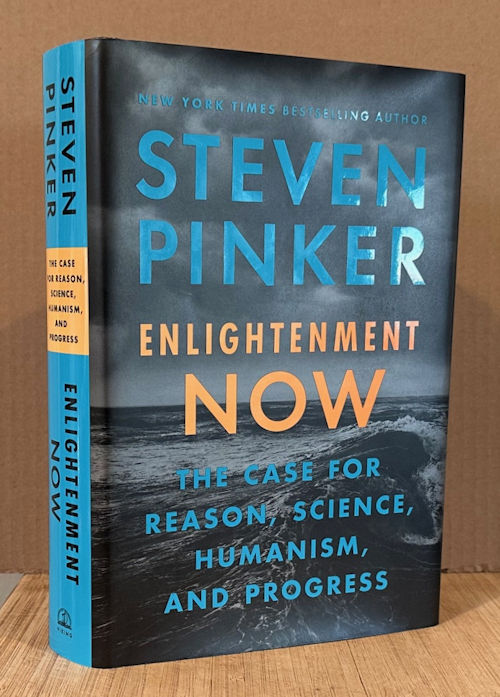
Subtitled “The Case for Reason, Science, Humanism, and Progress”
(Viking, Feb. 2018, xix+556pp, including 102pp of notes, references, and index.)
Posts about this book: Post 1; Post 2; Post 3; Post 4; Post 5; Post 6.
The final chapter considers humanism as the agent for deploying reason and science and thus producing progress. Pinker defines humanism, considers why some oppose it, and explores the two main alternatives: religion, and authoritarianism, with a particular call-out against the ideas of Nietzsche. As he sums up, Pinker warns against blaming problems (which will always occur) on evildoers, wrecking institutions, and “empowering a leader who will restore the country to its rightful greatness.” Finally, he closes with a page-long summary of the story of human progress: the crooked timber of human nature with its resources to redeem its flaws; how we combine ideas recursively and spread them with language and developed norms and institutions of reason; how we’re penetrating the mysterious of the cosmos; how the human condition has greatly improved, and how this is a heroic story that is true, because we have reasons to believe it.
*
Ch 23, Humanism
We need more than science to bring about progress—we need guidance to determine which things to achieve. The goal of maximizing human flourishing can be called humanism (which doesn’t exclude animals), which has had three manifestos since 1933. (They’re here at Wikipedia: https://en.wikipedia.org/wiki/Humanist_Manifesto) The third in 2003 has items, listed p410-411. Oddly, humanism is opposed by many, not just the religious and political, but by artists and intellectuals p412.4.
A key principle is impartiality, which underlies a list of other attempts to construct morality on rational grounds, p412.7. But we need deeper grounds. We can recall our existence as reasoners in a world of entropy and evolution; individuals are often at cross-purposes with each other, and so morality or wisdom is about balancing such conflicts. That we are so vulnerable to violence we prefer to engage in argument, and thus we develop moral codes that apply to everyone who can think. Thus sympathy in many forms evolves in an expanding circle.
Humanism isn’t merely the same as utilitarianism, which has problems, 415b, but it has fewer problems that deontological ethics, 416t i.e. principles deemed moral or not by their very nature, often as defined by God. Problems there include, who says? At various times various things have been deemed immoral by their very nature – list 416.7 (vaccination, life insurance, interracial marriage, etc.).
Anyway utilitarian principles often work, and have impressive results. It’s useful if any such principle is ‘thin’ i.e. easily appreciated. Joshua Greene points out that deontological convictions are rooted in primitive notions of tribalism, purity, revulsion, and social norms, whereas utilitarian concerns results from rational cognition. [[ Yes ]] P417.8 Also, when people from diverse backgrounds converge, they settle on such principles; thus the separation of church and state, and the universal human rights declared by the UN.
There are two perennial alternatives: theistic morality, and romantic heroism.
First, religion. Will it always push back? Is the enlightenment just a fad?
The problem with religion is, first, that there’s no good reason to believe that God exists. All the arguments have been refuted. (E.g. in an appendix in that Goldstein novel). P421. Some argue that science has no business on these matters, or imagine various escape hatches; but Coyne (in Faith vs Fact) points out that many religious claims are perfectly testable hypotheses, 422. Other claims, such as an immortal soul, might also have evidence in its favor; but none exists (rather 422.7 “The fact that these reports have all been exposed as tall tales, false memories, over-interpreted coincidences, and chap carny tricks undermines the hypothesis that there are immaterial souls which could be subject to divine justice.”)
And so the scope of religious claims has shrunk; the ‘god of the gaps’. There are two areas still cited.
First, the so-called fine-tuning of the physical constants. Cf Rees book. P423. Problem of theodicy: why did God design a universe with such misery? And there are plenty of ideas to explain these: we may not understand physics sufficiently; there may be a multiverse. Our ‘queasiness’ at the idea is no guide to its possible truth, 424b. A multiverse might be a simpler explanation than any alternative.
Second, the so-called ‘hard’ problem of consciousness. The ‘easy’ problem is 426t. The hard problem is an enigma. Dennett claims there is no hard problem; author agrees 427.7. Perhaps there are some concepts beyond human ken, 427.9 [sf connection here]. Colin McGinn; Ambrose Bierce. And appealing to a ‘soul’ is no help; it posits a bigger mystery, paranormal phenomena, that don’t seem to exist. 428m.
The second problem with religion is that it can’t be a source of morality. Goes back to Plato. Numerous OT examples, 429t. It’s religion that’s relativisitic, and can be immoral in its directives, 429.7. Steven Bannon’s claims are dunce-cap history, 430t.
Sophisticated people may not believe in heaven, hell, etc., but react against the ‘new atheist’ authors. Do any of their possible flaws implicate humanism? Faitheists claim that religion is necessary, 431t, but is this true? We understand the psychological origins of religion, but as with nationalism, this is a vulnerability, not a necessity. So we evaluate religions on their own grounds. Yes they’ve made positive contributions. But the benefits of religion are more about community than about supernatural beliefs. And its obstructions are harmful, e.g. political movements against various ends, 432.6. And evangelicals supported Trump, p 432.9:
In 2016 there was a brief hope that the Christian virtues of humility, temperance, forgiveness, propriety, chivalry, thrift, and compassion toward the weak would turn Evangelicals against a casino developer who was vainglorious, sybaritic, vindictive, lewd, misogynistic, ostentatiously wealthy, and contemptuous of the people he called “losers.” But no: Donald Trump won the votes of 81 percent of white Evangelicals…
What about religion’s wisdom on great questions? Dennett calls this a deepity. The opposite of religion is not science, but the entirety of human knowledge and reason. And religious wisdom is often shallow and archaic. Spirituality? Oprah’s claim that there are no coincidences; Amy Schumer and Bill Nye making fun of the idea of a universal force. p434b:
A “spirituality” that sees cosmic meaning in the whims of fortune is not wise but foolish. The first step toward wisdom is the realization that the laws of the universe don’t care about you. The next is the realization that this does not imply that life is meaningless, because people care about you, and vice versa. You care about yourself, and you have a responsibility to respect the laws of the universe that keep you alive, so you don’t squander your existence. Your loved ones care about you, and you have a responsibility not to orphan your children, widow your spouse, and shatter your parents. And anyone with a humanistic sensibility cares about you, not in the sense of feeling your pain – human empathy is too feeble to spread itself across billions of strangers – but in the sense of realizing that your existence is cosmically no less important than their, and that we all have a responsibility to use the laws of the universe to enhance the conditions in which all can flourish.
But is religion pushing back? People are hostile to the word ‘atheist’, which they equate with amorality, but surveys increasingly show decrease in religious alliances. The consequences of affluence and education. One sixth of the world is now ‘none’. That people think there’s a religious resurgence might be an effect of two things: religious people have more babies; and the religious vote more often.
And America is an outlier; de Toqueville. And yet the nones are rising, to 25% today.
There are numerous reasons why the world is losing its religion; the main one being reason itself, the observation that the teachings of religion aren’t true. The correlations among religious belief and happiness and well-being are established among countries, and among states in the US.
What about Islam? The Islamic world is sitting out progress, and is the locus of wars and terror in the modern world. The religion itself isn’t to blame; the Islamic world was once the center of learning, ahead of the West. Yet it is partly due to religion – the Quran is full of harsh statements about outsiders and beliefs. Most are very religious; there has been no equivalent of the Enlightenment; no separation of church and state. Apologists in the West suggest that the region can’t progress. Yet pockets are.
The second threat to humanism is authoritarianism, or nationalism, populism, fascism. The single thinker who represents the opposite of humanism would be Nietzsche – description of his thinking, 444, all about the ‘overman’ who achieves glory through heroism, and defeating the common masses; it hails to the heyday of the warriors of the Greeks and Vikings, and feels corrupted by Christianity and the enlightenment. Quotes.
These thoughts inspired the two world wars, 445. Yet he is still admired among intellectuals and artists. Why? Perhaps because those people respond to the idea that they are special, more worthy of living than the masses who consume mass entertainment, 447. Lists of admirers – 446. And the appeal of other dictators, 447. And thus, even an intellectual root for Trump, 448.
Two ideologies have derived from N: fascism, defined 448m, the idea that the individual is a myth and identity derives from culture, bloodline, and homeland. This is currently justified by appeal to evolutionary psychology and group selection, 448.
And the reactionary ideology of ‘theoconservatism’, 448b. The idea that Enlightenment values have led to a tepid society, which must be restored – via Christian values. The irony is that this is analogous to radical Islam, which is so feared; “with its horror of modernity and progress.” 449.7
But the case for this is intellectually bankrupt, 450. The idea that humans have an innate imperative to identify with a nation state is bad evolutionary psychology; it confuses vulnerability with need. There are many ways to identify with a tribe, 450m.
And ethnic uniformity does *not* lead to cultural excellence; thus vibrant cultures grow through interaction with other cultures, cf. Sowell and Diamond, 450b. And recall why international institutions arose; the struggle between nation states in the 19th and early 20th centuries didn’t work out. Thus the UN, and human rights.
The appeal of regressive ideas is perennial, and the case for reason, science, humanism, and progress always has to be made; beware thinking
that every problem is an outrage that calls for blaming evildoers, wrecking institutions, and empowering a leader who will restore the country to its rightful greatness.
Finally, Pinker ends with a page-long summary of “the story of human progress”, p452-3:
We are born into a pitiless universe, facing steep odds against life-enabling order and in constant jeopardy of falling apart. We were shaped by a force that is ruthlessly competitive. We are made from crooked timber, vulnerable to illusions, self-centeredness, and at time astounding stupidity.
Yet human nature has also been blessed with resources that open a space for a kind of redemption. We are endowed with the power to combine ideas recursively, to have thoughts about our thoughts. We have an instinct for language, allowing us to share the fruits of our experience and ingenuity. We are deepened with the capacity for sympathy — for pity, imagination, compassion, commiseration.
These endowments have found ways to magnify their own power. The scope of language has been augmented by the written, printed, and electronic word. Our circle of sympathy has been expanded by history, journalism, and the narrative arts. And our puny rational faculties have been multiplied by the norms and institutions of reason: intellectual curiosity, open debate, skepticism of authority and dogma, and the burden of proof to verify ideas by confronting them against reality.
As the spiral of recursive improvement gathers momentum, we eke out victories against the forces that grind us down, not least the darker parts of our own nature. We penetrate the mysteries of the cosmos, including life and mind. We live longer, suffer less, learn more, get smarter, and enjoy more small pleasures and rich experiences. Fewer of us are killed, assaulted, enslaved, oppressed, or exploited by the others. From a few oases, the territories with peace and prosperity are growing, and could someday encompass the globe. Much suffering remains, and tremendous peril. But ideas on how to reduce them have been voiced, and an infinite number of others are yet to be conceived.
We will never have a perfect world, and it would be dangerous to seek one. But there is no limit to the betterments we can attain if we continue to apply knowledge to enhance human flourishing.
This heroic story is not just another myth. Myths are fictions, but this one is true — true to the best of our knowledge, which is the only truth we can have. We believe it because we have reasons to believe it. As we learn more, we can show which parts of the story continue to be true, and which ones false-as any of them might be, and any could become.
And the story belongs not to any tribe but to all of humanity — to any sentient creature with the power of reason and the urge to persist in its being. For it requires only the convictions that life is better than death, health is better than sickness, abundance is better than want, freedom is better than coercion, happiness is better than suffering, and knowledge is better than superstition and ignorance.
\\\
Comments:
- I’ve followed the debate over the decades about whether “group theory” is valid, invalid, or simply unnecessary. Wilson stuck to it his entire career, even aligning individual selection (selfishness) with sin, group selection (concern for others) with virtue. What I didn’t realize until going through this book again is that the resistance to group selection may be its apparent support for nationalistic ideas, that one nation or race is superior to another. That would explain the distaste for the idea, but doesn’t necessarily impugn its validity.
- About Nietzsche. Here again his ‘superman’ idea aligns with authoritarian nationalism, Pinker notes. Does the music in 2001, by Richard Strauss and based on Neitzsche’s “Also Sprach Zarathustra,” reflect on the movie and Clarke’s novel at all? I would say it’s analogous, but not an endorsement.