
- Conservatives want to see media — now CBS — that tells them what they already believe;
- How Trump has made fools out of his populist supporters;
- How the “Donroe Doctrine” is now in effect;
- And how all of this reflects the theme of the original 1960s “Mission: Impossible.”

Slate, Jill Filipovic, 5 Jan 2026: The Big Problem With Conservatives’ Favorite Criticism of the Media
Beginning:
In 2026, there’s one easy resolution we should all commit to: Be better consumers of media.
Traditional media is in crisis, thanks to a combination of Trump administration attacks, corporate takeovers, and technological innovations. Social media sites compete for our attention by offering us addictive little bites: outrage-bait tweets and short-form shock-value TikTok videos, served up according to algorithms that track how long we linger and feed us more and more of what keeps us locked in (which is often what makes us angry).
The central issue:
[S]ome once legitimate news outlets are following suit and pledging to tell viewers what they want to hear and already believe, rather than what’s true and what it means. CBS, now helmed by former opinion writer and Substacker Bari Weiss, just relaunched its flagship show CBS Evening News, newly anchored by Tony Dokoupil, who opened the program’s reboot by telling viewers, “On too many stories, the press has missed the story. Because we’ve taken into account the perspective of advocates and not the average American. Or we put too much weight in the analysis of academics or elites, and not enough on you.” Dokoupil promised, “From now on, what you see and hear on the news will reflect what you see and hear in your own life.”
In other words they’re becoming another social bubble that merely reinforces what you already believe.
Programming that simply regurgitates what people already see, hear, and believe in their own lives is not, by any definition, “news” or even new. News media of course report stories that are relevant to their readers’ and viewers’ lives. But they should also be reporting the things those readers and viewers should know but don’t: political corruption or malfeasance; the actions of the very powerful; the disasters afflicting those less fortunate; innovations and world-changing achievements; the ways in which choices made in Washington invisibly but indelibly shape the lives of average people. The job of the reporter is to report what’s true, and to help the reader or viewer understand why it matters or what it means, which often requires bringing in subject-matter experts who are less “elites” than people who have spent years amassing knowledge and whose insights can expand minds and deepen public understanding. Mimicking the social media model of simply affirming people’s own beliefs, biases, and animosities and insisting that the guy next door knows as much about nuclear fission as a nuclear physicist is anathema to real journalism.
And so on with examples.
\\
They’re incoherent.

Sate, Zachary D. Carter, 5 Jan 2026: Trump Has Once Again Made Fools out of His “Populist” Supporters, subtitled “The president’s new GOP looks a lot like the old GOP, especially after his invasion of Venezuela.”
There was a time, not long ago, when people would claim with a straight face that Donald Trump was a populist who prioritized the interests of working-class Americans and avoided stupid foreign wars. “Trump’s Best Foreign Policy? Not Starting Any Wars,” then-Sen. J.D. Vance crowed in 2023. As Trump assembled his second-term national security team in 2024, Republican Sen. Rand Paul, of Kentucky, claimed to be “amazed by the Trump Cabinet” and the president’s rejection of “warmongers.” A mere two months ago, one of those Cabinet officials, Director of National Intelligence Tulsi Gabbard, told a conference in Bahrain that Trump had ended the “counterproductive and endless cycle of regime change or nation building” that has defined U.S. foreign policy for decades.
The president’s brazenly illegal military assault on Caracas last week would embarrass these people, were they capable of embarrassment. Trump did not govern as a populist during his first term; his second has been an unabashed celebration of crass imperialism and the superrich.
I don’t need to quote any more.
\\\
This has been going on for a long time.
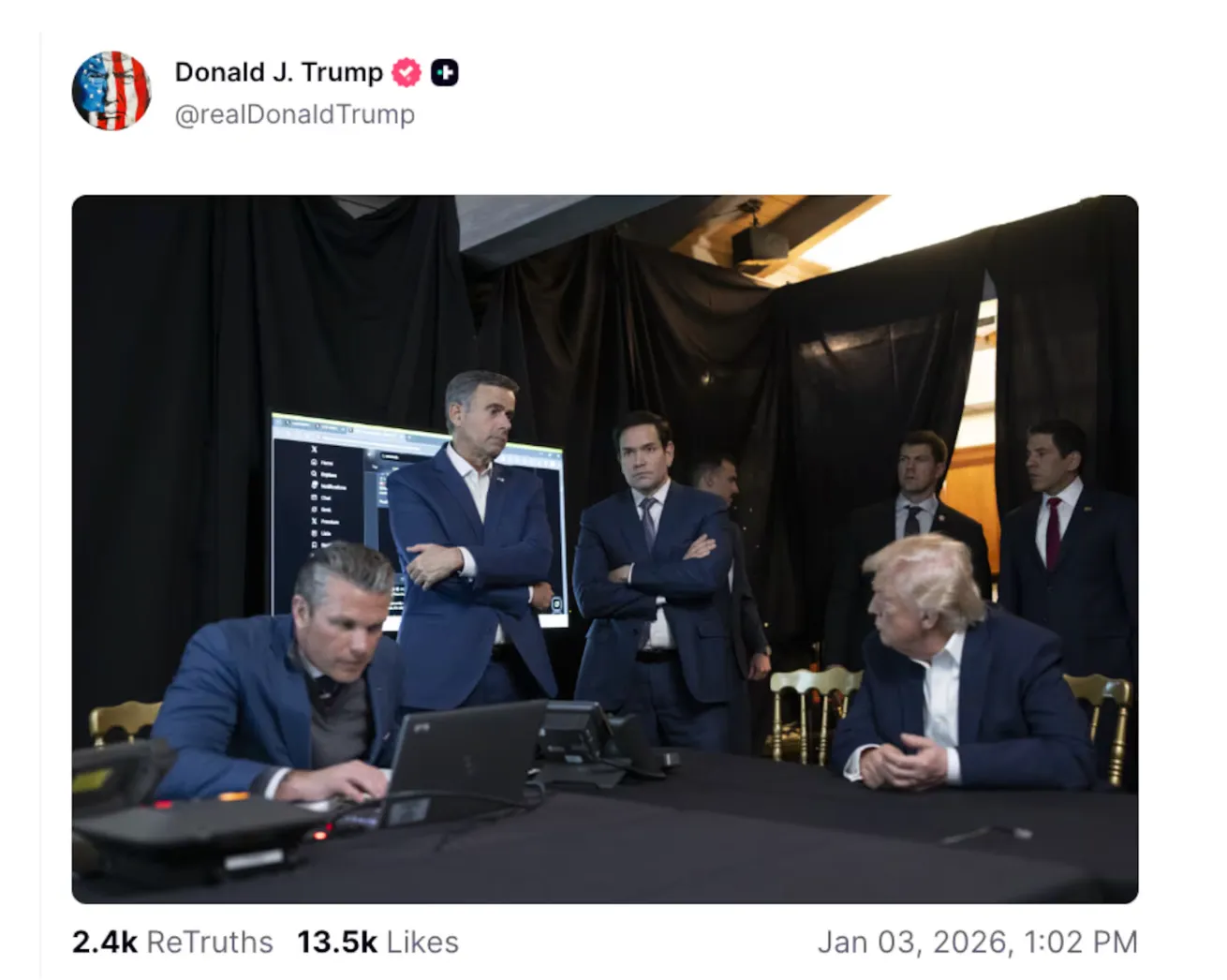
Paul Krugman, 5 Jan 2026: The Real Donroe Doctrine, subtitled “Seeking cash and an ego boost, not regime change”
Yes, “Donroe Doctrine” is a term going around, in reference to the historical Monroe Doctrine from 1823, in which President James Monroe declared the entire western hemisphere (the “New World”) to be the providence of the United States. But Trump’s ambitions are very specific.
For Americans of a certain age, the snatch and grab abduction of Nicolás Maduro, Venezuela’s president, brings back memories of the 2003 invasion of Iraq, in some ways with good reason.
Almost everyone now sees Iraq as a cautionary tale about the lies of the powerful: We were taken to war on false pretenses. Almost everyone also thinks of Iraq as a prime example of the power of delusional thinking on the part of the powerful themselves. Slogans of the time — “We will be welcomed as liberators”; “Mission Accomplished” — are now routinely used ironically, to denote foolish projects doomed to catastrophic failure. And Donald Trump’s Venezuela adventure is another tale of lies and delusion.
But in other ways the Trump/Venezuela story is very different from the Bush/Iraq story.
Two days after the abduction, it’s clear that Trump wasn’t seeking regime change, at least not in any fundamental way. He’s more like a mob boss trying to expand his territory, believing that if he knocks off a rival boss he can bully the guy’s former capos into giving him a cut of their take.
And so on.
\\\
In fact — there was a popular TV show in the mid-1960s, called Mission: Impossible. It bears little resemblance to the movie franchise with Tom Cruise of the past couple decades. The TV show involved a group of agents, licensed by some unnamed US secretary, who were given instructions to infiltrate a foreign government deemed hostile to the US and bring it down. The agents, led by Jim Phelps (from season two, played by Peter Graves), did this by pretending to be members of the hostile government (and somehow speaking the local language impeccably), and then tricking the locals into suspicion and deceit and self-sabotage. The locals killed themselves; their government collapsed; the Impossible Missions Force (IMF) walked away with clean hands. (Quite unlike the thuggish attack on Venezuela.)
But the premise of course was that the US took license to bring down foreign governments. The show began in 1966, but after five years or so, the idea of US government intervention in foreign nations became distasteful to American audiences uncomfortable with the Vietnam War. The show, rather abruptly, shifting its focus to internal enemies, such as drug dealers and organized crime.