
- Reactions to a speech by Marco Rubio claiming the superiority of Western Civilization over all others, by Bret Stephens, Eliot A. Cohen, Jamelle Bouie;
- Noting again Jared Diamond, who explained decades ago why the fact that the Enlightenment et al originated in Europe doesn’t mean white men are superior to all others;
- And by the way Trump is building concentration camps.
There are divergent takes on a speech given by Marco Rubio in Europe the other day.

NY Times, opinion by Bret Stephens, 17 Feb 2026: Western Civ Can Save Us — Again
But the title in print, in this morning’s paper, was “The Only Civilization Worth Defending.”
And I thought, seriously? Isn’t this a little like saying, the only religion that is true is mine — because it’s mine?
Stephens begins:
Marco Rubio gave a speech Saturday to the Munich Security Conference in which he extolled an ideal that’s supposedly long out of fashion.
“We are part of one civilization: Western civilization,” the U.S. secretary of state told his largely European audience. “We are bound to one another by the deepest bonds that nations could share, forged by centuries of shared history, Christian faith, culture, heritage, language, ancestry and the sacrifices our forefathers made together for the common civilization to which we have fallen heir.”
The speech got, and deserved, a standing ovation.
And then he asks,
What, exactly, is Western civilization?
It’s worth pausing here because Western civilization is typically taken to be what began with the Greeks, then the Romans, and then all of their descendants, from western Europe to all of the Americas, with Australia too. As distinct from the Far East (China and Japan), southern Asia (India and lots of islands), and all of Africa, despite European colonization. And yet, right before our eyes, the Trump administration and MAGA seem to consider Western civilization to be only white people, excluding all the Americas to the south, and southern Europe — all those brown-skinned people. That’s why Trump yearns for immigrants from Sweden and Norway (who have it much too nicely in their own countries to ever want to come to the US).
Let’s see how Stephens, one of just a couple conservative NYT columnists, deals with this. First he answers his rhetorical question.
Americans younger than 50 might be excused for hardly knowing. A 2011 report from the National Association of Scholars found that not one of America’s top colleges and universities had a required survey course in Western civ and only 32 percent even offered it as an elective. In 1964, 80 percent of these institutions had some form of introduction to Western civ.
And then he echoes common conservative complaints that history books don’t whitewash history and pretend that Western civ, or at least the US, has been perfect (as if ordained by the Christian God).
What many universities do offer (even more so now than when the N.A.S. issued its report) is what amounts to an education in anti-Western civ: the examination of all the ways in which Western civilization is, purportedly, an extended act of imperialism and colonialism, human exploitation and environmental despoliation, misogyny and white supremacy and phobias of every kind.
He then explains the damage that he thinks this point of view has done. And then tries to define what “the West stands for.”
It’s the conversation between Plato and Aristotle, Locke and Rousseau, Keynes and Hayek. It’s the tension between — and uneasy synthesis of — revelation and reason, theory and observation, the ancient and the modern, the familiar and the foreign. It’s the tradition that seeks a deeper understanding of the world through a continuous upending of its own methods, beliefs and aspirations. It’s a civilization that, at its best, values questions more than answers and the freedom to question more than life itself.
Well, OK, but he doesn’t seem to realize that these traditional tensions have mostly resolved in favor of reason, observation, and the modern. And he doesn’t actually say much about the Rubio speech. Moving on:
\
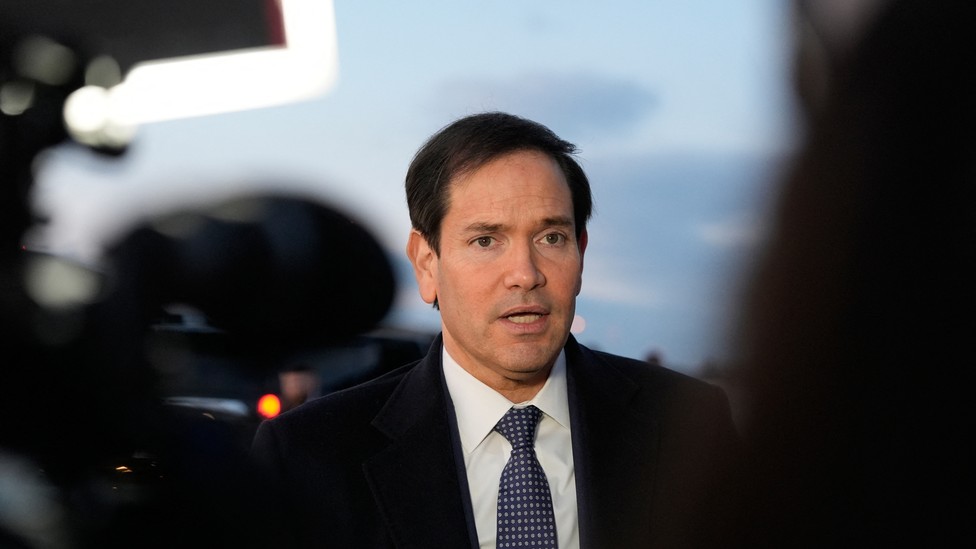
The Atlantic, Eliot A. Cohen, 17 Feb 2026: Marco Rubio’s Impressive Speech, subtitled “The secretary of state sought not only to reassure but to rally Europeans.”
The writer here gushes about Rubio’s diplomatic and rhetorical skills. But let’s look for the substance of what Rubio actually said.
While keeping Trump onside, Rubio sought not only to reassure but to rally Europeans. Where Vance seems only to have desired to berate and insult, there was something more urgently coaxing in Rubio’s tone. He seems to understand that the United States needs allies, that NATO was and should remain a cornerstone of American foreign policy, and he probably knows as well that an alienated Europe is dangerous for the United States. He spoke of our “intertwined destiny” and asserted that “the fate of Europe will never be irrelevant to our own.” In short, he reaffirmed the old saw that the only thing worse than fighting with allies is fighting without them.
His description of the common bonds, however, was predominantly civilizational. He cited poets and authors rather than political thinkers: Shakespeare, Mozart, Michelangelo, and the Beatles got shout-outs, not Montesquieu or John Locke. God appeared once, Christianity twice, and cathedrals, but not the Mother of Parliaments in London.
More to the point:
He disparaged globalism and the “rules-based international order,” though not in nearly as simple-minded a fashion as Pete Hegseth or his subordinates, a dull array of bumpkin Metternichs. The main themes that Rubio hit were the profoundly damaging consequences of unfettered free trade and mass migration.
He doesn’t like what’s “rules-based”? Coincidentally, I’m reading a book by Johan Norberg that emphasizes how progress over the past centuries came precisely from open borders and international trade — because before that everyone was stuck in their own little villages. But conservatives….
Moving on. Rubio seems to valorize the traditions of European colonialism and expansionism.
Rubio’s critique of the rules-based international order echoed that of Canadian Prime Minister Mark Carney. Both accept the truth that such rules as have existed have resulted much more from American hard and soft power well exercised than from a Kantian consensus among right-thinking politicians. Far more troubling was Rubio’s substitution of the word civilization for values.
Rubio’s vaunting of America’s roots in Europe may not play well with the descendants of enslaved peoples, Native Americans, and Asian American immigrants. His celebration of Europe’s expansion—“its missionaries, its pilgrims, its soldiers, its explorers pouring out from its shores to cross oceans, settle new continents, build vast empires extending out across the globe”—may seem rather one-sided to populations that felt the lash as much as or more than the benefits of colonial rule. And the invocation of Christian civilization leaves at best an uncomfortable marginality for atheists, Hindus, Sikhs, Buddhists, Muslims, and Jews.
Let me pause once again to add some perspective. While there’s an argument to be made that the great advances in world history — marked by the Enlightenment, the Industrial Revolution, and the Scientific Revolution — all emerged in the “West,” i.e. Europe, that doesn’t mean that the white people of Europe were somehow superior to all the other humans in the world. Jared Diamond dismantled that presumption almost three decades ago in his 1997 book Guns, Germs, and Steel, whose thesis was that contingent, or coincidental, circumstances like geography and environment explain why certain groups of human prevailed over others.
Yet conservatives take history to mean that somehow the white race from northern Europe is the superior one. No; it’s like an accident of birth — who is born of royalty, and who is not. It’s not that members of royalty are necessarily superior.
\
Analogously, there are other takes on Rubio’s speech. Here’s one.

NY Times, Jamelle Bouie, 18 Feb 2026: Marco Rubio Is Failing Western Civ
Americans of the Revolutionary generation did not think of themselves as direct heirs to Western civilization, a term that wouldn’t come into vogue until the 20th century. If anything, they saw their new nation as a break with the European past — a new civilization rooted in popular sovereignty and republican self-government.
Remember that, conservatives? Americans consciously *split* from the European idea of civilization to try something better — more, shall I say, “rules-based”. But recently the MAGA movement in the US are abandoning the ideas upon which America was founded, giving way to base human nature fear of the other.
In his second term, President Trump has held himself and his administration out as a bulwark in defense of Western civilization — the last, best hope for the grand heritage of the West against lawless incursion from foreign others.
“We cannot rebuild Western civilization, we cannot rebuild the United States of America or Europe, by letting millions and millions of unvetted illegal migrants come into our country,” Vice President JD Vance declared last February. During the 2024 presidential campaign, Stephen Miller, the architect of Trump’s immigration program, warned that re-electing Joe Biden would represent the “assisted suicide of Western civilization.” And in his eulogy for Charlie Kirk last September, Miller declared that the “legacy and lineage” of the MAGA movement “hails back to Athens, to Rome, to Philadelphia, to Monticello.”
But all of the immigrants that conservatives now demonize are from nations settled from Europe (mostly Spain and Portugal), the founder of Western civilization. Something more basic is at work: the tribalistic fear of the other. And you can’t for a moment believe that anyone in the Trump administration understands the principles of Athens, Rome, or the US founders. They are motivated by racism and greed, as has been now well-established.
Good essay. I’ll quote one more bit.
It is here, in this antipathy toward the egalitarian and universalist elements of the American founding — which is to say those parts of our national heritage that we owe to the liberal values of the Enlightenment — that the connection between the antebellum feudal obsession and the Trump administration’s vision of sovereignty and Western civilization becomes clear, if not obvious. Both are tied to a racial (and religious) conception of culture and bound up in notions of human hierarchy. The “one people” threatened by migrants in the United States and Europe, by Rubio and Trump’s account, are people of direct European descent, shorn of their particular histories and presented as a single, imagined whole. In other words, as white, first and foremost.
\\
And oh by the way, Trump is building concentration camps, just like Germany did.

Slate, Dahlia Lithwick, 17 Feb 2026: Trump’s Deportation Warehouse System Already Matches a Very Specific Period in History
Does MAGA care? Do they even realize what’s happening? I suspect not.