
So now Trump, the would-be-Nobel-Peace-Prize-winner, has started a war with Iran. All by himself, without congressional overview or approval. As someone on Facebook said, this isn’t how democracies start wars; it’s how dictators do.
I’m going to try not to get too absorbed by this, and just let it play out. But I have a couple items to note today.

Vox, Zack Beauchamp, 28 Feb 2026: Trump’s case for the Iran war makes no sense, subtitled “The scary incoherence at the heart of Trump’s latest, biggest war.”
Early Saturday, the United States launched an open-ended war on Iran. And nobody really knows why.
For the past several weeks, the United States has been amassing forces in the area — with an estimated 40 to 50 percent of its entire deployable air fleet in the region. Throughout this time, the Trump administration has refused to give any kind of straightforward public justification for the buildup: a clear accounting of why they were considering war with Iran, what such a war would entail, or what victory would look like.
After the war began, President Donald Trump gave an eight-minute speech explaining why the war had begun. The speech ran through a series of grievances with the Iranian government: its anti-Americanism, its history of supporting terrorist groups, and its nuclear program (which he had previously claimed to have “completely obliterated” after airstrikes last year).
“For these reasons,” Trump said, “the United States military is undertaking a massive and ongoing operation to prevent this very wicked, radical dictatorship from threatening America and our core national security interests.”
And so on. Later in the day Trump gave a speech explicitly citing “regime change” as a primary goal, and indeed, since this piece was posted this morning, there are reports that Iran’s supreme leader, Ayatollah Ali Khamenei, was killed in the airstrikes.
\
Apparently Trump now claims Iran tried to interfere in the 2020 and 2025 elections to stop him. (Daily Beast and JMG) Isn’t this the first we’ve heard about it? It’s remarkable how often he accuses various groups of interfering in elections. He’s obsessed by the idea. In fact, incidents of voting fraud are very rare, and mostly done, self-righteously, by Republicans. And how, I’ve wondered before, how would election interference actually be done? By carting out truckloads of invalid ballots that get accidentally discovered? No such suggestion has been remotely plausible, let alone based on evidence. All those conspiracy theories have been debunked (sorry, Dinesh). Far more plausible: many, many people just don’t like Trump.
\
And there’s this. Every accusation is a confession. And recalling an old Dustin Hoffman movie.

JMG, via Yahoo News: Trump Repeatedly Claimed Obama Would Attack Iran
“Wag the Dog” entered the political lexicon after a 1997 film about a president who manufactures a foreign crisis to distract from scandal. The movie was satire but the cynical political instinct it captured was not. When a White House under pressure reaches for military force, voters ask whether the battlefield just changed the subject.
In 2012 and 2013, he warned repeatedly that Barack Obama might attack Iran to appear tough or distract from political weakness. He urged Republicans not to let Obama “play the Iran card.” His argument was blunt: a president in political trouble might reach for war to reset the narrative.
And it’s widely noted that Trump manufactures crises in order the distract from earlier ones.
\\\
A couple substantial topics.

NY Times, 27 Feb 2026: The Birthrate Is Plunging. Why Some Say That’s a Good Thing., subtitled “The political class is worried about the historic drop. But the biggest change is among the youngest women, who are the least ready to have children.” [gift link]
The U.S. birthrate is declining. Rose Paz’s choices help explain why.
It describes a 22-year-old woman in Salt Lake City who has a bachelor’s degree and a serious boyfriend but who doesn’t want to have children right now. She’s not financially stable.
Not so long ago, women like Ms. Paz — in their early 20s, from backgrounds that are far from privileged — would have been among the most likely to be having children.
Now this group is a key contributor to the country’s declining birthrate, which is at an all-time low, down by over 25 percent since 2007, the year the fall began.
There’s a big picture perspective here. (Which aligns with a book I’ll post a summary of here tomorrow, about progress.) Over the past couple centuries, birthrates have declined worldwide as mothers have realized that, with improved healthcare, many more children live into adulthood than was true even a couple centuries before. And so they don’t need to keep churning out more babies, compared to a time when only a few of their many babies ever grew up. That’s good news. That’s one reason to think the declining birth rate is not a problem.
The other really-big-picture perspective is to imagine the future as the world population of humans keeps expanding. Yes, it’s true that prognostications by Malthus and Ehrlich haven’t panned out; in those cases technology has saved us. But that trend can’t, literally, go on forever, or humans would, literally, fill up the planet, and drive all other species into extinction. Progressives try to imagine “sustainable” solutions, in which a balanced population manages its energy needs and learns to live in its native environment. Only a very few seem to take that perspective.
While conservatives, driven by Biblical morality, are focused on expansion at any cost. Be fruitful and multiply. They ignore the context in which that commandment was given, compared to the state of the world today.
The NYT article is long, with many examples.
\\\
Here’s a great example about how to understand scientific studies, and the risk of “doing your own research.”
https://www.facebook.com/watch/?v=2296850680825398
This is another video by Dr. Noc, whom I’ve mentioned before, as he explains how the obvious interpretation of this graph is wrong.
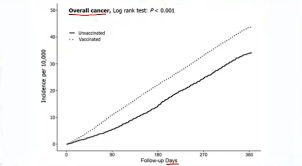
Sorry for the fuzzy image; it’s a screen capture from the video. But here’s the gist. The naive interpretation of this graph sees cancer rates rising as soon as someone is vaccinated. Right away. The informed interpretation is that people who get vaccinations are seeing their doctors more often, and thus more likely to see cancer diagnoses earlier than those who don’t, and don’t.