Trends in publishing can take place over decades, so they won’t be noticed by most people unless they’ve been buying (or borrowing) books for decades. Here’s a trend I’ve noticed for a while, which is now being noticed by the major media.
 NY Times, Elizabeth A. Harris, 6 Feb 2026: So Long to Cheap Books You Could Fit in Your Pocket, subtitled “The mass market paperback, light in the hand and on the wallet, once filled airport bookstores and supermarket media aisles. You may never buy a new one again.”
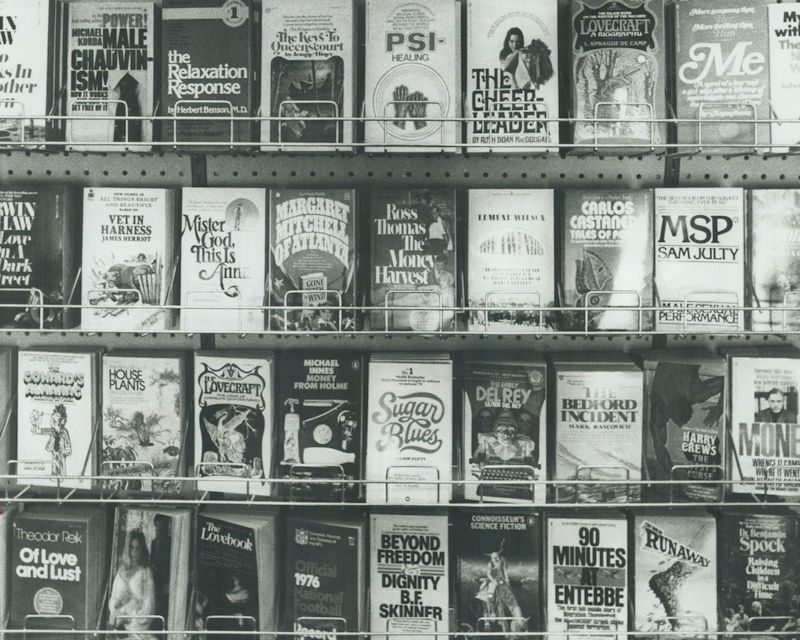
When the first book in the Bridgerton series was published in 2000, it was immediately recognizable as a romance novel. The cover was pink and purple, with a looping font, and like most romances at the time, it was printed as a mass market paperback. Short, squat and printed on flimsy paper with narrow margins, it was the kind of book you’d find on wire racks in grocery stores or airports and buy for a few bucks.
Those racks have all but disappeared.
After almost a century in wide circulation, the mass market paperback is shuffling toward extinction. Sales have dropped for years, peeled away by e-books, digital audiobooks and even more expensive formats like hardcovers and trade paperbacks, the mass market’s larger and pricier cousin. Last year, ReaderLink — the country’s largest distributor of books to airport bookshops, pharmacies and big-box stores like Target and Walmart — announced that it would stop carrying mass markets altogether.
“You can still find them in some places,” said Ivan Held, the president of Putnam, Dutton and Berkley, publishing imprints that once did brisk business in mass markets. “But as a format, I would say it’s pretty much over.”
The piece goes on with the various origin stories of paperback books, including the US government’s support to manufacture such books to send to troops overseas. But this piece makes a crucial error — as was noted by several of my Fb friends weeks ago when this article was published. These paperbacks, for decades now called “mass market paperbacks,” to distinguish them from the later “trade paperbacks” that appeared in the 1980s and ’90, where never called “pulps.” That terms referred to pulp magazines, meaning extremely cheap magazines published in the 1930s and before on the cheapest quality paper, the kind of paper that would easily disintegrate if gotten wet. “Pulps” were magazines, never paperback books.
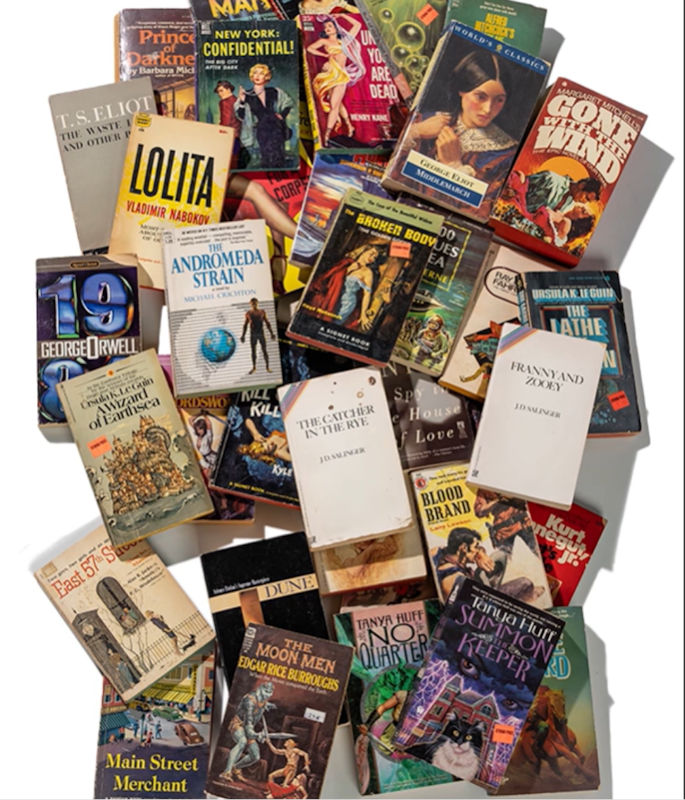
(Aside: I own, or perhaps once owned, the editions shown in this photo collage of A WIZARD OF EARTHSEA, THE ANDROMEDA STRAIN, DUNE, and CAT’S CRADLE (the red one in the back at bottom right).)
\
A more recent piece.
 The Guardian, David Smith in Washington, 24 Feb 2026: ‘We’re losing accessibility’: America says goodbye to the mass-market paperback
Subtitle: The so-called ‘pocket book’ sold in supermarkets is being phased out across the US, the latest sign of an ongoing shift in how people are choosing to read.
Shelly Romero has early memories of going to her local supermarket and picking pulp fiction off the shelves. “We were very working class; my mom was working two jobs sometimes,” she recalls. “The appeal of books being cheaper and smaller and able to be carried around was definitely a thing.”
For generations of readers, the gateway to literature was not a hushed library or a polished hardback but a wire spinner rack in a supermarket, pharmacy or railway station. There, amid chewing gum and cigarettes, sat the mass-market paperback: squat, roughly 4in by 7in and cheap enough to be bought on a whim.
The 2005 film version of The Chronicles of Narnia: The Lion, the Witch and the Wardrobe.
Myth, monsters and making sense of a disenchanted world: why everyone is reading fantasy
Read moreBut the era of the “pocket book” is drawing to a close. ReaderLink, the biggest book distributor in the US, announced recently that it would stop distributing mass-market paperbacks. The decision follows years of plummeting sales, from 131m units in 2004 to 21m in 2024, and marks the end of a format that once democratised reading for the working class.
Again the solecism about “pulp fiction”. (Has the name of that movie contorted peoples’ memories?)
\\
Here’s what I remember. (I’ve written some of this history in this personal history post: 15 Ways of Buying a Book, Part 1.) As a teenager I bought [mass-market] paperback books from newsracks in drug stores and markets, including Wayne’s Super Value market in Cambridge Illinois, where I spent a couple summers, on those spinner stands. This was the late 1960s. Paperbacks cost 60 cents or 75 cents. As years passed prices crept up to 95 cents.
It was only as years passed that I discovered actual bookstores, which sold hardcovers. I was only able to afford hardcovers, which in the early 1970s sold for $7.95 or so, in the 1970s while I was at UCLA, and making bits of money here and there.
Now there’s a crucial understanding to be made about mm (mass-market) paperbacks. The earliest paperbacks, the ones called “pocket books” (as my father continued to call them in the 1960s), were all reprints of books published earlier in hardcover. At some point, perhaps it was the 1950s with Ballantine Books, some publishers began publishing brand new never-before-published books, in paperback, without any precursor hardcover. “Paperback original!” their covers would crow.
Over the decades “trade” paperbacks, larger paperbacks almost the size of hardcovers, appeared, sometimes as reprint of hardcovers, other times with original titles. These continue to this day. In bookstores these days, Barnes & Noble and the independents, you see lots of hardcovers and trade paperbacks, but virtually no mass market paperbacks. They’ve quietly vanished. The only place I see them lately is in those little free libraries. People giving them away.
That doesn’t mean the older mm paperbacks aren’t just as valuable as hardcovers (or less frequently trade paperbacks). Abebooks. Partly because many of them are legitimately collectible, since some of them were actual first editions (e.g. Delany’s DHALGREN and Russ’s THE FEMALE MAN), and some of them were issued as matchable sets of titles by their author, sets which collectors of a certain type strive to complete.
Checking Abebooks just now, a “near fine” 1st printing of DHALGREN is asking $699. It originally cost $1.95, a huge price for the time, because the book was very fat at 879pp.