Subtitled: A Search for Who We Are
(Random House, Oct 1992, xvi + 505pp, including 85pp of notes, permissions acknowledgements, and index.)
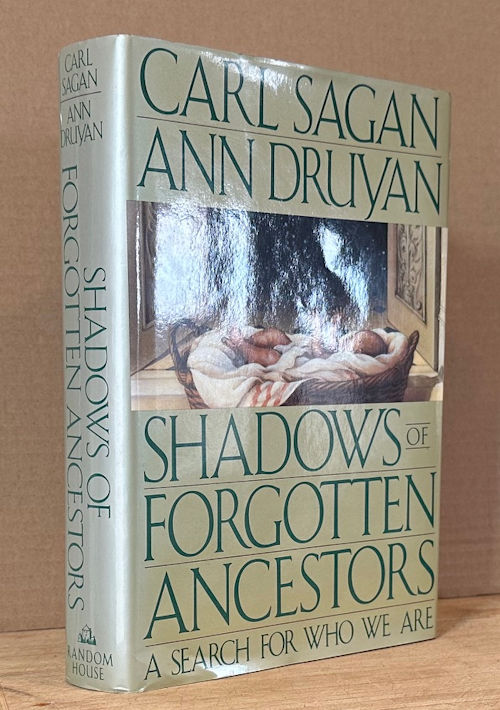
This is perhaps Carl Sagan’s most substantial book, on the grounds that it’s through-written as a single composition; it’s not a compilation or fix-up of previously written magazine pieces, as THE DEMON-HAUNTED WORLD was, or an edited series of lectures, as THE VARIETIES OF SCIENTIFIC EXPERIENCE WAS, or aligned by chapter to episodes of a TV show, like COSMOS was, or a book aligned to an earlier book, like THE PALE BLUE DOT was.
Also, it takes a sort of 10,000 foot view of a period of history not examined by most books about evolution, or the cosmos, or human history. It’s about the history of life up until humanity’s ancestors came on the stage, and so it outlines how and why life on Earth came to be, and how things like competition and violence necessarily came to characterize life on Earth.
When I first read this book I did this post quoting most of the last three pages, which summarize or anticipate how modern society is giving into ancient protocols of primitive life. Worth quoting again…
I’ll note of course that his wife, Ann Druyan, is given co-author credit for this book, even though it’s been tacitly assumed that she co-wrote several of his other books, including his one novel, CONTACT (reviewed here at Black Gate), without such credit.
*
Key points
- The book sets humanity in the context of a vast universe in which we’ve been orphaned from most of our past, and are now trying to understand our place in it.
- Early chapters describe how stars and worlds form, how life emerged, how until recently humanity ascribed our existence to a God. How Darwin overturned this presumption, how the faithful fought back, but how the evidence of the world does not require any kind of creator.
- Chapter 5 describes the modern understanding of DNA and of evolution, how it challenges human understanding of the time involved, how ideas of uniformitarianism and catastrophism shifted over the decades. Ch 6, history of life on Earth, all of it related. Here Sagan begins a series of striking perspectives. Once life was set up, a billion years ago, it became important to recognize inside and outside, us and them, so as not to eat others in your group; thus the beginnings of xenophobia and ethnocentrism. How arms races developed between plants with toxins and animals that would eat them. Brains evolved to learn survival behaviors; fear is the response of the primitive taking over from the thinking function. Self-sacrifice behavior (what the authors align with the ‘sentimental illusion’ of altruism) is the result of a cost-benefit analysis. How groups cooperate against common enemies (but how this isn’t necessarily group selection).
- Plants and animals live off each other’s bodily wastes. Oxygen reached current levels only about 2bya. Almost all of our ancestors went extinct. Sex has several competing explanations, but in any case it brought about the end of immortality. Different animals have very different behaviors than humans do. It was long thought that animals, especially insects, were unthinking robots.
- Once animals got good at reproducing, they risk starving from overpopulation. Thus aggression and competition within a species, including deterrence and submission. Again, ethnocentrism and xenophobia. Young animals will believe anything. Few animals societies are democracies; most are dominance hierarchies; while human tend both ways, toward hierarchies but also valuing personal freedom and dignity. [[ Thus anticipating the conservative/progressive division in human nature. ]]
- Ch 12 is on hormones, especially testosterone, and how it exacerbates tribalistic behavior.
- Ch 13 is about Darwinian selection and how it responds to changes in the environment; a species cannot specialize too precisely. These tendencies lead to rules against incest and the strategy of exogamy (marrying from another tribe).
- Ch 15 etc describes the discovery of apes and monkeys in Africa, not at first recognized as related to humans, which was cemented later with DNA evidence. Still, humans resist the idea that chimps or other primates had thoughts or behaviors, until 20th century studies established that they do.
- Ch 16 etc examine the behavior of gorillas and chimps in some detail, comparing and contrasting theirs with humans, with wide variations among them all. Some even have language of a sort.
- Ch 19 and 20 explore what might make humans unique from all the other primates, with various ideas from over the centuries, and can’t find any one thing. Some primate are conscious, some of language, some of culture. So what sets humans apart? No one thing, except perhaps our self-satisfaction.
- Finally Ch21 summarizing humanity’s family tree, from the beginning of life on Earth, how we’ve come to understand what we are, yet how we go from disaster to disaster, as if humanity has a learning ability. “A new generation gladly abandons its critical and skeptical facilities.” Yet we’ve made great progress, and have the ability to change our institutions. Nothing is preordained.
Comments.
The early part of the book explains the history of life with a series of inevitabilities that make conditions like competition and violence seem inevitable; humanity could not have ‘evolved,’ as other animals have, without all the consequences of living in competing tribes and groups. (Why didn’t God create humans to be angelic, without bodily needs and all living in perfect harmony?) The conclusion, about humans having no one particular quality that other animals don’t, is one perspective on that broad question; traditional perspectives have placed tool-use as the key development that triggered human development, while more recent thinkers have instead identified the ability to cooperate and pass knowledge from one generation to the next as key.
\\\
The implication is this is a kind of sequel to Cosmos, about who we are not just where; at the very end there’s a suggestion of a third volume to come.
Introduction
- Book was begun in the early ‘80s as the Cold War raged; meanwhile all sorts of problems (page xiii) that sound just like today’s. What caused it all? Have to look at all of history. Now the cold war is over, but there are new dangers, p xiv. Breadth is required, across disciplines. With cautions that science is never finished. Long list of people to thank. … even Parade magazine.
Prologue: The Orphan’s File, p1
- Considering the size of the universe, the relative emptiness, the stars, and life on one particular planet. What does it mean to be human? Can we escape our past and be trusted with our own future? Many blame the gods; others realize humans invented the gods. Our species is hundreds of thousands of years old; we have no records anywhere near that old. Our time-depth is shallow. We know our ancestors only a couple generations back. It’s like we know only what a spotlight following us through time illuminates. We’re orphans from time. So we invent myths, and penalize anyone who dare doubts them. The idea that the universe was made for us has crumbled for five centuries. So now many fear an indifferent, or meaningless, universe.
- We have only fragments of the past (see Darwin footnote). But we can trace the history of life.
- (The conceit here is that humanity is an ‘orphan’ without direct knowledge of its past; we have to piece it together, from fragments)
Ch1, On Earth as it is in Heaven, p9
- Description of the mass of gas that collapses into a star, the formation of worlds. In all the galaxy, there’s about one new star a month; in the observable universe, hundreds a second. Around each star, worldlets collide, sometimes stick together, growing until they become spheres. Big ones attract gases and become giants. The planets settle out. The ones with more-or-less circular orbits survive; others collide and dissipate. Odd fragments still collide with the regular planets.
- It’s easy to see in this regularity how early physicists thought they were evidence of a Creator. We understand it’s just physics and chemistry, and ages of time.
- Thus the Earth is about 4.5 billion years old. Occasional collisions have never ended, though the scars have been erased. Not so on the moon.
- The sun is now middle-aged. There are still occasional asteroids and comets. The history of earth has never been sealed off from the outer universe. Some ancient cultures recognized a connection between the earth and the sky.
Ch2, Snowflakes Fallen on the Hearth, p19
- Compared to the size of the earth, the habitable band is a very thin coat; go up or down 100 miles and you’re out of it.
- We can dig up our ancestors. Some of the oldest are nevertheless large; stromatolites. They could do photosynthesis 3.6 billion years ago. We don’t know the sequence of life’s development up until then. Ozone had to exist for oxygen to exist; and for UV to be blocked. No earlier fossils are known. We can narrow the origin of life down to a window of a couple hundred million years; it seems to have arisen very quickly.
- Then it was mainly an ocean planet. Continents began 4bya, became larger 3bya. They move across the surface, crashing into each other, sucked under; only fragments of the ancient continents have survived til our time. Maps of ancient earth, until recently, would have looked unfamiliar. We can reconstruct the single massive continent of about 600mya. Gondwana. And Pangaea, even larger, about 270mya. Then it broke up, slowly; by 100mya South America and Africa split. This became the world of the dinosaurs. Later movement made the world of the primates.
- Nice para summary p30.7.
Ch3, “What Makest Thou?”, p33
- For the last few thousand years, humans were confident that the world and everything in it was made for us, by God. With enormous casts of animals for us to do with as we pleased. Why so many beetles, no one could say. But the account satisfied everyone.
- Until Darwin, who wrecked this consensus reluctantly.
- (Sagan has a long footnote, p423, on the lingering resentment of evolutionary instruction, and belief in creationism and the flat earth.)
- Background of Darwin. Born 1809. Mother’s was the Wedgewood family, of pottery fame. Both patriarchs were progressive. The Lunar Society. Erasmus Darwin (Charles’ grandfather) wrote huge volumes of rhyming poems about plants and animals. Some of his writing indicates he was on to something, but he did no research. Charles read those books. M/w Lamarck suspected some kind of transformations among species. Lamarck’s family idea was also untethered by research. From circumcised boys to Chinese women whose feet are bound. Neither he nor Darwin knew about genes or how they worked.
- Darwin grew up absorbed by the natural world. He attended a school whose Dr. Butler discouraged curiosity. He went to university with his brother Erasmus, to study medicine, which did not take. Perhaps then a clergyman? Charles read some church dogmas and had no doubts about the literal truth of the Bible. So he went to Cambridge for three years, and got better grades, but was still fascinated by beetles. He took a course in geology, then one in botany, by a genius teacher who was also quite devout. Who, later, forwarded the message about the position on the Beagle.
- Authors imagine how this played out, getting permission from his father…. How the Beagle had already been to South America before, and brought back several “Fuegians,” now to return. Among the books Darwin took was one by Lyell – whose work some tried to reconcile with the Bible. P44. Lyell claimed these processes took ages and ages. Also, the captain, FitzRoy was conservative and racist, defending slavery. Darwin was perhaps more attentive to the injustices of his class than most, including the depredations of Europeans on the land and peoples in South America. So his book, Voyage of the Beagle, was an adventure story, but it also amassed much evidence for evolution by natural selection. The finches in the Galapagos islands, e.g. Once Darwin returned home in 1836, his letters had preceded him; he met Lyell; he conceived the idea that earthquakes etc were the result of slow movements of the earth. He married and had ten children, and outlined his theory of evolution. He and his wife sparred over religion. He resists publishing an essay on the subject, then takes 8 years to study barnacles. Perhaps this was smart; he needed proper training in biology.
- M/w Alfred Russel Wallace gathered evidence for the same idea, though lost it all in a ship fire. Darwin contacted Wallace; they exchanged ideas. The Origin of Species was finally published in 1859, and only mentioned humans in passing. Twelve years later came The Descent of Man.
Ch4, A Gospel of Dart, p51
- (Note opening quote from Thomas Reid who resisted anything that would “depreciate” human nature.)
- Darwin noted how humans, using “husbandry,” had changed traits in many animal and plant species. Natural selection does something similar. And it’s been at work for billions of years. Consider the varieties of dogs, derived over a few thousand years. The descendants of cabbages. Passage from Origin, p54-56. Then about the many things all living things have in common. What about the primordial form? Why it’s not happening today. …
- There was much reaction, pro and con, to the publication of Origin. We can dig up the reviews from popular magazines. Many raised objections. They did not know about genes and chromosomes in those days. Specious objections reveal how anxious people were to reject Darwin’s ideas, p60.4. Especially the idea that humans might still be evolving. Bishop Wilberforce objected that all of this was incompatible with the Word of God. P61t. Similar objections came from others. Darwin was accused of something like idolatry. Darwin replied. His motives were questioned. Teleology, or randomness? Herschel called it ‘higgledy-piggledy’; Thomas Carlyle called it ‘a Gospel of dirt.’ Darwin and allies countered that other principles, like gravitation, don’t ‘disprove’ God. Some critics simply missed the point. George Bernard Shaw understood their objections, 64t.
- Naïve Darwinists and Biblical literalists (like James Watt, in footnote) make similar mistakes. In general minds were changed by the 1870s and 80s. Some still objected to The Descent of Man, published in 1871. ..
- A detailed example: concerning malaria. The sickle-cell adaptation to it. How it spread via slaves from Africa to Suriname and Curacao.
- At the end of his life Darwin remained a believer in a First Cause – even while doubting if the mind of man, having evolved from the lowest animal, could be trusted with drawing such a conclusion, 66.7.
- Evolution doesn’t imply atheism, but it’s certainly consistent with it, and inconsistent with biblical literalism. The evidence for it has amassed, and the idea is now central to all modern biology. (Footnote 20 here leads to discussion of EO Wilson, and mention of other books about evolution.) Yet resistance is high, especially in the US, since it implies God is not a hands-on manager of the universe. That we’re on our own. “This is enough to explain much of the emotional anguish and alienation that evolution has worked.” 67.4
- This upsets a race “permeated by racism” 67.5, by imaging that darker-skinned people are closer to our primate relatives. So natural selection has been misused across the spectrum, to justify capitalism, racism; feared it would undermine equality. But censorship is not the cure for misuse of science.
- FitzRoy, Darwin’s captain, eventually committed suicide. Darwin was depressed and sick in his later years. He did not, as the pious like to think, renounce his ideas. And Members of Parliament appealed to have Darwin buried, near Newton, at Westminster Abbey.
- P70: Three-page boxed section “Huxley and the Great Debate”. T Huxley, born 1825, was largely self-taught. He became president of the Royal Society. He was part of the famous debate the Wilberforce, in 1860. Authors imagine a Hollywood movie version…
Ch5, Life is just a three-letter word, p73
- Motes of dust in the air are not driven by tiny souls; the Pythagoreans were wrong. But people look around the world and perceive design everywhere. Like the P’s we overlook what’s going on in the world of the very small. How much of life can we understand in terms of constituent atoms?
- So the molecule’s shape reveals its function: the two intertwined strands, the four nucleotides A,C,G,T. These codes are gradually being deciphered [in 1992]. Words in the code are three letters long, p77m. Special words indicate where to start, where to stop. The splitting and copying of these words goes on inside everyone’s cells constantly. How these came to be is the question of how life evolved. What Darwin had sought. We can see the genetic relationships between different animals. Three versions of a message from three animals, 81t. Mistakes are possible. Some messages overlap, p82. Some sequences are obsolete, like letters in certain words. (97% good for nothing, 83t)
- How did these come to be? Evolution. Mistakes or mutations occur; the results affect the later generation. A few are advantageous. There is no plan, no direction. Such changes over time are not how we would do it, nor a Deity intent on special creation. It’s the opposite of teleology. It wastes multitudes.
- There’s a between balance mutation rates too high and too low, for it to go on for long. Unrepaired mutations are rare. They can lead to cancer and other illnesses. The better the DNA repair, the higher the longevity. Example of molecule and UV light. And repairs. Sometimes it’s beneficial for mutation rates to be high. P87t.
- Thus major evolutionary changes require vast expanses of time. But lots of time has been available. “The mind cannot conceive…” Darwin himself recognized, 87.5. Kelvin came along and gave the age of the sun as no more than 30 million years. His assumptions were mistaken. Similar arguments supported the idea of special creation. Geological processes were questioned as well. Once timescales were extended to billions of years, everything made sense as a long series of tiny changes. Catastrophism gave way to uniformitarianism. With the latter, no catastrophes were presume. Yet evidence emerged that occasional catastrophes have occurred. Mass extinctions, including the dinosaurs. This became the “punctuated equilibria” of Eldredge and Gould. The idea didn’t help the biblical literalists; they imply some problem with the design or execution of the Divine Plan.
- So why do animals that live in darkness have eyes? Even though they’re blind? Because they evolved from sighted creatures. Whales have pelvises and leg bones; snakes have vestigial feet. Mutations that destroy those functions cause no harm. Sometimes it’s an advantage to let them wither away, if they’re no longer needed [e.g. in a new environment]. Evolution is trial and error. With huge amounts of time. “If you reproduce, mutate, and reproduce your mutations, you *must* evolve.” 91.3
- Where different languages are spoken are matters of historical accidents. Whereas the size and composition of the Earth derive from principles of physics, not contingent on events. Biology is more like language and history than like physics and chemistry. But perhaps we speak of contingent reality only because it’s too complex to be understood.
- About DNA polymerase, RNA, and simple experiments in a lab that mimic evolution.
- It only takes crude replication to get the whole engine going. A lot can happen in 100 generations. Major advances take longer. Exponential replication is powerful. And the external environment keeps changing, not only from populations of lifeforms. No planning is involved; it all just happens.
Ch6, Us and Them, p97
- There may have been multiple starts to life, but all life now is part of a single hereditary line; every organism is a relative to every other. Early on organisms had to be more than one molecule; the ways they grouped together were the bases of cells. Digestion. Every enzyme in a sequence must work. Plants are a kind of symbiotic relationship, with chlorophyll.
- These cells seem to know what they’re doing. And they can seemingly live forever. They reproduce by fission.
- Thus are some of the basics of life, set up over a billion years ago. Life is conservative. Yet given food, microorganisms can reproduce so quickly they evolve very quickly – e.g. how they evolve to resist antibiotics.
- We have the distinction between inside and outside, me and you, us and them; you learn not to eat yourself. If you’re in a group, you learn not to eat others in the group; you must recognize your friends and relatives. Us and them. The beginnings of xenophobia and ethnocentrism, 105.7.
- Big carnivores seem to enjoy hunting; even when fed, domestic dogs and cats hunt anyway. But their behavior depends on how they’re raised. So can such inborn proclivities be modified even in humans? Meanwhile strategies for hunting and escaping developed.
- About 600mya things like shells evolved, parts that have lasted until the present. Plants exhibit similar warfare, with toxins, etc.; so animals have livers. And predators can be tiny, e.g. microbes, that can change the behavior of those infected. Rabies. Virus cause us to cough and sneeze, spreading it. Other examples. These are all arms races. Some of these are behaviors, pre-programmed; others are best learned, and that requires brains. Especially as the environment changes. Like much else, the evolution of brains has been erratic. Different functions are controlled by various parts of the brain, some ancient, some more evolved (footnote here refers to Dragons of Eden and a later source). The fear response is when the primitive form takes over the thinking function. Similarly, when there’s a conflict between the ‘heart’ and the ‘head’, some do one, those with bigger brains the other.
- Life evolves to keep up. One can consider this the evolution of genes. (Again, no forethought is involved.) (Footnote to Dawkins’ Selfish Gene.) Self-sacrifice behavior is the result of a cost-benefit analysis; altruism is a sentimental illusion, 112.7. Kin selection isn’t altruism, though it explains many things. But why shouldn’t human cooperate against a common enemy, even if not relatives? Consider examples, 114b. perhaps they might depend on the size of the group. Thus examples of group selection have been explained in other ways. Presumably some balance of behaviors is most effective. In small communities all members have some kin relationship. Examples of macaques, or rhesus monkeys, p117.
- And so we see a deep interrelatedness of all life. Kin selection is everywhere, especially in small groups; altruism is something like love. Perhaps somewhere here an ethic is lurking.
Ch7, When Fire Was New, p119
- Plants and animals live off each other’s bodily wastes—oxygen and carbon dioxide. There was no oxygen in the early atmosphere. Of course humans place a special value on oxygen, on breathing. Yet oxygen can be dangerous, as with fire. When it appeared in the atmosphere there was an oxygen holocaust; many creatures died. Mitochondria help us process what is otherwise a poisonous gas. It could have gone very different. Things settled out some 2 or 3bya. If all life were wiped out now, no new life could arise, p124.
- The level of oxygen in the atmosphere reached current rates about 2bya. A bit earlier eukaryotic cells evolved, those with nuclei containing the DNA. Each DNA helix is a chromosome, of which humans have 23 pairs. … how some repeated sequences result in disease. These sequences evolve. Example from Dawkins, p126-7. A random string aimed to become a preselected phrase. This is cumulative selection.
- Eventually cells specialize. The oxygen produced ozone that made the land habitable. Biology then spread across the world. Some fossils were left; many were subducted by continental drift. At some point there was enough oxygen to cause a fire, say when lightning struck a plant. Plants developed seeds that would survive fire. On all our planets, only Earth has fire.
- Almost all our ancestors went extinct. Some that remain are similar. Three quarters of the history of life passed before it became visible, and before sex.
- Taxonomic richness has increased, though with the advent of humans it is now decreasing, with a hundred species a day going extinct. A million species of animals are known; some 400K of plants. At the end of the Permian, 245mya, some 95% of all species became extinct. After such a mass extinction it takes 10my or more for life on Earth to recover.
- Of all the species at the end of the Permian, only 25 of them have left descendants, only 10 for all the vertebrates. New species can appear quickly and last for millions of years. Think of how many potential species never evolved; some of them surely, by any standard, would have been more capable than any human.
- 65mya most species on Earth were snuffed out, including the dinosaurs, which had been dominant for 200my. That in turned allowed mammals, and humans to evolve. It was a close call. A layer of iridium marks the comet or asteroid that hit the earth. And soot; the world burst into fire. The food chain collapsed. Plants and animals consume each others’ wastes. And so on. The human body is teeming with microorganisms, 138m.
- An alien biologist would note how all life on earth is made of the same organic stuff, and are all interdependent. All of it (long list p139). Earthlife.
Ch 8, Sex and Death, p141
- Examples of mating behaviors, from fireflies to humans. Does it need an explanation? Many animals do without sex. It’s expensive. And sometimes dangerous. Biologists don’t fully understand what sex is for.
- One thing might be that it shuffles the genes and replaces damaged ones with uncontaminated ones. Some species can reproduce without sex, or with it. Dandelions. Certain lizards.
- Sex results in new combinations of genes. Creating new versions far more quickly than mere mutation can. These are what natural selection acts on.
- Or perhaps sex is a kind of arms race against disease organisms. If humans were all genetically identical, they’d be vulnerable, all of them all at once.
- Since females and males are physiologically different, they have different strategies for propagation. Most birds are monogamous, only 12% of monkeys and apes are. Once it gets going, it drives itself; passionate organisms leave more offspring than tepid ones. Sex involves a cooperation between two people; that can lead to other kinds of cooperation. It would lead to various protective behaviors, and to ways of showing off sexual fitness and general health.
- Once sockeye salmon mate, they fall apart and die. Sex brought about the end of immortality. While the hereditary line survives. For three billion years, everyone had one parent, and was close to immortal. Now most beings have two parents, and are mortal.
- Some animals routinely eat their young; frogs and fish. Others take great care to raise their young; you might call that love. In some species the parents die once conception has occurred and the eggs are safe.
- So sex introduced a new kind of cooperation, common endeavor, and self-sacrifice into the world.
Ch9, What Thin Partitions…
- (Title quotes Alexander Pope on sense vs thought)
- Why do most people want to be alive and not dead? Is this a meaningful question? Similarly few people have sex for the conscious intention of propagating the species. These passions for life and sex are built into us, hardwired. All the justifications of ‘purpose’ are added later. [[ What is the meaning of life? To be alive. ]]
- If you simply live to these predispositions without any reflection, what are you? Most people live like this. Only recently has contemplation entered the picture, a second way of living.
- [[ Can we contrast the primitive vs introspective modes of human nature here..? What conservatives think is revealed by contemplation and religious insight is actually just the priorities of brute survival… ]]
- Consider what a female tick does to reproduce, p160ff. In response the animals they would drop on groom themselves constantly. The tick has a very limited repertory; it’s blind, has limited smell, (doesn’t ‘know’ anything outside its limited world).
- Similarly moths don’t learn not to keep flying into windows. And yet, are we much better? Sometimes we walk into glass doors, too. Caterpillars get stuck when put on a circular trail. When a bee dies, it emits a chemical that triggers the other bees to push its corpse out of the hive. But do the bees ‘understand’ why they do this? Almost certainly not. [[ And again, do humans ‘understand’ why their behavior is what it is? No ]]
- So are insects merely robots? Descartes thought so. Consider also the behavior of a mother goose, a chick and its mother, a tropical fish alerted by red.
- Descartes wondered this; but risked being targeted by the church, as Galileo was. ( p165: Church doctrine was that the earth is stationary and the heavens went around it once a day. Flat earth, nearly. [[ Do people who think the bible is inerrant realize this? ]])
- He concludes that he thinks, therefore he is, and so granted souls to humans, and no one else.
- We can go beyond him. Do other animals think? If all life on earth is related? We seem to ‘know’ that insects respond as if programmed with simple routines that don’t require ‘thought’ or introspection. How do we know we are not robots? Consider the complexity of the honeybee’s response to finding food.
- Consider the complex things that our robots can accomplish. And consider the things humans may be fundamentally programmed for, 169t.
- Consider the spider on its web. … to what extent does an animal make decisions?
- There is so much we don’t know. Other animals sense things we do not. 172m. Every species has a different model of reality mapped to its brain; every model is incomplete, and different from the others. Darwin argued that many animals have emotions.
- Boxed sidebar, 174-179, four views on whether animals are machines, quoting Descartes, Voltaire, Huxley, and James L. and Carol G. Gould.
Ch10, The Next-To-Last Remedy, p181
- Once animals get good at reproducing, they quickly risk starving from overpopulation. Bacteria could quickly outweigh the Milky Way. Of course there isn’t enough food to actually do that. When crowding gets bad, parents winnow the herd, or eat their young, or weed out the weak. Zoos have problems with overcrowding and breeding in captivity. Even with food, crowded Norway rats behave in odd ways. Other animals exhibit a range of odd behaviors. Fortunately humans are not any of those. Many of these behaviors make a remorseless evolutionary sense, as ways to decrease the population, in a group selection sense. But individual selection can explain them too.
- What could be done to avoid such behaviors? Males could just withdraw. But they can’t, in a zoo. Some repulsive force is needed. Nature has come up with aggression, within a species. That’s where all the competition is. Aggression isn’t necessarily violence. Animals might leave scents or markers to warn others away. Or perhaps many other complex messages. Thus deterrence is the general solution to the threat of violence. In complement are gestures of submission.
- Completely different is predatory aggression, toward members of other species. … some species confuse sex and aggression. Lots of examples. Some greetings seem very much like displays of aggression. Smiling. Handshakes.
- Most incidents of aggression happen quickly, as if a hardwired response to a situation; not the result of a long thought process. Some responses are easily stimulated. Especially in males. It may seem that they’re too easily triggered. Animals like dogs can be bred toward very different temperaments.
- Most social animals consists of groups of females and their offspring, the males absence except when females are in heat. Exceptions include some of the primates, and a lot of the time, humans. Clues signalling when females are available have evolved, leading to timing to permit young to be born in the spring. Animals that hunt together used various strategies, and bury internal rivalries while hunting; they are loyal to their group only.
- Thus ethnocentrism. And xenophobia, p196b.
- And in many species the young are especially vulnerable. Humans require an unusually long time before young can be released to be on their own. Some young ‘imprint’ on who they see or hear.
- Tendencies toward ethnocentrism and xenophobia can change with each generation. Young animals will believe anything. Early experiences can profoundly affect later adult life. Humans, with their long childhoods and efficient imprinting, can adapt to changing environments in a generation or two. Thus culture.
- Thus as Marcus Aurelius said, what looks to be evil are behaviors that have adaptive value, 199b. A host of survival strategies. That embody mixes of contradictory inclinations. Thus our psychology and politic entail similar tensions of opposites.
- [[ The subject of this chapter – population increase, overcrowding, responses – applies to modern day humans more than most realize. That’s why populations are decreasing in some nations… ]]
Ch11, Dominance and Submission, p201
- When two pit vipers entwine around each other in a kind of dance, it turns out both are male; it’s not a courtship dance. It’s not a competition. It’s a struggle over hierarchy. Females tend to mate with the winners. Behavior of other snakes varies, but there is a core to such behavior familiar to humans.
- Few animal societies are democracies. Most are dominance hierarchies. The most dominant is the alpha, then beta, and so on. Thus most animals submit rather than dominate. A very few females dominate in certain species. The dominate males tend to get their choice of females. Thus there’s a selection advantage to being dominant.
- Promotion in the group comes from combat, real or ritualized. Or, submission. Keptogamy is a strategy to mate when the alpha isn’t looking. Dominance hierarchies generally minimize violence.
- Conflicts between other groups tend toward the xenophobic, and those do lead to casualties and deaths.
- In linear, military hierarchies, there are various names for the ranks, and everyone knows his. Similarly ‘pecking order’ among hens. How they get established…. Playing chicken in the 1950s. The terms top dog and underdog.
- In monarchical social systems most everyone is subordinate to just a few at the top. Everyone knows his place. Is this individual or group selection? An example of group behavior is called the lek. P210. Reptiles and amphibians exhibit common dominance behavior. Examples.
- Rarely do males start as alpha. They work their way up. Knowing how to dominate and defer as necessary.
- How about females? In hamsters, she doesn’t have the right to refuse; they always go for the dominant male. Chemistry, something in the dominant male’s pheromones. Tyson, Kissinger (and now Trump). Animals have ways of communicating who’s dominant, through gestures and postures. Humans do the same in law enforcement encounters, male preference for weak females (who won’t run away). In some species there is a female dominance hierarchy. Subordinate females suppress pregnancy, or have spontaneous abortions. Examples in other animals.
- Humans might tend both ways – the attraction of hierarchies in which everyone knows their place, vs personal freedom and dignity.
- Hierarchies require brains, to recognize others and response appropriately, to be able to change over time. But a lot of it is in our genes. We may rely on stereotypes rather than individual recognition. To get beyond those requires brains. Humans are good at recognizing all the individuals in a troop of baboons, say. Still, stereotypes, racism, sexism, and so on remain deep within us. But in our own age we may at last be able to move beyond them. Muting some of those ancient voices.
- Last paragraph of this chapter: “As for the larger issue of dominance and submission, the jury is still out. True, all but the pomp and costume of monarchy have, in the last few centuries, been swept off the world stage, and attempts at democracy seem fitfully to be breaking out planetwide. But the call of the alpha male and the compliant assent of the omegas remain the daily litany of human social and political organization.” 217.8
Ch12, The Rape of Caenis, p219.
- This was a Greek myth about a woman who was raped by Poseidon, and in compensation was turned into an invulnerable man. Until he became so arrogant the centaurs fought back, and he became a woman again. The lesson is there is a proper amount of whatever it is that makes one a male, and too much or too little can get you into trouble.
- Examples of how removing testicles turns males into lax, submissive creatures. Their masculine conditions can be returned with a steroid—testosterone, in humans as in any other animal. Manufactured mainly in the testicles. Testosterone ‘plugs in’ to several receptors in the brain, for aggression and so on. The need for sex, without understanding why. Such hormones are present in the underarm perspiration of men. And there’s a resemblance to truffles…
- Embryonic details are determined by testosterone and other androgens. The estrogens control female aspects. In most species the period for mating doesn’t last long. Humans and some apes can have sex at any time.
- Females suckled their young, but there are exceptions. The connection between steroids and aggression is regular across the animal kingdom.
- Aggression is adaptive, in controlled amounts. Tomcats can suffer great damage from their fights.
- Sex hormones are now manufactured. Bodybuilders, etc., but too much has side effects.
- Humans castrate some animals to keep them under control, 230.2. Losers in the dominance hierarchy see their testosterone levels decline. …
- When some animals feel fearful, they exude a characteristic odor. Some birds have an inborn fear of predator birds. As most babies have a fear of ‘monsters.’ Some animals sound alarms when others of their species are nearby. Is this heroism? Such warning alarms correlated with testosterone levels.
- Marking of territory, with urine, may be like ‘private property’ signs, and portraits of national leaders in public places.
- But testosterone is not the entire story. Other chemicals serve to inhibit aggression. Watching violence lowers the inhibiting chemicals.
- In other experiments, where cooperation is required, testosterone makes you stupid, 237t.
- Cooperation has democratic overtones; dominance/submission hierarchies do not.
- The latter behaviors result in males leaving more offspring. But there are other possibilities. Competition among sperm cells; male behavior of removing a previous male’s deposit.
- And there are other behavior-eliciting hormones… See 238.2.
- [[ So tribalism et al is caused by too much testosterone? And how would that be solved? …. Well, unlike the implicit criticism of this chapter (in Wikipedia?) it’s not as if the authors are recommending testosterone control. They’re pointing out that tiny chemicals can great include behavior, and reflecting on what this means for free will, responsibility, and law and order. ]]
Ch13, The Ocean of Becoming, p239
- Suppose a species has survived and become adapted to its environment to a high precision. But then changes happen. That’s when Darwinian selection goes to work. No animals is omnicompetent; whatever they’re good at can be a liability in some other environment. Examples; analogy to vehicle for land, sea, air.
- Yet organisms that are *too* specialized also tend to go extinct. Just as specializations, like slide rule makers.
- Organizations have to compromise, and make judgments along the way. An optimum between the short term and the long. Of course neither genes or organisms ‘know’ what the future will hold, and how to plan for it. [[ the strategy would have to be diversity within the population…? ]] Reproducing sexually helps. And it helps to have many nearly isolated subgroups. Some of this is still being debated.
- A mutated gene will only slowly spread through a population; it will never be carried by everyone.
- There are about 10,000 active genes in a typical mammal. Follow one of these through. Gene frequency. Darwinian fitness. When the environment changes, the optimum changes. There’s no foresight, no way to foretell the future. Humans should be smart enough to do this, but even we don’t do very well 247.2.
- Sewall Wright considers how these things work in small groups of no more than a few dozen. These tend toward inbreeding. Human cultures are various – but all of them abominate incest. Yet exceptions are sometimes made for the ruling class. Cleopatra was an exception to the rule that inbreeding leads to defects. Those that suffer include purebred dogs, and humans. Inbreeding makes it easier for groups to drift away from the optimal adaptation. Accidents of sampling happen in small populations, never in large ones. Like generalizing from a poll with a very small sample. Example of someone with an unusual name living in a big city, compared to a small town. How to mitigate the dangers of incest? You allow occasional interbreeding among otherwise separate, inbred populations. [[ exogamy? ]]
- Of course no organisms sit down and decide to do this. But the ones that do this preferentially reproduce. [[ Is this close to group selection? ]]
- How would it feel to live in such a group? Loyalty, patriotism, chauvinism, and so on. P254. Xenophobia, exaggerating characteristics that make other groups different. Or establishing differences of behavior. Arbitrary ones. Culture. But however much other groups are despised, occasionally a member of one will be found attractive. [[ yes ]]
- Summary, 255b. It leads to diversity. “So next time you hear a raving demagogue counseling hatred for other, slightly different groups of humans, for a moment at least see if you can understand his problem: He is heeding an ancient call that – however dangerous, obsolete, and maladaptive it may be today – once benefited our species, 256.4.
- A solution has been found, a familiar one.
Ch14, Gangland, p257
- Italicized narrative of how the Big Guy walks around the gets respect. POV of a woman. Always has to be ready for what the guys want, or they’ll beat you.
- Then narrative by one of the guys, who likes combat with the strangers. How Big Guy doesn’t go out on patrols anymore.
- And so on… at the end the female character is tempted to join a rival gang, but is chased off by two females.
Ch15, Mortifying Reflections, p265
- In the fifth century BC, Hanno of Carthage took a fleet of ships down the coast of Africa. Along the way they encounter ‘gorillas’ and try capturing three women, but have to slaughter them. They may have been chimps; but they were the first contact between apes and humans.
- Human civilizations had many ideas about apes and monkeys, without any thoughts of common ancestry. They were no part of the western religious traditions. Thus the connection of beasts and men was difficult. When apes were discovered, there was a sense of embarrassment and shame. Idioms, 269m.
- Darwin perceived that understanding baboons was more essential than the metaphysics of Locke, 270.0. Western scientists were especially bothered by chimps’ open sexual habits. Meanwhile the playwright William Congreve entertained libertine attitudes among the ruling-class, but he was still mortified by monkeys. Seeing monkeys in zoos forced people to wonder about themselves. Some observers thought they implied a godless universe.
- Carl Linnaeus founded taxonomy in the eighteenth century, with all its terms of classification. When he came to humans he worried about religious scandal. He settled on humans as a separate genus, rather than calling man an ape. Later T.H. Huxley compared the anatomies of apes and humans. Tactfully allowing man into the order of apes. And so concluded that apes and humans are close relatives. This scandalized Victorian England.
- These days we can compare the DNA of different animals. For example, comparing DNA that codes for beta-globin shows humans are closest to chimps than anyone else. P277. And we’re the closest relative of the chimps. Then the gorillas.
- Well, but maybe humans are smarter, more moral, etc etc. There may be profound different in the 0.4% difference in our DNA… The difference between any two human beings is 0.1% or less.
- So to understand ourselves, look to the chimps, to start.
- The tendency toward anthropomorphism was so great that a school of thought arose that animals had *no* internal states, no thoughts or feelings. Behaviorism. Gradually this has been challenged. E.g. via Occam’s Razor. Since animals have neuropsychological processes, just as humans do. p280. Their thoughts are not necessarily the same as ours 280.5. Authors submit these ideas are worth exploring.
- Thus, the previous chapter did not necessarily depict the interior monologues of … humans. They were about chimps. Based on observations by Jane Goodall and Frans de Waal. Still their social life seems to resemble humans under stress, as in prisons or urban gangs or crime syndicates. Tyrannies and dictators. Is there beneath the varnish of civilization a chimp struggling to get out?
- In many ways they are very different from humans. Example of experiments done by E.W. Menzel. And so on. Mostly peaceful but capable of great violence. They have their territories. Which they patrol. And when they encounter strangers, the males enjoy the opportunity for sex with strange females.
- Their behavior matches many of Sewall Wright’s ideas about evolution in a changing environment. (He finally mentions exogamy p290.4) Again, chimps don’t understand the reasoning for their behavior. [[ And only a few humans do theirs ]]
Ch16, Lives of the Apes, p293
- How an alpha male receives submission, from those who feel reassured by his touch. Like a president or a king. The alpha male will intervene in disputes when necessary. He reassures his subjects, who are natural followers, who need to be led. [[ key point 296.3 as I’ve noticed about some conservatives. ]]
- The most common style of submission is ‘presenting’, paying respects by presenting their hindquarters to the alpha male. Symbolically asking to be f*cked. Usually ceremonial. The alpha male shows off, communicating deterrence. Sun Tzu’s THE ART OF WAR from the 6th century bc summarizes this chimpanzee strategy. (“a hero to admire, who can tell you what to do” 297.8) The stability of the community is maintained. Inevitably, coalitions form to oust the alpha male. Combat occurs, but rarely death, or even drawing blood. And at the end males may heft each other’s testicles – the root of our words testify and testimony.
- Chimp infants are groomed by their mothers. As adults they groom other adults. It’s a central social activity. Humans do back rubs and body massages. There are other social bonds… you might expect crowded chimps to behave badly, but the opposite is true. Actually the males become more restrained. They become more democratic. The females make peace. Chimps are not rats. Perhaps humans should be more like chimps by having women play a larger role in politics.
- Chimp ‘courtship’ is brief and to the point. Usually females comply. All females are available to all males, with alpha male exceptions, and they are generally willing, not merely submitting. The male enters from behind. And it goes on all day, one or two and hour. Each takes only a few seconds. Males recover quickly. If a female refuses, she is threatened, and usually gives in. Possessiveness is hard to maintain. Sometimes couples sneak away. Males may try to isolate a female during her estrus—‘consortship’—for a period of several weeks.
- In captivity things work different; a female can decline and that is that. in the wild, infanticide is part of life. Hrdy speculates…
- Sperm cells compete. A surprising number are deformed or dead. The egg is not passive; it lures a sperm in then creates a barrier to turn away all others. 200 million fail; various factors determine which one succeeds. Given that in monkeys and chimps, where many males mate with the same female, sperm cells from different males are competing. Males of these species have relatively larger testicles. …
- Mothers and their young develop bonds of affection; males are more interested in rank and sex. Adult males spend much of their time alone. …
- Chimp social life 312b is familiar, especially among groups of men. And among ordinary people we see in the press, histories, religions, etc 313.4. Summary of human nature based on Shakespeare. It’s remarkable how many traits we share with chimps. Consider rape, and human attitudes about it. As if there’s a biological predisposition for men to rape. Statistics… In cultures where women have comparable political power to men, rape is rare or absent.
- Smry of chimp society, 314b. No laws or rulebooks, but they do have a code of ethics…
Ch17, Admonishing the Conqueror, p 317
- The archbishops are called ‘primate’ meaning principal, or first, just as other terms like prime minister have a similar meaning. Humans, apes, and monkeys were called primates by Linnaeus. Even though many of them hardly seem first in anything. The term reflects human arrogance; that all life is a dominance hierarchy, and we are the alphas. Sometimes we claim we were commanded to be so by a higher power, the alpha of alphas. There are about 200 species of primates known. This chapter samples them.
- They rarely share meat. Converge on a waterhole at the end of the day. Kalahari desert. Harems of females. But savanna baboons have no harems. Males leave for other troops, at puberty. Females provide social stability. More attention has been paid to the hamadryas baboons. They provide the most extreme example of hierarchy and brutality among all the primate. Females are property. They were declared vermin in South Africa.
- Attempts to isolate a group in a London zoo turned disastrous; after 6 years most were dead. Their behavior reinforced the idea of the struggle for existence. What went wrong? None of them knew one another. And they were overcrowded. (Note that the mutineers on the Bounty suffered a similar fate.) The anatomist at London, Zuckerman, didn’t believe primate behavior had anything to do with human behavior.
- Consider the gibbon. Long arms. Monogamous. They sing. Territorial.
- Central Africa, a subspecies of chimps. Smaller. Sometimes walk on two legs. They sometimes mate face-to-face. They gaze into each other’s eyes, sometimes snuggle. They have sex for longer periods. Sex is used for all sorts of things; resolving conflicts, social bonding… But still a male dominance culture. Etc.
- Monkeys, p333. We share diseases; they like tea, coffee, liquor, and even smoking.
- Eastern mountain gorillas. …. And so on many contrasting examples. Often of mating behavior. Some homosexual.
Ch18, The Archimedes of the Macaques, p341
- Humans are not descended from any of those primate species; we all evolved from common ancestors. We can construct the entire family tree of primates. Thus gorillas branched off some 8mya, and so on, 343b. Others since then; relatively recent in the big picture.
- Consider near the end of the Mesozoic, 100mya. Our ancestors were the size of mice. Hiding in the burrows during the day. At 65mya an impact wiped out the dinosaurs. By 50mya there were arboreal primates. They had the big eyes of nocturnal creatures. Dominance hierarchies likely appeared early. Complex behaviors appeared. As mammals moved into the daylight, they multiplied, and began eating each other. Birds of prey evolved. Mutual defense became vital. Competent predators drove rapid evolution, including what we would describe as military virtues. The ability to recognize facial expressions evolved. Evolving brains made holding of grudges possible. Aggression, the sex drive, etc, are mediated by testosterone. Sex evolved into much more than a means of reproduction. It serves as a mechanism of socialization, 347.7. Primates seem to be the most gregarious, and socially intelligent, of all species on earth.
- Vervet monkeys sound different warnings when seeing specific prey, including snakes. Is it hereditary, or learned? Probably a mix of the two. An inborn aversion that can be modified by experience. Most primate programs are open in such ways. Thus prone to ambivalence, complexity, inconsistency.
- Our species is maybe 100 or 200Ky old. Communal social life, under selection pressure from predators, brains evolved and developed new forms of intelligence.
- P349 About macaques in Japan. Who learned how to wash their food. One discovered it, the others saw and learned it. Potatoes, fine, washing wheat went with more difficulty. The one who first invented it was named Imo, an Archimedes among the macaques. Note that adult males were most reluctant to adopt something new. 351t. The same is true for humans, see footnote 16.
- There are myths that apes once could talk, but stopped, or can but refuse to. Lucy was a chimp that learned human language. Not to speak – perhaps they are limited by their anatomy – but using sign language. Several of them learned lots of words, or gestures, for particular words. But people debate how much the chimps actually ‘understand.’ Maybe only the hits were recorded; the anecdotal fallacy. In another chimp, Nim, the typical sentence was only two words long. But the work has been criticized. Yet the notion they do recognize ‘similarities’ now seems well demonstrated. Still, limitations are noticed. One chimp learned to understand spoken English. Others seem to understand transitive relationships. Some suggest that chimps have a ‘theory of mind’ 357.7. Perhaps they have their own language, which we’ve not deciphered.
- As adults chimps are stronger than humans and must be handled carefully. Traditionally language lessons ended then.
- Jane Goodall was astonished by Lucy, living in a human home; later, returned to Africa, she had a hard time adjusting. Eventually her body was found, presumably having been killed by humans.
Ch19, What is Human? P361
- So why have humans become the dominant species on the planet? Are we really so different? It’s hard to think of an unambiguous definition for humans, aside from chemical. Behaviors? Many of ours we share with the apes. Example of a chimp, 363-4. What do the philosophers say? They’ve assumed humans are fundamentally different from the other animals. With a distinction about something ‘other’ for which no evidence has ever been produced. Some cite ethics or morality. But evidence shows those ideas are false. What does it mean that we cling to belief of being so special?
- Perhaps we want to justify our using animals, to work or for us to eat.
- We’ll now proceed through some of these definitions and explanations.
- Plato: a featherless biped. But a plucked chicken.
- Adam Smith: the propensity to barter and exchange. But chimps and bonobos do so too. And Smith didn’t know how gregarious the primates are.
- Aristotle: man is a social (or political) animal. But the social insects are social, and many primate species are too.
- Civilis: courage. But there are plenty of animal examples.
- Aristotle: the rational animals. But other animals reason, to some degree.
- And so on. Aquinas: master of his actions. Von Uexkull: directs actions toward a goal. John Dewey: memory. Or kissing. Face to face sex. Concealed ovulation among females. Rape. Foreplay. Division of labor between men and women. Our long childhood. Play. Personal hygiene. Laughing. Weeping. Feeling pain. Various kinds of violence. But all of these have examples among other animals species. [[ Thought: all species are driven by the same circumstances and protocols of survival and the environment, so this is not surprising. ]] Class distinctions? And so on.
- How about culture? Examples from Britannica. Yet chimps have rudiments of culture. Different groups of them have different histories, and so on. Even medicines. Folk medicine. Sexual repression? But some human cultures don’t seem to have it. Art, dance, music? Yet there are examples of those among birds and primates. And so on. There are plenty of comparisons between man and ape.
- Consciousness and self-awareness are not so mysterious if considered as the awareness between inside and outside, self and others. But we presume it means more than that. (p472 see note 47 and why god would need to install souls on a case by case basis.) Most animals don’t recognize themselves in a mirror; some apes do. Orangs have it. Dolphins have it. Chimps. Not gorillas.
- Deception is sometimes cited. But fireflies do it; chimps do it, and so on. With yet again, examples of past philosophers denying the animals could possible have any awareness or concepts at all.
- Language? Traditionally it was denied that animals had any such thing. Descartes. Critics shown evidence of language in animals keep changing the rules for what constitutes language. Some simply assert it cannot exist. But it’s clear chimps and bonobos can manipulate many different words and communicate with them. Even if nothing near the ability of a child entering kindergarten.
- Perhaps our very early experiences, e.g. waking up in a crib, and experiencing panic and relief that we cannot express, is something like the conscious of chimps and other primate.
- [[ So the chapter ends without an answer; all potential answers are shared by animals. The lesson, as with so much else, is that we are part of a continuum, not an exception; the world isn’t black and white. ]]
Ch20, The Animal Within, p385
- Note Loren Eiseley quote about man realizing he is not a consistently reasoning animal.
- Time to take stock. What sets human apart? We can resort to certain thoughts which we imagine other animals don’t have. But we can’t know what other animals might think, so this is unfair. How about religion? But again, how would we know whether animals have some kind of religion. The omega looks on the alpha as some kind of god.
- [[ or—religion is just the hierarchy writ into the sky ]]
- Other animals might even feel self-satisfied about themselves, just as humans do. We may anthropomorphize them, but surely they have qualities we don’t perceive.
- It must be something about our intelligence and our use of tools. That’s where our technology and civilization come from. Yet we were human before that civilization arose. And not every man uses tools. Isn’t there some consistent trait shared by all?
- And chimps use tools, stones or clubs to break open fruit and seeds. And reeds to collect termites from a log. One anthropologist tried doing that for himself, to see how easy or difficult it was. … long descriptions. Like Fermi, the chimps learn by doing, figuring things out for themselves. Baboons can’t do what chimps do; while chimps can’t do what some humans do to gather termites. What’s interesting is the overlap. Some human cultures are as bad as the baboons. And chimps sometimes throw things.
- Some define humans as took-*making* animals. Yet chimps can make tools too. Examples.
- Technology is a continuum so you can’t pick any particular item, like fire, for defining humanity. Nonhuman primates are not all the same either. …
- List to purported human distinctions – 399b. [[ recalls Sagan’s list of demotions in Pale Blue Dot ]]
- Humans are the nouveau riche – 399.8, Q. Such studies are poorly funded. There is likely no unique distinction; everything is a matter of degree. Yet adult humans have large brains compared to similarly sized adult chimps, three or four times larger. Certain parts are proportionally much larger. Yet more study of primates needs to be done. But are humans merely upgraded chimps? Huxley wrote on this, p402. Why should the relationship demean humans? Perhaps we are like an enhanced version of a personal computer that already had substantial powers. But we are not mainly rational beings. We are capable of destroying our own civilization. We are conscious of the animal within us. Thoreau, Plato, Freud’s ‘id’. How humans go to great lengths to deny our animal heritage. Our higher nature sometimes resorts to blaming the wild beast within us. To widely acknowledge its presence might unravel the social fabric. Yet we realize that the natures of those beasts, the primate, are not all savagely violent. We can use our intelligence to restrain our destructive impulses. And without such control, we wouldn’t be murdering or committing incest anyway. (As the religious claim…) Any beasts who did that would become extinct. 406b, this is actually a significant point.
- There is more than one side of human nature. We must learn to use our intelligence better… 407m.
Ch21, Shadows of Forgotten Ancestors, p409
- Summary of the variety of life. Progress over billions of years. We may be rendering species extinct, but we cannot destroy nature. It’s happened before. The Earth would move on in its course even without life.
- Our family tree began as the earth was settling from world shaking events. A hundred thousand generations link us to the beginning of the genus Homo. Perhaps 100 billion to the earliest organic molecules. We understand that we are kin to all living things on earth. Would that our morality reflect that. like an heir squandering the family inheritance. We must stop pretending to be something we are not, 413.6 Science has awakened us to our true circumstances. Yet we go from disaster to disaster, as if humanity has a learning disability. “A new generation gladly abandons its critical and skeptical facilities.” 414.2 Renewed appeals to racism etc etc (and this was in 1992!) 414t Q. And the will of the alpha.
- We can understand why they worked 10,000 generations ago. When we were divided into many small groups. QQ in summary.
- Yet we’ve made progress in the last 10,000 years. Not natural selection; culture using predispositions we already have. Global problems, 415.5. We have the ability to change our institutions; nothing is preordained.
Epilogue, p417
- The next book will consider “the dawn of our species and its evolution up to the invention of civilization”… (But that book never got written.)