Subtitled: Blind Spots, Hidden Truths, and the Dangerous Illusions that Shape Our World
(Penguin Canada: Allen Lane, 2019, 366pp, including 15pp of acknowledgements and index.)
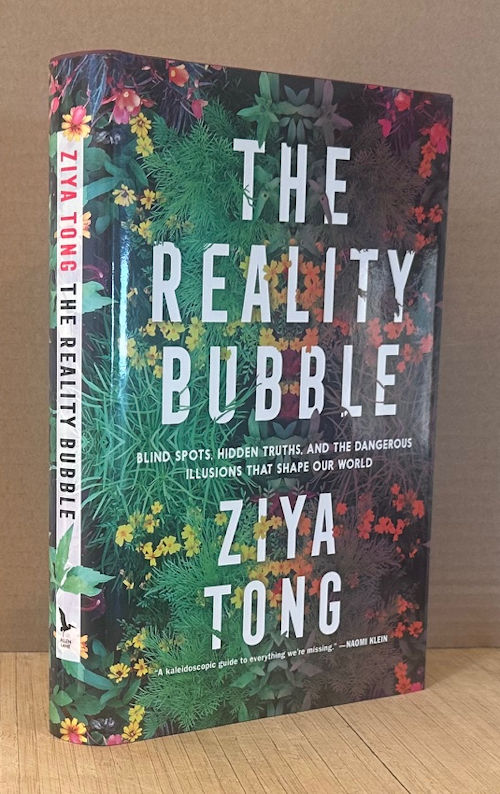
This is a pleasant enough book by a Canadian journalist. Her broad point is that there are many things about the world that most of us are unaware of, living as we do in a “reality bubble.” One way this is true is that many things are the way they are by convention, not because we live by some unalterable rules. Example: time zones. (This aligns with a key theme of science fiction: things might well be different in ways that wouldn’t occur to most people.) Another way this is true is that some things that we’re unaware of are just about the complexity of life. No one can, or necessarily needs to, understand all the details of where our food comes from. And a third way is more fundamental, that reality really does constrain what we perceive and what we don’t. Example of the electromagnetic spectrum and how humans perceive only a small fraction of it. There are lots of examples along all three of these themes… But they strike me as separate themes, analogous only in the broadest sense. So this is sort of a three-books-in-one. This is understandable, perhaps, in that the author is a journalist, for TV and radio, and presumably has been open to topics of all sorts that would be suitable science-oriented programming. (Also, very broadly, it aligns with similar works by Gladwell, Freakonomics, etc etc. But not in a hard science way.)
Key Points
- Common sense is blinding us from scientific truth. [[ Well yes, this is key: it’s not so much scientific truth, as anything outside …
- The book is divided into three biological blind spots, three societal blind spots, and five civilizational blind spots, 10 in all
- Intro: Common sense is blinding us from scientific truth. [[ Well yes, this is key: it’s not so much scientific truth, as anything outside … The book is divided into three biological blind spots, three societal blind spots, and five civilizational blind spots (and a conclusion):
- Reality is not human-sized [[ This goes to the problem of scale, and how human ‘common sense’ utterly fails outside very limited ranges. ]] She calls this ‘scale blindness‘, a good term
- We can’t see how connected we are to the universe around us. There’s no place where our body ends and the world begins. Our senses are limited, e.g. how we now understand solid objects are mostly porous.
- We believe we’re superior to all other creatures, unaware of how differently they perceive the world and how limited our own perceptions are.
- We’re unaware of the dirty truths of our food production system, from the gruesome way chickens are processed, to the impact on other species of our harvesting methods. We combine a certain reverence for nature (what Wilson called biophilia) with cognitive dissonance to avoid the unpleasant facts…
- We’re unaware of where our energy comes from, and the vulnerabilities of our infrastructure. We don’t realize how much energy we use, or the effects of the carbon dioxide we pump into the air.
- We’re unaware where all our trash goes, what happens to it. Biological waste, food waste, e-waste, plastic…
- Our time zones are conventions, but we have a natural sense of time, which we confuse with our measurement of time, which began with industrialization. Before that time didn’t need to be measured. Now we are obsessed it, and it drives our markets and daily life.
- We’ve created basic units of measure based on practical and subjective human experience. Many were standardized, but only the metric system, set up by the French, appeals to something objective, i.e. the size of the earth. Similar ideas of carving up space, defining nations. There were no passports until 1914, no nation-states before the 18th century. Now there are elaborate rules about property rights.
- Now robots take the roles of humans, all around us, from CCTV cameras in Britain to facial recognition devices everywhere, especially in China. Our social media and searches are tracked. Everyone is assumed guilty and just hasn’t been caught yet (turning culture paranoid and conservative). Some nations have social credit scores. We don’t notice that we’re surrounded by eyes.
- Our economy is largely electronic but we cling to the ownership of things. We’re hung up on animistic ideas that things have souls. We’re stuck on a hedonic treadmill. Perhaps ownership is a trait that’s become maladaptive.
- Author foresees an ‘apocalypse,’ an uncovering of knowledge, by escaping our reality bubble and recognizing our blind spots. We believe in a world that is largely imaginary, and may be disappearing. We need shifts of perception, like the overview effect experienced by astronauts. The old mythos of Joseph Campbell needs replacing. Because we’re on the eve of a planetary apocalypse.
Detailed notes
Note Buckminster Fuller quote before the table of contents.
Intro, p1
About Ann Hodges, in 1954, who was hit by a meteorite in her home. She became a sensation. Her cosmic perspective was changed. The heavens are hell. It doesn’t feel that way, because we live in a bubble, of the atmosphere that blocks many dangers. We also live in a psychological one, our ‘reality bubble.’ It shields unwelcome facts and unfamiliar ideas. Which means we’ve got a warped perception of reality. And all bubbles eventually burst.
Each of us has two blinds spots, in our eyes. Sample diagram, 3b. We can be blind to the obvious. Kids don’t know where food comes from. Or adults, what oil is. Or where our waste goes. Humans are smart. But life is disappearing; the sixth extinction. And yet we’re obsessed with zombies. We conform. Is there another way? Perhaps if we could perceive the real world…
Recalling 1988 movie They Live. Glasses that reveal things as they actually are. We can do the same with scientific lenses. Author has spent a decade interviewing scientists and thinkers. Humanity is on a collision course, because our ‘common sense’ is blinding us from scientific truth. This book will examine ten big blind spots. Individual, collective, and intergenerational. As Sagan said, we need to understand how the world works.
Part One: Biological Blind Spots: What Surrounds Us
1, The Open Jar, p13
About the disappearance of a flea, in 1913. In a flea circus. How to train a flea? Keep it in a glass jar all the time. The story of how they were trained wasn’t true. They were manipulated. It was torture. People treat fleas as tiny, insignificant. Robert Hooke discovered many things, but is best known for his illustration of a flea. His 1665 book Micrographia. Then van Leeuwenhoek used even more powerful microscopes. What he saw he called animalcules. Microorganisms were unknown before the 1600s. He looked at his own blood. And sperm. Plaque. Bacteria. Hooke replicated them.
Humans are relatively massive as living things go. Are fleas unworthy of being alive? Or other such pests? Thus we have chemicals to kill them. Which could lead to bad consequences. The food chain depends on insects. Most of those fleas are extinct. But other tiny mites live on our faces. Our bodies are covered in microbes. In our air. Most are harmless. Some are good, like probiotics. They help us digest. They produce oxygen. In the soil. Most of them are still unknown. Others are high in the atmosphere. So: our first blind spot is that reality is not human-sized. Examples of the range of sizes of other life. Large sizes are constrained by mass. Dinosaurs had air pockets in their bones. Whales live in water. Ancient animals were bigger when there was more oxygen in the air. Then birds arose to take out the large insects. Recently animals are getting smaller. Domestic species are getting larger. Example of chickens, p34. And so we eat more, and are getting fatter. And taller.
Galileo was the first to glimpse the colossal scale of reality. Glassmakers of the time made spectacles, and revealed the macro and micro worlds with microscopes and telescopes. Galileo improved their designs. Our own eyes are incredibly sensitive. Example of Mizar and Alcor. Galileo looked at the moon and saw ridges and craters. And Venus, orbiting the sun. The Church objected. Modern telescopes detect fields of stars in every apparently empty patch of sky.
Humans are bad at scale. We suffer scale blindness. (! maybe this is the term I was looking for.) We’re numb to big numbers. Examples. Sagan quote, 43m. Galileo realized that what humans perceive is just a slice of reality. It bothered him that others refused to open their eyes. …Galileo’s fingers were stolen, and one eventually recovered.
2, Mind Bomb.
Quote by Zamyatin.
Story about two women found dead in Vienna in 1992. Then recall Samuel Johnson and James Boswell arguing about George Berkeley’s notion that we only know the world through our sensory perceptions, not as it really is. [[ Just as in Hoffman bk just read ]] Boswell kicked a rock to refute the idea. Yet he was wrong, as now scientists are concluding. We now understand that there is no place where our body ends and the world begins.
Example of lab in Japan with a camera capturing neutrinos. Matter is not solid in the way we think. Neutrinos are so small that don’t have positions per se. Then, a mummy unwrapped in London. In 1895 X-rays were discovered. Then mummies could be examined non-invasively. X-rays became both useful and popular. And yet they had side effects. They caused damage. Not all radiation is the same. We ‘see’ some things with radiation, and remain blind to other things.
A 1957 paper by Hoyle et al established that matter is derived from elements created by the stars. Successive explosions. Hydrogen becomes helium until it runs out; helium fuses to become carbon, etc. until iron. Then it explodes as a supernova. Quotes Caleb Scharf ZOOMABLE. Most of the atoms in our bodies are as old as the Big Bang itself. Water is older than the sun. p59. Similar carbon. The body constantly renews itself. Scientists study this constant resurrection. Examples. Today, we have the power to create new elements. Fuse atoms, and to split them. Nuclear bombs.
Back to the two mummified sisters. They needed to know which sister died first. Carbon 14 spiked during nuclear bomb testing. Some cells turn over very quickly; skin, every two to three weeks. … then found that one sister had died nearly a year before the other.
Infants understand solid objects, even though we know solids are most porous. Eastern religions; everything is connected. Flowers and clouds. We live in networks. … So, our second blind spot is that we cannot see how connected we are the universe around us.
Ch3, I to Eye, p69
A primatologist in a Tanzanian national park to watch a sunset… joined by two chimpanzees. Unsurprising, or anthropomorphism? How we view other species. We don’t know; their experience is completely unknown to us. One Italian city passed a law about goldfish. Some fish can recognize human faces. Pigeons too. Who can find their way home. Consider how other species experience the world. [[ which is what Yong’s 2022 book is all about ]]
We perceive only a tiny fraction of the electromagnetic spectrum. Everything else is invisible – to us. But not to some other animals. Examples. Eagles. Fields of vision. Dung beetles map the sky, by the moon. Or the milky way. Dragonflies have the best eyesight. They can see more colors. And slow-motion. Like a colorblind person putting on EnChroma glasses to see color for the first time. And tetrachromacy in some people. Another condition, aphakia, sees ultraviolet. Monet; WWII agents. Oil spills. Other animals ‘see’ sound. Bats, whales. Dolphins and biosonar. Clicks and echoes. Animals use sight to learn from their parents. Bees and soccer. A chimp with eidetic photographic memory. Other examples. The gorilla Koko and sign language. Careful standards. Horses and blankets. A bonobo in Iowa.
Can humans understand animals’ languages? Con Slobodchikoff and prairie dogs. Different barks for different sizes, colors…
Ideas about animal awareness were once considered quackery. Frans de Waal sees such ideas in evolutionary terms. Thomas Nagel and the bat. Our minds are alien to other forms of life. but we can understand that they do feel and think. A 2012 declaration… p95. So we’ve revealed three big blind spots. We believe we’re at the center of the universe, separate from the world around us, and superior to all other creatures. But via science these assumptions can be overturned, 95b. But we do not see how our species survives…
Part Two: Societal Blind Spots: What Sustains Us
Ch4, Recipe for Disaster, p99
About the autopsy of a chicken nugget. As a way to study obesity. There wasn’t much chicken in the nugget. Frankenmeat. Since the 1970s. Zombie meat. ‘Fresh’ is relative. Preservation methods. Synthetic colors of salmon. Of egg yolks. Back to the 1950s. antibiotics. Cleaning with chlorine. Our eyes deceive us about what we eat.
The five-second rule is not valid. We’d rather not know the dirty truth about our food system. Revelations go back to Upton Sinclair’s The Jungle. Disgust is universal. But much that is disgusting is hidden. The garbage fed animals that we eat. We have a reverence for nature that Wilson called biophilia. We sense an affinity with animals. But employ cognitive dissonance to avoid unpleasant facts.
Consider the food chain. It all comes from dirt. You can test soil by burying underwear for a couple months. We are degrading our soil. Most of our food is made up of twelve plant species and five animal species. That makes our crops vulnerable, as in the Irish potato famine. Bananas. Biodiversity also suffers from the plants we grow for our own food. Feed for animals used for meat. Those animals don’t have natural sex. Artificial insemination. Various methods. Bull sperm is very valuable. Details… big industry. And about pigs. And piglets. Both human and livestock populations are increasing… p118.
So where does the water in our bodies come from? Clouds. Aquifers. Snow and ice melt from glaciers. These are disappearing too. … And fish are endangered, not by water, but by us. Planes are used to spot schools of fish. Populations plummet. Some fish are farmed. Trash fish are harvested for fishmeal. In the 1960s machines were built to strip meat from chicken carcasses. This produces a gruesome blind spot. How chickens are processed. Other animals are similarly processed in factories. Back to Chicago. Even vegetarians consume products made from meat by-products. Gelatin, made from skin and bones etc, becomes a binding agent and photographic film. Such rendering is the “invisible industry.” And more products: 128b. And pet food. and some producers use meat from euthanized shelter animals. Barbaric methods remain in the animal industry to this day. Future generations may regard us a hypocrites.
[[ Ok but this strikes me as a completely different topic that the earlier chapters… life is complex and no one can be aware of every detail. ]]
Ch5, Black Gold, p131
How breaks in TV broadcasts create sudden spikes in demand. Case of the Great British Bake Off, and pandas. The spike didn’t happen. Different kinds of power come from different sources. We don’t notice it, until it’s gone. Fukushima, 2011. Ordinary threats to power include squirrels and trees. The grid is growing older. And today we have new sources of energy, such as wind and solar, and even cheese.
A byproduct of Beaufort cheese in Savoie is used to generate power for 1500 people. 137. Electricity is made by turning turbines. Electrons actually move slowly. The power moves, just like sound moves, not air molecules. Ref Adam Frank, 139.4. Battery storage for electricity goes back to Volta. How batteries work. Lithium.
Einstein and the photoelectric effect. Solar power. Wind. Neither is consistent. Iceland, geothermal. Waterfalls. Niagara, and Tesla’s AC power. Dams. Fish cannons. Nuclear power. Problems: meltdowns. Fukushima. Fortunately such problems are rare. Gasoline and its byproducts. Barrels of oil. The military uses the most. Why is there so much oil in the middle east? Look to prehistory. Oil is dead stuff, much from an extinction event. Coal from ancient forests, mostly before dinosaurs lived.
Humans have artificial superpowers. We can do everything that Superman did. But the sources of our power is another blind spot. We don’t realize how much we use. We’re pumping carbon dioxide into the air. That’s invisible to us too.
Ch6, Trash & Treasure, p162
There’s lots of trash on the moon from the six moon landings. And other missions. Eventually the trash will break down. And there’s space junk orbiting the earth. Other spacecraft are dumped into the sea, especially one particular spot in the Pacific. Humans throw away a lot of trash. A lot more right here on earth. A lot of which comes from manufacturing. And we create biological waste. People used to throw it into the streets. And pigs ran wild in the streets. Paris too. The Chinese shipped it to farms. How much one person produces. Good and bad. But guano was even better. Island near Peru. Lots of nitrogen. Discovered in 1804. Eventually it ran out. Nitrates from deserts last for a while. Chemists came to the rescue. The Haber-Bosch process. Nitrogen mined from the air. It required a huge machine. Now factories all over the world. It enabled the growth in world population… Half of the nitrogen in your DNA comes from such a factory.
Food waste also grows. More than e-waste. Extending to other kinds of waste, like chemical fertilizers. Washed into the ocean by rain. Algae blooms. Dead zones. An escalating cycle. The HB process itself uses 2% of the world’s energy, and thus contributes to air pollution. In 2014 China launched a mission to change the color of the sky, at least for two weeks, to “APEC blue.” They just stopped polluting for two weeks. AQI (air quality index) is a familiar term. 300 is bad. Beijing got up to 905 once. The rich have air domes. Similarly in India, Saudi Arabia, Iran. Lung cancer. Millions of tons of various pollutants, 181b. Hundreds of new cities in China. Manufacturing. Especially visible as plastic waste. Plastic didn’t exist a century ago. Bakelite. Later many others. We throw most of it away. By the 1950s people threw more stuff away than kept antiques. Single-use plastics. Planned obsolescence and trends. Why isn’t plastic biodegradable? It’s chemically inert. Plastic is in all sorts of animals. … the US sends its trash back to China. Examples. Causes birth defects. Until 2018.
We use garbage as fuel for buses and garbage trucks. Sweden. Sewage can be mined for trace minerals. Even gold. Urine is sterile and could be used as fertilizer. Quote by Whitehead 192.3: “civilization advances by extending the number of important operations which we can perform without thinking about them.” [[ Yes isn’t this exactly the point?? Calling these ‘blind spots’ seems to miss this point – we should want everything to be ‘automated’ as much as possible; the problem isn’t that we’re unaware of them, it’s that we’re unaware of the negative consequences. ]]
Part Three: Civilizational Blind Spots: What Controls Us
Ch7, Time Lords, p197
How a plane left New Zealand on Jan 1 and landed in Hawaii on Dec 31. Some countries along the IDL change which side they want to be on. The prime meridian runs through Greenwich, for reasons. Longitude; Dava Sobel. They needed accurate clocks. Done by one John Harrison. Allowing Britain to conquer the world. How some plants have predictable daily cycles. Birdsongs. Incense. Some other animals. Honeybees. Worms. Do humans have a natural circadian rhythm? Example of a man kept in a cave for six months. He almost lost his mind; he experienced fewer days than he actually lived. Some cultures mark very long periods of time. Sundials, water clocks. Hourglasses. Watches set their own time, thus “o’ clock.” Without clocks, time is flexible, as on islands. Some people opposed setting local time to a standardized time. Now we have a blind spot: we confuse our measurement of time with time itself.
The Japanese have a term for “overwork death.” Also applies to hospital interns. A Roman playwright wrote about it. Hunter-gatherers worked very little. Industrialization was brought about by the measurement of work. Overtime. Punctuality. The idea of ‘wasting’ time. In 1875 America had 75 different local times, most centered on high noon. The railways led the synchronization of time. Signals sent from an observatory. Factory clocks. Time control. Punch clocks. Alarm clocks. Salaries based on time. Garments took hundreds of hours to make in the Middle Ages. Management systems. How long tasks took. Rules in Chinese Apple factories. Denial of bathroom breaks. Time is especially valuable in financial markets, where machine transactions take split seconds. Public figures never seem to have enough time. Before Einstein scientists thought time was absolute. Einstein showed otherwise. GPS relies on it. What is time, according to physicists? Imaginary time. Hawking. Brian Greene. The rat race. Retirement ages seem to get farther out. Leisure costs money. Chores have become hobbies. We have to keep up with fashion. All that manufacturing can change the climate. A hot NYC day in February. Changes in weather patterns. Plants and animals. Flowers and bees. Ecosystems out of whack. And one more clock: the Doomsday Clock.
Ch8, Space Invaders, p233
About England’s “right to roam” law. And Scottish “bothies” 235t. Humans have a sense of territory, space bubbles from intimate space to personal space to social space to public space. Other animals too. The Finns measure how far a reindeer can travels before it needs to pee.
Consider how we came to create our basic units of measure. We chop things into manageable pieces, human-sized. The cubit was from the elbow to the outstretched hand. Similar in various cultures. Of course all people are not the same. Measures were eventually standardized. 1196; Magna Carta in 1215. But some monarchs changed them. Eventually the French set up the metric system. Based on the planet, not human bodies. They began by measuring the earth. The meter was 1/10,000 the distance from pole to equator. 1799. Still, its definition depended on a physical object. Now we define the meter by wavelengths of a particular color of light. Or light in a vacuum. We come to impose our measurements upon the actual world.
Synthetic training environments, STEs. Bruce Sterling anticipated them in 1993. They can extend to the entire planet. Explorers have always come with mapmakers. Now there rules for continental economic zones, and continental shelves. Disputes between claims; Canada and Russia.
About the Apollo 11 astronauts. They had to return through customs. Passports. Only since 1914. The infrastructure wasn’t there before that. There were no nation-states before the 18th century. The border between Belgium and the Netherlands is a hodgepodge. Details. Consider how Africa was carved up. Examples. There are 6500 languages spoken on Earth, and 195 countries. … when humans could no longer expand outwards, the expanded upwards—thus hierarchies. Vs the nomads. Conflicts between farmers and nomads. Recall the Thirty Years’ War, Treaty of Westphalia 1648, the idea of sovereignty. Property rights. Different divisions of ‘space’ have various rights associated with them. Including above and below your property. Air rights for airmail services. Air force and chickens. Now drones. Rules keep shifting. Satellites. (“lose its grip” 258.0 – no; also ‘crashing to earth’ in footnote. Both of these misunderstandings of physics.) Star names.
Bit of property in NYC. The idea of ‘real estate’ is a modern one. Commons, privatization, etc. Wool. Clearances. Urbanization. Eminent domain. Now we have zombie flats and ghost mansions. Mostly unoccupied, owned by foreigners. The super-rich. In many cities. Especially China. While poor people live in tiny quarters.
Ch9, Human Robots, p267
Note Mencken quote. About tracking cyclists on long rides. In 2017, one such cyclist was hit by a car and killed. GPS. The signals are very faint. Now accurate to within a couple meters. There are ‘graveyard’ orbits for dead satellites. Spy satellites can resolve 25 cm. how the economy depends on thousands of satellites.
CCTV cameras in Britain. Keeping people in line. Also many in China. AI and facial recognition. Everyone tracked in one Chinese city. Indoors too, black domes. Public buses record conversations. Workplaces. All of this erodes trust. Vehicle data—assuming everyone is guilty and just hasn’t been caught yet. 278b. Brain surveillance in China. UK tapping into home webcams.
The eyes in our heads… Social media. Monitored by law enforcement. False positives. Example of Joe Lipari. Our searches, our likes, etc. Digital footprints. Megabytes every day for every person. Data is more valuable than oil. Personal data markets. Real-time bidding for ad space. Details. Swaying elections. Tracking children.
The eyes on our bodies. How police wanted to use a dead body to unlock a phone. Every security method can be hacked. Biometrics. But why is this all happening? Perhaps it began with sorting concentration camp prisoners into groups, but IBM and the Nazis. Even that was hacked. Which saved a lot of Jews in France. Data is the base of surveillance. Borders and magical thinking; Harari.
[[ Thought: that technology is increasing the ability of suspicious people to monitor everyone else is turning the entire climate conservative and paranoid. It used to be you tended to trust people because you had no other choice… but most of the time it worked out. ]]
The eyes with their own mind. How a Mr. Ao was spotting in the crowd at a concert in China. Where they have social credit scores. Pluses and minuses. Classes of citizens. Blacklists. Traditionally it was about public image, saving face. Now, computers never forget. You don’t necessarily have to do anything, just be in the wrong category. Schools. Babies.
Is it a crime to see? So we are surrounded by eyes. We don’t notice; that’s the blind spot. There are cameras everywhere except for those three big blind spots: where food comes from, where energy comes from, where our wastes go. Example tracking vegans, as threats to the meat industry. Pipeline protests. Chemical spills. Etc. Yet there’s no evil mastermind behind all this. We do it to ourselves to keep everyone in line. Despite that this system, left unchecked, could destroy most of life on earth.
Ch10, The Empire Wears No Clothes, p303
About a 2016 bank robbery that was invisible. Money moves electronically. Bangladesh. The culprit has never been ID’d, but may be North Korean. Why is there such disparity between right and poor countries? Goes back to colonialism. How money is abstract. Tax havens. Corporations avoid paying taxes. Bank fees. Punishments for being poor. Money grows on computers. Through debt. Money is a promise.
Example of an oak tree in Athens, GA. That owns itself. Trees communicate, connect. The idea has extended to the Amazon basin. A river in New Zealand. Of course big business fights back. But a corporation is as much a fiction as they claimed a watershed was. Yet legally corporations are persons. But not chimps, or dairy cows. But if we grant rights to some, where would it end? It would contradict the idea of ‘owning’ something. Story about a woman who accidentally bought a Renoir masterpiece. A judge ruled for the museum that claimed it. William James formed the idea of our attachments to things. Marketers know this. The instant endowment effect. Other animals behave similarly. But only humans are bogged down by our ‘stuff’. Perhaps a key to the power of our species. Every culture understands ownership. Toddlers understand. Studies of how they think. Circumstances matter. Examples. Land rights. Does ‘improving’ it matter? John Locke. And other ideas.
In Japan a funeral ceremony for Sony robot dogs. Aibos. All things have souls; animism. Shinto. The idea extends to the west too, how certain objects are endowed with special qualities. At the same time we throw lots of stuff away. The stuff we keep we have sentimental attachments too. Hoarders. Columbus was surprised that the natives didn’t think of possessions at all. But capitalism depends on excess goods. And to consume. Wal-Mart sale in Porter Ranch. Now frenzied sales are online. Having things makes us happy. The hedonic treadmill. Having things *doesn’t* make us happy. Perhaps ownership is one of those traits that’s become maladaptive.
Further: even if we believe we own the world, that doesn’t mean it’s ours.
Note definition of civilization, 332.8: “the shared effort to mitigate the danger of evolved responses.” [[ Another spin on the idea of primitive vs evolved human nature, and the unreliability of native ‘common sense.’ ]]
Ch11, Revolution, p333
Author traveled to the Lamu Archipelago in 2014 to begin research for this book. A primitive culture. Baobab trees. How could anyone own one? Back in Toronto there was a ‘housing bubble.’ She reflected on what home-ownership means. Or ownership of anything.
Recalling a Solomon Asch experience, p336. Conformity altered the perception. [[ How religion works! ]] What was remarkable that some people refused to conform, some 25%. [[ Well this is a key point about both politics and religion ]] But standing up for beliefs has a cognitive cost.
Apocalypse actually means an uncovering of knowledge, a revelation. The dawning of clarity. Escaping the reality bubble. We must recognize our blind spots. Reality is socially constructed; a product of our minds. We conform to a reality that isn’t there. Harari on imagined realities like gods, nations, and corporations. We’ve come to believe we own the world; thus much other life is disappearing. Climate change. Wm Gibson 341.4 on how no one writes about the 22nd century.
What does it means to ‘fight the system’? The system if our life support system. The goal of the system isn’t so much survival, as ownership. Yet this system exists in our blind spots. And so we are destroying it. Yet, cf PKD, our problems won’t go away just if we stop believing in them. Pirsig: patterns of behavior repeat themselves. How to escape? Science can shatter old worldviews. [[ Let’s claim this for sf too ]] Example 343. Contrary to common sense. Science proves our physical perceptions are wrong. Recall Kuhn. Thus his idea of paradigm shifts. The world changes. examples. Yet there is a huge gap between what science sees and what lay people understand. Big ideas take time to spread.
About the shifts in perspective of those who’ve gone beyond low-earth orbit. The overview effect. [[ Can we name a sfnal analogy? Conceptual breakthrough? ]] People on the ISS witness 16 sunrises and sunsets a day. Yet not every astronaut experiences it.
Recalling Joseph Campbell. The big movies, the Greek myths. Hero’s journey. Discovering a new perspective and bringing it home. It’s time for us to change. Hawking: how our existence is unlikely. (Anthropic principle) Chances of any one of us being born. Details. Basically zero. Yet here we are, on the bring of a planetary apocalypse…