- Lydia Polgreen on how the problem isn’t Trump, it’s America;
- David French wonders if America is so rich, why are Americans so miserable?
- Faith that climate change isn’t real;
- Short items: that classic poll against Arabic numerals; how people who lose elections don’t trust elections; yet another Jewish plot; a bloodthirsty prayer; another conservative convicted of what conservatives rail against; Biblical worldview;
- Radiohead’s “How to Disappear Completely”.
It’s not just Trump. It’s some deep undercurrent in American culture.

NY Times, opinion by Lydia Polgreen, today: It’s Not Trump. It’s America. [gift link]
Like a lot of other Americans, I’ve oscillated in these dark times between two emotional poles. At points, I tell myself that Donald Trump is a uniquely malevolent figure who has seized levers of power that no previous president had ever dared to grasp. The story doesn’t stop state violence in the streets or illegal military operations abroad. Yet it has its comforts. Once Trump passes from the scene — as the laws of nature, if not politics, require — some kind of restoration of the American democratic and constitutional project can take place.
On darker days, I find myself turning to a more thoroughgoing narrative: that Trump is the fulfillment of what America has always been — a self-satisfied nation, granted license by its myths about providence and exceptionalism to do whatever it wants. Trump didn’t come from nowhere, after all. His two victories were forged by choices made by Americans and the leaders they elected. If he had not existed, history would have invented someone like him. This explanation offers its own consolation. At least it is something a rational mind can grasp.
This is what I’m coming to think: “a self-satisfied nation, granted license by its myths about providence and exceptionalism to do whatever it wants.” It’s exceptionalism to the point of arrogance.
Is Trump a freak of history or its fulfillment, an aberration or a culmination? The answer, surely, is both. But in the course of his presidency, Trump has revealed a much older malady: America’s unshakable faith in its ability to shape the world to its liking, indifferent to what others might want and supremely confident that its plan is the right one. Beyond Trump, it’s this disfiguring mentality we Americans must face.
Remember, key figures in the founding of America were religious zealots. Fortunately, the country has grown so big that there are plenty of rational people living here too. The nation is *big*. That’s why America has been so successful, technologically and scientifically, despite that core of irrationality. That book by Kurt Andersen that I just mentioned may have some answers…
\\
Is this related? Perhaps. Americans who think we’re the bestest nation in the world don’t understand why everything isn’t perfect. But this is psychology, more than American exceptionalism.

NY Times, opinion by David French: How Can America Be So Miserable When It’s So Rich? [another gift link, I still a few to use before the end of the month]
The American economy is the envy of the world.
Actual Americans, however, are not happy about their economy, and they’ve been unhappy about it for a long time.
Both of those statements are true, and until recently, frankly, they stumped me. How could it possibly be rational to feel such prolonged pessimism in the face of such extraordinary economic growth?
Over the last quarter-century, G.D.P. growth in the United States has far outpaced growth in Europe and Japan, two of our primary economic competitors (outside of India and China), to such an extent that many of Europe’s most powerful nations have economies only as prosperous as those of our poorest states. British and French living standards, as measured by disposable income, for example, are more comparable to that of Mississippi, still the poorest state, than to America’s as a whole.
I find that last claim hard to believe, but he does cite a reference.
This is about how people compare themselves to each other, rather than to some absolute scale or even historical standard, and about the fallacy that the past was better than the present, the result of selective memory and biased thinking.
The result is that immense numbers of Americans live lives that would look extraordinarily prosperous compared with previous generations. For all their justified complaints about housing affordability, Americans on average live in larger and more luxurious homes than Americans in generations past.
Previous luxuries — things like central air, big-screen televisions, home computers and multiple cars — are now common staples of American life across most, although of course not all, of our social classes.
French then cites this NYT essay from last August that clarified his thinking.
…and once my perspective changed, I saw a reality that I couldn’t unsee — we are miserable in part because we are wealthy.
And he goes on with examples about Disney World, travel sports, flying, cars, health care, and so on. This is the hedonic treadmill:
Wealth always tempts us to be discontent. We’re cursed with that insatiable desire for more. We’re prone to envy. There is a reason we talk about keeping up with the Joneses.
Ending:
It’s these choices, made millions of times by millions of Americans, that are both spurring our growth and — perversely enough — increasing our misery. We can’t have what we can’t afford, and we can’t have what we used to afford, and that combination can make even a middle-class American who may be well-off by historical standards feel very poor indeed.
\\\
Faith is a commitment to something that is not true. If it were true, there would be evidence for it and it wouldn’t require faith.
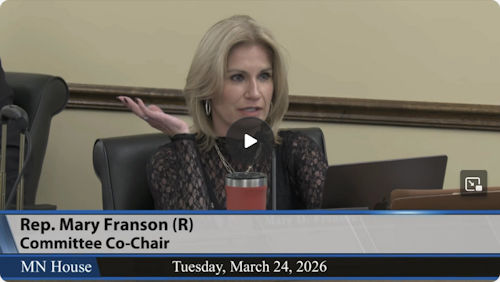
Friendly Atheist, Hemant Mehta, today: “My faith is not in climate change”: Minnesota GOP lawmaker doubles down on denial, subtitled “Minnesota Rep. Mary Franson dismissed scientists’ warnings because her Christian faith taught her the crisis is irrelevant”
During a House Capital Investment Committee hearing on Tuesday, a Republican lawmaker argued that Minnesotans didn’t need to worry about the impact of climate change because the Bible taught her it’s irrelevant.
She said:
But what doesn’t change, my friends, and that’s why, when you talk about climate change, I don’t get upset about it, I don’t get worked up about it, it’s because my faith is not in climate change. It’s not in scientists dictating what we should and should not do to save the environment. Because my faith is in Jesus Christ, right? He’s the same today, tomorrow, and forever. Yesterday. And so, um, you know, if you’ve read the Good Book, you know how it ends. It’s not with climate change.
If it’s not in the bible, it can’t be real? Dimwit. And dangerous.
\\\
Briefly noted.
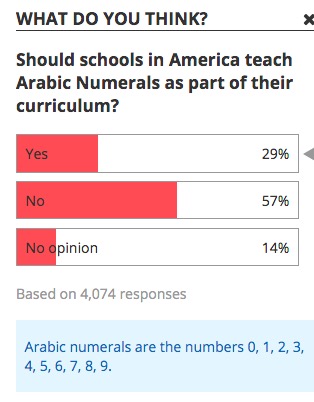
- Dakota Free Press, from 2019 (a classic MAGA survey): Arabic Numerals in School Draw Strong Opposition in Brookings Register Poll
- LA Times, 25 Mar 2026: He’s telling Californians they can’t trust elections — and it’s catching on with the GOP. | He’s only says this because his party doesn’t win every election.
- Right Wing Watch, Kyle Mantyla, 25 Mar 2026: Joel Webbon Says Gender Equality Is A Jewish Plot To ‘Eradicate White People’. | No, it isn’t. Paranoid dimwit.
- JMG: Hegseth Delivers Bloodthirsty Prayer Against Iran: “Break The Teeth Of The Ungodly, Kill The Wicked” | A dangerous, bigoted dimwit.
- Boing Boing: Conservative election fraud activist convicted of election fraud | Funny how often this happens. Like those conservatives obsessed with the gays and the transgenders who turn out…
- JMG: FRC Wails: Only 4% Of US Holds “Biblical Worldview” | And what is this Biblical worldview? Leviticus? Good thing then!
\\\
Up to Kid A. I read that this song is about the stress of being on stage and exposed every day… Dissociate yourself from the moment, to get through it.