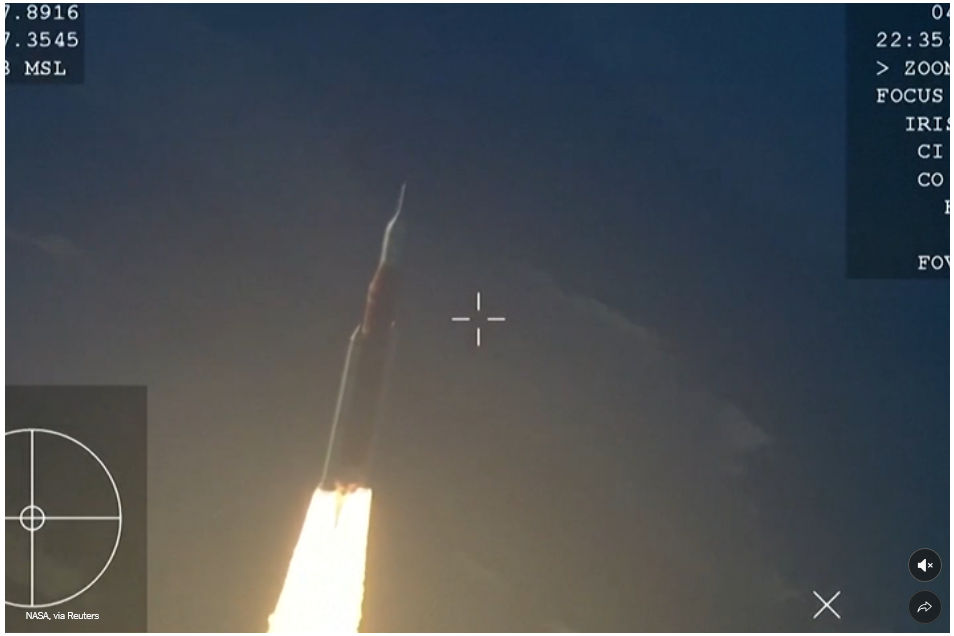
So America’s latest moon rocket launched this afternoon, a relief to those of us who witnessed a space shuttle explode on launch some 40 years ago, and have watched every launch since then with trepidation.
I’ve always followed America’s space program approvingly; I grew up with it, in the 1960s and 1970s, and then went to work in 1982 supporting it. It was a thrill, part of witnessing a kind of manifest destiny of humanity to expand into space, maybe making all those exploratory dreams of Star Trek possible. Of course we all knew at the time it was in part a political stunt, a ‘space race’ between the US and the USSR to demonstrate technological superiority, a battle in the so-called cold war. Once the US landed on the moon in 1969, Russia just sort of gave up and pretended not to care. Even as they kept trying, to the point of building a duplicate space shuttle and trying to fly it once or twice. But they never went to the moon.
Now the race seems to be between the US and China. Given realities of space travel and the difficulties in establishing any kind of base on Moon or on Mars, it’s not so easy to be as idealistic these days as many of us were in the 1960s. Also, given the pervading incompetence of the current administration and its incomprehension of the obvious technical issues behind various announced plans (see this post and David Brin’s comments), it’s hard to be optimistic that the current NASA has an idea of a cohesive set of goals for this mission or any others. Still, I support such efforts — they’re better than spending the money bombing other nations — and I’ll continue to follow them.
\\\
Here’s a book that I was about to throw out the proverbial window, as virtually useless, until I accidentally discovered its secret, just this last evening.
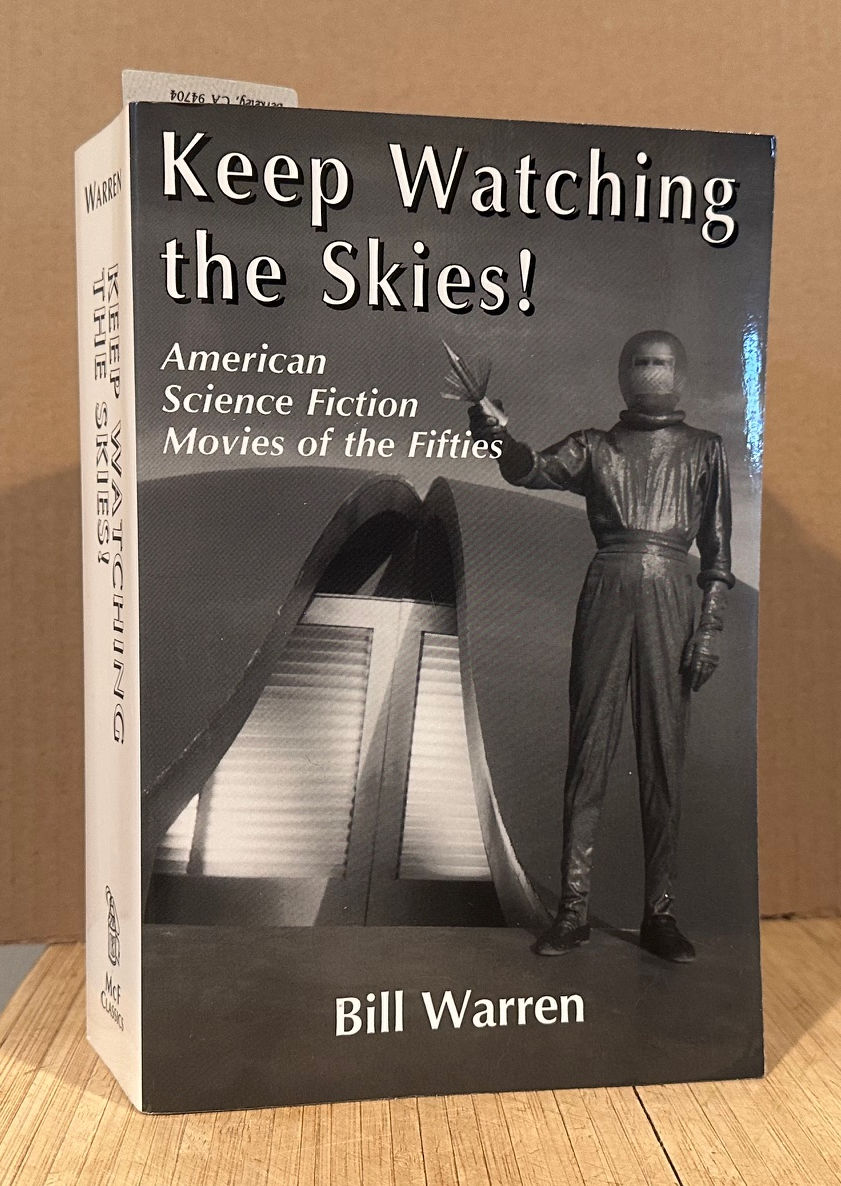
The book is Bill Warren’s KEEP WATCHING THE SKIES!, subtitled “American Science Fiction Movies of the Fifties.” Warren was a well-known ‘fan’ — he as an entry in SFE — back in 2003 when I bought this book from the publisher McFarland’s table at Worldcon that year — that would be in Toronto. A big fat book of 837 pages. I carried it and others home on the plane back to LA.
Over the years I’ve gone through periods of watching or rewatching old science fiction movies from the 1950s, which I’ve semi-affectionately, semi-derisively, called “skiffy flix” on this blog. And when I’ve done so, I consult the Bill Warren book, often in frustration. Its first sin is that there is NO TABLE OF CONTENTS that lists the movies covered. The table of contents at the front indicates only years, from 1950 to 1957. Recently, just in the past couple weeks, watching Invaders from Mars or It Came from Outer Space, I checked this book, turning to the index at the back, and found many references to these movies, but only to incidental references to them in the text. No primary entries. I checked the preface to the volume and read how Warren wasn’t trying to be encyclopedic, but was a book about his personal experience of watching these old movies. OK, but, really, no entry for Invaders from Mars??
But I discovered the secret! It’s there in plain site, but not evident enough. The book is *two* volumes bound together. Volume 1 and Volume II. The index at the back of the book covers only the second volume, which begins after the first volume ends on page 467. (Where the bookmark is in the photo.) The index for volume 1 ends at page 467, which was in no way apparent from the beginning of the book. This index has bolded page numbers for the main entries for films like Invaders from Mars and so on, which previously I had been unable to find.
I blame the publisher. Yes, there are tiny-print acknowledgements on the opening page and on the copyright page about this being two volumes, but I’ve looked at this book for 20 years and noticed that is was two books with two separate indexes.
Anyway. Warren’s commentaries are extensive and deep, once I’ve now been able to find them.
I don’t necessarily agree with him; I have a 50-years-on perspective of whether science fiction movies make sense or not. But his comments are deep reveals into how those movies were made, and how they did or did not make sense at the time.
(My next movie post will be about The Thing.)
\\\
This new movie is very popular. Even some of my relatively hard-to-please FB SF associates like it. Perhaps I will go see it. And yet, getting to a core issue here, the book itself, while also popular, has not had much impact among the SF professionals and critics who vote on awards.

NY Times, 19 Mar 2026: A ‘Hail Mary’ for Earth, Built on Solid Science, subtitled “Andy Weir discusses his science-fueled novel ‘Project Hail Mary,’ which has been adapted into a film that opens in theaters on Friday.
I mention this just to reiterate the distinction the popular and the critically acclaimed. You see this in the Oscars every year, of course.
\
I also came across this list, on GoodReads (a reader review compilation site), that ranks 21st century SF novels by averages of reviews.
Best Science Fiction of the 21st Century
The list is an odd mix of popular favorites and critical favorites. Will follow up on this.
\\\
The Gloaming.