
- Trump about Rob Reiner and the few who defend him and the many more who do not;
- How many people don’t finish most books, and how high school students barely read any.
Once again, we’re dealing with a despicable, demented lunatic in the White House. And the fact that so many still support him reveals a deep, disturbing aspect of human nature that I suspect the species will never overcome.
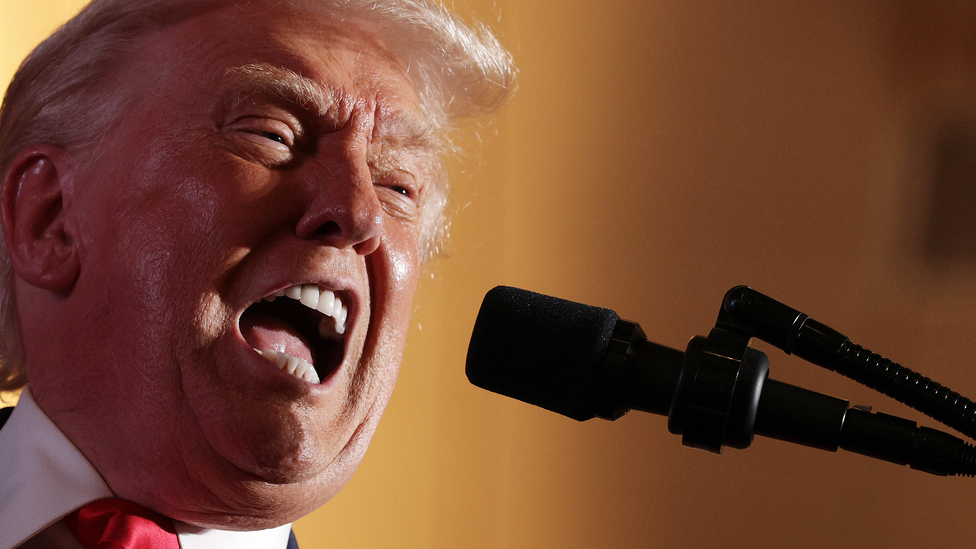
The Atlantic, David A. Graham, 15 Dec 2025: Trump Blames Rob Reiner for His Own Murder, subtitled “This morning’s Truth Social post was nauseating even by the president’s standards.” (gift link)
Looking for a considered meaning in Trump’s words might be a wild-goose chase, though. The simplest reason Trump posted this is the same reason he posts anything: The man cannot resist making everything about himself, even if it’s the heartbreaking murder of a beloved artist in an alleged domestic dispute. If “TDS” is the tendency to become irrationally obsessed with Donald Trump and project that obsession onto everyone else, then somebody is indeed deranged, and it wasn’t Rob Reiner.
\
It’s Trump who is deranged.
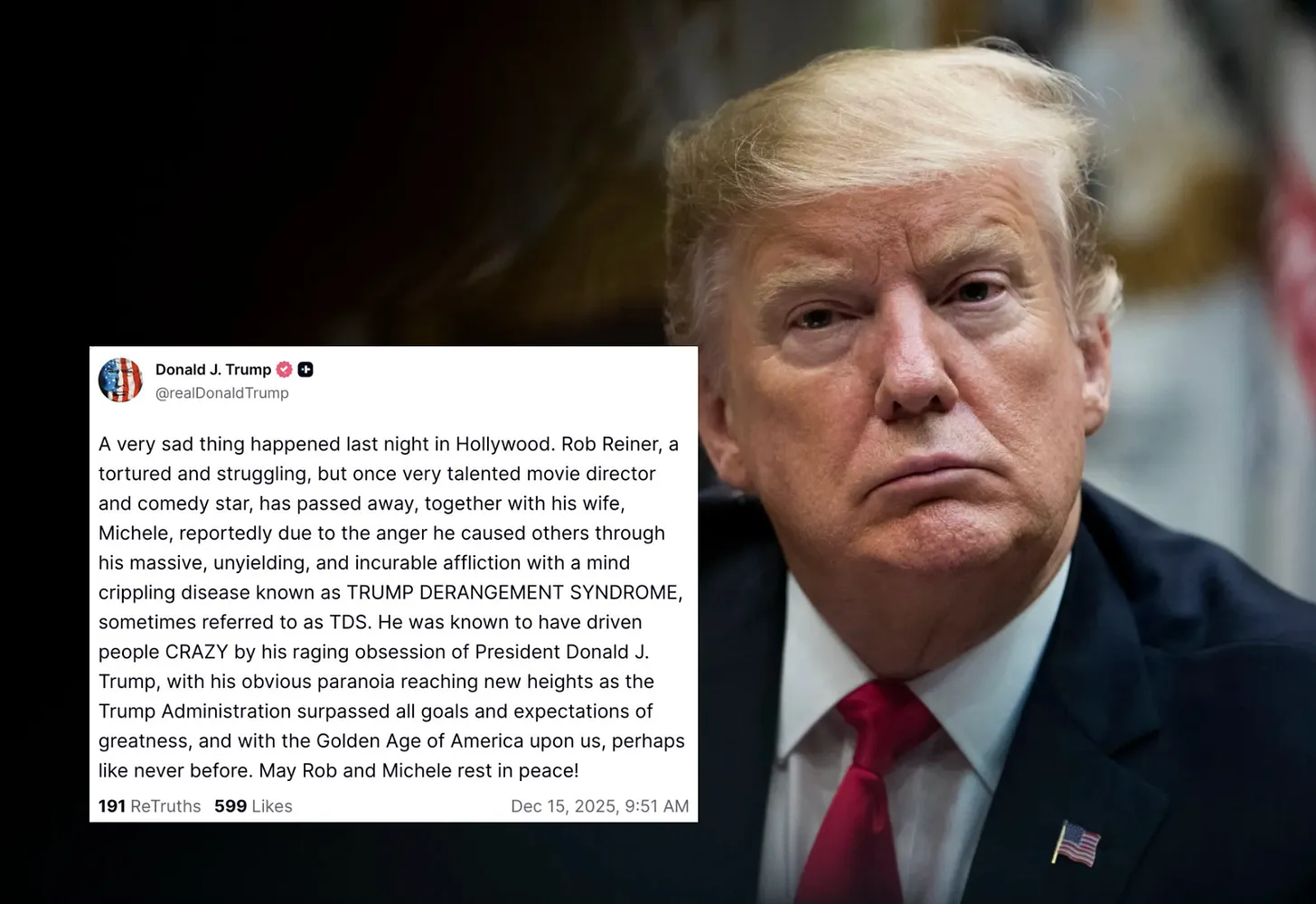
John Pavlovitz, 15 Dec 2025: Trump Derangement Syndrome Is Real. He and His Supporters Have It.
Claiming someone has TDS has become a MAGA standby; a quick and convenient slur allowing them to sidestep factual information, mask their refusal to have meaningful debate, and avoid culpability in defending a man whose very social media feed testifies that he is not at all well.
In the latest example, in a vile, grotesque, completely inhumane rambling social media diatribe about the shocking murder of Rob Reiner and his wife, Michele, Trump himself had the stratospheric gall to accuse the slain actor, director, and activist of having Trump Derangement Syndrome…
…
The evidence daily provided by Donald Trump shows, at best, a complete and utter narcissism, a gravely fractured and fragile ego, and an untethered mind not bound by any sense of decency or consequence.
At worst, it all paints a disturbing self-portrait of a seriously unstable human being who should be getting proper mental healthcare, not given the nuclear codes and carte blanche by opportunistic enablers and adoring sycophants.
\

The New Yorker, David Remnick, 16 Dec 2025: Donald Trump’s Remarks on the Death of Rob Reiner Are Next-Level Degradation, subtitled “On a weekend of terrible violent events, you would not expect a President of the United States to make matters even worse. But, of course, he did.”
Have you ever in your life encountered a character as wretched as Donald Trump?
\
Inevitably, some people defend Trump.
Media Matters, Matt Gertz, 16 Dec 2025: Here’s who is justifying Trump’s deranged response to Rob Reiner’s murder
President Donald Trump’s unhinged reaction to the stabbing deaths of Rob Reiner and his wife Michele Singer Reiner, which the president gleefully attributed to “the anger” the legendary director “caused others” via his anti-Trump activism in a Monday morning Truth Social post, triggered some of the most unified criticism from the right of Trump’s second term.
On social media, conservative pundits and Fox News stars used words like “disgraceful,” “appalling,” “disgusting,” “unnecessary,” “inappropriate,” “gross,” “awful,” “cruel,” and “insane” to describe Trump gloating about brutal killings. CNN’s MAGA commentators, whose jobs depend on their willingness to defend the president at his most indefensible, were unwilling or unable to back Trump’s self-centered rantings about Reiner. On Fox, coverage of Trump’s comment was nearly nonexistent outside of Special Report; star host Jesse Watters gave a lengthy monologue about the killings and interviewed Reiner friend James Woods, but he aired Trump’s defense of his post without comment beyond noting, “Whoa.”
So who is defending him? A long list, most of whose names are unfamiliar to me. I don’t dwell in the swamp of right-wing vitriol. Laura Loomer, I recognize her. Greg Gutfeld. That’s it.
\
But many other people are horrified by this one post.
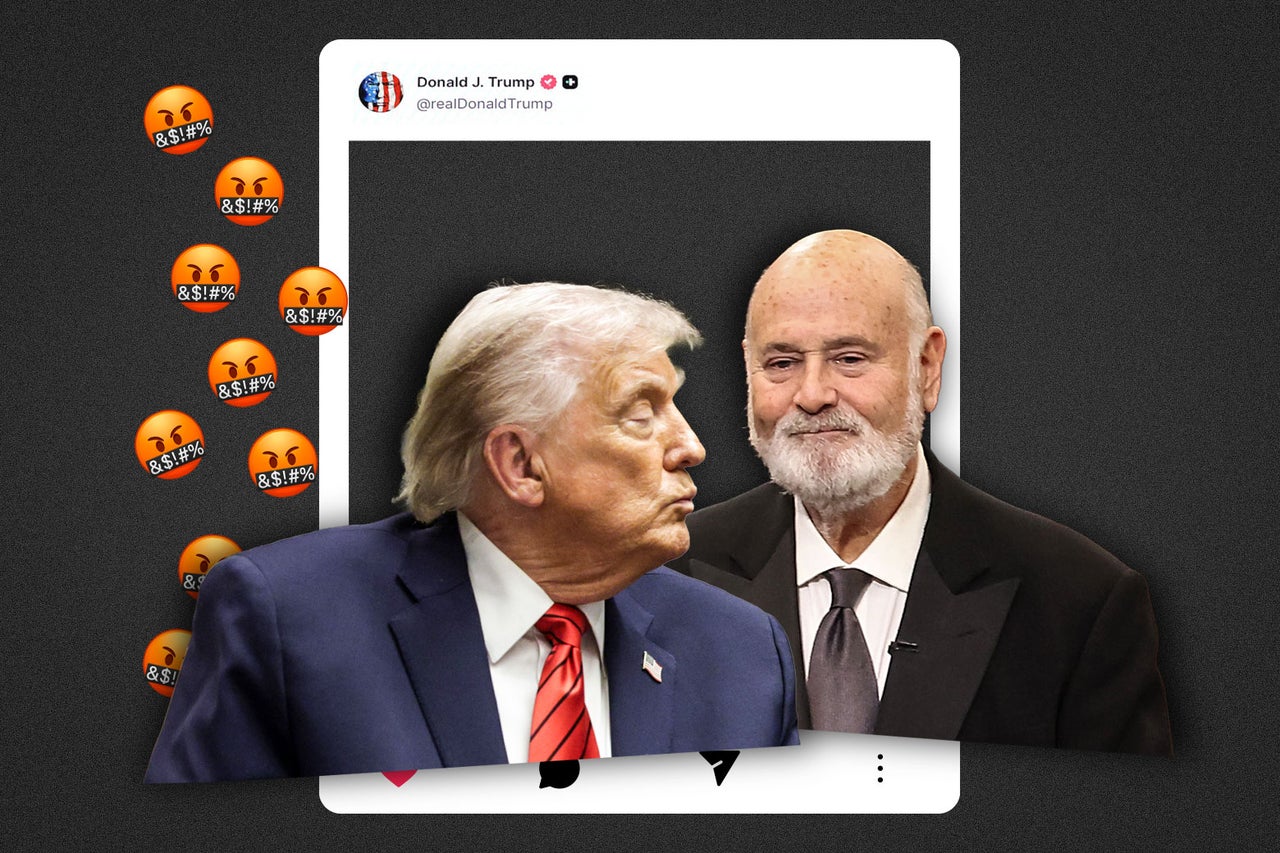
Slate, Ben Jacobs, 15 Dec 2025: Republicans Are Mad About Trump’s Awful Rob Reiner Post. Something Is Changing Here., subtitled “The president’s grip on his party will survive yet another heartless social media post, but we’re experiencing a shift.”
Donald Trump’s grip on the Republican Party has survived countless political setbacks, a global pandemic, and the Jan. 6 attack on the Capitol. It will survive his ugly Monday morning social media post about the death of Rob Reiner too. However, the immediate backlash to that post, in which Trump suggested that the Hollywood director had somehow brought death upon himself due to his disdain for the president, illustrates just how much that grip has slackened.
So far, in the intervening hours, congressional Republicans and other figures on the right have taken to the internet, without being prompted, to criticize Trump. The critics aren’t just swing-district Republicans, like Rep. Mike Lawler, of New York, or Trump adversaries, like libertarian Rep. Thomas Massie, of Kentucky. Instead, even an otherwise loyal Republican, Rep. Stephanie Bice, of Oklahoma, has chastised the president for the post. “A father and mother were murdered at the hands of their troubled son. We should be lifting the family up in prayer, not making this about politics,” wrote Bice on Twitter.
It’s not a full-scale rebuke of Trump by any means. But after years of hearing Republican members of Congress insist “I haven’t seen the tweet” to avoid commenting on the president’s latest post, the proactive engagement is notable.
\
Could a tide be turning? Perhaps there are some people so despicable they cannot be tolerated by half the population?
\\\
And now for something completely different.

Boing Boing, Ellsworth Toohey, 14 Dec 2025: Book data reveals most readers quit almost immediately
In 2014, mathematician Jordan Ellenberg invented a way to quantify something publishers and authors had long suspected: most people don’t finish the books they buy. He called it the Hawking Index, named after Stephen Hawking’s “A Brief History of Time,” famously dubbed “the most unread book of all time.”
I’ve read a Jordan Ellenberg book, reviewed here. Also, I did actually read A BRIEF HISTORY OF TIME all the way through, way back then. (Its gist is that time might be circular, the end and beginning somehow connected.)
Ellenberg’s method exploited Amazon Kindle’s “popular highlights” feature, which showed the five most-highlighted passages in any book. If those highlights were spread throughout the text, readers were actually finishing. If they clustered at the beginning, people were giving up early. The resulting percentage indicates roughly how far the average reader gets.
Results range from
Hillary Clinton’s “Hard Choices” scored 1.9%—meaning most readers bailed almost immediately. Thomas Piketty’s economics tome “Capital in the Twenty-First Century” managed only 2.4%.
…
The winner? Donna Tartt’s “The Goldfinch” at 98.5%—people who started it actually finished.
\\
Perhaps related to this.

NY Times, Dana Goldstein, 12 Dec 2025: Kids Rarely Read Whole Books Anymore. Even in English Class.
In American high schools, the age of the book may be fading.
Many teenagers are assigned few full books to read from beginning to end — often just one or two per year, according to researchers and thousands of responses to an informal reader survey by The New York Times.
Twelfth-grade reading scores are at historic lows, and college professors, even at elite schools, are increasingly reporting difficulties in getting students to engage with lengthy or complex texts.
Perhaps the age of print stories is passing?
Perhaps that is to be expected in the era of TikTok and A.I. Some education experts believe that in the near future, even the most sophisticated stories and knowledge will be imparted mainly through audio and video, the forms that are dominating in the era of mobile, streaming media.
It could well be. Social shifts happen.
(In my day, we read perhaps a dozen books, including two Shakespeare plays, in my 12th grade AP English class.)
Still, this abandonment of print means that complexity is being avoiding in favor of simplicity. It his a reaction against the complexity of the modern world?
For centuries, stories, not just classics but all the tropes of popular fiction, have become part of the extended language of modern culture. Language is not just about words, or cultural phrases, but references to stories that “everyone” knows. For centuries, those stories were Biblical stories. Not so much anymore. In the 20th century there was a certain “canon” of literature that all culturally sophisticated people were expected to know. But that lasted only as long as culture did not change. Contemporary conservatives resent the change, and would regress education to the focus on Biblical stories and the 19th and 20th century canon.