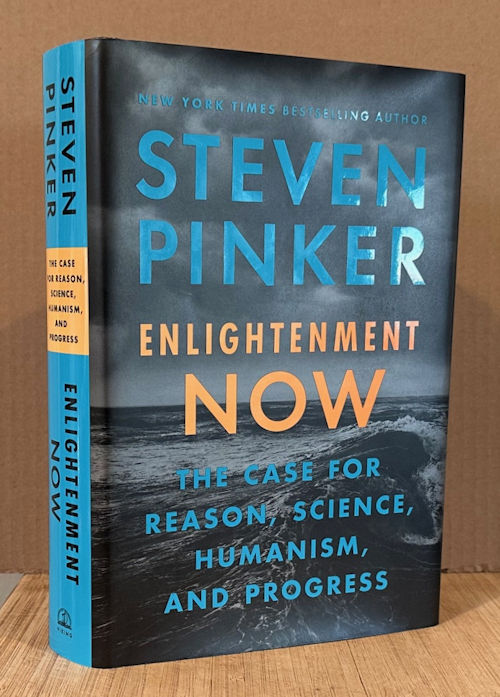
Subtitled “The Case for Reason, Science, Humanism, and Progress”
(Viking, Feb. 2018, xix+556pp, including 102pp of notes, references, and index.)
Here are the first seven of the 17 chapters in the long middle section of the book. The first one about “Progressophobia,” covers a range of familiar reasons from cognitive psychology why people think the past was better than the present, and the present is a mess. Topics about life, health, sustenance, etc., are addressed simply by looking at the data (as in the later Rosling book, reviewed here). Then come two topics, inequality and the environment, about which I’m not as sanguine, in 2025, as Pinker was in 2017 when he was writing this book. As even-handed as Pinker tries to be, since he wrote the Trump administrations have steadily tried to make everything worse.
*
Part II: Progress
Quotes Obama about how the best time to be alive, from any time in history, is now.
Ch4, Progressophobia, p39
Intellectuals hate progress; progressives hate progress, the Enlightenment idea that by understanding the world we can improve the human condition. Thus phrases like blind faith, false promise, onward march, and so on, all the terms used to dismiss this claim. The idea rather is that the world was better in the old days: Nietzsche, Schopenhauer, Heidegger, many others 40t. Individuals are optimistic about themselves, but not about society. This is the ‘optimism gap’, the idea that things are worse off than they were, p40. Despite the data that shows things getting better.
It’s easy to understand why: the news every day is filled with bad news, and commentaries about crises. Bad news leads; good news usually plays out over time and is unreported. Tversky and Kahnemann calls this the ‘availability heuristic’—people estimate the probability or frequency of some event but the events that first come to mind, 41b. This makes sense in certain contexts. Thus the better-informed become miscalibrated about the amount of bad news in the world, e.g. surveys 42b. The solution to this is to *count*. Look at the actual numbers, not just the examples at hand, as author did in his book BETTER ANGELS.
Author then addresses objections to that book’s thesis. No, violence hasn’t declined linearly; yes there are fluctuations; violence obviously hasn’t disappeared; no it won’t just take care of itself; it’s not Pollyannish, it’s a fact. Aren’t other things, like internet trolling or pollution, also forms of violence?
There are other issues than the availability heuristic. One is the negativity bias; it’s easier to imagine bad things that could happen to you, than good. Exception: autobiographical memory, which eases misfortunes. “Nothing is more responsible for the good old days than a bad memory.” 48m. Culture tends to resist quantitative thinking, and prefers pessimists, all the way back to the Hebrew prophets. Optimists are suspect as irresponsible or salesmen. OTOH we are sensitive to bad things that we took for granted in past years, e.g. wars as humanitarian tragedies; bullying. The media reflects the belief that ‘serious news’ is ‘what’s going wrong’. Look at some data: the tone of the news over the decades, judged from NYT and world broadcasts, p51. Keep this in mind.
So what is progress? Start with values like health, sustenance, abundance, peace, safety, freedom, equal rights, and so on, 51. These leave out religious, romantic, and aristocratic values, 51b, but this list matches a UN set of millennium goals.
And the data show that progress has been made in all these measures of well-being. And: that almost no one knows about it.
The data is easy to find: websites, numerous books – see list p52. Note that the Pulitzers, however, have gone to books about genocide, terrorism, cancer, racism, and extinction (!). On the other hand listicles reflect the positive news, because that’s surprising.
Ch5, Life, p53
Average lifespan is now 71.4; note Rosling survey, p53. See figure p54. The shift came in the 19th century, with the Great Escape: relief from poverty, disease, and early death. Child mortality dropped; it had been high even in advanced countries like Sweden, p56. When fewer children die, parents have fewer children. So there was no population bomb. And people live longer anyway; the trend isn’t only due to drop in child mortality, p58.
And years of healthy life have extended as well, p59. So is there a worry of living too long? What if Kurzweil achieves immorality? Unlikely based on evolution and entropy. Things that can’t go on forever don’t—but they can go on much longer than you think.
Ch6, Health, p62
Through most of human history, infectious disease was the strongest force of death. The rich were not spared. Humans fought back with all kinds of quackery: prayer, sacrificing, bloodletting, etc, p63t. The tide turned beginning late 18th C with vaccination, the germ theory of disease, and sanitation.
Now humanity shows its ingratitude, forgetting those pioneers whose work has saved millions and millions of lives. See list, p64, of discoveries and how many lives they saved.
Smallpox is extinct. For the cost of five Hollywood blockbusters, p65. Even diseases that remain are being controlled. The fruits of science aren’t just products; they are ideas, like cleaning water, washing hands, using latrines, using bednets, and so on. Bad ideas can reverse progress, like ideas about vaccines.
Ch7, Sustenance, p68
Famines used to be common; now we have too many calories; the poor are fat!. Malthus fears didn’t happen, 73b. Food production did increase, due to enhanced growing techniques, p74. Prices plunged. The Green revolution. Yet there are critics, especially of GMOs, by environmental groups, p77: “From there they capitalize on primitive intuitions of essentialism and contamination among the scientifically illiterate public.”
Most people who died of famine in the 20th century were victims of Communist regimes’ forced collectivization, p78: Russian, China, North Korea. Abundant food depends on the decline of poverty, war, and autocracy…
Ch8, Wealth, p79
Poverty is not the issue; how wealth is created is, obscured by debates about its redistribution. Chart 8-1 shows stunning rise in gross world product only in the past century, and this value doesn’t account for many other improvements, p82.
What launched this Great Escape? Application of science; the development of institutions for exchange of goods and services; a change in values that once looked down on tawdry commerce. Ref Rosling, p86. The decline in poverty, p89t. What is the world doing right? Five causes, p90: decline of communism; leadership; end of the Cold War; globalization; (note discussion of CP Snow and the loathing of his second culture for industry, and a response); and finally science and technology.
Ch9, Inequality, p97
The conventional wisdom is that rising inequality is a problem; thus Occupy Wall Street, Bernie Sanders. But the only real problem is poverty, not inequality per se, p99t. The lump fallacy, that wealth is a finite resource; note fallacy in Thomas Piketty 99m. Not a zero-sum game. Not a failure of modernity.
Still, there is the issue of status anxiety, 100t, how people *feel* worse off relative to others. The Spirit Level bk claims consequences. Not the same as fairness, 102t. So why has this changed over time? Even primitive societies have some inequality. The rise in the US has been acute since 1980. Early societies actually spent less on the poor, 107b. Governments have transferred from warring and policing to nurturing. This is a trend in developing countries. People like social spending, 109b. There are no libertarian paradises in the world where social spending is zero, 110t. The curve levels off about 25%. Yet there’s no ‘correct’ amount, 110.6
Returning to trend since 1980. Globalization hurts some, including the Trump voters. Does growing inequality make the world worse? 113. No, because everyone has gained to some degree. Compare poverty rates in past decades; there was no golden age, 113b.
Inequality statics can be misleading in four ways, 114: the difference between relative and absolute prosperity. Confusion between anonymous and longitudinal data. Low incomes are mitigated by social transfers. And rates of consumption, not just income, show that poverty has declined by 90% since 1960. The bar has been raised, 117.6, how most households below the poverty line have electricity, stove, color TV, etc. So the issue of inequality is too narrow a one; economic growth is more important, and perhaps the trend toward a universal basic income, 119m. Smry 120.
[[ I remain skeptical of his take on inequality, when it seems pretty obvious that taxing the uber-wealthy, taking away a few of their yachts, could fund all sorts of social programs for children and the poor that Republicans claim the nation can’t afford, while cutting taxes for the wealthy over and over. ]]
Ch10, The Environment, p121
Can progress continue without wrecking the environment? The key idea is that environmental problems, like other problems, are solvable.
The environmental movement has become quasi-religious, often denying progress or casting science and technology as villains, p122. An alternative approach is eco-modernism or other terms; cf Stuart Brand and others, 122b. This involves realizations that some pollution is a fallout from the 2nd law of thermodynamics, and that no landscape is pristine; and that industrialization has been good for humanity; and that the tradeoff between benefits and environmental damage can be moderated by technology, p124.
It’s worth noting the prophecies of doom have failed to materialize, from the population bomb of the ‘60s, to the prediction that resources would simply run out. The flaw in this thinking is not understanding that scarce resources become expensive, and new resources are found to replace them, leading to a kind of sustainability. Examples and Randall Munroe cartoon, p128. Over the past decades there have been fewer oil spills, less air pollution. Some believe claims of mass extinction to be hyperbole, 133m. Progress needs to be made, but the Industrial Revolution will not be undone.
The way forward is to decouple productivity from resources, putting a premium on density—more people move to the cities, freeing up the land. Also, dematerialization, using less stuff and replacing them with digital technology, using less paper, and how lots of old devices are replaced by a smartphone. And the sharing economy. We may have reached the era of ‘peak stuff’.
Still we must face the consequences of greenhouse gases on the climate. The numbers, 136-7. Some people simply deny it’s happening. “The great virtue of science is that a true hypothesis will, in the long run, withstand attempts to falsity it.” 137.8. Nevertheless, the American political right and fossil fuel interests “ha[ve] prosecuted a fanatical and mendacious campaign to deny…” 138t. A vast conspiracy theory.
There are also those who accept change but stress the positive. And a far left response, e.g. from Naomi Klein, suggests that climate change is a reason to abolish free markets and remake global economy and politics, 138b. Quote from Klein, railing against bean-counters.
Another response: a letter asking about sacrifices—giving up airplane flights, meat, jewelry. Author counters these are tiny, tiny matters, p140.
There are two psychological impediments. People have trouble thinking in scale, 140m, and can be moralistic in ways that won’t matter. It’s a public goods dilemma, the tragedy of the commons, 141t. Sustainable (primitive) development is a fantasy; what will work is economic development in poor countries.
So what *should* we do? We must get the most energy with the least emission of greenhouse gases. Already, carbon emissions have been decreasing as a proportion of GDP, p143. We can further decarbonization through carbon pricing. A second strategy would be to employ nuclear power, which is still more available than renewables like wind and solar. [[ Well, not in 2025 ]] Nuclear is the ultimate dense energy, and in comparison with other power sources, deaths are very few. Unfortunately western countries are reducing nuclear power. Yet those who know the most, fear the least, 148.2. The benefits are incalculable, 149.
Yet ultimately we must dismantle the CO2 already released, perhaps through geo-engineering means, bioenergy… p151m. The global consensus is represented by the [Paris agreement], which Trump has now announced withdrawal from. A last-ditch effort entails climate engineering, to reduce the amount of sunlight that reaches the surface. Ideas, p153.
[[ Again, Pinker is more sanguine about this topic, as with the previous one, than I am these days. But the book is eight years old, and now we have the Trump administration making everything worse – both inequality, and retreating from clean energy in favor of fossil fuels. ]]