
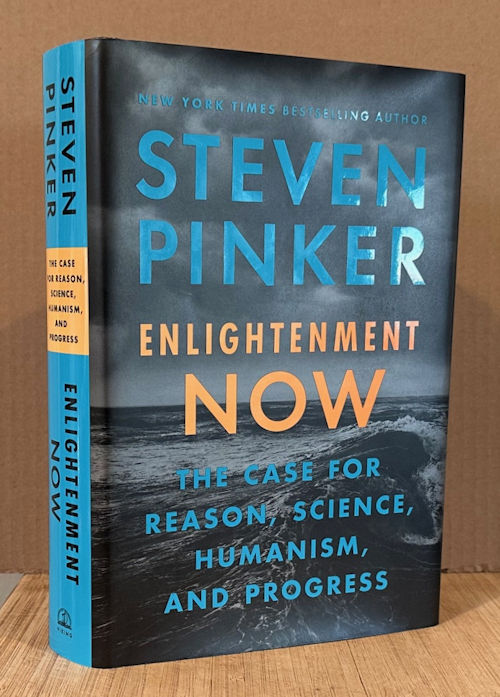
Subtitled “The Case for Reason, Science, Humanism, and Progress”
(Viking, Feb. 2018, xix+556pp, including 102pp of notes, references, and index.)
Posts about this book: Post 1; Post 2; Post 3; Post 4; Post 5. Expanded below.
Part I of this book outlined the ideas of the Enlightenment; Part II showed how those ideas worked. Part III defends the three other themes of this book against surprising enemies.
This post covers two of the three chapters in Part III.
The chapter on Reason addresses questions of why, since we *can* reason, we are so easily led into folly. Not so much from ignorance as affiliations with religions or other ideologies, and motivated reasoning, in-group thinking. Conservatives seem to doubt progress is even desirable, let alone possible; the certainties of traditional Christendom are preferable; Pinker rejects this resoundingly. But the left too rejects caricatures of certain ideas. Key idea: the test of empirical rationality is prediction. Some pundits are always wrong. And conservative politics is increasingly know-nothing. How to improve reasoning powers? Teach critical thinking, but it has to be hands-on teaching.
The chapter on Science exalts it as “the proudest accomplishment of our species.” Why the disdain, even from intellectuals? The fear of ‘scientism,’ the idea that science can have anything to say about CP Snow’s second culture, the humanities. But the practices of science are designed to make up for the flaws of individual human beings, and to rely on two key ideas: the world is intelligible, and we allow the world to tell us whether our ideas about it our correct. Most people are happy to accept the practical benefits of science, but reject science’s implications about the lack of truth of the world’s traditional religions and cultures — with quotes of two long paragraphs about what we know about the world through science, how many traditional ideas, from fate and karma to answered prayers, simply aren’t true, and how this underlying scientific understanding of the world necessarily grounds our approach to morality and our responsibility to take care of ourselves and our planet. With final comments about how science is treated in academia, how opponents resist quantification in favor of intuition, and how ideas of E.O. Wilson’s consilience offer more hope than the pre-Darwinian, pre-Copernican worldviews of people like Leon Wieseltier.
(Expanded Posts about this book; Post 1 (Preface); Post 2 (Part I, the first three chapters, on the book’s four themes, and about entropy, evolution, and information, and about counter-Enlightenments); Post 3, covering seven chapters in the central section of the book about Progress; Post 4, covering the remaining chapters about Progress, with some long quotes about the value of knowledge and education; Post 5, covering two themes, Reason and Science, in the last section of the book, with some long quotes about how people accept the practical benefits of science, but reject its implications about the truths of their religions and cultures and morals.)
One more chapter to go, about Humanism.
*
Part III: Reason, Science, and Humanism
Ch 21, Reason
Opposing reason is unreasonable; the arguments refute themselves. Reason entails coherence and a fit with reality.
And yet, we’re aware of research in cognitive psychology, e.g. Kahneman and Ariely. Examples 353t.
The Enlightenment thinkers never said we *are* rational; they said we ought to and can be rational, “collectively if not individually, by implementing institutions and adhering to norms that constrain our faculties, including free speech, logical analysis, and empirical testing.” 353m.
Selection pressures obviously favor explanations that are true.
Why are we so easily led into folly? P355. The standard explanation is ignorance. But belief turns out to be a matter of religious affiliation, 356, as with evolution, or with climate change. People accept beliefs according to who they are—cultural allegiances run across two dimensions, p357: right-wing hierarchy with left-wing egalitarianism, and libertarianism vs commutarianism. And this makes a sort of sense at a personal level, 358.2: it’s about respect in one’s social circle, at the risk of being a traitor.
Still, the effects of false beliefs matter, to society and the planet. People are actors in a Tragedy of the Belief Commons: “what’s rational for every individual to believe (based on esteem) can be irrational for the society as a whole to act upon (based on reality).” 358.7.
Thus we have ‘blue lies’, those told for the benefit of the in-group, 359t. In fact, preposterous beliefs are *more* effective, to show true commitment—359.4: “only a personal who is truly committed to the brethren has a reason to say that God is three persons but also one person, or that the Democratic Party ran a child sex ring out of a Washington pizzeria.”
Another paradox: reasoning can simply lead to better rationalizations: motivating reasoning, etc, 359.6. Political partisanship is like sports fandom: it’s about the experience.
And most depressing, p360ff: politics destroys mathematical reasoning. The bias bias. The left and the right are equally stupid in this regard.
But what do the ideologies say about progress? Conservatives are skeptical of the idea at all, since Edmund Burke, who thoughts humans too flawed to improve themselves, and had better to stick to traditions. The reactionary fringe, “recently disinterred by Trumpists and the European far right,” believes Western civilization is already out of control, “having abandoned the moral clarity of traditional Christendom for a decadent secular fleshpot that, if left on its current course, will soon implode from terrorism, crime, and anomie. Well, that’s wrong. Life before the Enlightenment was darkened by starvation, plagues, superstitions, maternal and infant mortality, marauding knight-warlords, sadistic torture-executions, slavery, witch hunts, and genocidal crusades, conquests, and wars of religion. Good riddance.” P363-64.
The left also missed the boat in its contempt for the market and its romance with Marxism. Many still think of free markets at their unregulated worst, so this is a false dichotomy. The libertarian right as equally extreme views in rejected any and all regulation, any and all social spending, and any tax rate too high.
But the fact of human progress belies both sides. In fact, countries with higher social spending and tax rates are better places to live than the US, by numerous measures, 365. “The empirical picture at present suggests that people flourish most in liberal democracies with a mixture of civic norms, guaranteed rights, market freedom, social spending, and judicious regulation.” 365.8.
The test of empirical rationality is prediction, a standard rarely applied to pundits etc. Some like Ehrlich are always wrong. A study of forecasters showed they do about as well as chimpanzees, p367ff. The worst were the ones with Big Ideas, and if their predictions didn’t pan out, they’d say “just wait.” The better ones, ‘superforecasters,’ used analytic tools and would admit to being wrong. They would adjust their estimate with Bayesian thinking. They accept the wisdom of the crowds, and they don’t believe in fate over chance, p370b.
Americans are increasingly polarized politically. Academia is increasingly left-wing, though in some ways this is natural, 372b; “In many ways we are (almost) all liberals now.” 373.2. But leftist politics can distort some studies, as author showed in The Blank Slate, 373. A study by Duarte, discussed by Kristoff in NYT in 2016, drew angry responses. [[I commented about this here ]] A faction of ‘social justice warriors’ decries trivial incidents as evidence of racism or aggression, 373-4.
But political polarization is more dangerous than academic; because politics has consequences. Republicans “became synonymous with the extreme right has been pernicious, because it is so convinced of the righteousness of its cause and the evil of its rivals that it has undermined the institutions of democracy to get what it wants.” 374.6, with examples of obstruction. And so now, “It’s harder to be a conservative intellectual when American conservative politics has become steadily more know-nothing, from Ronald Reagan to Dan Quayle to George W. Bush to Sarah Palin to Donald Trump.” 374.9
So let’s be clear about reason. We are certainly capable of reason. We don’t live in a ‘post-truth’ world; in fact, we’ve seen the rise of fact-checking, a corrective to history in which many wars were started by mistakes. We’ve outgrown irrationality, as the judge in the Loving case.
How can we improve standards of reasoning? People resist evidence that challenges their views—to a point, an ‘affective tipping point’. We can try to teach critical thinking, and ‘debiasing’—but experience shows it needs to be hands-on teaching.
The worst problem is identity-protective cognition (or the Tragedy of the Belief Commons), and to tackle this we need to address the rules of discourse: teach students to switch sides in a debate; challenge people to explain their understanding of issues they support or deny.
The world is *not* less rational than it was before; 381.1. An exception is electoral politics, which feeds on the worst irrational tendencies; people are encouraged to weigh in on issues they know nothing about. So issues should be depoliticized as much as possible—examples of climate change. The media should stop treating politics like sports.
Eventually, rationality will prevail – it will by definition – though it may take decades or centuries, as it’s done for the confusion between correlation and causation to trickle down to common understanding, and it’s taken 50 years for Tversky and Kahneman’s demonstration of biases to become known.
Ch 22, Science
It’s the proudest accomplishment of our species. Not just lists of facts, but the discovery of deep principles that knit them together. Sean Carroll’s laws of physics. It includes deep implications for our understanding of our place in the universe; also great beauty; and of course the benefits of life, health, wealth, knowledge, and freedom, as described in previous chapters.
So why the disdain for science? Not just from the religious and politicians, but from intellectuals?
It’s clear among American right-wing politicians; cf Chris Mooney’s book. It began with the Bush 41 administration; mocking scientists; the party of know-nothingism. But the deeper issue is the hostility toward ‘scientism’, the encroachment of scientific thinking in the humanities, from both the left and right.
Goes back to C.P. Snow’s Two Cultures. The resistance is from his ‘second’ culture, though only among academics, not from actual artists, 389b. Snow’s idea was that this divide should by superseded by a ‘third’ culture, similar to Wilson’s ‘consilience’. Escape the bunker mentality of Leon Wieseltier.
This isn’t about how scientists are wise and noble; the practices of science are designed to make up for the flaws of individual human beings, 390b. It’s not about making scientists in charge. It’s not about thinking all current science is true; most new hypotheses are not. It’s a fallacy to think that because some past ideas were wrong, all current conclusions are in doubt. Science is an extension of philosophy; the ‘scientific method’ as taught to schoolchildren is simplistic.
The two ideals of science are: 1, the world is intelligible – not a reductionist idea, because patterns emerge at different levels of complexity. And 2, we allow the world to tell us whether our ideas about it are correct. 393.4.
Most people are happy accepting the practical benefits of science, but take exception at its encroachment on the ‘deep questions’; thus Gould’s Rocks of Ages. But this ‘entente’ quickly unravels. P394:
To begin with, the findings of science imply that the belief systems of all the world’s traditional religions and cultures – their theories of the genesis of the world, life, humans, and societies – are factually mistaken. We know, but our ancestors did not, that humans belong to a single species of African primate that developed agriculture, government, and writing late in its history. We know that our species is a tiny twig of a genealogical tree that embraces all living things and that emerged from prebiotic chemicals almost four billion years ago. We know that we live on a planet that revolves around one of a hundred billion stars in our galaxy, which is one of a hundred billion galaxies in a 13.8-billion-year-old universe, possibly one of a vast number of universes. We know that our intuitions about space, time matter, and causation are incommensurable with the nature of reality on scales that are very large and very small. We know that the laws governing the physical world (including accidents, disease, and other misfortunes) have no goals that pertain to human well-being. There is no such things as fate, providence, karma, spells, curses, augury, divine retributions, or answered prayers—though the discrepancy between the laws of probability and the working of cognition may explain why people believe there are. And we know that we did not always know these things, that the beloved convictions of every time and culture may be decisively falsified, doubles including many we hold today.
Next para:
In other words, the worldview that guides the moral and spiritual values of a knowledgeable person today is the worldview given to us by science. Though the scientific facts do not by themselves dictate values, they certainly hem in the possibilities. By stripping ecclesiastical authority of its credibility on factual matters, they cast doubt on its claims to certitude in matters of morality. The scientific refutation of the theory of vengeful gods and occult forces undermines practices such as human sacrifice, witch hunts, faith healing, trial by ordeal, and the persecution of heretics. By exposing the absence of purpose in the laws governing the universe, science forces us to take responsibility for the welfare of ourselves, our species, and our planet. For the same reason, it undercuts any moral or political system based on mystical forces, quests, destinies, dialectics, struggles, or messianic ages. And in combination with a few unexceptionable convictions – that all of us value our own welfare, and that we are social beings who impinge on each other and can negotiate codes of conduct – the scientific facts militate toward a defensible morality, namely principles that maximize the flourishing of humans and other sentient beings. This humanism, which is inextricable from a scientific understanding of the world, is becoming the de facto morality of modern democracies, international organizations, and liberalizing religions, and its unfulfilled promises define the moral imperatives we face today.
Treatment of science in liberal curricula is often trifling, and confined to the classic Kuhn book, which has become conventional wisdom in the second culture as nihilistic. Thus some historians of science consider the pursuit of truth as naïve, 396. (Like an art critic watching basketball, 396.2) Thus insidious accusations that science is about oppression, or crimes as old as civilization – slavery, racism, genocide. Author provides several pages about the Nazis, Hitler, social Darwinism, eugenics, racism, and how these are not the result of science.
Yet science is still demonized in academia, e.g. trivial example of blaming science for Tuskegee. This demonization discourages students, and reviews board with their ‘bioethics’ discourages research, with examples.
The greatest payoff of science would be to get everyone thinking more scientifically. Opponents resist quantification, yet by waffling they are essentially saying, trust my intuition. Even though we know everyone is overconfident of their intuition. An experiment showed that simple actuarial formulas outperform expert judgment, 404t. Datasets must overcome anecdotes, with examples about peacekeeping, and campaigns of nonviolence. (And the failures get the headlines, not the successes.)
Currently the humanities are in trouble. They suffer the recovery from post-modernism. Consilience offers insight; this has happened in fields like archaeology, philosophy of mind, linguistics, political theory. There are other areas of potential: visual arts, literary scholarship. Author critiques Adam Gopnik’s review of a book by Jonathan Gottschall, and again Wieseltier, whose preference seems to be a worldview that is pre-Darwinian and pre-Copernican. “Let’s hope that artists and scholars don’t follow their self-appointed defenders over this cliff. Our quest to come to terms with the human predicament need not be frozen in the last century or the century before, let alone the Middle Ages. Surely our theories of politics, culture, and morality have much to learn from our best understanding of the universe and our makeup as a species.” With a quote by Thomas Paine.