
- Stephen Miller accuses the new Trek series of being woke, with my comments on how the original Trek series was extremely woke, especially for its era;
- An interview with Anil Seth about deep reality and whether it’s built by human perception, coincidentally reflecting the themes of books I’m currently reading;
- Jerry Coyne about whether art is truth;
- Brahms’ 4th.
More evidence of the cluelessness of the folks in the Trump administration. This concerns the debut of a new Trek series called “Starfleet Academy,” which I haven’t seen.
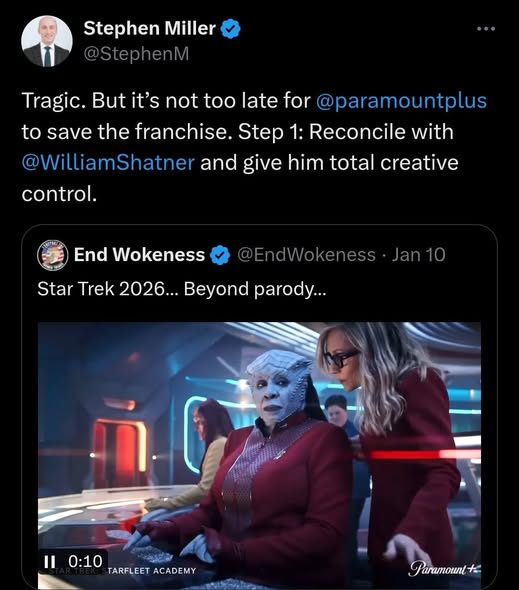
(Image from Facebook.)
HuffPost, 16 Jan 2026: Stephen Miller Mocked For Begging William Shatner To Save ‘Star Trek’ From Wokeness, subtitled Many people interpreted Miller’s X post as a variation of “show me you don’t understand the point of ‘Star Trek’ without saying you don’t understand the point of ‘Star Trek.'”
The Independent, 16 Jan 2026: Stephen Miller ridiculed over his next target – saving ‘woke’ Star Trek, subtitled “White House adviser says the popular science fiction franchise should boldly go back to 94 year-old William Shatner”
Because ‘woke,’ to the modern conservative, means acknowledging the existence of anyone who is not (human), white, straight, Christian, and male.
The irony is that the original 1960s Trek was *extremely* ‘woke’ by the modern definition, even though that term wasn’t used then. But Trek reflected the idealism of both science fiction and 1960s culture: that the future would be multicultural, and problems were solved by investigation and understanding, and not by demonization or bigotry. Look at that bridge crew! An Asian, a black woman, later a Russian, not to mention a Vulcan! (I recall my grandmother being puzzled by the Vulcan? Why would they let such a creature there?)
And how many passionate speeches were there by Kirk about the need for exploration and understanding and pushing the boundaries. The very first filmed episode of the series, “The Corbomite Manuever,” included such a speech, and a rebuke to a young navigator who — like a modern conservative — was certain that Spock was a traitor.
To be fair, the idealism of TOS, the original series, has not been maintained over all the subsequent series and movies, especially in the movies produced by those not familiar with TOS. Later shows and movies became focused on space battles, and villains like the Klingons and others, and soap opera among the regular cast, with very little “exploration” or “new life and new civilizations.” But to also be fair, I haven’t watched most of those later series or movies. TNG was fine, and the recent “Strange New Worlds” was fine until a point. But I haven’t made a career of watching Star Trek, even as I revere the original series for partly molding my own philosophy of life. As happens with whatever one is exposed to at age 11. Given to revisions.
\\\
Is anything a coincidence anymore? I’ve been reading books this month by Hoffman, Tong, and now Azarian, and Facebook showed me a link to this video on Psyche, a site I’d never previously visited, yet which is oddly relevant to the themes of those books. Perhaps I am naive about the extent which Facebook and Google and everyone else is monitoring my computer for whatever I type about, even without posting…
Psyche, interview of Anil Seth at University of Sussex, by Nigel Warburton, 16 Jan 2026: How we build perception from the inside out, subtitled “Perception is a process of inference, not an account of ‘reality’”
This is an audio interview, with this description.
It’s easy to mistake our conscious experience for an ongoing, accurate account of reality. After all, the information we recover from our senses is, of course, the only window we’ll ever have into the outside world. And for most people most of the time, our perception certainly feels real. But the notion that our senses capture an objective external reality can be dispelled by considering something as fundamental as colour, which can be culturally influenced and, even within a single culture, leave the population split between seeing the same picture of a dress as black and blue or white and gold.
In this Aeon Original, Anil Seth, professor of cognitive and computational neuroscience at the University of Sussex in the UK, puts our imperfect relationship with reality in perspective. In conversation with Nigel Warburton, consultant senior editor at Aeon, Seth argues that it’s not just that our perceptions provide flawed accounts of the outside world, but that our brains aren’t in the business of recovering the outside world to begin with. So it’s more accurate to think of our conscious experience as a series of predictions that we’re incessantly and subconsciously fine-tuning – a world we build from the inside out, rather than the outside in.
That reference to The dress is apt. The way we perceive the world depends on our circumstances. The books I’ve been reading go further, claiming that we do not perceive reality at all, but only what we’ve learned to perceive given the senses we’ve developed given our position on a particular planet with particular sunlight, and so on. In one direction, these ideas recall the philosopher Berkeley, who said that when we look away, the object we just saw does not exist (which can be true only given particular definitions of those words); in another direction, these ideas extend ideas of learning, of evolution, of Bayesian inference, even of AI learning, into a cohesive explanation of reality, beyond the reductionist explanations by physics of the cosmos as it has evolved. I’ll explain more clearly, I hope, once I’ve finished reading Azarian, and related books.
\\\
One more think piece, by Jerry A. Coyne on Quillette.
Quillette, Jerry A. Coyne, 26 Dec 2025: Can Art Convey Truth?, subtitled “Ways of feeling are not ways of knowing.”
Of course this relates to the previous item, and my presumption that there is a difference between objective truths, which are true for everyone, and subjective truths, which depend on circumstance and background. The frequent claim about so-called “other ways of knowing” begs the question of knowing *what* — something objective, or merely subjective?
As a scientist, I tend to get labelled an anti-art bigot when I tell my friends that, unlike science, the literary, visual, and performing arts are not about truth. My assertion is greeted with an eyeroll and a shrug of the shoulders, or, by humanities professors, with disdain and opprobrium. To them, I’m just another narrow-minded disciple of the science-as-hegemony school. For example, a discussion of the topic at the Heterodox Academy in June resulted in Louis Menand and John McWhorter telling me, in so many words, to stay in my lane. I’m writing this essay to explain my position.
Like so many philosophical debates, the issue depends on what you means by the words. Coyne defends his appreciation for the arts, then says:
Let me stop here and define what I mean by “truth.” I am referring to propositional truth, which The Oxford English Dictionary defines as “something that conforms with fact or reality.” Such truths can in principle be shown by empirical study to be either true or false, like the claims that “evolution happened” or “James Joyce was born in Dublin.” Such truths are the main component of “knowledge,” widely defined as “facts verified by a consensus among qualified people.” In contrast, subjective knowledge consists of personal feelings and beliefs that are valid for only one or a few people and can’t be verified empirically (e.g., “this painting is beautiful”). Perhaps we should simply distinguish objective from subjective knowledge. And subjective knowledge is not truth.
Again: well, maybe subjective knowledge is truth about the kinds of things that humans perceive and *think* are true. But that’s a truth about human nature, and not about any objective reality that exists independent of human nature.
\\\
We’re heading out this evening to a concert at Zellerbach Hall with the Chicago Symphony, conducted by Ricardo Muti, doing Brahms’ 4th and other pieces. Here’s the Brahms 4 by Carlos Kleiber.