- Kalen Dion on the right/left divide: homogeneity/diversity, and all that implies;
- What do historians mean that tomorrow won’t be better than today? Because human nature;
- The modern economy and the limits of human cognition;
- Conservative values: the Biblical right to the entire Middle East; how morality can come only from God (Coyne counters); deport Native Americans;
- Trump’s hospital ship to Greenland.
Busy day yesterday with events in the city. Stopped at Borderlands Books for the first time in years. Yes, they do carry the SF magazines, but not yet the Jan/Feb issues of Analog and Asimov’s, let alone Mar/Apr.
\\\

Here’s a post from Facebook today by someone named Kalen Dion, a poet, author, and visual artist. Never heard of him. Is Fb smart enough to show me short essays about human nature and the left/right divide, no matter who they’re by? Otherwise I’m not sure why I would have seen this.
The right wants homogeny.
The left wants diversity.
And this is why there’s no seeing eye to eye. These two objectives are fundamentally incompatibile. They cannot be simultaneously achieved.
The right wants uniformity; cultural, religious, racial, ideological. One way of being that applies to everybody . A strict social hierarchy. And a singular order controlled by those who are believed to have the most authority .
Diversity disrupts the social order… and that’s why it’s seen as a threat.
The left, by contrast, desires pluralism. They don’t want to be forced to conform to a single identity. They believe it should be their right to govern their own moral template. All they are asking for is dignity and equality.
That’s why the right doesn’t just oppose ideas on the left. It opposes the existence of people on the left. Queer people. Trans people. Immigrants. Religious minorities. Political dissidents. Their presence alone is seen as an act of provocation and a violation of natural law. They are treated like a manifestation of instability. And an attack on gods order.
The truth is that the anger from the people on the left
is a natural reaction to legislation, policing, surveillance, deportation, violence, and criminalization based on identity. When people are told they don’t belong, their existence itself a violation, that their families are illegitimate, and their culture, history, and spiritual traditions are a problem… anger is not radical. It’s reasonable and proportionate. In the least.The whole process creates one giant cycle.
The right initiates harm and the left responds. The response is subsequently framed as the actual offense. Self-defense is called “aggression”. Boundary-setting is “intolerance”. Refusal to assimilate gets labeled “extremism”. When marginalized groups protest police violence, the initial harm is minimized while the protest is called a riot. There is no demonstration quiet enough. When queer communities resist laws targeting their existence, they’re accused of “pushing an agenda.” When immigrants object to being caged or deported, they’re framed as ungrateful and told to leave… or called dangerous. When women assert the right to independence , they’re accused of destroying family values . When educators teach history about the harms we have committed , they’re accused of indoctrination.
The pattern is always the same. A scapegoat is chosen. Harm occurs. Resistance follows. Resistance is treated like the problem. The right makes sweeping moral claims disparaging those they are harming .
“Look how angry they are”
“Look how divisive they are”
“Look how violent they are”
This framing erases the original coercion. It paints dominance as neutral.
Then the right accuses the left of being unwilling to coexist. But genuine coexistence isn’t actually on the table . So when the left refuses(or is unable, by virtue of their identity, ) to assimilate…when it insists on visibility, autonomy, and legal protection… that refusal is framed as hostile. Refusing to disappear is called an act of aggression.
The right calls the left “divisive” while pushing policies that restrict or deny their right to exist. Calls for inclusion are labeled censorship. While bans and crackdowns are seen as “order.” It’s why the right insists it’s being persecuted by the very people it is trying to eliminate . The right claims to be defending peace while demanding unrestricted control. The left is blamed for conflict… simply for existing.
And over time, this framing conditions the public to see control as stability. Resistance as chaos. And domination as order. It teaches people to side with power instinctively, even when that power is openly violent to the very groups it is supposed to protect .
The whole “both sides” narrative is insane, the symmetry of oppression is a lie, and calling people divisive for refusing to disappear is bullshit. What we are actually witnessing is one side is demanding homogeny… and the other is refusing to disappear.
I could quibble with some wording, and of course it’s not obviously a binary left/right divide. But to the extent there are patterns that characterize the ends of the spectrum of human nature, this is pretty good. (And as I’ve said: these will never go away.)
\\
Meanwhile, I just finished a book, PROGRESS by Johan Norberg, that argues, as Steven Pinker and Hans Rosling and others have done, that humanity has ‘progressed’ along various measures of human welfare over time and especially in the past couple centuries, in ways that MAGA folks either deny or are simply unaware of. (I’ll write up the Norberg book here shortly.)
So then what do we make of this?

NY Times, guest essay by Ian Buruma (a professor at Bard College), 22 Feb 2026: Historians Confirm: Tomorrow Won’t Be Better Than Today
What could this be about? Is he denying the evidence cited by Norberg and Pinker and others? No. He’s explaining how human nature will never change.
He begins by talking about Nazi Germany.
To live in Berlin under the Nazis during World War II must have been an extraordinary experience. To be deported to death camps, if one was one of the tens of thousands of Jews who were still alive and living in Berlin, was horrific. For non-Jews, living in a police state was frightening enough. Being bombed day and night in the last two years of the war was surely terrifying.
And so on and so on. Would the nightmare finally end?
The human capacity for hope is an essential quality. Without hope, there can be no improvement. But hope can also turn into delusion. The United States today is not Hitler’s Third Reich. We are nowhere near the disastrous circumstances of Berliners in 1945, 1939, 1935 or even 1934. But as humans, we are prey to similar kinds of self-deception.
Yet here again we get to Trump, incrementally, as the essay ends:
When Donald Trump refused to say whether he would accept the outcome of the election in 2016, people should have sensed the danger. And yet at the time, respected intellectuals told me that everything would be fine: All he wanted was to play golf or make money. Anyway, Hillary Clinton and George W. Bush were worse, for they condoned or unleashed unnecessary wars. I was told by a well-known American historian that there was really nothing to worry about, for after all, Roosevelt once had authoritarian tendencies, too. Democracy would never be shattered, a law professor assured me, for “Americans love freedom too much.”
Since then, one red line after another has been crossed: Undocumented immigrants are called animals; civilian boats are blown out of the water; American citizens are gunned down in the streets and then accused of being domestic terrorists; universities, news organizations and law firms are being bullied and blackmailed; and refugees are deported to countries whose languages they probably don’t even speak. And that is aside from the blatant corruption of family and cronies.
All this was incremental, too, but compared with 1934, everything goes much faster. And yet life continues as usual. What was unthinkable only yesterday we now take in stride, and we wait for that moment when things really have gone too far this time, when the fever breaks and things will revert to normal.
But that moment probably won’t come. Things have gone too far too many times already. Hoping for better is still the right attitude, but only as long as we prepare for the worst.
OK then, though he doesn’t put it this way: tomorrow won’t be better than today because the dark currents of human nature are always with us and will occasionally re-emerge. Despite the rules and principles set into place by the by the enlightened aspects of human nature (in the Constitution, et al). And yet, despite such political currents, even social and moral progress has been made, as Norberg and those others document, along lines of sanitation and poverty and literacy and violence and education and civil rights. We may occasionally slip back, due to conservative forces, but the arc of progress, moral and otherwise, has been forward, for centuries. Even though it’s usually been three steps forward, one step back.
\\
Here’s a piece that suggests, as I’ve floated, that progress in certain ways might be limited by human cognition. Most people just aren’t very smart, or are smart only in the very limited way of “common sense,” while unable to think outside their bubbles of ordinary experience. And while some very smart people can advance human knowledge and understanding, these days they are increasingly attacked and undermined by the MAGA crowd, who insist that everything be very simple and intuitive.

Washington Post, Megan McArdle, 22 Feb 2026: Why our brains can’t handle a modern economy, subtitled “Insurance premiums and $50K SUVs blind Americans to the illnesses and accidents that never happen.
This is about technological progress vs the feeling among many who think that overall, we’re worse off than before. And it’s about the inability to think proportionately, to understand risk analysis. With discussions of auto safety and auto expense…
One reason cars are more expensive is that as the economy grew, consumers decided to spend some of the surplus on larger, plusher vehicles — for one thing, we’re buying more SUVs and fewer sedans. Another reason is that cars today have more bells and whistles, including features that make them much safer, such as air bags, stability control and advanced driver-assist systems. We’re not buying the same vehicles we were 30 years ago; we’re buying much better ones, and that shows up in crash data: In 1995, we lost 1.7 American lives for every 100 million vehicle miles traveled, but only 1.2 in 2024.
And a similar discussion of vaccines. And health insurance. And health care. Ending:
Stochasticity helps explain the mystery of good economic data and bad economic vibes. It might also explain another mystery: why so many seemingly normal people cheered the assassination of UnitedHealthcare chief executive Brian Thompson. People absolutely hate health insurers, because it feels as though they take your money and give you nothing back.
That’s not true — insurers are legally required to spend most of our premiums on care, and their profit margins averaged under 1 percent in 2024. But most people don’t know that. All they know is they’re paying a lot for what feels like nothing. Our brains just aren’t adept at parsing those sorts of unknowns. Sadly, they may be better able to process stochastic terrorism than to handle stochastic economics.
Well, OK, maybe most people, including me, don’t understand how insurance companies make their money except by, in effect, denying health coverage. (That’s why health care shouldn’t be privatized.) I will just observe that other countries seem to have better health care systems in which their populations don’t complain as much as Americans do about theirs.
\\\
We have some examples of conservative values at hand.

JMG, 21 Feb 2026: Huckabee: Israel Has Biblical Right To Entire Middle East (from The Guardian
And this is the problem with using the Bible as a guide to contemporary problems.
Today, from NBC News: JMG 14 Arab And Muslim Nations Condemn Huckabee’s Claim Israel Has “Biblical Right” To Entire Middle East
Don’t these other nations understand that Mike Huckabee’s religion is the *right one*?? This is the mentality of conservative Christians.
\\\
Similarly

Jerry Coyne, 20 Feb 2026: Dennis Prager in The Free Press: Morality can come only from God, so we should at least act as if He exists
Coyne responds to a new book by Prager: IF THERE IS NO GOD… , which claims that only (his) religion can be a source of morality.
But Prager is wrong on two counts. First, religion is not the only source of morality—or even a good one. Second, there is no “objective” morality. All morality depends on subjective preferences. Granted, many of them are shared by most people, but in the end there is no “objective” morality that one can say is empirically “true”. Is abortion immoral? How about eating animals? What is wrong with killing one person and using their organs to save the lives of several dying people? Can you push a man onto a trolley to save the lives of five others on an adjacent track? If these questions have objective answers, what are they?
Coyne goes on with many examples.
To me, it boils down to this: religious folks who assign ultimate moral authority to their favorite holy book are simple-minded, obtuse, or disingenuous. They pick and choose from the Bible, for example, and ignore all those moral strictures that no one takes seriously anymore. They prefer to defer to authority rather than think for themselves; times have changed since Leviticus was written, for example. And they ignore all rival holy books.
\\\
A couple more items on the current administration’s insanity.

JMG, via Snopes: MAGA Texas Candidate: Deport Native Americans
To where?
\
JMG: Trump: I’m Sending “Great Hospital Boat” To Greenland
CNN: Trump says he’s sending a hospital boat to Greenland as territory says ‘no thanks’
JMG, from Washington Post: Greenland/Denmark Mock Trump Over “Hospital Ship”
Including this response to Trump’s original post.
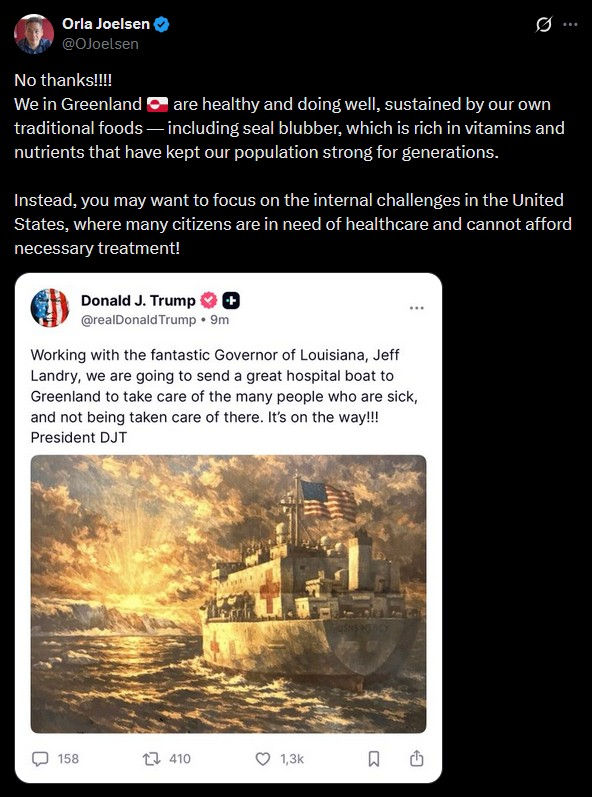
Why Louisiana? Why the AI-generated oil painting of a hospital ship? (Why not a photo of the actual ship?) And so on.
Trump is insane. And it doesn’t matter to many, many people.