This is about the 1953 movie, surely one of the best known and highly-regarded SF movies of the ’50s, along with THE DAY THE EARTH STOOD STILL, FORBIDDEN PLANET, and perhaps INVASION OF THE BODY SNATCHERS.
I wrote about the novel back in 2021, along with some comparison to this film. I watched the DVD of the film again last night.
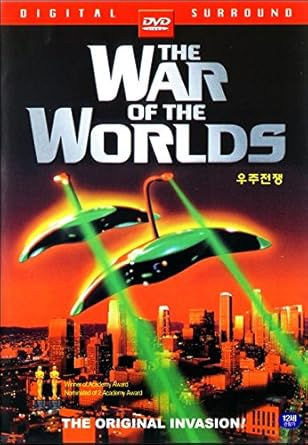
(My DVD cover is similar to but not exactly like the one shown here. On mine, “The Original Invasion” appears at the top, and there’s no Korean(?) text beneath the title.)
Couched among other skiffy flix of the era, this film is an example of the Hollywood-ization of a classic novel to fit the pattern of what audiences excepted a science fiction movie to be at the time. With so many resemblances to other sf movies of the era.
First: the location is changed from the London suburbs to the desert or hills outside LA. Second, a narrator portentously explains how no planets other than Earth would be suitable for settlement by Martians. Fuzzy photos of Martian cities and canals (as in RED PLANET MARS) are shown to justify the Martians’ search for another world, and how they must have settled upon Earth. But we never see any clue about whether the Martians are intelligent or not; we only see them as mindless invaders. That reflects the cultural fears of 1950s America.
The story begins as a meteor is seen from a small California town, how it starts a fire, how the local fire trucks respond. Investigators respond, including a local scientist from “Pacific Tech,” played by the relatively well-known actor Gene Barry (perhaps better known later for a couple TV series). Lots of cars and tourists, men wearing the baggy suits of the time.
Later that night we see a hatch on the ship slowly opening like a screw, and a head emerging (with a distinctive shaking sound effect), then a local waving a white flag. Who is zapped with some kind of ray that disintegrates him. Meanwhile, lights go out at a local dance, along with the phones and watches. Another meteor comes down.
True to cliche, the military is called in, as reports come in from around the world of other landings.
Eventually we see one of the Martian ships emerge from where it landed — and this is the most striking thing about the movie, as well as a departure from the Wells novel. In this movie, the Martin ships are flat ovoids, floating slowly above the ground, with huge stalks coming out of the top with tri-color eyes that fire disintegration rays at everything. In Wells’ original, the Martian ships walked around on tripods of mechanical legs. The movie’s ships are far more striking. (And it would have been easier for the movie to float the Martian ships over a stage landscape, rather than try to depict them walking around on three legs.)
Plot follows. More military. Gene Barry’s character and his girl find refuge in a farmhouse, until an encroaching alien sends its probe into the house… and even glimpse one of the Martians themselves. They escape as the house explodes.
More military, even atomic bombs, which do not phase the Martian ships at all. Los Angeles tries to evacuate, with mobs attacking each other. The Martian ships coolly glide into the city, disintegrating buildings, including the iconic Los Angeles City Hall.
And then, in what’s literally a deus ex machina, and coincidentally as Gene Barry finds refuge in a downtown church, the gliding Martian ships sputter, and sink to the ground, crashing. We see the arm of a dead Martian, with its three fingers, falling out of one of the ships. In the church, people were praying for a miracle. The narrator intones about how the tiniest of creatures, bacteria, infected the Martians, who had no resistance to what to them were aliens. Such small creatures as “God in his wisdom had put upon the Earth.” Amen.
\
Now, the movie excels for its production values. It was directed by George Pal, who earlier did DESTINATION MOON and WHEN WORLDS COLLIDE and later did THE TIME MACHINE. It won an Oscar for visual effects.
And yet, it’s just another skiffy flix. The same patterns appear that were in so many other 1950s Hollywood science fiction movies. Frightening invaders, military response, and the invocation of the Christian God to take credit for the invaders’ defeat.
The novel by Wells was much wiser, as I discussed here.
Here’s a more detailed summary, with lots of context: Wikipedia
I saw the Steven Spielberg 2005 remake when it came out, but have not watched it again. As I recall, it followed the basic plot closely, complete with the farmhouse encroachment of a Martian eye, but added on a sappy happy-ending coda involving a boy. Typical Spielberg. But perhaps I’ll watch it again some time.