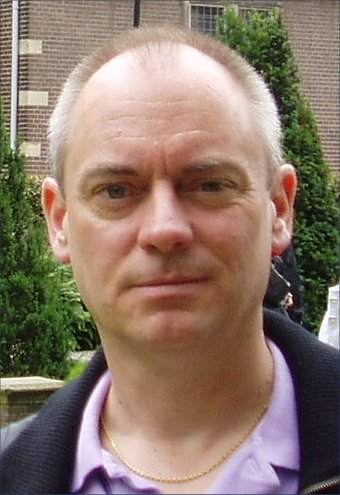
- Penn & Teller advise the Supreme Court about junk science, and the significance of how magicians are less easily fooled than lawyers, politicians, and even scientists;
- How most Americans think Trump isn’t religious, how MAGA doesn’t care, and the idea that people being fooled by magic tricks aligns with religious devotion;
- Long piece by David Brooks about how reactionaries are taking over the world, forever in search of roots, enchantment, moral order, and protection against change, i.e. the threats of modernity.

It’s been said that charlatans — psychics, spoon-benders, and so on — are happy to perform in front of an audience of scientists. Scientists are easily fooled, because they expect the universe to play fair. But charlatans will never perform in front of magicians. Magicians know all the tricks.
NY Times, Andrew Liptak, 16 Apr 2026: Two Magicians Warn the Supreme Court About Junk Science, subtitled “Penn & Teller filed a Supreme Court brief questioning the use of ‘investigative hypnosis’ in a death-penalty case in Texas.”
Penn Jillette, the talkative member of the magic act Penn & Teller, knows that people will find the duo’s new project a little surprising. It is a Supreme Court brief filed last month urging the justices to hear an appeal from Charles Don Flores, a death row inmate in Texas.
A key piece of evidence in the case was tainted by a police officer’s “investigative hypnosis” of a witness, the brief said.
On a video call from Las Vegas, Penn was quick to tell me that he does not know much about many things. But he said — and who could disagree? — that he is an expert in misleading people.
“I am bringing this to you with the utmost humility,” he said. “I am carny trash. I am uneducated. If you want to say I have a position of expertise, it is that I have lied to people onstage and gotten them to believe it. And I think I could do what that police officer did.”
My two favorite magicians. They have a long-standing gig at a hotel in Las Vegas, where we saw them way-away back in 2003. I like them because they don’t pretend they’re fooling you. They want you to know they’re just tricking you. In recent years we watch their TV show, which bounces around the TV schedule, though in Oakland it’s often on on Friday evenings after we’ve gotten home from our weekly dinner out. (Which we’re about to do.)
They don’t do this on their show, but at the performance we saw in Las Vegas, they ended with a trick they performed and then *showed the audience how they did it.*
Penn & Teller, as Jason Zinoman wrote last year in an appreciation in The New York Times, “revolutionized magic, demystifying and modernizing the form, while merging it with comedy.” That combination, Jason wrote, created “one of the great success stories of modern show business.”
The two magicians are ardent skeptics. They explored questionable and fraudulent practices over eight seasons of their Showtime series “Penn & Teller: BS!” One episode was devoted to the misuse of hypnosis.
Hypnosis being the core of the court case.
\\
This is not unrelated.
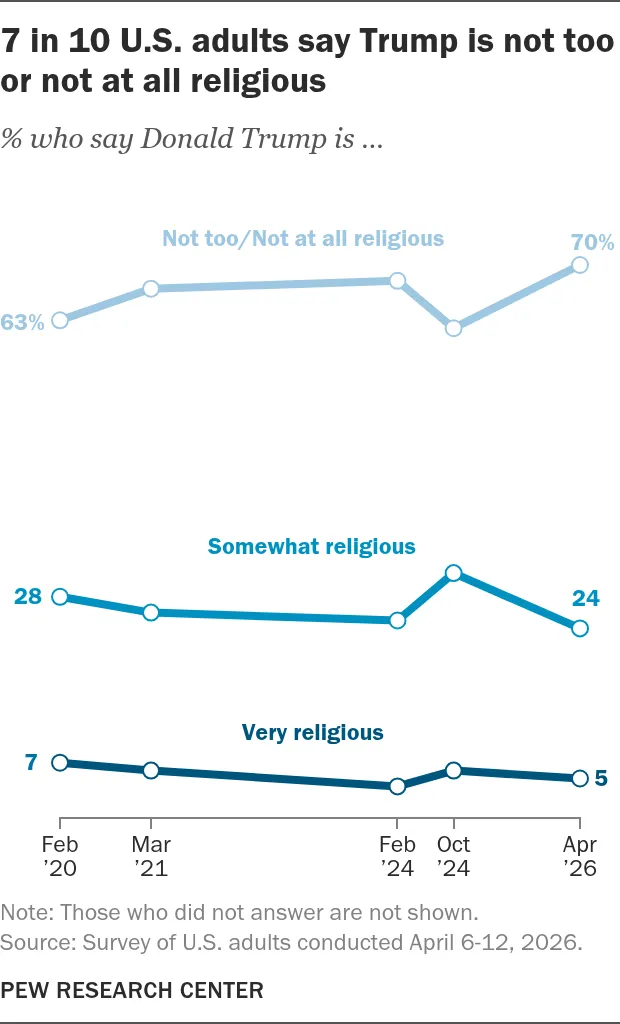
Friendly Atheist, Hemant Mehta, today: 70% of Americans say Trump isn’t religious. White evangelicals don’t care.
Subtitled: From “born again” claims to Bible photo-ops, the performance continues despite overwhelming skepticism.
70% of Americans say Donald Trump is not religious, according to new polling from the Pew Research Center. …
It raises two thoughts:
- That makes perfect sense. In no way is Trump virtuous or godly and it’s absurd for anyone to think he cares about a “higher power” when he already sees himself as God.
- How DARE anyone pretend he’s anything BUT a conservative Christian? He’s their problem, not ours. They OWN him. Everything he does is in the name of Jesus. You better BELIEVE he’s religious.
Somehow, both of those things are true.
With examples of conservative Christians who support Trump, despite everything. Photos of prayerful people around Trump in the Oval Office, and of Trump holding Bibles.
To a large extent, his Christian cosplaying has worked. In 2023, Republican voters said Donald Trump was more religious than Mitt Romney and Joe Biden. They just overlooked the fact that Trump was a thrice-married racist who paid hush money to porn stars he was having affairs with when his current wife was pregnant with his fifth child. That he was the Two Corinthians guy. That he said he doesn’t need forgiveness. That he couldn’t even name his favorite Bible verse.
My thought: this aligns with the idea of people being fooled by magic tricks — and by extension, charlatans bending spoons and whatnot. You can fool some of the people all the time.
And this is perhaps how religions survive. Perhaps this is a definition of the religiously devout.
\\
Here’s a long piece I noted yesterday but have not read through. I’ll read it as I post about it. OK, why are reactionaries taking over the world? I have my own ideas, but let’s see what David Brooks says.
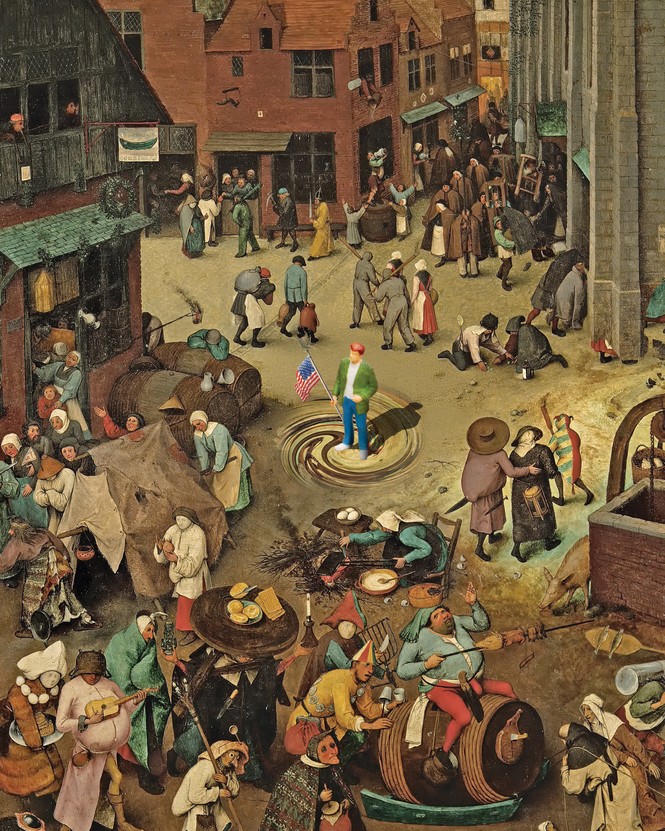
The Atlantic, David Brooks, yesterday: History Is Running Backwards, subtitled “Why reactionaries are taking over the world”
Maybe you’ve seen photos of Tehran in the 1970s, just before the Islamic Revolution: images of young women going to work in miniskirts, of couples making out in parks while wearing bell-bottoms, of people at pools in bikinis. It looks like Paris or Milan or Los Angeles. But in 1979 the revolution happened, and now Tehran looks like something from an earlier century.
Sometimes I think that our whole world has become kind of like that—going backwards in time. The religious movements thriving in today’s secularized age are the traditionalist ones that dissent from large parts of contemporary culture—not only the Shiite Islam of post-revolution Iran, but Orthodox Judaism and conservative Catholicism. Young Americans are flooding into Eastern Orthodox churches.
Many of us thought that the world would get more democratic as it modernized, but for the past quarter century, we have seen a reversion to authoritarian strongmen. Donald Trump, acting like some 16th-century European prince, has made the presidency his own personal fiefdom. Vladimir Putin borrows ideas from reactionary thinkers such as Aleksandr Dugin—an Eastern Orthodox, anti-liberal philosopher who rejects the Enlightenment—to justify his imperial conquest of Ukraine.
…
We used to have a clear idea of where modernity was heading—toward greater autonomy and equality, secularism, stronger individual rights, cultural openness, and liberal democracy. Progress was supposed to lead to the expansion of individual choice in sphere after sphere. Science and reason would prosper while superstition and conspiracy-mongering would wither away.
Turns out that was yesterday’s vision of the future. Billions of people around the world looked at where history was heading and yelled: Stop! They see that future as too spiritually empty, too lonely, too technological, too polluted, too confusing, too incoherent. Whatever their specific complaint, they are driven by a sense of loss, a desire to go back to a simpler, happier, and more sustainable time. Part of the brilliance of the phrase Make America Great Again is that it taps into that sense of nostalgia and loss.
Really long. About half-way through:
What do the traditionalists offer as a replacement for contemporary culture?
Answers: roots, enchantment, moral order, protection against the cultural depredations of modernity. And then:
My problem with the traditionalists is that I don’t agree with them about what a flourishing life looks like. Traditionalists strike me as the kind of people who would score extremely low on the personality trait called “openness to experience.” They focus overwhelmingly on the secure base and seem to have no interest in daring adventures. They seem to want to lead stationary lives.
That’s fine. Different strokes for different folks. But the traditionalists distort history when they write it as if all people have always wanted stationary lives and our goal as a society should be to make stationary lives the norm.
And so on. My short answer: humans are beholden to primitive human nature, i.e. the priorities of basic survival, which we’ve not yet outgrown, and may never outgrow.