
 Adair, Bill. 2024. Beyond the Big Lie: The Epidemic of Political Lying, Why Republicans Do It More, and How It Could Burn Down Our Democracy. Atria Books. ***
The founder of PolitiFact describes varieties of lies, a “Lying Hall of Fame” (from Big Tobacco to Donald Trump), and how people fall for lies (e.g. that the 2020 election was stolen), with running accounts of several victims. Of key interest is how Adair, though he’d dissembled about it for fear of seeming biased, admits that (of course) Republicans lie more than Democrats, and other fact checkers observe the same thing. He consults various officials and journalists to speculate why this is so. Republicans want to win at all costs, without caring deeply about issues; Democrats are too wonky, too concerned about getting things right, while Republicans rely on pithy sound bites; and (as I’ve speculated myself) because Republicans see themselves in an epic struggle for the soul of America, and so a little lying isn’t so bad. With examples, some my own. Further: conservatives predictably claim PolitiFact is biased, without providing any examples of Democratic howlers that it missed. Finally: how can we stop the lying? Clearly fact-checking doesn’t have much impact. So: Ask the politicians. Keep score. Invite them to pledge not to lie. Track misinformation as data. (post) (Read Dec 2024)
 Beauchamp, Zack. 2024. The Reactionary Spirit: How America’s Most Insidious Political Tradition Swept the World. PublicAffairs. ** 1/2
Has democracy been a nice experiment that’s become unsustainable? Beauchamp considers democracy to be an upending of traditional hierarchies; the reactionary spirit is anti-democratic, seeking to restore those tribal hierarchies. (This basic division echoes ideas of several other writers covered here: Lakoff, Greene, Urban, Richardson.) He meets a CPAC attendee who unapologetically calls for the return of segregation. He talks with Milo Yiannopoulos. He examines several countries in detail, including Hungary, Israel, and India. He discusses Nietzsche, who attacked both democracy and Christianity. But at the end, the author is optimistic. This book is fine as a description of current events, but lacks any depth to try to explain *why* these things are happening (much less explore the evolutionary basis for these different political attitudes). (post) (Read Dec 2024)
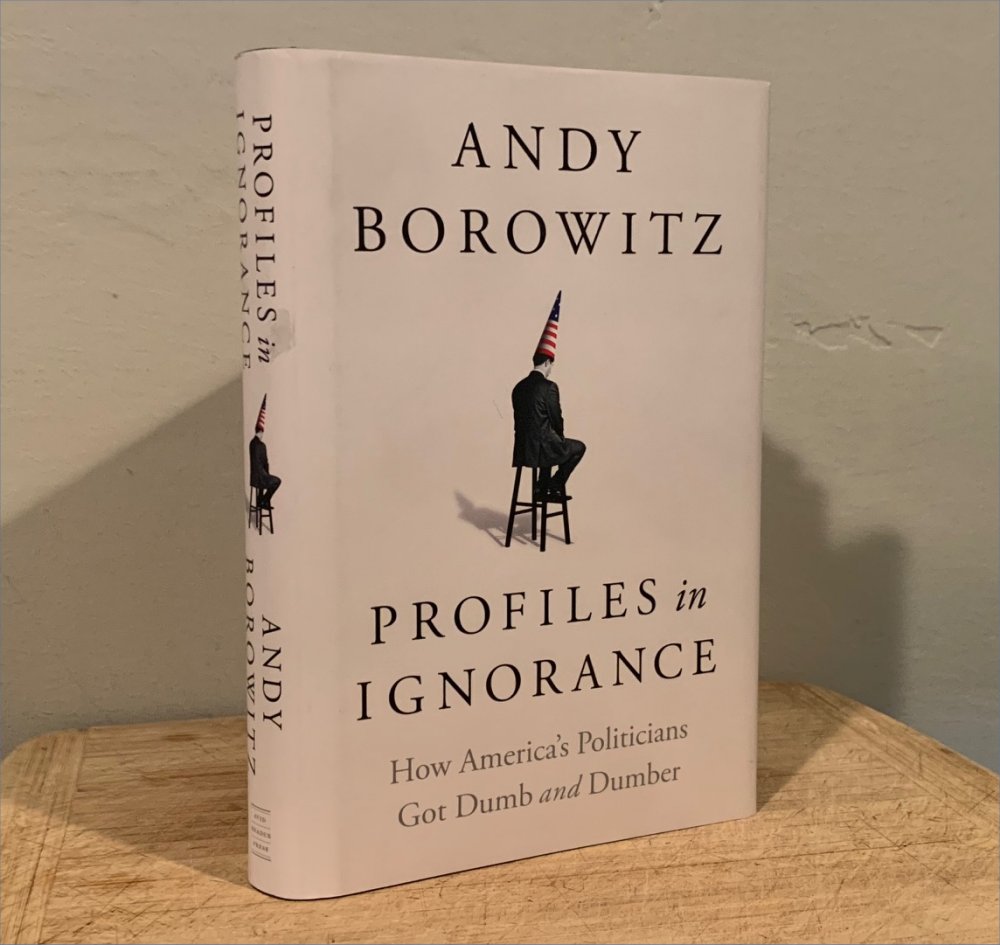 Borowitz, Andy. 2022. Profiles in Ignorance: How America’s Politicians Got Dumb and Dumber. Avid Reader Press. ** 1/2
Comedian and political observer Borowitz wonder why conservatives prefer dimwit candidates, and goes over the record of the past 40 some years. (And yes, Republicans have done far more dumb things than Democrats.) So: Reagan, Quayle; George H. Bush and Sarah Palin; Trump. Running themes are celebrity, wealth, legacy admissions, uninformed, unnuanced. Common man/dumbbell vs. intellectual/egghead. Solutions? Don’t treat politics like sports, get involved, tell better stories. (post) (Read Nov 2022)
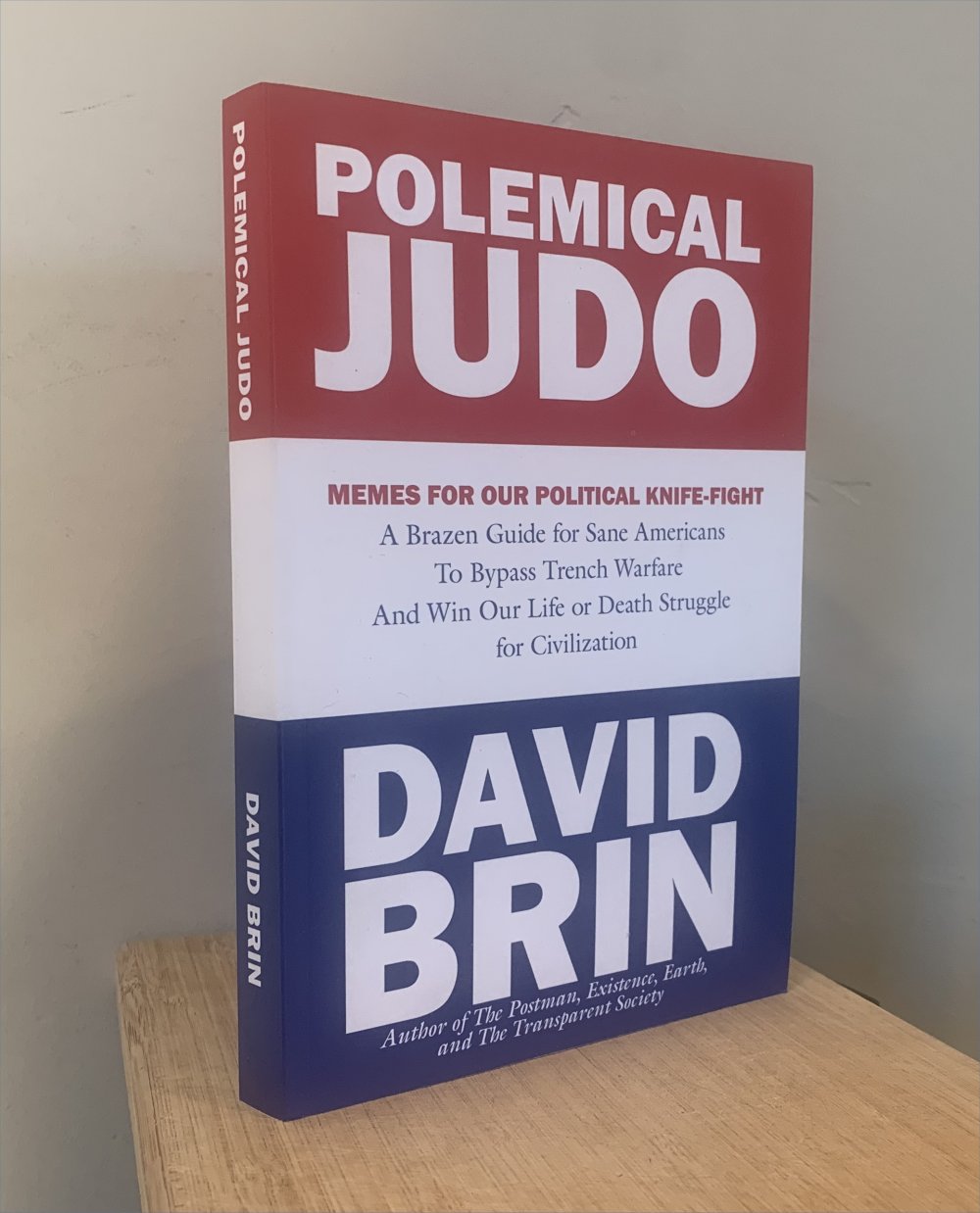 Brin, David. 2019. Political Judo: Memes for Our Political Knife-Fight. self-published. ***
A collection of essays and blog posts expressing Brin s rage and frustration about the current political situation. He berates Republicans (for being wrong about everything, for winning elections by cheating via gerrymandering and voter suppression) but also criticizes Democrats for being too timid in fighting them back. His big themes: the fact-based professions are under attack by the right (name one that s not, he challenges); that the way to solve political disputes is to make wagers based on verifiable facts and evaluated by non-partisan judges (e.g. retired military officers). He places current affairs in the context of America s 250-year-old Civil War between Enlightenment America and Confederate America. Yet he begins by emphasizing the commonalities that most Americans share, and hopes to get off the left-right political axes, determining policy issues based on outcomes and facts. (post) (Read May 2022)
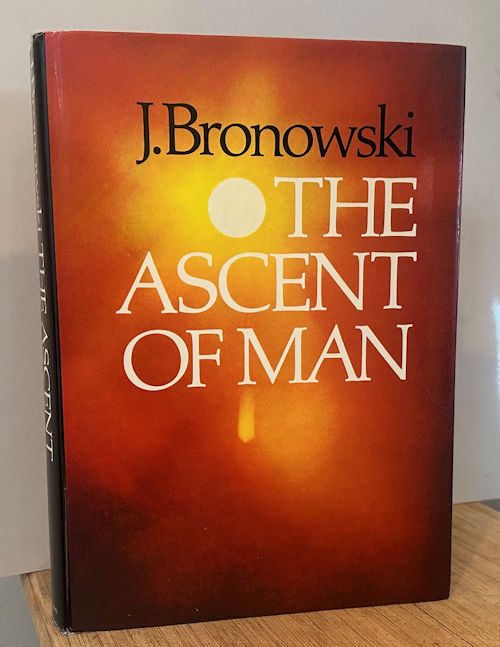 Bronowski, J.. 1973. The Ascent of Man. Little, Brown. *** 1/2
Like Carl Sagan’s COSMOS this book is a companion to a TV documentary series, one hosted by the author and shown on PBS in the early 1970s. It’s substantial and heavily-illustrated, covering everything from the evolution of “man” in Africa, through agriculture, structures built of rock, alchemy and minerals and atom, mathematics and early cosmological theories, astronomy and the church backlash against Galileo, Newton and Einstein and gravity and relativity, the Industrial Revolution’s factories and machines and canals, the discovery of evolution and that the world is not static, the discovery of the elements and the development of modern physics, concepts of uncertainty and how science is open to error and the possibility that we might be wrong, genetics and the discovering of DNA, and finally the modern understanding of man as both social and solitary, artistic and scientific, and how our modern culture must be aware of our origins and not be beholden to ancient morals or beliefs, lest some other culture take our place. The book’s flaw from a 2025 perspective is that some of the science, especially about human evolution, is out-of-date. Still, the final chapter is prescient both in its understanding of society and human nature (anticipating Wilson, Pinker, and others), and its concern that the modern US, by retreating from that understanding, may be handing the world to some other culture. (post) (Read May 2025)
 Diamond, Jared. 1997. Guns, Germs, and Steel: The Fates of Human Societies. Norton. ****
Notes forthcoming
- DK. 2016. Big History: Examines Our Past, Explains Our Present, Imagines Our Future. DK. –
Notes forthcoming
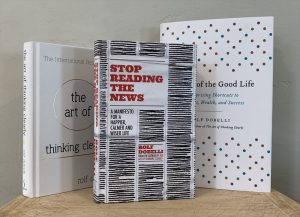 Dobelli, Rolf. 2020. Stop Reading the News: A Manifesto for a Happier, Calmer and Wiser Life. Sceptre. ** 1/2
A short, counter-intuitive book by a European author and entrepreneur who advises his readers to give up reading and watching the news, all of it: you won t be distracted by trivia, you ll have more time to yourself, you ll hear about major news events from your friends. At best, news is entertainment, he claims. He makes many good points but some of his recommendations are impractical for most people, e.g. cultivate fellow professionals with whom to have informative lunches. (post) (Read Mar 2022)
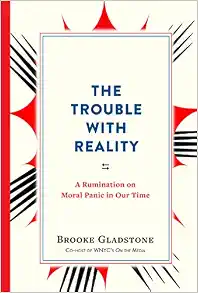 Gladstone, Brooke. 2017. The Trouble with Reality: A Rumination on Moral Panic in Our Time. Workman. ** 1/2
On the Media radio show co-host s short book is an essay with themes that overlaps Kakutani s, considering the existential question about reality and how we perceive it, and considering how Trump fits the criteria for a demagogue in trying to establish his own reality. Conclusion is that self-deception will undermine him, and that we all need to be aware the real world will catch up with whatever personal facts we possess. (post)
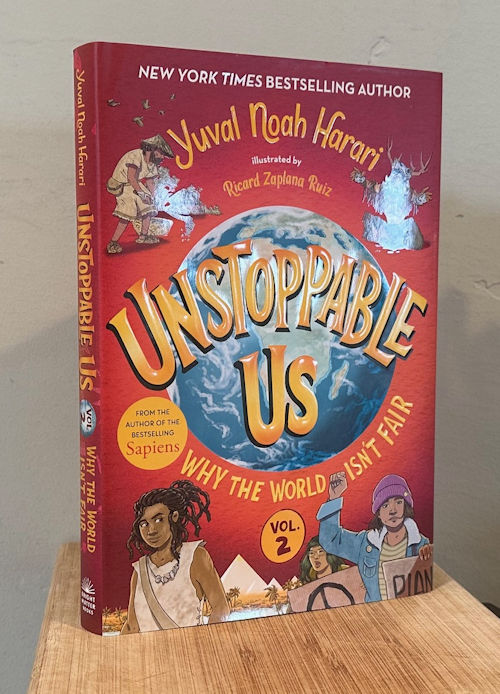 Harari, Yuval Noah. 2024. Unstoppable Us, Volume 2: Why the World Isn’t Fair. Bright Matter Books. *** 1/2
This second volume also has four chapters. First: the agricultural revolution, during which hunter-gatherers settled into villages and took control of other animals: goats, pigs, cows. The transition had problems: crops were subject to pests and droughts. Chiefs and priests explained how sacrifices were needed to appease the spirit gods, and if they didn’t work, you must have done something wrong. Second, how living as a farmer or herder is a lot more work than being a hunter/gatherer. As villages grew, diseases spread easily, people acquired more possessions, neighboring villages fought, and the peaceful became violent in order to survive. Farmers and gatherers learned to think differently. Third, larger communities led to more and more problems, including leaders to make decisions, taxes and assessors to determine them, punishments for non-payers, and slavery. This led to writing, and symbols for numbers, and eventually abstract works like poetry. The need to find documents that held this writing led to bureacracy, then schools, and exams. Fourth, how to get people to follow the rules. You invent stories. Priests tell stories about the gods who created the world and made its rules; follow the rules, heaven; disobey, you get eaten by a crocodile. Truth didn’t matter; believing in the stories and following the rules made society possible. In the world there are things we can sense, things only one person can feel, and things that are shared dreams. These last are harmful when they justify wars. But stories can change– e.g. about women, and gays. Part of growing up is learning which stories to keep, and which to change. Harari is remarkably blunt in describing things most historians take for granted, but which would offend true believers of all kinds. His take on changing stories synchs with how morality has evolved, as discussed by Pinker and Greene. (post) (Read Mar 2024)
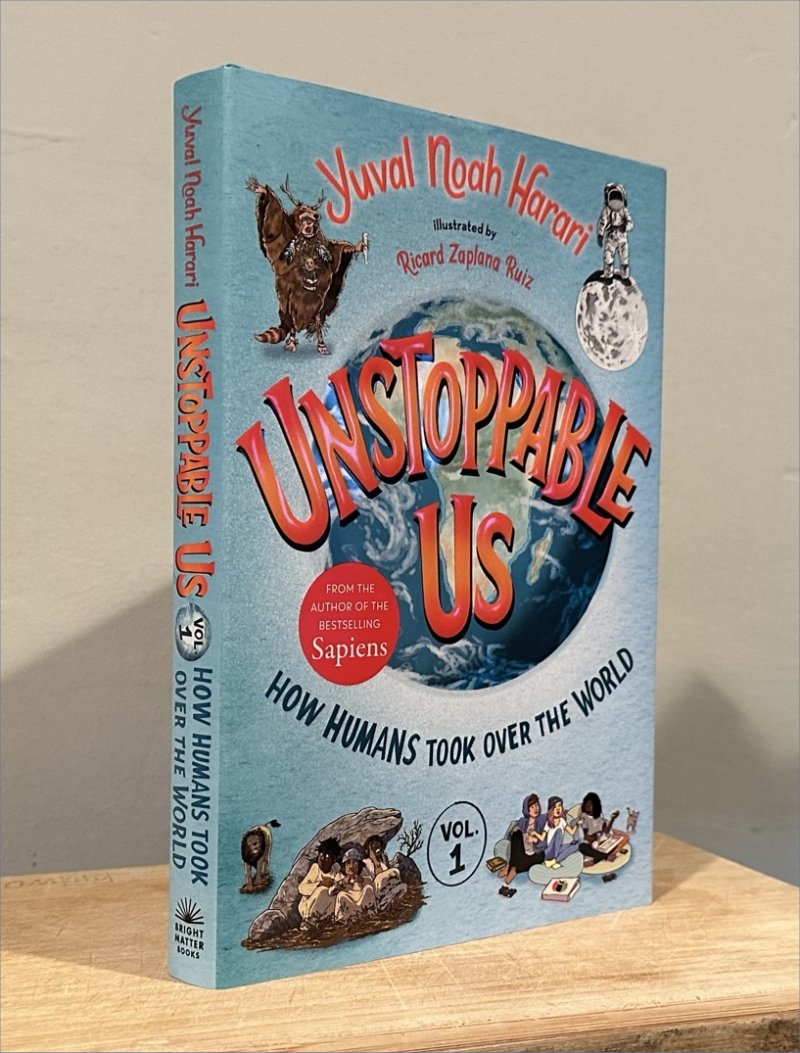 Harari, Yuval Noah. 2022. Unstoppable Us, Volume 1: How Humans Took Over the World. Bright Matter Books. ***
First volume of a series directed at younger readers, heavily illustrated, that parallels the ideas in the author’s SAPIENS. It’s as if he went from a 10,000-foot view of human history, to a 30,000-foot view. The result is in four chapters. First: Humans are animals, and there were once different kinds of humans, drifting apart by evolution and spreading around the globe, with only our own branch, Sapiens, still alive. Second: the superpower of Sapiens is to cooperate in very large numbers. One consequence was the ability to tell imaginary stories about spirits in the sky, and invent ideas about corporations, money, and religion, stories that enable society to work as long as everyone agrees to them. History advances as people realize some of these stories are nonsense and move past them. Third, we’ve deduced much about how our ancestors lived, but it was not that they made everything of stone or lived in caves. Tribes formed, grew, and split into smaller tribes; members were experts about their environment, were subject to accidents and diseases, and believed that trees and animals could talk, and in ghosts and spirits. Fourth, as human expanded across the planet over the past 50,000 years they have killed off all the big animals, especially in Australia and the Americas. Our ancestors didn’t know what they were doing; we do, yet elephants and whales could be next until we take responsibility for the future. (post)
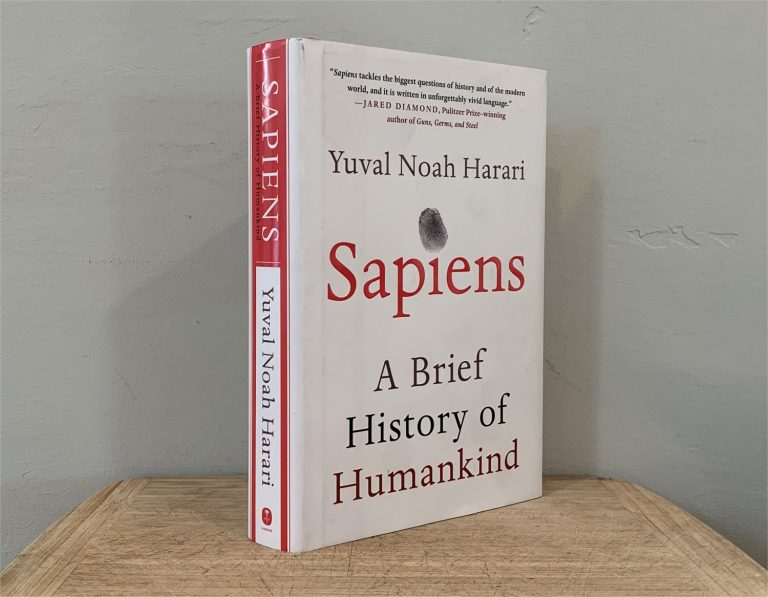 Harari, Yuval Noah. 2015. Sapiens: A Brief History of Humankind. Harper. *****
This is a history of humanity, with focus on the concepts that have allowed our species to grow and occupy the planet; it s a history of ideas, not of names and dates. The ideas include the cognitive revolution, 70,000 years ago; the agricultural revolution, 12,000 years ago; and the scientific revolution, 500 years ago. Harari is fond of trios, and his perspectives challenges conventional wisdom; e.g. he considers religion, nationalism, and laws as examples of common myths, or imagined realities , that have enabled human society to grow, though these ideas have no physical basis in the real world. Another trio: money, empire, and religion. I find his takes problematic at times, e.g. considering humanist philosophies (secular humanism, et. al.) simply other kinds of religions that worship humanity and not gods. Most striking is his conclusion is that humanity as we know it is about to end. (post)
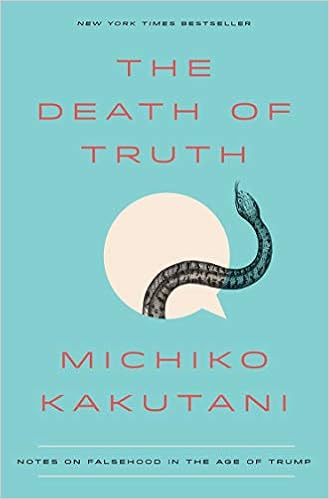 Kakutani, Michiko. 2018. The Death of Truth: Notes on Falsehood in the Age of Trump. Tim Duggan Books. ***
Long-time NYT book reviewer (now retired) explores how we got to the age of Trump (with only glancing suggestions about how to recover). It s partly that American anti-intellectualism, the right-wing media propaganda machine, and the internet in general but also the cultural relativism and post-modernist attitudes from the left in the 1960s that have now been co-opted by the right. (With chapter epigraphs by PKD, Gibson, and Heinlein, among others.) (post)
 Klein, Ezra. 2020. Why We’re Polarized. S&S/Avid Reader Press. *** 1/2
An examination of the political divide in the US. Broad conclusions: America s legacy of slavery and racism; the pace of change with non-white immigrants; obsolete aspects of our political systems; and of course modern social media. (post)
- Lepore, Jill. 2019. This America: The Case for the Nation. Liveright. –
Notes forthcoming
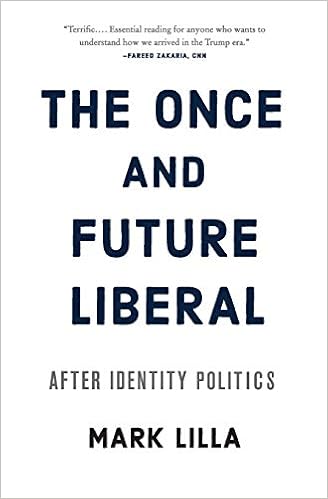 Lilla, Mark. 2017. The Once and Future Liberal: After Identity Politics. Harper. ** 1/2
Lilla s theme, being echoed currently by Francis Fukuyama and David Brooks and others, is that the liberal project is being undermined by identity politics, and how liberals need a new orientation into shared values that can attract voters. He advises focusing on winning elections, citizenship over personal identity, and civic education. (post)
 Lukianoff, Greg, & Haidt, Jonathan. 2018. The Coddling of the American Mind: How Good Intentions and Bad Ideas are Setting Up a Generation for Failure. Penguin. ****
The authors think Americans, students in particular, are over-protected, via commitment to three Great Untruths: What doesn’t kill you makes you weaker; Always trust your feelings; Life is a battle between good people and evil people. The second and third are familiar conservative attitudes, while the first is problem both on the left and the right. That first untruth involves the rise of “safetyism” that led to peanut allergies. The second contradicts much ancient wisdom, and is corrected by critical thinking. And the third is a core aspect of ancient tribal mentality, and is precisely the kind of thing university education should overcome. The book then examines how these ideas have played out (campus protests, etc.), how we got here: polarization; anxiety and depression triggered by social meda and the iPhone; and paranoid parenting, resulting in the decline of play and a beaurcracy of safetysim. Recommendation for creating wider kids include preparing the child for the road (not vice versa), practice intellectual humility, along with ideas to improve universities, and societies. (Have things improved? Not with issues of the demonization of transgenders, and the entire MAGA movement.) (post)
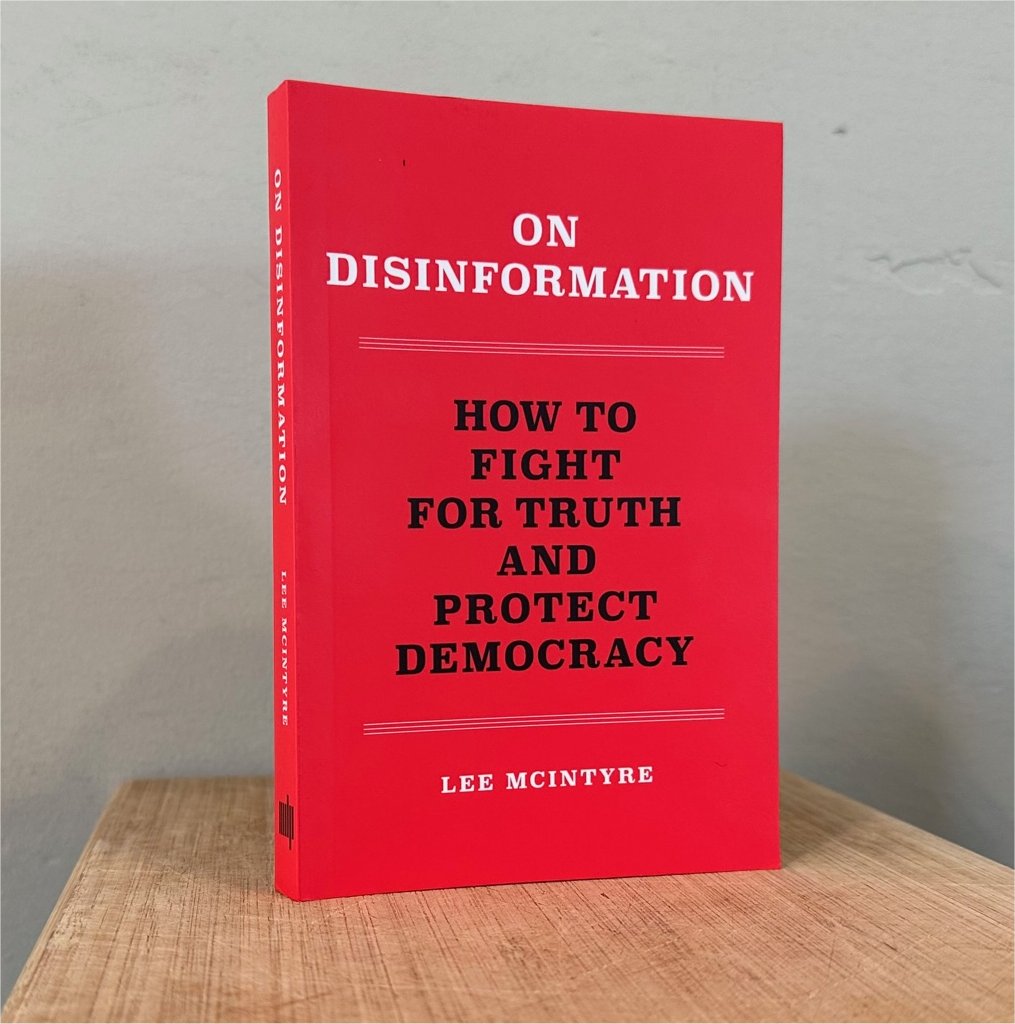 McIntyre, Lee. 2023. On Disinformation: How to Fight for Truth and Protect Democracy. MIT. ***
When people talk about misinformation they usually mean disinformation — lies that are spread deliberately to create armies of deniers, or for the liars’ own ends (money or political power). (That is, I comment, some promulgators of conspiracy theories may be sincere, but many are not.) McIntyre focuses on examples of tobacco, evolution, global warming, and vaccines. The strategy of disinformation creators: cherry-pick evidence; believe in conspiracy theories; engage in illogical reasoning; rely on fake experts and denigrate real ones; and have impossible expectations for what the other side must achieve. Then come the amplifiers: social media, and Fox News. And believers come from cognitive biases that allow people to believe things unsupported by evidence, more concerned about values, community, and feelings. How to fight back? Not so much about facts or education, but about exposing and naming the truth killers, revealing their tactics and financial ties. Author reflects that there are always those who fight against truth; the battle against them must be fought in every age. (post)
 Nichols, Tom. 2021. Our Own Worst Enemy: The Assault from Within on Modern Democracy. Oxford. *** 1/2
Nichols’ counter-intuitive thesis is that, despite what “everybody says,” these are not the worst times ever, rather in many ways we’ve never had it so good. So what’s the problem? We’re losing because we won; despite our success people *feel* miserable because they give in to their base instincts. [[ I would characterize this as human nature refined in an ancestral environment that is ill-at-ease in the modern one. ]] He explores these ideas along three lines: peace, affluence, and technological progress. He contrasts a small Italian village in which everyone mistrusts one another with the civil responsibilities required by those in a democracy. Americans have become overgrown children, angry at things they don’t understand and bad at assessing risk. Many see flaws in the system as something that justifies throwing the entire system out. Globalization has not ruined everything; that feeling arises from short memories, from rising expectations, immediate gratification, and little accountability. And our hyper-connected world allows crackpot ideas to spread, undermining the patience and perspective that liberal democracy required. Recommendations: people should become better citizens, e.g. read a reputable newspaper and turn off social media. Beware the reassurance of the pack and the safety of the herd; grapple with the ambiguities and consequences of freedom. He finishes by contemplating three nightmare scenarios and worries most about one in which insiders take control of the government because voters can’t produce coherent demands, life will go on, and people won’t care that elections are meaningless. (post) (Read Feb 2025)
 Nichols, Tom. 2017. The Death of Expertise: The Campaign Against Established Knowledge and Why it Matters. Oxford. *** 1/2
Nichols examines the peculiarly American strain of anti-intellectualism, noted by everyone from de Tocqueville to Asimov, that resents expertise and is proud of its ignorance, and how it s gotten much worse in the age of the internet (with its founts of conspiracy theories and misinformation), the expansion of college attendance, the right-wing spin machine, and the confusion of experts with celebrities; culminating in Trump, who thinks he alone knows everything. All of this is a threat to democracy, and author s conclusion isn t optimistic. (post)
 Pinker, Steven. 2011. The Better Angels of Our Nature: Why Violence Has Declined. Viking. *****
An expansive book that, in detailing how violence has greatly declined over millennia and especially in recent centuries and decades, tells the history of the human race, and how forces we would now call progressive have led to the improvement of the human condition. The book covers big trends of history (transition to agriculture, the age of reason and the enlightenment, etc.), our five inner demons (violence, dominance, revenge, sadism, ideology), our four better angels (empathy, self-control, moral sense, and reason), and five historical forces (Leviathan; commerce; feminization; cosmopolitanism; and the escalator of reason) that have brought about the modern world. The post link below links several initial posts, most of them with summaries of individual chapters and lengthy detailed notes. A magesterial book, one of the best books ever for understanding the modern human condition and how humanity has gotten here. (post) (Read Aug 2018)
 Prothero, Stephen. 2016. Why Liberals Win the Culture Wars (Even When They Lose Elections): The Battles That Define America from Jefferson s Heresies to Gay Marriage. HarperOne. ***
Cultural wars in America are not new; they go back to Thomas Jefferson. The author’s thesis is 1) that conservatives start cultural wars, as inevitable societal change gradually passes them by; and 2) liberals win those wars as once-controversial topics (women’s suffrage, gay marriage) become cultural norms. Conservatives then find something else to complain about [as in 2024, transgender people]. I read just the introduction, which describes this culture wars cycle; the chapter on contemporary culture wars, essentially a history of social controversies since the 1960s, exacerbated by Reagan, Falwell, et al; and the conclusion, that despite a few isolated victories, conservatives lost the culture wars badly. Yet there will always be disagreements; there will always be gays and bigots. The deep unstated premise: there will always be change, and conservatives will always be uncomfortable with it. (Now in 2024, will Trump’s new regime change this conclusion? Trump may wreck swaths of the US government, but ultimately he will fail to change the culture.) (post) (Read Aug 2024)
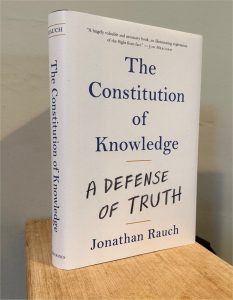 Rauch, Jonathan. 2021. The Constitution of Knowledge: A Defense of Truth. Brookings Institition. *****
Rauch reacts against the epistemic crisis formed by disinformation and conservative politics that has resulted in the public’s incapacity to tell truth from lie. The solution is to defend the set of rules and norms that have arisen over the past century to create our functioning society. This “constitution” has two essential principles: “no final say” and “no personal authority.” Adhering to these rules creates “a community of error-seeking inquirers accountable to each other but never to any particular authority, and knowledge will arise from their hive-like, largely self-organizing activities” — quite analagous to science. Rauch reviews why reason arose at all, given our psychogical biases, and how those biases were reigned in by the Industrial Revolution, and American revolution, and finally the scientific revolution, which introduced methods for making errors and finding them quickly. More formally, he characterizes the “reality-based community” as guided by a fallibist rule, and an empirical rule, that have become inherent in the “mainstream media” in contrast to the “yellow journalism” of the 19th century and now Fox News. The balance of the book recounts the history of how this “constitution” came about. Summary: “the Constitution of Knowledge is the most successful social design in human history, but also the most counter-intuitive. In exchange for knowledge, freedom, and peace, it asks us to mistrust our senses and our tribes, question our sacred beliefs, and relinquish the comforts of certitude. It insists that we embrace our fallibility, subject ourselves to criticism, tolerate the reprehensible, and outsource reality to a global network of strangers.” (Post 1; Post 2; plus this post showing pages of the book that detail how this reality-based community works, which happens to correspond the “deep state” conservatives unthinkingly want to dismantle.
 Reich, Robert. 2018. The Common Good. Knopf. *** 1/2
A short book that lies at the intersection of politics, morality, and human nature, by the UC Berkeley economist. The “common good” is the set of shared values of a society, it’s not about socialism or political parties, and it’s a sense that’s been lost in recent years. How do we get it back? It was the basis for “we the people,” FDR’s four freedoms, civil rights, and public education. It’s the opposite of Martin Shkreli and Ayn Rand. (Reich however does not explore the deep evolutionary reasons why the common good came to exist, as other writers do.) Breakdowns in the shared understanding of a common good began in the 1960s, from Watergate to Iran-Contra to Newt Gingrich to Bernie Madoff and the financial crisis of 2008. Three broad structural breakdowns: whatever-it-takes-to-win politics; whatever-it-takes-to-maximize-profits; and whatever-it-takes-to-rig-the-economy. (Reich diplomatically does not mention that it’s Republicans and conservatives who do most of these things.) How to restore the common good? Bring back a sense of honor and shame. Hold people accountable. Identify and share the truth, rather than spreading lies and fake news. And revive civic education. And critical thinking, how to be skeptical but not cynical. Realize there are more good things happening in the world every day that we simply don’t hear about. (post) (Read Jun 2024)
- Reich, Robert B.. 2017. Economics in Wonderland: Robert Reich’s Cartoon Guide To A Political World Gone Mad And Mean. Fantagraphics. –
Notes forthcoming
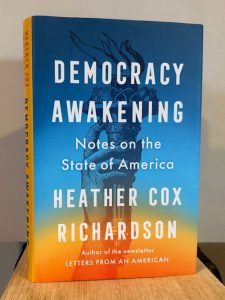 Richardson, Heather Cox. 2023. Democracy Awakening: Notes on the State of America. Viking. ****
Historian Richardson, now best known for her daily news commentaries at Letters from an American, looks back over the past century of American history to explain how we got to the point where someone like Trump could be elected president. Her style is straightforward and equanimous, matter-of-fact without being overly partisan, and she’s good at boiling down long histories and complex ideas into bite-sized chunks. Thus her definition of fascism: the idea that some people are better than others, and deserve to rule. A key historical thread is what she called the “liberal consensus” that emerged after World War II among both Democrats and Republicans: the idea that government was to regulate business, provide a basic social safety net, and invest in infrastructure. The first part of book is about conservative opposition to this, especially among racists in the south; the Ku Klux Klan; the glorification of the American cowboy; and intellectuals like William F. Buckley rejecting Enlightenment principles in favor of his religion. The second part is about the ascendance of Trump up to the “Big Lie” that the 2020 election was stolen from him. And the third part reviews principles of the Enlightenment, the founding of America, and considers what we can do to reclaim America from the authoritarians and autocrats. America is not based on land or religion or race, she emphasized, but on the concept of human equality. (post 1; post 2; post 3.) (Read Aug 2024)
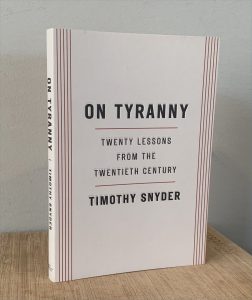 Snyder, Timothy. 2017. On Tyranny: Twenty Lessons from the Twentieth Century. Tim Duggan Books. *** 1/2
Prominent historian Snyder responds to the election of Donald Trump, in a small paperback of 20 chapters each 3 or 4 pages long, about the warning signs of rising fascism and how to avoid it. Some key points: do not mindlessly submit to an increasingly repressive government. Defend institutions; beware the one-party state. Observe professional ethics. Be wary of paramilitaries. Avoid cliches used by politicians (my people; struggles; treason; enemy of the people; fake news) and avoid the internet. Believe in truth; subscribe to print media (don t get your news for free); read books; realize that some of what is on the internet is there to harm you. Be a good citizen; mind your private life; contribute to good causes. Be a patriot (as opposed to dodging the draft, not paying taxes, and the many other things Trump has done). If the unthinkable arrives, be calm even as authoritarians end checks and balances, dissolve opposition parties, and so on. Be courageous. Finally: we thought when communism failed, we had won; but that didn t mean our story was true. Beware longing for the past, and MAGA. Think about the future, debate possible solutions to real problems. (post) (Read Jan 2022)
 Wright, Robert. 2000. Nonzero: The Logic of Human Destiny. Pantheon. ***
Progress exists in human history because history is not a zero-sum game (i.e. for one side to win the other doesn t have to lose ; both can win). Author wonders therefore, is there some point to human history? The author flirts with the idea that our species has a purpose which we may be designed to realize. Haven t finished this, but I m skeptical of his teleology; in fact, complexity can emerge from simplicity given basic rules of natural processes. It doesn t take a designer. Still, I see this work referenced by later writers even 20 years later, so many must find its basic point valid. (Intro and Chapter 1)
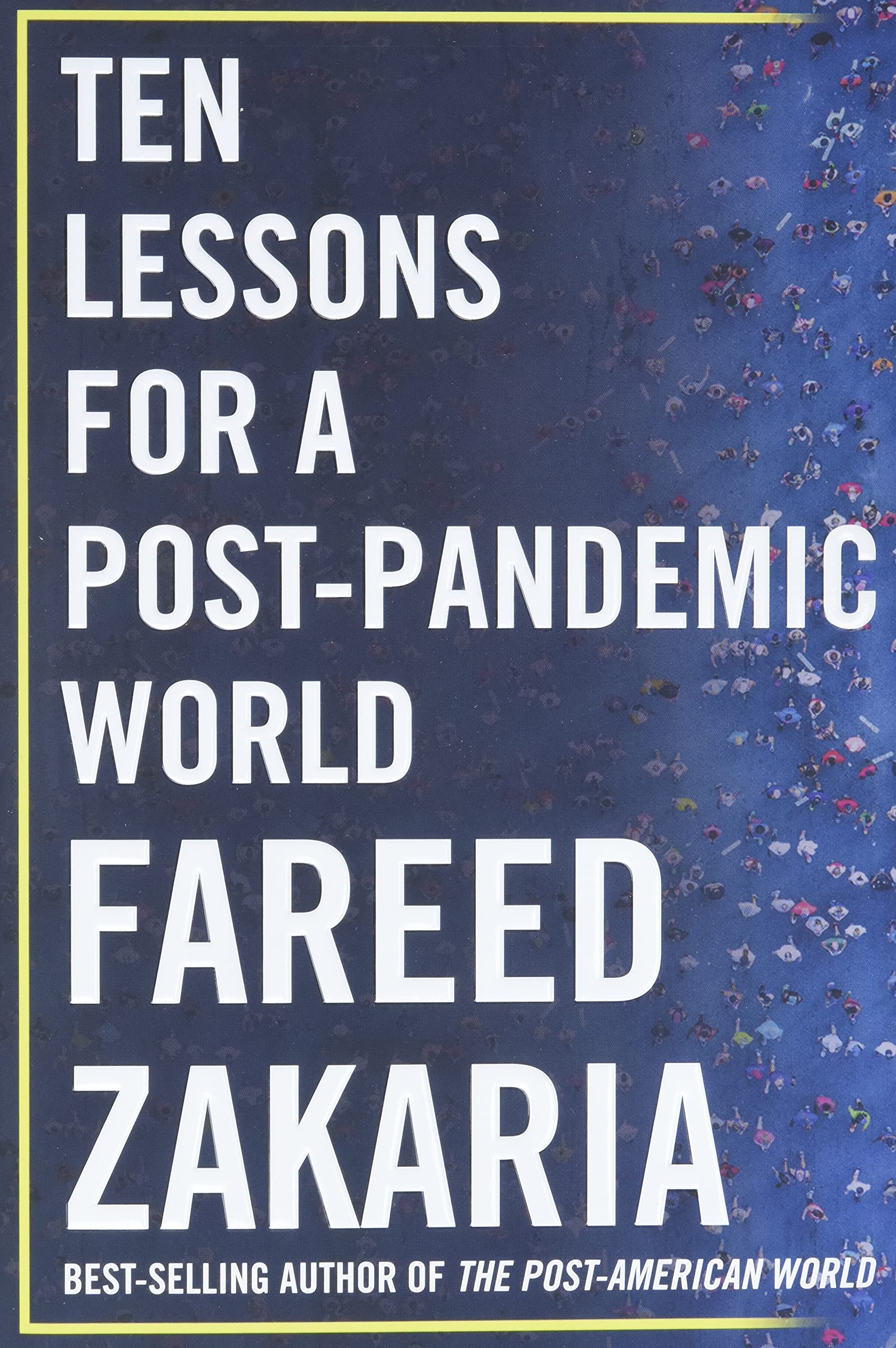 Zakaria, Fareed. 2020. Ten Lessons for a Post-Pandemic World. Norton. *** 1/2
The CNN correspondent, with a seemingly iron grasp of 20th century history, discusses what he sees as the effects of the pandemic that it will accelerate existing trends. 1) The world is resilient and is not doomed, but needs global coordination; 2) The US government is no longer a country to emulate, but needs to learn from other countries; 3) Markets are powerful but not sufficient, needing regulations, tax policies, government investment, education; 4) We can t govern by gut and celebration of ignorance; we need more experts, even as they should connect with people and mind their needs; 5) The digital economy will not save us, but it will refocus our lives; 6) Cities will not die; we are social animals, and cities are more productive and healthier than rural areas; 7) Inequality will get worse, and will increasingly disadvantage the poor, who rightly think the system is rigged against them; 8) Globalization is not dead, and can t be stopped; bringing manufacturing back locally would be too expensive; 9) The world is becoming bipolar, between the US (despite all its problems) and China; 10) As Trump and other leaders turn selfishly inward, the liberal international order remains idealistic: avoid war, and become intertwined economically, and everyone will lead longer, richer, and more secure lives. Finally: Nothing is written. Problems remain. We can address them, or ignore them. (post) (Read 2020; Jan 2022)





