Links and Comments: The Coup Attempt; Human Nature; Republican Fantasies

It’s hard to know where to start given events of the past few days. The general consensus among the pundits and sites that I read is that we knew this was coming all along, that this particular event (the seditious coup attempt, by hooligans and morons, on the nation’s Capitol) was easily foreseen, given chatter on right-wing websites, and that DC police should have been better prepared. (And why weren’t they?, is increasingly being asked. Why did some of those police seem to let the hooligans through?) And that Trump is the authoritarian, without concern for country or anything besides himself, that we saw him to be when he first announced he was running for office.

Let’s look at just a few headlines.

Vox: Republicans own this, subtitled, The Capitol Hill mob was the logical culmination of years of mainstream Republican politics.

Salon: The dangerous mind of Donald Trump has been exposed.

Washington Post: Trump’s evangelicals were complicit in the desecration of our democracy.

Examples of the last item at Slate: “God Have Mercy on and Help Us All”, subtitle: How prominent evangelicals reacted to the storming of the U.S. Capitol. With some of them simply denying what was plain to everyone else: that the seditionists were Trump supporters. No, some of them, say, they were “antifa” in disguise. They live in a fantasy alternate reality.

And this, which appeals to my sense that what is playing out is an expression of human traits that will always be with us. Democracy is an attempt to quell such tendencies, and in all of history, it hasn’t lasted for long.

NYT: Stop Pretending ‘This Is Not Who We Are’, subtitled, Electoral violence is in our DNA. The very paintings in the Rotunda of the Capital depict episode of violence as we saw this week.

This is an example of the No True Scotsman fallacy: “This is not who we are”; yes it is. And recognizing this truth, alas, undermines most of science fiction’s visions of techno-socialist utopias, from Arthur C. Clarke’s to Star Trek TOS’s.

\\

It’s not just Trump; it’s the entire conservative Republican establishment, which appeals to the paranoid and ignorant.

NPR: 1 In 4 Americans Thinks The Sun Goes Around The Earth, Survey Says (Oops, this is from 2014 (I saved the link from Fb), but there’s no reason why this would have changed.)

CBS News: 50 years of tax cuts for the rich failed to trickle down, economics study says. Cutting taxes for the wealthy is an article of faith for Republicans, and one of the few things Trump accomplished was passing a tax cut for the wealthy. But conservatives are apparently immune to evidence. Paul Krugman has discussed this topic endlessly, and characterized these kind of argument in his latest book called Arguing with Zombies.

Posted in Lunacy, Politics, Psychology | Comments Off on Links and Comments: The Coup Attempt; Human Nature; Republican Fantasies

Links and Comments: The Good Old Days; Accusations of Moral Decline

Wall Street Journal (via a ‘sponsored’ post in my Fb feed!): Why We Can’t Stop Longing for the Good Old Days, subtitled, “Neurology and nostalgia help explain why people have always worried that the world is going downhill.”

It’s an excerpt from a book by Johan Norberg called Open: The Story of Human Progress. His first point is something I had never heard of before.

Building ruins from scratch was the height of fashion for European aristocrats at the time, using shattered castles and crumbling abbeys to create an imaginary, romantic past. Hagley Park is a selective, artificial version of history—just like the politics of nostalgia that is so popular today.

People in many countries are longing for the good old days. When asked if life in their country is better or worse today than 50 years ago, 31% of Britons, 41% of Americans and 46% of the French say it’s worse.

Psychologists say that this kind of nostalgia is natural and sometimes even useful: Anchoring our identity in the past helps give us a sense of stability and predictability. For individuals, nostalgia is especially common when we experience rapid transitions like puberty, retirement or moving to a new country. Similarly, collective nostalgia—a longing for the good old days when life was simpler and people behaved better—can also be a source of communal strength in difficult times.

This is of course the narrative of what conservatism is about (cf. Haidt) — a longing to restore a golden age past (which didn’t actually exist).

The article goes on. Many think the 1950s was when America was last great. They didn’t think so in the ‘50s; then they thought it was the 1920s that were great. But no: in the ‘20s it was the Victorian era that was great. And so on.

People have been longing for the good old days at least since the invention of writing in ancient Mesopotamia, 5,000 years ago. Archaeologists have discovered Sumerian cuneiform tablets which complain that family life isn’t what it used to be. One tablet frets about “the son who spoke hatefully to his mother, the younger brother who defied his older brother, who talked back to the father.”

This psychological truth is partly about selective memory, a kind of biased thinking related to superstitions: we remember the hits and disregard the misses. We remember the nice things about the past, and forget or disregard and bad things (especially if those bad things affected others). More to the point, this is something that can be learned and understood. The entire MAGA movement is misguided on this ground, not to mention others. Can this be learned and understood? Not by most.

\\

Closely aligned with this idea is the constant fretting by religious leaders that the country is in a “moral decline.” And think that said moral decline is the cause of various disasters and calamities, or any trend these leaders disapprove of. And religious leaders who claim this tend to presume that only *his* version of God, or the savior, whatever, can possibly save America.

It’s superstition, presumption, and arrogance of the highest order. (And a failure of imagination.)

Patheos: Franklin Graham: We Will Have a “Dark Winter” Due to Immorality, Not COVID.

Nonsense, on several grounds.

Posted in Politics, Psychology | Comments Off on Links and Comments: The Good Old Days; Accusations of Moral Decline

Projects Status and Prospects

From Facebook, on Thursday 31 Dec 2020:

After years of compiling data, refining scoring schemes, and experimenting with very wide html pages, I’ve begun filling the last two menu tabs at sfadb.com — the one for Rankings (so far just the Short Stories page) and the one for Timeline. There’s also a page for the Scoring Methodology, linked from those. There will eventually be pages for four other categories (novelettes, novellas, SF novels, and F/H novels). In trying to make the rankings pages more interesting that numbered lists of titles, I’ve added cover images and annotations that are like miniatures of the essays I was doing for Black Gate earlier this year, except here I’m trying to avoid spoilers. Only 20 are written so far; more will be added.

http://www.sfadb.com/TopShortStories

http://www.sfadb.com/Timeline

I wrote three drafts of this because this update is significant but I didn’t want to oversell it or sound like I was promoting myself excessively. But in truth, this is something of a milestone. It’s the first part of a project I’ve been contemplating for fully 20 years.

I even remember — or remember remembering — the occasion when I conceived of the project. I was jogging around the indoor running track at the North Hollywood Bally’s (formerly Holiday Spa). I was just getting my awards database posted, and reflected on how simple tallies of how many awards this story or that novel had won or been nominated for were very poor guides to overall quality, mainly because the number of awards had been growing from year to year, and many of the “classic” works of SF dated from decades before there were *any* awards.

There were two further influences. Locus, or rather Bill Contento, a friend of Charles Brown’s, had compiled annual indexes of books and anthologies and their contents for over a decade, and had combined them all into a single index that he sold on CD ROM. There he had a tally of the most reprinted stories, with IIRC something by Harlan Ellison leading the list. Second, somewhere in the mid 1990s, even at the dawning of the internet age, some guy (his name was Aurel Guillemette, who so far as I know has never published anything before or since) had published a hardcover book called The Best in Science Fiction: Winners and Nominees of the Major Awards in Science Fiction, which title, it seemed to me, begged the issue I just described: it assumed tallies of awards were guides to the “best.”

So as I set up an online index to SF awards, I thought, I can improve on that idea by combining awards with anthology reprints (and later “citations” from expert books and all-time polls), that with appropriate weighting, could identify the best, or “most significant” is probably a more accurate descriptor, novels and stories of all times.

And it’s taken me 20 years to finish. Only near the end did I decide to write glosses on the top ranking stories, and include cover images, and so finishing the rest of the lists will take a few more weeks, perhaps two or three months. But the ranking scheme, and the rankings, are done. And soon I will be rereading all the top ranked novelettes to write glosses on the top ranking of those.

The irony is… gathering so much data, tweaking the scoring algorithm over the years, hasn’t substantially changed the results of simple tallies of reprints, or even of awards within a limited range. Guillemette’s results put “Bears Discover Fire” at the top; so do mine. Contento’s ranking put Harlan Ellison at the top; his story is very near the top of mine. And my highest ranking novels are familiar to anyone who has seen similar rankings, by whatever methods.

But I think my Timeline is really cool, and no one has done anything like it before.

\\

Meanwhile. The hospital stay and recovery both interrupted my progress on that and other projects, but then spurred me to apply myself to finishing arguably the most important one.

I think sfadb.com, with its pages of awards listings and indexes by author, will be my legacy, as long as I leave behind instructions for its maintenance. Everyone will forget my role in Locus Online. Reviews in Locus or at Black Gate are fleeting. My notion for a book would at best draw interest for a season, then be forgotten, or at worst never sell or be noticed at all.

In the middle is my personal project of writing family history and memoirs. I made a lot of progress in 2020, in part due to the pandemic shut-in. I think I’d finished perhaps 80%. I have a couple more memoir essays to write, and more family photos to post.

My current plan is to take a break of just a couple weeks from reading for the sfadb rankings, to polish and finish the family history and memoir posts. I started that today. (And I’ve written a 6000 word memoir post about my heart attack and hospital stay, first posted back on November 24th.)

Then I return to finishing the sfadb rankings and annotations, which I would think won’t take more than a couple months.

And then… I will return to reading of general nonfiction. Reading of classic SF novels. I’ll consider resuming some kind of reviews for Black Gate. I’ll start writing more drafts for what might be my book.

And hope that I stay alive long enough to finish all these projects.

Posted in Personal history | Comments Off on Projects Status and Prospects

Links and Comments: The Game of Life; Authoritarianism; Conservatives and the Feudal System

NYT, from last week’s Tuesday Science section: The Lasting Lessons of John Conway’s Game of Life. (Print title: “Life, In All Its Glory” with subtitle “Fifty year on, a game still offers lessons about simplicity, complexity and uncertain.”)

The article marks the passing of mathematician John Conway, who famously developed the “game of life” way back in 1970. I’ve heard about it for years, and consider it exhibit A in any matter in which someone claims, for example, I can’t imagine how the eye could have evolved on its own, therefore God.

The game of life shows how very simple iterative rules can quickly give rise to impressively complex results… results that give the impression of being… designed.

The game is played on a grid on which squares can be black or white. I’ll just copy from this NYT article:

The game was simple: Place any configuration of cells on a grid, then watch what transpires according to three rules that dictate how the system plays out.

Birth rule: An empty, or “dead,” cell with precisely three “live” neighbors (full cells) becomes live.

Death rule: A live cell with zero or one neighbors dies of isolation; a live cell with four or more neighbors dies of overcrowding.

Survival rule: A live cell with two or three neighbors remains alive.

With each iteration, some cells live, some die and “Life-forms” evolve, one generation to the next.

Starting with simple configurations one can quickly develop patterns that seem to move, intact, across the screen, or playing board, patterns that give the impression of life, of birth and death. And that’s just from three rules.

The article has testimonials about the game’s impact the implications from Brian Eno, Daniel Dennett, Rudy Rucker, Stephen Wolfram, and others.

(And of course this theme is explored in detail in a couple of Richard Dawkins’ books, The Blind Watchmaker and Climbing Mount Improbable.)

\\\

Not coincidentally, this New Yorker article, Three Mathematicians We Lost in 2020, has more about Conway (and about Ronald Graham and Freeman Dyson).

\\\

In the current New Yorker (the Jan 4 & 11 issue) the lead “Talk of the Town” piece, is “Fault Lines” by Alan Gopnik. A Google search turns it up as What We Get Wrong About America’s Crisis of Democracy, subtitled “The interesting question is not what causes authoritarianism but what has ever suspended it.”

The gist of his essay is that American’s current slide towards authoritarianism isn’t an exceptional circumstance that needs to be explained. It’s democracy that’s the exceptional circumstance.

Lurking behind all of this is a faulty premise—that the descent into authoritarianism is what needs to be explained, when the reality is that . . . it always happens. The default condition of humankind is not to thrive in broadly egalitarian and stable democratic arrangements that get unsettled only when something happens to unsettle them. The default condition of humankind, traced across thousands of years of history, is some sort of autocracy.

With discussion of past episodes in American history about Goldwater, the crazy things people have believed, conspiracy thinking, and so on.

The way to shore up American democracy is to shore up American democracy — that is, to strengthen liberal institutions, in ways that are unglamorously specific and discouragingly minute. The task here is not so much to peer into our souls as to reduce the enormous democratic deficits under which the country labors, most notably an electoral landscape in which farmland tilts to power while city blocks are flattened. This means remedying manipulative redistricting while reforming the Electoral College and the Senate. …

Ezra Klein makes very similar points (about how the electoral college favors farmland states, about redistricting) in his Why We’re Polarized.

The irony is that all the MAGA cultists are pining for the opposite of what the founders thought they were creating in America. Trump’s supporters don’t want democracy (increasingly this seems to be true for the Republican establishment as well) they want to win, at any cost, never mind hum-drum democracy.

\\

This resonates with some very high-level observations about science fiction and fantasy. It’s been noted many times how most fantasy is set in an imaginary past that is more feudal than republican or democratic. Even in much of science fiction, imagining future societies in which iniquities have been eliminated and some kind of social utopia has been achieved (as in, say, Star Trek TOS) is rare.

\\

So this connects with some passages I copied out of a Fb post a while back… well, five weeks back. They’re talking about Gene Wolfe, one of most literary and complex of fantasy (and science fiction) writers, who was also a devout Catholic, and (so), was conservative. The point here is the claim about how conservatives love the feudal system (which dovetails with the discussion about about the continual slide to authoritarianism).

Rick Norwood
Gene Wolfe was a conservative. I don’t remember him writing about C. S. Lewis, but I’ll bet he read and approved of Lewis’s views on The Great Chain of Being. I love Lewis’s fantasy, but what I can accept in fantasy I cannot accept in reality. Lewis, for example, rejected Einstein’s theory of relativity on the grounds that a being light years tall could wiggle his little toe by an effort of will, and human will was not limited by the speed of light.

James Pepe
Much as I love Gene Wolfe’s fiction, the quote above is utter bollocks. Conservatives love the feudal system because everybody knew their place. And, of course, Tolkien, Lewis, and Wolfe all imagined that their place would be higher than surf. The big problem with all hierarchies is that people who could make great mathematicians or poets or philosophers were, if born a serf, doomed to illiteracy, and never able to make a contribution. The huge progress of the human race in the age of enlightenment is due in large part because enlightenment allow people of “low” birth to contribute to progress. Of course, what I see as progress, Wolfe would not.


Micah Ingle
Plenty of criticism of the enlightenment/modernity to be made from a non-conservative POV of course

Rick Norwood
Hard to see how. We live longer, healthier lives, have far more freedom, have access to all human art and knowledge in a way undreamed of in the Good Old Days. What are your criticism of modernity?

I think I missed something between the first two quotes. I’m on Norwood’s side, about modernity. And all those feudal fantasy novels are about wizard and knights, not the ignorant who drudged in the fields and lived short lives, and knew their place.

Posted in Evolution, Mathematics, Politics | Comments Off on Links and Comments: The Game of Life; Authoritarianism; Conservatives and the Feudal System

Links and Comments: Gift-Giving; Australia is Fake; Facebook as Doomsday Machine

NYT: You’re Choosing a Gift. Here’s What Not to Do., subtitled “Many of our natural impulses turn out to be wrong. Psychological research can help us choose wisely.”

Another essay about how intuition and “common sense” can seem appropriate for an individual, but are dysfunctional in the bigger picture. Here applied to the mundane task of buying gifts for others.

There are five main points in the essay:

  1. Ignore price. “When researchers asked people to recall a gift they gave and then to rate how much they thought recipients liked it, higher prices went with higher ratings. But when people made the same ratings for a gift they had received, price was completely unrelated to enjoyment.”
  2. Give gifts that are actually usable. “Indeed, a study examined the prices that resold gift cards commanded on eBay, and showed that people were willing to pay around $77 for a $100 gift card to a more expensive store (for example, Bloomingdale’s), but would pay around $89 for a $100 gift card to an everyday establishment (for example, Lowe’s).”
  3. Don’t worry if your gift isn’t immediately usable. “Givers didn’t like the idea of giving someone half the money to buy a high-end blender, preferring to give a medium-priced model outright. Recipients showed the opposite preference.”
  4. Give people what they ask for. “…But recipients actually think it’s more thoughtful to give a gift that they requested. They see it as showing that the giver attended to and honored their wishes.
  5. Give experiences, not things. “…But givers are leery of experiences because they worry it’s more likely they’ll pick something the recipient doesn’t want. It’s a valid concern, but there’s an easy fix: Make sure there are choices. Instead of giving a massage, give a gift certificate to a spa that offers a range of services.”

I’ve been thinking about this last one for some time, even though arranging “experiences” can be more complicated than just buying something. But at a certain point in your life, you realize you have enough *stuff*, and don’t really need anything more, except perhaps replacements of things like clothes that wear out.

Also, I’ve tried to pay more attention to the fourth item, by being alert for a month or two before the holidays what people (well, my partner), wish they could have. Of four gifts this year, two will be fulfillments of such casual remarks.

\\

Via Facebook, a link from an Australian news source about the latest conspiracy theory from the Flat Earthers: Move over Atlantis – is Australia geography’s greatest fiction?.

A map of Australia is stamped with big red letters: FAKE. The text underneath reads: “Australia isn’t real. The people are either paid actors or robots.”

\\

Finally for today, a topic increasingly being discussed.

The Atlantic: Facebook Is a Doomsday Machine, subtitled “The architecture of the modern web poses grave threats to humanity. It’s not too late to save ourselves.”

Long essay which I haven’t read entirely, but the general thesis is that Facebook (and other social media) play off people’s worst instincts and provides aggressive feedback to everything you click on, no matter how paranoid or bizarre. (Don’t get your news from Facebook!) And how therefor it’s a kind of “doomsday machine,” a kind of automatic feedback mechanism designed to take any small violation (of international nuclear treaties, say), and respond so overwhelmingly that it leads to doomsday.

Related, an op-ed from a few weeks ago — What Facebook Fed the Baby Boomers, subtitled “Many Americans’ feeds are nightmares. I know because I spent weeks living inside two of them.” — about the vile content of two older Americans who rely on Facebook feeds for their news. How did all this propaganda and fake news get on their feeds? Because they clicked on one, presumably, and so Fb fed them more. (Just like if I watch an airplane video of 747s taking off from JFK or Hong Kong, Fb feeds me more such videos in my news feed.)

I have a notion to examine that op-ed and then reproduce my own Fb feed, on some random day. I never see any of the garbage the examples in the op-ed see.

(This was drafted last Thursday and posted only tonight.)

Posted in Lunacy, Psychology | Comments Off on Links and Comments: Gift-Giving; Australia is Fake; Facebook as Doomsday Machine

Links and Comments: The American Divide

Washington Post, Max Boot (a conservative who’s left the Republican party): No vaccine can end America’s pandemic of ignorance and irrationality

But the biggest divide in modern America, I would argue, is between those who are rational and those who aren’t.


The good news is that roughly two-thirds of the country inhabits the land of facts, where information comes from mainstream media. The bad news is that at least one-third live in a la-la-land of “alternative facts” and “fake news,” where the most trusted sources of information are Fox News and Facebook — or, heaven help us, Newsmax and OAN. There is plenty of irrationality on the left, to be sure, but it now appears much more prevalent on the political right, where so many deny both climate change and the coming change of administrations.

There is a vast, unbridgeable chasm that separates the brilliant scientists who came up with the coronavirus vaccines and the ignoramuses who believe that the coronavirus was engineered by Bill Gates to profit from vaccinations, or that it was created as a bioweapon by China, or that it is spread by 5G cell towers, or that it doesn’t actually exist, or that its dangers are vastly exaggerated, or that masks are either useless or harmful in stopping its spread. This pandemic of misinformation helps explain why the United States is among the countries with the highest covid death rates in the world despite having the most sophisticated medical sector.

\\

Recently in the news: right-wing “news” organizations have been obliged, under threat of lawsuit from voting machine manufacturers, to disavow their conspiracy-theory-mongering about the election. Truth will out, maybe.

CNN: After legal threat, Fox airs news package debunking election fraud claims made by its own hosts

Slate: Fox Airs Segment Debunking Voter Fraud Claims After Legal Threat From Smartmatic

But wait–! A case of voter fraud has been found!

The Hill: Pennsylvania Trump supporter charged with voter fraud

…But it’s about a man who used his deceased mother’s name to cast another vote for Trump.

\\

Some things never change. Except that, despite misinformation campaigns, certain diseases *have* been eradicated because of vaccines.

The Atlantic: Anti-vaxxers Think This Is Their Moment, subtitled, Society’s well-being depends on how well public-health officials and average internet users combat misinformation.

Social-media takedowns are not the right approach to addressing this content because they turn the propaganda into forbidden knowledge, often increasing the demand. Down-ranking and deprecating anti-vaccine content can minimize some of its reach, but it doesn’t address the underlying lack of trust in institutions, pharmaceutical products, or government. Restoring that trust requires far more work, but time has run out.

This reflects my conclusion, or change of mind, in recent years, that you can’t explain or reveal the facts to someone and expect them to change their mind. Humans rationalize away what conflicts with their emotional persuasions.

More to the point of these links: If the MAGA cultists think America needs to return to, or be kept at, greatness, why do they think nothing about America, its science, its government, its elections, can be trusted and must be corrupt or fraudulent?

Is it because their idea of greatness is to be belligerent, racist, and dumb as a sack of rocks, like Trump?

Posted in Lunacy, Politics | Comments Off on Links and Comments: The American Divide

Links and Comments: Religion and Abortion

I’m fascinated by how the supposed verities of religion turn out to shift and sway with the times, especially with politics. The religious cherry-pick from scripture whatever they currently want to support, since it’s so easy to find in scripture support for virtually any position. I’ve mentioned before what is substantiated by a couple links here from recent weeks.

Someone linked this on Facebook. It’s from 2014, but still apt of course.

Politico: The Real Origins of the Religious Right, subtitled, “They’ll tell you it was abortion. Sorry, the historical record’s clear: It was segregation.”

Long story short: the religious right, in particular the Dixiecrat south, lost on civil rights in the mid-1960s. So they found a new cause to rally around, and chose abortion, even though to that point it had been a non-issue, even among Catholics (who could cite scripture defending the practice and dismissing the person-hood of the embryo). As of course ’60s evangelicals cited scripture to justify segregation.

One of the most durable myths in recent history is that the religious right, the coalition of conservative evangelicals and fundamentalists, emerged as a political movement in response to the U.S. Supreme Court’s 1973 Roe v. Wade ruling legalizing abortion. The tale goes something like this: Evangelicals, who had been politically quiescent for decades, were so morally outraged by Roe that they resolved to organize in order to overturn it.


But the abortion myth quickly collapses under historical scrutiny. In fact, it wasn’t until 1979—a full six years after Roe—that evangelical leaders, at the behest of conservative activist Paul Weyrich, seized on abortion not for moral reasons, but as a rallying-cry to deny President Jimmy Carter a second term. Why? Because the anti-abortion crusade was more palatable than the religious right’s real motive: protecting segregated schools. So much for the new abolitionism.

\\

These points are echoed in Ezra Klein’s recent book Why We’re Polarized, which I’ve read and hope to summarize here. The issue is an example of his theme that politics was more nuanced in the ’60s, and since then has become more polarized. As he concludes on this matter, page 16:

Like on health care, it’s easy to see how a pro-choice voter could have found a home in the Republican Party of the 1970s, just as it’s easy to see how a pro-life voter could have found space among the Democrats. Today, however, there is no room for confusion. Democrats support Roe. Republicans oppose it. You can know almost nothing about politics and know that.

\\

And here’s a piece from Scientific American about how commonplace abortion has been, without much moralistic angst, in history.

Abortion and Contraception in the Middle Ages, subtitled “Both were far more common than you might think.”

Today, conversations around abortion in modern Christianity tend to take as a given the longstanding moral, religious and legal prohibition of the practice. Stereotypes of medical knowledge in the ancient and medieval worlds sustain the misguided notion that abortive and contraceptive pharmaceuticals and surgeries could not have existed in the premodern past.

This could not be further from the truth.

While official legal and religious opinions condemned the practice, often citing the health of women, a wealth of medical treatises produced by and for wealthy Christian women across the Middle Ages betray a radically different history—one in which women had a host of pharmaceutical contraceptives, various practices for inducing miscarriages, and surgical procedures for the termination of pregnancies. When it came to saving a woman’s life, Christian physicians unhesitatingly recommended these procedures.

This is not to say that religious officials approved; they did not. Also this key comment: “Legally, we see abortions being intimately associated with a patriarchal control of lineage and reproduction.” This concern by men for their progeny has always been, it seems to me, a key motivation for the control of women and their bodies.

\\

My own position is the issue is not a black and white one, as I discussed in this earlier post. Conservatives defend a simplex position: abortions always bad; life is precious from the moment of conception.

Reality is always more complex, in terms of the circumstances in which a woman might seek out an abortion, as Mayor Pete suggested. But the key to the controversy that almost no one mentions: an embryo is not a human being, any more than an acorn is an oak tree. To believe that an embryo is instantiated with life, with a “soul,” at the moment of conception, is magical thinking, in the service of simplex thinking.

There’s also this: a conception isn’t the creation of new life; it’s continuation of life. Both the egg and sperm are already alive before they join. *New* life hasn’t happened since the deep beginnings of the evolution of life on earth, which we can only speculate about, and of course depends on where you define the boundary between life and non-life.

Posted in Politics, Religion | Comments Off on Links and Comments: Religion and Abortion

Link and Comments: Dawkins, via Coyne, on Science and Truth

Today Jerry Coyne’s site (even though it’s a blog, with chronological posts every day, sometimes several a day, he’s obstinate about not calling it a blog, but a site) links an article by Richard Dawkins at the UK magazine The Spectator: The insidious attacks on scientific truth.

(Dawkins has gotten a reputation in certain circles for being intemperate, especially in his Twitter posts, but that doesn’t detract from his scientific expertise or arguments. Newton, he mentions, was not a very nice person, yet he revolutionized physics and mathematics. Dismissing someone’s argument for being, or accusing them of being, a bad person is, of course, the classic ad hominem fallacy.)

The theme of Dawkins’ piece is about the supposed “different ways of knowing,” different from scientific investigation and confirmation. These different ways supposedly include religious revelation and intuition.

Dawkin’s take is very familiar; Coyne himself addressed these issues in his book Faith vs. Fact. But here are some key passages.

The physics of the very small also goes beyond Newton. Quantum theory is too weird for most human brains to accommodate intuitively. Yet the accuracy with which its predictions are fulfilled is shattering and beyond all doubt. If I can’t get my head around the weirdness of a theory which is validated by such predictions, that’s just too bad. There’s no law that says truths about nature have to be comprehensible by the human brain. We have to live with the limitations of a brain that was built by Darwinian natural selection of hunter-gatherer ancestors on the African savanna, where medium-sized things like antelopes and potential mates moved at medium speeds. It’s actually remarkable that human brains — even if only a minority of them — are capable of doing modern physics at all. It is an open question whether there remain deep truths about the universe which human brains not only don’t yet understand but can never understand. I find that open question immensely exciting, whatever the answer to it may be.

This goes to my theme about how human intelligence is perhaps not capable of understanding the entirety of reality. Already, quantum mechanics is a mystery, confirmed from evidence but not through any intuitive understanding by human minds; and at a mundane level this is analogous to how too many people disbelieve anything they cannot personally feel or touch: thus Flat Earthers, and all sorts of other conspiracy theorists.

Theologians love their ‘mysteries’, such as the ‘mystery of the Trinity’ (how can God be both three and one at the same time?) and the ‘mystery of transubstantiation’ (how can the contents of a chalice be simultaneously wine and blood?). When challenged to defend such stuff, they may retort that scientists too have their mysteries. Quantum theory is mysterious to the point of being downright perverse. What’s the difference? I’ll tell you the difference and it’s a big one. Quantum theory is validated by predictions fulfilled to so many decimal places that it’s been compared to predicting the width of North America to within one hairsbreadth. Theological theories make no predictions at all, let alone testable ones.

And this is the obvious response from any rational personal to the fantastic claims of religions. …I’ve seem timelines about the progress over the past two millennia of science, and of religion. The former has brought about our modern understanding of the universe, and through technology, our modern interconnected world. The latter is empty. Religion has no more verifiable answers than it did two millennia ago.

And finally, about truth.

A layperson’s version of the pernicious philosophy I mentioned earlier is the familiar bleat of: ‘Well it may not be true for you but it is true for me.’ No, it’s either true or it isn’t. For both of us. As somebody once said (authorship multiply attributed), you are entitled to your own opinion but not to your own facts.

Some of what I have claimed here about scientific truth may come across as arrogant. So might my disparagement of certain schools of philosophy. Science really does know a lot about what is true, and we do have methods in place for finding out a lot more. We should not be reticent about that. But science is also humble. We may know what we know, but we also know what we don’t know. Scientists love not knowing because they can go to work on it. The history of science’s increasing knowledge, especially during the past four centuries, is a spectacular cascade of truths following one on the other. We may choose to call it a cumulative increase in the number of truths that we know. Or we can tip our hat to (a better class of) philosophers and talk of successive approximations towards yet-to-be-falsified provisional truths. Either way, science can properly claim to be the gold standard of truth.

Posted in Philosophy, Science | Comments Off on Link and Comments: Dawkins, via Coyne, on Science and Truth

Links and Comments: Trying to Be Smarter; Faith vs Fact

NYT: How Do We Get to Herd Immunity for Fake News?, subtitled, “We need to match our focus on the supply of misinformation with a focus on the demand for it.”

Yet the chorus of angst over misinformation has focused too sharply on the channels supplying it. The bigger problem is the public’s appetite for consuming it.

That demand has been evident recently in the fantastical beliefs of Mr. Trump’s most ardent supporters that not only did he win the presidential election, he also won by a landslide.…

Those who believe such claims, like others across the political spectrum, occupy an ecosystem of unreality that social media enables. But the bigger project is not to prevent lies. It is figuring out how to educate citizens so they are more resistant to them.

Another intellectual virtue is the ability to embrace nuance — the fact that most of life occupies a realm of opacity that is neither stark truth or fiction nor obvious right or wrong — without collapsing into nihilism. The rejection of nuance is perhaps the most compelling explanation for the rise of disinformation. In a Manichaean worldview that sees everything as wholly true or entirely false, a patina of plausibility leads to an extreme conclusion. A nuanced view of electoral fraud is that it occurs in isolated instances in every election, but that there is no evidence that it decided this one. A Manichaean view is that some electoral fraud — a Trump ballot in a dumpster, or a get-out-the-vote call to a dead person — proves that the whole election was fraudulent.

(This reflects my notions of hierarchies from the simple [black and white thinking] to the complex [nuanced and situational thinking].)

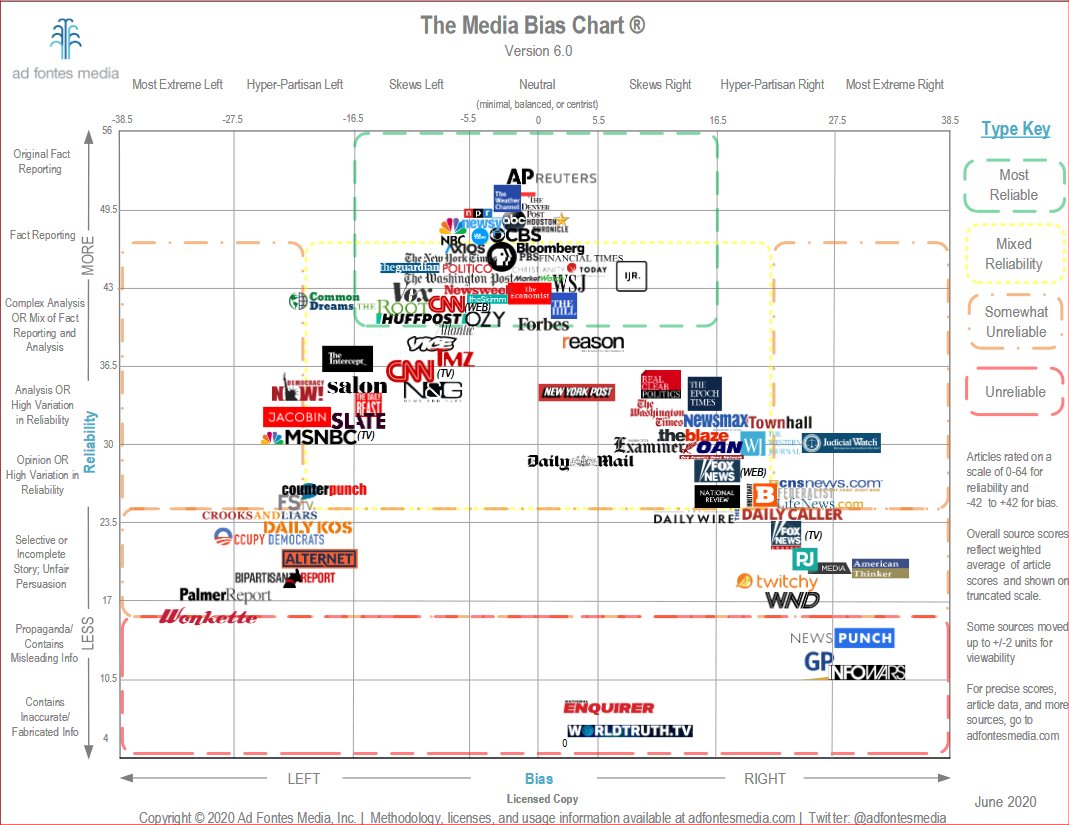
One method I recommend for insulating yourself from misinformation (fake news) is to be hygienic in one’s choices of news sources. Avoid junk news as you would avoid junk food — both are designed to appeal to basic instincts, but in large doses are very unhealthy.

Again, the Media Bias Chart, (at this link), latest version:

Pay attention to center top, and try not to be a victim of lower left or right.

The article cautions against a corrosive idea of “critical thinking.”

In a free society, the best response to viral misinformation is to fortify our immune systems against it, informationally speaking, by developing citizens who are motivated and able to distinguish truth from fiction. Perhaps more important, these citizens must be able to deal with the nuance in between.

In educational circles, this goes under the name “critical thinking.” The term’s foundations in criticism as careful analysis are noble. But critical thinking as taught today is often more criticism than thought, with criticism amounting to the parlor trick of deconstruction. Holes can always be poked in even the best arguments, but the technique is better at establishing what is fiction than what is true.

Don’t be cynical, as I’ve said, and think that everyone has ulterior movies for their arguments; learn about how the world works, and be savvy.

\\

Trying to avoid contentious takes on Republicans in this post. Let’s go to the core of savvy thinking: understand that religions are fabulous cultural traditions, but at their core, their supernatural claims are merely myths. If you really believe any of those claims… [insert favorite miracle of supernatural claim here]… then you have already sacrificed your ability to think and evaluate the real world, to some degree.

University of Chicago scientist Jerry Coyne wrote a whole book about the difference between faith and fact, and this past week he’s summarized his argument posted at Yahoo News, Yes, there is a war between science and religion. The opening (keeping all the internal CSS tags):

As the West becomes more and more secular, and the discoveries of evolutionary biology and cosmology shrink the boundaries of faith, the claims that science and religion are compatible grow louder. If you’re a believer who doesn’t want to seem anti-science, what can you do? You must argue that your faith – or any faith – is perfectly compatible with science.

And so one sees claim after claim from believers, religious scientists, prestigious science organizations and even atheists asserting not only that science and religion are compatible, but also that they can actually help each other. This claim is called “accommodationism.”

But I argue that this is misguided: that science and religion are not only in conflict – even at “war” – but also represent incompatible ways of viewing the world.

Later:

And while science has had success after success in understanding the universe, the “method” of using faith has led to no proof of the divine. How many gods are there? What are their natures and moral creeds? Is there an afterlife? Why is there moral and physical evil? There is no one answer to any of these questions. All is mystery, for all rests on faith.

The “war” between science and religion, then, is a conflict about whether you have good reasons for believing what you do: whether you see faith as a vice or a virtue.

Yet virtually everyone uses motivated reasoning to justify their beliefs based on emotion, or community standards, or simply what they were taught as a young child.

Posted in Culture, Religion, Science | Comments Off on Links and Comments: Trying to Be Smarter; Faith vs Fact

Links, Comments, and Memoirs: Republicans from Reagan Forward

Paul Krugman’s NYT column today is When Did Republicans Start Hating Facts?, subtitled “A straight line runs from Reagan to the Trump dead-enders.”

I’ll quote from this and comment, and then discuss my own attendance at a Reagan rally way back in 1980.

Republicans spent most of 2020 rejecting science in the face of a runaway pandemic; now they’re rejecting democracy in the face of a clear election loss.

What do these rejections have in common? In each case, one of America’s two major parties simply refused to accept facts it didn’t like.

I’m not sure it’s right to say Republicans “believe” that, say, wearing face masks is useless or that there was widespread voter fraud. Framing the issue as one of belief suggests that some kind of evidence might change party loyalists’ minds.

In reality, what Republicans say they believe flows from what they want to do, whether it’s ignore a deadly disease or stay in power despite the voters’ verdict.

See comments in earlier post about whether Republicans “believe” things or merely wish them to be true, and go along with the crowd.

Notice, by the way, that I’m not including qualifiers, like saying “some” Republicans. We’re talking about most of the party here. The Texas lawsuit calling on the Supreme Court to overturn the election was both absurd and deeply un-American, but more than 60 percent of Republicans in the House signed a brief supporting it, and only a handful of elected Republicans denounced the suit.

At this point, you aren’t considered a proper Republican unless you hate facts.

It began with Reagan, Krugman says, who has been turned “into an icon, … as the savior of a desperate, declining nation,” despite his actual rather dismal record as president. (Krugman outlines the several points of his presidency.)

The main point, however, is that under Reagan, irrationality and hatred for facts began to take over the G.O.P.

There has always been a conspiracy-theorizing, science-hating, anti-democratic faction in America. Before Reagan, however, mainstream conservatives and the Republican establishment refused to make alliance with that faction, keeping it on the political fringe.

Reagan, by contrast, brought the crazies inside the tent.

Many people are, I think, aware that Reagan embraced a crank economic doctrine — belief in the magical power of tax cuts. I’m not sure how many remember that the Reagan administration was also remarkably hostile to science.

Dismissing acid rain, promoting creationism, increasing influence of the religious right.

For rejecting facts comes naturally to people who insist that they’re acting on behalf of God. So does refusing to accept election results that don’t go their way. After all, if liberals are servants of Satan trying to destroy America’s soul, they shouldn’t be allowed to exercise power even if they should happen to win more votes.

(Another column in today’s NYT argues that George W. Bush did more actual damage than Trump has, citing for example Karl Rove’s derision of the “reality-based community.”)

\\

I’m old enough to remember Reagan, if not so much Carter, let alone Ford and Nixon and JFK who preceded him. What initially astonished me about his candidacy (even though he’d already been California governor) was why anyone found him the least bit qualified. He was an actor! He had a warm, comforting demeanor, and a pleasant, reassuring way of speaking, but he spoke in generalities and platitudes and naive, simplistic misconceptions. Taxes bad, regulations bad, religion in schools good (but only the Christian religion), and so on.

So here, lightly edited, is a passage from my 1980 journal about attending a Reagan rally, which I did only because it was within walking distance of my apartment. With some comments added, [[ in brackets ]].

(Written Saturday evening, 11 October 1980)

I attended a political rally last night. For Ronald Reagan. An announcement was in the CSUN newspaper [[ I was attending California State University at Northridge, at the time ]] Sundial yesterday; he would be at Devonshire Downs [[ a sports stadium, torn down years later and replaced by high-rise student dorms ]] between 5:30 to 7:00 that evening, prefaced by Roy Rogers and others.

Reagan is running very popular; current polls place him somewhat above the incumbant. What people see in him, I’m not sure: easy answers, I suppose, naively thinking, as Reagan apparently does, that they exist. Lately Reagan has spiced the campaign with a series of ignorant, even idiotic remarks: such as the assertion several weeks ago that Darwin’s theory of evolution was still only a theory, disputed by many scientists [[ it wasn’t disputed then, and it isn’t now, and why bring this up at all except to pander to a religious base that rejects science for religious myth? ]]; and most recently, that the EPA, Environmental Protection Agency, has become too restrictive because, after all, smog is pretty well under control.

[[ This is worth a longer aside comment. In the late 1970s and early ’80s I was doing lots of bicycling, and frequently after a ride of more than a couple hours, my chest would be physically tight from the heavy breathing of smoggy air. Further, it was not uncommon for the hills surrounding the San Fernando Valley to be invisible in the smoggy haze on many afternoons, though those hills were only 3 or 4 miles from my place in Northridge. Smog was *not* under control. Republicans hate regulations, because they always favor profits; but it’s only because of such environmental regulations that, compared to 40 years ago, our skies and rivers are now relatively clean. ]]

Resuming my narrative from 1980…

Then he comes to Los Angeles, where we’ve had ten days of excessively harsh smog conditions, so that reportedly his plane was diverted to another airport yesterday because of the smog. The claims about smog apparently stem from a profound misunderstanding and confusion about the various kinds of chemicals that compose smog, as opposed to those that occur naturally: Reagan claimed that two-third of all air pollution is from natural sources.

This kind of disregard of well-substantiated facts is nothing new; he has been doing it all along, particularly in the way he spouts authoritative sound statistics regarding his accomplishments as California governor. Alas, he can say all these things and get away with them because most of his audience doesn’t know any better. Response from the opposition is dismissed as just politics. And how many people read the op-ed pages? [[ This problem has gotten only worse, of course, in our age of bubbles and siloed news. ]]

Anyway, I walked to the stadium at Devonshire Downs, arriving about quarter to six, standing in the crowd as Roy Rogers emceed and a group of Country-western singers performed. Roy Rogers made some remarks of his own, including that the two people to have done the most harm to this country were Madalyn Murray O’Hair [[ the first promiment public atheist, who punctured religious presumptions ]] and Dr. Benjamin Spock [[ the famed pediatrician whose book about child care emphasized affection and downplayed authoritarian adherence to rigid rules ]].

A bunch of local notables were introduced as they came up to sit on the stage — Bobbi Fiedler, Mike Curb [[ both local politicians at the time ]], Efrem Zimbalist, Jr. [[ an actor in the popular ’60s series The F.B.I. ]], even Bob Nagler [[ no clue now who he was ]], and Christopher and Lynda Day George [[ actors ]].

The event was well-staged: colored spotlights surrounded the stadium, angled upward to converge at a point directly above the platform. A hot-air balloon billowed beyond the end of the stadium. When Reagan finally came up on stage, helium balloons were released from behind the stage to make a jolly picture for the bevy of TV cameras off to one side.

Reagan said nothing much new. He opened with a familiar Roy Rogers joke [[ which I don’t remember ]]. He attacked Carter’s record. He promised to lower taxes, balance the federal budget, and increase defense spending, all at once. He promised that his reign would bring security back to wage-earners, the family, and traditional American values, particularly with the guidance of God. (Does it matter that some politicians defy the Constitutional separation of church and state in their rhetoric — by implying a preference for the Christian religions? Not to Republicans.) He spoke for all of ten to fifteen minutes, then was quickly escorted behind the stage to his waiting limousine. He didn’t take questions (as Jimmy Carter had, when I saw him several years ago at UCLA.)

(end extract from my 1980 journal)

My later understanding of where Reagan came from did not improve my regard for him. His most famous comment came to be “Government is not the solution to our problem, government is the problem.” (From his inaugural address.) This was an astounding thing to say from someone who presumed to run the government! (Rather similar to Trump’s comments about “draining the swamp” and the “deep state.”)

Where this came from, I came to understand, was Reagan’s resentment of the IRS decades before when the IRS challenged him about his earnings as a film star. Thus his advocation of reducing taxes, indiscriminately, regardless of circumstances. Thus Reaganomics, dismissed even by George H. W. Bush as “voodoo economics,” and repeatedly debunked by NYT columnist Paul Krugman.

(What no politician on either side has ever done, to my knowledge, is to figure out how much money the country wants to spend, on the military, welfare, infrastructure, and so on, with targets like science or NASA being trivial expenses compared to those, and *then* figure out what taxes would be required to finance them. This would be a complex take.)

And of course another key point of Reagan’s legacy is how he ignored the AIDS crisis in the early ’80s, because it didn’t affect people he liked.

Also, Nancy Reagan made decisions by consulting with her astrologer. The Reagans were not savvy, reality-based people.

Posted in Politics, Science | Comments Off on Links, Comments, and Memoirs: Republicans from Reagan Forward