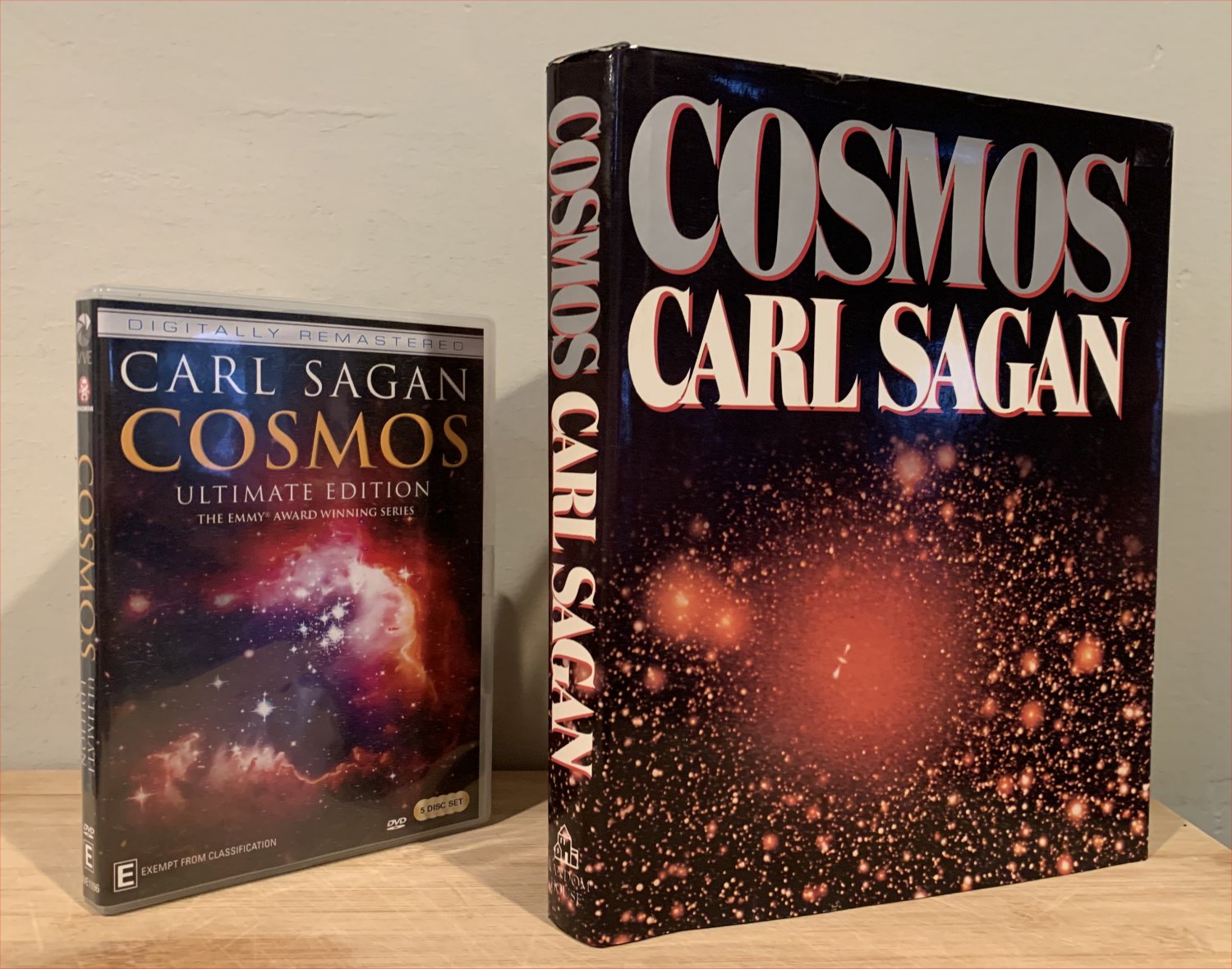
Carl Sagan: Cosmos (1980)


Cosmos may fairly be called one of the foundational books of my life (even moreso than Sagan’s earlier The Cosmic Connection, revisited here in 2015) even though I hadn’t read the entire book until this year. The book was a companion to a 13-part PBS TV series than ran in late 1980. In 1980 I was living in a one-room apartment with a tiny, maybe 15-inch, black and white TV, so even though I watched the show at the time, I saw it only in black and white. Recently, inspired perhaps by the latest of the Neil deGrasse Tyson-hosted Cosmos TV series (largely written by Anne Druyan, Sagan’s wife and cowriter back in 1980) that launched earlier this year. I discovered that all the episodes of the original series could be found on YouTube—though alas, several of them interrupted by commercials. So I sprung for the entire series on DVD (i.e. I bought it) and over a period of some months, beginning this past June, have watched the series (now seeing it in color!) and finally reading the book closely. I’m sure I’d glanced through the book back in 1980 (I got it as a Christmas gift that year) or early 1981, but likely didn’t feel the need to read it thoroughly, given its similarity to the TV series.

The show ran originally from September 28 – December 21, 1980, per Wikipedia, and the book was released in October 1980. So they were obviously developed in parallel. Indeed, some of the footage in the TV series, of Sagan at JPL as Voyager 2 pictures came in from Jupiter, was filmed back in 1979.
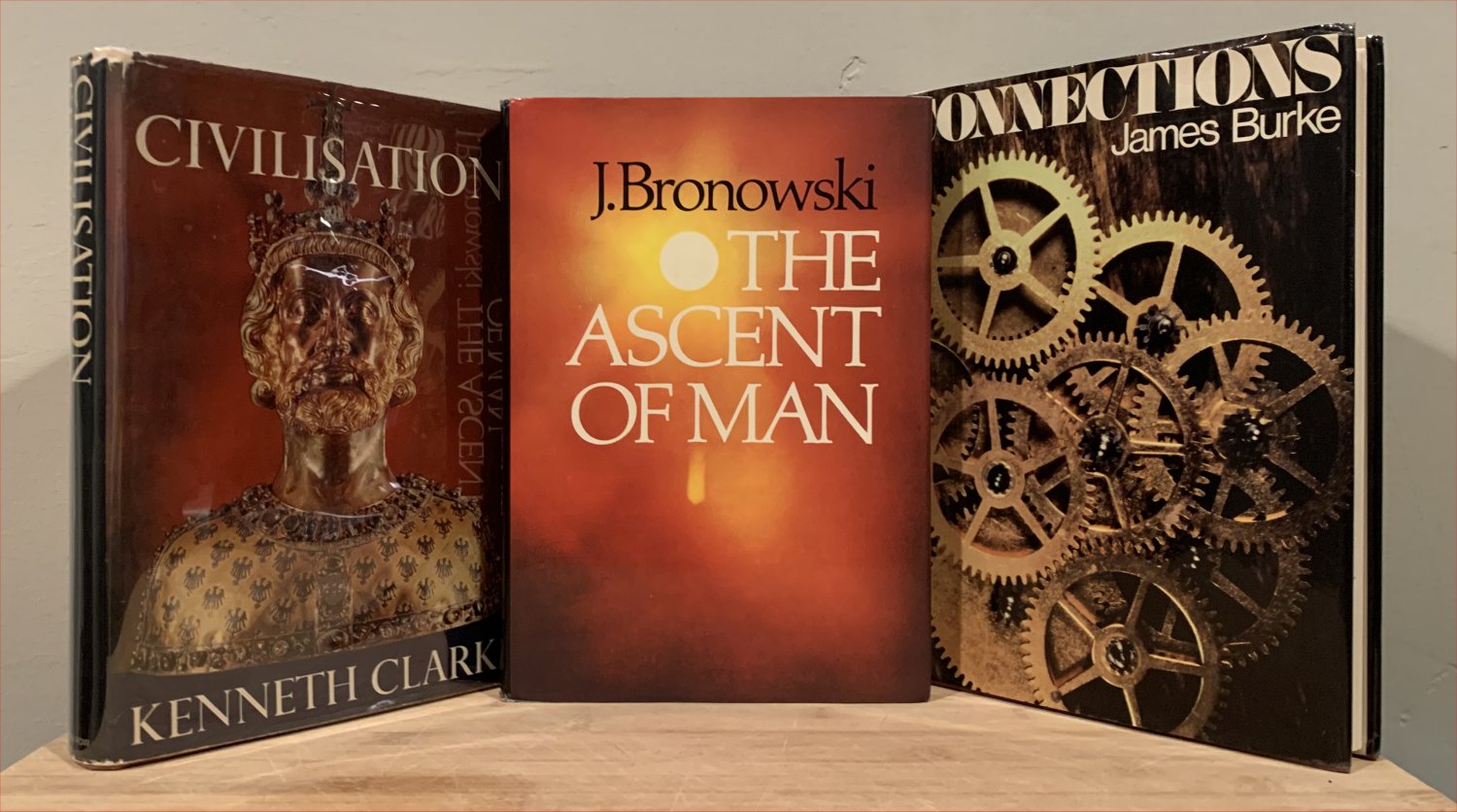
The TV show was a prestigious, high-end production, and very popular. It followed at least three similar productions on PBS, Alastair Cooke’s Civilization (1970), J. Bronowski’s The Ascent of Man (1973), and James Burke’s Connections (1978) – all three multi-episode TV productions with parallel, lavishly illustrated books. (Cooke’s now is dated in its parochialism, being limited almost entirely to western European civilization.)

That a book about astronomy and cosmology should follow those, and become as popular than those, seemed to confirm to me the ascendance of real science into popular discourse. TV had had its pop sci-fi in Lost and Space and Star Trek, the movies its simplistic space opera of Star Wars, now here was PBS doling out the real thing about the history of science and our knowledge of the cosmos. To me it was a validation, of sorts, that ideas about humanity’s place in the vast universe were filtering down into public consciousness, perhaps brushing aside superstitious notions like astrology and general ignorance about the difference between planets, stars, and galaxies. Alas, decades later, this has not happened; ignorance about reality, and adherence to conspiracy theories, has only grown.

Of course I knew much about the subjects of Cosmos in general, my astronomy interest going back to 1965 or so (when I was 10). Yet Sagan made the subject personal, appearing on camera in segments alternating with graphics and animations, with historical recreations (using actors and local sets) of pivotal events in the history of science, and the notion of a “ship of the imagination,” a futuristic spaceship bridge, where Sagan would stand to allow the POV to sweep into the atmospheres of the planets or through distant galaxies.

The TV series did have one influence on me quite apart from the scientific content: the music. The show used electronic music by the Greek composer Vangelis, many tracks from numerous albums, which I then sought out. (Vangelis went on, in just the next couple years, to do original scores for movies like Chariots of Fire [for which he won as Oscar] and Blade Runner.) There were also tracks from classic music composers, in particular Shostakovich, whose 11th symphony, mostly the quiet sections of tense music, were used in several episodes. (I’d already heard some Shostakovich in the 1975 film Rollerball.)

As it turns out, the TV episodes and the book chapters of Cosmos are not precisely in synch, even though the titles are the same. The differences include…

  • Sagan indulges in segments about popular misconceptions, in the TV show, that are barely mentioned in the book. These include astrology, UFOs, and alien visitations.
  • Sagan’s notion of “cosmic calendar” (https://en.wikipedia.org/wiki/Cosmic_Calendar — the notion that if the entire age of the universe were shrunk to the length of one Earth year, how events of the history would lie along it proportionally, e.g. that the last 12,000 years of human history would occupy only the last couple seconds of the cosmic year) is employed in the TV show, effectively (as Sagan walks around such a calendar projected onto the floor) — but it’s not mentioned in the book at all. That’s because Sagan had developed the idea in his earlier book The Dragons of Eden in 1977.
  • The TV series is quite ambitious in imagining, one or two per episode, historical scenes depicting scientific discoveries, complete with actors in period garb sometimes shot in actual locations. These are minimized in the book, summarized or even passed over in the book text.

Here are the most striking take-aways I had of the book and series:

  • The cosmic calendar remains a striking visualization of the vast history of the universe and the tiny sliver of our awareness of it.
  • The themes of destruction, of the biosphere, of the species, run through the book. The end of episode 4 could well be the inspiration for the documentary film Koyaanisqatsi.
  • Sagan is frank, in the series, about acknowledging and dismissing much pseudoscience, including astrology, alien visitations, and Velikovsky, and for that matter the religious presumption of a god as creator of the universe.
  • Sagan’s take on ancient philosophy is striking (in Chapter 7). He contrasts the early Ionians (e.g. Democritus, who first proposed the idea of atoms) with the later “mystics” (Plato and his followers) who set experiment and evidence aside, an attitude inherited by Christians, that lasted for 2000 years! That the heavens are perfect and so there simply can’t, for instance, be anything orbiting Jupiter. I’ve gone through summaries of philosophy and the history of science from time to time, but never seen this particular contrast spelled out like this.
  • The TV series was ambitious in its enactments of famous people in historical times and places. (The later Cosmos TV series of the past decade have used animations for such passages.)
  • Sagan himself is a striking character, with his odd emphasis on certain words (parodied in his citations of “billions and billions” of stars), and his obvious enthusiasm, even in the ecstatic look on his face as he is portrayed viewing the mysteries of the cosmos from his “ship of the imagination.” (Fittingly, Neil deGrasse Tyson in the recent Cosmos series has a similar enthusiasm, if a different style.)
  • And of course the key points are the cosmic perspective, the repeated emphasis on vast quantities of time and space, and how science, with its two rules (there are no sacred truths, and, whatever is inconsistent with the facts must be discarded or revised), is the only way understand reality. Not by tradition, revelation, or intuition.

So now I’ll summarize the subject  and main points of each chapter/episode, with some further comments about any key differences between the two. (Wikipedia’s page, https://en.wikipedia.org/wiki/Cosmos:_A_Personal_Voyage, has three or four-line descriptions of each episode.)

1, “The Shores of the Cosmic Ocean”

  • “The cosmos is all that is or ever was or ever will be.” Sagan opens live on the coast of California, in Big Sur at Monterey, a rugged section of cliffs, pine trees, and crashing surf. (Which I’ve driven through several times.) “The cosmos is also within us; we’re made of starstuff. We are a way for the cosmos to know itself.” He discusses large dimensions, speculates on aliens, and plucks a dandelion, launching it into the air where it turns into his “spaceship of the imagination.”

2, “One Voice in the Cosmic Fugue”

  • Wondering about alien life is the same problem as understanding life on earth, and evolution. About human domestication of animals and plants. “Evolution is a fact, not a theory.” The Cosmic Calendar. “Part of the resistance to Darwin and Wallace derives from our difficulty in imagining the passage of the millennia, must less the aeons…”
  • There’s a remarkable animation depicting the evolution of life on Earth from single cells all the way to humans… in just a couple minutes (to music of Vangelis). “Those are some of things molecules do given four billion years of evolution.” This animation is used again in later episodes.

3, “Harmony of the Worlds”

  • Opening section shows Sagan live, in NYC, discusses the difference between astronomy and astrology. The evidence fails; modern astrology ignores all the astronomical phenomena discovered since Ptolemy. And how would it even work? (The book notes the many national flags that display stars of constellations or crescent moons.)
  • Yet we are connected to the cosmos, in the deepest ways. Cultures across time have studied the sky—perhaps merely to predict the seasons, to plan agriculture. They noticed the “planets” wandering across the sky; discovery of how they moved with prediction has led to our modern civilization, despite early belief in an immobile Earth, a notion supported by the Church throughout the Dark Ages, until Copernicus in 1543. After him, Kepler, with his notion about how God’s plan must entail the five perfect solids…but the evidence didn’t support it. He threw in with the wealthy Tycho, a brilliant observationalist, whose data led to Kepler’s three laws of planetary motion.
  • And then Newton, who hid his disbelief in the Trinity. He invents differential calculus, studies light, lays out a theory of gravitation. Kepler’s three laws became derived from Newton’s gravitation. Yet Newton pursued astrology, and alchemy; the distinction between science and pseudoscience had not yet been made.

4, “Heaven and Hell”

  • (The title here echoes the Vangelis album used for much of the music.)
  • Now the series moves on to considering other planets, and comets and meteors. 1908, the Siberian event, which Sagan concludes must have been a comet hitting the Earth, with effects like a nuclear bomb but without the radiation. About the history of comets; how superstitious beliefs become self-fulfilling prophecies. Comet pills dispensed in 1910!
  • Meteor craters; an explosion on the moon observed in 1178 at Canterbury Cathedral, giving lie to the notion that the heavens were unchangeable.
  • Discussion of Velikovsky [a popular writer in the 1950s with an outlandish theory that totally implausible planetary movements and collisions explained various events in the Bible]; Sagan makes the point that the worst aspect of his popularity was that some scientists wanted to actively suppress his books. Science is self-correcting, so his ideas would be eventually dismissed (as they were).
  • How the prism, the spectrum, the discovery of absorption lines, led to the detection of elements in other planets’ atmospheres [and later, of the composition of stars]. Venus: discovered to be very hot, like hell.
  • How erosion has worn down the Sphinx. Storms, volcanoes, fires, climatic catastrophes. Short-term profits over long-term habitability. If we destroy the planet, we have no place to go to. “If a visitor arrived from another world, what account would we give of our stewardship of the planet Earth?”
  • Sagan was worrying about global cooling back in 1980, but his larger point remains that the planetary environment is fragile and can easily be knocked out of kilter, one way or another.
  • ==> The episode ends with a remarkable sequence of mining explosions and demolitons; it’s like a premonition of the 1982 documentary film Koyaanisqatsi, famous for its early Philip Glass score, and its many scenes similar scenes of miners exploding mountains and natural landscapes ruined by development.
  • “Do we value short-term advantages above the welfare of the Earth? Or will we think on longer time scales, with concern for our children and our grandchildren, to understand and protect the complex life-support systems of our planet? The Earth is a tiny and fragile world. It needs to be cherished.”

5, “Blue for a Red Planet”

  • All about Mars. Holst, Wells, Lowell, Schiarprelli and his canals, his observatory in Flagstaff. The idea of an ancient race there mostly wish fulfillment.
  • The real road to Mars began with Goddard, his rockets, back in 1898. No canals. [As of 1980] We’ve sent robots, Viking 1 and 2. And much background about the planning of these missions, and their inconclusive results.

6, “Travellers’ Tales”

  • About exploration of the outer planets, with explicit comparison to the 17th and 18th century European voyages around the globe. The Enlightenment; Dutch East India, explorations for profit. Sagan visits the actual Amsterdam town hall, and discusses Galileo, Bruno, and in Holland Huygens; Leeuwenhoek invents the microscope to see “animalcules.” How primitive telescopes saw features on Mars, the rings of Saturn. The pendulum clock; how the understanding came that stars were other suns.
  • In the book: Christians argued that, since the entire heavens turned around the Earth once a day, they couldn’t be infinite…146.0) Some thought the plurality of worlds absurd; 146m. (But it was all baseless speculation, based on ideology, not evidence.)
  • Then we see 1979 scenes of Sagan at JPL seeing photos come in from Voyager 2 at Jupiter. (Technicians with lots of mustaches! And smoking!)
  • Some early travelers’ tales from their global travels were lies or exaggerations; yet they inspired Voltaire and Swift.

7, “The Backbone of Night”

  • About the Milky Way, easily visible in dark skies throughout human history.
  • The episode has Sagan visit his old digs in Brooklyn (driving a Chevrolet Citation). He recalls asking for books, at the library, about stars, and was given a book about movie stars. He explained. Later, Sagan visiting a 6th grade classroom and taking questions, illustrating the natural curiosity of the young.
  • How lucky we are to live at this time; in an earlier age we would not have understood all this, about stars, the milky way, gravity.
  • Contemporary hunter-gathering tribes call it the backbone of the night. Early observations gave rise to the idea of gods, one for every human concern, who all had to be propitiated through rituals and myths, temples and monuments.
  • Sagan visits the Greek islands, where about 2500 years ago there was a kind of awakening by the Ionians: the idea that the universe was knowable—that it’s ordered and regular, and predictable. ==> This is a key idea. Why did this idea develop at this time and place? Perhaps, Sagan suggests, because these islands had been newly colonized, unlike other places that were in the centers of old empires; and thus ready for new ideas.
  • But the Ionians were suppressed and ridiculed by later Greeks (Pythagoras, Plato, Aristotle) who thought knowledge about the world could be deduced from first principles, that experiments were undignified. Thus preoccupation with the five regular solids, how knowledge that the square root of two was irrational was…suppressed! This unease with the real world, in preference to the supposed abstract perfection of the heavens, was reinforced by Christianity (which dismissed scientific discovery that challenged scripture as heretical), and stifled philosophy and science for over a thousand years, until Leonardo, Copernicus, and Columbus, and the Enlightenment.
  • Here Sagan becomes explicit about religion: What do you do about conflicting gods from other lands? Zeus, Marduk? Suppose that they were invented by the priests? Then why not all of them? The world could be understood without the god hypothesis.

8, “Travels in Space and Time”

  • How can we travel to the stars? Can we travel close to the speed of light, or greater than it? Looking out into space is looking back in time.
  • We visit Tuscany, in northern Italy, in 1895, when Einstein wondered what the speed of light was relative to, and whether velocities of two moving objects add. To avoid paradoxes he concluded the special theory of relativity: you can’t add velocities, and you can’t travel at or above the speed of light. Despite how these conclusions clash with our common-sense notions.
  • We see what would happen if the speed of light were 40 mph, depicting a near-accident at a rural intersection. Funny things happen near that speed; time slows down; the young man Paolo could return to his village after a near-lightspeed trip and find his brother is an old man.
  • So we *can* go to the stars, even though we wouldn’t return until centuries might have passed on earth. If we could accelerate at 1g, the stars are only years away, and the known universe could be circumnavigated in 56 years ship time.
  • Can we travel to the past? Physicists think it’s fundamentally impossible. Paradoxes of changing history…unless there are threads of history. [[ The ideas briefly discussed here have been much speculated about in science fiction, for decades ]] How the past might have been about the same, if key figures removed. Yet if the Ionian tradition had prevailed (avoiding the dark ages) we might be going to the stars now.
  • Other solar system would have different arrangements of planets, different evolutions. Everything is made of starstuff; we are starstuff which has taken destiny into its own hands.

9, “The Lives of the Stars”

  • “If you wish to make an apple pie from scratch, you must first invent the universe.”
  • How many slices in half of an apple to get to an individual atom? About 90.
  • The episode/chapter traces the understanding of atoms, at Cambridge University (how an atom is mostly empty space), to our understanding of the 92 common elements. Modern physics and chemistry have reduced the complexity of the sensible world to an astonishing simplicity. Chemistry is just numbers. Each element has a different number of protons. The nuclear force holds the atom together. Multiples of helium nuclei (2 protons, 2 neutrons) make familiar elements. [[ This theme echoes David Deutsch’s observation that scientific theories become fewer and broader, replacing earlier separate theories not understood to be related. ]]
  • And then to where the elements came from: from the insides of stars. Depending on mass, stars die in three ways: white dwarf, neutron star, or black hole. Before final collapse, a star swells into a red giant. Some of these go supernova, in which rare elements are created by the intense explosion. Our sun is probably a third generation star. All elements except hydrogen and helium were made inside other stars: thus we are starstuff.
  • And radiation due to cosmic rays are drivers of evolution, via mutations.
  • Examples of primitive civilizations that marked ancient supernovae: the 1054 “guest star”, now the Crab Nebula.
  • Sagan imagines life in light gravity, or higher gravities, imagining Alice and that cat, and how gravity is a curvature of space. Would a black hole lead to a wormhole and then to a different universe entirely?
  • Then Sagan is back in Big Sur. We’re all solar-powered; we are the stars’ children.

Ch10, “The Edge of Forever”

  • Where the universe came from, and where it’s going. Everyone has in common the experience of birth, and so we imagine the birth of the universe, which we currently understand has happening 15 billion years ago, with the Big Bang.
  • The key to cosmology is the Doppler effect. (Live example of a train going past.) Mount Wilson, complete in 1917, and how a janitor, Humason, became an observer alongside Hubble (this filmed at the actual observatory, with actors), and their discovery that the more distant a galaxy, the greater the red shift: thus the expansion of the universe.
  • Is space curved? Sagan imagines flatland, then a fourth dimension, and speculates that moving in a continuous direction would bring you back to where you started, like walking around a globe. We don’t know whether the universe is open or closed. [[ We do now: it’s expanding even more quickly than we’d thought, cf. dark energy. ]]
  • Cultures have imagined gods that created the universe. But if the universe was created by a god, where did the god come from? Save a step and suppose the universe has always existed.
  • Scenes of other cultures: people herding animals, in fields, village scenes, harvest festivals. A tradition of cycles in nature, as on Earth; all such myths should be respected for perceiving this basic pattern. The Hindus, remarkably, imagined an ancient universe of billions of years, and an infinite number of other universes. The big bang might have been the end of a previous cycle. Does the universe oscillate?
  • Sagan at the Very Large Array in New Mexico: we can look back into time with radio telescopes, which are extremely sensitive, in order to detect if enough matter exists for the universe to be closed. But we don’t know yet.

Ch11, “The Persistence of Memory”

  • How information on how to live proceeds from genes, to brains, to books.
  • The variety of life on earth (location shots of a boat that records whale songs, with background on how 19th century steam ships interfered with whale communications) is due to common sets of genes, that make DNA; each creature is determined by some number of information bits encoded in the DNA. Some 5 billion for a human, equivalent to 1000 books.
  • Beyond that, we have brains. Our brain consists of a brain stem, then an R-complex (the reptilian brain), then the limbic system (the mammal brain), then the cerebral cortex (in primate, millions of years ago), the last the realm of intuition and critical analysis. [[ Sagan wrote a whole book about the brain, The Dragons of Eden. ]] The brain has 100 billion neurons, and 100 trillion connections between them, the equivalent of 20 million volumes. The brain library is one of loose-leaf books, with memories stored in lots of places.
  • The brain betrays vestiges of its evolution, just as cities are built on top of older versions of themselves, rather than periodically rebuilt from scratch.
  • When brains weren’t enough, we stored information outside our bodies—in books. In libraries. One can read perhaps a few thousand books in a lifetime; the trick is to know which ones to read.
  • Thus: cuneiform, 5000 years ago; paper, ink, printing, with many copies of earth work. Then, movable type in 1450, and within 50 years, 10 million printed books.
  • And now we have computers and satellites, communications across the world. And beings on other planets might have vaster more neurons; what would they be like? We launched messages on two Voyager spacecraft, in 1977, that might be found by such creatures. They would be interested in our culture, not our science (since the science would be the same).

Ch12, “Encyclopaedia Galactica”

  • About contact between alien civilizations. Why haven’t we been visited? There’s no good evidence.
  • Episode has dramatization of the famous Betty and Barney Hill incident, about a couple supposedly abducted by aliens late one night on a New Hampshire highway. But extraordinary claims require extraordinary evidence, and their best evidence – crude star maps that resembled nothing much – was worthless. And their story is claimed as one of the best such cases of supposed alien visitation.
  • Photos can be faked; home movies show asteroids; there’s never any compelling physical evidence.
  • Dramatization of Joseph Fourier and his student, Champollion, who figured out how to read Egyptian hieroglyphics, via the Rosetta Stone, in effect making contact with an ancient, alien civilization.
  • Now we try to make contact via radio astronomy, an Arecibo.
  • How many civilizations might be out there, in the galaxy? Sagan explores the famous Drake equation, making estimates for each factor, and gets a range from 10 to millions.
  • So where are they? No credible evidence of their visiting us. Other explanations? Maybe we’re the first. Maybe they all destroy themselves. Maybe they’re here but hiding. Or: it’s a big cosmos, why come here? A civilization might take thousands or millions of years to expand across space, into a network of outposts and pathways, perhaps compiling along the way an encyclopedia of everything known about all those worlds.
  • And we see ‘profiles’ of various planets and their biosphere, including one for Earth…

Ch13, “Who Speaks for Earth?”

  • The final chapter/episode brings together Sagan’s recurring ideas about the fate of humanity, whether we will survive without blowing ourselves up in nuclear war.
  • We see the dramatization of a French expedition to Alaska and the native Klingat, who were seeing outsiders for the first time, and who imagined their ship to be a giant raven. (Incidentally, this material is discussed in Chapter 12 of the book, though it’s depicted in episode 13.) That encounter was friendly, but not the Spanish visit to the Central America,  where Spanish greed for gold led to the destruction of the Aztec society.
  • Now all humanity is in jeopardy. How many other intelligences develop technology and then destroy themselves with it?
  • Scenes of nuclear explosions. Every nation has an excuse for building nuclear weapons, at great expense. How would we explain this, to outsiders? Who speaks for Earth? Shouldn’t we be making fundamental changes in society to avoid such conflict? We’ve made changes before: slavery eliminated, women liberated, some wars stopped, our recognition that the world is an organism.
  • Again, Alexandria did not flourish perhaps because its scholars did not challenge the political or religious beliefs of that society, e.g. slavery, while the surrounding population knew nothing of the knowledge inside the library. About Hypatia, her murder, and the library destroyed by 416. We mustn’t let it happen again.
  • Recap: the beginning; the history of the cosmos; the animation of evolution. We are a way for the cosmos to know itself.
  • The only sacred truth of science is that there are no sacred truths. Arguments from authority are worthless. It’s the best tool we have, and applicable to everything. More images, including a space shuttle launch. “These are some of the things hydrogen atoms do, given 15 billion years of cosmic evolution.”
  • Finally: Sagan along the Monterey coast again, releasing the dandelion.
  • From the book, page 318:

The Cosmos was discovered only yesterday. For a million years it was clear to everyone that there were no other places than the Earth. Then in the last tenth of a percent of the lifetime of our species, in the instant between Aristarchus and ourselves, we reluctantly noticed that we were not the center and purpose of the Universe, but rather lived on a tiny and fragile world lost in immensity and eternity, drifting in a great cosmic ocean dotted here and there with a hundred billion galaxies and a billion trillion stars. We have bravely tested the water and have found the ocean to our liking, resonant with our nature. Something in us recognizes the Cosmos as home. We are made of stellar ash. Our origin and evolution have been tied to distant cosmic events. The exploration of the Cosmos is a voyage of self-discovery.

Page 338:

How pallid by comparison are the pretensions of superstition and pseudoscience; how important it is for us to pursue and understand science, that characteristically human behavior. …Those afraid of the universe as it really is, those who pretend to nonexistent knowledge and envision a Cosmos centered on human beings will prefer the fleeting comforts of superstition. They avoid rather that confront the world.

Page 339:

Present global culture is a kind of arrogant newcomer. It arrives on the planetary stage following four and a half billion years of other acts, and after looking about for a few thousand years declares itself in possession of eternal truths. But in a world that is changing as fast as our, this is a prescription for disaster. No nation, no religion, no economic system, no body of knowledge, is likely to have all the answer for our survival. There must be many social systems that would work far better than any now in existence. In the scientific tradition, our task is to find them.
Posted in Book Notes, Science | Comments Off on Carl Sagan: Cosmos (1980)

Links and Comments: How People Think; the Election and the Pandemic

It’s been a few days since last bunch of links and comments, and I’ve collected several since then that perhaps can be fit together into some kind of overe-arching theme. It’s about how different people think differently.

I should say first, as I have before, that different people exhibit different strengths from a range of possible aspects of human nature. Some people are gregarious, others private; some open to novelty, others prioritizing the traditions of the past; and so on. There is no one right way to be human. In fact diversity is a strength; diversity within a species means that the species is more to likely survive as circumstances change, and circumstances can change radically in different, unpredictable ways. Behavior suitable for survival on a desert island would not work in a large communal city, and vice versa. So again: neither ‘side’ in any given dichotomy is right, or wrong, they’re just different, and perhaps ideal for various circumstances.

Yet different types of behavior and psychological attitudes do play out into how people think, how they organize themselves into groups, how they react to adversity.

Here’s one mundane example. Some people assume their tastes in food, or music, are so obviously intuitively correct that they can’t imagine why anyone would disagree. How can anyone *not* like fried chicken?? Or white rice?? This parallels my comment a couple posts ago, about how some Trump voters apparently can’t imagine why the entire country doesn’t support their candidate, and therefore if Trump lost the election, it must due to be fraud.

This dichotomy, in general, plays out, it seems to me, in very broad strokes, to the political parties and to how people think about science.

Example: Jerry Coyne’s blog asks today, American scientists are mostly Democrats, with almost no Republicans. Is this lack of diversity a problem?. Coyne is a university professor (Chicago) and so concerned with issues about diversity and cancel culture. He dismisses the question on affirmative action grounds, in part because no one knows the political persuasions of most scientists; it’s simply not an issue.

More to the point, Republicans in particular are clearly conservative and prone to ideology over facts and evidence; thus they are more religious, more likely to cling to ideological positions (the poor are deadbeats; tax cuts for the wealthy trickle down) that have clearly been disproved. As I type there is debate in congress about another stimulus package to address the impact of the pandemic, but Republicans don’t want people to depend on hand-outs because, they suppose, people will then be unwilling to work. This is counter to the evidence. (If anything, bailouts in event of national catastrophe is precisely one of the most important things the federal government should do.)

But let’s move away from generalities and look at some specific links.

Salon, Amanda Marcotte, Dec 9th: Trump voters don’t really believe Biden stole the election — but they do want a coup, subtitled, Conservatives aren’t entirely delusional — they’re trolls arguing in bad faith to de-legitimize Democratic voters.

Do Republican voters really believe that Joe Biden stole the election from Donald Trump? Do they sincerely see Trump’s efforts to overturn the election as the legitimate actions of a wronged man trying to defend democracy? When they declare “stop the steal,” are they truly unaware that they are the ones trying to steal this election from the rightful winners?

Or are millions of Americans arguing in bad faith, merely claiming to believe Trump is the true winner?

Here we enter the realm of trying to understand how so many people think in ways that do not involve evidence, or savvy understanding of how the world works. Marcotte:

Well, as the author of a book called “Troll Nation,” it’s clear where I stand: By and large, Republican voters who claim that Biden stole the election are arguing from bad faith, not delusion.

This distinction is important because it shows that the intentions of Republican voters (and too many of their elected leaders) are sinister, and need to be taken seriously as an overt assault on democracy. Understanding modern politics means understanding one crucial reality about the current landscape: Conservatives don’t hold beliefs, they only have rationalizations.

This parallels my provisional conclusion that conservatives value ideology over reality.

Many of their long-standing beliefs don’t hold up to modern moral standards or rational scrutiny. Rather than give up those beliefs, however, Republicans have developed a series of disingenuous gambits, conspiracy theories and trolling tactics to derail conversations, sow confusion and otherwise distract those who would challenge their indefensible ideology.

Of course, it’s morally indefensible to come right out and say you care more about keeping your gas guzzler than protecting the planet. So, instead, conservatives claim to be “skeptical” of climate science, wasting their interlocutor’s time by forcing them to prove, over and over and over and over again, that climate change is real. Similarly, open contempt for women’s rights is hard to argue, so instead, conservatives will claim concern for “fetal life” to justify support for forced childbirth — even though none of their other policy preferences point to concern about the wellbeing of children, much less fetuses.

The article goes on with examples about birtherism and the illegitimacy of votes… from certain black cities, revealing obvious racist motivations.

\\

The danger of clinging to ideology, of course, is that rejecting reality for ideology can get you killed. Masks are Satanic offenses against the God-given beauty of the human face? (I’ve seen this claim.) For communities and states that think that — more of them will die. Think of it as evolution in action.

\\

More briefly:

NY Magazine: White Evangelicals Made a Deal With the Devil. Now What?

This echoes my thought that conservatives are motivated by fear, and paranoia.

To be Evangelical in the 1990s was to learn fear. [many examples follow]


Whatever the cause, whatever the rumor, the fear was always the same. It was about power, and what would happen if we lost it. Certain facts, like the whiteness of our congregations and the maleness of our pulpits and the shortcomings of our leaders, were not worth mentioning. You were fighting for God, and God was not racist or sexist; He was only true. The unsaved hated this, it made them angry, and that was proof you were doing the right thing. If “owning the libs” has a discernible origin point, it’s here, in the white Evangelical church.

This next echoes my thought that religious conservatives are so certain of their righteousness, that hypocrisy (in vetting Supreme Court justices) or cheating (as in trying to overturn a democratic election) are legitimate means to an end.

A party out of step with most voters must either reform, or it must cheat. This, too, is something the modern GOP has in common with the Christian right. Democracy is the enemy. People can’t be trusted with their own souls. Leave them to their own devices, and they make the wrong choices, take the easy way out, threaten everything holy. They need a savior, whether they like it or not.

\\

And so here we are.

WaPo: The president and his party have gone to war against America.

It’s becoming hard to find the right words to describe what Republicans have become at this moment in history. We can call them reckless in their eagerness to undermine the functioning of government. We can call them heartless in their willingness to deprive Americans of aid in such a desperate time. We can call them unhinged in their embrace of deranged conspiracy theories.

But now the Republican Party is quite literally becoming the enemy of America.

…The foundation of that system is that the people vote, we count the votes, and the winner takes office. The GOP is now saying, “No. We win, no matter what. And if the people vote for a Democrat, then they must simply be overruled.”

Media Matters: Rush Limbaugh: “There cannot be a peaceful coexistence” between liberals and conservatives, subtitled, Limbaugh: “I actually think that we’re trending toward secession”

Limbaugh lives in Florida.

I see more and more people asking what in the world do we have in common with the people who live in, say, New York? What is there that makes us believe that there is enough of us there to even have a chance at winning New York? Especially if you’re talking about votes.


There cannot be a peaceful coexistence of two completely different theories of life, theories of government, theories of how we manage our affairs. We can’t be in this dire a conflict without something giving somewhere along the way.

Perhaps this is the moment to recall that the red states are the recipients of more government hand-outs from the federal government, via taxes from the blue states.

The Week: Why Trump supporters won’t accept election results.

Does the result of a presidential election depend upon our attitudes concerning it? You might as well ask people whether they “accept” the results of bad weather or personal financial setbacks.

Which is why I believe it makes more sense to see the conservative response to the 2020 election not as some bizarre new development on the American right or even as the outgrowth of QAnon and other conspiracy theories, but rather as the inevitable culmination of a process that began long ago.


For decades now it has been clear that the flipside of Americans’ veneration of the office of the presidency, which combines the functions of head of government and head of state into one extraordinarily powerful title, is our insistence that presidents whom we do not ourselves support cannot be just that: politicians we did not vote for and would just as soon not see re-elected. Instead, the opponents of virtually every president in my lifetime, from Bill Clinton to Trump, have insisted that he was at the very least illegitimate, if not a tyrant.


Complaining about supposed democratic norms is a mug’s game. In a country in which authority tends to be understood in what might politely be described as conditional terms, it should not be surprising that the sizable portion of the electorate supporting one candidate should reject the other. The days when people of my grandparents’ generation calmly insisted that the person in the White House deserves our full respect and support regardless of one’s vote are as remote as the gold standard or smoke-filled rooms at party conventions.

WaPo: Do not forget how insane it has been all along.

I can’t resist quoting this list.

Only as we return to normal do we full appreciate the serial assaults on democracy, decency and the rule of law. Biden, unlike Trump, does not:

  • Decry the media as the “enemy of the people.”
  • Single out individual lawmakers as “losers.”
  • Elevate his supporters as “real” Americans.
  • Select individual companies for retribution.
  • Lob bizarre threats and insults at foreign leaders.
  • Brag about the wealth of his Cabinet secretaries.
  • Promise to “lock up” his opponent.
  • Insist on concealing his tax returns.
  • Declare that millions of votes were cast by immigrants living in the United States illegally.
  • Designate an oil executive as secretary of state.
  • Insist he knows more than the generals (and everyone else about everything).
  • Scheme to ban Muslims from the country.
  • Promise Mexico will pay for a border wall.

A couple more.

WaPo: Prominent evangelicals are directing Trump’s sinking ship. That feeds doubts about religion.

“I’d be happy to die in this fight,” radio talk-show host Eric Metaxas assured Trump during a recent interview. “This is a fight for everything. God is with us. Jesus is with us in this fight for liberty.”

Elsewhere Metaxas predicted, “Trump will be inaugurated. For the high crimes of trying to throw a U.S. presidential election, many will go to jail. The swamp will be drained. And Lincoln’s prophetic words of ‘a new birth of freedom’ will be fulfilled. Pray.”

None of this will happen.

(And I have refrained from posting the stories, on sites like AlterNet, Right Wing Watch, Friendly Atheist, and Progressive Secular Humanist, about the many religious crazies making absurd, irresponsible claims about the election and the coronavirus pandemic. Jesus will save us!)

NYT, Paul Krugman, Dec 7th: Republicans Can’t Handle the Truth, subtitled, You shouldn’t be surprised that they’re still backing Trump.

The thing is, Republican rejection of reality didn’t start in 2020, or even with the Trump era. Climate change denial — including claims that global warming is a hoax perpetrated by an international cabal of scientists — has been a badge of partisan identity for many years. Crazy conspiracy theories about the Clintons were mainstream on the right through much of the 1990s.

And one half-forgotten episode in particular seems to me to have foreshadowed much of what we’re seeing right now: Republican reactions to the mostly successful introduction of Obamacare. …

WaPo: Who’s going to tell the GOP base that they’re being scammed?.

President Trump has, thoroughly and completely, lost the 2020 election. Now who’s going to tell the Republican base?

Or more to the point, who’s going to tell them they’re being scammed?

The message of the scam is this: Trump can still win — but only if you stay angry enough, keep tuning in to our network and keep sending those donations. He’s counting on you!

All the people making this pitch — Trump himself, his White House staff, his campaign, Republican elected officials, party leaders and conservative media figures — know that it’s a lie. But it’s also the basis of their business model.

\\

So to wrap up: scientists, and Democrats more than Republicans, are about evidence and reality. Conservatives are about ideology, including religion, even in the face of evidence.

(But does anyone read this blog? If so, leave a comment, no matter how brief.)

Posted in Conservative Resistance, Politics, Psychology | Comments Off on Links and Comments: How People Think; the Election and the Pandemic

Links and Comments: Pandemic Responses and Routines

The Atlantic, 24 Nov: Your Individually Rational Choice Is Collectively Disastrous, subtitled “Stopping the virus from spreading requires us to override our basic intuitions.”

This isn’t about haywire individual thinking (cognitive biases, the appeal of simplistic stories to explain the world, etc.); it’s about how thinking in one context, or at one scale, can be inappropriate at others. Individual vs. group thinking.

One major problem is that stopping the virus from spreading requires us to override our basic intuitions. Three cognitive biases make it hard for us to avoid actions that put us in great collective danger.

These are:

  1. Misleading Feedback
  2. Individually Rational, Collectively Disastrous
  3. Dangers are Hard to Recognize and Avoid

The first is about how, even if you behave badly during the pandemic (not wearing a mask, attending large events, etc.), you usually don’t get immediate feedback; you most likely don’t get the disease just because you didn’t wear your mask once. But eventually the odds will catch up with you. (This is a variation, I think, about how humans think well in the short-term, while dismissing long-terms threats. Like climate change.)

The second is about how, even if you do follow pandemic guidelines, you might think that going to one dinner (and not becoming infected) means it’s fine for everyone to go to one dinner. But it’s not; a certain percentage will become infected, even if you don’t.

And the third is that the virus is invisible and hard to detect or anticipate. What we don’t see we don’t fear.

In time, we can overcome these biases (at least to some extent).

We can spread the message about the dangers of indoor socializing in order to counteract the misleading feedback you’re likely to receive if you have friends over for dinner.

Social disapprobation can help too. Most people don’t litter, because they fear the judgment of their neighbors. Eventually, inviting someone to dinner in the midst of a pandemic surge may elicit similar disgust.

Social conventions change. Young people are much more likely than their elders to sneeze into their elbows. Eventually, they may also be more adept at graciously refusing to shake an outstretched hand.

(This whole subject is somewhat like the “tragedy of the commons,” (Wikipedia), in which individual actions, rational to the individual, come at the expense of the common good. I had the luck — I didn’t realize the significance at the time — to hear Garrett Hardin himself speak on the subject at UCLA when I attended there in the 1970s.)

\\

NYT, 28 Nov: Pandemic-Proof Your Habits, subtitled “Too many people are still longing for their old routines. Get some new ones instead.”

How people are upset when traditions are violated — e.g. an alternate Thanksgiving dinner.

The good news is that much of what we miss about our routines and customs, and what makes them beneficial to us as a species, has more to do with their comforting regularity than the actual behaviors. The key to coping during this, or any, time of upheaval is to quickly establish new routines so that, even if the world is uncertain, there are still things you can count on.

First, a little background on why we are such creatures of habit. Psychologists, anthropologists, neuroscientists and neurobiologists have written countless books and research papers on the topic but it all boils down to this: Human beings are prediction machines.

“Our brains are statistical organs that are built simply to predict what will happen next,” said Karl Friston, a professor of neuroscience at University College London. In other words, we have evolved to minimize surprise.


So the unvarying way you shower and shave in the morning, how you always queue up for a latte before work and put your latte to the left of your laptop before checking your email are all essentially subconscious efforts to make your world more predictable, orderly and safe.

The answer is to find new habits to calm the nervous brain. (This reminds me of Matthew Hutson’s book, about acknowledging the biases the mind is prone to, and assuaging them [e.g. by carrying a rabbit’s foot] even as you know in some other part of your brain that those biases are irrational.)

Luckily, there is a vast repertoire of habits you can adopt and routines you can establish to structure your days no matter what crises are unfolding around you. Winston Churchill took baths twice a day during World War II, often dictating to his aides from the tub. While in the White House, Barack Obama spent four to five hours alone every night writing speeches, going through briefing papers, watching ESPN, reading novels and eating seven lightly salted almonds.

The point is to find what works for you. It just needs to be regular and help you achieve your goals, whether intellectually, emotionally, socially or professionally. The best habits not only provide structure and order but also give you a sense of pleasure, accomplishment or confidence upon completion. It could be as simple as making your bed as soon as you get up in the morning or committing to working the same hours in the same spot.

I confess I have not been upset in this way. I was already retired, staying home every day except for occasional market trips or Mexican lunches out every Tuesday, before the pandemic shutdown set in last March. My daily and weekly habits — working my websites, reading my books — were already well-entrenched, and have not been upset. Well, I miss by Tuesday Mexican lunches, but I can deal with it.

On the other hand, I did just nix a weekend visit by some close friends who just found out I had a heart attack. It would be nice to see them, and their little boy Caiden (whose birth inspired certain thoughts years ago), but it’s not worth the risk, not to mention the official stay-at-home orders imposed recently in Northern California.

Posted in Culture, Psychology | Comments Off on Links and Comments: Pandemic Responses and Routines

Links and Comments: Politics and Conspiracy Theories; Epistemology

Another batch of links and comments, again on topics of politics and conspiracy theories, not because I’m trying to dissuade anyone in particular of any such beliefs (let alone supernatural ones), but because all these examples (more and more of them, for months and months!) raise epistemological questions about how people know what is so. Or think they do.

Why are so many MAGA Republicans convinced that if their candidate didn’t win the presidential race, it must be because of fraud? Can they simply not imagine, or are they not aware of, how much of the country’s population consider Trumps an incompetent, dangerous buffoon, and would vote him out of office after one term (even for the milquetoast candidate Joe Biden)?

How do people reach the conclusions they do, especially about conspiracy theories? Do they not wonder why people who believe the opposite of what they do come up with their conclusions? Don’t Flat Earthers wonder why most of the world’s population “believes” (understands) that the world is not flat?

I have several tentative conclusions: people do in fact isolate themselves in ‘bubbles’ of similar believers, which is to say, most people do not actually think through what they decide to “believe” (and/or are massively uneducated in the complexities of the world), they accept what their tribe (family/community/congregation/political party) tells them is true, and they go along to show allegiance to that tribe. And if they harbor private doubts, they don’t speak them, since community bonding is more important than acknowledging reality.

\\

From back in September, a big issue of Time magazine about the issues of 2020 included this one: How Conspiracy Theories Are Shaping the 2020 Election—and Shaking the Foundation of American Democracy.

We’re told about a hairdresser in Wisconsin who’s done her “research.”

When I ask what she means by research, something shifts. Her voice has the same honey tone as before, and her face is as friendly as ever. But there’s an uncanny flash as she says, “This is where I don’t know what I can say, because what’s integrated into our system, it stems deep. And it has to do with really corrupt, evil, dark things that have been hidden from the public. Child sex trafficking is one of them.”

Echoes of QAnon.

None of this is even remotely true. But an alarming number of Americans have been exposed to these wild ideas. There are thousands of QAnon groups and pages on Facebook, with millions of members, according to an internal company document reviewed by NBC News. Dozens of QAnon-friendly candidates have run for Congress, and at least three have won GOP primaries. Trump has called its adherents “people that love our country.”


Two women in Ozaukee County calmly informed me that an evil cabal operates tunnels under the U.S. in order to rape and torture children and drink their blood.

So what’s going on here? Part of this is ignorance about how the world works; part of this, I think, is kneejerk resentment of the educated “elites” who are supposedly running everything, and disrespecting the values of the flyover masses. (Hey, I’m a college-educated west-coat elite, why didn’t I get the memo?)

It’s hard to know exactly why people believe what they believe. Some had clearly been exposed to QAnon conspiracy theorists online. Others seemed to be repeating false ideas espoused in Plandemic, a pair of conspiracy videos featuring a discredited former medical researcher that went viral, spreading the notion that COVID-19 is a hoax across social media. (COVID-19 is not a hoax.) When asked where they found their information, almost all these voters were cryptic: “Go online,” one woman said. “Dig deep,” added another. They seemed to share a collective disdain for the mainstream media–a skepticism that has only gotten stronger and deeper since 2016. The truth wasn’t reported, they said, and what was reported wasn’t true.

And most of these delusions come from voters on the right. Perspective: this is a pattern in American history (perhaps related to the idea of American exceptionalism?).

American politics has always been prone to spasms of conspiracy. The historian Richard Hofstadter famously called it “an arena for angry minds.” In the late 18th and early 19th centuries, Americans were convinced that the Masons were an antigovernment conspiracy; populists in the 1890s warned of the “secret cabals” controlling the price of gold; in the 20th century, McCarthyism and the John Birch Society fueled a wave of anti-Communist delusions that animated the right. More recently, Trump helped seed a racist lie that President Barack Obama was not born in the U.S.

Why especially now?

The rise in conspiratorial thinking is the product of several interrelated trends: declining trust in institutions; demise of local news; a social-media environment that makes rumor easy to spread and difficult to debunk; a President who latches onto anything and anyone he thinks will help his political fortunes. It’s also a part of our wiring. “The brain likes crazy,” says Nicco Mele, the former director of Harvard’s Shorenstein Center, who studies the spread of online disinformation and conspiracies. Because of this, experts say, algorithms on platforms like Facebook and YouTube are designed to serve up content that reinforces existing beliefs–learning what users search for and feeding them more and more extreme content in an attempt to keep them on their sites.

So again: social media spreads memes that are welcomed by anti-elitism resentment, motivated thinking, and conspiratorial thinking.

I also think that ideas about massive conspiracies are fed by popular media: super-hero and James Bonds thrillers, which depict single evil guys as capable of wielding vast schemes to control the world.

These are comic book stories. They are attractive because they reduce the world to simple, reductionist terms of black and white, evil and good. They are fantasies.

\\

From UK newspaper The Guardian: It’s only fake-believe: how to deal with a conspiracy theorist, subtitled, “As the pandemic has taken a grip, so have the misinformation spreaders. Here are five ways to spot the holes in their logic.”

This piece presumes you can reason with people who are committed to conspiracy theories, which usually you can’t.

Certain niches of internet are already rife with the “plandemic” theory, which alleges that the spread of the virus has been designed to create big bucks for pharmaceutical companies and the philanthropist Bill Gates (whose charity is funding many of the efforts). The idea has been debunked numerous times, whereas there is good evidence that conspiracy theorists such as David Icke are themselves reaping huge profits from spreading misinformation. The danger, of course, is that their ideas will discourage people from taking the vaccine, leaving them vulnerable to the actual disease.

Note comment about David Icke.

Here are the five points:

  1. Hunting an invisible dragon. (This evokes Carl Sagan’s famous thought experiement, about claiming to have a dragon in the garage which, whenever evidence for its existence is asked for, an explanation for why such evidence not possible is presented.)
  2. Fake authority. (About quacks. They can always be found, just like YouTube videos to ‘prove’ anything.)
  3. Coincidence or covert operations? (Many things are just coincidences, not evidence of evil plots.)
  4. False equivalence. (Why, e.g., deaths from coronavirus are not comparable to car crash deaths.)
  5. The thought-terminating cliche. (E.g., “You can prove anything with statistics,” and resigning from the debate.)

\\

NYT, David Brooks (a former Republican): The Rotting of the Republican Mind, subtitled “When one party becomes detached from reality.”

In a recent Monmouth University survey, 77 percent of Trump backers said Joe Biden had won the presidential election because of fraud. Many of these same people think climate change is not real. Many of these same people believe they don’t need to listen to scientific experts on how to prevent the spread of the coronavirus.

We live in a country in epistemological crisis, in which much of the Republican Party has become detached from reality. Moreover, this is not just an American problem. All around the world, rising right-wing populist parties are floating on oceans of misinformation and falsehood. What is going on?

Not the Internet, he thinks. “Why would the internet have corrupted Republicans so much more than Democrats, the global right more than the global left?” Very broadly, he’s speaking about an “epistemic regime” that, as it happens (in my reading of it), aligns with the coastal elite/flyover country dichotomy, after all.

Over the past decades the information age has created a lot more people who make their living working with ideas, who are professional members of this epistemic process. The information economy has increasingly rewarded them with money and status. It has increasingly concentrated them in ever more prosperous metro areas.

Thus, “intense populist backlashes against the highly educated folks who have migrated to the cities and accrued significant economic, cultural and political power.”

For those awash in anxiety and alienation, who feel that everything is spinning out of control, conspiracy theories are extremely effective emotional tools. For those in low status groups, they provide a sense of superiority: I possess important information most people do not have. For those who feel powerless, they provide agency: I have the power to reject “experts” and expose hidden cabals. As Cass Sunstein of Harvard Law School points out, they provide liberation: If I imagine my foes are completely malevolent, then I can use any tactic I want.

Finally,

What to do? You can’t argue people out of paranoia. If you try to point out factual errors, you only entrench false belief. The only solution is to reduce the distrust and anxiety that is the seedbed of this thinking. That can only be done first by contact, reducing the social chasm between the members of the epistemic regime and those who feel so alienated from it. And second, it can be done by policy, by making life more secure for those without a college degree.

Rebuilding trust is, obviously, the work of a generation.

\\

About politics in general. E.J. Dionne, Jr. in WaPo: Why they fight, subtitled “The Democrats are a big-tent party. The GOP isn’t. That explains everything.”

Republicans fight Democrats while Democrats battle each other. These contrasting behaviors reflect a simple fact: Democrats are a big-tent party, while Republicans are a closed circle. For more than a half-century, Republicans have purged dissenters and turned themselves into a rigid, radical, unified bloc — ideologically, racially, religiously. As the Republicans cast off free-thinkers, Democrats took them in.

And this goes back to the 1960s “backlash against civil rights and a New Right.”

\\

MSN: Why Republican voters say there’s ‘no way in hell’ Trump lost.

So again: why would anything think so, given all the expert opinions, even from Republican officials, that the election was the most secure in American history?

Many voters interviewed by Reuters said they formed their opinions by watching emergent right-wing media outlets such as Newsmax and One American News Network that have amplified Trump’s fraud claims. Some have boycotted Fox News out of anger that the network called Biden the election winner and that some of its news anchors – in contrast to its opinion show stars – have been skeptical of Trump’s fraud allegations.

As with YouTube videos, you can find anything to support your preconceived belief, no matter how loony. Now we’re seeing cable channels become popular that parrot back the conspiracy theories of Trump die-hards who won’t accept the truth.

Sample reactions from Trump voters:

“You are going to tell me 77 million Americans voted for him [Biden]? There is just no way,” said Fontaine, 50.


“There’s millions and millions of Trump votes that were just thrown out,” said Hedrick, 70, a retired teacher and librarian. “That computer was throwing them out.”


“I think if they ever get to the bottom of it, they will find massive fraud,” said another of the diners, Larry Kessel, a 67-year-old farmer.


“If I’m being manipulated by Trump … then he is the greatest con man that ever lived in America,” Caleb Fryar said. “I think he’s the greatest patriot that ever lived.”

Claims based on no evidence whatsoever. (In contrast to the vast amount of evidence of his being a con man.) That’s why many of us call Trump supporters a cult, who regard their leader as incapable of error, as perfect in every way, as godlike, who can do no wrong.

\\

Enough for today.

Posted in Lunacy, Politics, Psychology | Comments Off on Links and Comments: Politics and Conspiracy Theories; Epistemology

This Week’s Facebook Memes

Quoted without comment. Opinions, not claims of fact;

From Gloria Steinem:

How about we treat every young man who wants to buy a gun like every woman who wants to get an abortion — mandatory 48-hour waiting period, parental permission, a note from his doctor proving he understands what he’s about to do, a video has to watched about the effects of gun violence… Let’s close down all but one gun shop in every state and make him travel hundreds of miles, take time off work, and stay overnight in a strange town to get a gun. Make him walk through a gauntlet of people holding photos of loved one who were shot to death, people who call him a murderer and beg him not to buy a gun.

From UC Berkeley economist Robert Reich:

Wouldn’t it be nice if pro-lifers focused on suicide prevention. Or ending the death penalty? Or fighting poverty? Or curbing hunger? Or stopping gun violence and police killings: Or combating the opioid epidemic? Or ending wars?

You know, things that would actually save lives?

One more, that I’ve seen times in the past months:

How sad it must be — believing that scientists, scholars, historians, economists, and journalists have devoted their entire lives to deceiving you, while a reality TV star with decades of fraud and exhaustively document lying is your only beacon of truth and honesty.

Or the purveyors of YouTube videos. Oops, that was a comment.

Posted in Conservative Resistance, Culture, Lunacy | Comments Off on This Week’s Facebook Memes

Memoir Post: My Heart Attack

On Sunday October 25, 2020, I had a heart attack, though I didn’t realize what it was at the time. I woke up at 6:15 in the morning, and while lying in bed, had mild pain in my chest, such as I’d experienced before, but also mild pain in my lower jaw, and my upper arms. I had broken into a sweat. That the mild pain (not a sharp pain) had spread, suggested to me that the condition I’d had was worsening, and needed attention, despite my dread at the expense of going to the ER.

Early Issues

There had been two stages of foreshadowing to this event. The first stage began at Christmas 2017, when I got a wrist health monitor as a gift, from my partner Y. (It was a Garmin device, which monitored steps and heart rates.) What I noticed after a few weeks was that my resting heart rate would vary widely, without apparent cause. Some days it would be in the 60s, other days in the 90s, even when I was just sitting at home. And out exercising, by which I mean walking through neighborhood streets, or hiking in the nearby woods, it would bump up into the 90s on the former days, and jump up into the 130s on the latter days. Despite which, I didn’t feel symptoms of any kind, no shortness of breath, no feeling of strain. I went to see my doctor, Dr. Faith C, who said any resting rate below 100 is normal, don’t worry about it.

A year later for Christmas I got an even better health monitoring device — an Apple Watch, which not only tracked steps and heart rates, it had an ECG (or EKG) monitor, and could detect atrial fibrillation. I didn’t even know what atrial fibrillation was, but in retrospect that must be what I detected on the first device a year before. Atrial fibrillation is an irregular beating of the heart that shows up as a slight variation in the path the heart signal traces. And sure enough, the Apple Watch indicated symptoms of atrial fibrillation on occasion. And those occasions, I realized soon enough, corresponded with those periods of higher resting heart rates.

So I went back to my doctor, or rather, Primary Care Physician (PCP) as they are called, since in this case it was a nurse practitioner named Douglas F, who referred me to a cardiologist, a Dr. David A. He was tickled by the Apple Watch — he hadn’t had a patient with one before — and was grateful that I brought him paper printouts of the recordings from my watch. He had me do a treadmill test in the office and, once I passed it, prescribed some new medications.

Six months went by before a recheck, and I was the same. Occasional periods of Afib (a couple times a week, for hours or a day at a time) but no outward symptoms. Still, Afib can cause problems even where there are no symptoms, the chief worry being that a blood clot could form in a corner of the heart where the muscles are not workg properly, and that clot could migrate to the brain and cause a stroke.

Dr A suggested I see another cardiologist, a Dr. O, who specializes in electrophysiological procedures. Perhaps he could do a treatment called catheter ablation, where a slender probe is injected from the groin area, then up through the blood vessels to the heart, where the problematic heart cells would be electrically neutralized. Dr O had me wear a Zio monitor, a device that is glued to your chest for two weeks and makes a continuous recording of heart activity, until you mail it back in for processing. By this time it was April 2020, so my appointment with him was by video using an iPhone app. When the Zio data came back, it was sufficiently unalarming that Dr O suggesting checking back in 6 months, and an appointment was made for early December.

(To jump ahead a bit: the Afib condition wasn’t necessarily associated with the heart attack, as was explained to me later. But it seemed to presage some concern about my heart. Despite my several decades of bicycling and jogging…)

Later Issues

By late August I began having other symptoms, while out walking or hiking. The earliest occasion was in late August, when Y and I did a walk around the local neighborhood, past the house that was crushed by the fallen eucalyptus tree some four years ago and now rebuilt but still unoccupied, and on the return leg, uphill, felt more stress than I’d ever had on a walk or hike. At the time I attributed it to the bad smoke in the Bay Area. This was just a week or so before the infamous orange sky condition over the Bay Area, that I posted a couple times on Fb, on Sept 9th. (Does this link work? Apparently so.)

Over the next month, I had sharper symptoms while walking or hiking. I would break into a sweat, feel a tightness in my chest and temples. But I would pause, stand still for a minute or two, and the symptoms passed. I walked on, if perhaps a bit slower. Perhaps I was just getting old, I thought; I had turned 65 on August 30th.

Later conversations with a cardiologist, and my partner’s ex-wife, a pharmacist, suggested that I was suffering from “stable angina”, and then unstable angina.

By early October I made phone calls to my PCP (primary care physician) and then to the cardiologist Dr O, and each time spoke to a physician’s assistant. The PCP assistant said that if it happens again, consider going to the ER. The cardiologist assistant said they would arrange to have another Zio monitor sent to me. In retrospect, they were both remarkably unalarmed, and neither mentioned the term angina. (The Zio device, ironically, arrived at home while I was in the hospital following the heart attack.)

Now, my notion of what a heart attack was, was that it entailed someone having severe chest pain, clutching their chest, and falling onto the floor, or sidewalk; and if there was someone to apply CPR, or in a gym situation to grab those paddles mounted on the wall, to keep your heart going until the ambulance arrived, could save you. If no one was there to save you, you would flop around on the gym floor, or perhaps at home, like a fish out of water, and die.

It wasn’t like that at all.

On that Sunday morning, October 25th, I sat up in bed, at 6:15am, feeling light-headed, and in a sweat. These symptoms had passed before, after a minute or two on my walks. But now there was mild pain my lower jaw, and upper arms. I sat up, and after 45 minutes, the symptoms didn’t go away. Y asked, should we go the ER? I sat there and considered, and said, yes, let’s go. He drove me to the ER.

To the ER

Not knowing any better, we drove to the nearest ER from our home, via Google Maps, which was at Highland Hospital, on 14th St. just south of the 580. It was not busy at all. The ER entrance was marked “ambulances only” so we found the regular parking garage, almost empty on this early Sunday morning. We found the entry into the building from the parking garage. A man at a desk. Which way to the emergency room? He asked, you’re having…? Some chest pain, I said. He pointed down the hall. We had to walk down a hall, through some double doors, down another hall, then *outside*, then along the front of the building to where the ambulance ER was. Not very efficient, especially if I had been in excruciating pain. As it was, I could walk OK; I just felt rather woozy.

Inside we were met by a nurse with a thermometer to check us for Covid symptoms. Then we sat in plastic chairs for a couple minutes. Then were summoned to a triage station, again, *outside* (which seemed odd; Covid precautions?), where I was hooked up to an EKG. The nurse immediately saw something alarming, and summoned a wheelchair. I was taken back inside, while Y had to leave; he couldn’t go with me, and there wasn’t really anyplace he could wait.

Now I got into a proper ER room, and moved from the wheelchair onto a bed, or a gurney. More EKG. They took off my shoes and most of my clothes and put them into plastic bags. Also my iPhone, and my wallet. The nurse opened up my wallet to verify with me that there was $32 cash in my wallet. (In fact, weeks later as I write, I still have $32 in my wallet; I virtually never use cash anymore.) And I got my first Covid test, the kind with the very long swab that goes up your nose, which left me gasping and drooling. (The news came back later, the test was negative.)

Things start becoming a blur about here.  There were more tests (blood pressure etc.), and then a move on the wheeled gurney into an examination room, which was a couple floors lower in the hospital. It was large but dim, with fixtures hanging above me from the low ceiling. And then… I waited. Apparently a cardiac team was being summoned (not being already at the hospital before 9am on Sunday morning), and nothing more could happen until they arrived. That took about an hour.

Once he got there, the cardiologist, Dr. Y, explained what he was going to do: insert a catheter from my groin area up into my heart (much as the catheter ablation procedure would go). This would have a tiny camera on it, I gather, so they could inspect for damage, and possibly even repair the damage right then. There would also be a tiny pump to keep the heart going should anything go seriously wrong. And by this point things definitely started to blur, because they were giving me sedative. I remember someone came in to shave my body hair around my groin and upper legs.

Some time went by before I woke up, vaguely, with various medical staff hovering above me. Dr. Yang was there, and told me that my condition was more serious than he’d thought, and I would have to be transferred to another hospital for major surgery, that could not be done at Highland. And he said, “The good news is, you’re still alive. You’re not at home dying of a heart attack. You did the right thing coming in this morning.”

More time passed, in a daze. An ambulance was being summoned, but it had to travel all the way from Cupertino (south, near San Jose), and that took another hour. Meanwhile, since my hospital stay would likely be for a few days, a young technician came in to install a catheter, so I could pee without getting out of bed, or moving at all. This was another first for me (Covid test; catheter). It was one of those procedures where you’re told, Now take a deep breath…! And as you do, they do what they do. It wasn’t painful exactly, but it wasn’t pleasant; it was a sensation where you don’t expect to ever have a sensation.

Hospital Transfer

The ambulance team finally arrived. The driver and two assistants all politely introduced themselves to me, as if we were going to have a personal relationship of more than half an hour. (Everyone beginning in ER introduced themselves to me, but of course everyone was wearing masks. I’m not great and remembering names and associating them with faces at the best of times, so even with nurses I later saw day after day, there were only one or two whose names I remembered.) The ambulance technicians connected various monitors to mobile drip stands so they could be rolled alongside the gurney. Actually, they moved me from one bed or gurney to another (to the ambulance’s), by several people lifting me bodily and moving me horizontally, a procedure I would experience over and over in the next week.

(There’s a Nobel Prize for anyone who can efficiently solve the problem of managing all the cables and drips when moves like this take place; they seem to invariably get tangled up. The same principle would apply to computer cables behind your desk. In the hospital it always took a couple three nurses a couple three minutes to get situated for any kind of move.)

So, then, on the gurney out to the ambulance. Another first (Covid test; catheter; ambulance ride). I was on my back staring at the ceiling of the ambulance, of course. There were a driver and assistant in front; and three or four technicians wedged into niches on either side of me. I was on oxygen by this point, and a portable oxygen canister that rolled with me along the gurney was switched out for an oxygen feed in the ambulance.

The ambulance set off, running its siren though not driving very fast. We went to Alta Bates Summit Medical Center, just a couple miles northwest from Highland, mostly on surface streets but perhaps partly on the freeway, the 580. We pull in to the ambulance area of Summit. They pull out my gurney, and wheel me across a considerable expanse of very bumpy pavement (like a sidewalk made of stream pebbles; who plans these things?) and into Summit.

(The ambulance company later sent us a bill for something like $5000. For a 10 minute ride. We got lots of other bills too, from both hospitals, and from individual doctors. We’re working them, with the insurance company.)

The Operation and Aftermath

Then what? Was there a stop before they put me in my own ICU room? Don’t recall. They gave me another Covid test (with a shorter swab; again, negative). Nurses and other staff came by. The heart surgeon who would be taking care of me, Dr. Kahn, came by and advised me they were evaluating options and doing more tests, but would likely be doing coronary artery bypass surgery, perhaps as early as this afternoon. (It was by now past noon.) So I lay there all afternoon as various technicians came and went, doing tests. Taking X-rays and whatnot. They wanted to see if I was healthy enough for surgery, apparently. The afternoon passed without any indication of surgery (which would take 3 or 4 hours) that day. Tomorrow morning, then.

The staff at Highland, and then Summit, phoned Y (who had gone home) to advise him of the hospital move and the planned procedure. Summit had only recently, a week before, relaxed its visitation policy, to allow one visitor to a patient at a time, though only from 11am to 6pm. Y showed up every day to my ICU room to visit. Sunday evening I’d had no surgery done yet, so the staff brought me a regular dinner, around 6pm. It was a Thanksgiving-like dinner, with turkey and gravy, mashed potatoes, yams. Alas, I wasn’t really hungry, and I suppose I was on enough meds, or stressed by all the tests, that I ate only three or four bites and then couldn’t keep it down.

I may have watched some TV that evening.

One thing I learned during this experience is the routine of emergency hospital visits. I had not been a patient in a hospital since I was a teenager (and only rarely had occasions to visit anyone in a hospital, and then only in a regular hospital room). The progression is: ER, ICU, hospital room. (I suppose for elective surgeries one would go straight to a hospital room.)

Another thing I learned the following week was that, in ICU especially, you don’t get much sleep. At best, a couple hours at a time. They wake you up every couple hours for one thing or another: to give you meds; to draw blood; to check your oxygen; to take a chest x-ray. And there’s a blood pressure cuff attached continuously, which goes off every 15 minutes. I thought it curious that sleep was so undervalued as a restorative from major surgery. But I suppose they know what they’re doing; those tests every two hours are intended to help you survive, and sleep deprivations can be recovered from.

I remember nothing of Monday morning, of course, except perhaps the vague impression of being wheeled out of ICU to a formal operating room, with those big light fixtures glaring down on you from various directions.

(And, of course, another first: Covid test; catheter; ambulance ride; open-heart surgery.)

The surgery, to be clear, entailed cutting the sternum, the bone in the middle of the chest that holds the ribs together, to gain direct access to the heart. The coronary arteries along the outside of the heart, three of which were clogged in my case, were bypassed by attaching pieces of an artery from my lower right leg between spots on the heart around the clogged coronary arteries. When the surgery was done, I had this big evil-looking incision, nearly a foot long, down the middle of my chest, covered not by zipper-like stitches (as in the old days apparently) but by purple glue (which gradually came off over a month of showers) and also a sewn-up incision in the upper thigh of my right leg. There were two sets of plastic tubes coming out my chest, at the lower end of the incision (right at the point where the alien burst out of John Hurt’s chest), which led to plastic tanks on the floor alongside my hospital bed, to drain fluid from the chest area. And also the catheter, to a plastic tank for urine.

If I understood the surgeon later, they actually *stopped* my heart for about an hour, and kept me alive with some kind of external pump until the surgery was done, then restarted my heart.

I remember none of the procedure, which took all morning, of course. The first thing I remember was one of the worst experiences of the entire stay — when they un-intubated me (the correct terminology is extubation), pulling out that plastic tube they stick into your mouth and down your throat to keep you breathing during surgery. Having it pulled out caused much coughing and spitting up for a good 30 seconds.

Coming out of surgery like this, you’re flat on your back, of course, and you can hardly move even if you wanted to, because you’re connected to IVs and draining tubes and monitor cables on all sides, including the blood pressure cuff on one arm. To the side of the bed is a monitoring screen that shows heart rate, blood pressure, EKG, and so on, a screen at eye-level on a wheeled stand. Even days later, when most of these tubes were disconnected, it wasn’t easy to turn on my side to sleep, as I usually do, because of the strain it put on my chest. I had to learn to sleep on my back.

Another curious device in ICU: they strap something onto your lower legs that are, in effect, calf massaging devices. (The correct terminology “sequential compression device.”) They’re inflatable sleeves that go over your ankles and calves, connected to a pump that’s mounted at the end of the bed. The pump keeps them alternately inflating and deflating, for the purpose of keeping blood flowing in the lower legs, to avoid blood clots. They were weird, but weird in a curious way. I mentioned them to one of the nurses, who said some patients hate them. I liked them well enough to check how much they cost. Hundreds of dollars!

Monday afternoon, I likely slept. Y was there. For months he’d been working from home most days (due to the pandemic), but he told his work about me and took the entire week off, to be with me in the hospital as much as he could. On Monday evening I was allocated only broth for dinner, which was OK. Otherwise, I’d eaten virtually nothing for a second day in a row.

I remained in ICU on Tuesday and Wednesday, tended to every couple hours, as I’ve said, drinking more broth, finally take some solid food on Wednesday. The doctors were concerned about fluid build-up, especially in my lungs.

Tuesday night was the worst part of the entire stay. Someone — the surgeon? Or one of the other attending doctors, like the cardiologist and nephrologist who were resident in the hospital? — was concerned about my ability to breath, or about fluid in the lungs, or something. Tuesday evening about 9pm (just about the time I was trying to fall asleep, given the 5am wake-up times) a nurse arrived to tell me they needed to do a CT scan of my lungs. They moved me from my regular hospital bed onto a gurney (again, with that complicated process of disconnecting and reconnecting tubes and wires), wheeled me down the hall, into an elevator, down a couple floors, and eventually into a room with the scanner. (At the time I’d confused this with an MRI; the CT scanner is much smaller and the scan doesn’t take nearly as long.) I was back in my ICU room in under an hour, by 10pm.

–But then, right about midnight, they brought in some infernal device I guess called a breath machine, a device with a big mouthpiece that pushes air into your lungs, forcing you to take deep breaths, over and over. The problem with this is, you can’t sleep! They left it on from midnight until 4am. I suppose I went partially into a semi-sleep daze from time to time, but it wasn’t comfortable; it was agonizing, like sleep-deprivation torture.

They wake you up at 5am routinely. In my case the reason was to take a chest X-ray, and to be awake for the perfunctory visit from the surgeon, Dr. Kahn. (I gathered he has some kind of schedule routine: patient visits in early morning; surgery in later morning; office visits in his clinic across the street in afternoons.) Dr. Kahn would get all the reports from my nurses and from my tests, so there was little he didn’t already know, except to hear my own reassurance that, all things considered, I was feeling fine, no particular pain, and so on. And so every morning at 5:30am or so, he would show up cheerfully at my room, tell me I was recovering fine, and I’d be going home in a couple days. Thirty seconds max.

There were other routine procedures, every couple hours or before every meal: a prick on a finger to measure blood sugar (as I gather diabetics routinely do), and a plastic cuff over a finger, a pulse oximeter, to measure oxygen absorption.

And I was given two devices to practice improving my breathing, one to blow into, the other, an “incentive spirometer,” to inhale through. In the latter device as you inhale a little marker rises up a scale, and you’re given a target to reach on the scale, and instructions about how often to use it. (When I eventually checked out, I was given both of these to take home, as well as the heart pillow that I’ll mention later.)

By Wednesday, still in ICU, the surgeon and other doctors had settled on a regimen of new medications, replacing a couple of the prescriptions I’d been taking for two, three, or more years from my PCP (primary care provider) and earlier cardiologist. These new prescriptions were targeted at dealing with my blood pressure and atrial fibrillation, with optional drugs for pain and for stool softening.

The latter item is worth a point. The stress of a major operation like this causes, I gather, the body’s GI system to lock-down, so to speak. You can’t stop peeing, but your system can go several days without evacuating solids. In my case, I’d eaten virtually nothing on Sunday and Monday, and not much on Tuesday. But by Wednesday, the nurses would routinely ask, have you had a bowel movement today? Um, no not yet. By the time I was moved to a regular hospital room (on the 8th floor, with a great view of the San Francisco skyline), a nurse explained that conditions for release included several things, one of which was the resumption of regular bowel movements. And every day they offered a stool softener pill to make the process easy, without straining. But it took me until Saturday before my system resumed normal functioning (even without the pill).

Thursday, three days after the surgery, the doctors thought I was well enough to leave ICU and be moved to a regular hospital room, which was on the 8th floor as I’ve just said. I ate lunch there, with Y already visiting, and then felt light-headed. Nurses came in, I was laid back into bed, and they saw my blood pressure was 80/50; doctors were summoned, and suddenly there were all these people hovering over me, while I was in a bit of a daze.

They moved me back to ICU, for one more night. The only conclusion I gathered was that the various new prescriptions were not quite right, and needed to be adjusted. Y, to his credit, was very alarmed and upset, pleading with me to survive. He had been very attentive throughout the week, often questioning the nurses, asking why the same equipment in the ICU rooms wasn’t available in the regular hospital rooms, checking my drips, and so on. No one could ask for a more caring and attentive partner.

That evening back in ICU, I was visited by the hospital’s dietician (a quite young Asian man), who was concerned about why I hadn’t been eating my meals. I explained that I had no issue with the hospital food (bland, but sustaining), it was only the stress after my surgery that left me with little appetite. Here I can add that while the hospital brought standard meals routinely, they offered the option of ordering off a menu, by phoning the kitchen. I tried that once or twice, but when I was told that I could not have a cheese quesadilla, or a couple other things, because I was on a cardio diet, I gave up and just took the standard meals.

On Friday, the medications crisis passed, they returned me to a regular room on the 8th floor. The pace and routine is much different in a regular room than in the ICU. You’re not constantly hooked up to a monitor that displays your heart rate, with a blood pressure cuff that goes off every 15 minutes. Instead, a nurse comes in every couple hours to take blood pressure manually, or to give you meds. You get a little more sleep than in the ICU. Another curious difference: the nurses and technicians downstairs in ICU are all relatively young (not to mention multi-racial); the nurses upstairs are, shall we say, further along in their careers, and thus somewhat slower, without the emergency attention ICU patients often need. More deliberate.

Once in a normal hospital room, the staff encourages you to get out of bed, at least to sit in a chair for meals, and to walk around. But for patients with my kind of surgery, there are strict guidelines about getting in and out of bed. You can’t use your arms. The nurses are always there to help. They give you a heart-shaped pillow to hold across your chest, to prevent you from using your arms, and then they help lift you to a sitting position, pivot 90 degrees, and to lean forward far enough to get you on your feet. And a reverse process for sitting in a chair, and later getting back into bed.

A particular problem is that most of the time your hospital bed is raised so that you’re slightly sitting up. But you have a tendency to slide down into the bed. To get you back up to a semi-sitting position — remember, you can’t use your arms! — at least two nurses come in, flatten the bed so your head is slightly down, then lift you bodily, usually via the sheets underneath, and slide your up headwards. Then raise the upper end of the bed again.

One of the exit conditions, in my case, was that the fluids draining from my body needed to diminish. Because of the fluid in my lungs, I was on some medication to make me give off fluids, both through the tubes coming out of my chest, and from the catheter. At some point they removed the catheter and gave me plastic bottles to pee in so I wouldn’t have to get out of bed to use the restroom. After a couple days the volume of liquids into the plastic tanks on the floor, from those tubes, and the volume of urine peed into those plastic bottles, subsided.

In parallel, another exit condition, of course, is that you no longer need any of the various IV needles in your arms. I needed one drip or another often enough that they just left an IV in each arm (or hand), clamped off, for whenever needed. (They would occasionally need to “irrigate” these to keep them clean.) Your arms also have various bandages where blood draws were done. There were at least a couple such draws a day.

And it turns out my arteries (veins?) are smaller than normal — they used some commonplace word to describe how they were problematic, like “inconvenient” though it wasn’t that — and so on more than one occasion they had to poke me several times, in various places, until they got a fit. And they would use not just the crook of the elbow, but also the back of the hand, and various spots along the inside of the lower arm. At one point they brought in a nurse with a supposed special prowess for finding difficult veins… And even he had to try three times!

Eventually all of these have to come out, of course, with varying ease. I have fairly hairy forearms. (Ironically, for the surgery, they had shaved my upper legs near the crotch, and my entire stomach and chest — but not my arms!) And so every time they pulled the tape away from from one poke site or another, there would be this ripping of my arm hair.  The worst, one of the last ones, was on my lower left arm, the bandage across the top. It would be painful, so I offered to pull it off myself — and in doing so removed a swath of arm hair. Which has not grown back.

(And once I got home, and for a week, my forearms and hands were covered in small bruises.)

By the end of that week, once I could get out of and back in bed well enough, an occupational therapist would come by and talk about my recovery. It would begin by my getting out of bed and walking down the hospital corridor, for at least a few minutes. Initially I used a walker, but by the second or third walk I was just pushing the walker in front of me. (They gave me a walker to take home with me, which I haven’t used.) They explained how once I got home it was important for me to keep walking, a few minutes a day, gradually working up to an hour a day. And how to climb stairs, initially. (I’d told them I live in a three-story house.) One of the therapists (I think I saw three different ones over four days) took me into an emergency escape stairwell to show me. You put your left foot up on the next step, and then the right foot to that step beside it. One step, in two steps, at a time.

These therapists also gave me instructions about body movement even once back home. No lifting of both arms above the head. No lifting any object more than 5 or 6 pounds. No driving for 6 weeks — the concern there is that in an accident, an airbag explosion would damage the chest. (If I had to go anywhere, I would have to be driven, and sit in the back seat away from airbags.)

The Week Goes On

Meanwhile, my stepson Michael and his wife Honey, from SoCal, came up for the weekend following my surgery to visit, in part to calm Y. (Yes there’s a lockdown because of the pandemic, but Honey is an ICU nurse herself, and she had been calling my hospital to speak with my nurses directly, so I can’t imagine anyone I would trust to make a personal visit than her and Michael.) Honey visited me for three hours on Saturday afternoon, discussing my experiences as recounted in this essay, and took walks around the floor perimeter with me.

Also, I started getting “get well” bouquets once I’d been moved to a regular hospital room and had a room number for delivery. One from the crew at Locus, others from family members, plus a phone call from my sister, whom typically I see only at Christmas (as I wouldn’t be this year), and a couple little videos from young family members in Tennessee via the iPhone.

Y and I did a Facetime with my other stepson, Jimmy, and his wife Hailey (who just had a child, three days before my heart attack), and did several more walks.

The fluid situation had involved a team of technicians, during that week, to sit me up, stick a drainage needle through my back and into the lung, and drain pale red fluid. This happened twice in ICU. The total from both times was well over a liter. It stung when they stuck in the needle in, but I felt nothing as the fluid drained out. I got a reputation among the staff as having a high pain-threshold, though it didn’t strike me that way at the time.

Sunday came the final criterion for release from the hospital: my fluids had drained sufficiently that the final tube coming out of my chest could be removed. Take a deep breath, they told me, as they pulled it out…unghk. Again, the doctor remarked that most patients feel more pain when that happens; I only slightly flinched.

Monday morning various doctors came around to do a final check. And a final stage of being released is taking a shower. (There are no private bathrooms in ICU, but each hospital room upstairs has a full bathroom with shower.) So my nurse led me in to the bathroom, told me how to the shower, and once I’d finished, helped me towel off, discretely.

Another concluding step was a visit by the hospital pharmacist with a bagful of prescription bottles, basically take-home supplies of the medications I’d been receiving in the hospital. There were about 10. She stood near the end of the bed and described each one (rather awkwardly holding them all in one hand or another, rather than setting them down anywhere).

And one of the nurses brought an “After Visit Summary,” a check-out package so to speak, summarizing all my prescriptions, when to take each one (and which of my previous prescriptions to stop taking), as well as guidelines I had to follow once at home, in terms of diet and exercise. It also, almost belatedly, included descriptions of the procedures done at the hospital–spelling out plainly that I had a heart attack, 3 vessel bypass surgery to treat it, as well as “right pleural effusion” (fluid in the lung), pericarditis, atrial fibrillation, and acute kidney injury.

(I’d actually asked a nurse a couple days before if there would be some kind of documented summary of my stay, including description of the surgery I’d undergone — a project summary, in the parlance of my engineering career. Indeed there was.)

I wasn’t released by lunch, and so we ate lunch in the hospital. But finally they brought the traditional wheelchair to my room, to take me downstairs and out the front door, to where Y had brought his car, to drive me home.

Back Home

Once back home I started by sleeping on a stack of pillows, to keep my upper body elevated, that was gradually reduced over the following month. I walked up stairs as instructed, though it only took a week or so before I could walk upstairs normally.

Our three cats seemed glad to see me (perhaps only since I’m typically the one who feeds them), though we had to take pains to keep them from climbing up onto my chest. The heart pillow was useful for that. I would hold it on my chest with both arms, just as I was still doing when getting in and out of bed, to keep one cat or another from climbing on me any higher than my tummy.

I was given instructions about physical movement, described above, which I generally followed. The best restorative from a heart attack, everyone told me, is to keep moving. Walk, more and more up to an hour a day. Once home Y and I started with very short walks, up and down the block for 10 minutes, and gradually extended them over the next few weeks. And it took a good three weeks or so of Y helping me sit up to get out of bed, he literally pulling or pushing me as I held my arms over that pillow onto my chest.

And instructions about diet, similar to instructions for anyone with high blood pressure or cholesterol. While in the hospital I was on a ‘cardio’ diet, which meant no fatty foods like cheese, but also non-caffeine and low-fat. So decaf coffee, one egg dish a week, and so on, on the hospital’s weekly standard meal plan. Initially every meal would come with a small carton of (low-fat) milk, which normally I never drink, so I got them to substitute a small can of diet Ginger Ale instead. (I grew quite fond of Ginger Ale, and chamomile tea, and also those little cups of pineapple they would bring with meal desserts, during that week.)

Once home there was a challenge of settling in to a new regimen of medications. I had eight or ten of them, I think, and some were once a day in the morning, some once a day in the evening, one was every other day until they ran out, another was twice a day, and a couple (including a pain medication) were optional and went untaken. Y took charge of sorting them out and dispensing them at the proper times.

For several weeks after returning home, still recovering from the trauma of the operation, I was tired and sleepy most of the time. I took two or three naps a day. I’d get up in the morning and sit in a leather chair as Y brought me my morning prescriptions and a mug of (decaf) coffee and something bland for breakfast, like yogurt. After an hour I’d sit at my laptop a while, to check my daily sites and do my scheduled Locus Online posts a couple times a week, then take a nap before lunch. And another after. And so on. It was a good month before I was back to my usual schedule, which entails taking a nap after lunch on most days, though not every day.

Once back home we’ve made some significant dietary changes. For a decade now, we’d focused on a eating a healthy, protein-based, diet, limiting unhealthy carbs (white bread etc), and eating two eggs a day, each, whether fried or scrambled or mixed into an omelette. Now I’d been instructed to cut back to two eggs a week, or so. Less meat. Less fatty food. Without eggs for breakfast every day, we had to find other things to eat. Oatmeal, cereal, yogurt with a bit of granola sprinkled on top. Or a fried egg or two of which I ate mostly just the whites.

I’ve become less obsessed with the heart monitor on my Apple Watch (which has never shown Afib since the operation) than with the Pedometer on my iPhone, which I now carry obsessively around me wherever I go. An hour a day, they told me; well, I’d established my pace at 1000 steps every 10 minutes, and now I’m pacing 5000 or 6000 steps a day, two months out. Some days we go for walks outside; other days I walk back and forth around the house, e.g. while listening to the evening news on TV, or watching “Jeopardy,” to get my step total for the day above 5000.

Meanwhile, I was instructed to make follow-up appointments with 1) my PCP, 2) my cardiologist, and 3) the surgeon, within two weeks. The first was conducted as a phone call, and consisted mainly of my reading the list of my new prescriptions to Douglas F. (You’d think different medical facilities could communicate this kind of information through some kind of master database? Apparently not.) For the cardiologist I was seen in person by that physician’s assistant, and also had to go down the list of prescriptions. Also in person was a trip to the surgeon’s office adjacent to the hospital, and to have a final chest x-ray done. Yet again, I was seen by an assistant for most of the visit, with Dr. Kahn himself ducking in for the final minute or two.

There were nurse visits to the house over the following couple weeks as well. He or she would check my vital signs, visually inspect the incisions (chest and leg), and ask about my general health. I was well enough by the third or fourth of these, that we agreed to discontinue them.

And there was my first in-person visit with my cardiologist, Dr O, at his office in Walnut Creek. I’d begun seeing cardiologists because of my atrial fibrillation, of course, which had become a non-issue with the drugs prescribed after my surgery. As Dr. O explained, though, one of those drugs is not meant to be taken indefinitely, but only for two or three months, and that was the drug now controlling the Afib. So once I suspend that drug in February, I will wear that Zio monitor after all for a couple weeks, so he can evaluate my Afib status.

Also, to be clear — Dr. O said there’s no necessary correlation between the Afib, that I’d detected for the past two or three years, and the heart attack. The heart surgery would not magically solve the Afib — though in fact, since I’d discussed it with the surgeon, he did actually include a couple steps during his surgery to assuage the Afib, including cutting the bit off the outer heart that typically causes strokes. So my Afib is still an open issue.

So now here we are in January 2021, nearly 10 weeks after the heart attack, and I’m feeling mostly fine. I’m nearly as active as I ever was, this past year, though I’m less inclined to do the ambitious hikes, up and down hills in our nearby woods, that I was doing three or four years ago. I do notice the occasional twinge in my chest, or slight aches or itches at my incision… but not so serious that I’ve been inclined to phone my cardiologist. I have a follow up with him in a couple months.

Life Goes On?

I know (or know of) other people who’ve had heart attacks, and survived them and lived for years and years. I hope I will emulate their experience. Yet I’ve already started re-planning and re-prioritizing the things I want to finish in life, and get the most important ones done first. As I’ve already (as of Jan 2021) started to do.

(Draft 24nov20; updated and revised 2Jan21 and a bit more on 3Jan21, and a bit more on 4jan21; and somewhat more on 5jan21; …and on 6jan21; …and on 7jan21.)

Posted in Personal history | Comments Off on Memoir Post: My Heart Attack

Links and Comments: Science, Reality Bubbles, and Stories

The most interesting one is at the bottom.

\\

Scientific American: To Understand How Science Denial Works, Look to History, subtitled, “The same tactics used to cast doubt on the dangers of smoking and climate change are now being used to downplay COVID.” By Naomi Oreskes.

But while the events of 2020 may feel unprecedented, the social pattern of rejecting scientific evidence did not suddenly appear this year. There was never any good scientific reason for rejecting the expert advice on COVID, just as there has never been any good scientific reason for doubting that humans evolved, that vaccines save lives, and that greenhouse gases are driving disruptive climate change. To understand the social pattern of rejecting scientific findings and expert advice, we need to look beyond science to history…

How the chief culprit was the tobacco industry. And now we have Facebook…

…the industry was able to delay effective measures to discourage smoking long after the scientific evidence of its harms was clear. In our 2010 book, Merchants of Doubt, Erik M. Conway and I showed how the same arguments were used to delay action on acid rain, the ozone hole and climate change—and this year we saw the spurious “freedom” argument being used to disparage mask wearing.

…In the summer of 2020 a report from civil-rights law firm Relman Colfax suggested that Facebook posts could contribute to voter suppression. Climate scientists have complained that the social media giant contributes to the spread of climate denial by permitting false or misleading claims while hobbling responses by mainstream scientists by labeling their posts “political.”

Without a historical perspective, we might interpret this as a novel problem created by a novel technology. But this past September, a former Facebook manager testified in Congress that the company “took a page from Big Tobacco’s playbook, working to make our offering addictive,” saying that Facebook was determined to make people addicted to its products while publicly using the euphemism of increasing “engagement.” Like the tobacco industry, social media companies sold us a toxic product while insisting that it was simply giving consumers what they wanted.

What does this boil down to, ultimately? How American capitalism prioritizes profit over truth and responsibility?

\\

NYT: Your Brain Is Not for Thinking, subtitled “In stressful times, this surprising lesson from neuroscience may help to lessen your anxieties.”

… This story of how brains evolved, while admittedly just a sketch, draws attention to a key insight about human beings that is too often overlooked. Your brain’s most important job isn’t thinking; it’s running the systems of your body to keep you alive and well. According to recent findings in neuroscience, even when your brain does produce conscious thoughts and feelings, they are more in service to the needs of managing your body than you realize.

This is another perspective on the idea, one my themes here, that humans aren’t rational animals; they’re tribal, self-serving animals who reach conclusions on emotional grounds, then employ lawyerly tactics, by cherry-picking information and using motivated reasoning, to justify those conclusions. The article here addresses issues at a more fundamental level.

We’re all living in challenging times, and we’re all at high risk for disrupted body budgets. If you feel weary from the pandemic and you’re battling a lack of motivation, consider your situation from a body-budgeting perspective. Your burden may feel lighter if you understand your discomfort as something physical. When an unpleasant thought pops into your head, like “I can’t take this craziness anymore,” ask yourself body-budgeting questions. “Did I get enough sleep last night? Am I dehydrated? Should I take a walk? Call a friend? Because I could use a deposit or two in my body budget.”

This is not a semantic game. It’s about making new meaning from your physical sensations to guide your actions.

\\

The Atlantic: Right-Wing Social Media Finalizes Its Divorce From Reality, subtitled, “Fox News acknowledged Trump’s loss. Facebook and Twitter cracked down on election lies. But true believers can get their misinformation elsewhere.”

Again, we’re not rational animals, objectively evaluating the world around us; we’re tribal animals, eager to ignore the evidence if doing so validates the tribe’s beliefs about the world.

This is mostly about Parler.

A feedback loop is now at work: Mainstream platforms have come to the conclusion that certain content or behavior has serious downstream implications, so they moderate it with a heavier hand. That moderation, particularly when sloppily executed, is perceived as censorship by those affected, and the content or accounts taken down are recast as forbidden knowledge. The claim of censorship is turned into a mass-aggrievement narrative, deployed as a cudgel by politicians who use it cynically to rally their base, and various demi-media outlets and grifters attempt to leverage it for profit. Ordinary people, meanwhile, are pushed deeper into echo chambers.

Whether they will stay there is not yet clear. Parler is one of a suite of social-media spaces built for conservatives. Others include the YouTube-like sites Rumble and BitChute and the Twitter-like Gab. … For some Trump supporters, the whole point of politics is to “own the libs,” but on Parler, there are no libs around to own.

Part of this is the human tendency, not just among right-wingers, to not understand that other people have different tastes and beliefs than their own.

\\

Lawrence M. Krauss on Quillette: Why Is Scientific Illiteracy So Acceptable?.

In the mid-1980s, when I taught a Physics for Poets class at Yale University, I was dumbstruck when I gave the students a quiz problem to estimate the total amount of water flushed in all the toilets in the US in one 24-hour period and I started to grade the quiz. In order to estimate this, you have to first estimate the population of the US. I discovered that 35 percent of my Yale students, many of whom were history or American studies majors, thought the population of the US was less than 10 million! I went around campus interrogating students I met, asking them what they thought the population of the US was. Again, about one-third of the students thought it was less than 10 million and a few even thought it was greater than a few billion.

How was such ignorance so common in a community commonly felt to contain the cream of the crop of young US college students?

Then it dawned on me. It wasn’t that these students were ignorant about US society. It was that they were rather “innumerate,” as the mathematician John Allen Paulos had labeled it in a book he wrote in the 1980s. They had no concept whatsoever of what a million actually represented. For them, a million and a billion were merely both too large to comprehend.

(The population of the US is now about 330 million. When I was growing up, it was 250 million.)

This is a problem all by itself. The physicist Enrico Fermi used to give students thought problems to solve on the proverbial back of the envelope. E.g., how many piano tuners are there in Chicago? You had to have some general knowledge about the world, in terms of populations and proportions, to get the answer; he only asked for the nearest order of magnitude. Most people can’t do this; from those who could, Fermi chose his students.

Science fiction writer Philip K. Dick once said, “Reality is that which continues to exist even when you stop believing in it.” The line between being scientifically or empirically controversial vs being politically controversial has been blurred to the point of erasure. In Washington, and many other seats of government throughout the world, belief trumps reality.

With the example of Amy Coney Barrett.

I should underscore that when I discuss scientific illiteracy, I am not focusing on how many scientific facts people may remember. I rather mean the process of science: empirical testing and retesting, logical analysis, and drawing conclusions derived from facts and not hopes. The impact of increased CO2 on heat absorption in the atmosphere is something that can be tested, as can the expansion coefficient of water as heat is added, one of the key factors affecting measured sea level rise. Accepting the reality of these is not something that should disqualify you from, or assure you of, a government appointment.

The article was linked from one of my science fiction email groups because of this comment:

When it comes to public perceptions of medical or scientific prowess, I blame in part science fiction programs on television or in feature films that give the illusion that faced with a technical problem, sufficiently talented scientists and engineers can both ascertain the cause and create a solution in hours instead of years or decades. That is just not the way science often works. Most important scientific developments are not revolutionary. More often than not they are baby steps taken along a long road of discovery.

Yes, this is a problem, not just with science fiction dramas. And this is a reason why relying on stories to build your world-view (as most people do perhaps) can be misguided. The general example being that so many shows about police actions and hospital crises gives you the impression that the world is more dangerous and frightful than it actually is. A larger issue for future thought.

The essay has a nice conclusion:

The Enlightenment was well-named because it led to a greater understanding of ourselves, our society, and our environment, and was accompanied by the rise of the scientific method. Acting for the common good requires subjecting our own ideas to empirical scrutiny, being open to considering and empirically testing the ideas of others, and letting empirical data be the arbiter of reality. The most compelling reason that all of us, most importantly our public figures, should take science seriously, and honestly, was expressed best by Jacob Bronowski, a personal hero who exemplified the union of the two cultures of science and humanities:

Dream or nightmare, we have to live our experience as it is, and we have to live it awake. We live in a world which is penetrated through and through by science and which is both whole and real. We cannot turn it into a game simple by taking sides.

Posted in Culture, Narrative, Science | Comments Off on Links and Comments: Science, Reality Bubbles, and Stories

Links and Comments: Obama; Conspiracy Theories; Big Government; Liberty

Guardian: review of Barack Obama’s new book.

Obama makes clear he believes the whiplash from the 44th to 45th president is no accident. On the contrary, the mere fact that an accomplished, intelligent, scandal-free black man inhabited the White House was enough to trigger his antithesis.

Of course. Trump. Dinesh D’Souza. And all the racist Republicans freaked out by a non-white president.

\\

Nautilus: Why America Is Ripe for Election Conspiracy Theorizing.

Can people become less susceptible to believing conspiracy theories? Perhaps. One of the things that underlie conspiratorial thinking is a teleological bias, the tendency to see intention or planning where it doesn’t exist. A 2018 study found that this bias, “a resilient ‘default’ component of early cognition” that shapes adult intuitions, is associated with both creationist and conspiracist beliefs. Both of these, the researchers wrote, “entail the distant and hidden involvement of a purposeful and final cause to explain complex worldly events.”


What makes people susceptible to conspiracy theories isn’t healthy skepticism, a sensitivity to evidence joined to a sense of proportion. It’s a skepticism that’s abetted by political sectarianism and, as Cichocka explains, exacerbated by society-deranging events like the onset of COVID-19. It’s “created a perfect storm for vulnerability to conspiracy narratives,” she wrote. “Uncertainty and anxiety are high. Lockdown and social distancing bring isolation. People struggling to understand this unprecedented time might reach for extraordinary explanations.”

\\

Vox: Conspiracy theories, explained

There’s no hard evidence that conspiracy theories are circulating more widely today than ever before. But over the past five years, it has certainly seemed like average Americans have bought into them more and more. Surveys within the past year have shown that a quarter of US citizens believe the mainstream media is lying to them about Covid-19, and that it is “definitely” or “probably true” that the outbreak was intentionally planned.

Meanwhile, the headline-grabbing QAnon, a conspiracy theory that evolved from Pizzagate and posits that Trump has been working in secret to capture high-powered figures who are engaged in child abduction and trafficking, is still a niche belief. But a quarter of those who know what it is think there’s at least some truth to it, and that number is growing rapidly as the QAnon theory begins to converge with Covid-19 theories.


As 2020 enters the home stretch, new conspiracy theories seem to keep coming up. The latest? Trump’s baseless claims of voter fraud during the presidential election, which many of his followers are echoing, despite zero evidence, in any state, to support the assertion.

Long essay. Major points:

  • Sociopolitical turbulence tends to generate conspiracies
  • The modern misinformation crisis allows conspiracy theories to flourish
  • More people are profiting off the spread of conspiracy theories than ever
  • Conspiracy theories are resistance-proof — and increasingly disruptive
  • Conspiracy theories aren’t easy to stop — but empathy for believers is a crucial first step

The third is key, I suspect.

\\

Why global problems like the pandemic [and climate change] require big government. (As I’ve been saying.)

NYT: The Pandemic Is Showing Us How Capitalism Is Amazing, and Inadequate, subtitled, “Why big business needs big government and vice versa.”

It may seem like a trivial case of a company and an administration each claiming credit for some happy news. But it speaks to a deeper reality the pandemic has revealed — both what is amazing about capitalism, and how the free market alone comes up short in solving enormous problems.

The nine months of the pandemic have shown that in a modern state, capitalism can save the day — but only when the government exercises its power to guide the economy and act as the ultimate absorber of risk. The lesson of Covid capitalism is that big business needs big government, and vice versa.

\\

From before and during my hospital stay.

NYT, 25 Oct: How to Talk to Friends and Family Who Share Conspiracy Theories, subtitled, “Fringe movements will persist long after Election Day. Here’s how to help.”

Subheadings:

  • Ask where the information is coming from.
  • Create some cognitive dissonance.
  • Debunking is difficult.
  • Don’t debate on Facebook.
  • Mocking and scolding don’t work.
  • Know when to walk away.

\\

NYT, Paul Krugman, 22 Oct: When Libertarianism Goes Bad. (Print title: How Many Americans Will Ayn Rand Kill?) Subtitle: “Liberty doesn’t mean freedom to infect other people.”

But why does this keep happening? Why does America keep making the same mistakes?

Donald Trump’s disastrous leadership is, of course, an important factor. But I also blame Ayn Rand — or, more generally, libertarianism gone bad, a misunderstanding of what freedom is all about.


But you also see a lot of libertarian rhetoric — a lot of talk about “freedom” and “personal responsibility.” Even politicians willing to say that people should cover their faces and avoid indoor gatherings refuse to use their power to impose rules to that effect, insisting that it should be a matter of individual choice.

Which is nonsense.

Many things should be matters of individual choice. The government has no business dictating your cultural tastes, your faith or what you decide to do with other consenting adults.

But refusing to wear a face covering during a pandemic, or insisting on mingling indoors with large groups, isn’t like following the church of your choice. It’s more like dumping raw sewage into a reservoir that supplies other people’s drinking water.

Posted in Politics, Psychology, Social Progress | Comments Off on Links and Comments: Obama; Conspiracy Theories; Big Government; Liberty

Links and Comments: Christian Nationalism; Covid and Climate Denial

NYT: Trump or No Trump, Religious Authoritarianism Is Here to Stay, subtitled “Their unlikely ally may have lost the White House, but Christian nationalists still plan to win the war,” by Katherine Stewart.

The 2020 election is proof that religious authoritarianism is here to stay, and the early signs now indicate that the movement seems determined to reinterpret defeat at the top of the ticket as evidence of persecution and of its own righteousness. With or without Mr. Trump, they will remain committed to the illiberal politics that the president has so ably embodied.

In their responses to the election outcome, some prominent religious right leaders have enabled or remained true to the false Trumpian line of election fraud. Michele Bachmann, the former Minnesota congresswoman and 2012 presidential candidate, said, “Smash the delusion, Father, of Joe Biden is our president. He is not.” In Crisis Magazine, a conservative Catholic publication, Richard C. Antall likened media reporting on the Biden-Harris ticket’s victory to a “coup d’état.” Mat Staver, chairman and founder of Liberty Counsel, added, “What we are witnessing only happens in communist or repressive regimes. We must not allow this fraud to happen in America.”

After processing their disappointment, Christian nationalists may come around to the reality of Joe Biden’s victory. There is no indication, however, that this will temper their apocalyptic vision, according to which one side of the American political divide represents unmitigated evil. During a Nov. 11 virtual prayer gathering organized by the Family Research Council, one of the key speakers cast the election as the consequence of “the whole godless ideology that’s wanted to swallow our homes, destroy our marriages, throw our children into rivers of confusion.” Jim Garlow, an evangelical pastor whose Well Versed Ministry has as its stated goal, “Bringing biblical principles of governance to governmental leaders,” asserted that Mr. Biden and Ms. Harris are at the helm of an “ideology” that is “anti-Christ, anti-Biblical to its core.”

They collaborate in a densely interconnected network of think tanks, policy groups, activist organizations, legal advocacy groups and conservative pastoral networks. What holds them together is not any centralized command structure, but a radical political ideology that is profoundly hostile to democracy and pluralism, and a certain political style that seeks to provoke moral panic, rewards the paranoid and views every partisan conflict as a conflagration, the end of the world. Partisan politics is the lifeblood of their movement.

The power of the leadership is the function of at least three underlying structural realities in America’s political and economic life. …The first is the growing economic inequality that has produced spectacular fortunes for the few, while too many ordinary families struggle to get by. …

The second structural reality to consider is that Christian nationalism is a creation of a uniquely isolated messaging sphere. Many members of the rank and file get their main political information not just from messaging platforms that keep their audiences in a world that is divorced from reality, but also from dedicated religious networks and reactionary faith leaders.

The third critical factor is a political system that gives disproportionate power to an immensely organized, engaged and loyal minority. One of the most reliable strategies for producing that unshakable cohort has been to get them to agree that abortion is the easy answer to every difficult political policy question. Recently, religious right leaders have shifted their focus more to a specious understanding of what they call “religious freedom” or “religious liberty,” but the underlying strategy is the same: make individuals see their partisan vote as the primary way to protect their cultural and religious identity.

These people are living in a fantasy world. As I’ve noted before, what will they rally behind if they do overturn Roe v. Wade? It won’t make a huge difference in the number of abortions performed across the US. This essay suggests a rallying point will be their “specious” view of “religious liberty,” even though, as I’ve noted before, American culture is saturated from end to end with Christian assumptions and practices, which they seem as unaware of as fish are unaware of water. What they want, apparently, is to stifle everyone else who doesn’t follow their practices. Liberty to discriminate and suppress.

\\

Also today, Paul Krugman: Why the 2020 Election Makes It Hard to Be Optimistic About the Future. (Print title: “Covid, Climate and the Power of Denial”.) Subtitle: “If we can’t face up to a pandemic, how can we avoid apocalypse?”

The climate apocalypse. I’ve long noticed the human inability, among many (not all), to have very short-term concerns, dismissing projections of long-term problems through misunderstanding or simple selfishness. Climate change is a long-term problem that many still dismiss, despite the increasing number of natural disasters, because so many think it doesn’t affect themselves, never mind their grandchildren. Wreck the economy? Do nothing, there will be no economy. Many can’t think this through.
Krugman:

As many people have noted, climate change is an inherently difficult problem to tackle — not economically, but politically.
Right-wingers always claim that taking climate seriously would doom the economy, but the truth is that at this point the economics of climate action look remarkably benign. Spectacular progress in renewable energy technology makes it fairly easy to see how the economy can wean itself from fossil fuels. A recent analysis by the International Monetary Fund suggests that a “green infrastructure push” would, if anything, lead to faster economic growth over the next few decades.

So getting people to act responsibly on the coronavirus should be much easier than getting action on climate change. Yet what we see instead is widespread refusal to acknowledge the risks, accusations that cheap, common-sense rules like wearing masks constitute “tyranny,” and violent threats against public officials.

Most tragically, a story making the rounds yesterday:

Washington Post: South Dakota nurse says many patients deny the coronavirus exists — right up until death

USA Today: ‘It’s not real’: In South Dakota, which has shunned masks and other COVID rules, some people die in denial, nurse says

WGN TV: Nurse says some patients deny COVID-19 is real, even as they die from it

Even if if you live in a fantasy reality, the real reality can still kill you.

Posted in Politics, Religion | Comments Off on Links and Comments: Christian Nationalism; Covid and Climate Denial

Links and Comments: Republican Shamelessness and Hypocrisy; Voter Fraud and Science Denialism

Mostly just links; the headlines and subtitles and quotes speak for themselves.

NYT, Bret Stephens: The Conservative Movement Needs a Reckoning: subtitled, Just as ignorance was strength in George Orwell’s “1984,” shamelessness is virtue in Trump’s G.O.P.

Trump lost for two main and mutually reinforcing reasons. The first is that he’s immoral — manifestly, comprehensively and unrepentantly.

The second reason Trump lost is that conservatives never tried to check his immorality. They rationalized, excused, enabled and ultimately celebrated it. For Trump’s presidency to have had even a faint chance of succeeding, he needed his allies and fellow travelers to provide reality checks and expressions of disapproval, including occasions of outright revolt. What he mainly got was an echo chamber.

\\

GOP Hypocrites Hammer Dems for Refusing to Concede in Must-Watch ‘Daily Show’ Supercut
Featured hypocrites include Kayleigh McEnany, Laura Ingraham, Newt Gingrich, Greg Gutfeld, Jeanine Pirro, Lou Dobbs, Matt Gaetz, and Sean Hannity.

\\

The Atlantic: How Trump Sold Failure to 70 Million People. Subtitle: The president convinced many voters that his response to the pandemic was not a disaster. The psychology of medical fraud is simple, timeless, and tragic.

\\

Washington Post: ‘My faith is shaken’: The QAnon conspiracy theory faces a post-Trump identity crisis. Subtitled: President Trump’s defeat and the week-long disappearance of its anonymous prophet have forced supporters of the baseless movement to rethink their beliefs: ‘Have we all been conned?’

Comment: yes.

\\

Slate: Goodbye! to Trump’s swamp; a directory to short articles about each one.

\\

Slate: Maybe This Is Who We Are

The fact is we are, perhaps more than any time since the late 1850s, a divided country—divided not only by ideology and policy preferences (that’s normal; it’s what elections are supposed to decide) but also by the way we see the world. The two sides seem to occupy different universes. One universe observes facts, respects science, and values at least the goals of democracy and civility; the other universe does not. And the two view each other with seething contempt. Trump may wind up defeated, but Trumpism very much endures.

\\

NYT: Republicans Claim Voter Fraud. How Would That Work?. Subtitle: Stealing a presidential election requires an unrealistic level of planning, coordination and good luck.

Comment: like a conspiracy theory.

\\

CNN: Five alarm fire: How right-wing media is encouraging Trump’s election denialism

Election Week has given way to two parallel Americas, one that’s reality-based and one that’s grievance-based.

\\

Scientific American: The Denialist Playbook. Subtitled: On vaccines, evolution, and more, rejection of science has followed a familiar pattern

Recalling how chiropractors (!) rejected the Salk vaccine in 1955.

1. Doubt the Science
2. Question Scientists’ Motives and Integrity
3. Magnify Disagreements among Scientists and Cite Gadflies as Authorities
4. Exaggerate Potential Harm
5. Appeal to Personal Freedom
6. Reject Whatever Would Repudiate A Key Philosophy

The purpose of the denialism playbook is to advance rhetorical arguments that give the appearance of legitimate debate when there is none. My purpose here is to penetrate that rhetorical fog, and to show that these are the predictable tactics of those clinging to an untenable position. If we hope to find any cure for (or vaccine against) science denialism, scientists, journalists and the public need to be able recognize, understand and anticipate these plays.

To illustrate how the playbook works—and sadly, it is very effective –I will break down the chiropractor and creationist versions, which have endured for many decades in spite of overwhelming evidence, and point out parallels to the coronavirus rhetoric.

Posted in Politics | Comments Off on Links and Comments: Republican Shamelessness and Hypocrisy; Voter Fraud and Science Denialism