Bullets Dodged

A couple posts ago I listed several events in my life that, having survived them, provided a kind of “afterlife” that I would not have experienced in an earlier age, e.g. when medical procedures were not available to solve a ruptured appendix or blocked coronary arteries.

The third I mentioned was actually something different: I misssed getting hit by a car running a red light, that might easily have T-boned my car and killed me.

That was more of a dodging of the bullet. Nothing but chance. I suspect everyone experiences a few of those in their lives. (And those who don’t dodge them, die.)

So here’s something I’ve never talked or written about before. The biggest bullet I’ve dodged in my life.

Which is that, being gay, I survived the AIDS crisis of the 1980s and 90s, when many others did not.

And the explanation is easy enough. I was a bit slow.

As discussed elsewhere (in my memoirs), I did not have close friends growing up, at least not outside of school. In high school I did not date, did not have girlfriends (let alone boyfriends), as I gather others did. I didn’t socialize at all; never went to parties, never hung out with friends.

I was past 20 before I *realized* I was gay. It was like a light-bulb went off in my head — ah ah, that’s that answer! But what to do about it?

Even then I was a solitary person, not at all sociable. I attended UCLA as I had high school, attending classes during the day and then going home at night, staying home on weekends.

The standard, perhaps cliche, scenario of how gays meet each other is at bars. There are lots of such bars in big cities, few in smaller cities, none in small towns, which is why those who realize they are gay move away from the small towns they grew up in for the big city. In New York City, it’s Chelsea; in Los Angeles, it’s West Hollywood; in San Francisco, it’s the Castro.

But even once I had my own car, in 1982 (when I was not quite 27), I was not inclined to visit gay bars. I did a handful of times, in WeHo. But — in those days everyone smoked, which I hated; the bars were very noisy, which I hated (being a notch or two along the spectrum); and I could not hold a conversation with anyone, because of the noise and perhaps being a bit hard-of-hearing (which is why I don’t like to talk on the telephone).

So in the ’80s I avoided the gay social scene, and thus likely saved my life. I did not get AIDS. I joined a couple social groups (gay bicyclers, gay scientists, a group of gay friends who skied at Mammoth), and met a number of guys via classified ads in the gay newspaper of the era, THE ADVOCATE. But the guys I met that way were similar to me, not the sociable, more promiscuous guys who did the bar scene.

And so I survived. Major bullet dodged.
Posted in Personal history | Comments Off on Bullets Dodged

The Afterlives, Part 2

I read a striking insight somewhere recently, but don’t remember where it was or who said it. The insight flips inside out the standard belief (at least among Christian faiths) that living a good life gets you into heaven, so that while your body perishes into dust, your spirit or soul survives, presumably (if you’ve been a good person) in heaven, forever.

(As an aside, I’ve never understood how this concept of eternal life in heaven makes a lick of sense. Eternal life, but what kind of life? Whatever it is, *forever*? Really?? Human imagination fails with spans of space and time outside ordinary human experience, and completely self-destructs, sort of like dividing by zero, when trying to comprehend ideas of infinity or forever. No matter how blissful one can imagine life in heaven — a standard idea is that one is reunited with all your loved-ones (but in what form? As they were just before the died? No. As they were at the prime of life? So everyone’s a strapping 30-year-old? [Or each person’s heaven is different from everyone else’s, which would mean they’re not the same and your version of your loved-ones isn’t, in a sense…real.]) to live in eternal happiness — would it be bearable to experience *forever*? Contemplate this, and the incoherencies and contradictions and paradoxes mount, spinning wildly out of control. Or is it the idea of eating one’s favorite food, performing one’s favorite sport, watching one’s favorite TV program …forever? Forever! Over and over and over and over and over and over and over. And an infinite times over. Whatever it is, it would becoming palling, quickly. Sounds more like eternal torture. –Or does God somehow reset you everyday, so that you experience your favorite experiences of life fresh each time without the pall of remembering all the earlier iterations? Like the background cast of Groundhog Day. But how is it satisfying to be such a manipulated automaton?)

Returning to the original point: In fact, the opposite is true. The substance of your mortal body survives, and the pattern that was you mind (soul if you like), vanishes just as a rainbow fades away as the clouds gradually shift or the angle of the sun changes. The atoms and molecules in your body are part of the biosphere of the planet, billions of years old, and they survive themselves, endlessly rearranging themselves into new forms, in endless combinations. But the *patterns* of those physical particles don’t survive. The rainbows, the flames, the minds. There is no heaven for rainbows; there is no heaven that compiles every sentence ever spoken. Once spoken, a sentence is gone; once sounded, the symphonic performance no longer exists. Once the substrate fails, the pattern it held vanishes. But the components of the substrate survive and form new substrates, which give rise to new patterns.

It’s been noted that, while alive, some 98% of all the atoms in your body are replaced annually. Your mind is pattern held by a particular formation of atoms and molecules, but not even the same ones from year to year!

The difference between minds, and rainbows or flames, is that, through the inescapable logic of biological evolution, the physical substrates (bodies) that hold the patterns of minds become more and more complex over time, thus the patterns they are able to support become more and more complex. So that as one substrate recycles into the biosphere and its pattern dissolves, the next substrate supports as complex a pattern, or a more complex pattern. But they’re new patterns, and thinking the old ones are preserved somewhere is a naive fantasy.

Posted in Evolution, Religion | Comments Off on The Afterlives, Part 2

Principles and Moral Guidelines, Update

I polished my Principles page today, tightening a bit, and adding a section at the end listing my favorite alternatives to the Biblical Ten Commandments.

Posted in Humanism, Morality, Philosophy, Psychology | Comments Off on Principles and Moral Guidelines, Update

The Issues that Divide Us (in the US at least)

I commented somewhere that the “issues” that divide the electorate today become more and more trivial the farther one zooms out to take a broader perspective of time and space. Issues so important at one time in history are irrelevant in others. Consider at random DC in 1960, New York in 1900, Paris in 1800, Bombay in 1700, and no doubt there were issues that divided their populations and drove partisan fighting. And I’m guessing that those issues have long since disappeared. Mostly having been resolved in progressive ways.

A corollary to this thought is that the “issues” themselves are almost beside the point. That a substantial portion of the population can spend so much time and energy worrying about abortion, say, or affirmative action, means that we live in an era when far larger problems, like infant mortality and slavery, have been resolved and have gone away. Getting worked up over abortion is a *luxury* of modern people whose far worse problems have been solved by past generations. That’s progress. (The further corollary is that when abortion is solved, say by perfecting contraception and preventing unwanted pregnancies in the first place, conservatives and progressives will find issues to bicker about that would seem trivial to us today. There will always be tribalism, and bickering.)

So what divides the left and right in the US? Again, it’s not really about particular issues. It’s about different ways of life. The most obvious lesson of all the voting returns maps is that, even in the red states, blue votes are concentrated in big cities. What divides red and blue? Life in small towns where little changes from generation to generation and people like it that way; and think that small government is all that they need. Life in big metropolises, typically port cities of one type or another, that bring into contact people of many types who have to learn to get along with one another; cities where the innovations occur that require “big government” to coordinate and spread to the entire population: building the interstate highway system, putting a man on the moon, inventing the internet, or successfully managing a global pandemic. No collection of small town governments (let alone libertarian ones) would accomplish those things. (As indeed, the uncoordinated federal management of the coronavirus pandemic, in which each state is one its own, has led to the disastrous response of the US.) Those things require big governments, even worldwide cooperation, in ways that are the inevitable wave of the future, unless you want our global technological society to completely collapse.

Posted in Culture, Social Progress | Comments Off on The Issues that Divide Us (in the US at least)

The Afterlives

I wrote this on my phone on 31Oct20, 5 days after having triple-bypass surgery, and a couple days after I formulated the thought but didn’t have a chance to write it down on anywhere.

If there’s an afterlife, it is the extension of life we gain in the modern era, via the increasing ability of the human species to manipulate its environment and save individuals who would have died young in an earlier era.

And all of the children of those people, the ones those people had, who had not otherwise died in infancy or childhood.

Now back home, 2nov20, expanding on this a bit.

On the first point, every time a person doesn’t die in some circumstances where he might easily might, the result is an “afterlife” in the sense of the extension of that life.

When I was 13, I had a ruptured appendix. I spent two weeks in the hospital. I survived. Having a similar malady a century before would likely have ended that life, right then. For me, surviving, everything since is an afterlife.

When I was in my 40s, I think it was, I left a movie theater in Santa Monica about 10pm on a weeknight to drive home. Approaching the on-ramp to the 405 freeway, following another car through a green-light intersection, I narrowly avoided being t-boned by a car running the red light from the left. Instead that car clipped the car ahead of me, spinning it around, and I avoided calamity by half a second.

Everything since: another afterlife.

And now at age 65, a typical age I gather for such an event, I’ve suffered a heart attack and gone through triple-bypass surgery to correct for it. I had been having symptoms for several weeks, but they would go away in a minute or two. This time, on Sunday morning at 6.15am on 25Oct, I decided to head to the ER instead. The initial doctor who did a catheter probe said, It’s worse than we thought it might be, but you’re still alive, you’re not at home dying of a heart attack. You did the right thing.

Had I waited a bit longer, I might have lay at home and died of a heart attack. (As some SF writer reportedly did just a couple days later.) And so now, a new afterlife.

\

On the second point….. the history of our species has been a burgeoning self-awareness of ourselves and our environment. While the trend has been gradual and erratic, most people live better lives, and longer lives, than people did thousands of years ago, hundreds of years ago, even one hundred years ago. (Note the Hans Rosling book I wrote up here a few months back.) The consequence of this is not only that more people are living longer, healthier lives, they are also bringing into existence children who otherwise would never have existed at all, millions and billions of them. The numbers in this direction, I suspect, vastly overwhelm the numbers of potential births those opponents of abortion are so preoccupied with. A world that accepts science and modern medicine, and allows women to make their own reproduction choices, is a richer, healthier one, than the world which rejects those options.

Posted in Personal history | Comments Off on The Afterlives

Links and Comments: Bubbles and B.S.

Trump’s performance at the second vice-presidential debate indicated to numerous people that all he knows about the world are conspiracy-mongering talking points from Fox News and other right wing sites. In some cases all you have to do is read the headline.

Slate, Ben Mathis-Lilley: Trump Complained That Biden Wants to Talk About Middle-Class Families Instead of Fox News Conspiracy Stuff

Slate, Aaron Mak and Molly Olmstead: A Guide to All the Nutty Things Trump Said That You’d Need Fox News Brain to Understand

And Washington Post: What was Trump talking about? How the language of Fox News invaded the final debate.

“You need an encyclopedia to understand what is going on because it’s a series of buzzwords that have meaning perhaps if you’ve been studying the Daily Caller,” said CNN political correspondent Abby Phillip. “But if you’re a regular person going about your life, you’re not going to understand what rabbit holes the president is going down.”

And Jennifer Rubin at WaPo: Trump’s three fatal flaws

Second, Trump has always been a conspiracy monger, a know-nothing and a non-reader. He grabs on to whatever garbage floats his way on the stream of right-wing blather. He now is entirely unintelligible to those who do not immerse themselves in the make-believe world of talk radio, Fox News fiction and Russian propaganda. (Disclaimer: I am an MSNBC contributor.) He has become the nutty neighbor in the tin-foil hat, the dotty relative who cannot see others scoffing at him. Only someone trapped in an alternate universe would think that babbling on about Hunter Biden would get him anywhere. It is fitting that the right-wing media that has done such a grave disservice to the country in spreading racism, undermining objective reality and assaulting democratic values is now an instrument of Trump’s downfall.

More generally: NY Times, Jamelle Bouie: This Is Why Republicans Fear Change, subtitled “The party’s survival depends on frozen politics.”

The Republican Party as currently constituted is a minority party representing a demographically narrow segment of the American electorate. It needs stasis — institutional and constitutional — to survive. Democrats do not. Just the opposite, they need a political system that can grow with and respond to change within our society. Progressive government is necessarily active government. And if we can speak of original intent, it was not the intent of the founders of this country to have a static government, a static constitutional order, or — for that matter — a static society.

\\

I think I was fortunate to grow up in a household where the evening network news was on every night (on NBC), where a daily newspaper (the LA Times) arrived every day, and how when in Advanced Placement English in the 12th grade, we students were obliged to read Time (or was it Newsweek?) every week and take a short quiz on the issue’s contents every Friday. So paying attention to the world became second-nature. These days I read several papers, in print or online, several news and opinion journals (The Week, Time, The New Yorker, The Atlantic), and listen to NPR most of the day unless I’m reading. (I’m not obsessed with politics or most political issues (most of which are trivial in the big scheme of things), so much as interested in spotting developments in the big issues that interest me: progressive social issues and resistance to them, issues of science vs. religion, long-term trends and society’s responses to them, etc etc.)

More and more I am coming to realize that most people’s encounters with news is far less systematic than mine have been, that in fact, most people don’t pay much attention to anything outside their daily concerns at all. (For parents raising small children, I completely understand.) If they pay attention it’s to sources that reinforce their preconceived notions, i.e. only sources within their Bubble. Newspapers are a dying breed; I’m fairly sure neither of my stepsons or their partners reads a daily paper. OTOH they seem reasonably well-informed on various national issues, and on who the politicians are, so they’re getting informed somehow.

On the perennial topic of conspiracy theories, in The Atlantic, Anne Applebaum: You’re Not Supposed to Understand the Rumors About Biden, subtitled “To raise doubts about the Democratic nominee, right-wing-media smears don’t even need to make sense.”

The deception failed, according to The New Yorker’s Jane Mayer, because James O’Keefe, the notoriously unprincipled leader of a group called Project Veritas, forgot to hang up the phone after calling the Open Society office. In a long voicemail, he inadvertently recorded himself plotting to embarrass Soros. These are people who think that smear campaigns are politics, harassment is journalism, and online stalking is something you do for fun.

More and more I am coming to understand that conspiracy theorists don’t have reasons to put forth their ideas, rather they just make stuff up at random, for purposes of thrilling some and trolling others, alluding only to the vaguest possibility that something *could* be true, with plausibility or evidence being completely beside the point. It’s analogous to a comment someone made about Trump: it’s not that he consciously lies all the time, exactly (though he certainly does lie a great deal), it’s that he’s a consummate B.S. artist. As Jennifer Rubin says above, grabbing on “to whatever garbage floats his way on the stream of right-wing blather.”

Posted in Conservative Resistance, Culture, Politics, Social Progress | Comments Off on Links and Comments: Bubbles and B.S.

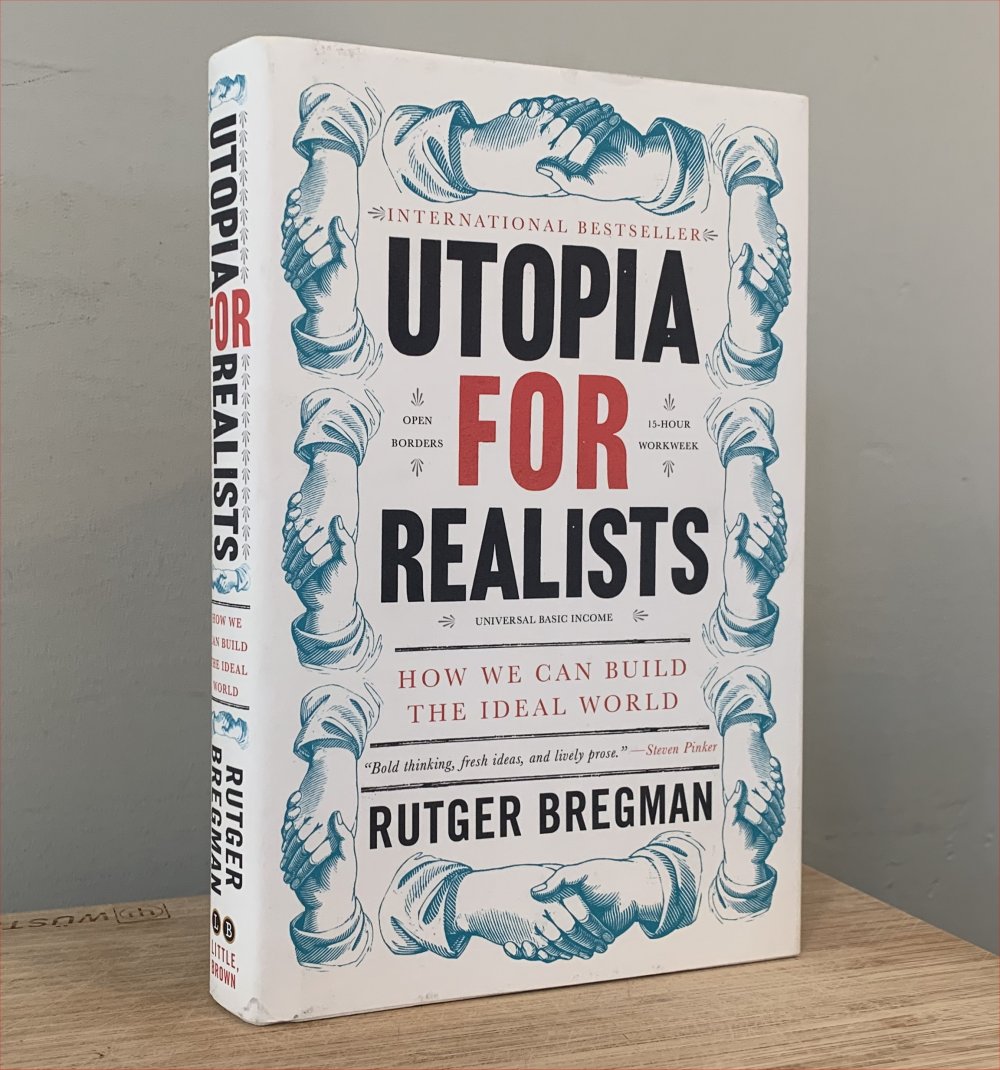
Rutger Bregman, UTOPIA FOR REALISTS: How We Can Build the Ideal World (2014/2017)

This is a breezy, fast-reading book that summarizes grand conclusions simply and directly, and then provides background references to support those conclusions in 40 pages of notes at the end.

The Dutch author is “one of the continent’s most prominent young thinkers”; the book was published in the Netherlands in 2014, and first translated into English in 2017.

The book starts out in Pinker/Rosling territory, alerting us to the fact that the world has improved greatly in recent decades and centuries, then moves through a constellation of ideas, some intersecting those in Harari’s HOMO DEUS, for improving the world, and ends with some insights from psychology about why people cling to old ideas and have trouble considering anything new. Reminding us in the final lines about how nevertheless – slavery, women’s suffrage, gay marriage – new ideas have changed society.

(I read this book a year and a half ago, and it’s one of a backlog of reading notes I mean to post here, for the benefit of anyone who might encounter this blog.)

Take-away key points:

  • The idea of free money, of universal income. Idea goes back to Thomas More’s Utopia.
    • From summary below: It’s been thought that poor people are lazy, or that free money would make people lazy. But it doesn’t, according to the evidence. Various examples show that giving poor people cash lets them invest and improve their lives—Kenya, Uganda. These programs reduce poverty and cost less that alternatives. Instead of outsiders deciding what poor people need, let them decide. Studies show they don’t spend the money on alcohol and tobacco.
    • And I’ve made this point recently: It’s not terribly expensive; people would find the work they want; and it’s less perverse than the army of welfare workers we have now that monitor all the recipients.
    • Examples; relative poverty; poverty is not about lack of character; it almost happened under Nixon.
  • Why GDP is outdated, a myth that it must always grow. It’s handy for journalists. What’s needed is a dashboard of indicators driven by a vision of what makes life worth living. Which entails asking, what is progress? [[ Rosling’s book speaks to this; I need to catch up on that summary too. ]]
  • People used to worry that leisure would be a problem, e.g. short work weeks, the Jetsons. But people are obsessed about having more stuff, and now there’s the cult of overwork.
  • People rage against the machine — how new machines take away job, e.g. the loss of job for draft horses in 1901. We have to get over the dogma that you have to work for a living. That means redistribution. As Piketty advocated.
    • [[ And this dovetails with Heinlein’s notions in his early novels, as I’ve described here. And of course matches Harari’s thoughts on a future in which people, becoming unemployed, need to find something to do. ]]
  • How to deal with poverty — a solution would be open borders. Only since WWI broke out did some countries seal their borders. Opening borders could double the “gross worldwide product.” Arguments against open borders are fallacies.
  • Leon Festinger and his study of cognitive dissonance, about the group who believed aliens would arrive. People search the internet for what they want to be the answer.
  • The Overton Window can shift. We need a conviction that change is possible. Cultivate a thicker skin: Be unrealistic, unreasonable, and impossible. “Remember, those who called for the abolition of slavery, for the suffrage of women, and for same-sex marriage were also once branded lunatics. Until history proved them right.”

Detailed Summary:

1, The Return of Utopia

  • In the past, everything was worse. Only in the last 200 years have most of us become rich, clean, healthy, etc. For centuries not much changed; the annual income in Italy in 1300 was about the same as 600 years later. Then things took off beginning around 1880. See chart p3.
  • Medieval people imagined “Cockaigne”, a place that’s pretty much like western Europe now. Now we worry about adverse effects like obesity and pollution. We can make biblical prophecies come true. And science fiction. Wealthy, hunger, disease; vaccines. Smarter; less crime.
  • We have a Land of Plenty. What’s left to do? New gadgets. What to do? We haven’t come up with any new dream.
  • This book is about unlocking the future. There have been two types of utopias: more familiar is the blueprint utopia, with rules about everything, e.g. 1602 The City of the Sun. The other is utopia as just a vague outline, finding the right questions to ask, and willingness to change. We’ve become cynical, with nothing but a technocracy, concerned about quantity, not quality. It’s all about personal freedom, but driven by the market. The welfare state focuses only on symptoms. The market and commercial interests have free reign. Thus the dystopia we have today.
  • Young people have it good, but they’re both narcissistic and fearful. Traditional guidelines from family, church, and country have been replaced… Capitalism brought about the Land of Plenty, but it’s insufficient to sustain it. The nostalgia for the past reveals a yearning for ideas that we can no longer achieve.
  • True progress is about wisdom about what it means to live well.
  • So we need alternate horizons to spark our thinking. There have been such dreamers for centuries, p21. B Russell quotes.

2, Why We Should Give Free Money to Everyone

  • In London in 2009 an experiment with 13 homeless men, costing L400,000 per year of government expenses, were given money directly instead, for a cost of L50,000/year. They were asked what they needed, and those things were supplied. A year and a half later seven of them had roofs over their heads.
  • It’s been thought that poor people are lazy, or that free money would make people lazy. But it doesn’t, according to the evidence. Various examples show that giving poor people cash lets them invest and improve their lives—Kenya, Uganda. These programs reduce poverty and cost less that alternatives. Instead of outsiders deciding what poor people need, let them decide. Studies show they don’t spend the money on alcohol and tobacco.
  • The idea of free money, or a universal basic income, goes back to More’s Utopia. A monthly allowance, no conditions.
  • In 1973 the Canadians tried it in a town in Winnepeg, a program called Mincome. The program worked well until a conservative government won the election and stopped it, even money to analyze the data. Later, Medicare archives showed the program had been a resounding success.
  • No, people didn’t stop working and start having large families; rather the opposite. School performance improved; hospitalizations dropped 8%.
  • Four other experiments were done in the US, back in LBJ’s day. The experiments worked—but were deemed politically unfeasible. In 1968 five economists, including Galbraith, wrote an open letter to congress advocating the idea. The idea was including in a bill put forth by Nixon. But the Senate was skeptical, and democrats were opposed because it didn’t go far enough. Later versions were shelved when the Seattle data showed a rise in divorces—basic income gave women too much independence. But even that turned out to be a statistical error.
  • Utopian ideas are generally dismissed as futile, dangerous, or perverse. Even democracy was, once. In 1967 80% of Americans supported gbi.
  • But the data show differently. It’s not terribly expensive; people would find the work they want; and it’s less perverse than the army of welfare workers we have now that monitor all the recipients. And so the right is afraid people will stop working; the left doesn’t trust them to make their own choices.
  • The welfare system is a vestige from an era when men were breadwinners and had the same job all their lives. But times are changing. “In the end, only a fraction of our prosperity is due to our own exertions. We, the inhabitants of the Land of Plenty, are rich thanks to the institutions, the knowledge, and the social capital amassed for us by our forebears.” P46-7.

3, The End of Poverty

  • In 1997 a new casino opened in North Carolina run by the Cherokee, despite the governor’s opposition. Income of the Cherokee to by $5500/year. It was known that poverty causes behavioral problems in children, but which was cause and which effect? The rise in income from the casino resulted in improvements among the children. Crime was reduced. The money helped parents to parent better. Both nature and nurture can cause mental-health problems, but genes can’t be undone, and poverty can.
  • But why is it poor people seem to have more problems, make bad decisions? It’s widely thought that poor people have to help themselves. A recent book claims it’s about context. There’s a psychology about scarcity. Scarcity narrows your focus. Poor people are preoccupied with many narrow decisions. Studies show the effects correspond to 13 and 14 IQ points. Studies show…
  • Reducing poverty would expand the gross domestic mental bandwidth. Reducing policy would reduce the costs of poverty. But the mindset of scarcity leads many who qualify for assistance programs to ignore them.
  • What is to be done? Nudges are cheap, but don’t solve anything. Free money is one thing, but scarcity is a perception based on what others have—thus inequality is a key problem.
  • Increasing income only increases happiness to a point. There’s no correlation between incomes and social problems, p64 chart. (The US has the highest index of social problems.) But there is a strong correlation of social problems to inequality, p65. It doesn’t matter that the poor are better off than anyone a couple centuries ago. It’s about relative poverty.
  • Poverty used to be a fact of life. The poor used to be required, to some thinking, to balance the wealthy, p68. We’ve learned better in the 20th century. Poverty is not about lack of character.
  • In 2005 Utah attacked the homelessness problem with free apartments. It got people off the streets, and benefitted the economy.
  • The same strategy worked in Amsterdam and other Dutch cities, p71. But then the financial crisis trimmed budgets and the problem returned. Despite studies that showed the investments in homelessness enjoyed double or triple returns. Still, some people merely fight the symptoms.

Ch4, The Bizarre Tale of President Nixon and His Basic Income Bill

  • How the past is a foreign country.
  • None other than President Nixon almost got a guaranteed annual income, of $1600, into law, despite conservative fealty to Ayn Rand. But then Nixon was sent a report – based on a particular book—about a town in England, Speenhamland, in the 1830s, that supposedly ruined the competitive labor market, etc. Nixon was stunned, and shifted his position to require people to register for work with the Dept of Labor, to address the (myth) of the lazy poor. Welfare became workfare.
  • But what really happened in Speenhamland? History shows plans for aiding the poor were criticized by, among others, Malthus, who worried that an expanding population would cause famine etc., and assisting the poor would just enable them to have even more children. After an uprising in 1830, the British government did a study on Speenhamland, which concluded it had been a disaster, and when repealed, the poor became more industrious and improved their conditions. The study influenced Karl Marx and others—Bentham, de Tocqueville, et al, p87.
  • But a later study showed that report completely flawed—largely written without analyzing the data, because funding was cut for doing so. Later analysis showed it had been a success. Malthus was wrong; people had children for the child labor, which was in high demand. Similarly, Marx and Engels were misguided, p89.
  • After that laws were changed that created the poor houses that Dickens wrote about—people locked up or given menial work for being poor, as remedies against sloth and depravity. The myth of Speenhamland persisted—among conservatives, among them Charles Murray—and ultimately led to the dismantling the welfare system by Clinton in 1996.
  • Orwell knew poverty. And problem with the nanny state is that it’s like a surveillance state, having unintended consequences, p96.

Ch5, New Figure for a New Era

  • The Japanese tsunami in 2011, ironically, boosted the Japanese economy, i.e. its GDP. But the GDP is outdated; it doesn’t measure many things – free stuff, the black market, advances in knowledge—treating society like a production line, and benefiting from activity that’s actually harmful. 105b: “If you were the GDP, your ideal citizen would be a compulsive gambler with cancer who’s going through a drawn-out divorce that he copes with by popping fistfuls of Prozac and going berserk on Black Friday.” Another problem is that the financial sector is included.
  • And it’s a problem, a myth, that the GDP must always grow. Certainly it’s handy for journalists.
  • Measures of society go back to 1665 and we preoccupied with financing wars. The modern GDP was developed by Simon Kuzmets for Herbert Hoover. It works well in times of war. But it’s full of subjective elements.
  • But how else to measure the quality of society? Simple happiness isn’t enough; you need some unhappiness to drive people. Other measures include the GPI and the ISEW, p118. A key issue is that some things can’t be expanded or made more efficient—a performance of Mozart, for example. And considering that manufacturing has gotten more efficient, so that products are cheaper, you’d expect things like education and health care to be relatively more expensive. Being obsessed with productivity means having no vision.
  • So what’s needed perhaps is a dashboard of indicators driven by a vision of what makes life worth living. And that entails answering the question, what is progress?

Ch6, A Fifteen-Hour Workweek

  • Keynes in 1930 predicted such a thing by 2030, and worried that leisure would be the biggest challenge to overcome. Similar predictions, or worries, were made by Benjamin Franklin, by John Stuart Mill, by Asimov in 1964—“a race of machine tenders”, p132. Henry Ford cut back the work week to 5 days, to allow his employees time to drive his cars!
  • The Jetsons portrayed such a future, where work involved pushing a single button, for a couple hours a day.
  • Why hasn’t this happened? Instead, we got more stuff. And feminism, and increased time parenting. Others tried cutting back, e.g. Kellogg, but eventually those tries faded. And now there’s a cult of overwork.
  • But working less would solve many problems: reduce stress, climate change, accidents, unemployment, and benefit women, old people, and relieve inequality. And most people agree they could use more leisure time. But getting there would require careful planning.

Ch7, Why It Doesn’t Pay to Be a Banker

  • A 1968 garbageman strike in New York City showed that it does pay to strike.
  • At least for some professions, not many—lobbyists, media consultants. Some people create wealth, others just shift it around. And ironically the latter professions are the ones that are the best paid. Farms and factories have grown more efficient, so they employ fewer people.
  • In 1970 a bankers strike in Ireland last six months, and had little effect. People created their own currency, exchanged at pubs, where they were known.
  • Bankers get rich by taxing their customers, in effect.
  • Another cause of overwork are what are called “bullshit jobs,” those that are nearly superfluous. And some of these pay very well.
  • You can shift the economy so that innovation and creativity pay off, e.g. with taxes on the financial sector to reduce their profits. The Reagan tax cuts led to more people working as bankers and accountants. Higher taxes get more people to do work that’s useful.
  • Education is too focused on predicting needed skills in tomorrow’s job market. Instead ask, what knowledge and skills do we want children to have? We want to use that extra leisure time doing things that are meaningful.
  • And now garbage collectors in NY are well paid.

Ch8, Race Against the Machine

  • One million jobs for draft horses in 1901 were taken away by machines. And now robots may take away many other jobs.
  • Moore’s law, from 1965, seems to still be in effect.
  • Shipping containers reduced time in port from 50% to 10%.
  • A ‘fact’ of economic growth in 1957, that the share of national income that goes to labor was two-thirds, has shifted to just 58%, due to technology gains. Products like iPhone and Nutella are international. Big players drive out hundreds of smaller players. We have a ‘winner-take-all’ society. This increases inequality.
  • Asimov’s prediction about machine tenders was optimistic—we may not even need the tenders. It’s estimated that 50% or so of jobs might be usurped by machines. In the past, new jobs have appeared to replace ones removed by automation. But beginning around 2000, productivity increased while jobs decreased, p187. Consider how quickly computers have learned to play chess, and win game shows. Kurzweil predicts as intelligent as people by 2029.
  • So what do we do? We face a new generation of Luddites. Recall 1812, an attack on a mill with a new type of power-loom. The Luddite rebellion peaked in 1811, and was crushed.
  • What can be done? Not much. The gap between high earners and lower classes will increase. There are calls for greater education.
  • And shorter work weeks and universal income. We have to get over the dogma that you have to work for a living. That means redistribution. As Piketty advocated.

Ch9, Beyond the Gates of the Land of Plenty

  • What about people who are still in poverty? The West has spent a lot on foreign aid, and we don’t really know if it’s helped. We have theories and surveys and gut feelings. It’s like bloodletting. Then in 2003 MIT created a Poverty Action Lab.
  • Recall the story of Daniel and his experiment about eating vegetables. In 1836 this was done for bloodletting. In 1998 it was done for foreign aid, for distribution of free textbooks. They didn’t help at all. These researchers are named ‘randomistas,’ and they set up RCTs, random control groups, e.g. about free nets vs. nets for sale. The randomistas realize that humans aren’t rational actors. One RCT debunked the idea of microcredits. Others have shown that cash works just fine. Others show that deworming works as well as free meals to raise school attendance.
  • It’s about evaluating Ideology, Ignorance, and Inertia, to see what works.
  • One that would work is: open borders. It’s estimated that could double the “gross worldwide product.” AS they effectively were, a century ago. Only when WWI broke out did some countries seal their borders. Goods and services cross borders, but not people. Opening borders would boost wealth by $65 trillion. Because borders stop people from finding better work, or markets. Only a few countries in the world are very rich—p218.
  • The arguments against open borders are fallacies: they’re not terrorists, they’re not all criminals (look at the data). They don’t undermine social cohesion—a study by Putnam in 2007 was debunked. They’re not taking our jobs. They don’t force wages down. They’re not too lazy to work. And open borders make it easier for immigrants to go back.
  • We know migration fights poverty—the Irish in the 1850s and Italians in the 1880s came to America. And now the world is building more barriers than ever.
  • Perhaps someday we’ll look back on boundaries at the borders the way think of slavery and apartheid today.

Ch10, How Ideas Change the World

  • In 1954 psychologist Leon Festinger followed a group who believed aliens would come rescue them from a flood that would destroy Lake City. How would they react when it didn’t happen? AS they sit through the fatal night, they get more ‘messages’ and update their predictions. His book, 1956, made points [exactly like we read about today]. Cognitive dissonance. Note 236b, “position in social circles”. Not about intelligence. The internet makes it worse. They search for what they want to be the answer.
  • For example, author’s encounter with evidence against his 15-hour work week idea. And author has become so attached to the idea of a universal basic income, what would happen if counter evidence came along?
  • Does this mean new ideas can’t change the world? We know that ideas have changed over time. Shocks work. How the world works, p240t. Group pressure can overcome our own senses. But sometimes a single opposing voice can make the difference.
  • In 2008 the financial crisis seemed to overthrow economic dogma. Alan Greenspan was shocked. But a few years later, his confidence was restored, and fundamental reform never happened.
  • Consider neoliberals Milton Friedman and Freidrich Hayek. They challenged their archrival, John Maynard Keynes. They were anti-government and pro free market. Their predictions seems to come true with the oil crisis in 1973, p247. Over the years Reagan and Thatcher carried the ideas on. Thus a once radical idea came to rule the world.
  • These ideas have become establishment thinking—despite the financial crisis. But we need new ideas, even if right now they’re crazy dreams.

Epilogue

  • So how do we implement these ideas?
  • Consider the Overton Window—how only ideas considered acceptable at the moment get considered. But the window can shift. You proclaim an idea so shocking that anything less radical sounds sensible. Trump and others have mastered this art. It’s been moving to the right for decades. Left-wingers are stepping back, becoming ‘underdog socialists,’ caving in on taking radical actions. They side with society’s unfortunates, but they are dull, they have no story to tell. They’re more concerned with identity than achieving results. It should be a narrative of hope and progress, told in simple language. Reform, meritocracy, innovation, efficiency, cutting the nanny state, freedom. Redefine the concept of work, to be concerned about what matters.
  • First, we need a conviction that change is possible, that utopia is within reach. See how the idea of basic income is now widespread.
  • Two final pieces of advice: first, there are more people out there like you. Second: cultivate a thicker skin. Be unrealistic, unreasonable, and impossible. “Remember, those who called for the abolition of slavery, for the suffrage of women, and for same-sex marriage were also once branded lunatics. Until history proved them right.”
Posted in Book Notes, Social Progress | Comments Off on Rutger Bregman, UTOPIA FOR REALISTS: How We Can Build the Ideal World (2014/2017)

Link and Comments: Social Health is more than Endless Growth

Recalling this post, about the US rank in social progress, and thoughts by the writer Rutger Bregman (via this NYT profile and his book Utopia for Realists), about how the GDP is a poor measure of social healthy, and the endless focus on growth of the stock market really matters only to a very few.

Here’s a post by popular Facebook writer and blogger (and retired US Navy Chief Warrant Officer) Jim Wright, today, spelling this point out:

Trump: “Stock Markets will hit new highs if President Trump wins. Tremendous growth like never before. If Biden wins, it’s strangulation. Not good.”

This is everything wrong with the modern Republican Party, with what the Conservative mindset has evolved into.

Profit hits a new high. Yay!

You never see a modern day Republican crowing about how WAGES hit a new high.

Or how the standard of living for the middle class is growing like never before.

They never talk about how more people have healthcare or enough to eat or a decent place to live.

The president never tweets about how poor people are getting a quality education to help lift the next generation out of poverty.

They never tell you how we saved a species from extinction or lowered the increasing temperatures which are driving more and more powerful storms and destroying croplands and giving rise to new and virulent diseases. They never talk about how they’ve balanced the budget or just passed a sustainable energy policy or achieved Peace In Our Time.

Nope.

It’s ALWAYS profit.

That’s the only thing which matters to them. Money. Rich people get richer. Wealthy companies get richer. The stock market is up like never before. Nothing else matters. Nothing.

“Stock Markets will hit new highs if President Trump wins. Tremendous growth like never before. If Biden wins, it’s strangulation. Not good.”

If Trump wins, rich people get richer like never before.

If Biden wins, they don’t.

Not good.

For them.

That’s what he saying here.

Posted in Social Progress | Comments Off on Link and Comments: Social Health is more than Endless Growth

Links and Comments: Against Trump; Roe v. Wade and Personal Choices; Scientists and Stories

Sunday’s NYT Opinion section — typically 10 or 12 pages — was devoted entirely to spelling out (yet again!) why Trump is such an awful president: End Our National Crisis, subtitled “The Case Against Donald Trump.” One section of which tries to answer (yet again) Why They Loved Him.

\\

The Week: If Roe Falls

As I was saying.

Would the number of abortions fall?
Yes, but not dramatically. A study from Middlebury College in Vermont found that states most likely to criminalize abortion already have the lowest abortion rates, because there are already so many restrictions.


The Middlebury study found that repealing Roe would result in a 32.8 percent reduction in the abortion rate in conservative states, but nationally, America would only experience a 12.8 percent reduction. “Even if the pro-life legal movement locates its Holy Grail,” said pro-life conservative writer David French, “almost 90 percent of the American abortion regime would remain intact.”

\\

Guardian US, Robert Reich: Trump and Barrett’s threat to abortion and LGBTQ rights is simply un-American

Trump and many Republicans insist that whether to wear a mask or to go to work during a pandemic should be personal choices. Yet what a woman does with her own body, or whether same-sex couples can marry, should be decided by government.

\\

David Gerrold today on Facebook:

Trump says that Joe Biden is going to listen to the scientists.

He says that like it’s a bad thing.

But for his cult-members, science is the enemy. These are people who went to too many movies where science was the reason why things went wrong and dinosaurs ended up eating people. Science is that unknowable power that only super-villains have, therefore it’s something to be feared.

Religious fanatics, especially cult members, hate science — because science is about evidence. Religion is about belief — and if the evidence challenges belief…? Well, there are people who would (literally) die rather than admit they were wrong.

Or to put it in the bluntest possible terms: Science flies to the moon. Religion flies into buildings.

Joe is going to listen to the scientists? Damn right. The thinking that got us into this mess is not the thinking that will get us out of it.

\\

This dovetails with Cory Doctorow’s comments recently (see several posts ago), and also a thesis by David Brin about why Hollywood usually makes scientists the bad guys. (Related is an essay by Brin, Our Favorite Cliché — A World Filled With Idiots…, or,Why Films and Novels Routinely Depict Society and its Citizens as Fools, an essay I posted at Locus Online back in the days when I was in charge of that site.)

All of these are reasons to understand that Hollywood mass entertainment tells stories that are much closer to conspiracy theories than they are to the complexities of the real world.

Posted in Conservative Resistance, Narrative, Politics, Science | Comments Off on Links and Comments: Against Trump; Roe v. Wade and Personal Choices; Scientists and Stories

Film Notes: Summer Stock and others

Lately our evening TV has trended toward checking the movie channels around 8pm (after watching the TV game shows Jeopardy and Wheel of Fortune, the former my favorite and the latter Y’s) to see what’s on. We subscribe to a set of HBO channels and a set of Starz channels and TCM, Turner Classic Movies. Usually I’m enough of a purist to see movies only from the beginning, and then watch them to the very end, all the way through the credits, as I always do in theaters. Recently I’ve become more relaxed on the first point, especially for movies I hadn’t been motivated to see when they came out.

(Yet I was fascinated to read an article somewhere recently about how common it was for families in the 1950s to show up at the theater in the middle of the movie, then stay for the next showing until they got to the point where they walked in, and then leave the theater. This strikes me as barbaric. Yet it happened to me once: when my father took me to see 2001 for a second time, back there in Glen Ellyn in late 1968, he got home from work late and so we didn’t get to the movie on time. So we watched the movie as we arrived, I think during the Blue Danube space waltz scenes, and then stayed for the next showing…and so left the theater during the Blue Danube space waltz scenes.

There’s also the point that in those days the theater managers didn’t clear the theaters between showings. You could sit there and watch the movie again and again, without paying more than once. My pals at the time and I did this with Star Wars, in 1977, at the Chinese Theater in Hollywood. We stood in line to get in, and once seated, stayed for two showings. [And then I didn’t bother to watch it again for… 40 years. I thought it was simplistic, juvenile, comic book sci-fi.])

So for example, recently,

  • We saw the last hour of “Cats,” the recent film version of that musical that was ridiculed for its weirdly anthropomorphic cat costumes. I’ve never seen the musical, but of course I know of it. Sub-points:
    • I didn’t know that the grand finale song, “Memory,” is about an aged cat about to go off to cat-heaven, the “heavy-side layer.”
    • I also thought that song was entirely an invention of the musical’s composers, but Wikipedia advises it was based on an Eliot poem not included in Old Possum’s Book of Practical Cats.
    • There have been at least two times in my life when, the first time I heard a song, it so arrested my attention that I knew I was listening to a future classic. The first was hearing “Memory”, IIFC while visiting my parents in Tullahoma around 1979 or 1980, seeing it on TV. The second was hearing Nirvana’s “Smells Like Teen Spirit” on the car radio, driving home from work. Those chord progressions.
  • We saw the last hour of “Titanic” and I was enraged when, as soon as the credits began, Starz moved the image into a box in the corner in order to play a commercial or two, with their own sound. I wanted to hear the song! (Which I know many people hate, presumably from overexposure, but I actually quite like it.)
  • We saw most of “Sense and Sensibility,” the 1995 Ang Lee/Emma Thompson adaptation of the Jane Austen novel. Austen wrote what could now be considered super-high-end soap operas, though informed by English class consciousness. I never remember the details of her stories. This one, in Emma Thompson’s screenplay and Ang Lee’s direction, builds to an amazing emotional release I wasn’t expecting.
  • We saw the original “True Grit” a while back, with John Wayne, who won an Oscar for the performance, in the typical award win for a perennial candidate who hadn’t won it for anything else. He was OK, quite good in some scenes, but so was Kim Darby, who wasn’t nominated for anything.
  • Others recently: “Blackboard Jungle,” a 1950s message movie about juvenile delinquency, with a young Sidney Poitier (a movie I’d never previously seen); the last half of “Field of Dreams” (which I saw when it came out); almost all of “Mrs. Doubtfire” (which we’ve both watched a couple times before); most of the Elton John biopic “Rocket Man” (never seen til now); some of “Crash” and some of “La La Land” (both seen on release), and so on.
  • And earlier: the animated “The Lion King,” which I’d never seen before. Some of “Doubt” and “A Simple Plan” which Y didn’t like. The “Psycho” remake (the original a film I can watch over and over, as with many Hitchcock films). Most of “The Remains of the Day” (another film I can watch over and over). “Michael Clayton.” “A Beautiful Day in the Neighborhood.” That’s back to June.

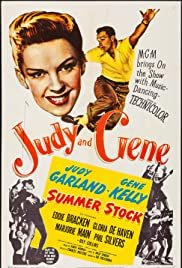
And last night, perhaps most significantly — a 1950s musical called “Summer Stock,” with Judy Garland and Gene Kelly. https://en.wikipedia.org/wiki/Summer_Stock. It’s pretty good —

And so my thought was, that for every classic movie (or novel), there are 5 or 10 others, on similar themes or with similar actors or by the same writer, that are nearly as good (or perhaps just as good or better depending on your personal criteria) but that are not as well-remembered as that classic.

In “Summer Stock” Gene Kelly’s and Judy Garland’s acting and singing is as good as in any other movie. So why is this film not as well-remembered as, say, “A Star Is Born” or “Singin’ in the Rain”? Perhaps the story, rather more cliched here, or the score, which is mostly just OK yet which has one classic song — “Get Happy”. Gene Kelly does a brilliant dance number in which he improvises a routine from a squeaky floorboard, and a loose rug.

So my thought is that a too tight focus on lists of “all time best” movies or novels or whatever might lead you to miss those many others nearly as good ones. And I’m going to apply this lesson to my own currently in-work project.

Posted in Films | Comments Off on Film Notes: Summer Stock and others