My Religious Upbringing, Such As It Was

My upbringing was not especially religious; my parents attended church, and took their kids to Sunday school, but more out of social habit and propriety, was my impression, rather than from any deep-seated faith. My parents both grew up in small-town Illinois, where they attended Methodist churches. When they settled in Apple Valley in 1958 or so, when I was perhaps 3 years old, we attended Church of the Valley (http://www.churchofthevalley.net/), a Presbyterian church along Highway 18; it didn’t seem to matter much that they switched from one Protestant sect to another. My single memory of that church—I was only 6 years old before we moved away from Apple Valley—was that we met Roy Rogers and Dale Evans, popular TV stars of the 1950s, now likely forgotten, who’d retired to Apple Valley and who also attended that church.

When we moved to Reseda in 1962 we attended another Presbyterian Church, called almost identically Kirk O’ the Valley (https://kirkval.org/), on Vanowen down the street from the large public library. There I attended Sunday School, where we were read children’s versions of stories out of the Bible, with pictures. My mother sang in the church choir, and did two services each Sunday morning. After the first service, and Sunday School, my father took us kids to the nearby supermarket Piggly Wiggly—long gone, but I think at Vanowen and Tampa—where we ate donuts, until the second service was over. It was during these years that I attained some rite of passage—confirmation?—and was given my very own Bible, bound in red, which I still have.

In early 1968 we moved to Glen Ellyn, Illinois. There we attended Southminster Presbyterian Church (https://www.southminsterpc.org/; north of us on South Park Blvd., halfway to the center of town). I don’t recall attending services at all, but I do recall attending youth group meetings on Sunday evenings, and I recall some of the projects we did, including visiting nursing homes to pass out magazines or, once, to put on a play. One meeting I remember distinctly is when the group leader walked us through the lyrics of Simon & Garfunkel’s “Mrs. Robinson” as if they held deep theological significance (never mind the ironic tone they struck in the film, which I didn’t see until years later). During the three years we lived in Glen Ellyn, we took frequent weekend trips to Cambridge, where my parents had grown up and where my grandfather, aunt, and cousins still lived, and on those Sundays we attended the Methodist church in town.

And one other youth group meeting I recall. I was thinking that throughout all these various Sunday Schools for children and youth groups for teenagers, they were never about instruction into what the church believed and why. They were about stories and dressing up on Sundays and hanging out with one’s tribe, learning its ways, to define itself distinct from other tribes; about ritual, not intellect. But I do recall an except to that general rule, at the Illinois youth group. The leader was discussing how Presbyterian beliefs were different than those of other Christian sects, the Methodists maybe. I think the example was about predestination, but it doesn’t matter. The point was that he explained what *our* beliefs were, and what the *other* beliefs were, in such tones as to make it *obvious* that we were right and the others were misguided. His intonation and body language left no doubt, and the youths listening had no choice but to agree; it was a groupthink, not a matter for discussion, certainly not one of reason or evidence.

Earlier in California and especially in Illinois I had discovered books. Not just science fiction books, but astronomy books and general science and puzzle books by various authors. (I went through a very brief phase of being fascinated by UFOs and various supernatural mysteries, through the books of Frank Edwards and others. This was cured by discovering the nonfiction of science fiction authors, ironically – I say that because of the popular impression, at least then, that science fiction authors “believe” in UFOs or whatnot, when in fact science fiction authors, being educated or at least familiar with scientific methods, are far less credulous than the average citizen. But more about this another time.)

We returned to California in the summer of 1971, in between my 10th and 11th grades in high school, just as I turned 16. After an interlude of some weeks in Apple Valley, we settled in a neighborhood of the San Fernando Valley then called Sepulveda, now called North Hills (despite the conspicuous absence of any more than half of one hill in the region), coincidentally half a block from my Uncle Bob’s house. My parents dutifully sought out the nearest Presbyterian church, Valley Presbyterian Church (https://www.valleypresbyterian.org/) on Haskell, right across the street from my high school. I may have attended once. I told my parents the next week that I’d prefer to stay home. They weren’t surprised, given my reading and the topics I found interesting. They did stage a kind of intervention, though: a pastor from the church came to the house to visit me. We sat on the sofa and he talked and invited me to pray to Jesus, or accept Jesus into my heart, or somesuch. I didn’t roll my eyes or burst out laughing; I probably just sat there uncomfortably and said nothing, and he got the hint. No doubt he checked in with my parents and the subject of my attending church never came up again.

And I’ve rarely been in any kind of church ever since, except to attend weddings.

And my siblings? As I’ll discuss elsewhere, I wasn’t especially close to my siblings, all younger than me – Sue by 4 years, Lisa by 7 years, Kevin by 9 years – simply due to age differences, especially between me and my brother. Sue was the opposite of me, in terms of temperament and intellect. For purposes of this discussion, I don’t remember anything about her church attendance. Lisa, on the other hand, took to religion in those Sepulveda years, when she was in grade school and junior high. Yet my impression and remembrance are that she found going to church charming and fun; she liked the carols and the stories; it served as her social group; it wasn’t so much about commitment to a faith. In later years she devoured the C.S. Lewis books. (I suggested Ursula K. Le Guin; she found her books dour.) And my younger brother Kevin, I have little impression at all from this era. But his life has been the major religious drama in our family. Just as I graduated from college, my parents, and Lisa and Kevin, moved to small town Tennessee (Sue and I stayed in LA). Kevin finished high school there and married his high school sweetheart from a devout Christian family, and so converted, and allowed his wife to home-school their three children, in ways I can only imagine (I’ve asked). Kevin once promised to explain to me his conversion from indifferent atheism to committed Christianity, but he never has. (Of course, I completely understand: it’s all about marrying into a religious family and community.)

\\

In later years I reflected that none of my church attendance was about any kind of education. Sunday school and church services weren’t about education; they were about stories, and ritual, and communing. The principles of the religion were assumed, and repeated so often they became unchallengeable, the way the social principles of one’s community, or country, are absorbed and assumed. Of course Sunday school could never instruct children in the content of its religion, in the way a class in algebra or science would, because there’s no reason or evidence behind the religion’s beliefs. (Parents, I suspect, become adept at deflecting questions about religious beliefs from their children – e.g. why doesn’t Billy’s family celebrate Christmas? – in much the same way they deflect questions about sex.)

\\

In later years I became fascinated by religion in principle. Writers like E.O. Wilson (in ON HUMAN NATURE) treated religion as a human behavior that could be understood as serving an evolutionary purpose, especially in a group selective way. Where there are two rival tribes or nations competing for resources, the social bonding within each group is strengthened by shared beliefs, especially shared beliefs in the superiority of one’s tribe as favored in the eyes the gods, or god. (The Old Testament is drenched with belief that God, presumably the creator or the entire, incredibly immense universe that we perceive today, had a special concern for one tribe of herdsmen in the Middle East desert, on this one tiny planet. It seemed to me obvious that other tribes had analogous beliefs, and it’s only an accident of history, not divine providence, that led one tribe’s beliefs to later prevail. One or another of them had to, and it’s apparent that history is mostly a series of accidents, coincidences, and circumstances.) In an odd sense, the more incredible the claims of a tribal religion, the more resistant they are to ordinary reason, the better they serve as a basis for these social bonds. The cost of accepting such beliefs leads to the sunk cost fallacy, where beliefs persist because the cost of giving them up and rearranging one’s life is too high.

I’ve also read a bit of comparative religion. A recent insightful book is Stephen Prothero’s GOD IS NOT ONE, from 2010, subtitled “The Eight Rival Religions that Run the World—and Why Their Differences Matter.”

(Prothero wrote an earlier book called RELIGIOUS LITERACY, in 2007, keying off the bestselling CULTURAL LITERACY from 1987, by E.D. Hirsch, Jr.; Prothero argued that most Americans, despite their supposed faith, know very little about the Bible, let alone anything about other faiths. He proposed a high school course in religious literacy, replacing, perhaps, algebra. I appreciated his motive that people should know more about the religions they supposedly believe, but I was not amused by his suggestion to replace a course about how to think for one about blind tradition.)

Prothero’s 2010 book is to challenge the nostrum that all religions are more or less the same, that they all worship the same god. No, they’re not, no they don’t. His central observation is that all the major religions presume to identify some crucial problem that afflicts humanity, and offers a cure.

  • Christianity identifies the problem as sin; the cure is salvation.
  • Islam thinks the problem is pride; the cure is submission.
  • Confucianism identifies the problem is chaos; the solution is social order.
  • Judaism identifies the problem as exile; the solution is to return to God.
  • Buddhism identifies the problem as suffering; the solution is awakening.

And, to take a later example, L. Ron Hubbard’s Scientology identifies the problem as childhood traumas (engrams), and provides an (expensive) solution for “clearing” them. All of these are analogous to the snake-oil salesman who arrives in town, squints at a citizen’s face, and says, “How long have you had that rash?? Fortunately”—pulls bottle out of his satchel—“I have the cure!” Dressed up.

They’re not the same, but they all play off human psychology, the need for simple answers, the need for shared cultural beliefs and tribal unity, and are in no way about objectively identifying truths about the universe.

(there will be more)

\\\

(The rest of what was in this original post has been moved to a separate entry on the same date.)


Posted in Personal history, Religion | Comments Off on My Religious Upbringing, Such As It Was

Sam Harris, THE END OF FAITH (2004)

Sam Harris, The End of Faith: Religion, Terror, and the Future of Reason. Norton, 2004.

In the 2000s, in the aftermath of 9/11, several well-known intellectuals wrote books examining the bases and legitimacy of religion in general. Four of them—Sam Harris (the book discussed here), Daniel Dennett (BREAKING THE SPELL in Feb. 2006), Richard Dawkins (THE GOD DELUSION in Oct. 2006), and Christopher Hitchens (GOD IS NOT GREAT in May 2007)—became known as the “four horsemen” of the “new atheist” movement, though their books were all quite different from one another. Harris was not previously well-known; he was pursuing a doctorate in cognitive neuroscience at UCLA when he was motivated to write his book, specifically concerned with Islam, following 9/11.

There were numerous other books on similar topics, by Carl Sagan, John Allen Paulos, A.C. Grayling, and others. But these four were the best known.

I read these books as they appeared with great interest and fascination. Their arguments were not necessarily new—philosophers and scientists had been debunking the various arguments for the existence of god (whichever god the claimant might imagine) for centuries, and the violent and intolerant history of most religions has long been well known. The authors’ sometimes calm and sometimes pointed dismantling of supernatural religious claims seemed to me merely obvious, the kind of thing smart people realize on their own, even if they know better than to assume others think the same way.

But the appearance of these books made public discussion of the pros and cons of religion respectable in a way it hadn’t been; no longer a subject to be avoided in polite conversation for fear of offending the credulous. Critics didn’t answer their arguments so much as dismiss their presumption to make them, on the grounds they were insufficiently schooled in theology, or religious history, or whatever. The response to that line was PZ Myers’ famous “courtier’s reply” (https://en.wikipedia.org/wiki/Courtier%27s_reply), in which insufficient knowledge of high couture is used to dismiss critics of the emperor’s new clothes.

So here’s a summary, first overall then in detail, of the first of these: Sam Harris’ The End of Faith: Religion, Terror, and the Future of Reason.

Super Brief summary:

Harris was the first of the “four horsemen,” public intellectuals who published controversial books about religion in the years following 9/11. He discusses the irrationality of faith and of rival faiths, with particular concern about the dangers of fundamentalist Muslims whose belief system would exterminate unbelievers. Also, the pernicious influence of Christians on American politics, issues of morality that can be addressed through reason, and the spiritual aspects of human existence that should be rescued from the irrationality of faith.

Brief summary:

  • Ch1, Harris explores the incompatibility of rival faiths, and of reason and faith, while hinting that nevertheless there is a “sacred dimension” to existence that must be respected. Moderation in religion is fiction when fundamentalists consider moderates as bad as unbelievers. The incompatible claims of religions deserve no respect. Religious beliefs, immune to evidence, will one day be looked back on as impossible quaint and suicidally stupid.
  • Ch2, Beliefs should correspond with the world, and be logically coherent; belief in God equates to no factual knowledge about the world, Saying it makes you feel good isn’t a reason. Faith is credulity that abandons constraints like reasonableness, internal coherence, civility, and candor. Faith isn’t required for a doctor or engineer. Faith leads billions to believe what no sane person would believe on his own. The most monstrous crimes against humanity have been inspired by unjustified belief.
  • Ch3, About the sordid history of Christianity: the Inquisition, putting heretics to death, obsessed with demonstrating how Jesus fulfilled prophecy, the imagined rituals of the Jews, the complicity with the Holocaust.
  • Ch4, about Islam, which has more than its share of bad beliefs: its support of suicide bombers, its belief that martyrs are rewarded in paradise, the Koran’s endless passages that vilify unbelievers. Claims of moral equivalency for the sins of the US ignore intentions. Dealing with Islam is like thinking how to live with Christians of the 14th century. Islam must transform itself, from within, or a world government may be needed to confine it.
  • Ch5, Politicians in the US regularly pander to the religious; some actually apply Biblical morality. Legal policies derive from the Christian idea of sin, never mind many such crimes are victimless, never mind that other activities actually are harmful. Thus drug laws, stem cell research, the option of abortion. We need better ways of answering questions about right and wrong.
  • Ch6, The issue of good vs. evil can be cast as a question about happiness and the suffering of sentient creatures. What the ancients thought is irrelevant. “What can be asserted without evidence can also be dismissed without evidence.” Moral relativism is self-contradictory. Pragmatism offers no solution. Realism is better. Intuition can be useful, but its guesses can be tested. Reason can link morality and happiness.
  • Ch7, Author discusses ‘mysticism’ or spirituality as something to rescue from religion, which would hold “bad concepts in place of good ones for all time” in denial of “the vastitude of human ignorance” (that can be steadily overcome); thus we need the end of faith.
  • And in the epilogue, he pleads for an end to a “certain style of irrationality” the better to appreciate the true mystery of the universe and our place in it.

The book isn’t just a renunciation of the idea of faith, but the author’s attempt to save what he considers spiritual experiences from the shackles of irrational faith. Some of these themes — morality, lying, spiritualism — emerge more fully in his later books. I’m not completely in synch with his appeal to “spirituality” or his occasional leaving the door open to “psychic phenomena” (which I think have pretty much been shown not to exist), but the bulk of the book is very solid. To get a flavor of his writing, glance down the page and read the passages I’ve block-quoted.

–Detailed summary:

Ch 1, Reason in Exile

A young man boards a bus and detonates a bomb, killing himself and twenty others. When told, his parents are sad but proud; he has gone to heaven. What can we infer about such a person? Not much—except that it’s trivially easy to guess his religion.

Beliefs are mere words—until you believe them. Many of our cherished beliefs are leading us to kill one another. Most people in the world believe that the Creator of the universe has written a book. But there are many such books on hand, and so people align themselves along these factions. They seem to share a lack of ‘respect’ for unbelievers. Page 13:

Our situation is this: most of the people in this world believe that the Creator of the universe has written a book. We have the misfortune of having many such books on hand, each making an exclusive claim as to its infallibility. People tend to organize themselves into factions according to which of these incompatible claims they accept—rather than on the basis of language, skin color, location of birth, or any other criterion of tribalism. Each of these texts urges its readers to adopt a variety of beliefs and practices, some of which are benign, many of which are not. All are in perverse agreement on one point of fundamental importance, however: “respect” for other faiths, or for the views of unbelievers, is not an attitude that God endorses…

Unfortunately criticism of a person’s faith is taboo, everyone seems to agree. Thus when Muslim suicide bombers strike, his motives are assumed to be political or economic—not simply motivated by his faith. Modern technology makes the faithful ever more dangerous; it is thus imperative to send such ideas to the graveyard of bad ideas, as alchemy has gone before it.

Of course there are ‘extremists’ and ‘moderates’, but the latter are as much of the problem, for they support that respect for the unjustified beliefs of others. Two myths: that religion provides good things that nothing else does; that the terrible things done in the name of religion are due to base motivations other than the faith itself. In any case, faiths routinely criticize the errors of other faiths. The so-called truce between reason and faith is another delusion. And yet—there is a sacred dimension to existence; it just requires no faith in untestable propositions to pursue.

The Myth of ‘Moderation’ in Religion

Despite the implausibility of the idea that any one religion represents the sole truth, most people say they believe various literal notions—that the bible is inerrant; that god directed creation; etc. Presumably ‘moderates’ have decided to ignore, or loosely interpret, their canonical books in order to live in the modern world. Thus they don’t kill their children for converting to another religion, as Deuteronomy instructs (p18). Moderation has been forced by advances in human thought from elsewhere—democracy, human rights, etc. Even fundamentalists require evidence for mundane claims (p19). Most people know more than anyone did 2000 years ago; we don’t equate disease with demons, etc.

But to fundamentalists, moderates are as bad as unbelievers; and moderates do not permit criticism of even fundamentalist belief. Moderates implicitly endorse belief systems passed down from people who knew nothing about the world. A well-educated 14th century Christian would be an ignoramus by today’s standards—but he’d know everything there is to know about god.

Nor does religion progress, incorporating new knowledge. Whatever is true now should be discoverable now… p22

The Shadow of the Past

Religions preach the truth of propositions for which there is no evidence. Should all knowledge disappear overnight, we would need to relearn many things, but knowing Jesus was born of a virgin wouldn’t be at all useful. How would that even be re-learned –except by reading a book? But there are many books; why not believe similar facts about Thor or Isis?

Hasn’t religion enabled communities to cohere? Yes, but it’s also responsible for wars of conquest. There are plenty of past things we hope never to return to: slavery, cannibalism, etc. (p25). Religion is a vanishing point beyond which rational discourse proves impossible.

The Burden of Paradise

The world is full of people killing others for the sake of their religion (list p26). India and Pakistan verge on nuclear war; are their beliefs to be ‘respected’? Islam represents a particular danger at this point in history. Why do Muslim terrorists act? They are not poor or uneducated. And the answer is that such men really believe what they say—the literal truth of the Koran. An explanation reluctantly accepted.

Muslim Extremism

They are extreme in their faith, and thus belief that western culture would lead their families away from god. They fear contamination; they’re consumed by feelings of ‘humiliation’ over seeing a godless people become masters of the world. This isn’t ordinary hate. Bin Laden is most upset by the presence of unbelievers in the Muslim holy land… And most terrorists are explicit about their desire to get to paradise.

Some argue that it isn’t faith itself that inspires such violence, that e.g. Islam is a ‘religion of peace’—but the Koran itself says this isn’t true. Muslims view cultures of partial revelation, Jews and Christians, as inferior in every respect. The Koran makes martyrdom sound like a career opportunity; to be preferred over staying at home. The appropriate response isn’t to quibble about the line in the Koran that forbids suicide… but to challenge the entire presumption that such books are the literal word of God. (How do we know they are? Because the books themselves say so!) Imagine a world in which people believed that certain films were made by God, or software..?

Death: The Fount of Illusions

We live in a world in which everything is eventually destroyed. We each contain a virus that will eventually, tomorrow or in decades, kill us. We worry about ourselves, and our loved ones. We can disappear into the world or within ourselves. We’ll all die eventually. So of course the idea that you won’t die is an attractive one—and carries one to a faith-based religion. Religious moderation leads to a world in which a person who doubts the existence of heaven and hell could never be elected president.

The World beyond Reason

There is of course a range of human experience that could be called ‘spiritual’ or ‘mystical’, and while these are associated with religion, they in no way endorse particular books. There’s also data “attesting to the reality of psychic phenomena…” (p41.2 –!?) The problem of dealing with religion is to reconcile such experiences with the beliefs that have grown up around them. “We cannot live by reason alone.” But spirituality can, must, be deeply rational.

Coming to Terms with Belief

Belief is more than a private concern when beliefs translate into actions. Certain beliefs are intrinsically dangerous.

We must admit that there’s no evidence that any of our books was authored by the Creator of the universe (45.0) Reason must transcend national and religious boundaries (there is no ‘American’ physics). Religion does not admit such discourse; no evidence is involved. We can’t tolerate diversity in religious beliefs any more than we can beliefs about hygiene.

Gathering Our Wits

Our own national discourse has a dark current of unreason. The president routinely cites God and attends prayer groups.

If we’re still here in 200 years, something will have changed, or we would already have killed ourselves. We’ve reached the age where a single person can destroy a city. Our descendants will look back upon many of our beliefs as impossibly quaint and suicidally stupid. So our task here is to identify those most dangerous beliefs, and subject them to sustained criticism. Maybe this time hasn’t arrived—but author prays, in the spirit of prayer, for day it will happen.

[[ Is Harris going to suggest, in response to the litany of dangers he identifies, what can be done about it? Is it possible to defuse religious belief? ]]

Ch2, The Nature of Belief

Believing a proposition means believing that it faithfully represents some state of the world, 51t; thus we should value evidence and demand that propositions logically cohere. 51.3:

“Freedom of belief” (in anything but the legal sense) is a myth. We will see that we are no more free to believe whatever we want about God than we are free to adopt unjustified beliefs about science or history, or free to mean whatever we want when using words like “poison” or “north” or “zero.” Anyone who would lay claim to such entitlements should not be surprised when the rest of us stop listening to him.

Beliefs are principles of action; they are processes of understanding the world and made available to guide our behavior. Might some propositions be so dangerous that it would be ethical to kill people for believing them? 53.0

Beliefs require logical coherence with each other. You can’t believe opposite things or contradictory things. Humans are not actually perfectly coherent, as in examples of cognitive dissonance. Example, p55, of a hotel room in Paris overlooking the American embassy. Even a perfect brain couldn’t keep track of the logical consistency of more than about… 300 beliefs.

Beliefs are representations of the world, and they should require that they be true (not that we just wish them to be true). Thus ‘because’ = by cause. What does it mean to believe that God exists? Because why? There’s no reason equivalent to factual knowledge about the world; and saying so because it makes you feel good isn’t a reason. Thus Pascal’s wager, Kierkegaard’s leap of faith are “epistemological ponzi schemes” 63.0. Most people’s reasons, about spiritual experiences, trust in authority, etc., are typical games of justification; but if a belief represents an actual state of the world, it must be vulnerable to new evidence…

Is faith the same as belief? There are rarefied ideas about faith (Tillich) but author takes it to be the ordinary sense. 65.7: “Faith is what credulity becomes when it finally achieves escape velocity from the constraints of terrestrial discourse—constraints like reasonableness, internal coherence, civility, and candor.”

Faith is eager to find phenomena that seem to confirm their faith; but it doesn’t stoop to reason when there are no good reasons to believe, 66m.

We don’t require faith in other spheres of life—we require the engineer or the doctor to have reason for their claims about the world. But not the priests. How does the priest or mullah know that God wrote their holy books? They don’t, not in any way that uses the word ‘know’ properly, 67.3

The men who flew the jets on 9/11 were men of perfect faith.

No doubt the faithful reading this will claim the consolations of their faith. Indeed, the faithful hold truth in highest esteem, 68.3; 68.8: “The faithful have never been indifferent to the truth; and yet, the principle of faith leaves them unequipped to distinguish truth from falsity in matters that most concern them.”

The dividend of faith is the conviction that the future will be better than the past, 69b. Despite the actual world, e.g. long quote p70 about the Black Death.

Smry so far, 71b-72. There is sanity in numbers. 72m:

And yet, it is merely an accident of history that it is considered normal in our society to believe that the Creator of the universe can hear your thoughts, while it is demonstrative of mental illness to believe that he is communicating with you by having the rain tap in Morse code on your bedroom window. And so, while religious people are not generally mad, their core beliefs absolutely are. This is not surprising, since most religions have merely canonized a few products of ancient ignorance and derangement and passed them down to us as thought they were primordial truths. This leaves billions of us believing what no sane person could believe on his own.

Example: transubstantiation. You can eat Jesus Christ in the form of a cracker. “Because each new generation of children is taught that religious propositions need not be justified in the way that all others must, civilization is still besieged by the armies of the preposterous. We are, even now, killing ourselves over ancient literature. Who would have thought something so tragically absurd could be possible?”

So what should we believe? We all rely on the authority of others; the more educated we become, the more our beliefs come to us second hand. Examples: a news report; a scientific conclusion; a religious claim. Which should you believe? By what justification are we to believe or disbelieve each one?

We should examine closely what is really in our holy books. “A close study of these books, and of history, demonstrates that there is no act of cruelty so appalling that it cannot be justified, or even mandated, by recourse to their pages.”

Thus the Spaniards in Mexico and Peru would baptize infants – before bashing their brains out (cf Bertrand Russell).

Yes some faithful benefit others. But the most monstrous crimes against humanity have been inspired by unjustified belief. Even Stalin and Mao operated on a political religion, communism. And the Soviet Union followed Lysenko rather than the “capitalist” biology of Mendel and Darwin.

Ch 3, In the Shadow of God, p80

The terrible consequences of Christianity. The Inquisition started in 1184; people were accused of heresy, or often of casting spells to bring disease or storms (before science people thought such things were possible), and put to torture until they confesses, and often to implicate others. The Bible requires that heretics be put to death (p82), in Deuteronomy. The Dominican order was particular enthusiastic about this. Torture often ended in the ‘auto-da-fe’, the public burning.

Witches and Jews were particular targets of Christian zealotry. Jews, in a sense, collaborated in being despised through their own sectarian belief in being the ‘chosen people’.

P94. Biblical writers and scholars went to great lengths to demonstrate that Jesus fulfilled prophecy, and therefore must be the son of God; such arguments impressed even Pascal into a conversion late in life. But some tenets of faith may have arisen out of mistranslations—‘virgin’, for example, re Mary (the word could just as well have meant a young woman).

Jews were often thought to practice bizarre rituals involving the blood of Christian babies – ‘blood libel’ – or of ‘host desecration’, bringing harm to the wafers used in the Catholic ritual of transubstantiation.

The Holocaust came about after decades of anti-semitism rooted in Germanic tribalist attitudes about the special role and purity of the Aryan race (not just Hitler et al). The Catholic church collaborated in a sense, by providing information, by helping Jews escape only if they’d be baptized, and by remaining mute on the subject even while persecuting scholars who engaged in ‘modernism’, i.e. scholarly examination of the Bible that led some to doubt its inerrancy. The Church banned Descartes, Lock, Voltaire, Paine, Kane, Darwin.

The history of Christianity is “principally a story of mankind’s misery and ignorance rather than of its requited love of God.”

(Harris supplies extensive notes to the main text. For example in this section, Note 5 about how William Tyndale was punished for having translated the New Testament into English—a capital offense at the time, p82.2; about what Deuteronomy says; about John 15:6; about an 1860 book that compiled outright contradictions in the Bible.)

Ch 4, The Problem with Islam, p108

All religions have their share of insupportable beliefs, but Islam has more than its share of bad beliefs. We’re at war with the Muslim worldview—the beliefs, stated over and over in the Koran, that Muslim must destroy nonbelievers, engage in ‘jihad’. In Islam changing one’s faith or renouncing Islam is punishable by death. Polls of Muslim countries find widespread support for ‘suicide’ bombers against civilian targets, p124.

Some writers address the issue of why the Muslim world has stagnated in recent decades, or why it is Muslims so often feel ‘humiliated’, but avoid the literal content of the Muslim religion [a recurrent theme for Harris] – they really do believe their martyrs are rewarded in paradise, etc.

Long list of quotes from the Koran that vilify unbelievers, 117ff, for five full pages!. Note ‘People of the Book’ phraseology.

He notes how the description of the Koranic paradise reflects the limits of human imagination, p127-8.

What will happen when such people get long range nuclear weapons? Democracy isn’t necessarily the answer; the people in some countries just vote back in theocratic leaders. Nor is education; many terrorists have had western educations and advanced degrees.

The problem was once called a ‘clash of civilizations’—Edward Said objected to generalizing about an entire culture or religion. The problem is the faith itself.

Is Muslim ‘humiliation’ at the root of terrorism? But democracy in these countries would only enforce sharia law. Many of the terrorists had decent educations.

P136b here’s another solution to Fermi’s paradox—a toxic faith that destroys the world in favor of being transported to paradise.

It’s popular among some to claim a kind of moral equivalency – that the west brought 9/11 upon itself, that terrorism is in response to western oppression. Noam Chomsky is an example. Many of his points are well-taken (the sins of the US), p140. Anudhati Roy makes similar arguments about American arrogance, p142. But there is no equivalency. We can see the distinction but considering the ‘perfect weapon’ that could kill or disable precisely at a distance, and imagine how GW Bush would use it vs Saddam Hussein. Not all cultures are at the same stage of moral development, p143m. Consider New York of a century ago, or My Lai in 1968. There are good and bad ways for a culture to behave, p145 [[ this anticipates his later book The Moral Landscape ]] Even if the US does kill innocents or behave badly, it expresses remorse. Intentions matter.

Bottom line is the colossal waste of time and energy taken by religious practice (see p149.2). All the good things religion does can be had elsewhere.

What to do about Islam? It is like thinking how to live with Christians of the 14th century. We need a civil society, meaning a society where ideas can be criticized without risk of physical violence, p150b. Even if imposed from without. Ultimately, a world government. And Islam must transform itself, from within. And the west should develop new energy sources.

Ch5, West of Eden, p153

Compared to Islam the influence of religion in the west is rather benign. But still, politicians regularly pander, and religious leaders often hold major influence on politicians, e.g. Falwell and Reagan. And Christians ‘support’ the state of Israel (cynically) because they believe it heralds the second coming—and the destruction of the Jews! P153.8

Politicians and judges routinely apply Biblical morality, e.g. Judge Roy Moore, who insisted on erecting monuments to the 10 commandments. Other examples. Tom DeLay. Antonin Scalia, long quote 156-7, finding guidance in St. Paul and perhaps Leviticus, 158.

Legal policies derive from Christian’s attitude about sin; thus drugs, prostitution, and so on. It doesn’t matter if these are ‘victimless’; if God sees everything, there is no such thing as privacy, and laws are put in place to avoid angering God. Thus the state still prohibiting oral and anal sex. Drug laws. They’re not about health, since cigarettes and alcohol are still legal and more harmful. The draconian drug laws, and the amount spent, considering other things such money could be spent on. Prohibition just drives up the market. In fact, terrorist groups often depend on drug revenue! 164t.

We don’t celebrate other sources of irrationality (astrology, reasoning biases, 165.6), only religious faith.

Thus laws against research on human embryonic stem cell, banned in 2003. Bush cut funds to group who would mention abortion.

Rightly criticized, some try to delink such events from religious faith—Nicholas Kristof, e.g., exonerating faith p168.

We need better ways of answering questions of right and wrong.

Ch6, A Science of Good and Evil, p170

Is the difference just whatever people say it is? Recall cat burning in 16th c Paris. Ethical truths seem contingent; without a rule-making God, how do we know what’s right or wrong?

We recast the question as one about the happiness and suffering of sentient creatures, p171. From that pov, much of what people think of about morality is irrelevant. It doesn’t matter what the ancients thought; we can seek answers in the present. We don’t derive a sense that cruelty is wrong from the Bible; we have a rudimentary sense that it is. what we know about the natural world is evidence of no creator who is not a monster; Bertrand Russell quote p173t. The God of Abraham is capricious, petulant, and cruel. The problem of God and evil, the problem of theodicy, has no solution; (long footnote about free will).

These questions should be tied to our understanding of the consciousness of other creatures. Thus Descartes, convinced that nonhuman animals were mere automata, allowed vivisection, p174. The Spanish supposed the Southern American Indians had no souls. How can we know if other animals can suffer? (long footnote 11) (Also note footnote 13, in which author steers clear of past philosophical approaches in favor of starting fresh.)

Religious dogma is of no help. Hitchens: “What can be asserted without evidence can also be dismissed without evidence.” P176.

The idea of moral communities clarifies some matters. Religion only advances tribalism. Then how do we draw boundaries of moral concern? Not just ability to feel pain. Author has no simple solutions; examples 177-78.

Relativism is a demon; intellectuals sometimes speak as if all worldviews are on equal footing; add Kuhn, and can we ever really know everything? But this is nonsense. It implies that tolerance of all viewpoints is necessary; this itself is a moral stand. Moral relativism is self-contradictory.

Another approach is pragmatism, as discussed by Richard Rorty. This is the idea that a statement is true only to the extent that it functions in some area of discourse—not that it is ‘really’ true about the universe. Thus different views of the world might be useful at different times. This suggests one can never be right about anything; recalls Yeats, 180.7.

This is as opposed to realism, in which statements are true or false based on how reality actually is. We may not understand all truths, but they are there waiting to be discovered. But is this even possible without mediation by our language and thus interpreted? But the pragmatist’s argument against this possibility relies on realism being realistic or not; a self-contradiction (long footnote 23). So truth is not a matter of consensus; everyone might agree on something and still be wrong. And so we proceed as if facts, even about ethics, can be discovered.

P182. Intuition is generally scorned (except among mathematicians). Yet intuition underlies our use of reason itself. It’s a necessary first step. We know intuition can mislead p183b [[these are ways in which we are unable to perceive the world]] Intuitions underlie superstitions; but these can be tested. For ethics to matter, the happiness and suffering of others must matter to us. We understand that not everything evolved is good for us (erroneously called the naturalistic fallacy).

We are not limited by our genetic priorities; we are not completely selfish. We treat each other out of concern for others’ happiness (the golden rule etc 186b). These observations hold even for people who claim no concern for others. Christians do not seem to be especially concerned about honor killings, which seem invariably Islam. We can say that the men who commit such acts love their women less than men in the West do, but it’s not polite to think so. It’s not just cultural; it’s a failure of ethics.

We can use reason to link morality and happiness. Happiness can be improved by being loving and compassionate. (long footnotes 31 on ethical intelligence.) We used to think torture evil, but some are reconsidering it in this age of terrorism. And this isn’t really any different from accepting collateral damage in the deaths of civilians. If we are willing to do one, we should be willing to do the other.

Pacifism seems morally unassailable, even though difficult in practice, but it is immoral—it’s the willingness of pacifists to be killed by thugs. P199.

Author tells about incident in Prague in which he diverted a couple thugs so a woman could escape. But he did so by lying and not confronting the men directly.

Gandhi made great successes but his remedy for the Holocaust was that the Jews should commit mass suicide.

Given the threat is Islamic fundamentalism, we must be ready to resist by any means necessary.

Ch7, Experiments in Consciousness

It’s undeniable that one’s experience of the world can be radically transformed. The problem with religion is that it blends this truth with the venom of unreason. A component of happiness that isn’t about food and shelter can be called spirituality, p205. That and mysticism both have unfortunate connotations, but author will use them interchangeably.

Consciousness… It’s assumed now that the mind is a product of the brain, but in truth we don’t know what happens after death. Investigating the nature of consciousness through sustained introspection is another name for spiritual practice. It’s perfectly rational to carry out various experiments, as long as we don’t make claims about the world without empirical evidence, p210.4.

Each person is a system that is in turn an eddy in the great river of life. Even our minds are composed of things from all around us, scarcely under our own control. So what is this feeling of self? p212 It’s about appropriating the world, not just being. … Humans experience a duality of subject and object, and thus a sense of separateness. But to explore a spirituality that undermines such dualism has an obstacle in current beliefs about God.

So we turn to the wisdom of the east. No western philosophers can rival those from the east. Perhaps because of the western idea of faith. He compares a passage from Buddhist literature to anything in the Bible, p216. Meditation, to author, is about making the sense of self vanish. The obstacle is thinking.

[[ I see him jumping the shark here … I’m glazing over. ]]

P221:

Mysticism is a rational enterprise. Religion is not. …. The roiling mystery of the world can be analyzed with concepts (this is science), or it can be experienced free of concepts (this is mysticism). Religion is nothing more than bad concepts held in place of good ones for all time. It is the denial—at once full of hope and full of fear—of the vastitude of human ignorance.

Epilogue

Nice summary paragraph, page 223:

My goal in writing this book has been to help close the door to a certain style of irrationality. While religious faith is the one species of human ignorance that will not admit even the possibility of correction, it is still sheltered from criticism in every corner of our culture. …Our religions have seized upon ancient taboos and prescientific fancies as though they held ultimate metaphysical significance.

Is the problem hopeless? How to get billions of people to reconsider their religious beliefs? And yet we have no reason to think we can survive our religious differences indefinitely. Just give children honest answers to their questions.

Page 225:

Where we have reasons for what we believe, we have no need of faith; where we have no reasons, we have lost both our connection to the world and to one another. People who harbor strong convictions without evidence belong at the margins of our societies, not in our halls of power.

Page 226:

There need be no scheme of rewards and punishments transcending this life to justify our moral intuitions or to render them effective in guiding our behavior in the world. The only angels we need invoke are those of our better nature: reason, honesty, and love. The only demons we must fear are those that lurk inside every human mind: ignorance, hatred, greed, and faith, which is surely the devil’s masterpiece.

And the last paragraph, page 277:

Man is manifestly not the measure of all things. This universe is shot through with mystery. The very fact of its being, and of our own, is a mystery absolute, and the only miracle worthy of the name. … No myths need be embraced for us to commune with the profundity of our circumstance. … The days of our religious identifies are clearly numbered. Whether the days of civilization itself are numbered would seem to depend, rather too much, on how soon we realize this.

Posted in Book Notes, Culture, Religion | Comments Off on Sam Harris, THE END OF FAITH (2004)

My take on religion and its role in society, circa 2004

My take on religion and its role in society, circa 2004

Back when I first read Sam Harris’s THE END OF FAITH, published 2004, and later books by Dennett, Dawkins, Hitchens, et al, I took notes on the books but also wrote down my general take on the appeal of religious faith and how I thought religion functions in society. These sum up my attitudes about the subject over my early life, beginning in my middle teenage years when I politely declined to continue attending church with my family, up until publication of those books (and some websites) led me to consider the issues more closely.

  • One idea I haven’t seen discussed (I wrote in 2004) is why most people, who assume religion to be a good thing per se, thereby are much more disrespectful of atheists than of people who follow different religions from their own. You’d think if someone believes their own religion is the only truth and all others are mistaken and whose believers are condemned to hell, that those of other religions are just as wrong as those who follow no religion. Yet the disregard most people express for atheists isn’t consistent with that. My own interpretation of these circumstances is that people assume religion—any religion—is a good thing per se, because it signals a degree of social conformity and tribal identity, without which (as in the atheist’s case) a person is an unpredictable ‘free agent’ representing a greater risk to society or oneself than anyone subscribing to any religion. A person following a religion has ‘submitted’, in just the way the literal term Islam indicates.
    • This is perhaps why it doesn’t seem to bother most people that the particular religion they follow is merely that which they were born into. It was never a matter of considered choice. It doesn’t matter, in some sense; any religion will do. (A curious example, in a sense, of ‘relativist’ thinking, that believers worry about in the absence of religion.)
    • It’s also the case, I think, and this is something Harris at least doesn’t allow for (but Steven Pinker in his later books does), is that *most* people who say they are religious do *not* in fact believe as literal fact all the details of what their religious books say. Or even *know* what those books say. In fact, most people haven’t made deliberate study of what to ‘believe’, because following the example of their family or community doesn’t require them to. If pressed, I suspect most US Christians, for example, would disavow the many harsh passages of the Bible, while insisting on adhering to the general spirit of a God-focused universe and a Jesus-centered regard for humanity. (I suppose these are the ‘moderates’ Harris does speak of, in his first book.)
  • Another idea the religious themselves don’t appreciate the easy way any talk of ‘god’ conflates to the same ‘god’. For example, a common ‘proof’ of god is that of the first cause: everything has a cause, the universe exists, it must have had a cause, etc. Even if you accept this, how does the idea of ‘god’ as first cause presume that any particular idea about god, any particular religion, is thereby justified? But religious defenders do this all the time. It’s very sloppy thinking.
  • Elementary illustrations of how events are recorded in history, from the accuracy of the daily paper to childhood games of ‘telephone’, not to mention how tales grow in the telling, become folk tales, and change over generations, should make anyone skeptical of the veracity of any ‘holy book’. Is this how people assume all those *other* holy books came to exist, perhaps?
  • Harris does mention a profound irony in the way religious defenders accuse scientists of being arrogant, when in fact it’s the scientists who happily admit what they do not know, and the religious defenders who presume that the creator of the universe has particular interest in their own daily lives. Human religions are, in the broad sense, a reflection of the natural but naïve notion that humans are the center of existence, all that matters, and everything not known can be disregarded.
  • Another idea I haven’t seen anyone suggest, or put forward [I later collected many such examples and even formulated 10 Provisional Conclusions, not the same as commandments but similarly structured]: what rationalists/atheists/whatever need is some very simple, easily listed, set of precepts that would serve as a counterpart to the ’10 Commandments’. Here again religionists claim that without such precepts, there’s no basis for morality, etc. (As if, without checking the list in the Bible, no religious person would ever guess there’s anything wrong with stealing or murdering.) It should be easy to come up with a set of (non-religious) principles that would in fact serve as an easily-agreed to basis for morality. (Starting with the Golden Rule)
  • The central issue about religion is—why believe that particular unverifiable myth as opposed to any other? What is the reason? It’s easy to understand the existence of this ancient text or that holy book on purely historical grounds, and based on easy-to-imagine primitive rules of social conduct and naïve speculation about the nature of the universe. Such justification entails no basis for accepting the content of said book as true. Why is God or Allah any more plausible than Zeus or Ooga-boogah the Rain God?
  • Because of social tradition and community or personal circumstance? That seems to me like the best possible answer. I understand that most people who subscribe to a religion don’t do it because for whatever reason they’ve signed on to every article of its faith—every verse of the Bible or Koran, as the word of God. But so many, so many social habits have been adopted, without thinking, because of tradition, and personal exposure at impressionable ages, and subservience to community standards. None of them have anything to do with the reality that would still exist if human history started over, or the reality that would exist for an intelligence arising on another planet. Real reality can be rediscovered from itself. There is no Christian reality, vs Islam reality or Catholic reality.

Later Refinements

Over the past 15 years I haven’t substantially changed my thoughts on any of these points, but let’s see if I can add a few refinements.

  • In science fictional portrayals of the far future it is routine to ignore religion and/or assume that society has matured and left behind such irrational belief systems. Some works by Arthur C. Clarke (I’m recalling Childhood’s End) state this decline in religion explicitly, and statistics do in fact show that the better-educated and wealthy a nation is, in the modern world, the less religious they are – think northern Europe including England. Suggesting that as the world grows more wealthy and peaceful, the trends Pinker detects, religious faith will dissolve away. The US, as in so many things, being an exception that proves the rule. Because of those statistics I still find the idea of a future global society, one that has overcome poverty and improved education, plausible, if such threats as resource shortage and climate change can be solved. On the other hand, religion endures not because of its epistemological plausibility but because of its social function; it’s a way of bonding social groups, and the nominal acceptance of the tenants of any particular religious is a way of signaling loyalty to the group. The more outlandish the tenants, the better, for this function. That’s why, given so many ways humanity might slip back from modern culture, I’m sure religion will never go away.
  • At best—and this is my provisional conclusion of recent years—the understanding that religion’s supernatural claims about reality are obsolete is largely a private, individual project. Educated, well-read people easily perceive the contingent nature of religious belief, and its social functions, and will disregard its presumptions to identify cosmological truth, not only because of the rival claims of thousands of other religions, and the way their claims arose from the traditions of primitive tribes, but also of course because of the systematically discovered and tested discoveries of science in recent centuries and decades. But you still don’t casually mention this in public. The nature of social grouping, especially in physical small towns or neighborhoods, makes this difficult to acknowledge of speak of. Conversely, any number of virtual social groups, or groups bound by profession, do support this understanding, at least in the way no members of these groups would ever imagine their fellow members were among the faithful. But the individual has to find them. Charles Mackay, 1841, in “Memoirs of Extraordinary Popular Delusions,” wrote “Men, it has been well said, think in herds; it will be seen they go mad in herds, while they only recover their senses slowly, and one by one.”
  • Studies show that casual believers know less about the content of their holy books than atheists. The best way to create an atheist, I think Isaac Asimov once said, is to actually read the Bible. Or the Koran. And see how they reflect the superstitions and values of desert tribes who lived thousands of years ago when people had no knowledge of the world beyond what they could see the horizon. How history was written by the winners.
  • Religious faith is an abjection of intellectual honesty. Humanity has compiled more information about the nature of the world and universe than ever before, and it is all available to anyone, easily. Those of us who accept this understanding see those inside religious faith who deny or ignore this see the obvious special pleading and psychological motivations. The faithful can’t accept the reality of the physical universe and so ignore it, but we rationalists out here completely understand the motivations of the faithful to deny or ignore reality.
  • Religion is to be respected only the extent it gives people something to do in the way of bonding themselves to their neighbors, serving as social groups analogous to those for sports fans.
Posted in Religion | Comments Off on My take on religion and its role in society, circa 2004

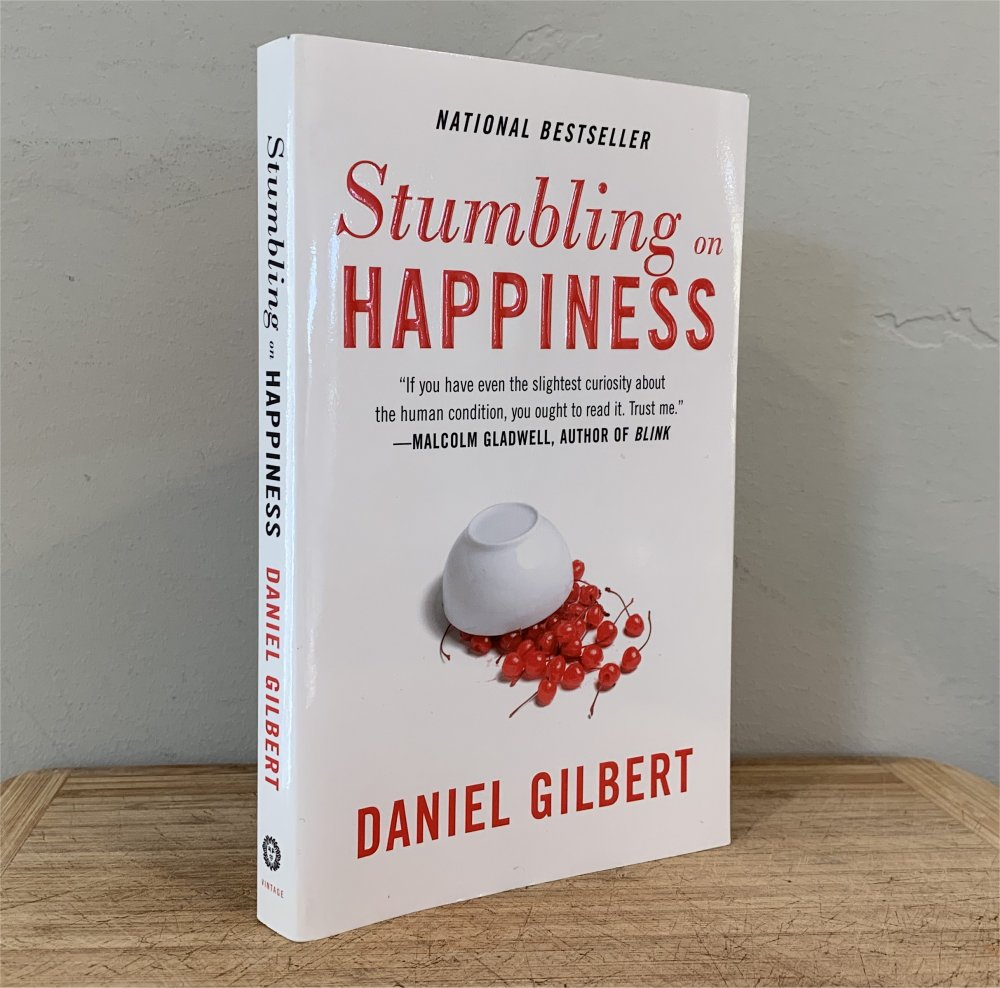
Daniel Gilbert, STUMBLING ON HAPPINESS (2006)

The author is a Harvard psychologist, recently familiar for several TV commercials he’s done for Prudential, which typically depict him in a public park doing surveys of groups of people. (https://www.ispot.tv/topic/expert/k7f/daniel-gilbert). This seems to be the only book the author has done; it was published in 2006. I have the 2007 trade paperback edition.

The idea of this book is that people aren’t very good about identifying what makes them happy, or what happiness even is. The cover blurb offers several paradoxes of modern life:

  • Why are lovers quicker to forgive their partners for infidelity than for leaving dirty dishes in the sink?
  • Why will sighted people pay more to avoid going blind than blind people will pay to regain their sight?
  • Why do dining companions insist on ordering different meals instead of getting what they really want?
  • Why do pigeons seem to have such excellent aim; why can’t we remember one song while listening to another; and why does the line at the grocery store always slow down the moment we join it?

The book is about applying recent insights from psychological studies—familiar from many other books I’m summarizing here—to answer these issues about happiness. Short answers: people aren’t good at anticipating the future; and since most people think they are special, they don’t rely on other people to testify about what makes them happy. The answer to the problem is, people *should* rely on the testimony of others.

This a nice big-picture summary of human history at the end of the book to provide perspective on how this is a modern problem–it’s quoted at the end of this post.

Key points:

These are summarized at the end of Part I: Journey to Elsewhen.

  • The idea of happiness is subjective.
  • Our imagination about future happiness works so quickly we are insufficiently skeptical of its product.
  • Our imagination’s products are not particularly imaginative.
  • Imagination has trouble anticipating how we will think about future events once we get there.
  • And why illusions of foresight are not easily remedied. The simple recipe is one you will almost certainly not accept.

The simple recipe is, as mentioned: rely on the testimony of others. Trust them.

Detailed Summary:

Foreword

Author wonders what you’d do if you learned you had only 10 minutes to live, and then reflects on how bad we are at anticipating our own future needs and desires. Then recalls the Muller-Lyer lines, and the Necker cube, and how he was fascinated by optical illusions. It turns out the mistakes we make anticipating our future are also systematic, how they play in other kinds of illusions. “This is a book that describes what science has to tell us about how and how well and human brain can imagine its own future…”

Part I: Prospection

Ch1, Journey to Elsewhen

Psychologists dread ever writing a sentence that begins “The human being is the only animal that…” because they are apt to be disproven by later discoveries. Use tools; use language. Author suggests: “that thinks about the future.” Many animals anticipate the future, but only about what happens next: nexting. Only humans develop the concept of ‘later’, at some point millions of years ago. [[ science fiction might be thought of as literature that acknowledges ‘later’ and not just the present moment; unlike traditional literature ]]

It seems the frontal lobes are involved with this feature. Recall Phineas Gage (who survived a spike rammed into his skull that destroyed some of his brain); some people do better *without* their frontal lobes—except when it comes to planning, or feeling anxiety.

So *why* do people have this ability? Ironically, it was popular in the ‘60s to take LSD and “be here now” – to live in the moment. Still, most people find imagining the future pleasurable. Americans in particular are optimistic about the future. People are xxxxxx ‘fearcast’ as means of avoiding bad events.

And we think we want to do something about the future. Why? To exercise control; having control is good for us. (Example of nursing home patients taking care of plants.) Even the illusion of control makes us happy. And: we think we know where we want to go, and want to control getting there. The problem is, this is a wrong answer, because we usually can’t perceive the future accurately – the subject of the rest of the book.

P26, summary and look forward. [[ xxxxxxxx and yes, this applies to SF, in how many visions of the future are so conservative; covered later. ]]

Part II: Subjectivity

Ch2, The View from In Here

We think conjoined twins must be unhappy—but they aren’t. Happiness has three components: emotional; moral; judgmental, 33.8.

Emotional is the most basic, and it’s entirely subjective. People want to be happy. Pope, Freud, others: 37m

Moral: some think merely being happy is unworthy of us; that we should attain a worthy happiness, Nozick, p38; simple happiness is fine for pigs. Christians turned happiness into a reward for living a moral life. But are virtue and happiness the same? 40m. Not necessarily.

Happiness as judgment is the abstract idea of being happy about something, as in being happy for someone despite personal unhappiness. But it’s difficult to compare instances of happiness; memory is fallible; later descriptions tend to override our actual memories. And we’re sometimes blind to change – e.g. the card trick, p49.

We suspect that other people have different scales of happiness; a birthday cake to conjoined twins is more important to them that to us; p51. We’re apt to think, they only think they’re happy; they don’t know better. Xxxxx Experience stretching; the difficulty in evaluating other people’s claims of happiness.

Ch3, Outside Looking In

Can people be mistaken about how they feel? Yes. We can be wrong about our emotions. Examples of people crossing the Capilano River bridge, 63.7.

There’s an issue with being *aware* of experiencing – “In fact, awareness can be thought of as a kind of experience of our own experience.” 66.4 [[ yes, this is exactly the kind of awareness that my project tries to describe, in contrast to the day to day existence of most people. ]]

Sometimes we realize we’re completely unaware of something we’ve obviously done, as while being distracted. Blindsight.

Nice para summarizing the history of what we’ve thought about the world, from bearded God to Descartes: 69b, worth quoting. QQQQQxxxxx

Can we measure happiness? If not is it science? We must accept imperfection in such measurements, but realize that real-time reports are the least flawed of all possible measures.

Also count for the law of large numbers – the more measurements, the more errors will balance out. And large numbers lead to emergent properties.

Feelings are what means, 78m

Part III, Realism

Ch4, In the Blind Spot of the Mind’s Eye

Author compares Adolph Fischer, who upon his execution said it was the happiest moment in his life, and George Eastman, founder of Kodak, who became wealthy and then committed suicide.

We usually make errors when we imagine “what it would feel like if.” Our imaginations have shortcomings. It’s analogous to Harpo, pulling large objects from beneath his cloak; we fabricate memories from summaries, rather than retaining detailed records. You can trick people into ‘remembering’ things by suggesting details that didn’t happen. So, we know that memory fills in details—and we know that this happens quickly and unconsciously. It’s like the eye’s blind spot. We fill in words in a list based on their theme, p88. And these tricks work even when we know about them.

Recall how the wizard in Oz said he was a very good man, but a bad wizard. In the 18th century philosophers realized this about the brain. Locke maintained the idea of realism, that what is perceived actually exists. Then Kant put forth idealism, 94.4, in which our perceptions blend with what we think, feel, know, want, and believe. Piaget noticed this about children—who learn that how things are and how they appear are different. [[ cf Bering ]]

And yet we don’t get over realism entirely; we outfox it 95b. We sometimes quickly correct ourselves from observation to what we ‘know’ must be so. Thus the “crowning intellectual accomplishment of the brain is the real world.” 97-98. [[ but this is half of it; there is more real world we can barely intellectualize ]]

Mental images are interpretations, and we often forget this—imagining something more elaborate than is likely to happen. Example of ‘spaghetti for dinner’. (see examples p99). This is one reason reality disappoints us, and we are bad at anticipating the future.

Author goes back to recount the true stories of Fischer and Eastman—and how you can sympathize with their fates. But the point is there are ways of being things that the brain doesn’t imagine; we unthinkingly treat what we imagine as accurate representation of the facts. We’re bad wizards.

Ch5, The Hound of Silence

Now the issue of what imagination leaves out. It’s like the dog that didn’t bark, in Sherlock Holmes. We notice the hits, and not the misses, e.g. about pigeon poop. [[ this is a very familiar point. ]] Sir Francis Bacon noticed this, p109, recalling claims of miracles and wondering about the sailors who *weren’t* saved.

We have a hard time imagining many things—e.g. what life is like after death of a child. That people go on with their lives and aren’t as devastated as people imagine. How happy people are in different cities, or in California. (Kahneman uses this example too.)

A Pygmy once saw buffalo in the distance and assumed they were insects, because they looked tiny and he had no experience seeing things on a distant horizon. [[ nice analogy to some SF perceptions ]]

We imagine events differently whether close or far in time, p116. And the problem is that we’re not aware of all this.

Part IV, Presentism

Ch6, The Future Is Now

How imagination can be too conservative. Examples of visions of tomorrow, from the 1950s—all the things that are missing., p123. And examples of predictions of impossible things, e.g. flight. Mention of Clarke’s law.

We tend to backfill current attitudes onto the past, e.g. how we felt about a candidate before he actually won or lost. And we use today’s attitudes, e.g. why our appetite vanishes after a big meal – we can’t imagine being hungry again. Other hungers are also hard to forecast.

We have mental images for things in the world; our imagination previews objects and ‘prefeels’ events. Ironically this allows nonthinkers to better predict future satisfaction. And yet the brain does prioritize reality—otherwise we’d ignore a red light if we happened to be thinking about a green one. The same happens with emotion – we extrapolate from the moment. Depression is when people think about future events and can’t imagine liking them much.

Ch7, Time Bombs

It’s easy to imagine physical objects, but not abstract ideas. So how do we think about time? Like space; moving forward or looking back, etc.

This helps explain the restaurant conundrum where we anticipate trying different dishes each time we visit – or choosing something different than the other diners – even though you prefer a single dish. We think variety is the spice of life—but it is only in the short term, e.g. exchanging plates part way through. Repetition wanes pleasure; we compensate with variety and time; but with time, we don’t need variety.

Mental images are atemporal, and this leads to errors when we make judgments based on different starting points. [[ priming, another familiar idea ]]

People dislike salary cuts; they are sensitive to relative change. Thus shopping mistakes in comparing earlier prices rather than overall finances.

And shopping errors as in making comparisons at the store that we’ll never make again once we get our selection home, p159.

This is like ‘presentism,’ the tendency to judge historical figures by contemporary standards, 161-2.

[[ this is why I’ve always hate shopping, especially the obsessive shopping that compares every possible option, despite knowing that once you get the thing home you’ll never think about those options ever again. ]]

Part V, Rationalization

Ch8, Paradise Glossed

Note quote from Hamlet – thinking makes it so.

Quotes from xxxxxx JW and others suggest a method to become fulfilled and enlightened—and the method is that something terrible happens to you and you recover. People are resilient; they often say that tragedy made them a better person. Negative events do affect people, but not as much as we think.

The mind exploits ambiguity, as in figure 16 and 17 whether looking for zero or the letter O.

We disambiguate objects based on context, frequency, and recency, p171. And we often prefer one option over another. E.g. the way we define ‘talent’ depends on what we ourselves think we are good at. We tend to exploit ambiguity in the way that is positive for ourselves, 175b.

Recall Voltaire’s Pangloss – humans are not hopelessly Panglossian. We’re a mix, of reality and illusion – 1774.:

We cannot do without reality and we cannot do without illusion. Each serves a purpose, each imposes a limit on the influence of the other, and our experience of the world is the artful compromise that these tough competitors negotiate.

[[ an interesting take perhaps on reality v fantasy, SF v fantasy, story v fact, etc ]]

This is a psychological immune system that’s analogous to the physical immune system. Thus when faced with adversity, it must not defend us too well (i.e. avoid “I’m perfect and everyone is against me”) but must defend us well enough (avoid “I’m a loser and I ought to be dead”). We do seek positive views of our experience, but only when they are credible.

So what’s credible? For one, we place a lot of stock in what scientists tell us. But we cook the facts. We select various techniques for collecting, interpreting, and analyzing facts, to reach different conclusions. Bad scientists choose techniques that lead to the conclusions they favor. An easy technique is sampling bias—we only look at evidence that supports our views. Most people are bad scientists. We ask leading questions that favor a particular response. We make selective comparisons. And we see what we want to see, as when rival fans watch the same sports game. We ask whether facts allow us to believe what we favor, vs whether they compel us to believe what we disfavor. [[ this is a citation from Gilovich ]]

Ch9, Immune to Reality

About reality and illusion. Clever Hans—the horse that seems to respond to questions – was a fraud, but even his owner was unaware; he was signaling the horse subconsciously. We invent the reasons we do things, in a way that we truly believe them. We are strangers to ourselves.

Example: getting jilted at the alter. People claim later that it was the best thing that ever happened to them. Similar example: a study in which applicants were rejected by a single judge, or by a jury. Beforehand, people thought either case would hurt equally; afterwards, rejection by jury stung most – obviously, it seems, but it wasn’t obvious beforehand.

Casablanca: the last lines about regret. We regret the things we *didn’t* do more than those we did, 197t.

The psychological mind is calibrated to reject small triggers, as too expensive. Thus we rationalize big triggers, like infidelity, and worry about smaller triggers [example on back cover about dirty dishes]. Thus painful initiations seem more worthwhile than smaller ones.

We’re more apt to find a positive view of things we’re stuck with. These trigger our psychological immune system. Examples; and of how we can’t predict the circumstance that will actually make us happier, p203. We prefer more freedom, but are more content when options are limited.

We associate pain and pleasure with circumstance, and we also tend to invent explanations for those relationships, and those explanations tend to ameliorate both the good and bad. Just as explanations reduce the impact of special events. And once explained, we stop thinking about them. Movies that end mysteriously stay in the mind. Even fake explanations calm the mind, and make one feel less happy, p208.

And yet people choose certainty over uncertainty, though it makes them unhappier. [[ is there a key point here about science v artistic mystery? Unweaving the rainbow? ]]

Can we remedy the problem of fallible foresight?

Ch10, Once Bitten

First-hand and second-hand knowledge is all there is, in pooping as in anything else; how we learn. And yet in our search for happiness we keep making the same mistakes. Why can’t we learn?

We do try, but the problem is we don’t remember correctly—the brain edits memories etc. The availability heuristic makes it easier to bring some things to mind than others. Unusual events are more memorable. That’s why it seems we always end up in the slowest line at the market –those are the cases we remember. P219. And we mistakenly conclude that those cases are more likely than they really are. We remember an awful train trip and think they will all be like that; or we remember the best moment of a vacation and forget all the dull times.

Author recalls not liking Schindler’s List—because it ended badly, despite how brilliant it was most of the way through. Because memory has a tendency to value the final items in a series. Examples: the hand in cold water experiment. Thus we make some strange choices, based on how we’ll remember it, than on the experience itself. Another example: two women, one whose final years are dull.

And memory tends to reconstruct in error; e.g. how California must have voted for Dukakis—but it didn’t, it went solidly Republican for years. Thus we can remember our own emotions incorrectly. E.g. pop theories of gender roles influence our memories of emotional states. People remember how they had expected to feel, not how they actually felt, p231.

So if our memories [practice] are fallible, what about coaching?

Ch11, Reporting Live from Tomorrow

Doris Day’s song “Que Sera Sera” is not helpful advice. We *should* be able to offer advice on what to do. We ask the teacher. Virtually everything we know we learned from others. And so we communicate with others, and we should be able to learn anything that way. And yet we still make bad decisions. Either we’re getting bad advice, or we’re rejecting good advice. Answer: both.

All our communication are attempts to make others think the way we do, p236. What makes this transmission of beliefs successful? Example of gene transmission—circular logic that is inescapable. P237. “Genes tend to be transmitted when they make us do the things that transmit genes.” Even if they have bad consequences.

What affects the transmission of beliefs? Accuracy [cf Dennett Brainstorms quote in note]. But false beliefs also transmit. Because some false beliefs may have beneficial consequences, e.g. by leading to the transmission of more accurate beliefs. “False beliefs that happen to promote stable societies tend to propagate because people who hold these beliefs tend to live in stable societies, which provide the means by which false beliefs propagate.” 239t.

One such belief is about wealth – studies show that wealth brings happiness only to a certain point. And yet people work to make more money, even if it doesn’t increase their happiness. Adam Smith. The economic problem of keeping an economy going is not the same as the personal problem of happiness. Thus the delusion that making money increases happiness. Q 241.8. It’s not a conspiracy; it just works out that way, 242t.

This is why we believe some things that simply aren’t true. The joy of money. The joy of children. Actual happiness varies. [[ but without the delusion, how would the race survive? ]] Because the opposite belief unravels any society that holds it, e.g. the Shakers. We do these things for reasons beyond our ken, 245t.

And so, what is the solution? There is a simple method to make accurate predictions about the future—but no one wants to use it.

Perhaps we ask other people who are having the experiences that we contemplate, and ask how they feel.

Because they are not you; everyone is unique.

Responses to this: Imagination has three shortcomings. It fills in and leaves out without telling us. It tends to project the present onto the future. It fails to recognize that things will look different once they happen, e.g. that bad things will look better (via the psychological immune system).

When surrogates are used, predictions about the future are much better. So the best way to predict our feelings tomorrow is to see how others are feelings today, 251.6

Yet people don’t do this. Because the average person doesn’t think of themselves as average, p252; they see themselves as better, and so other opinions or experiences don’t apply. People see themselves as unique, better in some things and worse in others. We know ourselves the way we can’t know others. We enjoy thinking ourselves as special. And we tend to feel everyone is more different from one another than they actually are; all people are similar in many ways. Our similarities are irrelevant, and so we emphasize our differences. We have the impression that others don’t experience the same intensity of emotion that we do, 255m.

And this is why we don’t rely on surrogates. 256.3

Afterword

We are the first species in history to be able to make decisions about where to live, what to do, whom to marry. Things changed; happiness is in our hands.

For most of recorded history, people lived where they were born, did what their parents had done, and associated with those who were doing the same. Millers milled, Smiths smithed, and little Smiths and little Millers married whom and when they were told. Social structures (such as religions and castes) and physical structures (such as mountains and oceans) were the great dictators that determined how, where, and with whom people would spend their lives, which left most folks with little to decide for themselves. But the agricultural, industrial, and technological revolutions changed all that, and the resulting explosion of personal liberty has created a bewildering array of options, alternatives, choices, and decisions that our ancestors never faced. For the very first time, our happiness is in our hands.

In 1738 Daniel Bernoulli claimed an answer based on probability and utility. But what we get is not what we experience. Only utility matters. Bernoulli suggested that each successive dollar provides a bit less pleasure than the one before it. People are sensitive to relative rather than absolute magnitudes. But Bernoulli was wrong in not understanding that many things besides wealth that affect one’s happiness. This book has explored many examples. That’s why it’s so difficult to predict our subjective experiences. We’re forced to rely on imagination. It’s a great talent, but it’s not perfect. At best, our intellects allow us to understand how we stumble.

\\

Thumbnail summary:

So… we can’t imagine the future with any accuracy, and thus make bad decisions about what would make us happy. A simple solution would be to use surrogates – that is, other people who are having similar experiences – but we don’t because we feel special to an extent that we can’t rely on others.

Posted in Book Notes | Comments Off on Daniel Gilbert, STUMBLING ON HAPPINESS (2006)

Hans Rosling: FACTFULNESS (2018)

This is a book that explores why most people are wrong on key facts about the world, thinking it worse than it is, e.g. concerning poverty, life expectancy, etc. In a sense it’s a modern-day counterpart to Steven Pinker’s THE BETTER ANGELS OF OUR NATURE, which explains how violence has declined over the centuries, despite the impression of many that the world is still such a violent place. (Notes on that still to be posted.)

Hans Rosling, FACTFULNESS: Ten Reasons We’re Wrong About the World—and Why Things Are Better Than You Think (2018)

Author was a medical doctor and public educator, a worldwide speaker, has done TED talks. (He died in 2017.) He notes the book is cowritten with his son and daughter-in-law.

Brief Summary:

  • In surveys around the world, (e.g. the one at https://www.gapminder.org/) most people think the world is worse than in is, along measures of life expectancy, poverty, etc. This is due to various ‘instincts’ the people have; the 10 chapters of this book explore these. Handily, each chapter ends with a 1 or 2 page summary (indicated).
  • Gap Instinct: People reflexively divide the world into ‘us’ and ‘them’; the split of the world into developed nations and developing ones is no longer valid. Author proposes a divide instead of four levels of income, from $2/day to over $32/day. Of the world’s 7 billion people, the divide is roughly 1, 3, 2, and 1 billion in those four levels. (p46)
  • Negativity. In fact, the world is getting better, overall. There will always be bad news, and these days we hear all of it. (p74)
  • Straight Line. In fact, things don’t always continue as they have before, e.g. the world population increase, for various reasons. (p100)
  • Fear: People tend to jump to the worst possible conclusion; the effectiveness of modern media makes the world seem dangerous, even though the world has ever been less violent or more safe. (p123) [[ cf. Pinker 2011 ]]
  • Size: Keep things in proportion; look at rates, not absolute numbers. (p143)
  • Generalization: Don’t suppose everyone thinks the same as you; don’t think other people are idiots for behaving differently. (p165)
  • Destiny: Don’t assume people have innate characteristics and can never change. Sweden used to be much different. Africa will catch up. (p184)
  • Single Perspective. Beware simple either/or solutions; test your favorite ideas; have a few opinions that are right, rather than many that are wrong. Look at the results. (p202)
  • Blame. People look for clearcut bad guys or heroes, or suspect those they don’t like. Understand the system before assigning blame. Examples of pharma, refugees, foreigners. (p222)
  • Urgency. Rash decisions are often bad decisions. The world is complex; it’s usually better to wait and reconsider. Floating worst-case scenarios can backfire. Five global risks to worry about: global pandemic; financial collapse; world war III; climate change; extreme poverty. (p242)
  • Finally, Factfuless in Practice. The key is education. Teach children humility and curiosity. Business need to become global. Be aware that journalists will always focus on the unusual, not the common. A fact-based worldview is more useful for navigating life, and leads to less stress and hopelessness.

With many appendices and notes. The book’s endpapers show color charts and photos of several key concepts: the four levels of income; the distribution of people across the world.

Rosling uses very plain language when he might, for example, explain the “availability heuristic” or discuss rates and proportions in chapter 5; he’s trying to reach a broad audience.

Detailed Summary:

Introduction

Author presents a 13-question test about the state of world, concerning life expectancy, portion of people in poverty, and so on, pp3-5, and discusses how poorly almost everyone does on the test. (The test, and much else, is at https://www.gapminder.org/ ) Most everyone knew that the climate is warming, but on average people got only 2 of the other 12 right. This is because they think the world is worse than it is; or perhaps, they reflect what they learned decades ago, and their knowledge simply needs upgrading.

We maintain an overdramatic worldview, not one that’s fact-based. This is understandable from evolution; we’re wired to be on the alert for dangers, for things that are scarce p15t. But we can overcome this tendency, learn to get the world right. “So, if you are more interested in being right than in continuing to live in your bubble…. Then please read on.” 17.

Ch1, The Gap Instinct

Recalls discussing child mortality, and how students reflexively think that ‘those’ countries can never live like ‘us.’ People split the world into us and them. We still speak of the developed nations and the developing ones, as if there is an actual difference, chart p25 – this was true, in 1965! But it’s not true now, chart p26, when only 9% of the world’s population live in truly poor countries.

Author proposes a different kind of divide: four income levels, Level 1 thru Level 4, representing up to $2/day to over $32/day. Of the world’s 7 billion population, the divide is roughly 1, 3, 2, and 1 in those four levels. The World Bank made the change; the UN still hasn’t. This kind of binary thinking pervades journalism, and stories.

Beware: don’t compare averages; look at spreads, or change the scales. Compare extremes; beware the ‘view from up here’ when, from a tall building, distinctions among smaller ones disappear. Mass media love extraordinary events and shuns normality.

Ch2, The Negativity Instinct

Everyone thinks the world is getting worse. And it is, in parts, like Syria, or with species die-offs, or the US economy. But overall, the world is getting better. Extreme poverty has dropped to 9%, from 85% in 1800 and 50% in 1966. [[ Note -! P52, that in 1800, “One-fifth of the entire Swedish population… fled starvation to the United States…” – could this explain the Swedes in Illinois? Note Bishop Hill wasn’t founded until 1846. ]] Life expectancy was 31 in 1800 [on *average* since so many children died; adults still often lived to 50 or 70] and is 72 now. Sweden itself has changed, from 1800 to now, in health and wealth, p57.

Four pages of charts, bad things decreasing and good things increasing, p60-63.

This happens because we think old times were better than they were; we forget the bad parts. Selective reporting by the media ironically makes the world seem worse, since press freedom is greater now and every atrocity is reported; in the past many went unknown.

Author says he’s not an optimist; he’s a ‘possibilist,’ who sees progress and hopes that further progress is possible. The skewed view of the world is dangerous because it may cause people to give up hope, 69m.

How to control: remember that things can be better, yet still partly bad. Expect that there will always be bad news. And don’t censor history.

Ch3, The Straight Line Instinct

Recalls Ebola outbreak, doubling every three weeks. The misconception here is that things simply keep increasing as they’ve done, as he says the world population is ‘just’ increasing. Thus people assume world population will be much higher by 2100 than estimates make it, p81. In fact it will ease off to about 11 billion in 2100, and this is because the number of children will remain steady – an effect of women having fewer children as they rise out of extreme poverty. The average number of babies per woman has fallen from about 6 in 1800, to 2.5 today. As this rate sustains, the population will grow into higher age groups, p86.

Humanity was ‘in balance’ with nature – humans *died* in balance with nature because so many children died young. Now we’re moving to a new balance where most children survive.

But don’t some cultures, and the religious, have more children anyway? Maybe, but poverty is till the overwhelming factor.

So: some lines are straight. Others are S-shaped, and like slides, or with humps, depending on the phenomenon, p94-97. And some are ‘doubling’ lines [he means exponential] p98-99.

Ch4, The Fear Instinct

Anecdote about a patient author thought was bleeding; he wasn’t, it was a color marker from his life jacket. We tend to jump to the worst possible conclusion. Our attention filter is alert for dangers: physical harm, captivity, contamination.

A paradox (as mentioned above) is that the media makes the world seem as dangerous as ever, even though the world has never been less violent or more safe. Thus, deaths from natural disasters are far lower than 100 years ago. Because countries are wealthier and better able to react. We never think about the 40 million planes that land safely – only the handful that don’t. (Recalls 1944 standard form for recording crash data.)

Yes, Syria; but battle deaths have fallen over history. We are so concerned with contamination, that more people died fleeing Fukushima than were ever imperiled by the radiation itself. The relatively minor risks of DDT have made us all fearful of chemicals, and contamination in general. Thus, fear of vaccinations.

And terrorism; again, the number of actual incidents is small. (Note that Wikipedia is far from complete about incidents in the non-West.)

Ch5, The Size Instinct

Author recalls treating children in Mozambique, and applying a harsh sort of relative effort: it’s not worth setting up a drip in a child when the same time could be spent saving many other children. Trying to do the best every time was out of proportion. As in other cases, the most effective strategy is to apply low-level methods, e.g. sanitation, rather than building hospitals.

To realize this, think compare and divide. Avoid lonely numbers. Maybe 4.2 million babies died last year – but compare than to the 14m that died in 1950. Consider how in Vietnam their memorial to the war with the US is incidental. Consider that one man being killed by a bear in Sweden got more press than the women killed by their partners, once a month. Don’t treat rare diseases when common ones still prevail.

Recall where people live: mostly in Asia. The PIN code is 1 1 1 4, p136, about where most the world population lives. (Billions of people in the Americas, Europe, Africa, and Asia respectively.) Don’t look at absolute numbers; look at rates. Don’t worry about everything ‘out there’

Ch6, The Generalization Instinct

Anecdote about being served dinner in a region near the Congo river—rats, and larva. His friend saved him from the latter by explaining that his ‘tribe’ had different customs. Don’t suppose everyone thinks the same…

Genralizations and stereotypes are necessary and useful. But businesses wrongly think the ‘developing’ world isn’t a market for their products, and are losing out. The solution is to travel, experience the world first-hand. Anecdote about a Swedish student sticking her foot in the elevator door.

Develop better categories, e.g. the four income levels. Five ways to counter this instinct, p158, among them, don’t assume other people are idiots, they may have good reasons for doing strange things. Example of half-built house in Tunisia, p161. And don’t generalize from one group to another – example of advice about not letting babies sleep on their backs.

Ch7, The Destiny Instinct

We tend to assume people have innate characteristics and can never change. This bias can be simply self-serving, as to confirm the superiority of one’s own group, e.g. Europeans against the Islamic world.

In fact, Africa can catch up, and has already made great progress doing so. For that matter, continued Western progress cannot be taken for granted; thus assumptions of 4% annual growth have been tempered. P172. How women in Iran have greatly reduced their birthrate. (Again, number of children tied to income, not religion.) And values can change. Recalls how the Swedish weren’t always so liberal about sex. Used to be patriarchal.

Tools: realize that slow change is not no change, e.g. how nature preserves have expanded. How knowledge needs updating, especially in the social sciences. Recalls speech in Africa in which he missed the point – soon *they* will be the tourists to our countries.

Ch8, The Single Perspective Instinct

Who do we trust? Beware simple single solutions, whether it’s government control or the free market, equality via distribution of resources, etc. Test your favorite ideas. Have fewer opinions that are right, rather than many that are wrong. Even experts have limitations, e.g. beyond their own fields. Activists tend to exaggerate, to promote their own causes.

There is no one solution, like the proverbial hammer where everything looks like a nail. Even numbers are not a single solution, example 192. Nor is medicine. Or ideologies; compare Cuba and US. The latter is the sickest of the rich, spending more on health care for less, because of absence of public health insurance, p199b.

Nor is democracy a single solution; it doesn’t always correlate with other positive outcomes. The answer is to look at results.

Ch9, The Blame Instinct

Example of story about pharma not investing in drugs for certain diseases. Angry? Punch the CEO? The shareholders? Who? Maybe grandma, the retirees who depend on stable pharma stock for their retirements.

People look for clear, simple reasons; a bad guy; or a hero to claim success. 206b. And we tend to blame those we don’t like. Author recalls investigating an extraordinarily low bid from a pharma firm, being suspicious, then discovering they’d hit on a scheme no one else had to make money with cheap prices.

It’s not that the media is misleading you. Journalists do no better on the test than anyone else; they have the same misconceptions. But it’s their job to portray the world as it is; they are competing for consumers’ attentions.

Another example: refugees. Why are they stuck in shabby rubber rafts? Because the airlines require visas; even though many of these refugees have plenty of money to buy plane tickets. And authorities confiscate the boats—so there’s no reason to use good boats. The situation is one of unintended consequences.

Similarly the tendency to blame foreigners – especially India and China – for climate change. But they’re not to blame, if you look at *rates*. By that measure, the rich nations like the US and Canada still produce the most CO2. Leaders like to think they are powerful, but they are less than they think; Mao; the pope (i.e. so many Catholics use contraception anyway). The actual heroes are institutions – e.g. those on the ground who enforce health practices – and technology – e.g. simple machines like washing machines to free up women’s time to read.

Understand the system, before assigning blame. P222.

Ch10, The Urgency Instinct

Story about studying a strange disease, and an impulsive decision to cancel a bus and block the road; so the locals took a boat, which overturned, drowning many. Later stories similar: the instinct is to block the roads. But these are rash decision made under time pressure, and these are usually bad decisions.

Act now! This is your last chance! This is almost never true, 227.7. It’s actually better to wait, return to the subject later, and consider it again.

The urge to action might have made sense in our evolutionary past, when the environment was mostly stable, and any perceived danger required emergency action. But the world is more complex now.

Example: author met with Al Gore, who wanted data emphasizing the worst case. Author tried to explain why this wouldn’t be effective, and declined. It’s counterproductive to raise alarms; in the long run it risks credibility. This is a problem with activists, who have a motivation to exaggerate problems, or to blame everything on climate change. Author insisted on following the data. Example: data on the Ebola outbreak showed it had already peaked, two weeks before, and so the measures already taken were working.

Author admits five global risks we should worry about: global pandemic; financial collapse; world war iii; climate change; extreme poverty. Summary: take a breath; insist on data; beware of fortune-tellers; be wary of drastic action.

Ch11, Factfulness in Practice

Another story, about taking blood samples to diagnose a disease in Zaire, in 1989, how the villagers rose up against him, and about how one brave woman, who somehow understood, spoke passionately and drove them off.

The key to factfulness is education – a list of key ideas to teach children p248 – and teaching children humility and curiosity. Acquiring these traits becomes relaxing, 249.4, “because it means you can stop feeling pressured to have a view about everything, and stop feeling you must be ready to defend your views all the time.”

Businesses need to learn to become global. Journalists might add context, but author acknowledges “Ultimately, it is not journalists’ role, and it is not the goal of activists or politicians, to present the world as it really is. They will always have to compete to engage our attention with exciting stories and dramatic narratives. They will always focus on the unusual rather than they common, and on the new or temporary rather than slowly changing patterns.” P253t

Can everyone do this? P255. Author thinks it will happen, for two reasons: a fact-based worldview is more useful for navigating life; and it creates less stress and hopelessness, since the dramatic worldview is so negative and terrifying.

Posted in Book Notes, Changing One's Mind, Culture, Social Progress | Comments Off on Hans Rosling: FACTFULNESS (2018)

Yuval Noah Harari, HOMO DEUS: A Brief History of Tomorrow (2017; 2015 in Israel)

This is, in effect, a sequel to SAPIENS.

Top level summary:

  • It opens with a long prologue: now that humanity has largely overcome famine, plague, and war, what next? Three possibilities: immortality, happiness, divinity. However these are predictions; this book is not a manifesto. They are the ideals of humanism, but humanism has flaws: that’s what this book is about.
  • He reviews human history from the agricultural revolution, emphasizes the idea of the algorithm, and wonders how humans are superior to animals: it’s our ability to connect, to use ‘imaged orders’ (money, law, gods, empires) to manage groups larger than 150 people. Meanings exists only within the networks of stories people tell each other. Science, meanwhile, has given rise to humanistic religions. [[ He still uses that word in a problematic sense, as noted for the first book. ]]
  • Religion is a social function that confers superhuman legitimacy on human laws, norms, and values. Modern history is about forming a deal between science and one particular religion: humanism.
  • Modern power comes from scientific progress and economic growth; free-market capitalism is virtually a religion. But it can’t go on forever: we’ll run out of resources, or risk collapsing the ecology.
  • So humanism is about being true to oneself, prioritizing personal feelings over scriptures. There is now no serious alternative to the “liberal package of individualism, human rights, democracy, and a free market.” The old religions have nothing relevant to say about the world.
  • And yet—some of liberal presumptions may not be true—e.g. free will. Brain studies show the complexities of our minds; there is no one authentic self. Thus one’s ‘true’ self is an imaginary story too, like nations, gods, and money. People live their lives as if living one type of story or another.
  • The final chapters explore three possible futures, ways that liberalism might be made obsolete: humans will lose economic and military usefulness (e.g. by being replaced by robots); the system will value humans collectively, but not individually; or the system will find some individuals valuable, and they will constitute a new elite. Useless people, their lives supported by robots that rend them unemployable, take drugs and play computer games. Or income inequality might lead to gaps in physical and cognitive abilities, rendering ideas of equality and civil rights obsolete.
  • Some in Silicon Valley want to upgrade humanity—e.g. by pursuing immortality. Alternatively, data might take over the world, an expanding internet of everything, with the new value of sharing everything, uploading experiences to the internet.
  • Finally: so what should we pay attention to: In the short term, immigration, refugees. Over decades: global warming, inequality. And in the long term: examining the dogma that organisms are algorithms and life is a data process; whether intelligence is decoupling from consciousness; whether intelligent algorithms may come to know us better than we know ourselves. Are these valid?

General comments:

Again, note how frequently Harari rolls out concepts in groups of three. I’m still irritated of his use of the word religion to describe value systems that explicitly revoke traditional religion, e.g. secular humanism. He does so because he wants to identify those values with the analogous presumption about the world that religions make, so that he can challenge them and thus consider whether the western liberal project is doomed. There are lots of interesting ideas here, but I’m not as alarmed about the future as he seems to be. For example, does it matter if free will doesn’t exist in some fundamental sense? People still act as if they have free will. Perhaps it only matters if these intelligent algorithms he anticipates learn to manipulate us to what we think we are choosing freely is really chosen for us. But this already happens—we are guided in our tastes by culture; we are guided in our beliefs by our families and social groups.

He examines many of these same themes in this third big book, which I’ll cover next.

Detailed summary (with key points in bold and my comments [[ in brackets ]])

The book begins with a long, 70-page, prologue: “The New Human Agenda.” To some extent this recalls themes from SAPIENS, and to some extent it gives the impression that he forgot about another triad of ideas—or perhaps one cut for space—and is filling it in here. But no; reflecting on this book’s theme, instead what he’s doing is setting the stage, by explaining how several eternal trials of human existence have largely been overcome. Which leads to the book’s theme: what do we do now? But first, review those eternal trials.

  • Humanity has largely overcome the three ancient problems—famine, plague, and war. Now that these have been addressed, what do we do now? Consider history.
  • Famines—example of France in 1694. Ironically, now more people are obese than die from famine.
  • Plagues—recalls the Black Death, about which people could do nothing by pray, or assign the problem to demons. Other examples: Europeans coming to the Americas, and spreading plagues, 1520; later Hawaii, 1778. In world war I, the Spanish flu.
  • Now child mortality is down. Smallpox is gone. The recent plagues, SARS et al, even AIDS, have been relatively small by historical examples.
  • And doctors are getting better at diagnosing new diseases. When something goes wrong now, we don’t blame god or demons, we demand responsibility and arrange investigations. [[ Well, some simple-minded evangelical types still blame God—or blame whatever social matter they personally don’t like, e.g. homosexuality or abortion, for having triggered God’s wrath. This egocentric bias will never go away. ]]
  • Wars, p14. Statistics, 15t. We have overcome the ‘law of the jungle’, wherein people live their lives assuming that at any moment a neighboring country might invade them. No governments make plans with contingencies for war, anymore. There are exceptions – e.g. where the author lives (Israel).
  • True, there is a potential for cyber warfare. Yet we have also broken Chekhov’s Law [i.e. by the 19th century Russian playwright], the notion that if a gun appears [in a play], it must be used; that is, we’ve nuclear weapons for decades, and not used them.
  • Terrorism? It has worked only by provoking its enemies to overreact, 18.7, then rage like a bull in a china shop, doing the terrorists’ work for them. [[ Every time I go through airport security, I can’t help but reflect, here at least the terrorists have won. ]]
  • So—
  • What will replace these threats in the human agenda? Well, we might take steps to protect the planet from our influence.
  • What else? 21t – three things: immorality, happiness, divinity.
  • About death – religions have depended on it. They don’t make much sense if death did not exist.
  • Nowadays, death is viewed as a technical problem, with potential technical solutions. A few talk about defeating death entirely – like Ray Kurzweil, Peter Thiel. But by 2050? That’s optimistic. A-mortals would be cautious. [[ an idea already exploited by sf ]]
  • If even human life-spans were only doubled, it would greatly change social arrangements – families; how long individuals would reign over corporations or religions. Ideas would linger. 26.
  • Note that the *natural life span* has not been extended; people in the past sometimes did live until 70 or 80. We’ve just been eliminated causes of early death. Extending the life span will be more difficult.
  • But science, and capitalism, seem to inevitably drive the search for extended life spans.
  • P30, the right to happiness. Epicurus; Jeremy Bentham; nations provided education and health care as a means of making the nation stronger (not to make people happy). By now there is the idea that nations *should* make people happy. By GDP, Singapore must now be happiest. Is this true? It’s hard work to be happy; advanced nations aren’t necessarily ‘happier’ than less fortunate ones. Quality of life has increased, but not overall happiness. [[ A recurring theme; one of the closing ideas in SAPIENS. ]]
  • Why? First, happiness depends on expectations rather than objective conditions. Second, happiness is a matter of pleasant sensations and lack of unpleasant ones. Beyond that, said John Stuart Mill, there’s no objective good and evil. And this is, in effect, current scientific orthodoxy. The problem is, pleasant sensations don’t last long; they must be constantly renewed.
  • One answer might be drugs—pharmacology. We increasingly take drugs to mediate moods and behavior; to calm soldiers. This recalls the Buddhist view of the transience of existence.
  • P43, the gods of planet earth. Upgrading into gods might happen in three ways: biological engineering; cyborg engineering; or through non-organic beings. We can’t grasp what new minds would think to do.
  • Attaining divinity doesn’t mean becoming omnipotent—p47.5; it’s more like becoming Greek gods, with great powers but still with human foibles.
  • Recall that ancient agricultural societies, their religions weren’t metaphysical, so much as about attaining superhuman powers.
  • Is this moving too fast? It will happen bit by bit. It may take only decades. Recall the internet in 1993.
  • But if it’s scary, can we hit the brakes? No; we don’t know what the brakes are; if we put a halt to such efforts, the economy would collapse; and we can’t even separate these three goals.
  • Examples: Viagra; plastic surgery; in vitro testing. Three-person embryos. Upgrades are always first about healing, then about applying them for enhancements.
  • P56, the paradox of knowledge—four points: 1, only a few people will be engaged in these activities [[ recalls Gibson comment about how the future is already here, just not evenly distributed ]]; 2, these comments are only predictions based on history, not a manifesto; 3, they may not succeed!, and 4, these are about choices. New knowledge changes behavior; e.g. Marx’s writings were read by capitalists, who accommodated his thinking, so his revolution never came. That’s the paradox.
  • So why study history? To understand the choices we have. Example: lawns, a history of status symbols—then follow 7 pages beginning p59, with photos, about how lawns have been status symbols.
  • These goals are the ideals of humanism, which has ruled for 300 years. But there are flaws in humanism—and that’s what this book is about; these plans are likely to cause its disintegration, 66b.

[[ He may be right to the extent that, in the sense that humanism endorses continued expansion of the species, we’ll destroy the planet and thus ourselves. That’s why I’ve never been entirely happy with the idea of ‘humanism’ – what’s really needed is an *understanding* of our place on earth and in the universe, and the goal should be long-term sustainability, not continued expansion. (Which might subvert the SF fantasy of exploring and colonizing the universe.) And certainly the commandments of religions to keep reproducing and fill up the globe. ]]

Part I, Homo sapiens conquers the world

1, The Anthropocene

  • There are very few lions or wolves left; humans have impacted the world over the past 70k years, recently by mixing up all the previously separate (on various continents) ecologies.
  • Early human were likely animists, believing in a network of beings.
  • The story of the expulsion from Eden reflects the agriculture revolution, p77ff; changed the relationship between humans and animals; now animals were domesticated, subjected to humans. Today 90% of animal mass on earth is domesticated animals. And those animals live in misery; their evolutionary drives haven’t changed. Pig farms, etc.
  • We understand that organisms are algorithms, collections of needs and survival strategies….  83.7: “’Algorithm’ is arguably the single most important concept in our world.”
  • Example of recipes, and machines that follow algorithms; they work in humans through sensations, and emotions, and thoughts 85.3; humans are algorithms that produce copies of themselves, 85.1.
  • Animals like baboons operate through feelings and sensations—but these are in fact algorithms, built into their instinctive thinking. 86.2. even in humans, 99% of our decisions are based on subconscious algorithms (sensations, emotions, and desires) 87.2, note 18, citations of books by Kahnemann and Ariely.
  • In the early 20th century experts denied the idea of human nature; theories were behaviorist. Harry Harlow demonstrated the instinctive mother-infant bond, among monkeys, in the ‘60s. The animal industry violates this, 90.4
  • P90, The agricultural deal: Farmers justified their behavior toward domesticated animals through… theist religions, in which a parliament of beings was reduced to humans and their relationship with a god or gods, with only humans having souls, in which the gods played intermediary, 92b. “The gods safeguarded and multiplied farm production, and in exchange humans had to share the produce with the gods. This deal served both parties, at the expense of the rest of the ecosystem.”
  • 92.3, “Much of theist mythology explains the subtle details of this deal.” Gilgamesh! Example even cites how the gods smelled the savor of sacrificed animals (!!) – because the animals weren’t for safekeeping, they were for sacrifice! [[ important point to relate back to biblical reading! ]] (a good example of, why these stories and not others?) 93.8: “Non-human organisms have no intrinsic value; they exist only for our sake.” And see 94t.
  • Some religions are more animal-friendly; but all justify human exploitation of animals, and the subsequent classification of people into classes, 96b. “The farm thus became the prototype of new societies, complete with puffed-up masters, inferior races fit for exploitation, wild beasts ripe for extermination and a great God above that gives His blessing to the entire arrangement.”
  • P97, Five Hundred Years of Solitude. Science silenced the gods. The new paradigm was curiosity leading to greater control, another step toward paradise on earth.
  • Science gave rise to the humanistic religions. [[ He is still using the word religion in a problematic sense here. ]] But what makes humans special, that artificial intelligence wouldn’t be moreso? Is there some human spark?

Ch3, The Human Spark

  • Why are human lives superior? The tradition is that only humans have souls; it’s a central pillar of society.
  • Yet there’s no evidence of ‘souls’; in fact the idea of evolution contradicts it, which is why so many hate Darwin and evolution.
  • Why no such anger about relativity etc? [[ I’ve long though this is a key point; fundamentalists hate evolution, but are indifferent to cosmology, even though the latter just as much contradicts the Bible. Why? Because evolution offends people’s sense of being special. ]] Because evolution contradicts prior beliefs. … or is it because we are conscious and animals aren’t?
  • Yet we have no good idea about what consciousness is… what is the evolutionary advantage of subjective experience? What happens in the mind that doesn’t happen in the brain? No one knows.
  • Can we discard the idea? … no; perhaps it is real but performs no useful function. Perhaps our analogies are wrong.
  • 121, so do animals have minds? Examples of dogs, chimps, lab rats; legal acts, p123.
  • So what gives our species an edge? Tools? Intelligence? No—it’s the ability to connect, 132.7. [[ 2018—yes, this echoes ideas about how human social cooperation has been more important than merely using tools, a key theme of EO Wilson. ]]
  • Historical examples—communism, how it fell apart; example: the video of people booing Romanian leader Ceausescu, p135.
  • Communists held power for three reason, 136b: they placed loyal apparatchiks in control of everything; they prevented the creation of rival organizations; third, they relied on support from parties in other countries.
  • 138, So how is human life sacred? What makes humans able to cooperate so well? Our group size is limited, only up to about 150. And we are not ‘logical’… examples.
  • Larger groups depend on ‘imagined orders’, 143b – 144: sets of rules that exist only in our imagination yet we believe to be as real as anything – these are ‘intersubjective’, p144. Examples are money, laws, gods, empires. It can happen, e.g. that some currency is defined to suddenly be without value.
  • 146.4: Maybe hard to accept; “Yet in truth the lives of most people have meaning only within the network of stories they tell one another.” And following: “Meaning is created when many people weave together a common network of stories…” Why does anything mean anything? Because it did to our parents, etc, examples. [[ aligns with idea of understanding reality via narrative – and the stipulations that all such narratives, stories, are made up ]]  [[ again – the smart ones understand that these are just stories, that we tell ourselves to provide meaning, and that they could easily be entirely different stories. ]]
  • Long historical example of how meaning at the time of the crusades changed over the centuries.
  • The idea of human rights might be just as absurd in another century. 150.6.
  • Only human understand these chimeras – intersubjective realities. That’s our advantage. This is what separate humanities from life sciences; the latter depend on complete understanding…
  • So, 152 last lines, “If you want to understand our future, cracking genomes and crunching numbers is hardly enough. We must also decipher the fictions that give meaning to the world.”

Part II: Homo Sapiens Gives Meaning to the World

Ch4, The Storytellers, p155

  • Animals are a dual reality – objective entities, and subjective experiences. Humans add a third reality – those intersubjective stories.
  • We had the cognitive revolution 70kya, but fictional webs remained weak. With the agricultural revolution, 12kya, the Sumerians imagined gods like modern corporations. Only with the invention of writing, and money, were these enabled. The idea of pharaoh, a living god, became a personal brand. Society’s rules became written down, i.e. became algorithms, p160m. Now we have ‘the system’, e.g. hospitals, where everything is a matter of procedure and rules. These worked so well that the Egyptians could create pyramids and an enormous lake, even without iron or the wheel…
  • P163, Living on Paper. Written texts became so important that, example of visas in Portugal, 164.5. Yet they could backfire: the Chinese effort to expand led to imaginary reports which led eventually to government actions that led to famine.
  • Writing reshaped reality, 167t. –it could describe, and then it could reshape, reality, to the extent that reality had to give way to what was written.
  • Examples: how African borders, drawn up by Europeans, ignored local circumstances. How school function to aim for high marks [grades] rather than knowledge or understanding.
  • 170b: “In theory, if some holy book misrepresented reality, its disciples would sooner or later discover this, and the text’s authority would be undermined. Abraham Lincoln said you cannot deceive everybody all the time. Well, that’s wishful thinking. In practice, the power of human cooperation networks depends on a delicate balance between truth and fiction. If you distort reality too much, it will weaken you, and you will not be able to compete against more clear-sighted rivals. On the other hand, you cannot organize masses of people effectively without relying on some fictional myths. So if you stick to unalloyed reality, without mixing any fiction with it, few people will follow you.” [[ nice summation of this current quandary ]]
  • Thus the power of money; even of holy scriptures, which become self-fulfilling prophecies in the way they function in society. P172b, “Even when scriptures mislead people about the true nature of reality, they can nevertheless retain their authority for thousands of years. …”  A monotheistic view in which my good fortune or bad luck must be about my relationship with an all-powerful god. P173.4, “Such self-absorption characterizes all humans in childhood. Children of all religions and cultures think they are the centre of the world, and therefore show little genuine interest in the conditions and feelings of other people. … Most people grow out of this infantile delusion. Monotheists hold on to it till the day they die.”
  • In contrast, ancient animist religions actually had a more accurate view of the world—as a playground of numerous different powers rather than a single god. Historians like Herodotus and Theucydides…
  • And yet the Bible won—because “No matter how mistaken the biblical world view was, it provided a better basis for large-scale human cooperation” [[ –the essence of the human tragedy? To survive we must believe in what is not real? ]]
  • 174, “Fictions enable us to cooperate better.” At least by the criteria of those fictions. Examples. Yet real entities suffer; gods don’t suffer; even nations don’t suffer, exactly. “That is exactly why we should strive to distinguish fiction from reality.” And last line p178: “Being able to distinguish fiction from reality and religion from science will therefore become more difficult but more vital than ever before.”

Ch5, The Odd Couple

  • Has modern science replaced the importance of stories, of myths? No; in ways science has made some myths stronger. So what is the relationship between science and religion?
  • 181, Germs and demons—there are many faulty definitions of religions; they’re not about superstition or belief in gods. Religion rather is a social function that confers superhuman legitimacy on human laws, norms, and values. 182.4; moral laws that exist and that we cannot change. Examples of boys asking questions of their fathers. Thus liberals and communists don’t like to be called religions, yet in fact they believe in some system of moral laws that wasn’t invented by humans, that humans must obey. And all societies have some version of this. All believers think theirs is the one true religion.
  • 184, If you meet the buddha—distinction between religion and a spiritual journey. Religions are about cementing a worldly order; journeys are about escaping it. If you meet Buddha on the road, kill him – i.e., if you encounter a fixed law, free yourself from it, 186. Such ideas are threats to religions, thus Martin Luther; details.
  • 188, Counterfeiting god—so what about the relationship between science and god? Sworn enemies? All scientific projects require religious insights, 189m. How to determine which projects to build?
  • Or are they separate kingdoms? Yet this ignores the factual statements made by religions. Abortion; biological facts, about when life begins. Religious stories almost always involve ethical statement, factual statements, and the conflation of the two, p191. Science has a lot to say about factual statements. Example about the Donation of Constantine, in AD 315… which later historians agree was forged, in the 8th century.
  • 193, Uganda criminalized homosexual activities, inspired by the Bible; long example.
  • 196, Holy dogma—it’s not easy to separate ethical judgements from factual statements. Philosophers like Sam Harris have argued that science can always resolve ethical dilemmas. And yet, what is happiness? We can’t measure it. And without the guidance of some religion [ in the broadest sense of course ], we can’t maintain large-scale social orders, 198.3.
  • 198, The witch hunt—history. In theory, both religion and science are interested in truth. “In fact, neither science nor religion care much about the truth, hence they can easily compromise, coexist and even cooperate.” 199.4 Religion is interested in order; science is interested in power, over truth. [[ Really? At best this is a cynical take. ]]
  • Thus modern history is about forming a deal between science and one particular religion: humanism.
  • Next two chapters about this covenant; and the final part of the book about how this covenant is disintegrating, and what might replace it.

Ch6, The Modern Covenant, p200

  • Modernity is a deal: “humans agree to give up meaning in exchange for power” 200.7. This deal shapes our entire culture, and ourselves from the moment of birth. [[ it doesn’t seem to matter to Harari that the meaning given up is false – fictitious – and invented by humans; doesn’t reality matter? ]]
  • Modern power comes as a result of scientific progress and economic growth. There was no such ‘growth’ for much of history; productivity was steady, etc. It was for lack of funding. The miracle of credit enables economic growth. (reference to zero-sum, p204b) Example vampire bats, who loan blood to each other, but without interest, unlike bankers.
  • Modern economic growth is vital. We must produce more in order raise the standard of living, handle expanding population, and making any headway against poverty. And economic growth turns out to be the solution for everything, p207, e.g. to solve religious and political strife.
  • And so free-market capitalism has become virtually a religion, 210.1; certainly it “helped global harmony far more than centuries of Christian preaching about loving your neighbor and turning the other cheek.” P201.5
  • The first commandment of capitalism is: reinvest profits. Thus a typical conservation today is about how best to invest one’s gains. P211. Even games these days are oriented around capitalism, e.g. Civilization.
  • 212, But can this go on forever? Only if we have a store of resources. We used to rely on the discovery of new lands. Now, despite talk of “new planets and even galaxies” (212.7 !? – perhaps the only allusion to space travel in this book?), we need other methods.
  • That new resource, beyond raw materials and energy, is knowledge, provided by science. People used to believe the holy scriptures contained all knowledge worth knowing, 213.4.
  • Now the danger is ecological collapse. Do we slow growth? Or expect that expanded knowledge, and more growth, will solve the problem? In some quarters people are taking measure to shut out the consequences of ecological collapse, e.g. in China, protection against the smog. Yet the poor, as always, will suffer the most. And despite understanding the danger, greenhouse gases haven’t slowed, despite international agreements.
  • 218, The Rat Race. And so we’re always under pressure to produce more. We *need* upheavals; all that is solid melts into air. And it feeds on the natural human tendency toward greed. And it’s been a huge success, 220. Yet, how did we avoid the loss of meaning? By a new religion: humanism.

Ch7, The Humanist Revolution (60 pages)

  • We’ve managed to find a new meaning. Ironically, the greatest danger these days come from those who cling to the old meaning of a grand cosmic plan, 222b: “Yet today, those who pose the greatest threat to global law and order are precisely those people who continue to believe in God and His all-encompassing plans.”
  • So absent that, what keeps world order? Humanism. “The humanist religion worships humanity, and expects humanity to play the part of that God played in Christianity and Islam, and that the laws of nature played in Buddhist and Daoism.” [[ I still take great exception to use of the loaded term ‘worship’…..]]
  • In past centuries no one trusted human thinking; we needed God for meaning, and authority. Compare 1300 to now.  [[ again, Harari sidesteps the obvious point that ideas of God and God’s meaning and authority *were invented by humans* ]]
  • Today, the humanist theme is everywhere: be true to oneself. What do you feel? People marry for love. When conflicts arise, the resolution is about feelings, not scripture. Even zealots – e.g. religious zealots upset by gay pride parades – resort to their hurt feelings, 228t.
  • And in politics: democracy, never remotely conceivable in the middle ages, when even art was attributed to superhuman inspiration—the Holy Spirit, represented by the dove.
  • Now, anything can be art, e.g. Duchamp’s urinal. [[ again, saying “feelings” makes it sound wishy-washy; one could just as well talk about trust and accountability… ]]
  • Again: the customer is always right; education is about thinking for oneself. The cosmos has changed—236m, the exterior universe became empty; the interior world became deep and rich with meaning. And so even belief in God is a *choice* about what one feels…
  • The medieval formula for knowledge was Scriptures X Logic. (multiplied; just one won’t do). With the scientific method it became Empirical Data X Mathematics.
  • Now the humanist formula is Experience X Sensitivity. Now understanding is about having a wide variety of experiences, and interest in what they mean, and being able to change one’s views 239.6. Thus author might cultivate fine teas. 240.7, “The highest aim of humanist life is to fully develop your knowledge through a wide variety of intellectual, emotional and physical experiences.”
  • Thus we have a yin and yang, a balance between science and humanism, between power and meaning.
  • In premodern narratives, there was no change—heroes killing monsters or villains. Modern narratives are all about inner lives, how people change, from Ulysses to Survivor, Oz to Trek etc. [[ Thus the standard definition of modern literature, which science fiction subverts, as being about someone’s inner life, typically about the most important events of that life. There was no such literature until about 150 years ago. ]]
  • 243, War. Similarly, attitudes about war changed; used to be depicted as the results of fearless leaders; now about the experience of the common soldier, rather than about dying in battles ordained by God. Examples of paintings.
  • 248, Yet the humanist movement split into three schisms: ‘liberalism’, 249.7; socialist humanist; and evolutionary humanism. They all deal differently with the contradictions that arise. E.g., what to do about refugees, Angela Merkel.
  • Liberal humanism is about allowing each person to experience their own life fully, and not valuing any one over others. This can lead to nationalism, a mild sort where the shared values of an entire country must be protected from outside influence.
  • Socialist humanism focuses on others’ feelings and how one’s actions influence others. These people might consider liberalism a capitalist trap, a self-absorption, a naivety about how the system really works and how it came to be. The goal of socialist humanism is to understand the system; thus an emphasis on political parties and trade unions.
  • Evolutionary human keys off Darwin to emphasize that conflict is necessary, because only the fittest should win; the superior beings and cultures should prevail. Famous quote from the film The Third Man. This attitude is popularized by Nietzsche –what doesn’t kill me makes me stronger—and in the memories of soldiers who’ve gone to war, an experience that pales all others.
  • Author cautions that the extremes of Hitler or Stalin don’t mean these approaches have no value – they are all sections of the ‘human horizon’, 259t.
  • An extended example: consider four experiences, listening to Beethoven, to Chuck Berry, to a tribal chant, or to a wolf’s howling. Which is most valuable? The liberal might dismiss only the wolf – thus the Voyager record. The socialists look at context of each. The evolutionary humanists are eager to declare Beethoven as obviously best, there I said it., p262
  • Are these distinctions frivolous? No—these schisms have widened. At the start of the 20th century, liberalism thought history was on their side. Then they were assaulted on both the left and right. (Long brilliant sketch of 20th century history p264-269). Liberalism eked through only by virtue of nuclear bombs, the MAD stalemate. And eventually prevailed, as the 21st came around, as more and more countries became liberal democracies.
  • There is now no serious alternative to “the liberal package of individualism, human rights, democracy and a free market”, 269.2
  • Not the religious fundamentalists? No; they have nothing relevant to say about the world. Technology depends on a kind of ‘religion’ to give it purpose, but the ancient fundamentalist religions have nothing to say about new technologies. Hundreds of millions may go on believing, but numbers don’t count much in history – history is made by small groups of engineers and financiers who change the technological world.
  • There’s never been a shortage of “priests, mystics, and gurus who argued that they alone held the solution to all of humanity’s woes…” 272.2
  • Examples of religious reactionaries—a religious leader in Sudan, in 1881, who beheaded the local British commander and established an Islamic theocracy that lasted until 1898. A Hindu revival movement for Vedic knowledge; Pope Pius IX, who discovered the principle of papal infallibility; a Chinese scholar named Hong had visions of being Jesus’ younger brother that led to wars that killed 20 million people. While elsewhere factories and railroad and steamships filled the world.
  • P275 Now, in the early 21st century, the last train of progress is leaving the station – after which there may be no more homo sapiens. It’s about 21st century technology to create bodies, brains, and minds.
  • Traditional religions are reactive, not creative. Contraceptives, the internet, … religious leaders fret.
  • Compare the most important influential inventions or discoveries of the 20th century – there are so many to choose from – to the influential discoveries or inventions of traditional religions – of which there are virtually none? Except perhaps the industry of torture, via YouTube.
  • New ideas come from new thinkers, not ancient religious texts, 277-278: when considering new ideas. “Yet Christian true-believers – however progressive – cannot admit to drawing their ethics from Foucault and Haraway. So they go back to the Bible, to St. Augustine and to Martin Luther, and make a very thorough search. They read page after page and story after story with the utmost attention, until they finally discover what they need: some maxim, parable or ruling that, if interpreted creatively enough means God blesses gay marriages and women can be ordained to the priesthood. They then pretend the idea originated in the Bible, when in fact it originated with Foucault. The Bible is kept as a source of authority, even though it is no longer a true source of inspiration.”
  • Yet—liberalism may become obsolete.

Part III: Homo Sapiens Loses Control

Ch8, The time Bomb in the Laboratory, p283

  • Some of Liberalism’s ‘factual statements’ don’t stand up to scientific scrutiny. In particular: free will, the elephant in the lab.
  • Brain studies show that biological functions are either deterministic or random – but not free. Even though we ‘feel’ free. Studies show our minds make decisions a few hundred millisecond before we are consciously aware of them. We feel, but we don’t choose.
  • [[ tempted to wonder why author doesn’t simply acknowledge soul and free will as ‘stories’ like his others… ]]
  • Further, we can manipulate and control the mind, e.g. robo-rats, treatments for depression, and ‘transcranial stimulators’ that enable a person to play first-person shooter games without the ‘voices in the head’ causing doubts, 291.2.
  • This undermines the belief in individualism; there is no one authentic self. Our minds have two hemispheres; experiments and accidents; our minds concoct explanations for things the other side has already perceived. Kahneman: we have a narrating self. We’re subject to the ‘peak-end rule’ as in childbirth, colonoscopies.
  • We identify with our narrating self, as opposed to our experiencing self.
  • 301, A Borges story. We cling to justification; ‘our boys didn’t die in vain’ – that causes us to pursue lost causes, send even more soldiers to die in battle. Priests know this too—by making people sacrifice, it cements their commitment to the cause they are sacrificing for. [[ this is the sunken cost fallacy, though he doesn’t use the term ]] Applies to economics, etc. Our ‘self’ is just another such story, 306m—
  • “We see then that the self too is an imaginary story, just like nations, gods and money. Each of us has a sophisticated system that throws away most of our experiences, keeps only a few choice samples, mixes them up with bits from movies we’ve seen, novels we’ve read, speeches we’ve heard, and daydreams we’ve savoured, and out of all that jumble it weaves a seemingly coherent story about who I am, where I came from and where I am going. This story tells me what to love, whom to hate and what to do with myself. This story may even cause me to sacrifice my life, if that’s what the plot requires. We all have our genre. Some people live a tragedy, others inhabit a never-ending religious drama, some approach life as if it were an action film, and not a few act as if in a comedy. But in the end, they are all just stories.”  [[ one gets used to such passages, but taken in isolation, such passages like this are quite extraordinary…
  • Thus, 307.2: “Medieval crusaders believed that God and heaven provided their lives with meaning; modern liberals believe that individual free choices provide life with meaning. They are all equally delusional.”
  • And yet even people like Dawkins and Pinker cling to liberal values…

Ch9, The Great Decoupling

  • So what are the practical implications? There are three points about how 21st century development might make liberalism obsolete:
    • 1, Humans will lose economic and military usefulness;
    • 2, The system will find value in humans collectively, but not in unique individuals;
    • 3, The system will find some value in particular unique individuals, and they will constitute a new elite
  • Historical sketch that notes how conscription, beginning in the French revolution, came with civil rights… even women’s suffrage, since women were required to support America’s wars.
  • Yet, with modern cyber warfare, individual warriors are no longer needed. Computers are as *intelligent* as us without being conscious. Autonomous cars; etc
  • So unenhanced humans may become useless. We have algorithmic stock market trading; lawyer searching; digital teachers; even doctors; Watson. There are technical problems to be solved – but they only need to be solved once. Pharmacists.
  • 322, So what to do with this useless class? Humans over history have specialized into various specialized professions – which make them *more* easily replaced by algorithms.
  • Humans are algorithms; even things like facial recognition and chess have now been done better by machines. Baseball. Truck driving.
  • Might algorithms become legal entities? Even art, and music. Examples. Poetry.
  • So what to do with all the useless people? Estimates of various professions being taken over by computer algorithms, p330. What will they do all day? Take drugs and play computer games? Or would an advanced AI simply exterminate humanity? –note scenario 332t, in which a computer assigned to compute pi takes over the universe – is this an SF scenario?
  • So, 332, summary. Algorithms may know us better than we know ourselves.
  • 334.7, “People will no longer see themselves as autonomous beings running their lives…” [[ really? Why not? Most people today see themselves in the context of ancient religions… ]]
  • Algorithms need not be perfect, only better. Medical devices; health monitors. Angelina Jolie and her genetic test. In theory, if Google monitored all emails, it could detect flu epidemics more quickly than ever. 23andm3; Google’s life advance 342.
  • The system will know you better. Would elections become obsolete? [[ again, can’t imagine this actually happening ]]
  • Through our interaction with google and Fb, we are giving away our lives for free.
  • 346, Waze, and driving system. What if it goes from being an oracle, to a sovereign – that is, it *runs* all traffic to best efficiency?
  • Similarly, Cortana, and Siri, and Amazon recommendations, and Kindle’s statistics.
  • And yet, these devices are subject to attacks…
  • 351, Third threat: that a group of elites might emerge. We already have huge income inequality; what if real gaps of physical and cognitive abilities emerge?
  • The age of the masses may be over, and thus the idea of equality or civil rights for all.
  • What new ideologies might emerge?

Ch10, the Ocean of Consciousness

  • The new religions will emerge from labs, e.g. in Silicon Valley. Two alternatives: techno-humanism, or data religion.
  • The first uses technology to upgrade humanity to achieve the humanist goals.
  • 358, The gap between our perceptions and mental states, with all those possible – the spectrum; the “vast ocean of alien mental states”. Psychology has only closely studied sub-normatives and WEIRD (i.e. Western, Educated, Industrialized, Rich, Democratic) people, especially psychology students themselves. Yet many exotic mental states may be unique, as in primitive cultures. [[ really?? Never seen any suggestion why this might be so, only cf Haidt about cultural attitudes ]]
  • Thus we can’t know how Neanderthals thought, let alone bats, or other animals.
  • We’ve lost some of our earlier senses. ‘Positive psychology’ tries to explore not damaged minds but prosperous minds. Our sense of smell is no longer so important; we’re not so attentive as in the past; we dismiss insights from dreaming.
  • Yet attempts to explore these senses might *downgrade* humans…
  • 368, So do we listen to our inner voices, or control them? We can do that through chemicals – drugs that calm nerves and so on. Yet doesn’t this violate the humanist first commandment? 370t, to listen to oneself? That is, what is the authentic self? Where do we peg the nail of authentic self?
  • It’s the humanist dilemma. And so what could replace desires and experience? Information.

Ch11, The Data Religion

  • The idea of ‘dataism’ is the result of Darwin and Turing – biology and computer science. There’s no longer a chain from data to information to knowledge to wisdom. The idea that biology is about data is now scientific dogma, 373.8
  • It’s seen in the dynamic between central vs distributed data-processing, i.e. communism vs capitalism. The former failed, e.g. Lysenko, because it couldn’t deal with change as well as the latter.
  • 378, Where has all the power gone? Political systems can’t keep up with technology, e.g. the internet. Thus voters selected Brexit, etc.
  • Thus, currently, no politicians have grand visions. As if they are leaving everything for the market to decide.
  • And yet, of course, market forces cannot address global warming, or the threat of AI, 382t.
  • So what might emerge? p383, history in a nutshell, as:
    • 1, increasing number of processors;
    • 2, increasing the variety or processors;
    • 3, increasing the number of connections between processes; and
    • 4, increasing the freedom of movement along existing connection.
  • And then a sketch of history along these four methods. What is the output? The internet of all things.
  • 386. Dataism becomes a religion through its values: the flow of information should be free; everything should be linked…
  • This is the first new ‘value’ since 1789.
  • About Aaron Schwartz, who felt information should be free, and hung himself before he was convicted.
  • And so, we have communal cars, and Wikipedia, and how young people these days welcome the connectivity 391.8—“What’s the point of doing or experiencing anything if nobody knows about it, and if it doesn’t contribute something to the global exchange of information?” [[ brilliant, but – isn’t modern technology simply allowing a human tendency that has always existed? And here I am posting these notes on the web! ]]
  • And so: share! Upload! Otherwise nothing has any value, 392b, “We must prove to ourselves and to the system that we still have value. And value lies not in having experiences, but in turning these experiences into free-flowing data.”
  • 393, Know Thyself. So this trend is not humanist nor anti-humanist. Music is mathematical patterns.
  • Hollywood pictures about how love defeats aliens; how simplistic; is that the best you can do?
  • Whatever happens, it will take decades, or centuries.
  • Feelings remain as encapsulating millions of years of evolution, 397t—“When you read the Bible you are getting advice from a few priests and rabbits who lived in ancient Jerusalem. In contrast, when you listen to your feelings, you follow and algorithm that evolution has developed for millions of years, and that withstood the harshest quality-control tests of natural selection.” …
  • “Yet in the twenty-first century, feelings are no longer the best algorithms in the world….”
  • And so what are our new guidelines: get a DNA sequence! Monitor your body! Put everything online! Allow Google and Fb to access all your email and posts!
  • Where do these algorithms come from? Some are designed… some emerge.
  • 399, There are critiques. We don’t know how ‘data flows’ produce consciousness; so maybe life is more than data flows. And maybe there’s more to life than decision making. A critical examination of this dogma is in order. But even if it’s wrong, it might still take over.
  • If it does—initially it would promote health, happiness, and power. Eventually though individual humans would become less and less important than the internet-of-everything. Humans may just become another ripple in the data flow.
  • All the ideas in this book are just possibilities, not prophecies. So what should we pay attention to? We need to decide what to pay attention to. In the short term, immigration, refugees. Decades: global warming, inequality.
  • Long term:
    • 1, A scientific dogma that organisms are algorithms and life is data process;
    • 2, Intelligence is decoupling from consciousness;
    • 3, Non-conscious but intelligent algorithms may come to know us better than we know ourselves.
  • Are these valid? What will happen if they are?
Posted in Book Notes, Evolution, Human Progress, Religion, Science | Comments Off on Yuval Noah Harari, HOMO DEUS: A Brief History of Tomorrow (2017; 2015 in Israel)

A note about book notes

I’ve always intended to post notes about my reading on this blog. It’s a way of making my reading not just a selfish, personal endeavor, but a way to pass along the my experiences, along with my reactions, to books I find worth reading, to anyone else who might read this blog. (Though in the background, I have in mind certain fam– well, I shouldn’t say that.)

But I read a lot more books than I get around to posting about here. I almost always take detailed notes on my reading, in part because I have a poor memory (unlike eidetic readers like Isaac Asimov, and apparently Gary Westfahl), and in part because I want to capture points, and even specific quotes, for use in my own later projects (i.e. writing my own book). Those notes are far longer than a conventional review, or blog post, and so the impediment to posting about my reading here has been taking the extra time to boil down my notes into a blog post.

I think with the Carl Sagan book I reread last month, I’ve given up on needing that extra step. Instead, I’ll just clean up the notes I’ve taken while reading (more and more, I read books while sitting at the computer and writing notes as I go), create a summary at the top, and post that. So that’s what I did with today post about Harari’s SAPIENS — the most important recent book I haven’t yet blogged about — even though my notes about it are almost 10,000 words long. (And even trying this shortened process, it took 3 hours to review and clean up my notes from 2 years ago and compile a summary at the top.)

I should say that the tipping point, perhaps, was when, in mid-December, John O’Neill of Black Gate asked to repost my EARLY ASIMOV post from my blog here. (I don’t think he reads my blog; he saw my plug for that post on Facebook.) I asked if the format was OK — a somewhat sorted set of summaries, with my comments — or if he wanted a more traditional review. No, he said, he liked my posts as they were. And so it went, and my second post for him was another virtually unchanged summary with comments and conclusions, that for Stewart’s EARTH ABIDES.

And I’ll continue, over the next few weeks, to capture my readings of books I’ve read in recent years that I think important, and even create a short list of those important titles in the sticky Intro post that appears on the homepage here.

Posted in Personal history | Comments Off on A note about book notes

Yuval Noah Harari, SAPIENS: A Brief History of Humankind (2015)

Yuval Noah Harari, SAPIENS: A Brief History of Humankind (2015)

This is a history of the human species in the context of “Big History” – the first page sketches the history of the entire universe as a backdrop – and is a history of trends, discoveries, concepts, and ideas, not of wars and conquests and politicians. It’s been a perennial bestseller since its English-language publication in 2015, and seems to have established itself as part of the cultural zeitgeist, much as Jacob Bronowski’s The Ascent of Man and Jared Diamond’s Guns, Germs, and Steel have. Harari has since published two further books, Homo Deus: A Brief History of Tomorrow and 21 Lessons for the 21st Century, which I’ll summarize here too.

The prime virtue of this book is that it covers an enormous amount of material about the growth and expansion of our species, using the widest possible perspective, and not getting bogged down by the names and dates of conventional history. Harari likes big ideas. Yet at times he’s overly reductionist in collapsing many ideas into those few big ideas.

Top-level summary:

  • Harari demarks human history by three great revolutions: the cognitive, the agricultural, and the scientific.
  • He echoes Diamond’s assessment of the agriculture revolution as a ‘fraud,’ i.e. not so much a great leap forward as the cause for many of our problems today.
  • A principle theme is the notion of ‘imagined orders’ based on shared myths to build societies larger than small tribes in which everyone knew each other. These are ‘inter-subjective’ ideas like religion, nationalism, and legal system, that depend on the beliefs of many people in the society to sustain them. (E.g. without a shared belief about money, the coins and paper would be valueless.) And that modern society is impossible without them.
  • Between the agricultural and scientific revolutions he traces the history and significant of…
    • Writing, numbers, and hierarchies;
    • Money, empire, and religion.
  • (Opinion: In his discussion of religion his penchant for reductionism becomes problematic, by equating religion with ideologies, like communism, and considering secular philosophies to be ‘humanistic religions’! Thus a lack of worship of gods is, to him, a worship of humanity.)
  • And then he relates:
  • The idea of ignorance and how science admits ignorance and thus allows discovery and progress
  • How science and empire supported each other to allow humanity to expand across the world
  • How economic growth became the trend of history; how this depends on increased productivity, and the discovery of new kinds of energy, and the necessity of consumerism
  • How this threatens the ecology of the planet; how modern life has replaced family and local community with the state and the market, with imagined communities, with the idea that we live with incessant change
  • But how this threatens the ecology of the planet, and how it hasn’t necessarily led to an increase in human happiness.
  • Finally he considers the end of the species, threatened by various kinds of engineered creatures, biological or cybernetic.
  • He concludes: we are powerful as gods, but don’t know where we’re going.

\\\

Detailed summary, with key points bolded and [[ my comments in brackets ]]

Part One, The Cognitive Revolution

1, An Animal of No Significance

  • Book begins with thumbnail recap of history—summarized in timeline, several pages earlier. In this history there are three revolutions: the cognitive revolution, 70Kya (i.e thousand years ago, my abbreviation), the agricultural, 12kya, and the scientific, 500ya.
  • There were humanlike minds 2mya, but those creatures were insignificant on the world stage. Species come in families, and humans used to belong to a family too, i.e. other humans, including the Neanderthals and others, which have become extinct. At one time thousands of years ago there were several such species existing simultaneously; there was no linear progression from one to the next. He calls our species ‘Sapiens’ to emphasize that there were other ‘human’ species.
  • Author doesn’t expect that our species will last another 1000 years, 6b [my abbrev. For page 6 bottom].
  • Our success came from our large brains, and our ability to walk upright. Human babies are born relatively prematurely, 10m, and require years of care, requiring social ties (it takes a village).
  • The earliest tools were likely used to extract marrow from bones of animals killed by other animals; humans were in the middle of the food chain. What changed was the use of fire, which enabled cooking, and reduced the amount of time needed to eat each day.
  • About 70kya we emerged from Africa, to places other human species already resided. Did we interbreed, or replace them? Most favor the second theory, though recent evidence does show that modern humans have some Neanderthal DNA; this has implications for notions of racial equality, but that’s what the evidence shows.
  • What drove those other species to extinction? Were we more resourceful, or simply more violent? Key observation about intolerance toward humans of even slightly different groups, 80.0: “Tolerance is not a Sapiens trademark. In modern times, a small difference in skin colour, dialect or religion has been enough to prompt one group of Sapiens to set about exterminating another group.”
  • What if those other species had survived? How would religion and politics have been different?
  • So why did we prevail? Perhaps language.

[[ Passing thought: is the rejection of evolution, by a large part of the modern population, in part due to distaste at being related to chimps and gorillas—which trigger the same disgust attitude that racists feel when encountering other colors of their own species…? ]]

2, The Tree of Knowledge

  • We acquired our current intelligence by 30K years ago, presumably due to random mutations. This was the Cognitive Revolution.
  • Language is supple, enables gossip, and enables the thinking of things that don’t exist—collective myths, that enabled cooperation.
  • Chimps are highly hierarchical, with an alpha male ruling, and coalitions among members of groups, which typically have 20-50 members each.
  • Our own threshold for groups is about 150 – beyond that, we cannot keep track of inter-relationships. [[ this is a commonly cited psychological limitation; e.g. you may have 500 Facebook friends but most of them you don’t know very well. ]]
  • In order to manage larger groups, humans need common myths—religious, national, and legal.
  • Example: the lion of Peugeot (the car maker), representing the legal fiction of an LLC or corporation.
  • We tell stories and need others to believe them. These aren’t lies, but sincere beliefs. [[ as I’ve long thought, ‘rights’ are simply social agreements, not anything handed down from on high or pre-existing in nature. ]]
  • These are ‘imagined realities’, 31b that come to override genetic dictates. Changing stories can lead to changed behavior. Thus the emergence of childless elites… trade between groups (Neanderthals didn’t trade), cooperative hunting… cultures… and history. It’s our mythical glue that makes all this possible.
  • He summarizes, p39.

[[ This keys with ideas about how religion is *useful*, like nationalism, and perhaps why it should not be disabused? –issue to consider: if every person could recognize all these myths for what they are—would society collapse? What would hold society together? Well, the answer might be, how do freethinkers of various types keep on living? What makes them keep on going? ]]

3, A Day in the Life of Adam and Eve

  • We’ve spent almost our entire history as hunter-gatherers, and that has shaped our eating habits and much else; thus now we have obesity because we crave sweets, which used to be rare. There are also suggestions that primitive tribes were communities without monogamy, where children were imagined to have multiple fathers; a ‘commune’ theory, controversial [[ author footnotes the Sex at Dawn book I read some years ago, by Christopher Ryan and Cacilda Jetha, and reviewed here: http://www.markrkelly.com/Views/?p=732 ]]
  • This was how humans lived from roughly 70,000 to 12,000 years ago. They left few artefacts. We can look at modern forager societies for clues – yet these are highly variable. There is/was no single ‘way of life’.
  • Yet these societies generally consist of small bands, of only humans – except, at some point, dogs. Contact between them was rare, and only valuables were traded. Still, slow wandering or spreading of these tribes would have reached China in 10K years.
  • These were the original ‘affluent society’. The earliest settlements were fishing villages along rivers, perhaps 45K ya. Most people had intimate knowledge of the natural world, and led more interesting lives, than people today, who exist in niches of specialty. They worked less. They had high infant mortality. They had a more varied diet, and fewer infectious diseases (which came with settlements).
  • Animistic beliefs were common; these were not a religion, but rather assumptions about individual animals, rocks, etc. Not theism, 55t, which “is the view that the universal order is based on a hierarchical relationship between humans and a small groups of ethereal entities called gods.”
  • We don’t know much about whether these people lived mostly at peace, or in war. They exist behind a ‘curtain of silence’.
  • What they *did* do was reshape the ecology of the planet.

4, The Flood

  • (Author uses term ‘flood’ to mean how Sapiens spread across the globe and killed off many other species)
  • Early sapiens lived in the Afro-Asian region, while around the world were many independent eco-systems, with different animal species. Sapiens didn’t reach Australia until 45K ya, and quickly became the deadliest species. Soon most large marsupials became extinct. Life there had survived multiple ice ages, and humans didn’t affect sea life, so human cause is virtually certain. This happened around the world; New Zealand, reached only 800 years ago (!).
  • Three reasons: those large mammals or marsupials were slow breeders; humans had fire, and could burn down forests (which is how eucalyptus, formerly rare, thrived and became dominant); and climate change at the time did contribute.
  • The Americans, 16K ya, and the very southern tip of South America by 10K bc. Many species lost, p71.
  • Again and again: Madagascar, 1500ya, Hawaii in 500, NZ in 1200. There were three waves of extinction: the first, by the foragers; the second, by the spread of farmers; the third, by industrial activity today. It may well reach sea life as well.

[[ all of this echoes the big extinctions in Kolbert’s book; in hers everything humans have done is part of her big Six. ]]

Part Two, The Agricultural Revolution

5, History’s Biggest Fraud

  • The transition to agriculture began around 9500-8500 BC in Turkey, western Iran, and the Levant [middle east]. It developed independently elsewhere, but only certain areas, because so few plant and animals species were amenable to domestication. See map p79.
  • The idea that the agricultural revolution was a great leap forward for humanity—is a fantasy, p79. In fact, people weren’t more intelligent at the time, and the life of farmers was generally less satisfying than that of hunter-gatherers, and farmers worked harder; it led to population explosions and pampered elites. It was history’s biggest fraud, 79b.
  • The culprits were the plants themselves, esp wheat, rice, and potatoes. The transition was slow; there was no planned series of steps. Wild wheat etc was part of the hunter-gatherer diet. The plants domesticated the humans. To maintain the plants, humans settled into communities, with rises in violence and spread of diseases. (Note violence rates, p82—compare Pinker?)
  • The one benefit was the expansion of the human population, an evolutionary success only in that way, even if their conditions were worse.
  • The luxury trap—as throughout history, people were unable to fathom the full consequences of their decisions, p86.7. People worked hard, had more children, then had to keep working hard. An iron law of history is that luxuries become necessities, 87b. Thus it was never practical to abandon the settlement and go back to foraging. This is an important lesson…88.
  • P89, possibly there were cultural motivations: evidence has been found of monuments built in 9500 BC by foragers. For some religious purpose? Did building the temple require a village to support it? Gobekli Tepe in Turkey.
  • Meanwhile the domestication of animals was underway, especially by breeding docile varieties of sheep etc, managing the young to keep the milk coming, slaughtering the males for food. Ironically, these few species—sheep, pigs, cattle, chickens—number in the billions in today’s world, but live miserable lives. A few other species—dogs, cats, horses—live pampered lives. But again, evolutionary ‘success’ for most came at the cost of misery, p97.

6, Building Pyramids

  • There was no turning back from the agricultural revolution. By the 1st century, there were 1 or 2 million foragers left, and 250 million farmers.
  • With that came a shift in human sensibilities: an attachment to home and neighbors. As late as AD 1400, farmers occupied just 2% of the planet’s surface—the rest was too hot, dry, cold, wet, etc. Most people felt tied down.
  • The farming life entailed concern about the future—seasons, preparing against bad years—with worry and stress.
  • Growing communities brought rulers and elites, including soldiers, priests, artists, and thinkers – “History is something that very few people have been doing while everyone else was ploughing fields and carrying water buckets.” 101b.
  • Throughout history wars have more often been triggered by these elites, not by food shortages. The cooperation of large groups required myths to bind them. It turns out mythology was much stronger than fables about spirits and totems. Mighty empires were created when “people invented stories about great gods, motherlands and joint stock companies to provide the needed social links” 103.3.
  • History: a few hundred people in Jericho, 8500 BC; Anatolia, a town of some 10,000 in 7000 BC; 3100 BC the first Egyptian kingdom in the Nile valley; 2250 BC Sargon’s empire of Akkadia, with a million subjects. By 1000 BC to 500 BC, the mega-empires of the middle east, 103.8. 221BC, the Qin dynasty in China; later the Roman Empire with 100 million subjects.
  • These ‘cooperation networks’ were seldom benign, but they were ‘imagined orders’ based on shared myths.
  • Two examples. In 1776 BC, the code of Hammurabi in Babylon laid out rules for various offenses, p106-7, with examples like “If a superior man should blind the eye of another superior man, they shall blind his eye.” The order entailed three classes of people, superior people, commoners, and slaves, and two genders, with different values placed on each combination. Families were hierarchical; children were property of their parents.
  • In 1776 AD, the Declaration of Independence also claimed to be divinely inspired, but with much different tenants: that “all men are created equal” and so on. Both of these declarations were wrong; they reflect no objective reality; they were both imagined realities about universals that exist only in the minds of Sapiens. For example, we can replace the presumptions of the Declaration with what we know about the reality of biology and sociology, and come up with “We hold these truths to be self-evident, that all men evolved differently, that they are born with certain mutable characteristics, and that among these are life and the pursuit of pleasure.” P110.4
  • [[ Of course Harari is being cheeky; what the founders meant wasn’t that all men were literally equal, but they were intended to be treated equally before the law. Or as much as seemed feasible at the time, without the 14th amendment. ]]
  • The point is these imagined orders are *useful*:
  • Quote:
    • We believe in a particular order not because it is objectively true, but because believing in it enables us to cooperate effectively and forge a better society. Imagined orders are not evil conspiracies or useless mirages. Rather, they are the only way large members of humans can cooperate effectively.

[[ and my personal theme is that it’s possible to, privately, understand that all these schemes are not objectively true, and that an objective truth about the nature of the universe can be found, is available to be found, and understood ]]

  • At the same time, there needs to be ‘true believers’ in these orders for them to survive; Voltaire: “There is no God, but don’t tell that to my servant, lest he murder me at night.” Natural orders are fragile, prone to collapse if people stop believing. A society can not survive merely by force. Those who lead cannot all be cynics, p112.

[[ this recalls a theme among atheist writers, that perhaps it’s not wise to disabuse people of their beliefs, for the maintenance of social order; and the counter-theme that this is condescending, to think that people are not able to handle the truth. Harari suggests that the social order depends on some kind of myth – if not a shared religious one, then a shared nationalist one, or similar. This is why my project only addressed the individual’s ability to step away from the myths and apprehend reality for what it has been found to be, not any attempt to revolutionize society. ]]

  • So, how do make people believe? First, never admit that the order is imagined, 112b. Educate them from birth in this order. The humanities and social sciences are all about how the imagined order is woven into the tapestry of life, 113m. There are three factors that keep people from realizing that these orders exist only in their imagination:
  • 1, The imagined order is embedded in the material world. Thus, modern belief in individuality is reflected in modern house’s divisions into individual bedrooms for each child, where they can maintain privacy; this was never true in medieval times.
  • 2, The imagined order shapes our desires. Thus romantic ideals shape both our consumerism, and our desire to travel to exotic locations, a notion expressed in ancient societies by the building of pyramids, in times when travels abroad would have made no sense.
  • 3, The imagined order is inter-subjective. Not objective, like radiation; not subjective, like imaginary friends; but subjective among the larger group, p117, shared by many people. “Inter-subjective phenomena are neither malevolent frauds nor insignificant charades. They exist in a different way from physical phenomena such as radioactivity, but their impact on the world may still be enormous. Many of history’s most important drivers are inter-subjective: law, money, gods, nations.” 117.
  • To change these imagined orders is difficult, given they might require a change of consciousness of a billion people. “A change of such magnitude can be accomplished only with the help of a complex organization, such as a political party, an ideological movement, or a religious cult.” And to change the imagined order, we must first believe in an alternative imagined order.
  • There is no escape. When we break down the walls or a prison and run towards freedom, we are merely running into the more spacious yard of a bigger prison. 118b.

[[ again, you can escape the prison through science, but likely only privately ]]

Ch7, Memory Overload

  • Rules for games allow even strangers to play. As societies grew the rules became too elaborate and complex to be remembered—laws, taxes, etc. Human brains are inadequate: their capacity is limited; they die; they are only adapted for certain kinds of information, p121, e.g. about flora and fauna, and about personal relations among the tribe.
  • And so complex societies required—numbers. Growing societies collapsed if they could not manage the information to manage them.
  • The earliest solution came from the Sumerians, in 3500bc – writing, on clay tablets. Those tablets show accounting records, about who sold what to whom.
  • These early systems of writing were ‘partial scripts’, like math and music notation – systems to record only particular kinds of information. They didn’t capture poetry. The Andeans used knots tied on cords, the quipus, p125.
  • Full scripts came by 2500 BC, in Sumeria, that became cuneiform. The issue then became, how to store and maintain huge amounts of information inscribed on clay tablets? P127. Some cultures did develop methods of storing and retrieving such records; they had catalogues; they had schools for scribes. This entailed developing ways of categorizing, of thinking about the world—free association and holistic thought gave way to compartmentalization and bureaucracy. 130.3.
  • Then came numbers. The ‘Arabic’ numerals were invented by the Hindus. Mathematical notation has become the world’s dominant language (example of equations, p131). They are needed because “With rare exceptions, human brains are simply incapable of thinking through concepts like relativity and quantum mechanics.” 131.5
  • Entire fields of knowledge require mathematics.
  • And the extension – the binary script of computers.

Ch8, There is No Justice in History

  • How did humans organize themselves into large mass-cooperation networks, without instincts to do so? They created imagined orders and devised scripts.
  • But these imagined orders were neither neutral nor fair. Thus Hammurabi established classes of people; even the American order created a hierarchy between whites and others, between rich and poor.
  • Ironically, every imagined hierarchy claims its order is natural and inevitable. Ordained by gods; Aristotle’s natures; white supremacist theories. Hindus cosmic forces. All of these are of human origin. Modern Americans are shocked by racial ideas—yet are OK with the hierarchy of the rich and poor, who both get what they deserve, 136m.
  • And yet—complex societies seem to *need* some imagined hierarchies and unjust discrimination; there are no known societies that have no discriminations. Hierarchies serve functions; they enable people to know how to interact with others, though social cues.
  • The vicious circle, p138—all hierarchies arose through accidents of history, e.g. the Hindu caste system, from the invasion by the Indo-Aryan people 3000 years ago; thus outcasts == untouchables.
  • 140, Purity in America—Europeans imported slaves from Africa because 1, Africa was closer than, say, Asia; 2, there was already a slave trade in Africa itself; and 3, Africans were partially immune to the malaria and yellow-fever that plagued the plantations. And then religious and scientific myths were created to justify it. These myths remained even after the slaveholders gave up, in a vicious circle of cause and effect; Jim Crow laws; see diagram p143.
  • 144, He and She—every society has a hierarchy that divides men and women, and almost everywhere men prevail. Girls are thought unlucky; wives ‘belong’ to their husbands. Is this an imagined system, or why is it so widespread? Is there a biological basis? Similar concerns about homosexuality, p146, which has been perfectly fine in some societies. Rule is: biology enables, culture forbids. Whatever is possible, is by definition natural p147.2. The idea of the unnatural comes from Christian theology, with its ideas about the purpose of each limb and organ. In fact, organs have evolved to perform many functions; evolution has no purpose. Mouths, wings, sex organs.
  • 148, Sex and Gender—are different things; diagram p149. Standards of masculinity have varied; compare Louis XIV to Obama, p150-1. Gender is serious business; men must prove themselves their whole lives.
  • 152, What’s So Good About Men?—so why are men preferred? Many theories, none satisfactory. Because men are stronger? This is true only on average; and social power doesn’t depend on muscle power. Because men are more aggressive? But again, the lower classes are more often employed to fight, while the upper classes stay at home. Because of differing reproduction strategies? P157. Men are more ambitious; women more choosy. Yet other species are matriarchal, as in elephants and bonobos. Humans are a cooperative species; why then don’t more cooperative women lead the way? So we don’t know the answer to this. We do know that gender roles have changed greatly in recent decades: women can vote, hold high offices; homosexuality now taken for granted.

Part III: The Unification of Mankind

Ch9, The Arrow of History

  • A century ago it was thought different cultures were unchanging, each with its own essence. Now it’s the opposite: cultures are in constant flux. All manmade orders are packed with internal contradictions, e.g. Christianity and chivalry in medieval Europe; freedom and equality now, with the battle between Democrats (more equality) and Republicans (more freedom). This cognitive dissonance drives cultural change; it’s an asset, 165.
  • 166, the spy satellite—history does have a direction, when seen from on high: small simple cultures coalesce into bigger and more complex cultures. History is moving relentlessly towards unity, 166b. thousands of years ago there were many separate human worlds. By 1450, there were five: the whole Afro-Asia world; the Mesoamerican world; the Andean world; the Australian world; and the Oceanic world, map p169.
  • Today we all follow the same geopolitical system, the same economic system, the same legal system, the same scientific system, 168b. The foods we think of as ethnic are really imported from elsewhere, 170t. Indians adopted horses from Europeans.
  • 170 the global vision—homo sapiens evolved to distinguish between us and them. Now we are shifting to a universal order, driven by three universal orders: the monetary order; the imperial order; and the order of universal religions. These are the next three chapters.

Ch10, The Scent of Money

  • When Cortes arrived in Mexico in 1519, the locals didn’t understand his interest in gold, to them a useless metal. When coins became common, they were exchanged with tolerance for the varieties of opposing sides.
  • 174, how much is it?—small tribes bartered; as larger cultures allowed specialization, the barter system was impractical, e.g. p176. The largest barter experiment, the Soviet Union’s, failed miserably.
  • 177, shells and cigarettes—money was created many times in many places. Money is anything to mark an exchange, not just coins and banknotes; cowry shells were used, cigarettes are used in modern prisons. And now money resides on computer servers. It’s a way to store wealth, where some kinds of wealth cannot be moved, e.g. real estate.
  • 180, how does money work?—it works by trust, in the figments of collective imagination; money is the most universal and efficient system of mutual trust ever devised, 180.6. Early money had intrinsic value, e.g. barley. Later the shekel (mentioned in the Bible) is a standard 3 oz. weight of silver. Coins came in 640 BC, with ID marks and a stamp of authority. They didn’t have to be weighted. Roman denarius became the dinars of many cultures. Once one group believed in the value of gold, or any money, it spread automatically to other groups, based on common belief.
  • 186, two universal principles: convertibility, and trust.
  • Some things are ‘priceless’ like honor and loyalty, which is why certain things can’t be done, like selling one’s child. But money keeps working its way into everything. And it comes to be valued for itself, turning the world into a heartless marketplace. Money itself isn’t enough to explain the world….

Ch11, Imperial Visions

  • An empire like Rome could be defeated in battle, if it kept winning the war. They responded to Numantia by starving them, a story that became enshrined in myth and Spanish culture—ironically.
  • 190, what is an empire?—it rules over a significant number of distinct peoples, and it has flexible borders and an unlimited appetite, constantly acquiring new territories. Other factors, like its origin, form of government, etc., are not relevant.
  • 191, evil empires? – we now regard empires as evil. But they work, and the argument that it’s somehow immoral for one group to rule over another is problematic, because history is constant stream of empires, one take over by another, lasting for centuries. And they exploit conquered peoples by enabling artists and other elites. Today’s world is a legacy of empires, 194t.
  • 194, it’s for your own good—the first empire was the Akkadian Empire of Sargon, c2250 BC. It didn’t last long, and was subsumed by the Persian empire by 550 BC, whose attitude was that being part of an empire is for a nation’s own good. Other imperial visions, 196b, presumed legitimate authority from heaven, to rule over all for the good of all. The Quin of China.
  • 197, When they became us—empires have brought together smaller diverse cultures, entailing standardization and legitimacy, and a sense of a large family of common people, sometimes including barbarians who needed to be converted to the one true faith in a moral imperative, 198b. Examples.
  • 202, Chart of the ‘imperial cycle’—empire established; its culture adopted by subject peoples; they demand equal status in the name of those values; the empire’s founders lose their dominance; the culture continues to flourish and develop.
  • 204, Good guys and bad guys in history—it’s tempting to label the emperors as bad, but we all derive from imperial legacies. There are no pure authentic cultures. Would the Indians want to abandon the legacy of British rule—democracy, English, the railways, etc.? There is no dividing the world into good and bad.
  • 207, The new global empire—now, nationalism is losing ground; more people feel part of all humankind. Then why not a global government? The problems of the modern world cannot be solved by any one nation.

[[ ironically things have backslid a bit since he wrote this ]]

Ch12, The Law of Religion

  • Description of the holy Ka’aba in Mecca. P210:
    • Today religion is often considered a source of discrimination, disagreement and disunion. Yet, in fact, religion has been the third great unifier of humankind, alongside money and empires. Since all social orders and hierarchies are imagined, they are all fragile, and the larger the society, the more fragile it is. The crucial historical role of religion has been to give superhuman legitimacy to these fragile structures. Religions assert that our laws are not the result of human caprice, but are ordained by an absolute and supreme authority. This helps place at least some fundamental laws beyond challenge, thereby ensuring social stability.
  • So religion is “a system of human norms and values that is founded on a belief in a superhuman order.” This entails both this superhuman order, and that this order establishes norms and values that are binding. Thus football is not a religion, and beliefs in ghosts and fairies are not a source of moral standards, and are not a religion.
  • To unite peoples, a religion must espouse a *universal* superhuman order, and it must spread this belief: both universal and missionary. Many ancient religions were local and exclusive. The universal and missionary religions appeared in the first millennium BC.
  • 211, Silencing the lambs—the earliest beliefs involved animism, the idea that every animal and rock represented some kind of spirit. [[ Author doesn’t address the psychological source of these beliefs, i.e. agency detection. ]] These were very locale-specific. The agricultural revolution made plants and animals into property, creating a problem. The answer: gods. Ancient mythology often involves a contract with these gods for mastery over plants and animals—see Genesis. Recall animal sacrifices. [[ recall Equus: a thousand ‘local gods’ ]]. This development raised the status of humans.
  • 213, The benefits of idolatry—some of these polytheistic religions nevertheless identified a single power or law. Greeks had a head god. Hindus identified Atman. The principle here was that this supreme power has no interest in human wants and desires. Whereas the lower gods with partial powers can be dealt with. Polytheistic religions rarely persecute heretics, or tried to convert subjects. The local gods of conquered people were fine.
  • Except for the Christians under Rome, who refused to pay respect to the divinity of the emperor, 215b. Thus the Romans treated them as a subversive faction, though in 300 years only a few thousand Christians were killed, compared to the millions killed by fellow Christians over the next 1500 years. Especially in wars between Catholics and Protestants, in disagreement about the nature of Christ’s love, p216, gruesome examples.
  • 217, God is one—some followers of polytheistic gods came to believe that their own particular patron was the only god, the supreme power, but moreover that he did have interest in humans and could be bargained with. “Thus were born monotheist religions, whose followers beseech the supreme power of the universe to help them recover from illness, win the lottery and gain victory in war.”
  • The first was that of Akhenaten, c 350 BC, whose worship of Aten was abandoned after his death.
  • Others remained marginal, like Judaism, who believed the supreme power’s interest was only in their tiny Jewish nation.
  • The breakthrough was Christianity, who believed Jesus of Nazareth was their messiah, and who leader Paul of Tarsus reasoned that this news should be spread to the entire world. “In one of history’s strangest twists, this esoteric Jewish sect took over the mighty Roman Empire.” 218t.
  • This served as the model for Islam, in the 7th century. “In an even stranger and swifter historical surprise it managed to break out of the desert of Arabia and conquer an immense empire stretching from the Atlantic Ocean to India.” [[ this would have to be because of the appeal of such a belief to human nature… obviously not because of any actual evidence from the real world. ]]
  • Monotheists have been more fanatical and missionary than polytheists, part of their mission being to exterminate all rival religions. It worked. Monotheistic religions spread across the globe, by the end of the first millennium and by today, outside East Asia.
  • And yet, the idea of monotheism doesn’t always settle well. Thus Christians have their patron saints, each one to watch over this country or that specialty—an analog to the polytheistic gods, sometimes the same old gods in disguise, 220.
  • 220, The battle of good and evil—and there were dualistic religions, which claimed two opposing powers: good and evil, that the universe is a battlefield between two forces. This explained the famous Problem of Evil.
  • Yet it begs the problem of order: if there are two forces, who created this set-up and what are the rules? 221m. Monotheism explains order, but is mystified by evil; dualism explains evil, but is puzzled by order. One possible answer: there’s one single omnipotent God, but He’s evil.
  • An early example of dualism was founded by Zoroaster (Zarathustra) by 1000 BC. Later, Gnosticism and Manichaeanism. The latter creed rivaled Christianity for dominance of the Roman Empire, but lost.
  • Yet dualism survived; belief in the Devil or Satan are now commonplace, though such claims are not to be found in the Old Testament. Humans believe in logical contradictions. Another dualistic concept led to the distinction between body and soul, matter and spirit. Why, if all was created by God? Led to the belief in the dualist heaven and hell—again, though not in the OT.
  • “The average Christian believes in the monotheistic God, but also in the dualist Devil, in polytheist saints, and in animist ghosts. Scholars have a name for this simultaneous avowal of different and even contradictory ideas and the combination of rituals and practices taken from different sources. It’s called syncretism. Syncretism might, in fact, be the single great world religion.” 223m
  • 223, The law of nature—there have been other religions, that do not focus on gods, creeds which think a superhuman order is a product of natural laws; if there were gods, they too were subject to those laws. The prime example is Buddhism, whose central figure was a young prince who, around 500 BC, reflected on suffering and realized that people are never content. He meditated for six years and realized the problem was in the human mind, and the solution is to simply understand things as they are, and avoid suffering through practices of meditation, achieve a state of contentment and serenity known as nirvana. “…the only way to be liberated from craving is to train the mind to experience reality as it is” 226b.
  • Still, most Buddhists don’t attain nirvana and continue to worship various gods, 227.7… many Buddhas and bodhisattavas. [[ so the belief in gods has some root in human nature, the idea of deferring to authority perhaps? Parents? ]]
  • 228, The worship of man—the last 300 years has seen growing secularism, but not if you consider ‘natural-law religions’. These are liberalism, communism, capitalism, nationalism, and Nazism. These are usually called ideologies, not religions, but they all entail belief in a superhuman order. [[ Here his conflation of religion with ideology, and calling a non-religion a religion, becomes annoying. ]]
  • Thus communists believe the law of nature was discovered by Karl Marx, et al. It has its holy script, Das Kapital. It has its holidays.
  • Author admits this line of reasoning is dicey, p229. [[ Yup. ]]
  • These modern creeds are also syncretic: a typical American is a nationalist, a capitalist, and a liberal humanist, p230t. More on these later.
  • Humanist religions worship humanity 230m (!???); the world and all other beings exist solely for our species. [[ Nope; humanists merely deny any supernatural order superseding human values, which isn’t the same thing at all. ]]
  • There are three sects, depending on the definition of humanity.
  • There is liberal humanism, in which the quality of individual humans is paramount; its priority is human rights; it reflects monotheist beliefs about eternal individual souls.
  • Socialist humanism, that believes humanity is a collective, that equality is the priority; it also reflects monotheistic beliefs in the idea that all souls are equal before God.
  • And evolutionary humanism, which believes humankind is a species that can evolve or degenerate. The most famous representatives are the Nazis, who prioritized the Aryan race as the finest, against degradation by other races or by the infirm. Their ideas have been debunked, but similar ideas survive; thus racist laws have persisted. They emphasized what they thought was the struggle for survival, 235-6.
  • And now today ideas about projects to upgrade humans are back in vogue. Life sciences have undermined belief in eternal souls, but this recognition has not filtered down to our laws or political science, 236e.

[[ The end of this chapter is extremely problematic in that author thinks deference to human values is ‘worship’. No no no no no. It’s realism, the recognition that there are no gods to worship, that humans are able to establish their own values. At best his descriptions are analogies. Furthermore it’s increasingly recognized by ‘humanists’ of various shades (and not by folks who think that God is in charge) that it’s not true that “the world and all other beings exist solely for our species” because acting like they do will destroy the planet, and thereby humanity. ]]

[[ I note that conservatives in the US treat the constitution as a kind of holy script, and the founders as some kind of infallible gods. This is again a reflection of a certain kind of thinking; a psychological matter. ]]

[[ p236, might be worth exploring how natural selection, the ‘struggle for survival,’ isn’t about weeding out the weak; the process preserves almost everyone. The process is about responding to changes in the environment, mostly. ]]

Ch13, The Secret of Success

  • What can we saw about why the world exists as it does, rather than some other way?
  • First, the Hindsight Fallacy. Why did Rome choose Christianity, when there were so many other options? Some have come up with deterministic explanations – about geography, genetics, or economy [[ pretty sure he’s alluding to Jared Diamond here ]] – but in fact the future is always a fog; the iron rule of history is that what looks inevitable in hindsight was far from obvious at the time, 239.2.
  • And it’s easy to imagine alternate scenarios. But history cannot be predicted; it’s chaotic. And history is a Level Two chaotic system—it reacts to predictions about it. [[ well this is why Hari Seldon kept his predictions secret! ]]
  • Then why study history? Precisely to understand that our present situation is neither natural nor inevitable, 241m.
  • Second, Blind Clio. History’s choices are not made for the benefit of humanity. There’s no reason to believe that the way things turned out was for the best. The victors always believe their definition of good is the correct one.
  • But maybe cultures are ideas that spread at the *expense* of their hosts, an idea variously called memetics [[ after Richard Dawkins’ ‘memes’ ]] , or in post-modernism ‘discourses’, or game theory, e.g. arms races.

Part Four: The Scientific Revolution

Ch14, The Discovery of Ignorance

  • Things have changed more in the past 500 years than over any comparable time before that; since then we’ve circumnavigated the earth, landed on the moon, become aware of micro-organisms, and become able to end history, with atomic bombs.
  • This process, the scientific revolution, entailed the realization that life was not static, that new discoveries could be made that improved the human condition. The feedback loop involved resources to do research, research that provided new powers, and powers that provided new resources. P250 How did the bond between science, politics, and economics emerge?
  • 250, Ignoramus. First by the willingness to admit ignorance; then the centrality of observation and mathematics; and then using new theories to acquire new powers.
  • This is contrast to the scriptures, which were assumed to possess all-encompassing wisdom; anything they excluded (like details about how spiders built their webs) was irrelevant. Anyone who suspected that religious traditions were ignorant of important things… were treated as heretics. Modern science allows for collective ignorance on such issues. “The willingness to admit ignorance has made modern science more dynamic, supple and inquisitive than any previous tradition of knowledge.” 253.4 But doesn’t this undermine the shared myths that enable society? There are two responses. First, simple declare some theory to be true—as the Nazis and communists did. Second, declare a non-scientific truth and live with that, as liberal humanism does.
  • 254, The scientific dogma. There is no dogma; there is always the possibility of completely new knowledge. Traditional rules were told as stories. Science resorts to math, and when calculus didn’t work, statistics were developed, at first by life-insurance people, to identifies trends where uncertainties prevails in individual cases. P256, in 1744. These techniques were so useful they changed education, making math something no longer for elites.
  • 259, Knowledge is power. Yet most people find math hard, because its finding often defy common sense. [[ key point ]] 259.4 Science and technology only became aligned only by World War I, with aircraft, poison gas, etc p261. In the past, military advantages were organization; it didn’t occur to general to search for new technology.
  • 264, The ideal of progress. Yet most societies have thought the golden age was in the past; that progress was not possible. Stories taught about the dangers of human efforts; lightning; poverty. [[ p264, note how progress moves beyond the idea that human efforts are fruitless, or evil ]]
  • 266, The Gilgamesh project. The most ancient problem is that of death: Gilgamesh follows his best friend into the underworld, and emerged persuaded that death was inescapable. But now death is a technical problem, to be solved, 268.2. Examples from the past, how common injuries led to death; child mortality; how many children of Queen Eleanor died before she produced a male heir. And modern religions have lost interest in understanding death. [[ well, that’s because author’s modern ‘religions’ aren’t really religions…. P271 ]]
  • 271, The sugar daddy of science. Science is expensive, and it’s naïve to think that science is funded for any reason other than for some political, economic, or religious goal. Science can’t make such judgements itself, or decide what to do with the results.

Ch15, The Marriage of Science and Empire

  • How far is the sun from the Earth? In the 18th century it was realized this could be determined from transits of Venus, of which there would be two, in 1761 and 1769. So expeditions were sent to far places around the world, including one led by Captain Cook, who used citrus to avoid scurvy. The expedition had both a scientific and a naval mission; he ‘discovered’ Australia, and within a century, many of its natives died, and the Tasmanians were wiped out completely.
  • 278 Why Europe?—Europe was relatively a backwater; the world was dominated by Asia until 1850 or so. But then Europe discovered technology, like railroads, that quickly spread around the world. Why Europe? Modern science, and capitalism.
  • 283, The mentality of conquest—the key factor in the spread of Europe’s science was its imperial mentality. Europeans admitted ignorance; they sought out new knowledge, rather than merely spreading their own view of the world, 284.
  • 286, Empty maps—earliest world maps were full of the known world; by 1525 the Salviati world map had lots of empty space, for lands yet to be explored. The discovery of America was key, because it was aa area unknown to scripture—new knowledge was possible. The European voyages to explore and conquer were unprecedented in world history, p289b. Compare Zheng He’s expedition, which did not try to conquer or colonize.
  • 291, Invasion from outer space—The Aztecs knew of no other world; when they were invaded, it was as if from outer space. Cortes captured Montezuma. Pizzaro used the same strategy for the Inca. China and other nations weren’t interested in the new world. Only in the 20th century did non-European nation adopt a global vision.
  • 297, Rare spiders and forgotten scripts—when Britain conquered India, they studied it (unlike the Muslims before them); they deciphered the cuneiform script, and the languages; these conquerors knew their empires. They identified this as a progressive, altruistic project, thus the ‘white man’s burden’ p301. OTOH some discoveries led to racist theories that later became anathema. These days we don’t speak in terms of race; we talk in terms of cultural purity.
  • Thus science and empire building supported each other, 304.

Ch16, The Capitalist Creed

  • Modern economic history is all about growth—unlike most of history, when the size of the economy stayed the same. To grow, you needed the concept of credit, and the idea that the future would be better. Example about a baker, a banker, etc. The idea that the future would be better was new. The idea that life was a zero-sum game was the reason wealth was considered sinful (in the Bible); to be wealthy meant someone else was deprived, 308b.
  • 310, A growing pie—the scientific revolution brought the idea of progress. Adam Smith wrote in 1776 that greater profits enable businessmen to hire more assistants; thus increase in profits is what drives collective wealth. Greed is good. But it depends on the rich using profits to open new factories, rather than counting their coins like Scrooge. Medieval noblemen gave way to today’s corporate elite, in dreary suits. Economic growth became the supreme good, and became possible through science’s new discoveries every few years. If that bubble bursts, we’d be in trouble.
  • 315, Columbus searches for an investor—Asia was a powerhouse, but did not use much credit. Columbus tried several nations before resorting to Spain. Financial systems became more complex. The Dutch succeeded with credit, by repaying their loans and protecting property rights; while the Spanish fought wars. Example of two sons who invest differently. Famous Dutch joint-stock company was VOC, which drove the conquest of Indonesia, and the settlement of New Amsterdam—New York, when the Dutch lost it. France did the Mississippi Company, for the lower M valley, including New Orleans, but a stock bubble led to a huge crash, which triggered the French Revolution, p324. M/w the British settled North America, and India.
  • 325, In the name of capital—eventually governments did the bidding of companies, as in the first opium war of China, 1840, in which free trade (to sell opium to the Chinese and create millions of addicts) was defended by war. Similarly the UK funded a Greek war with Turkey.
  • 328, The cult of the free market—how much should capital and politics influence each other? Capitalists argue that politics should do nothing—reduce taxation and regulation; this is the most common creed today. Yet this belief is naïve; all markets have some political bias. The job of politics is to protect against cheats and enforce the law—if not, we get the Mississippi bubble, or the 2007 US housing bubble and recession.
  • 329, The capitalist hell—another reason markets shouldn’t have free rein is that monopolies can grow and take over freedom of the employees. Thus the slave trade, driven by markets to supply workers for sugar plantations. The slave trade wasn’t a government operation; it was a free market enterprise, p331. Free markets don’t guarantee that profits are made in a fair way. Capitalism has killed millions out of cold indifference coupled with greed, 331.6.
  • Another example: Belgian Congo, exploited for its rubber, the natives exploited; 6 million died.
  • Capitalism has two answers: first, only capitalists are capable of running the modern world. Second, we need patience for the pie to grow big enough for everyone to have a slice.
  • But can the economy grow indefinitely? What will happen if we exhaust the raw materials and energy of the planet? [[ Still an important question, which is why some thinkers are exploring ideas for sustainability, how societies can thrive without growing indefinitely, like cancer. ]]

Ch17, The Wheels of Industry

  • Answer: the amount of energy and raw materials to be exploited have *increased*. [[ But they can’t increase indefinitely; the planet is finite. ]] Before the Industrial Revolution, humans were unable to convert energy except by muscle power, from plants and from the sun.
  • 336, The secret in the kitchen—one method was staring people in the face: steam. The first steam engines were invented to clear flooded coal mines – after Britain had cut down all their forests—and the coal powered those engines. By 1825 steam locomotives were invented, and people became obsessed by the idea that machines could convert one type of energy to another. Internal combustion engines converted petroleum into power. Then electricity.
  • 339, An ocean of energy—so we keep discovering new sources of energy. This solved the scarcity of raw materials; cheap methods were found to refine aluminum for example.
  • 341, Life on the conveyer belt—productivity swelled, especially in agriculture, with tractors and refrigerators. Even animals became machines, locked into pens or put down conveyer belts to be harvested. This led to the discovery of distress in animals. Now only 2% of the population is involved in agriculture. Increased production raised another problem: who would buy all that stuff?
  • 347, The age of shopping—thus consumerism, a new kind of ethic, replacing the thrift of never throwing anything away, 347. Now we are all good consumers, and products are designed with short-term lifespans. Religious holidays have become shopping days. This holds true in the food market, where ironically obesity is now more of a problem than starvation. And now it’s the rich who invest, and the poor who buy all that stuff they don’t need. Capitalist and consumerist ethics are two sides of the same coin.

[[ of course SF anticipated this in the 1950s, in Pohl et al. ]]

Ch18, A Permanent Revolution

  • And so the population has expanded, and there are few large animals left, part of the ecological degradation that threatens homo sapiens. It’s not that nature is being destroyed—only changed.
  • 352, Modern time—daily life has become aligned with industry. We live by timetables and clocks now. The advent of trains required nationalized time. Which happened in 1880. Everything in our daily life… 355m.
  • 356, The collapse of the family and the community– And this led to the collapse of the family and local community, to be replaced by the state and the market. Most of us no longer live with a nuclear family, an extended family, and a local intimate community. In the old days family was everything, and the community performed favors without payment; government intervention was limited. The Industrial Revolution gave the market immense powers—education, police, courts. With this came the notion of being individuals, to do whatever one wants without regard to family or community—the state will take care of you, 359m. [[ This is the state that conservatives want to dismantle. Problem is there’s no going back, without vastly reducing the population. ]]
  • And women and children were recognized as individuals. The cost was weak families and communities, and diminishment of parental authority (to discipline children, etc).
  • 362, Imagined communities—and so now markets provide ‘imagined communities’ of people with common interests, including national identities, and more recently fans of pop stars, or fans of sports teams.
  • 364, Perpetuum mobile—once humans assumed the social order was stable; now it changes so quickly that every year is revolutionary, e.g. how the internet emerged only 20 some years ago, 365t. Now we live with incessant change, with a presumption that things will improve; even conservative politicians don’t strive to return to the past, but at best keep things as they are. [[ well arguably there is some reactionary movement currently. ]]
  • And the past seven decades have been remarkably peaceful…
  • 366, Peace in our time—we forget how violent the world used to be. Deaths from wars are far fewer than from car accidents, etc. [[ recalls Pinker ]]. This decline is due to the rise of the state [[ that conservatives want to dismantle ]].
  • 368, Imperial retirement—and so the empires gradually retired—the British, the French, the Soviet. They went away peacefully.
  • 370, Pax atomica—there are few international wars; countries don’t invade each other much anymore (examples 370). Humans have broken the law of the jungle, 371.5. The price of war is too high, with the threat of nuclear annihilation. And profits have declined from invading other countries. Intellectual wealth can flee. Peace is more profitable. The elites see war as evil. And there is positive feedback among these four forces. The result is most countries are no long truly independent—they are inter-dependent on each other, 374m.
  • Thus we are witnessing the formation of a global empire, which effectively enforces world peace.
  • But is this a genuine trend, or could we swing back toward war and destruction? We could go either way.

Ch19, And They Lived Happily Ever After

  • Summary. But are we happier? Such questions are rarely studied. The assumption might be that as our capabilities increase, alleviating miseries, we become happier (the progressive account). Or, is it that evolution shaped us as hunter-gatherers, and the modern world takes us far away from that environment, away from Eden? P478. Both are oversimplifications.
  • While it’s true that the last few decades have been a golden age, 379t, perhaps our timeframe is too narrow. And we are ignoring looming ecological havoc, and the harm we cause to other animals.
  • 380, Counting happiness—what makes people happy? Surveys have been done. Money does buy happiness—but only to a point. And illness reduces happiness, but only to a point. Beyond these points people readjust. Family and community help. But the most important finding is that happiness is relative—it depends on subjective expectations of objective conditions. 382b. It’s about expectations.
  • Mass media and advertising erode satisfaction (example of football star marketing underwear, p385). And this suggests that immortality would bring about rage among those who could not afford it.
  • 385, Chemical happiness—we don’t stay happy for very long; there’s no evolutionary advantage in staying happy, and the pleasure of sex quickly subsides; if it did not, males would be uninterested in anything else, 386b.
  • Different people do have different innate levels of contentment. And these can be adjusted with drugs—like Huxley’s soma. What would be wrong with that?
  • 390, The meaning of life—people often say what makes them happy is doing something meaningful, e.g. raising a child, which is hard work. Kahnmann. Thus the faithful might be very happy, and a faithful person from the middle ages might have been just as happy. 391.6: “So our medieval ancestors were happy because they found meaning to life in collective delusions about the afterlife? Yes. As long as nobody punctured their fantasies, why shouldn’t they?” And yet as far as we can tell, there is not purpose or cosmic plan (that is, those beliefs are delusions). So does happiness depend on self-delusion?
  • 392, Know thyself—they idea that people know their own happiness is a liberal idea, because liberalism sanctifies individuals. Whereas religions held that objective standards to be met, that individual desires were irrelevant or sinful. Modern geneticists point out that DNA is about promoting genes, and happiness is irrelevant.
  • Buddhism has studied ideas of happiness and reached different conclusions: that the problem is suffering and wanting, and the solution is to understand these feelings and stop craving them. The ideal is serenity. Western cultures have turned these insights upside down: “Happiness Begins Within” 395b, what we feel inside. This is the opposite of Buddhism.
  • So perhaps the issue isn’t whether people are fulfilled and enjoy pleasant feelings. Perhaps the question is whether people know the truth about themselves. Do people today understand this truth better than the ancients? Most history has ignored this theme.

[[ and of course the answer is YES, at least for some people – those who study reality and try to understand it, i.e. scientists and philosophers, and likely NO for the vast majority who live their lives in the ancient human roles. And this is perhaps my ultimate PvC: it’s all about understanding reality outside the bubble of merely being human. ]]

Ch20, The End of Homo Sapiens

  • Now the in the 21st century we are beginning to break the laws of natural selection, replacing them with the laws of intelligent design. Scientists are engineering creatures, like a green rabbit. This may be the most important biological revolution since the appearance of life on earth, 399.4. This process could happen three ways: biological engineering; cyborg engineering; engineering inorganic life.
  • 399, Of mice and men—People have been doing this for millennia—castrating bulls. But now we can grow an ear on a mouse. We can transfer genes from one creature to another.
  • 402, The return of the Neanderthals— we might revive extinct animals, or even Neanderthals. Or we could redesign sapiens, despite ethical concerns; the changed species might no longer be sapiens.
  • 404, Bionic life—cyborgs from animals or humans. Replacement limbs. Brain computer interfaces. (lots of sf ideas here) again, the results might no longer be human.
  • 408, Another life—computer viruses, that mutate on their own. Is this life? What if human brains were backed up to a hard drive?
  • 409, The singularity—mapping DNA. The issue of rights arises—could companies discriminate based on DNA traits? Most SF [movies] depict humans like us in the far future with fast spaceships, 411t, but the real potential is changing the species itself.
  • 411, The Frankenstein prophecy—Frankenstein created a monster; the lesson is that if we try to play god, we’ll be punished. But we are nearly able to do that now. We find comfort in that story because we like to think we are the best of all beings, that nothing can be better. But we may need to decide, what do we want to become? This will dwarf all current problems. The real question may be, what do we want to want? 414e

Afterword: The Animal that Became a God

  • 415. summary. We remain unsure of goals; nobody knows where we’re going. Yet we are powerful as gods. “Is there anything more dangerous than dissatisfied and irresponsible gods who don’t know what they want”?

[[ The final chapter echoes Wilson, in THE MEANING OF HUMAN EXISTENCE, that humanity is on the verge of transforming itself. ]]

Posted in Book Notes, Evolution, Human Progress, Religion, Science | Comments Off on Yuval Noah Harari, SAPIENS: A Brief History of Humankind (2015)

Carl Sagan’s THE DEMON-HAUNTED WORLD: Science As a Candle in the Dark

This is a book I think of as one of my foundational nonfiction books, i.e. a major book of central importance for its discussion of a critical theme. That theme, essentially, is that given the prevalence of pseudo-scientific claims in modern society (in the 1990s alien abductions were a popular theme) science is the methodology for determining what’s real and what’s bunk. Furthermore, there are psychological reasons for why people are attracted to pseudo-science (and religion) and put off by real science. And there are ways in which the ideals of science and democracy align.

I first read it in 1996, not long after it was published. Rereading it now, I have to temper my assessment just a tad; it’s a less than perfect book, because it’s not a single sustained thesis and development leading to an overall conclusion. Rather, like Sagan’s first book THE COSMIC CONNECTION, it’s composed partially of pieces originally published separately, in magazines or newspapers, making the book instead a collection of essays around a common theme, and perhaps inevitably giving some topics more attention than you might think they deserve. In that, the book reflects its era: over 100 pages, chapters 4 through 10, discuss the then-current phenomenon of alien abductions, together with related topics of UFOs and the (legitimate) search for extraterrestrial life. That supposed phenomenon has pretty much faded away, I think, perhaps replaced by conspiracy theories and fake news on more strictly political themes.

A chapter-by-chapter summary follows, with comments, but first some highlights:

  • The key chapter is 12, “The Fine Art of Baloney Detection.” Skeptical thinking in a nutshell. The positive steps for constructing a sound argument, and the counterpart steps for recognizing a fallacious or fraudulent argument. As it happens, the key points have been posted online, here: https://www.brainpickings.org/2014/01/03/baloney-detection-kit-carl-sagan/
  • And a key metaphor, which later writers have cited, is the “dragon in my garage” described in chapter 10. How, for example, one might claim to have a dragon in one’s garage, and for every request for any kind of evidence, provide some reason why such evidence isn’t possible. What’s the difference between an invisible, incorporeal dragon, and no dragon at all?
  • Chapters 2, 14, and 15 have strong discussions of the methods and values of science, how it’s different from pseudo-science and religion, and answering criticisms of science.
  • And several of the later chapters, written with Ann Druyan, discuss how the values of science relate to those of democracy, [[ Implicitly aligning the values of religion and pseudo-science to those of authoritarianism; the current example being evangelical support for Donald Trump. ]]
  • A running theme is about how science is a balancing act between being open to wonder, and being skeptical when drawing conclusions. Followers of pseudoscience are open to wonder but lack all skepticism. (Ch17 especially)

Detailed summary with some key points bolded and [[ my comments in brackets ]].

Preface: My Teachers.

Sagan recalls his childhood in 1939, especially the 1939 New York World’s Fair and the World of Tomorrow. His parents weren’t scientists, but they introduced him to skepticism and wonder, pxiii.6. They supported his idea to become an astronomer. He recalls no inspirational teachers. Schoolwork was rote, with no broad perspectives. With college came fulfillment; professors, etc. (see bullets). Still, his parents provided the most essential things…

  • He mentions the value of being able to do back-of-the-envelope calculations.
  • And, page xiv bottom: at U of Chicago “It was considered unthinkable for an aspiring physicist not to know Plato, Aristotle, Bach, Shakespeare, Gibbon, Malinowski, and Freud—among many others.” [[ I confess I had to look up who Malinowski was. ]]
  • [[ My parents provided no such support. The best things my parents did was to fill the house with certain kinds of books: various kinds of encyclopedia, and the Harvard Classics. But they never provided story books, or chapter books, and they never consulted those encyclopedias themselves. When I started buying my own books – paperbacks from Scholastic, e.g., or science fiction – they were mostly indifferent, except to wonder why I couldn’t just check such books out of the library. My father was anti-elitist, sneering at scientists who thought they knew everything (as he thought) so far as to doubt religion. And I had no inspirational teachers, not even in college. I discovered everything through books, many of them encountered quite by happenstance. ]]

Ch1, The Most Precious Thing

Author tells of a limo driver asking him about various conspiracies and pseudo-science. Author reluctantly dissuades him, and asks what he knows about real science – not much. There are hundreds of books about Atlantis, and crystals, with no evidence. Little in public view of evidence, or skepticism, which doesn’t sell. In popular culture, bad science drives out the good; Gresham’s Law. Every generation thinks educational standards are decaying, e.g. quote from Plato.

  • [[ Note! —just as some always think the “good old days” were in the past, it’s common to think “kids these days” don’t measure up to past standards. Neither is true. ]]

Yet such ignorance is more dangerous now than ever – long list of topics, p7t – given how politicians ignore the experts. How do Americans make decisions about such matters?

Hippocrates brought some insight into medicine that had previously been entirely superstitious. He emphasized observations. Most of this was lost during the dark ages. [Because religion] Queen Anne, late 17th century. Things have improved enormously since then. (Despite Christian Science.) Life expectancy is increasing. For humanity to continue to thrive requires science and technology. Not that they are always for the good: there have also been nuclear weapons and all the other military applications; thus the image of the mad scientist. …

Do we care what’s true? Does it matter? P12. Serious question. Some think too much knowledge is damaging; author disagrees, better to know that persist in delusion. A maturing. Anyway, we are stuck with the discoveries of science; there is no way back. Yet pseudoscience keeps getting in the way. Based on insufficient evidence or ignoring contrary evidence. Pseudoscience speaks to emotional needs; to fantasies about personal powers; reassurances of our importance.

Pseudoscience is the counterpart of misunderstanding science. It reflects the way humans have always thought. The cases here are mostly American, but these afflictions are present around the world. Many examples p15-16. Most recently, TM, transcendental meditation. Russia encouraged ideological religion, and considered critical thinking dangerous. [[ as do some modern state educational boards ]] China. Summary 19.4.

So what’s going on? The situation relates to what religions are and how they arise. There is a natural selection of doctrines, how some thrive and most quickly vanish. There’s a continuum from pseudoscience and superstition to religion based on revelation. Some religions reign in their excesses; yet they are reluctant to challenge their extreme fundamentalists.

Pseudoscience is not erroneous science. The former often frame hypotheses that are immune to potential disproof, and often appeal to conspiracy theories.

We don’t appreciate how our perceptions are fallible—mention here of the first Gilovich book, p21m. Science better appreciates human fallibility.

And it’s just as important to teach the methods of science, as its conclusions. Otherwise scientific claims seem arbitrary. And to acknowledge how in the history of science there were often stubborn refusals to accept new discoveries…

Ch2, Science and Hope

To love science is to want to tell the world about it. More than a body of knowledge; a way of thinking. Foreboding—p25b, about the dumbing down of America. Can already be seen in the media. “A Candle in the Dark” was a 1656 book attacking the notion that anything bad must be due to witches. Now, any kind of threat or stress seems arouse the demons of ignorance.

Science doesn’t claim to know everything. It’s not perfect, just the best instrument of knowledge we have. It has a built-in error correcting mechanism. Error bars. Absolute certainty is unattainable. Mistrust arguments from authority. Scientific findings are at times unsatisfying, but there is deep satisfaction in understanding the methods of science. Science can be “spiritual” without presuming anything outside the realm of science.

Science may be hard to understand, but it delivers the goods—no religion delivers prophecies with anywhere near the accuracy of science. This is not ‘faith’ in science, it is using what works best. It works best because of that error-correcting machinery. Science is relentlessly self-critical, in papers, in conferences, in theses.

Science is not arrogant; it’s humble in its taking seriously what nature tells it. Thus Newton was superseded by Einstein, p33. Now, even general relativity may break down, e.g. if gravity waves don’t exist. [[ They’ve been found since this book ]]

You never hear of religion questioning itself and rewarding critics. Science always reminds you that you might be wrong.

Example: two paragraphs about electrodynamics. From Einstein: concise and clear. Scientists experiment wherever possible. Whereas metaphysics has no laboratory.

There are four main reasons to convey science to every citizen.

  • Science is the means to escape poverty and become wealthy.
  • Science provides early warning systems for damage we may be doing to our world.
  • Science teaches us the deep issues of our origins and fates, our place in the universe, in a way no other endeavor has done.
  • The values of science and democracy align. Without them both, we risk being a nation of suckers.

What would an extraterrestrial think of us by reading our papers?

Ch3, The Man in the Moon and the Face on Mars

Every field of science has its counterpart pseudoscience—see long para p43. Author starts with those related to his area of study, the planets: the face on Mars, and that aliens are visiting earth.

Cultures have seen many things in the face of the moon; in ours, a “man in the moon.”

Infants recognize faces. It’s hardwired. And so we sometimes see faces from patches of light and dark where there are none. Thus there are geological formations named faces or body parts. Shapes in clouds, or wood grain, etc. Insects that have evolved to look like sticks.

Recalls book by John Michell, and Richard Shaver and Antonin Artaud, who thought artifacts like these were evidence of ancient civilizations, p47, dismissing rational explanations as “materialism” p48t, and that nature intends more than that.

Then we had the canals on Mars. Inspiring much popular fiction. But of course spacecraft never found them. They were errors of pattern recognition. The advent of space flights brought thousands of amateurs perceiving amazing things. We see familiar shapes in galactic nebulae. Geological features look like pyramids.

And then Cydonia, on Mars, and the ‘face’ found by Viking in 1976. Speculation went wild. Accusations of NASA cover-ups. Tabloids made wild claims. E.g. about suppression of evidence to avoid world panic. But scientists are not secretive by nature.

So what do we know about the ‘face’? Blurry images. Worth further examination, however unlikely they’re alien artifacts.

Such phenomena will not go away. Further ‘discoveries’ are announced. Other tabloid stories., p56-57. It would be funny if many readers didn’t take the tabloids quite seriously. Some people need the thrill of such possible discoveries, p58. The tabloids have the pretense of using science to validate ancient faiths and superstitions.

But there are enough real wonders out there without inventing any.

[[ Note he doesn’t mention Richard Hoagland, the most notorious author to promote the “Mars Face”, even indirectly. ]]

Ch4, Aliens

Author describes scenario of waking in the night, being abducted, probed. Sometimes not remembering until later. Polls indicate widespread belief in such abductions, from UFOs. Who are we to doubt them? Yet, how could such an alien invasion be taking place? Why would they be doing that? Why not in a more efficient way?

How strong is the actual evidence? The early ‘flying saucers’ seemed partly plausible given the number of stars out there. And there were plenty of photos.

The 1841 book Extraordinary Popular Delusions and the Madness of Crowds told of similar events throughout history—of scams and delusions. Usually with some political or religious motivation. Mesmer.

Also Martin Gardner’s Fads and Fallacies book. More examples. Thus the fallibility of humans might easily explain flying saucers. It all depends on evidence. The more we want something to be true, the more careful we have to be.

Examples of misquotations, frauds, pranks, hoaxes. The last go back to Richard Shaver and his Lemuria, in Amazing Stories.

Similar credulousness and shoddy standards of evidence are seen in reports of crop circles. Enthusiasts credited superior aliens. In 1991 two pranksters admitted being behind them. Copycats followed. But few heard about the hoaxers.

The tools of skepticism aren’t difficult, but are seldom taught—too many politicians, advertisers, and religious leaders rely on discouraging skepticism.

Ch5, Spoofing and Secrecy

UFO is a more general term than flying saucer. We hear many claims, but none where evidence requires them to be alien spacecraft. We seldom hear about those that are explained. Author has spent some time concerning UFOs. People ask if he ‘believes’ in them. Many have no problem assuming a government conspiracy to cover them up. Project Bluebook was so shoddy it reinforced that impression. And it makes perfect sense that the government should study the phenomenon. Military balloons were a thing. Roswell is likely explained by such balloons carrying classified equipment.

In this era there was much experimentation into missiles for carrying nuclear bombs, and into how they reentered the atmosphere. Those indeed were top secret. Another idea is ‘spoofing’ where an enemy craft sees how far they can get into southern US airspace before being detected. Again, such incidents would be secret. Also, routine surveillance of tv, radio, and mail is subject to secret, and even FOIA releases are heavily redacted…

The most credulous UFOlogists seem unaware of this secrecy culture, taking it as evidence of a government coverup of alien spacecraft. And the so-called MJ-12 documents, likely a forgery that served the interests of its discoverer. (also: Deuteronomy, p 91m, and the Donation of Constantine.)

And how could such a worldwide conspiracy be maintained? 92.5 Why wouldn’t NASA be interested? Or the DoD? This isn’t to say the subject isn’t worthy of study. And there are many other (unlikely) explanations. Sidebar about a secret government plane, Aurora, which the air force denies exists.

[[ This whole chapter reads like a sidebar, reflecting Sagan’s special interest in debunking UFOs. ]]

Ch6, Hallucinations

Consider the advertisements in an issue of the magazine UFO Universe, p99, all appealing to unlimited gullibility.

Sometimes someone in ‘contact’ with aliens will ask Sagan for a question to ask the aliens – but questions about math, say, are never answered. Aliens seem preoccupied by current concerns of humans.

George Adamski. Betty and Barney Hill. James E. McDonald. Author met the Hills.

Another kind of explanation are hallucinations. Drugs. Some cultures venerate them—vision quests. Religious quests. A signal-to-noise problem. Some percent are subject to them; it’s part of being human. The stories alien abductees tell are like those in other cultures of meeting goblins, elves, etc. Only recently in human history did children sleep alone; thus their being afraid of the dark.

Once the idea of extraterrestrials became popular, people imagined contacts with aliens. But after the canals were debunked, stories of visits by Martians disappeared….

Ch7, The Demon-Haunted World

Belief in demons was widespread in the ancient world. They were taken to be natural, not supernatural, often thought intermediaries between humans and God. Socrates, Plato. The early church tried to distance itself from ‘pagan’ beliefs. But St. Augustine was vexed with demons. Psellus in the 11th century. Incubi and succubi. The external reality of demons was almost entirely unquestioned from antiquity through late medieval times. The obsession reached a crescendo with a Bull of 1484, by Pope Innocent VIII, which justified the pursuit and torture and execution of ‘witches’ throughout Europe. The Protestants followed suit. Handbooks about how to torture and kill witches. Accusation was sufficient; confessions were exacted through torture. The priests were obsessed with the details of orgasms and bodily parts. P122 in one small city there 100 or so immolations in one year.

Anyone who doubted the justice of this was said to be attacking the church and thus committing a mortal sin. The inquisitors and torturers were doing God’s work. Heresy was also a crime, e.g. attempting to publish an English language bible, Tyndale in the 16th century.

Burning witches has declined since then. But we still use language like pandemonium and most Americans say they believe in the Devil; modern Christians accuse rock music of being demonic.

And what did these demons do? They interfered with copulation; they transferred human semen and transferred it. Either demons really exist, or for centuries, unto today, most people suffered shared delusions.

Which brings us to alien abductions. In many cultures there are stories of gods appearing to humans, e.g. the Greek gods impregnating women. Lilith. A 1645 case about fairies.

Now we have alien abductions, beginning with a 1982 book. Edward Gibbon describes the credulity of the ancients. James I wrote a book on demons. They were imagined to be everywhere.

If the aliens are real, why were there no reports of flying saucers before 1947? And why haven’t their experiments finished by now?

In fact, some believe the aliens are really demons—the Raelians; Whitley Strieber; fundamentalist tracts. Christians are split on whether scripture allows for the existence of aliens, e.g. Hal Lindsey.

Since the early 1960s author has argued that UFO stories were crafted to satisfy religious longings. They’re rewrites of older stories about supernatural beings. Our hallucations interpret what we see according to the assumptions of culture of the day, see 131t. People remember fragments of experiences from childhood that emerge later. And now popular culture is full of alien imagery, often with the assumptions that aliens will be small framed but with large heads.

What most reports reveal is a failure of imagination and a preoccupation with human concerns. “The believers take the common elements in their stories as token of verisimilitude, rather than as evidence that they have contrived their stories out of a shared culture and biology.”

Ch8, On the Distinction Between True and False Visions

If we see something or hear a sound and wonder if it’s just our imagination, do we tell others? Depends on the surrounding people and culture; on what other people might think, doubt or credulity. In therapy reticence is often overcome. Hypnosis encourages fantasy, or incorporation of the hypnotist’s beliefs. Hypnotists can cue their patients. People are suggestible; they’ll accept false evidence and claim they saw it too, 139m; false memories. Children especially. Reagan famously told of liberating concentration camp prisoners—but he didn’t; it was a movie. We form memories that are seldom challenged by new facts.

Most common are apparitions of religious figure, e.g. the Virgin Mary. Shrines are built; the local economies thrive.

In 1400 a book [title of this chapter] was written about which visions could be taken as true and which not. Authorities were not to be challenged; ordinary objects were compelling.

Motives are easy to imagine. That doesn’t mean they just made things up. Many were likely species of dream—or hoaxes and forgeries. Such apparitions were welcome by the church in medieval times. This changed around the time of Reformation; they then became threats church order. Thus Joan of Arc was burned at the stake.

Needless to say, the requests of Virgin Mary were prosaic—e.g. pay your tithes. Never any revelations of knowledge that could only have come from God. Why doesn’t Mary approach the authorities herself? None of the saints criticized the torturing and burning of witches.

There are many parallel with the alien abduction stories. In our time there are as many apparitions of Jesus.

Why would people invent abduction stories? Perhaps simple notoriety. Like claimants of product tampering. Which happen even without therapists encouraging them. As they are for alien abductees.

Ch9, Therapy

Author cites Harvard psychiatrist who interviewed abductees and became convinced—based entirely on the emotional power of those experiences. This is a bad guide to truth. Perhaps they are remembering childhood sexual abuse. Therapy tries to draw them out. But memories can be confabulations too. Claims of alien abduction are similar to ‘recovered memories’ of childhood sexual abuse. A third class of claims come from satanic cults. To some, satanism is any religious belief system other than their own, p159b. Much abuse has been done in the name of religion. Consider five cases. Many such cases don’t hold up to scrutiny. Long example involving man who went to prison for 20 years. Why does all this happen? Perhaps a way for evangelicals to ward off threats of new religious movements, 163b. They have no patience for skeptics.

All three of these classes of ‘recovered memories’ have their own specialists. What is the larger picture? A kind of hysteria; people are suggestive and gullible; the specialists validate their fantasies. In a few cases therapists have been found guilty of negligence. Therapists have no motive to identify simple solutions.

[[ As in much of this book, the lessons aren’t so much about, say, alien abductions per se—it’s about how easily we can fool ourselves, or be misled by others, or manipulated by circumstances, into believing things that aren’t real. ]]

Ch10, The Dragon in My Garage

Suppose author claims to have a dragon in his garage, and you want evidence. But it’s invisible, incorporeal, and so on—no evidence is possible. Even if many people make such claims. Scant evidence is likely faked. The best conclusion is to wonder why so many people are having delusions about invisible dragons. Similar reasoning applies to claims of alien abduction.

Recalls case from 1954 about a physicist who had an elaborate fantasy life of a far future starship pilot. The psychoanalyst found himself being sucked into the fantasy. Until the patient confessed, he made it all up. The two had switched roles.

Consider radio search for ETs. Signals detected from CTA-102, later called a quasar. And in 1967, pulsars. All the reasons scientists are careful before announcing aliens. P180: “I try not to think with my gut. … Really, it’s okay to reserve judgment until the evidence is in.”

We must rely on the evidence. No anecdote is good enough. And there isn’t any verified evidence that couldn’t have been scammed. Photos are faked. Scars are claimed but can’t be seen. Explanations resort to ‘other dimensions’, a notion from physics; borrowing its language without its methods.

What’s needed is critical thinking, even for psychiatrists. P184. As you would when buying a used car. A 1995 TV broadcast of an alien autopsy might easily have been faked. No physical evidence from alien spaceships has ever turned up. Discoveries of real evidence would be momentous.

It’s good to keep an open mind. But evidence must be strong.

Ch11, The City of Grief

The previous 7 chapters were summarized in Parade magazine (a supplement to many Sunday newspapers) in 1993. It provoked much reaction, including misunderstandings. What follows is a representative sampling of mail on the subject…  almost all skeptical of his conclusions, many spouting crazy ideas of their own. Including religious ones.

Ch12, The Fine Art of Baloney Detection

Author recalls parents and how there are moments he thinks perhaps they’re not really dead. There’s something within us ready to believe in life after death. Regardless of whether there’s any sober evidence for it. Why don’t channelers ever provide information otherwise unavailable? Secrets lost to the past? Better the hard truth than the comforting fantasy, 204.4. Examples: JZ Knight and Ramtha. Ramtha offers no details, e.g. 205t, only homilies. –another good example of specific evidence that never turns up. Another, 205b.

JBS Haldene supposed in an infinite universe, everything would happen again… infinite times.

We tell our children fabulous tales to soothe them. They get disabused of Santa Claus, etc; but not the faith of religions. Quotes from Tom Paine, TH Huxley p208. Their thoughts were about religion, but similar remarks can be made about modern advertisements—claims we’re not supposed to question. Paid endorsements corrupt attitudes about scientific objectivity. New Age Expos promote highly questionable products. Psychic healers. Astrologers. Dowsers. Miracle workers.

Scientists employ a baloney detection kit. Tools for skeptical thinking, p210. Skeptical thinking is about constructing a sound argument, and recognizing a fallacious or fraudulent argument. [see here: https://www.brainpickings.org/2014/01/03/baloney-detection-kit-carl-sagan/ ]

  • Try to independently confirm ‘facts’
  • Encourage debate on the evidence
  • Arguments from authority carry little weight; at best science has experts.
  • Think of all possible hypotheses to explain the evidence, and think of ways each might be disproven. Keep going until one is left. (Compare the issue of jury trials, where people make up their minds early.)
  • Don’t get attached to a hypothesis just because it’s yours.
  • Wherever possible, quantify.
  • Every chain in an argument must work, not just most of them.
  • Occam’s Razor: choose the simpler of two hypotheses that explain the data equally well.
  • Ask if the question is falsifiable

Key is reliance on carefully designed and controlled experiments. Variables must be controlled. Often experiments must be done “double-blind”.

We must also recognize fallacies of logic and rhetoric—used often in religion and politics, where often two contradictory propositions must be justified.

  • Ad homimen
  • Argument from authority
  • Argument from adverse consequences
  • Appeal to ignorance. (absence of evidence is not evidence of absence)
  • Special pleading
  • Begging the question
  • Observational selection, e.g. counting the hits and forgetting the misses
  • Statistics of small numbers
  • Misunderstanding the nature of statistics
  • Inconsistency
  • Non sequitur
  • Post hoc, ergo propter hoc, i.e. it happened after, so it was caused by.
  • Meaningless question
  • Excluded middle, or false dichotomy
  • Short-term vs. long-term, a subset of excluded middle
  • Slippery slope, also related to excluded middle
  • Confusion of correlation and causation
  • Straw man
  • Suppressed evidence, or half-truths
  • Weasel words

Examples of how the tobacco industry argues against causation from tobacco to lung cancer. And Du Pont with Freon. [[and deniers of climate change.]]  Aren’t low-tar cigarettes a tacit admission…? Data is faked. What does this say about how well free enterprise can police itself? Part of tobacco’s success is due to unfamiliarity with critical thinking and the scientific method.

Ch13, Obsessed with Reality

Epigraph about a man who didn’t worry his ship might sink; he sincerely believed it would not. But from the evidence, his sincerity was not earned (and the ship sank).

There’s a whole range of ideas that are appealing, but not subject to the Baloney Detection Kit by their advocates—long list, p221-2, from astrology and Bermuda triangle to scientology and the remains of Noah’s ark.

Some fundamentalists reject these on the ground of Deuteronomy, 222b—not because they’re false, but because they’re unsuitable for a follower of god. A 12th century writer was more insistent that they just don’t work. It’s always about how good the evidence is. Examples of claimants who fail when examined privately.

And then the long tale of Carlos, a new age figure, supposedly an ancient soul that would take over the body of Jose Luis Alvarez, and their appearance in Australia in 1988, to much media attention. –But it was all an elaborate hoax staged by James Randi with an assistant. The press didn’t do due diligence in checking on his background.

Such fraudsters can be dangerous in situations like faith healing… some people do get spontaneously better, but they likely would have anyway. Placebos often work. Death rates drop before major holidays and events…then rise afterwards. Mark Twain criticized Christian science; cults almost began about JFK, and Elvis.

The Australian press was criticized. But there were still a few believers! What did it all prove? That how readily people are willing to be fooled. And the few random successes sometimes convince charlatans they really do have powers!

Another lesson: if someone is bamboozled long enough, they reject evidence of the bamboozle. [[ Sunk-cost fallacy and religion! ]] it’s too painful to acknowledge we’ve been taken. Thus séance tricksters, and crop circle hoaxers, when they confess, the news doesn’t get out, or believers always say, but what about this other case.

Sending out the same horoscope to 150 people; almost all see themselves in it. The required evidence for sexual abuse, e.g., is often so broad everyone will exhibit some symptom or another.

And these things happen in all nations, not just the US.

Ch14, Antiscience

Epigraph summarizing new age beliefs in which there is no objective truth.

Motivations for doubting the framework of science—science envy; it can be dismissed, p247.

Edward U. Condon and the House Committee on Un-American Activities. Arthur Miller wrote The Crucible. Concon was impugned on the ground that quantum mechanics was ‘revolutionary.’

Quantum mechanics is impossible to understand without the math. Purveyors of religion and new age doctrines often use the same ploy: it takes 15 years to understand all the ‘mysteries’. [[ Jerry Coyne points out that theologians often use this argument. ]] The difference is: we can verify that QM works. And shamans claim their cures work. But do they? Also, science is open to everyone; those who question non-rational authoritarianism are considered disloyal and unfaithful.

Certain kinds of folk knowledge are valuable—but they don’t extend to general principles.

Science has for centuries been attacked by antiscience. That it’s subjective, like history, written by victors to justify themselves—list of historical examples, p252-3. [[ Knowing such examples is another example of being savvy. ]] This subjectivity has been recognized for centuries. Historians have biases, and can try to overcome them. Scientists have biases too, and make mistakes; but it has built-in error-correcting machinery. And science, unlike history, can do experiments.

There’s also the claim that science is arbitrary or reason is an illusion. Ethan Allen—how to argue this without using reason? 255m. [[ Isaac Asimov made the same point, somewhere. ]]

Within the framework of science any scientist can prove another wrong and make sure everyone else knows about it, 255b. Fred Hoyle was so productive of ideas that there were many efforts to prove him wrong, and these led to new areas of knowledge. All the major scientists made serious mistakes. Even author himself: about Venus, Titan, Kuwaiti oil wells.

Arguments about the motivations of this or that scientist are irrelevant if their results work—just as arithmetic is the same everywhere. Examples of arguments against Newton and Darwin. Analogous to Jefferson and Washington owning slaves. Habits of our age that may be considered barbaric in future ages, p259b. Thomas Paine stood out.

Ideas can be misused, but should not be dismissed; who would decide which ideas to suppress? Ideologues do so: Nazi science; Lysenko in Russia, who hampered Soviet science for two generations. And Americans who promote the pseudoscience of creationism, and their efforts to prevent evolutionary theory from being taught in school.

Ch15, Newton’s Sleep

Epigraphs from Blake, and Darwin (about ignorance…)

Blake seems to have meant to criticize the narrowness of Newton’s physics; and it’s true that science rules out, lacking evidence, many wonderful ideas: spirits, souls, angels, and so on. The term scientism is used to condemn the idea that we are nothing but material beings, despite the attraction of psychic or spiritual. Yet there are many things once thought miraculous that we now understand.

Still, life seems unfair; it would be nice if there were some eternal reward, or a second chance. Cultures that believe such things might have a competitive advantage. People want to believe such things. Some people resent the limits of nature that science identifies.

Or that science is too simple-minded or ‘reductionist.’ That it will all be explained by a few laws. Newton’s clockwork universe. That’s just the way the universe is. It used to be thought some ‘vital force’ must exist to explain life. Study of DNA was considered reductionist. But with that we understand are organisms work. Reductionism works especially in physics and chemistry. The universe might have been different, but it isn’t.

Attempts to reconcile science and religion go back to Aquinas. Yet the tenets of religion can be tested scientifically—and this makes believers wary of science. Examples p275. Consider prayers of other religions. Which prayers work, if any? Why are they needed, if god knows all? Why don’t monarchs live long, when so many pray for them? This is data. Those fundamentalist sects that take stands on matters subject to disproof have reason to fear science. If some central tenet of faith were disproved, what would they do? Fortunately some tenets are difficult to prove or disprove. Are there some things it’s better not to know? Author suggests it’s better to know.

Ch16, When Scientists Know Sin

Oppenheimer’s comment about the Manhattan Project; Truman never wanted to see him again. Charges that products of science can be used for evil probably go back to the domestication of fire. It’s a statement about human nature. Some try to have it both ways by attributing evil uses to other agencies. Edward Teller advocated the hydrogen bomb, over Oppenheimer’s concerns. Author warned against prospect of nuclear winter in the 1980s. Teller claimed that he discovered it—but never told anyone. Teller advocated using nuclear bombs for all sorts of purposes. He sold Reagan on the idea of Star Wars. His ideas might be seen as attempting to justify the invention of the hydrogen bomb.

No realm of human endeavor is not morally ambiguous. Aphorisms. Maintain religion. All the slaughter in Joshua and Numbers. You can find something in the bible to justify anything. It is a particular responsibility of scientists to be aware of ethical issues, and issue appropriate warnings.

Ch17, The Marriage of Skepticism and Wonder

It’s impossible to literally tell the truth, the whole truth, and nothing but the truth. We try to weed out bias among jurors. Shouldn’t such biases be accounted for in other areas? We should consider ourselves and our institutions scientifically, with no areas off limits. All societies have incest taboos and belief in supernatural gods of some sort. And a world of myth and metaphor. How can we enjoy the fruits of technology and still believe in creationism or astrology?

True, scientists can sound smug and offensive. Supporters of superstition and pseudoscience are people too. Aren’t their comforts deserving of respect? Or is staying silent harmful to rigorous thinking? A prudent balance takes wisdom.

CSICOP, founded in 1976 by Paul Kurtz, helps challenge credulous reports of every faith healer and visiting alien. And yet the skeptical movement creates polarization, us vs. them. They’re not all crackpots; many are sincerely exploring alternatives to conventional answers to various issues. Yet the defenders dismiss skeptics as atheistic materialists. It’s more important to some that people feel strongly. And the skeptics are a tiny minority.

There are a few ideas from ESP that *might* be true. Author could not endorse Objections to Astrology; some criticisms were beside the point. Astrology remains popular.

Science must be open to any idea, no matter how bizarre or counterintuitive, and at the same time ruthless in its skepticism of all ideas. Creative thinking and skeptical thinking. There are many absurd-sounding ideas that are nevertheless true. Better to be skeptical than credulous. The marriage of these skills should be taught to every child.

Ch18, The Wind Makes Dust

Why should science be hard to learn and hard to teach? Perhaps because science is relatively new. Many cultures made inventions; only ancient Greece developed science, due to numerous factors over 1000 years, p310t.

Yet the early Ionians made no lasting impression. What’s needed are unfamiliar challenges, where fundamental changes are needed. Early Greek science was riddled with error. And science requires experiment. The later idea that the universe was created by one Supreme God was a motive in the development of modern science. Monotheism.

And yet—recall a vignette of Kalahari desert people on a hunt. Forensic tracking skills. Science in action. Like understanding craters on other planets. Techniques passed on from generation to generation. A scientific bent that’s been around for millennia. Skills that enhance survival.

What happened in ancient Greece was the idea of systematic inquiry, and the notion that laws of nature, not capricious gods, govern the world.

So…a proclivity for science is embedded deeply with us, all times and cultures.

Ch19, No Such Thing as a Dumb Question

Stone age tools were the same for long periods of time—techniques were passed down by tradition. When new things must be learned, students complain about relevance, respect for elders diminishes. The skill needed is learning to learn. Young kids ask all sorts of questions; high school seniors memorize ‘facts’. As if asking deep questions is a social blunder. Students must be given tools to think with.

Americans are worse in most subjects than many other countries; why? The larger issue is producing a scientifically literate public. Examples of how few know basic facts 324b. Even more important is understanding *how* we know these things. Religious texts say the earth is flat, and only 6000 years old; and people believe what they want to believe, e.g. about evolution. Children need hands-on experience. American kids need to do more homework. Workers are often incompetent.

Wonders of science. Questions framed to trigger discoveries, p330-3.

Scientists need to talk to general audiences differently than they do other scientists. Speak as simply as possible. Learn which analogies work, etc. List of popular writers, p336

[[ At the same time I’ve begun to wonder if it really matters if modern adults don’t know this stuff? Making a living and being aware might be independent. ]]

Ch20, House on Fire

Parable about a man who escapes his burning house while inside are his sons unaware of the fire…

A short version of previous chapter was published in Parade. He got feedback from students, p339. And from parents, 341. (Note comments about not wanted to stand out, or show up the other kids.) Religious resistance. These issues affect all subjects, of course. Exhibits. Museums—wildly popular. Discusses the film Powers of Ten, and the Sciencenter in Ithaca, as effective ways of teaching science.

Ch21, The Path to Freedom

Only the educated are free.

Recalls slaves, especially in Maryland, 1820, when children separated from their parents, and whipped, as endorsed by the Holy Bible. Illiterate. And the slave boy who became Frederick Douglass, by learning to read.

Books are the key to examining the past. But many Americans are only barely literate. Those with the lowest rates are poorer and less likely to vote. It helps to have parents who read. Good nutrition. Criticizes the book The Bell Curve – which argued that programs to help the poor didn’t work and should be abandoned — for confusing correlation and causation. Programs like Head Start do work.

Tyrants and autocrats understand that learning can be dangerous. Early America had a high literacy rate; now not so much. We bear the costs of illiteracy…

Ch22, Significance Junkies

Television is profit-motivated. Can science programming be successful on TV? Basketball is relatively modern. Can it be used to teach science and math? People absorb sports statistics, and financial news.

Some people are impressed by hot and cold ‘streaks’. But using BDK, such streaks are to be expected. Recall Gilovich. We see streaks and find them meaningful—we’re junkies for significance. Isn’t it harmless to entertain such ideas?

Scientists in TV shows are usually mad, power-crazed. We get credulous shows like In Search Of. (These exhibit much thirst for wonder, but no skepticism.)

The X Files, p374, always choosing the fantastic explanation. Star Trek, which doesn’t come to grips with evolution. Star Wars’ parsec.

Science covers in the news is nil. Author lists several ideas for more science on tv, p377.

[[ An example of how the whole book, and even individual chapters like this, is a grab-bag of assorted ideas not well coordinated. The title here alludes to one specific point, about seeing meaning in randomness, while most of the chapter is about science on TV. ]]

Ch23, Maxwell and the Nerds

Reagan quote: “Why should we subsidize intellectual curiosity?”

Everyone is stereotyped. Even if valid on average, stereotypes are bound to fail in many cases. Recall the bias against women in science. How skeptics tend to be men. How scientists are nerds. There may be reasons why this is sometimes so.

You can’t just order scientists to make some discovery. Suppose in 1860 you imagined a [television], and ordered it to be built. Couldn’t have done it. The technology that made it possible came from James Clerk Maxwell, who was called dafty; he was a nerd. And he was interested in how electricity makes magnetism and vice versa. He developed four equations to describe what was known about both. And what they would be in a vacuum—a changing field of one generates the other. And would propagate at the speed of light. He imagined an ‘aether’ for such waves to travel through. But that was ruled out by Einstein. It’s counterintuitive to think of these fields as not being somehow mechanical. Nature is stranger than human common sense. P392m From these came radio, TV, radar. And much else. Long Feynman quote. Yet Maxwell was never knighted, nor has he been celebrated by film or TV.

Now such electromagnetic signals are being sought from extraterrestrial civilizations. But congress pulled funds for SETI after one year. Yet again and again, discoveries made by scientists have led to widespread technological and medical advances. While politicians like Proxmire make fun of such proposals. The failure of the SSC was due in part to the scientists not making a comprehensible, easy to understand case for it. And the free market would never fund most of these discoveries. No one can predict which research will have practical value. Cutting off basic research funding is like eating the seed corn.

Ch24, Science and Witchcraft

The 1939 world’s fair presented a vision of the future reached through science. But it was oriented to consumer products; it could have been more, with some basic science, as a way of thinking.

50 years later, author wonders if Americans know how to keep their freedom. 1798, the Alien and Sedition Acts. Criticism of Federalist officials was a crime. The French and Irish were seen as threats, undeserving of equal rights. Then there was 1942 and the Japanese; now there’s a war on drugs.

Recall again the witch hunts. In 1631 von Spee wrote a list of charges against those trials—the list follows, for 4 full pages. Whatever happens is proof of witchcraft. And eventually the accusers are accused themselves… A few, like von Spee, protested. Eventually the witch hunts stopped, and not abolished by the church until 1816.

Quote p413 about the witch mania:

Why was it resolutely supported by conservatives, monarchists, and religious fundamentalists? Why opposed by liberals, Quakers and followers of the Enlightenment? If we’re absolutely sure that our beliefs are right, and those of others wrong; that we are motivated by good, and others by evil; that the King of the Universe speaks to us, and not to adherents of other faiths; that it is wicked to challenge conventional doctrines or to ask searching questions; that our main job is to believe and obey—then the witch mania will recur in its infinite variations down to the time of the last man.

Recall Goebbels, and Orwell’s 1984, how they tried to rewrite history. Now [as the author writes] we have the sudden demonization, 1991, of Saddam Hussein. And in the war on drugs, where evidence is distorted and invented. And now with changes in media – fewer newspapers; control of TV by a few corporations, etc. 416t. “It’s hard to tell how it’s going to turn out.”

Nationalism is rife in many parts of the world. Science is international. Note how often scientists are among social critics. Linus Pauling. Edward Teller. Again, the powers of science must come with ethical focus.

[[ how relevant is this chapter in the age of Donald Trump! ]]

Ch25, Real Patriots Ask Questions

The methods of science can be used to improve social, political, and economic systems. Every change of policy is an experiment. Policy can be tested; it would be a waste to ignore results of social experiments because they seem to be ideologically unpalatable, 423b.

Yet humans tend to make the same mistakes over and over. Many of the founding fathers were science oriented. Jefferson described himself as a scientist. He helped spread democracy around the world. Conservatives denounced his Declaration, for its ideas of rights for all, the idea that people could lead themselves. And yet people are easily misled. Thus the balancing of powers. Later he advocated term limits for the president, and a bill of rights. Where are the likes of Jefferson and the other founders today?

Freedoms of expression are broad. There is no mandatory or forbidden ideology. Quotes from narrow-minded abortion critics p430: “Let a wave of intolerance wash over you… Yes, hate is good… Our goal is a Christian nation…We are called by God to conquer this country…We don’t want pluralism.”

But our system has error-correction mechanisms; the exchange of ideas, the criminal justice system.

Once people were tortured for doubting religious leaders; gradually Christianity became more tolerant. The Bill of Rights decoupled religion from the state. The establishment clause.

With rights comes the responsibilities to use them.

Last lines, p434

In every country, we should be teaching our children the scientific method and the reasons for a Bill of Rights. With it comes a certain decency, humility and community spirit. In the demon-haunted world that we inhabit by virtue of being human, this may be all that stands between us and the enveloping darkness.


 

Posted in Book Notes, Science | Comments Off on Carl Sagan’s THE DEMON-HAUNTED WORLD: Science As a Candle in the Dark

Intuitive Theories about Intuitive Theories

I’m about to read a book (by Andrew Shutlman) about “intuitive theories” and before I do I’m going to write down my take on intuitive theories, since the idea of them has been an occasional theme in these posts, and I don’t think I’ve ever written directly on the subject. And I want to record my thoughts so far before they are overlaid by the new book.

As usual I’ll use bullets to mark distinct points.

  • Intuitive theories are notions people have about how the world works that are seemingly correct, but are upon examination wrong.
  • An example is that heavy objects fall faster than light objects. They don’t (disregarding the effects of atmospheric friction).
  • Another example is if the starship Enterprise is flying past, it must making a swooshing sound.
  • Another example is that spaceships (in Star Wars) maneuver in space as jet fights do in the atmosphere.
  • Another example is that any moving object will eventually come to a rest.
  • Another example is the earth seems obviously flat.
  • Closely related are misconceptions taught us by movies and TV, where effects are enhanced for the sake of drama or spectacle. In ’70s TV action shows especially, whenever a car crashes, it explodes. In TV and films for decades, fist fights are amazingly loud (in contrast to fist fights in films of the ’30s, say, that seem remarkably wimpy by comparison).
  • Intuitive theories arise because our experience of the world is limited to a small slice of time and space, compared to the planet or the entire universe. We see only a small part of the electromagnetic spectrum; we experience moving objects only at certain scales and in certain environments.
  • To some extent intuitive theories are heuristics, in that they are valid in many of these ordinary circumstances.
  • But the point of understanding them is that they are demonstrably not true in general, in all circumstances, and scientific experiment, for example, can demonstrate so.
  • Nevertheless these notions are so powerful they can trump logical demonstration of their invalidity, just as for flat-earthers their intuitive sense that the earth goes on forever in all directions is so powerful that trumps any evidence that the earth is in fact a sphere.
  • Science is the methodology for determining which theories are true and which are not.
  • And by extension (is my own thesis) science fiction serves an analogous function in suggesting that culture, or even reality, is not necessarily what you think it is.
  • Most intuitive theories are benign, I suspect, at least to the extent that it doesn’t matter what people believe as long as it doesn’t interfere with their making a living in the broadest sense–living their lives, having families, participating in their cultures. Whether spaceships make noise as they fly by doesn’t pertain to any of that.
  • On the other hand intuitive theories can be dangerous or malicious if they lead to behavior dangerous to the individual or to others. People who don’t “believe” in germs, for example, because they can’t be seen, might seek “alternative” medicine that appeals to their sense of essence or symbol.
  • And from there the topic leads to the cognitive biases and perceptual illusions that affect us all, but that can be overcome with conscious awareness.

Also: The idea that certain attitudes about how the world works arose because they were evolutionary successful. They *work* even though they’re not actually true.

Also ideas from Kahneman and Haidt about instinctive thinking, our quick take on what we experience, before the more deliberate, slow thinking takes over to draw valid conclusions. Haidt, recall, said that humans aren’t instinctive rationalists; we’re instinctive lawyers, making up our minds quickly based on intuitive notions, then using rationality to justify those conclusions. (The methodologies of science are the correctives to supporting invalid conclusions, when wants to understand the truth and not just win an argument.)

The book by Matthew Hutson cheekily admits the existence of various “irrational beliefs” (which may or may not be precisely what Shtulman considers as “intuitive theories”) but then suggests we live with them and let them make us happy. (E.g. you can understand that a lucky charm doesn’t *really* improve your luck, but if carrying it around with you assuages some insecure corner of you mind, then go for it.)

Posted in Psychology, Science | Comments Off on Intuitive Theories about Intuitive Theories