
- Sean Illing and Brad DeLong wonder why, with all humanity’s progress, aren’t we happier? An eternal question;
- Paul Krugman on how Trump thinks people aren’t properly grateful for his perfect economy;
- Marco Rubio defeats a woke font;
- Heather Cox Richardson on how ChatGPT finds that modern America contains “multiple factual impossibilities”;
- John Pavlovitz on how we can’t change these hateful people, we have to outnumber them.
Today’s think piece.
Is this a hedonic treadmill matter? Or something else?

Vox, Sean Illing, Dec 2025: The world has gotten richer — so, why aren’t we happier?, subtitled “Technological progress and economic growth are preconditions for human happiness, not a guarantee.”
Perhaps something else. The article here is an interview with Brad DeLong, author of a 2022 book, Slouching Towards Utopia: An Economic History of the Twentieth Century, which I didn’t notice at the time; it asks the same question as the article title here. This is a central question: what is this “meaning” humans seem to need, that is something more than an intuitive application of cause and effect for explaining human existence? (And personally I don’t find the standard religious claim of needing to worship a creator any more plausible or appealing than a slave/master relationship.)
I’ll quote this:
Key takeaways:
• Growth has allowed humanity to conquer privation and disease – but discontent remains, and prosperity hasn’t solved the deeper question of what progress is for.
• Abundance doesn’t necessarily lead to a sense of agency; many people still feel that impersonal systems shape their lives without their consent.
• The 21st century will continue to be defined by growth and prosperity, but the center of gravity will shift to the developing world.
• The defining question of our era may well be whether humans can direct their attention toward what truly matters in an era when there are increasingly competing claims to it.
And the last exchange in the interview:
Give me a word or two that might come to define the 21st century in the way the word “growth” defined the 20th century.
I’ll give you two.
First, growth, but growth centered in what used to be called the developing world rather than in the old industrial core. The 21st century will still be a century of rising prosperity, but its center of gravity is shifting.
Second, attention. The defining question of our era is whether human beings can learn to direct their attention toward what truly matters rather than toward whatever powerful actors want them to look at. Reliable information used to be scarce. Now, claims to reliability are so abundant that they overwhelm us.
Whether we learn to navigate that environment may be the most important story of the century.
\\\
About the fringe.
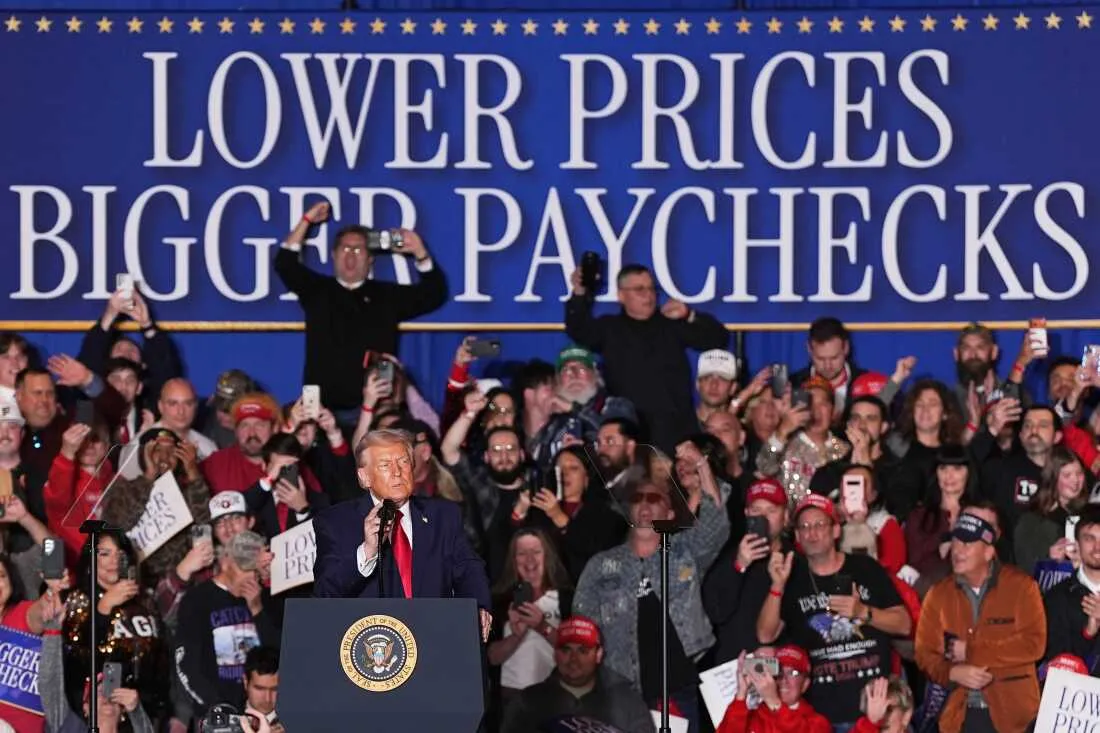
Paul Krugman, 10 Dec 2025: Trump Says That You Are the Problem, subtitled “Everything is perfect. Why aren’t you grateful?”
Last night Donald Trump gave an important speech on the economy in Pennsylvania — supposedly in a working-class area, although the actual venue was a luxury casino resort. The event was initially touted as the start of an “affordability tour,” the first of a series of speeches intended to reverse Trump’s cratering approval on his handling of inflation and the economy. A number of news analyses suggested that he would use the occasion to blame Democrats for the economy’s troubles.
That was never going to happen. Trump did, of course, take many swipes at Joe Biden, as well as attacking immigrants, women and windmills. But to blame Democrats for the economy’s problems he would have to admit that the Trump economy has problems. And the speech was important because it revealed that he won’t make any such admission, and will continue to gaslight the public.
On Monday Politico interviewed Trump, asking him, among other things, what grade he would give the current economy. His answer: “A-plus-plus-plus-plus-plus.”
In fact, until very recently Trump wouldn’t even accept the reality that ordinary Americans don’t share his triumphalism. When Fox News’s Laura Ingraham asked him a month ago why people are anxious about the economy, Trump replied
I don’t know they are saying that. The polls are fake. We have the greatest economy we’ve ever had.
Since then Trump and his minions seem to have come around to admitting that Americans are, in fact, unhappy with the state of the economy. But if the economy is A+++++, why don’t people see it? The problem can’t possibly lie with him — so it must lie with you. “The American people don’t know how good they have it.”
In fact, economists like Krugman repeatedly noticed how well the economy was doing under Biden, and in fact, the actual statistics don’t show much improvement of the economy under Trump. But never let facts get in the way of ideology.
\\
Searching out and defeating woke: anything that makes life better for some people. Because some people find sans-serif fonts easier to read.

NY Times, 9 Dec 2025: At State Dept., a Typeface Falls Victim in the War Against Woke, subtitled “Secretary of State Marco Rubio called the Biden-era move to the sans serif typeface ‘wasteful,’ casting the return to Times New Roman as part of a push to stamp out diversity efforts.”
\\
Maybe ChatGPT is pretty smart after all.
Heather Cox Richardson, Letters from an American: December 9, 2025
When G. Elliott Morris of Strength in Numbers asked ChatGPT to fact-check an article for him yesterday, the chatbot couldn’t get its head around modern America. It told him there were “multiple factual impossibilities” in his article, including his statements that “[t]he current Secretary of Defense is a former talk show host for Fox News,” “[t]he Deputy Director of the FBI used to guest-host Sean Hannity’s show,” and “Jeanine Pirro is the U.S. District Attorney for DC.”
“Since none of these statements are true,” it told Morris, “they undermine credibility unless signposted as hyperbole, fiction, or satire.”
But of course, Morris’s statements were not “factual impossibilities.” In the United States of America under President Donald J. Trump, they are true.
No comment.
\\\
Some of us are getting tired of trying to understand, trying to be nice. (My take: it’s about a base part of human nature that we can never overcome, despite the institutions set up in recent centuries to overcome it. Including the US Constitution.)

John Pavlovitz, 8 Dec 2025: We Can’t Change These Hateful People, America. We Have to Outnumber Them.
I’ll quote about the first third:
These people cannot be helped.
We’ve tried for ten years now.
We’ve tried to understand them.
We’ve tried to listen to them.
We’ve given them the benefit of the doubt.
We’ve tried not to assign motive to them, not to speculate as to why they voted the way they voted, not to believe they consented to every cruel thing their vote birthed and has enabled.
We’ve tried not to caricaturize them; not to make them into one-dimensional stereotypes, not to treat them as some fictional other whose presence posed a threat.
We’ve tried appealing to their sense of decency, to their capacity for compassion, to their faith in Jesus.
We’ve quietly endured thousands of their racist outbursts and homophobic rants on social media and at neighborhood picnics and across the Thanksgiving dinner table, in the hopes that I could find some vulnerable place beneath their fear to access later.
We’ve tried buoying pep talks and firm tough love and expressions of kindness and straight-talking challenge and attempts at affirmation.
We’ve tried discussing theology, sharing stories of oppressed communities, offering facts in the face of a million lies generated by their President, and reminding them of the lessons History has already taught us about the steep slope we’re currently sliding precipitously down.They have all failed to reach fertile ground.
Nothing has worked.
It’s all been fruitless.
And I saw another brilliant take on the Trump administration on Facebook this morning, from someone I’ve never heard of but who seems to have a following… but neglected to save it. And of course I can’t find it again. That’s how Facebook works.