Subtitled “A Hopeful History”
(2019 Dutch; 2020 Little, Brown, xviii+461pp, including 64pp acknowledgements, notes, and index)
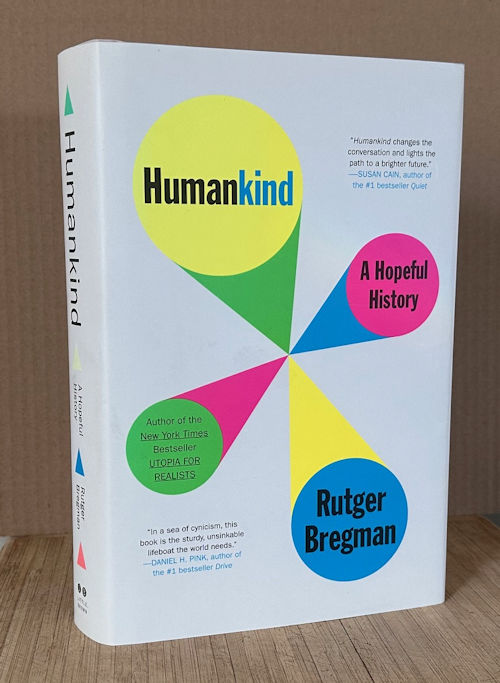
Still catching up posting about big books I’ve read in recent years. This book came out in 2020 (in the US) and I blogged about it briefly here. His first book, UTOPIA FOR REALISTS, came three years before this one, and I blogged about that one here. His third book, MORAL AMBITION, was released last year, and I picked it up last week to read next, before realizing I should catch up on the second book here, first.
Bregman is an historian and thinker and all-around optimist about things that many people are pessimistic about. This he aligned with Pinker and Rosling and Norberg and others. The title of this book is a play on words; Humankind doesn’t mean just humanity, it stands for the author’s conviction that people are more often kind rather than innately bad. In the big picture, he’s aligning himself with Rousseau rather than Hobbes, and so on that level he’s challenging the ideas of people like Pinker, who in THE BETTER ANGELS OF OUR NATURE documented the decline of violence over human history in the context of Hobbes’ Leviathan and the ideas of the Enlightenment that reigned in earlier violent tendencies. Bregman is claiming those early violent tendencies didn’t exist, or have been misinterpreted through bad history or bad storytelling. And he makes a good case, even though he seems to rely on anecdotal evidenced a bit too often…
As I did with UTOPIA, I’ll summarize key points in some bullets, then dump all 9000 words of the detailed notes I took while reading the book.
\\
Key Points:
- Premise: most people are pretty decent. He cites a number of historical anecdotes about how [contrary to a lot of movies and TV shows] when calamities occurred, people did not go crazy, but more often reacted with courage and charity, helping each other in times of crisis. Examples of Titanic, 9/11, Katrina; and of how placebos work and how the grim view of humanity is a ‘nocebo.’ The idea that people are inherently bad is partly an effect of watching too much news, which highlights all the bad things that happen, and too many movies and TV shows [which play to our biases]. And now social media makes it worse.
- Famous example: Lord of the Flies. In fact, the real events the novel was based on turned out completely differently: boys stranded on an island cooperated, were finally rescued, and started a business together.
- Author recalls Hobbes and Rousseau; which of them has been right? Author reviews the evolutionary history of humanity and why humans might have prevailed while Neanderthals did not; our sociability enabled the ability to learn from others.
- More evidence: The discovery that most Japanese soldiers on islands in WWII never fired their guns. Studies of ancient hunter-gatherers were tainted by error or misinterpretation. Bregman quibbles with Pinker in how data is selected to represent various groups. [[ I.e, both Pinker and Bregman could be right, in different contexts or from different perspectives; I’m not going to try to judge. ]]
- Perhaps, Bregman speculates, ancient humans were mostly peaceful, until agriculture entailed settling down and accumulating possessions, requiring the formation of governments, became the basis of patriarchy, and leading to ideas of gods and sin. Hobbes [and Pinker] thought the ‘Leviathan’, i.e. a government to create rules and keep for itself the right to use violence, solved those problems. Yet author notes that civilization has been pretty miserable for most people, until just the past two centuries, when genuine progress has been made.
- Author examines a bunch of familiar historical events for what they imply on this subject: the statues on Easter Island and who built them; the Stanford study in which students play prisoners and guards; the Stanley Milgram experiment in which volunteers are instructed to shock patients; the Kitty Genovese murder in New York City in 1964 in which no one came to help. In all of these, Bregman says, the true stories have been distorted. [[ He doesn’t make this point exactly, but these also raise the question of how stories, and history, are created and propagate. ]]
- A couple chapters consider the psychology involved. Why do good people turn bad? Soldiers don’t fight out of ideology, they fight to support their mates, their friends. Thus there’s no such thing as ‘pure evil’; our enemies are people just like us. Babies and toddlers gravitate toward others like themselves, and can be taught prejudice against others arbitrarily deemed different. Yet empathy can go haywire, focusing on a single person or situation while ignoring the bigger picture. A key idea is the ‘mismatch’ of our ancient human nature in modern society.
- Further: power corrupts; the powerful easily become sociopaths. Most of human history was egalitarian, until about 10,000 years ago, when things went wrong, until the Enlightenment brought law, democracy, education, and science. So now we’re in the Age of Reason. Yet ideas of race, and racism, remain.
- A new realism entails understanding that children, and teachers, can be manipulated by making them believe things that aren’t true. Business motivation presumes that people can’t motivate themselves, and must be given incentives (i.e. behaviorism). Recent studies show that ‘intrinsic motivation’ works better. Allow children to play; playing and learning used to be the same thing; encourage trust. [[ These ideas echo Haidt and Lukianoff ]]
- Humans can be more cooperative if given the chance; some cities have introduced participatory budgeting. Other structural changes can lead to engagement, trust, inclusion, etc. It’s the old idea of commons, which pre-dates the idea of land ownership. Alaska does a version of this.
- Other changes might involve the treatment of criminals; enlightened treatment reduces recidivism. Conservatives resist such ideas.
- The best remedy for hate, injustice, and prejudice is: contact. Get to know perceived enemies. This has helped civil rights movements, until conservatives rebel. Final anecdote about how Germans and British took breaks on Christmas Eve 1914 and celebrated with each other.
- Bregman ends with ten rules to live by, which I posted about before, here: http://www.markrkelly.com/Blog/2020/06/15/rutger-bregmans-ten-rules-to-live-by/: Assume the best; think in win-win scenarios; ask more questions; temper your empathy; try to understand the other; love your own as others do; avoid the news; don’t punch Nazis; don’t be ashamed to do good; be realistic.
Comments:
- This is a provocative book that tries a little too hard to support the thesis the author wants to prove. He relies a little too much on anecdotes, or single examples, to overturn the generalizations of previous thinkers. (E.g. “I accepted the general consensus, but then I heard about this guy…”)
- He makes some good points that dovetail with those of other writers, e.g. the unfortunate consequences of the agricultural revolution, how most of what we call progress has happened only in the past centuries, how over-management by bosses or parents can stifle play, creativity, and learning.
- I don’t see any reason why his thesis should be correct at the expense of the other theses. For example, one general consensus is that people cooperate with their in-group, and are suspicious of or hostile to outsiders. And the boundaries between in- and -out groups can shift depending on circumstances. As usual with many supposed scientific controversies, differences are those of scale and perspective, not fundamental principles. And a fundamental principle of human evolution is that survival depends on competition, yes, but the growth of large societies has depended on cooperation.
\\\
Detailed Notes:
Prologue, page xi
Author recalls the start of WWII when both the British and Germans expected the English population to become hysterical as London was bombed. Did they? No. Oddly, a kind of serenity settled over London. The British stiff upper lip. The economy went on. No traumatized victims. Mental health actually improved. Still, the British thought they could break the German spirit, because the latter ‘lacked moral fibre.’ They did not let the facts change their minds. So they bombed Germany, including Dresden. What was the effect? Again, no mass hysteria. After the war, evidence suggested the bombings strengthened the German economy, extending the war. All of this disproved the prevailing theories of Gustave Le Bon that civilization was only skin deep. Yet later the US bombed Vietnam, and failed yet again.
[[ I immediately recall the famous Twilight Zone episode “The Monsters are Due on Maple Street”, in which residents of suburban street turn on one another in fear that one of them is an alien invader. The idea was that any strange disturbance would quickly shatter the norms of civilization, returning everyone to savagery. But the episode wasn’t an example of that — because, the residents didn’t know, the strange disturbance were being manipulated by real aliens precisely to trigger the worst paranoid fears of ordinary people. ]]
Ch1, A New Realism, p1
- This book is about a radical idea, one denied by religions and ideologies but legitimized by science: that most people, deep down, are pretty decent.
- Consider two scenarios in a plane crash: everyone helps others; or everyone fends for themselves. Most people imagine the latter; in fact it’s usually the former. The evacuation of the Titanic is one example. And 9/11. And Katrina. The media played up the worst incidents, as if to confirm de Waal’s ‘veneer theory’. Actually, after Katrina, many of those incidents were debunked. Most people reacted with courage and charity. Studies going back decades conclude there’s never total mayhem after a disaster. But the media feeds us the opposite of what actually happens.
- In the case of Katrina, this caused authorities to delay, and then overreact. Powerful people – who are ruled by self-interest—think that everyone else is just like them. [[ just as conservatives so often project… ]].
- P7. In 1999 several kids getting sick led to a panic over Coca-Cola products that cost $200m. Yet nothing was found wrong with the Coke.
- What is truth? Some things are true whether or not you believe them. Other beliefs become self-fulfilling prophecies. There’s the placebo effect. Even surgical placebos (where they don’t actually do the surgery) work. It works the other way: if you’re afraid something will make you sick, it probably will. The ‘nocebo’ effect. That’s what happened with the Coke. Mass psychosis. Some beliefs can become real.
- So: our grim view of humanity is also a nocebo. It comes from our view of human nature. In fact, a positive view of human nature is more realistic than we think.
- P10. Author describes how people thought his idea for this book was crazy. [[ what was the other book where author had similar reactions? – Better Angels ]]
- Cynics think people who do nice things for others have selfish motives in mind. Most people around the world think most other people can’t be trusted. Unrelated to education or political conviction. So why do we believe in this wicked view of human nature?
- It’s an effect like that of an addictive drug: the news. Contrary with how we grew up, scientists are concluding that the news is a mental health hazard. It leads to ‘mean world syndrome.’ When asked if the world is getting better or worse, most people say the latter. The reality is the opposite. But news is about the exceptional… p13b. (Ref’s in this section to Rosling and Dobelli and Taleb.) When bad things become rarer, the news gives them *more* coverage.
- First reason: the negativity bias: we’re more attuned to the bad than the good. 14b. And the availability bias, 15t. Now we have social media that knows how to attract our attention.
- Most books are about the exceptional too. In various fields cooperation is often taken as selfishness and exploitation. In fact, most people are decent, but the research into ‘homo economicus’ turns out to apply to chimps. The doctrine of human selfishness has a long history – 17.4. Since the Greeks. And of course Christianity. Even the Enlightenment philosophers. Only recently have these ideas undergone a radical revision.
- P19. Three warnings. Standing up for human goodness is like fighting a hydra—cynical counterarguments keep popping up. Second, this means taking a stand against the powers that be, whose positions in charge would be threatened. Third, taking this view means weathering a storm of ridicule. It’s easier being a cynic.
Ch2, The Real Lord of the Flies, p21
- Summary of that famous book. But it never happened; Golding made it up. His notion appealed to the times, following the atrocities of WWII. It’s a textbook example of veneer theory.
- P24. In reality Golding was an unhappy man. Author decided to find out what real children would do in such a circumstance. He did some research and eventually discovered a story about six boys who were marooned on an island near Tonga for nearly a year.
- P27. Author and wife visits Peter Warner, who discovered the boys. Learned his story. How they found the boys…
- P30. The boys’ story was very different than Lord of the Flies. …. They ended up on the island of ‘Ata. How they learned to cooperate, keep their fire, and so on. Finally rescued in 1966. When returned home, the boys were arrested and thrown in jail, for stealing the boat. Later the TV people came out, and barely survived on the island long enough to get 20 minutes of footage. Author eventually tracks down the documentary. And the boys eventually started a business trapping lobster.
- P36. Their story has never become known. Meanwhile the Golding book inspired reality TV, in which people behave like beasts. ‘The Real World.’ But to film them, candidates had to be egged on.
- Stories can be nocebos; cynical stories affect how people actually behave.
- In general, this might be seen as yet another example of how consuming the news gives you an impression that’s not true.
- Does author explore evolutionary rationale for this? A cooperation gene, so to speak, without which large social groups could not have evolved?
- Or is this like the perception of conspiracy theories? Better to be safe…
- And again, this challenges the religious idea that people are fallen and must be fixed. The obsession with ‘sin’. See “the one you feed” parable p10m.
Part One: The State of Nature, p41
- Recalling what Hobbes and Rousseau thought. Hobbes: pessimist, believed in the wickedness of human nature. Rousseau: in our hearts we’re good, it’s civilization that ruins us. The divide informs many debates, 44t.
- Hobbes focused on how we must have lived 50,000 years ago. Humans could do whatever they wanted; but were driven by fear. So: relinquish liberty to the sovereign Leviathan. Thus do tyrants insist on power, or all is lost. A century later, Rousseau, who perceived that civil society was a curse; man is naturally good. He was a great writer, p46 sample. Since the birth of society, everything has gone wrong—farming, urbanization, statehood. Writing, the printing press. Now we’re feeble. Thus the argument: give us liberty, or all is lost.
- Now 300 years later. Economics took the Hobbesian view. Rousseau inspired education. Conservative and progressive. Realists and idealists. So which of them has been right?
[[ COMMENTS SO FAR: Both this book, and the big book by Graeber and Wengrow, seem to dispute Pinker’s data in BETTER ANGELS. Bregman here casts him as a die-hard Hobbesian—humans were violent until calmed by social factors, beginning with the Leviathan. So what will the resolution be? Perhaps they’re both right, just from different perspectives.] ]]
Ch3, The Rise of Homo puppy, p49
- We need to understand that in evolutionary terms, humans are babies. History of life chart p51: history of life reduced to 1 year, humans appeared at 11pm on the last day, and all of ‘history’ within the last two minutes. But why us?
- God’s plan? If so it wasn’t apparent even on Dec 30th. In fact we’re a product of evolution. The basic ingredients are suffering, struggling, and time, lots of all three. Animals have more offspring than they can feed, and so on. Some of the ways animals survive are revolting. Darwin put off accepting it. Much later Dawkins wrote about ‘selfish’ genes. It dispirited many readers.
- So why us? We’re not especially smarter than chimps or orangutans. Charts, p55. Are we more cunning? Again, not compared to the chimps. And why do we blush?
- P57. In 1856, bones were found of what became known as the Neanderthal. A different species of human. Antidiluvian. More bones are found, some even already in museums.
- We’ve concluded that 50,000 years ago there were at five hominins besides us. Why did they disappear? The Neanderthals were stronger, and had bigger brains. Intelligent. Maybe we were just meaner, and wiped them out, as Harari and Diamond suggested.
- P60. In 1958 a secret experiment was conducted in the USSR to try to domesticate a fox. Darwin had puzzled about domesticated animals. Perhaps certain traits were byproducts of friendliness. So it was tried with foxes. Within four generations a fox wagged its tail. They remained physically more juvenile. Results were revealed in 1978. Perhaps all due to hormones – and could be applied to humans.
- Perhaps humans are domesticated apes, and only the friendliest ones survived. Indeed, evidence came along supporting the idea that human faces and bodies have become more youthful and feminine: childlike. Homo puppy. This accelerated around 50,000 years ago. When the neanderthal disappeared, and humans came up with new inventions. How does that make sense?
- P66. In the 1980s Brian Hare studied dogs. And showed they are smarter than chimps. How? Perhaps because our ancestors selectively bred the smartest ones. He tracked down the Siberian fox experiment. He would give them the object choice test. The foxes had been bred for friendliness, not intelligence. What happened? The friendly foxes were also smarter. Friendly is also clever.
- P68. Social learning, the ability to learn from others, was the key—human toddlers are much better at it than chimps. Humans learn, bond, play. Thus blushing can be seen as fostering trust. So too with the whites of our eyes. Unlike all the other primates.
- Humans constantly reveal our emotions to others. It’s a superpower. Imagine comparing anti-social geniuses with sociable copycats. Neanderthals were a little bit like the geniuses; humans are slower, but better connected. Language too may be a product of sociability.
- So what happened to the Neanderthals? Maybe humans were just better able to handle the conditions of the ice age, because we were able to work together. Yet in the 1970 corporations like Enron developed ‘rank & yank’ cultures, implementing Hobbesian universes. Today, Amazon and Uber.
- Dawkins toned down his claims in later editions of his book. Cooperation, feelings of connectedness, kindness, are more important than competition.
Ch4, Colonel Marshall and the Soldiers Who Wouldn’t Shoot, p73
- The elephant in the room: humans also have a dark side. Homo puppy can be cruel. Why? Because we’re social, but we feel more affinity for people who are most like us. Oxytocin makes us kinder and gentler, but the effect is limited to one’s own group. And it intensifies aversion to strangers.
- P75. Was Hobbes right after all? Indeed, archaeologists have found evidence of violence among ancient hominins. Killer apes. Up until the advent of farming. Raymond Dart. Then Jane Goodall, who discovered chimp wars. Then some studies showed humans were nicer. The !Kung. Later studies showed hunter-gatherers were just as violent as the chimps. The Yanomami. Then came Steven Pinker’s 2011 book. Did that settle it? Author thought so, for years.
- P79, Then he found out about Colonel Marshall. [[ beware – anecdote alert! ]] Historian Samuel Marshall witness a 1943 battle to retake an island in the pacific from the Japanese. After the battle, he interviewed the soldiers and discovered that most of them never fired their guns. He confirmed that with other battles: many soldiers balk and fail to shoot. They stayed at their posts, but didn’t shoot. He later wrote about an innate resistance to killing a fellow man. Has this always been true? Yet later his findings were challenged, even dismissed as a hoax. Apparently he did twist facts. So who’s right?
- Any other evidence? Evidence supporting Marshall kept piling up. Most casualties were due to a small minority of soldiers. Evidence from the Civil War—many guns of fallen soldiers were still loaded. And the French army. Analysis shows that only 13 to 18 percent of soldiers in combat actually fired their guns.
- [[ of course this in no way contradicts the data Pinker gathered… ]] [[ it’s still perfectly possible that a small percentage of people are perfectly willing to inflict violence on others. ]]
- Is the idea that humans are violent an artifact of popular culture? Author went back to academic literature. Are we misled by a fascination with horror and spectacle? [[ plausible – yet another psychological bias. It’s like asking if kids who play violent video games really are more violent themselves. ]]
- Recall the killer ape theory, and the movies Planet of the Apes and 2001. Kubrick quote. Raymond Hart’s findings were reinterpreted. What about the chimps? Well, gorillas and bonobos are more peaceable.
- The real question is, how violent were the first human beings? Well, that evidence from modern hunter-gatherers is tainted; it doesn’t tell us much. That book about the Yanomami people made statistical errors. What about Pinker? There are issues with his selection of which groups to study. Deaths among the Ache in Paraguay were often killed by Paraguayans, not each other.
- [[ And thus not representative of truly primitive societies. Could there be an alternate big picture? That violence erupted as humans settled down in farms…? Or spread across the world and encroached on more primitive groups of humans? That would sort of split the difference between Hobbes and Rousseau – not so simple; not just a single timeline. ]]
- What about modern anthropology? When we study truly representative societies we find war is a rarity. Nomads would simply walk on. And some of these nomadic groups were not that small. How about archaeology? Cave paintings never show war against other people. Pinker’s data mixes primitive with after the invention of farming. Data from the true ‘natural state’ show almost nothing. The truth is, war had a beginning.
Ch5, The Curse of Civilization
- So maybe Rousseau was right and humans were noble by nature, until civilization came along. Thus the inhabitants of the Bahamas were peaceful, allowing Columbus to enslave them. There are even places today where natives are repulsed by the idea of killing another person, 95t.
- Keep in mind that prehistoric politics avoided inequality. Shame was used to keep people in their place. They were gentle and generous. Yet in extreme cases they might execute an unmanageable tribesman. Example of the /Twi. Early tribes had more equality between the sexes. Infants were raised by the whole village. Monogamy was serial.
- P98. So what happened to that world? Because large populations need someone to organize big projects? Yet some historical examples seem to have gotten built without hierarchies of leaders. What changed?
- P100. Go back 15,000 years to the last ice age. People settled down, and possessions grew. Inequality grew. This is about the time wars break out. Settled life made people more distrustful of strangers. Generals and kings arose to manages wars fought against other clans. The Bible warned of the dangers, 101b. Thus a new age in the history of mankind began.
- P102. Again, maybe Rousseau was right; it wasn’t agriculture and private property that brought us peace and prosperity. Rather. Compare work weeks of hunter-gathered to those of farmers. (Ref to von Schaik here). Settling onto farms meant brides had to be fetched, like commodities. The patriarchy was born. Settled life was less healthy. Diseases spread. STDs, via sex with animals. Reasons for obsession with female virginity. Settlements became subject to famines, floods, epidemics. Whole populations could be wiped out. Thus shifts in ideas of the gods, someone to blame. Gods who became enraged by something we’d done. The idea of sin. Example of the Aztecs, killing to appease the gods. So why did all this happen, settling in one place. No single event. Thought the fertile plain was a temptation. Then settlements grew. Farming became harder. Eventually it was too late to go back; the population was too big. Farmers outnumbered the foragers. Villages were conquered by town, annexed by cities, swallowed up by provinces. Then the birth of the state.
- P107. Recall Hobbes thought Leviathan was the solution. But the early states were slave states. Milestones of civilization like money and writing were originally instruments of oppression. Slavery was inherent in Hammurabi, Athens, Plato and Aristotle. The Great Wall of China kept subjects in. And how colonists fled into the wilderness, while the reverse rarely happened. [[ Sebastian Junger describes how this happened between the English settlers and the native Americans. ]]
- Civilizations rose and fell. Rather than ‘dark ages’ in between, those periods might be regarded as reprieves from the problems of civilization. Book by James C. Scott. Why our negative notion of ‘barbarians’? History is written by the winners.
- P110. So Hobbes was off the mark. Genuine progress is a very recent phenomenon. For ages civilization was a disaster. Most people suffered. Until just the past two centuries. Healthier, richer, slavery abolished. Peaceful. So the curse of civilization can be lifted. Yet we face an ecological crisis; how long can our current lifestyle be sustained?
Ch6, The Mystery of Easter Island, p113
- So our understanding of history has shifted. But look at one more example of how people behave on their own. How would those boys on ‘Ata have built a civilization if girls were present? We have Easter Island.
- In the 1720s explorers search for the ‘Southern Land’ they felt had to exist to balance the land masses in the north. In 1722 a vessel discovered a small island they dubbed Easter Island. With people on it. And those huge statues. Mysteries abounded; eventually the truth was discovered. Polynesians. Two tribes and a civil war. A Hobbesian war. Caused by what? In 1955 Thor Heyerdahl visited. Among his discoveries: the island once held a vast forest.
- P119. How the statues, the moai, were built, until all the trees were gone. Soil eroded, crops failed. The two tribes went to war. Jared Diamond summarized the island’s history in Collapse. The moral: like the planet earth, its resources were finite, and humankind’s greed is boundless.
- So now we’re back to Hobbes’ veneer theory. We’re doing the same to the planet that they did to their island. But then author discovered Jan Boersema.
- [[ is this a pattern of ‘saved by the anecdote’? ]]
- P122. Boersema is an environmental biologist, who made a key discovery in 2002. He went back to the logbook of the explorer who found the island – and who described the natives as healthy, the soil as fertile, and no toppled statues. So go back to first sources.
- Some of the early stories were based on memories. The trench where a key battle was supposedly fought was a natural feature; and so on. The population of 15,000, from Diamond, was implausible. The large population that supposedly disappeared never existed. What about the forests? Exaggerated estimates; and rats. Food production actually increased!
- P127. But it didn’t last long. European ships brought a plague. Further expeditions. Captain Cook in 1774. He was the first to report toppled statues and the natives as small and miserable. But that description traces back to Thor Heyerdahl…. Not a reputable source. What about the statues? Consider how the natives lived for hundreds of years thinking they were alone in the world. One idea is a cargo cult; or, they just found something better to do. Fascination with hats.
- P132. The first slave ship came in 1862. Peruvians. Some 1400 slaves taken, many dying of diseases in Peru. Peru sent some of them back—infected with smallpox. Leading to many more deaths. By 1877 only 110 inhabitants remained.
- So: there was no war, famine, cannibalism; the culture was killed by infestations from Europeans. Just as we are now threatened by climate change. Yet they were resilient, and hopefully we will be too.
Part Two: After Auschwitz, p135
- So if it’s true that humans are kind-hearted by nature, how do we explain Auschwitz? And similar events throughout history? Following the murders of six million Jews, the field of social psychology arose to explore whether humans really are monsters at heart. Humans are capable of appalling acts—given a tweak in our situation. Famous experiments….
Ch7, In the Basement of Stanford University, p139
- This was the study, in 1971, in which one group of students play prisoners, another group guards. Things quickly got out of control, but the experimenter kept going for 6 days before calling it off. The experiment became widely taught, and known. The Tipping Point. It was about how anyone could commit heinous acts given their situation…
- P143, a similar experiment was done in 1954 with two groups of boys—the Robbers Cave Experiment. Initially separated, the two groups were brought into contact. Things degenerated fast…. Note it was the experimenters who made the two groups compete.
- P146. Author meets writer of a book about Robbers Cave. Gina Perry. She found a story that contradicts how the story has gone for 50 years. The experimenter had tried it before. Again, edging them into competition. The boys didn’t want to.
- P148. The manipulation in 1971 was even worse. In fact, Zimbardo *instructed* the ‘guards’ on how to play their roles. This completely undermined the objectivity of the experiment. Later in 2013 and 2018 a French researcher uncovered more: the idea for the experiment was from a student, with admitted sadistic tendencies. Again, the guards were prompted. Zimbardo was actually only interested in the prisoners. Many of the ‘guards’ were unwilling to play their roles. One of the prisoners tried to leave and was refused. Until he faked his outraged complaints. It was all a farce.
- P154. Another experiment in Britain played things more fairly. A replay of Stanford, but without the coaching. The result was dull. The guards weren’t told what to do. The guards and prisoners decided to form a commune. And yet, this experiment is forgotten, while people still talk about Stanford.
Ch 8, Stanley Milgram and the Shock Machine
- An even more famous psychological experiment. Milgram’s study was in 1961. He placed an ad. Yale. Volunteers were assigned to be teachers or learners. Actually the shocks were faked, but the teachers didn’t know that. The voltage increased. 65% of the participants went all the way to 450 volts. Just because someone told them to do so. Results were widely reported. Milgram presented this as an explanation for the Holocaust. It was all about authority.
- The study began just as the trial of Adolf Eichmann was finishing. Eichmann seemed utterly normal. Hanna Arendt wrote about the ‘banality of evil.’ Over time he and the shock machine became tied together.
- Author admits he wanted to bring the experiment down. Gina Perry investigated and became a critic of Milgram. Near the end of the experiment Milgram took photos, and one subject, Fred Prozi, was highlighted. His star subject. Again, Milgram kept egging them on. As it turned out, many didn’t believe they were actually administering shocks. And the majority who did called it quits. Milgram didn’t tell them the truth.
- P167. So, it was a farce? Author later had second thoughts. Later replications of the experiment verified the results. And yet, subjects grew more disobedient the more overbearing the experimenter became. They resented being bossed around. But they cooperated as long as they trusted him. They wanted to be helpful.
- P170. Recall that Eichmann wasn’t meek; he was a fanatic at heart. He somehow believed he was doing good. He lied when he claimed he was only following orders; the Nazis didn’t work that way. Followers one-upped each other to please Hitler. Arendt never claimed he just followed orders; and she criticized Milgram. Milgram’s experiments weren’t about obedience, but about conformity. But his simplistic thinking stuck. It echoed the ancient idea that humans are born sinners. Why do we believe this? It’s convenient; it provides an absolution for making excuses.
- P175. One more story about resistance. Copenhagen, 1943. A Nazi raid. Jews would be taken aboard ships, to be taken to concentration camps. So most of them fled the warning. An ordinary Danes simply refused to cooperate. Instead they helped the Jews escape to Sweden. …
- [[ but recall that old TV movie with William Shatner – The Tenth Level, from 1976; maybe the question is, why were the experimenters so insistent on creating, or verifying, such behavior? Maybe *they* were the monsters. ]]
Ch9, The Death of Catherine Susan Genovese, p179
- March 13, 1964, past 3 am, Kitty arrives home, is stabbed. She screams, people hear, but no one comes to help. “I didn’t want to get involved.” The story became famous for that reason. Everyone chimed in with explanations.
- P183. Gladwell covered it in The Tipping Point. It became famous. Again, author’s research turned up something a little different. Later experiments revealed what is called the ‘bystander effect.’ Individuals respond; those in a group wait for others to go first. A symptom of big-city life?
- P185. Author assumed so. In 2016 a car slid into a canal in Amsterdam and four men jumped in to rescue the mother and child. All without speaking.
- P187. A later meta-study showed that the bystander effect exists, if the stakes seem low or witnesses are isolated; otherwise there’s an inverse effect. Author met with a researcher whose conclusion was that people help each other out 90% of the time.
- P189. Why then Kitty Genovese? A later amateur historian did some digging and found out what really happened. The police were called, and may have assumed it was a marital spat. 38 people were interviewed—but they were not all eyewitnesses. Two who did witness were a man who hated Jews and another afraid of being outed as homosexual. The latter called someone else, Sophia, who did run to help. And comforted Kitty as she died. Why was Sophia forgotten? She and others complained that their words were twisted by the press. Reporters left out details that would ‘have ruined the story.’ 192.9.
- So very little of the original story holds up. And five days later, the killer was caught, because strangers intervened during a daylight robbery.
- Lessons: our view of human nature is out of whack; journalists know how to push buttons to sell sensational stories, 194.3. And in emergencies, we *can* count on each other.
[[ one way of understanding all these incidents is that they were complex situations reduced to simple narratives – that appeals to cliches about human nature derived from religion, perhaps.
so some of these biases, like the bystander effect, aren’t actually true very often.
Harlan Ellison wrote a famous story based on the Kitty Genovese incident: The Whimper of Whipped Dogs
2026 thought: or are all these examples of twisting real events into satisfying narratives? Stories? And another reason to distrust journalism, especially sensationalists. ]]
Part Three: Why Good People Turn Bad, p195
- Author recalls his earlier book The History of Progress in which he discussed the Stanford Prison experiment without criticism. Why was he attracted to the notion? Many others cited it over the decades, or variations on veneer theory.
- So why do people do evil things? Could it be a result of settling down to private property and farming? 198.8: “…were not equipped.” A so called ‘mismatch’. Obesity. Something like that? Something that misfires in the modern world? If so, what society might emerge if we acknowledge the mismatch..?
Ch10, How Empathy Blinds, p201
- Story of Morris Janowitz, who joined the US Army with a group of psychologists in London to unravel the mystery of the Nazi mind. Why did they keep fighting so hard? The assumption had been: ideology. As if they were possessed. They fought better. Later, when interviewing German prisoner of war, Morris realized they had it all wrong.
- The reason, prisoners said, was friendship. They didn’t want to let down their mates. The generals knew what they were doing. They weren’t monsters. They weren’t brainwashed by politics. Years later transcripts of conversation between German prisoners confirmed it. Same in the US and Britain—men fought for their comrades, more than for their countries.
- P207. Thus the ‘myth of pure evil’. Our enemies are just like us—even terrorists. What they share is that they’re easily swayed, by other people, by authority. Many of them brothers. Ideology plays a role, but not a big one. Nor Islam. They nevertheless felt they were part of something bigger.
- P209. In 1990 an ‘infant cognition’ lab opened at Yale. In 2007 it published result of a study that showed infants have an innate sense of morality. They had babies watch puppet shows and saw how they reacted. Homo puppy is not a blank slate; we’re born with a preference for good. [[ because otherwise we couldn’t be able to cooperate…… does he go there? ]]
- On the other hand… babies also gravitate to those who are similar to them. We’re all born xenophobes. In big cities, we’re suspicious of strangers.
- Toddlers were also studied. It turns out 18-month-olds are eager to help others. On the other hand, children can easily be turned against each other. An experiment in 1968 told children that brown-eyes were better; they believed it and acted accordingly. Parents were outraged. But the experimenter was taking pains to pit the kids against each other. In 2003 another experiment was done, with two colors of shirts. They developed group identity. They were quite sensitive to differences. It’s easy to become tribal.
- P214. Could oxytocin be involved in this? People can be distrustful of strangers, but also empathetic toward others. We’re easily made happy or sad by movies. But then author read the book by Paul Bloom. He’s against empathy. It focuses the attention too much on one person. You sympathize more with them than everyone else in similar circumstances. And it’s impossible to feel empathetic toward everyone. Empathy is like the news: it zooms in on the exceptional. Sympathizing with victims allows us to generalize about the enemy. Empathy is just the flip side of xenophobia.
- P217. Why do good people turn bad? Soldiers fight for comradeship. Even fewer use bayonets than shoot their guns. Game of Thrones and Star Wars mislead. It’s not easy to skewer another person. Most people who died in wars did so through mortars or grenades, 218m. Remotely. Attacking enemies remotely gets us over our aversion to violence close up. It also helps to increase psychological distance—by dehumanizing the other. You can also drug soldiers to reduce their resistance to violence. And other methods. With results like PTSD. And the leaders always keep the enemy at a distance. Who are often paranoid narcissists.
- Which leads to: why do we seem to be ruled by those who are utterly shameless?
- [[ then all those war films are massive misrepresentations of the reality of war. Again: why do people want to see it?
Key idea: the ‘mismatch’ of our ancient nature in modern society. Ch10.
Ch11, How Power Corrupts, p223
- The unavoidable name is Machiavelli. The Prince, 1513. All the great leaders read him, p224. His philosophy is doable. You must be shameless, without principles or morals. So was he right? Must people shamelessly lie and deceive to gain power?
- In the 90s Dacher Keltner [[ who later wrote the book Awe ]] noticed that everyone thought he was right, but no one had done the research to back it up. He was disappointed; most groups throw out such jerks. Rather, the friendliest survive. But, once people have power, it’s a different story. The powerful are messier eaters; people in expensive cars drive worse. It’s ‘acquired sociopathy.’ It turns nice people into Machiavellians. It was seen as a result of brain damage in the 19th century. And they don’t blush. They don’t ‘mirror’ others’ feelings. As if they’ve become unplugged. And they become more cynical about other people. That other people must be herded, told what to do. And the powerless feel far less confident.
- P228. Power corrupts, everyone seems to agree. We pick modest and kind people to lead us—but then power goes to their heads. We see this among gorillas and chimps. Humans share lots of DNA with chimps—but also with bonobos.
- Studies show Machiavellianism is almost always a recipe for disaster. It worked better to be generous, brave, and so on 231t. We’re also averse to inequality. OTOH we’re not communists; a little inequality is fine. Thus leaders have to persuade their followers that they’re worthy of having more. Yet why do we believe their stories? Maybe because we’re naïve, and that’s a feature, not a bug—it works to bind large groups together, larger than 150. Thus we have myths—narratives we tell like religions, states, companies, fictions that we tell ourselves. For example God. Recall how we can tell where other people are looking. But not in large groups. And so God was imagined, as seeing over everyone. Such myths enabled large groups of strangers to work together.
- But, author points out, this theory ignores 95% of human history. Nomadic ancestors already exceeded extended groups of more than 150. But the myths they told could easily be torn down and replaced. It took armies to enforce certain myths; people forced to believe. Today, *threats* of violence are still around. Even now, ignore the idea of money, and you’ll soon be fined or locked up.
- P236. Author wonders if private property and farming led Homo puppy astray. Those made the powerful more difficult to unseat. Revolutions don’t work, or simply lead to different tyrants in charge. Even democracy doesn’t usually work out. It’s more like an ‘elective aristocracy’ according to Rousseau. The nice ones lose their kindness and modesty; the shameless ones prevail. Shaming is still effective. Gossip. Blushing. A minority is unable to feel shame. And they tend to get ahead.
Ch12, What the Enlightenment Got Wrong, p241.
- Think back to how people reacted during the Blitz. How soldiers at the front are reluctant to use arms. Bombing doesn’t break morale.
- (Smry here) So: is human nature good, or bad? There are two sides. For most of our past, we lived in an egalitarian world. It all changed about 10,000 years ago. People settled, amassed property, we became more wary of strangers, becoming xenophobic. Peoples massacred each other. History has been a struggle against the biggest mistake of all time. The mismatch. How to escape that curse?
- P244. It seemed as if the Enlightenment made have done it. Law, democracy, education, science. Yet thinkers like Hobbes still assumed that human nature is corrupt. We could save ourselves through reason. Not faith. Our bad qualities could be made to serve the common good. The one sin was greed. So Adam Smith wrote about the free market, harnessing greed for the common good. The world would become wealthy. Similarly the checks and balances in the US constitution. And the birth of the modern rule of law, binding everyone. A consequence was that belief in a vengeful god diminished. Thus Denmark and Sweden.
- So here we are in the Age of Reason. Our lives are better and the world is richer and healthier. [[ endnote to the Rosling book ]] Diseases conquered, violence reduced.
- But the Enlightenment had a dark side. The idea of race, and racism. Then the Holocaust happened. Yet Smith and Hume recognized humanity’s good side; so why did their institutions premised on pessimism? Hume believed we should act as though people are selfish. Even though they mostly don’t. Has that become a self-fulfilling prophecy? Can things be different? Can we design new institutions operating on a different view of human nature?
- That’s for the rest of the book.
Part Four: A New Realism, p251
- Author first heard Bertrand Russell, who became his hero. His intellectual integrity, his fidelity to truth. Never let yourself be diverted for what you *wish* to believe. This is what author has done here. Russell spoke of ‘the will to doubt’ in opposition to William James, who spoke of ‘the will to believe.’ That some things must be taken on faith. Author agreed, for a while…
- P255. Until he heard about an experiment where rats that students *believed* were better (but weren’t) actually did better. Could this be applied to children? He did an experiment at a school in San Francisco. In it, he told the teachers – but not the kids — certain students at random were ‘high-potentials.’ Sure enough, the teachers gave those students the most attention. He called it the Pygmalion effect.
- Nor has this effect been debunked. It’s been verified in other contexts. Yet it didn’t have much effect on the world. The flip side is the Golem Effect, where we distance ourselves from those we have negative expectations about. It’s a mechanism behind racism.
- P259. Both of these effects are woven into our world. It’s part of how mirroring works. When it involves negative emotions, it can drive beauty pageants and economic bubbles. Tulip mania. Ariely showed you can fool people with ‘pluralistic ignorance.’ Everyone goes along with what they don’t understand. It perpetuates racism, even genocide. So are our negative ideas about human nature just pluralistic ignorance? Maybe this is where ‘the will to believe’ comes in, to break such cycles. Examples will follow.
Ch13, The Power of Intrinsic Motivation, p263
- About Jos de Blok, who created a home healthcare organization, Buurtzorg, but who doesn’t believe in managing.
- P265, Business management goes back to the early 20th century, based on the Hobbesian view that people are greedy by nature, and need to be managed and incentivized. Both capitalism and communism share this view; the former relies on carrots (money), the latter on sticks (punishment).
- People believe they motivate *themselves,* but that other people need some incentive, like money. Management scientists measured work performance. Timesheets; billable hours, and so on.
- P267. Things started changing in 1969, with Edward Deci, when behaviorism still ruled. He noticed that people do lots of things for no money. Money can even lower their motivation. His ideas were rejected. Later studies validated his ideas, the one in which parents picking their kids later from school were charged a fee. Economic incentives can backfire. Targets generate work designed to the target. These lessons haven’t made it into daily practice. Incentives only work for robot-like tasks. Examples, 270-1. How targets change how people do their jobs badly.
- P271. What Jos de Blok did. He treats people like intrinsically motivated professionals. Rather than needing MBAs to manage them. How Buurtzorg works, p273. Great success; awards. It’s hard to make things easy. The healthcare system needs to change, he says. Too many lawyers. Simplify everything.
- Another example: FAVI, a French firm that supplies car parts. …
- P277. These are examples of companies that take a more positive view of human nature. People do good because they want to.
Ch14, Homo ludens, p279
- What if the whole of society was based on trust? You’d have to start with kids. Yet their lives are so managed there’s little time for play. [[ this dovetails with the Lukianoff/Haidt book… ]] … and parents spend much more time with their kids. Children are under more pressure to succeed, but losing their playfulness.
- What play is p282. Almost all mammals play. And many other animals too. A Dutch historian called us Homo ludens, playing man. In early societies, playing and learning were the same thing.
- P284. The culture of play changed when humans settled down. Children then provided labor. And the idea that children required raising. Then education systems, churches, military. Play was the enemy of all of these. Children had to be taught to love their country. To be good citizens. To read and write. In the late 19th century child labor was banned and children had more time for play. The trend reversed in the 1980s. Now kids who are too playful are diagnosed with behavioral disorders. ADHD. Education is now something to be endured. In order to get a job and earn money.
- P286. Is there another way? More freedom and creativity, more time for play? Yes. In 1943 a Danish landscape architect created a lot full of broken-down cars, where children could smash things as they liked. After the war, bombsites were opened to children across Britain. One problem is these places are eyesores. And dangerous. In Britain in the 1980s safety became important, but more recently those old ideas are being revived.
- P288. How about modeling education to match? One Sjef Drummen created a school called Agora, in 2014, without dividing walls, not separated into classes. Lots of improvisation in setting up individual plans. Example students. Every student follows their own passion. Sense of community. Unlike environments where bullying is endemic, p291. As in prisons, hospitals, schools (like Hogwarts). Schools like Agora are more laissez-faire. There is *some* structure. Coaches and goals. Of course, this system clashes with the old one. But what is the purpose of education? Why are there so many well-paid but meaningless jobs? Is the only point economic ‘growth’? Agora shows there is a different way. What makes life meaningful is… play.
Ch15, This Is What Democracy Looks Like, p297
- Example of a city in Venezuela. Democracies suffer seven plagues, 298m. In Torres they found a remedy for all those problems. What if citizens were constructive and conscientious? In 2004 a third-party candidate won for mayor. He had promised, if elected, to hand power over the citizens. And he did. Over the next 10 years, everything improved.
- P301. It had been happening before, since 1989. Hundreds of cities began to enable participatory budgeting. It’s a trend that nobody’s heard about. It addresses those seven plagues.
1, from cynicism to engagement;
2, from polarization to trust;
3, from exclusion to inclusion;
4, from complacency to citizenship;
5, from corruption to transparency;
6, from self-interest to solidarity;
7, from inequality to dignity.
- Britain’s channel 4 once hosted a TV programmed in which ordinary people were invited to discuss controversial issues and reach a compromise. But, compared to politicians, the debates were too calm and rational, so the show was canceled. But it showed that ordinary people can behave like adults.
- P306. As a child, the idea of communism sounded great. But it doesn’t work in practice. Supposedly it can’t work because without private property people lose all motivation. In fact communism has worked for hundreds of years, in everyday situations. The households, the parks, the beaches. Everyday politeness. We just don’t realize that’s what those practices are. Capitalism depends on the generosity of strangers – e.g. Facebook. It breaks down when someone decides they own a common resource. The concept of the commons was popularized by Garrett Hardin. He wrote about the tragedy of the commons. Thus he disapproved of foreign aid, for instance. The idea endorsed the growth of the market and the state.
- P311. But Elinor Ostrom was never convinced by his argument. Humans can talk, and reach agreements, and manage the commons. Her research found many such instances where commons were managed without tragedy. She wrote a book in 1990 about governing the commons. Which won a Nobel Prize in 2009.
- P313. The commons had worked for hundreds of years, in the Middle Ages. Until the 18th century, when ‘enclosures’ were created, creating landowners. Then as now, a slow revolution to overturn that system. Rather than being selfish, our natural inclination is for solidarity. …So now we have the post-capitalists.
- P315. A promising alternative to capitalism can be found in… Alaska. Its Permanent Fund, which distributed wealth from oil to all its citizens. Not a welfare state; a right. What doomsayers feared didn’t happen. Details.
Part Five: The Other Cheek, p319
- Anecdotes about a social worker who treated his mugger nicely… recalling part of the sermon on the mount. Turning the other cheek. It’s a behavior called non-complementary behavior. So how about we treat everyone nicely?
Ch16, Drinking Tea with Terrorists, p325
- A prison south of Oslo with no cells or guards, but nice rooms and facilities, but surrounded by a tall steel wall. It’s maximum security. Even softer is Bastoy, nearby. It seems plush, but inmates have to work.
- [[ but all these examples depend on ‘progressive’ thinking that would be shot down by conservative voters. ]]
- Crazy? But the inmates will be released eventually. And recidivism is comparatively low. Compared to the US. Those prisons cost more, but they save money by avoiding repeat crimes. So they pay for themselves.
- P330. In 1965 a commission put forth numerous ideas for prison reform. Pilot prisons were built, similar to today’s system in Norway. But backlash came in the ‘70s. a report by Robert Martinson concluded ‘nothing works.’ He was harsh by nature, omitting many positive studies. He confirmed what conservatives thought. Martinson later retracted his conclusion, but by then no one was listening. He committed suicide.
- P333. But James Q. Wilson listened. He had no use for coddling criminals. Just put them away.
- Author recalled the name from Gladwell’s The Tipping Point, concerning the broken windows theory of crime. The epidemic theory of crime. Experiments seemed to validate it. Wilson advocated a cost-benefit approach: does crime pay? William Bratton, a police chief in NYC, cracked down hard on minor crimes. And it seemed to work: major crimes plummeted. It seemed to be a huge success.
- P337. Time passed before author realized that few criminologists believe in the theory any longer. The original experiment was dubious. A set-up by Philip Zimbardo, the guy before the Stanford Prison Experiment. Falling crime under Bratton also happened in other cities. Later studies didn’t validate it at all. If anything it encouraged police misconduct—being harsh for trivial infractions. A quota system to encourage fines and citations. While real criminals were neglected. And the theory became aligned with racism.
- Author realizes the broken windows theory depends on an unrealistic view of human nature. A variant of the veneer theory. Wilson supported it to the end. Can we turn the idea around, as we did with prisons?
- Elinor Ostrom studied police departments and concluded small forces worked better: community policing, that assumed most people are decent, law-abiding citizens. It’s happening more in Europe. Could it even apply to the war on terror. That had been tried in the Netherlands. And in Denmark. Being friendly with young Muslims who wanted to go fight in Syria. Remaining open is not easy; what’s easy is tough talk, shutting down borders, and so on.
- P344. In 2015 a delegation of prison officials from North Dakota—a conservative state with old-fashioned prisons—went to Norway, to visit those prisons. Meanwhile incarceration has risen the US; prisons have become training grounds for criminals. The team from North Dakota returned to change their strategy to implement some of Norway’s ideas. Less expensive, more realistic.
Ch17, The Best Remedy for Hate, Injustice and Prejudice, p347
- Author wonders if this strategy can’t be applied to sworn enemies… he recalled a tale of two brothers.
- P348. This concerned two brothers, born 1933, one sent to college, the other to the military, and over the years drifted apart. The former came to feel apartheid was a criminal system; his country considered him a traitor. The other remained a decorated soldier, and defended apartheid.
- P351. M/w an American psychologist came to South Africa in 1956. He thought he found a miracle cure for prejudice and hatred. Simply: contact. Many dismissed the idea as too simplistic. But there was evidence to support it. Even from the US military. And when African Americans were allowed into the seamen’s union in 1938. Yet doubts resurfaced.
- P354. 1993 rugby match. Demonstrators against Mandela. They need a leader. Who do they find? That brother who grew up in the military, Constand Viljoen. He spoke against the upcoming election. Meanwhile his brother listened, and felt they needed to talk. They meet, and meet Mandela. Leading to secret talks.
- P357. Later Allport’s associate returns to South Africa in 2006 with evidence from studies that contact works. … Mandela understood this too, once he got out of prison. Nonviolent campaigns worked more often than violent ones. Self control is necessary for the former. He was greeting with cheers at the rugby match in 1995… [[ this was that movie Invictus ]] Mandela chose to see good in people where most others would not.
- P361. We’ve seen this in recent decades. The emancipation of gays and lesbians. Yet Trump reversed such sympathies. And Brexit. Those most for such measures were those with the littlest contact with perceived enemies. Diversity can help; it can also heighten prejudice. It takes time. It helps to start interacting with strangers from childhood. Allport’s lessons 363: the importance of zooming out.
Ch18, When the Soldiers Came Out of the Trenches, p365
- Soldiers were optimistic in the summer of 1914, but by Christmas more than a million were dead.
- P367. Christmas Eve 1914. The Germans light up a tree and sing carols. The British respond. They meet in no man’s land. And the next day. Gifts. Football. Later, it was all hard to believe. The Germans were friendly, not the ferocious Huns as portrayed in the British papers. The greater the distance from the front lines, the greater the hate. The war resumed, and millions more were killed. The incident became a myth. Until a 1981 BBC doc told it. And similar things happened in other wars. The rhetoric is the same now. Can it be reversed?
- P372. In 2006 an ad agency was hired by Colombia’s defense minister to create a campaign aimed at the FARC, a guerilla army. Who were ordinary people. Who celebrate Christmas. In 2010 two thousand Christmas lights on 75 ft trees. With a plea for peace. It worked; hundreds gave up the fight. And again the next year. Lights to light the jungle. Snapshots of their mothers. More rebels go home. Half of them within a few years. Eventually all of them.
- P376. Not everyone was persuaded. The generals were resistant, ordering their men not to make peaceful gestures. It was the generals who kept the war going. We must remember that other folks are a lot like us. They have families too. People who dig trenches lose sight of reality.
Epilogue: Ten Rules to Live By
- The Temple of Apollo at Delphi displays “gnothi seauton” or “know thyself.”
- We know now that humans have for millennia possessed a faulty self-image. This book has attempted to present a revised view of human nature. Author is not a fan of the self-help genre. We should rebuild institutions, not self-reflect. But author did change his view of life… So here are author’s own ten rules to live by.
1, When in doubt, assume the best. Avoid the negativity bias. If you’re too trusting, you’ll find out. Give people the benefit of the doubt. Maria Konnikova, who wrote a book about con artists, suggests accepting the fact that sometimes you’ll be cheated.
2, Think in win-win scenarios. Doing good usually feels good. We don’t always have to be in competition with each other. Donald Trump (in his zero-sum thinking) insists the other side as the loser. The best deals are those in which everybody wins. And forgiving others works in our own self-interest.
3, Ask more questions. Recall the Golden Rule. Author think it falls short. Instead, start by asking a question. And George Bernard Shaw’s platinum rule.
4, Temper your empathy, train your compassion. Story about a Buddhist monk, Matthieu Ricard. Empathy can be exhausting. All you see after a while is suffering. Better for feel concern, rather than suffering. Comfort people, rather than pity them.
5, Try to understand the other, even if you don’t get where they’re coming from. Author not big on meditation. Even though people are often irrational, maybe we think better than we think. Our intellect can overcome our intuitions. It’s a muscle you can train. Sometimes you have to suppress your desire to be nice, in order to keep the peace. …
6, Love your own as others love their own. Story of Malaysian airliner shot down over Ukraine in 2014. It didn’t hit author until he read of a particular couple on that flight. We care most for people who seem like us.
7, Avoid the news. It skews your view of the world. It focuses on the bad. Same with social media. It feeds our negativity bias. Avoid TV news; read the more nuanced Sunday papers and in-depth feature writing.
8, Don’t punch Nazis. Don’t be cynical; that’s just being lazy. And avoid reacting as the bad guys want you to. It’s counter-productive. Hold a charity event instead of a protest.
9, Come out of the closet: don’t be ashamed to do good. Do your good deeds in secret. Sermon on the Mount. Recalls experiment with people contributing to a kitty. Good deeds are infectious. Kindness is catching. Jonathan Haidt studied this in the 1990s.
10, Be realistic. Knowing now what’s realistic. Knowing a new view of humankind.
Wikiepdia has this summary: https://en.wikipedia.org/wiki/Humankind:_A_Hopeful_History, with comments from critics.