A couple evenings ago I rewatched the pilot episode of Star Trek: The Next Generation, called “Encounter at Farpoint,” for the first time since I watched it as the series premiere back in 1987.
Some background and context. I was 11 years old when the original Star Trek series, later dubbed TOS (the original series), debuted, and I was a fan of the show and then increasingly obsessed with the show when, after it was cancelled by NBC after three years, it went into syndication. Meaning that reruns of the original episodes were shown, often five times a week on weeknights at 5pm or 6pm, on local channels (different in every city) and not the networks. The early 1970s were long before the internet, and only a couple books had been published about the show, including THE MAKING OF STAR TREK by Stephen Whitfield, in 1968, which covered only the first two seasons, and two books by David Gerrold, including THE WORLD OF STAR TREK, in 1973 or so. In the meantime an obsessive fan of the show like me would take notes and compile lists of the episodes and their writers and guest stars and the names of the planets in each episode and each episode’s stardate. (How frustrating that a few episodes had no stardate!) Others had similar ideas and published “concordances” for the show, first in the fan press and later from reputable publishers.
Years and years passed; by 1987, when TNG premiered, four of the Trek movies had been release, using the cast of the original series.
By that time the powers that be at Paramount decided the time was ripe for another TV series, and so many of the original producers and writers, like Gene Roddenberry, David Gerrold, and D.C. Fontana, were brought in to create the concept for a new show. It had a completely different cast, and a completely new Enterprise, being set some 95 years after the original show. The pilot, this episode, was approved, and the show went into production, then shown in syndication — that is, not on one of the networks, CBS or NBC or ABC, but on local channels, in most of the nation. (I don’t remember what local channel in LA I saw it on.)
By 1987 I had a VCR and, if I recall correctly, taped all the TNG episodes as broadcast for future reference. (By that time Paramount was releasing VCR episodes of TOS, generally two episodes per tape, and I bought a few.) TNG was on for seven years, and as I recall I saw every episode except for one. For some reason, I missed one, one I can’t even identify now.
And by 1994 or so when the show ended, I had moved on to so many other things that I never did watch all those videotapes I made of the TNG episodes. And eventually they got thrown away, as all my videotapes did. In all the years since 1994 the only time I’ve rewatched any of the TNG episodes was, oddly, when I was in the hospital about five years ago, and one of the channels on its internal TV system was showing TNG reruns. I watched five or six. After 25 years, mostly unfamiliar.
And oh by the way — I have sampled but have never followed any of the other Trek series. Not Deep Space 9, not Voyager, not Discovery, not Picard, not Lower Decks. OK, I did watch the Animated Series way back in 1973 or so, and in fact I bought the DVD set of that, but have still not rewatched it. Perhaps I will.
I’m not sure what to think of the obsessive fans who have watched all the shows. Some 960 episodes altogether, according to Google. I’ve been obsessed in my own way, about various things over periods of time, so I’m not going to judge. There are so many other things I could have done.
By 1994, I’d moved on. I did watch a few episodes of the latest show, Star Trek: Strange New Worlds, until it started getting silly. And I watched two or three episodes of Star Fleet Academy. Too many better things to watch.
Still, with my partner away on a trip beginning last weekend, something prompted my curiosity and I decided to find out if TNG was available for streaming anywhere.
Yes, on Amazon Prime. So I watched that premiere episode. It was initially broadcast as two parts, but is an hour and half as a single episode.
There is so much documentation online about this episode, and all the others that followed, that I don’t feel compelled to write a detailed plot summary, as I have for the early ’40s and ’50s and ’60s movies that I’ve called Skiffy Flix on this site. Links about this episode are shown below. I’ll just record some of my reactions to watching it.
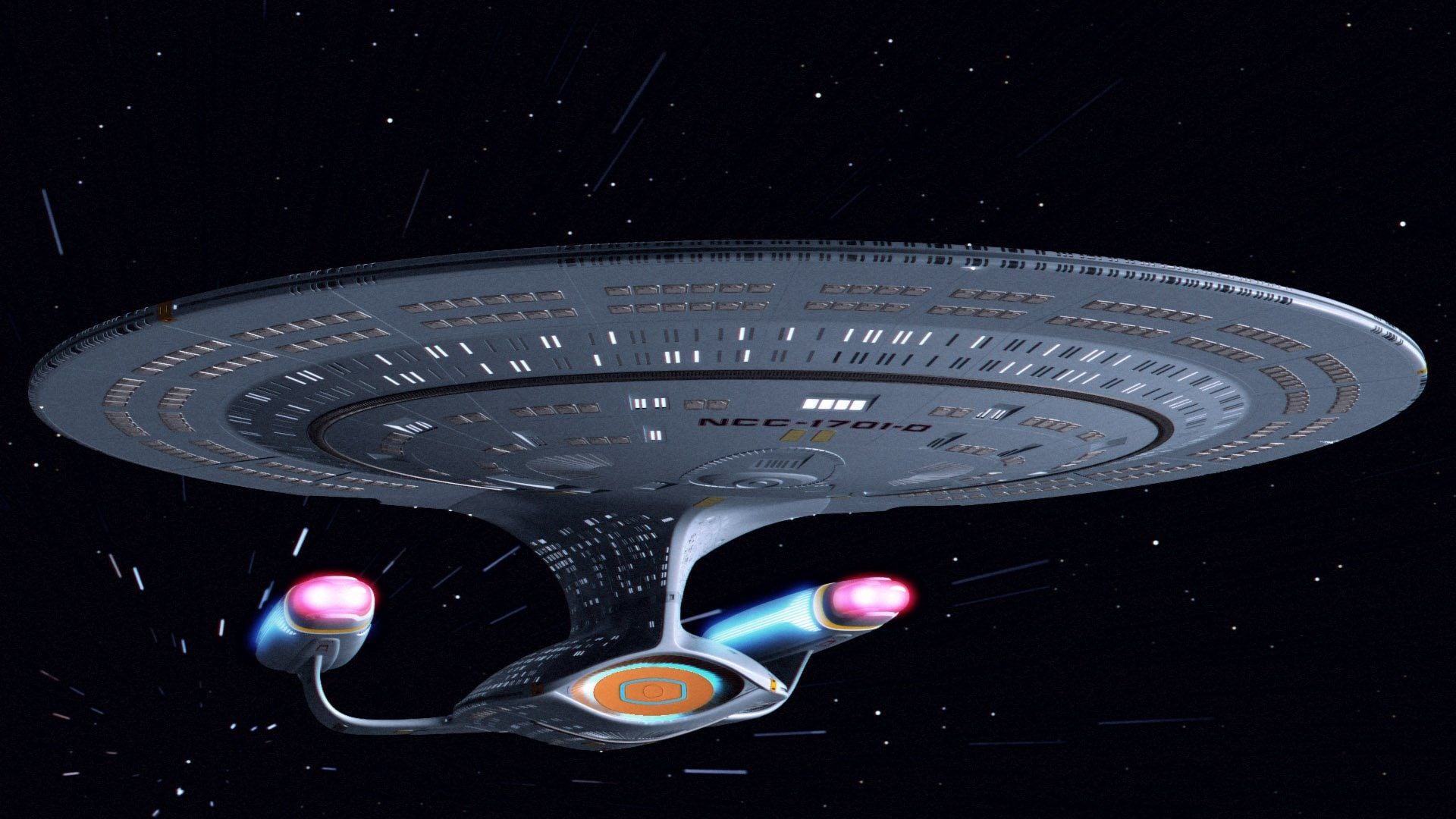
- First, the new Enterprise. The movies had already upgraded the original Enterprise, generally in ways that made it look swoopier, more aerodynamic. Which is pointless of course, in space. The original Enterprise had a geometric symmetry (which I discussed here) that, to me, suggested some higher-dimensional alignment, perhaps in they way in went into warp drive — but this is idle speculation. That movie and TV designers kept making the Enterprise more aerodynamic, and then imagined other starships as merely being pieces of the Enterprise reassembled in different configurations (just one warp nacelle in the center, for example), indicated to me a lack of imagination, and the fallacy of projecting local circumstances to situations they do not belong. This new Enterprise was apparently much much larger (though it’s hard to tell given that the relative proportions of this to the original were roughly the same) but with an attenuated rear end. The purpose of the curvy sections holding up the nacelles? Mindless aesthetics, as far as I can tell. (And of course there’s no “holding up,” since…)
- This episode made a big point about the ability of the saucer section of the Enterprise to separate from the lower section, a point which had been established in the original show, but IIRC, never used until one of the movies. (Don’t remember which one.) Not sure I ever understood the point. It’s not as if either section could descend into the atmosphere of a planet. Only the lower section had warp drive. The saucer had impulse drive, which limited it to sub-light velocities. Again IIRC. The series’ premises kept changing.
- About this episode: I had forgotten that this was when the character Q was first introduced. In fact my vague recollection of this episode was that it involved an Enterprise visit to some sophisticated starbase, for some reason. That must have been a different episode.
- The episode is in part the origin story of all the characters, showing or recalling how they first meet or met, in a way TOS never depicted. Data even has to explain himself as an android (to an elderly McCoy, in a cameo appearance by DeForrest Kelley).
- It’s significant that there’s a conversation between Riker and Picard about the advisability of the latter beaming down the planet. This was a major complaint by David Gerrold in his book THE WORLD OF STAR TREK, that it’s implausible for the captain of the ship to beam down every week into potentially dangerous circumstances. Of course the rationale for that was, especially in the ’60 with limited budgets and casts, producers would use their lead actors in every possible scene. In this way TNG advanced the concept over TOS.
- The most striking element is the conceit that, as Picard keeps explaining to Q, humanity has evolved over the past 400 years, has ‘grown’, and is no longer the quarrelsome, violent species that once existed. It’s striking because, as has become apparent in recent decades, it’s so naive. There’s no evolution of human nature possible in 400 years, and if anything we see progressive movements undermined by conservative ones over and over, in a kind of inevitable cycle (that personally I’m not sure humanity will ever escape). Still, this was a premise that series creator Gene Roddenberry kept insisting on, to the point that he drove writers away with the stricture that there could be no true conflict between characters. Where is the drama then? How do you write stories in which people are not in conflict with each other? (Well, perhaps stories that are only about alien puzzles to solve. But those aren’t dramatic.)
- The bottom line about this episode is that it’s about yet another test of humanity. I say yet another because it was an old idea in science fiction. Aliens demand that humanity explain itself, or demonstrate its fitness, in order to join the galactic community, or even to survive. (The most famous earlier example I can think of is Robert A. Heinlein’s HAVE SPACESUIT — WILL TRAVEL, in which the protagonist is confronted by a galactic council demanding the same defense of humanity.) But then Trek was seldom notable for original ideas. Roddenberry and his writers drew on a history of written science fiction going back to the 1930s that entailed galactic empires, other planets with strange species, hostile aliens, friendly aliens.
- The best thing Star Trek did was to introduce these ideas to a mass audience. They’ve become part of popular culture.
Links, the last two with detailed plot summaries:
Wikipedia: Star Trek: The Next Generation
Wikipedia: List of Star Trek: The Next Generation episodes
Wikipedia: Encounter at Farpoint
Memory Alpha: Encounter at Farpoint (episode) with a very detailed plot summary