- John McWhorter: Don’t pronounce the T in ‘often’;
- How an American living abroad realizes the problems with America;
- Why we’re stuck with a religious calendar.
My favorite pet peeve.

NY Times, John McWhorter, yesterday: What’s Better Left Unsaid
(I made this point in one of my earliest (and shortest) posts on this blog)
People without enough to do like to find unnecessary rules for English speakers. I discussed dangling modifiers last week. In that vein, let’s do “often.”
Many think it should be pronounced “off-ten” rather than “offen,” or at least feel better saying “off-ten.” But why, when we don’t pronounce “listen” as “lis-ten”?
He considers defenses and rebuttals. The general theme is how the language keeps changing, and some people think it shouldn’t.
Saying “off-ten” doesn’t hurt anybody, but it is, frankly, inconsistent. Keeping the “t” in “often” but not “soften” is a symptom of something larger — our reluctance to let our language do what all languages always do: change. We are taught to think that when a language changes, it’s falling apart. But really, it’s just morphing. All languages always have — a language that stays put is as impossible as a sky where clouds never move.
So this issue is all about resistance to change! The hallmarks of conservatives!
Anyway, he goes on with examples of English words that had letters *inserted* so as to reflect their Latin or French roots. And concludes (fortunately on my side):
But this nevertheless leaves us with a language in which what we pronounce as “vittles” is spelled “victuals.” With about 1 in 5 people worldwide using this language and more to come, we should at least try to make our spelling the least crazy as possible. Like buying war bonds in the 1940s — it didn’t change the world, but at least you were pitching in. If we’re not going to start saying “sof-ten” and “lis-ten” — and we’re not! — why not learn to stop worrying and say “offen.”
\\\
Perspectives. You take for granted what you grew up with. (From 2 months ago, but came up in my Fb feed yesterday.) Part of wisdom is learning how things might be different.
Upworthy, Annie Reneau, 28 Feb 2026: American shares his 9 realizations about the U.S. after 13 years abroad and it’s eye-opening, subtitled: “If you’ve never left, you can never understand what it’s really like…”
Evan Edinger moved to London over 13 years ago to study abroad but never planned on staying overseas permanently. His goal was to get his degree, return to the United States, start his career, and make a life for himself. He thought of his time in London as a “temporary adventure.”
But when he finished his degree, he found himself in an unexpected situation: He didn’t want to go back. “The longer I stayed in London,” Edinger shares on his YouTube channel, “the more I began to notice all of the assumptions that I’d grown up believing in America, the things I was brought up to believe were undeniably true and just the way the world worked—it turns out they weren’t true at all.”
One of the benefits of living in another country is seeing your country of origin through different eyes. That perspective can cause you to appreciate some things and question other things. Edinger shares nine realizations he’s had about the U.S. since he left, starting with one of the most quintessentially American realities he found himself questioning.
I’ll just list the nine realizations. You can guess what he says about each one.
- Guns
- Government
- Walkability and Public Transport
- Food quality and Price
- Healthcare in the U.S. vs. Europe
- Consumer Protections in the U.S. vs Europe
- Worker Rights
- Money (Live to work or work to live?)
- On Romanticizing Europe
Needless to say perhaps, but most Americans think America is the best nation in the world on every possible ground. It isn’t.
On another note — this is exactly what science fiction is all about. Really. It’s about challenging the presumptions of humans: their cultures, their identities, their conceptions of the universe. On yet another note: all of this applies to religion, too.
\\\
OnlySky, Ulrich Stange, 20 Apr 2026: Godless time: Time for a secular calendar, subtitled “Time is measured by scientific standards, so why do we still use a calendar based on religion?”
(The answer, before I read the article, is about the sunk cost fallacy.)
We derive our time unit, the second, from a global network of atomic clocks. This atomic time forms the basis of Coordinated Universal Time (UTC). To line the seconds up to form a time scale, UTC bundles them into larger derived units—minutes, hours, days, months and years—and identifies the days, months and years by the Gregorian calendar. And that’s a problem, because the Gregorian calendar is a Christian calendar conceived by the Catholic Church for ecclesiastical purposes. This leads to the curious situation where in our standard time, the time units are defined by science, but the time scale is defined by religion.
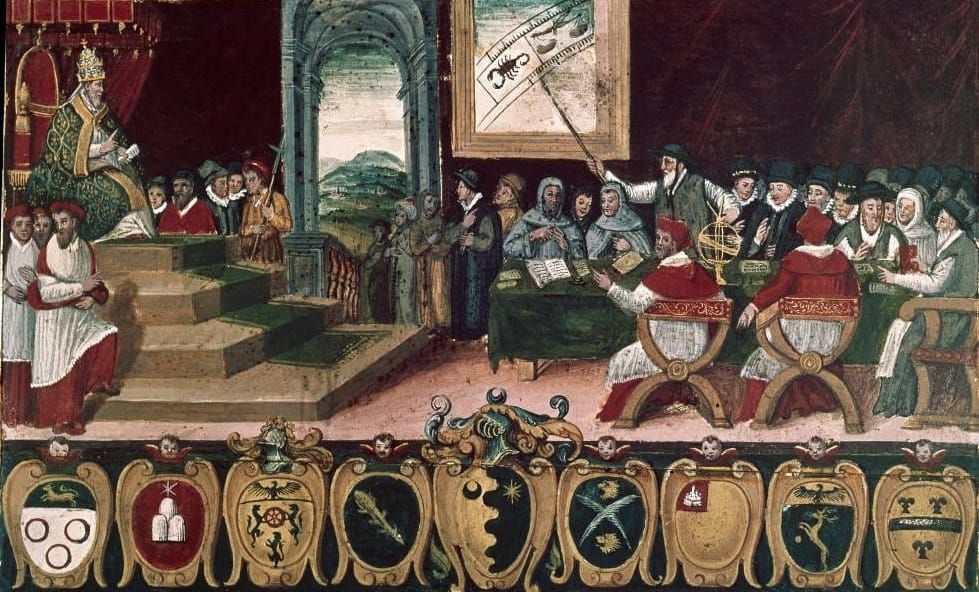
The Gregorian calendar was introduced by Pope Gregory XIII in 1582 and has since been adopted by (almost) every country in the world: Catholic European countries and their colonies adopted it immediately in the 16th century, Protestant countries over the course of the next two centuries, some Muslim and Buddhist countries in the 19th, and Eastern Orthodox countries followed in the 20th century. The most recent convert, Saudi Arabia, joined just 10 years ago in 2016. This slow pace of adoption—over 450 years and counting—is indicative of just how problematic this standard is. So, what is wrong with it?
The article then details technical and conceptual details. A technical problem is that our traditional calendar has no year 0. Then:
Those are some of the technical problems. More problematic, though, are the conceptual problems: The year of the onset of the Christian era is referenced to the immaculate conception and the virgin birth of Jesus Christ and the day (and month) is linked to the resurrection of Christ (the Pope wanted to fix the date of Easter somewhere close to the spring equinox) as well as to the biblical creation (supposed to have occurred at 6 PM on October 22, 4004 BC). This means that the origin of the Gregorian time scale is defined entirely in reference to supernatural happenings in religious stories of a minority religion. That raises some serious questions.
…
Does it make sense to measure time by a time scale that is indeterminate, inaccurate and referenced to the supernatural? Can that even be considered a “scientific” time scale? In the humanities the question is: Does it make sense to evaluate the histories of other cultures along a timeline that is defined by the religious beliefs of one particular culture? Is that really unbiased science? For civil society: Does it make sense to run the affairs of a multicultural world by the calendar of one particular minority religion? Is that really inclusive? If the answer to these questions is no, then the next question is: What to replace it with?
The article goes with an idea of “Anthropocene time,” which entails adjusting for the shift that the Gregorian calendar implemented:
Implementing the Anthropocene Era as standard time involves nothing more complicated than a simple shift of origin: Subtract 1952 years from the current date and add 10 days. That’s it. Most physicists can perform this conversion in their heads; most historians can do it with a calculator. For the rest of us, our smart phones will do it for us.
But as it happens, astronomers have already solved this problem, via their establishment of the Julian day, and Julian Date. In fact, now that I recall… one of my first computer programming projects was to compute, for a given calendar date, the corresponding Julian Date. As the article indicates, it’s straightforward.
But the answer, again, is that societies around the world have committed to our current calendar system, including the names of the days etc., and will likely never change, any more than English will change to reasonable spelling, or religions surrender their magnificent cathedrals to become natural history museums. Too much has been invested, over too long, to admit any kind of change.
And thus humanity may be stuck where we are, forever.