
Subtitled: “Human Meaning in a Silent Universe”
(University of Chicago Press, 2015, xi + 197pp, including 13pp of acknowledgments, notes, suggestions for further reading, and index)
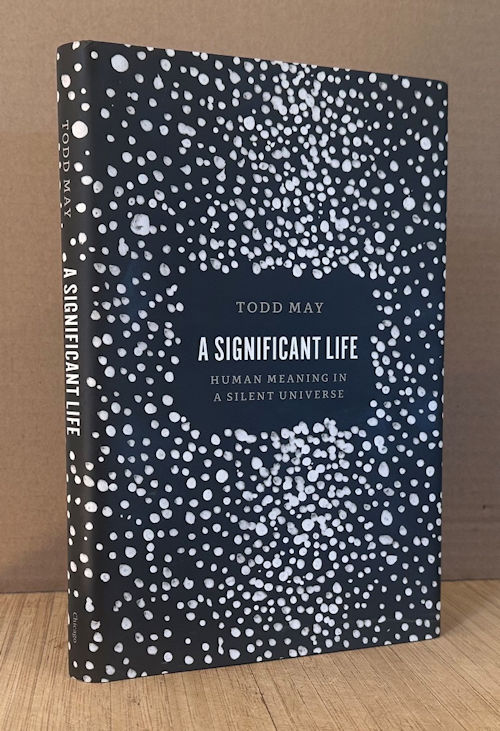
This is the first of three slender books I’ve collected over the years by Todd May, who’s just a bit older than I am and who gained some prominence by being a philosophical advisor to the TV show The Good Place. Is that where I first heard of him? Probably, though I’m not sure after ten years. (The two later books are A FRAGILE LIFE and A DECENT LIFE, and I also have his latest book, SHOULD WE GO EXTINCT?)
First, it’s peculiar that he doesn’t use the word “significant” in the book much if at all; he speaks of “meaning,” as in the subtitle. Second, the author explores mostly familiar ideas about what people have meant by “meaning,” and how looking up at the sky, at the universe, provides no answer to the “meaning” of human life. Ultimately, it boils down to deciding what we mean by meaning.
It was while reading this book that some of my thoughts about writers, physicists mostly, who discussed how it is better to think about different “levels” or “realms” of reality, with different “stories” appropriate to each. I’ve been mentioning some of these as I’ve been posting, but soon I’ll be consolidating such thoughts on a series of theme pages…
*
Key Points
- Like Camus, we search for meaning in the universe around us and find only absurdity.
- There are three problems with relying on God for meaning: One, we understand how we got here, without God. Second, even allowing for God or gods doesn’t solve anything, because different religions have different answers. Science provides methods for determining correct answers, but not religion. Third, does God dictate what’s good and what’s bad based on some external criteria, or just because he says so? Either way doesn’t solve anything.
- Some think merely being happy is enough; it’s what parents want for their children. Is happiness mere pleasure? More substantially, higher pleasures, like projects that engage with the world, could provide “meaning” in the world, a psychic affirmation. More precisely: when a subjective attraction meets objective attractiveness. Your project has to matter. But what is mattering?
- We can adopt a narrative approach to life. But not all narratives are meaningful. Better to consider narrative values. Where do they come from? Something unique to oneself?
- Other ideas: Intensity. Steadfastness. (Many examples of real people throughout these chapters.) Meaningfulness doesn’t necessarily align with morality.
- How do we ground narrative values? How can they be objective? Based on values? Where do they come from? Values can change, and we can debate rationales for doing so.
- Values can be culture-specific. Meaningfulness too? There seems to be nothing that justifies any particular web of beliefs. Our scientific theories occur within the same web. That’s all we have.
- Ultimately, meaning is what we create, with how we engage with the world. It’s more than happiness. It’s not about success. We are not required or obligated to live meaningfully. There are no underlying standards for meaning. But realizing this is, at least, something.
*
Detailed Notes
Introduction.
Author grew up near the Museum of Natural History in NY. “One is born, one dies, the land increases.” Is that all there is? We often wonder, what have we made of ourselves? Will we lie on our deathbed and think we should have done it differently? If there is a meaning to life, we shouldn’t have to wait until the end to find it. Camus wrote about the feeling of the ‘absurd’ – weariness and amazement. What does anything matter? The absurd is something precise, p ix: “It is the confrontation of our need for meaning with the unwillingness of the universe to yield it to us.” Perhaps there is a meaning, and it is just inaccessible to us. Where do we look? Camus thought the only escape was physical suicide. The human condition demands meaning. Or we commit philosophical suicide—accept that the universe will give us no reason to go on. We pretend that there is meaning to be found: in belief in God, in self-help books. Author decided to think more deeply. This book will offer a way of thinking about meaning. Maybe nothing grand, but something.
[[ My thoughts so far. Is meaning is relative? Things mean to you just what you mean to them? Or, meaning is a kind of metaphor or analogy, that just as things serve some function in a larger whole, so perhaps does our life. Purpose is something different: one’s purpose is to achieve what you and no one else can do. Or, the purpose of humanity is to make progress, to fight entropy, because as intelligent life forms, these are what we can do that no other creatures can do. To not to this – to merely perpetuate a self-congratulatory fable about worshiping your creator, say, accomplishes nothing and is a waste of potential. Your personal purpose is to identify what you can do that no one else can, and do that. That’s my current provisional conclusion.
Further: we understand the need for ‘meaning’ in the way humans evolved to perceive causes and effects, for improved survival. We perceive lots of false causes and effects too, and while some may be harmless, we’ve devised this self-correcting process called ‘science’ to filter out the false-positive cases. But eventually we search for ‘meaning’ at scales that don’t matter for our perpetual existence – except in some of the existential threats. Everything fits together.
The universe is *not* silent. It is showing us exactly what kind of meaning exists. That we’re uncomfortable with that is a problem of scaling. We seek causes and effects where none exist. It’s like infants and children who believe that everything must be about them. It’s immaturity.
There are two core issues. One might be called ‘scale-blindness’. The other might be the same thing: asking the wrong questions.
(later)
So: meaning makes sense only in human realms. And it is built. You get to choose what is meaningful and what is not. That’s my current take.
Also: consider ‘meaning’ in the dictionary sense. There, it’s the equivalence of one word with a set of other words that describe the same thing. A word doesn’t mean in the context of a sentence or a book…
Perhaps you could say your purpose – the one things you can do better than anyone else – is what gives your life meaning. ]]
Ch1, A Meaningful Life?, p1
The question seems to ask for something that is the point of our being alive. How do we discover this? And it is not up to us what it is, 1.8 [contra my thought; this is why my notes conclude there is no meaning in that sense.] It exists independent of us. Camus. Perhaps the universe contains a meaning that is independent of us. Aristotle, whom author detested. Then he read the Nicomachean Ethics. Then he taught Aristotle. Aristotle talks in terms of the good. What is the human telos? Eudaemonia, or happiness, or flourishing. And this is rare. It’s about expressing virtue. It’s not an end state. It takes work. There are two types of virtue, and three parts to the human soul. Vegetative or nutritive; then desire; then reason. The first is immune to reason. But desire can be controlled or channeled. We can apply reason to desire. It’s about finding the mean between extremes. There are virtues of character, and virtues of thought. … A good life is a life in which our mental capacities are exercised as an end in itself. What would this life look like? It is one dedicated to self-cultivation. (Not a life dedicated to others.) It might be found among some of one’s peers. A reflective discipline to understand the world and act well and thereby be wise. It includes cultivation of physical health. Eventually these traits become automatic, and won’t require constant struggle not to do bad. True friendship is possible only among the virtuous. This is an attractive vision.
But is it a meaningful life? We must know what makes life meaningful. For Aristotle the universe is not silent. It allows us to find it for ourselves. That what his ethics does. Camus wasn’t satisfied. Nor are most of us; we don’t see the cosmos as a rational place. Some of us need a God. A deity that grants meaning from the outside. A popular option, if perhaps unconscious. We could forget Aristotle and rely on God to provide meaning. But there are three challenges to this way of thinking.
First, the arguments of the ‘four horsemen.’ We understand how we got here, without God. This returns us to Camus’s silence of the universe. Does this deny a meaning of life? Let’s set that aside. Second, granting the existence of God or gods doesn’t provide a roadmap toward meaning. Different religions offer different answers. [[ Prothero ]] Even within the monotheistic religions. Science could offer us a method of determining the answer, but religion does not. E.g. Catholic vs Protestant debate over faith versus work. Philosophy has a similar problem. But religion begins with an individual choice of which religion to follow. Third, what if we did allow a single God and knew which religion was right. Even this doesn’t help. Because it is we who decide what’s good and what’s bad. What God decides? Why isn’t God dictating what’s meaningful then? Example from Douglas Adams, 20m; would that make our lives meaningful? [[ this is like my thought of the carbon atom as part of a table leg. ]] Or, does God answer to some external good? The same argument applies to meaningfulness. How and who decides? But we’ve already considered this, and found an empty universe.
So, we can’t count on the universe being rational, as Aristotle did, nor can we count on God. Recall Dostoevsky: if God does not exist, then everything is permitted. It seems the same is true even if God existed. But: must meaning be written into the nature of things? Maybe we can make choices that are more meaningful than others. Human flourishing, perhaps. [[ Recalling Sam Harris and others. ]] This casts the idea of meaning as something different than the traditional one. It can be a someway: a way of living in certain ways rather than others. Two tasks: what might this meaningfulness be. And how would this apply to us? It’s not about external meaning or the meaning of humanity. Think of a perspective that between our living and dying and increase of the land, “something worthwhile will have a chance of taking place.” 24b
Ch2, Is Happiness Enough?, p25
Everyone is talking about it. There’s a world database of happiness, etc. Note books in footnote 7. Parents just want their kids to be happy. But it was a side effect, not the point, for Aristotle. [[ this discussion echoes Bregman — The monk who lives eternal peace, but doesn’t accomplish anything ]] Why is this? Because these are difficult times? The concern goes back a couple decades. Or is happiness easier to think about than meaning? Also, it’s quite American, as in ‘pursuit of happiness.’ And, happiness is entirely subjective, whereas meaning might be measured by some external standard. So happiness is more democratic. And happiness goes with tolerance, the acceptance that there is not any singular religious conception of a good life. So maybe the search for meaning is obsolete.
But what is happiness? Not just what makes people happy. Simple answer: Jeremy Bentham. Pleasure. We seek pleasure and avoid pain. These are obvious experiences. Yet pleasure can become pain, as in strenuous running. Sometimes pain necessarily precedes the pleasure of an accomplishment. But, is it enough? The brains of rats. Would this work for humans? Would anyone want to sign up for continual pleasure without being able to do anything? Almost no one does. Because such a life isn’t really living. No life projects. It is the projects that call to us. So let’s think of happiness differently, as did John Stuart Mill. Who thinks there are different kinds of pleasure, higher and lower. Higher pleasures are those preferred by those who have experienced both. We fritter away time with lower pleasures, but it’s the projects that are most worth doing, higher pleasures. And Mill chose philosophy as the highest pleasure. Not everyone would agree. How about an experience machine? (Nozick) Virtual reality of a sort. But most people wouldn’t take this either. What’s missing is engagement with the world. Book by Daniel Haybron. Happiness is an emotional relation to how one’s life is going. A psychic affirmation. Attunement, engagement, endorsement. Flow. Unconscious.
Is happiness enough? Imagine your last days. You wonder if your life was worth living. Is saying, you were happy, enough? Isn’t that a bit too self-absorbed? Doesn’t that miss something more? Something… meaningful? Some kind of significance? Something we have not found? That’s the existentialist view. Then author read bk by Susan Wolf. It approached the question of meaning from a different angle. An idea so obvious… Meaning arises when subjective attraction meets objective attractiveness. To find something important and engage with it. It’s about not being a spectator, but a participant with something that matters. Projects. One can live a good life without this kind of meaning. Meaningful involves that sense of engagement. And what is engaged is a valuable object. Example of an obsession with goldfish. Maybe Mary is happy. We might consider her pathetic. But her life isn’t very meaningful. That doesn’t mean she’s worthless. And who are we to judge about her meaningfulness? But it misses the need for meaning in the previous chapter. To seek meaningfulness entails some kind of standard for what is meaningful. Standards give us goals. Which we may not meet. We need that standard. It’s not in the universe or in God or inside us where then? Susan Wolf had no answer. There must be some kind of answer. We can’t leave it there. we must confront the question of criteria for meaningfulness. We at least a conception. (There might be others.) Where can we look?
[[ how about: your life is meaningful if you’re making some kind of progress in the world. then define progress ]]
Ch3, Narrative Values, p61
We live in an arc from past to future; only humans do that. The past is who we are (Faulkner). Yet we can change. It is the trajectory that amounts to being meaningful. What makes a life trajectory meaningful? We can adopt a narrative approach. We conceive of lives like stories. What’s a person’s story? Example of a colleague at work. Author gradually got to know his story. There’s a recent movement in psychotherapy called narrative therapy. Our stories inform who we are. Sometimes we need to escape them. (Fn 23 for books about use of narrative.) Perhaps we can detect meaning in these narratives – not *the* meaning of life. Some people claim not to live narratively. Like Buddhists who advise living in the moment. To eliminate desire, and thus suffering. An episodic life. But not all narratives are meaningful. People who are depressed. Such narratives seem to lack meaning.
Smry 70. Consider Faulkner’s The Sound and the Fury. The family endures. Steadfast. Like teachers, parents, athletes, craftsmen. Author sees this steadfastness as example of narrative value. And this can be the basis for meaning in lives. Smry74. Steadfastness is not a what, but a how. How she navigates the world. Perhaps a human life can be meaningful without attaining some sort of meaning. Consider Jimi Hendrix… the narrative value of intensity. Other such values, 76m. Even spirituality. Courage. Some if not all of Aristotle’s 12 virtues. Even a religious life can be meaningful in these ways. We need not be aware of the narrative value that we express. Example of author’s uncle. Narrative values are not binary, either there or not. They are levels of degree. Nor need a life express only one narrative value. Example of Coltrane. Author’s life is more of a serial intensity. Many people balance different interests, or narrative values. So assessment of narrative values in a person is not simple. Smry: we are concerned not with narratives, but narrative values. Even that episodic guy can be seen as expressing narrative values. But not story or plot. Narrative values would be a subset of aesthetic values, which Foucault argued should apply both to objects and to individuals. We’re drawn to people who live such values. But are such values merely subjective? This is a deep question that will be in ch5. But briefly: we can be mistaken, e.g. about intensity. An intense meaningful life watching sports? Mary and her goldfish? That would be a problem. We need both subjective attraction and objective attractiveness. Compare Hendrix with a fan. Hendrix is creating the music, not just experiencing it. Narrative values are about activity rather than passivity. … recall Invisible Cities. Moby Dick. Not a shopping mall. And what about love? Author is not in a position to explore this. But has a couple ideas. Subjectively, it does seem to be a source of happiness. Objectively, we can associate love with steadfastness and intensity and so on. Back to narrative values: we like to think ourselves unique. Doesn’t assigning narrative values make us less so? But this is true about any kind of category. What’s meaningful should be something personal to oneself. But then there are no standards for objectivity. Examples. Unique aspects of a person doesn’t provide meaning. So, we need categories of some sort. We’re usually concerned with our own lives. We need to find some kind of value, to keep going on. But that’s not the only important question about life. Recall Aristotle. A life can also be good. It can be happy. What is the relationship between these? And morality?
Ch4, Meaningful Lives, Good Lives, Beautiful Lives, p105
About Portrait of a Lady. Ralph is steadfast but not happy. Contrast him with Lance Armstrong. In 2013 he was just confessing his use of banned drugs. He had sued people for accusing him of doping. His struggles against cancer were admirable. He too was steadfast. But we approve of Ralph, and not of Armstrong. Ralph was not happy. Armstrong might have been happy with what he was getting away with. Consider the terms of “subjective attraction meets objective attractiveness.” Author mentions he’s assumed that readers understand in general what living a moral life is about. …then author goes on about Ralph Torchett. Something is missing in his life. Also recall Claus von Stauffenberg, who unsuccessfully sought to murder Hitler. … A moral life is not necessarily a meaningful one. Can it be meaningful without being moral, as in Armstrong’s case? What about rock stars who treat everyone badly? We can think of other examples. But their moral flaws should not make us disregard them entirely. There is another scale, of meaningfulness. We admire those people, but only in a certain way. (We tend to allow ‘meaningful’ people more latitude in their morality.) The human life is complex; it cannot be neatly wrapped up as some would prefer. Morality and meaningfulness are not necessarily aligned. Examples of individual engaged in massacres. Whereas one who participated but had doubts might live a life less meaningful but more moral. How to account for this? Perhaps severe immorality, evil, subtracts from meaningfulness. Suicide bombers.
A meaningful life has to be a life that is in some way worth living. How about another question. How can a life be beautiful? Contrast van Vogh and Rothko. Do their styles align with different narrative values? This should be resisted; a painting does not unfold over time. How about music? But many musical values seem to have no correlation to narrative values. Then how about literature? But values of literary characters are not values of literature itself. There’s a debate here that is as old as the philosophy of art itself. But author resists the idea. Narrative values are more like moral values than aesthetic values. Yet beauty in art isn’t necessary in the way narrative values aren’t necessary for a moral life. Finally, a question remains: what is it for a narrative value to be objective? Smry of earlier arguments.
Ch5, Justifying Ourselves to Ourselves, p139
Smy. But a piece of the puzzle is missing. Why should narrative values be objective measures of meaningfulness? How do we ground them? How are they not arbitrary?
[[ idea: they have to be grounded in the priorities of long-term survival ]] [[ you just need a wider perspective than mundane living. ]]
What makes something objective? It’s rooted in the material world. Example evolution. Yet ideas like Ptolemaic theory survived despite many examples that evidence did not support it. But what about values? Author suggests values are constrained by the practices through which we make them up. So, where do values come from? Examples of suggested values that others might think silly. It helps to have ‘reasons’ why something might be a value. We have to know the context, e.g. as in soccer. Yet soccer is a game, it’s made up. And it evolves. Examples. Individual rules can be changed to support the broad point of the game. And such rules are particular, given how circumstances change. As they do in everything we do in our lives. Some changes would be pointless. Changes, one, don’t need to derive from existing ones; two, they must respond to the practice as a whole. E.g. to make things fairer, more exciting, more accurate, more democratic. Technology can have similar effects. These are all values by which we can assess a process as being better or worse. Sometimes the outcome is worse. We can suggest reasons for such judgments. … and people can disagree. We can assess new practices against other practices. Author studied Foucault. About how things have changed and aren’t inevitable and can be changed again. (Ideas of rehab, 154m, like in Equus? “The normal.”) We can debate his ideas.
Take stock. To debate practices we use values and reason, but some values have to be held constant. This is called holism. Wilfrid Sellars. Quote 156m. (sounds like science.) What would a foundation for knowledge or values be? The option here is a third option: we can question any part of the whole network of knowledge, but not the whole itself. 157t. Similar for values. Values aren’t arbitrary; they respond to reasons. We evaluate values in comparison to other values. Neither an individual nor a community can arbitrarily declare something to be a value. Some values apply across practices, like moral values. Within limits. Similarly narrative values. Both can be criticized in the context of the practice in which they are applied. Using philosophy. … a community can be wrong about the narrative value it holds. Examples. A person who is steadfast, yet driven by unknown compulsions, like OCD, which when discovered, can lead to adjustments. The community might have been wrong. Example of the value of subtlety. As democracy arises subtlety may not be as valuable. New narrative values might emerge. Or we can argue for a narrative value not already recognized. Like, intensity.
But still, are there universal moral or narrative values? Or are they culture-specific? The problem of relativism. Consider clitoridectomy. Nazis. But we are not concerned with morality here. But with meaningfulness. Those other cultures might possess that. And other cultures might well have other ideas of what meaningful is about. But we work within a web of beliefs. What justifies the web? Nothing. We’ve reached the point where justification comes to an end. We can’t steps outside our current web… We might claim that the world provides such an anchor. But even our scientific theories occur within this web. Again: there is no God or external foundation; all we have left is the web of our current understanding… There’s no bedrock. Perhaps future posthumans will understand something we do not. We cannot rule it out. For now, our web offers all the objectivity we need.
Conclusion: Not Everything, But Something, p175
We would have preferred it otherwise. But the universe is silent, we are evolutionary contingencies. Even a God could not impose meaning upon us. But Camus despaired too quickly. 176t: But never move too quickly. There is always more than meets the eye. Meaning is what we create. We find ways of meaning to the world. It comes not from what, but of a how. It’s how we engage with the world. Meaningfulness is more than happiness. There can be meaningfulness without success. TV game shows involve pointless goals. University environments often compromise ideals with ‘success.’ Narrative values offer ideas about how we think of ourselves in ways other than success. Example of Gauguin. Suppose he had no native talent, try as he might. Or other variations… Suppose he made great art and no one ever saw it. Meaningfulness need not be held hostage to success. Social accomplishment is not the determinant of a worthwhile life.
Further, is it necessary to live a meaningful life? We are obligated to live morally, but we are not obligated to others to live meaningfully. A bit like beauty in that way. It is not the same as worth.
So there is human meaning to be had in our silent universe. If not the one we sought. Narrative values are ways of seeing how our lives are more than Camus thought, at the risk of not living up to them. And yet without some standard we have no way of making that assessment. So… this is not nothing.
\\
Further thoughts:
Given that we can derive basic conservative values from the protocols of tribal survival, what values can we derive from the idea of long-term, species survival? For the escape from entropy?
The most basic level of concern is for the self—the infant who relies on his needs to be taken care of by other people.
This gradually expands as one grows older and becomes relatively self-sufficient. But immediate family is still the primary concern. At some point, the circle of concern expands (Singer). To the community, the nation, the species. Beyond that? What would a cosmic meaning of existence be?