
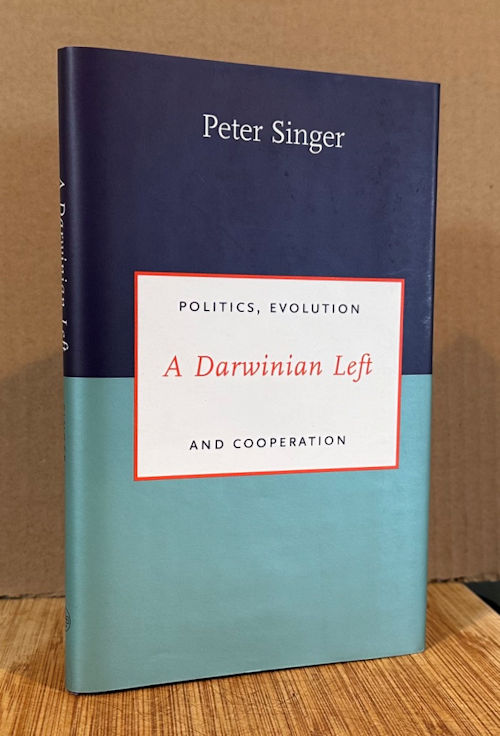
Subtitled: Politics, Evolution and Cooperation
(UK 1999; Yale University Press, 2000, 70pp, including 7pp notes and references)
What’s interesting about this book is the background of progressive idealism that is not widely acknowledged, or perhaps has simply been forgotten. That idealism involved Steven Pinker’s notion of the “blank slate,” the idea that the human mind is malleable and can be formed into any shape and thus, in principle, might be perfectible. Thus some Americans in the 1960s thought you shouldn’t automatically buy boys boy toys, or girls girl toys, because that was playing to cliches, when you could choose to guide children’s minds however you wanted to. (Also, I was just reading something about how Mao with his cultural revolution was trying to retrain Chinese minds into some ideal form. That didn’t work out either.)
Singer comes a little late to the party of scientists and philosophers, most prominently E.O. Wilson and later Steven Pinker and many others, who pointed out that there *is* a base human nature that cannot arbitrarily be reset. Thus this book, in which Singer is challenging the left to acknowledge the truth of Darwinian natural selection, and take it into account…
More broadly, these ideas go to the big theme of evolved human nature, and how what was suitable in the ancestral environment is not necessarily suitable in the modern world. How cooperation has become more important than competition. We need to understand that.
Key points:
- The right took Darwin to mean the strong have a right to trample the weak. But we cannot deduce values from facts. Though we can discredit non-Darwinian beliefs and ideas, e.g. the divine right of kings.
- The left erred in accepting the right’s assumptions, but believed that human nature could be perfected.
- Those ideas fell away as sociobiology discovered many universal aspects of human nature. Singer outlines how behavior varies across cultures greatly (e.g. food production), somewhat (sexual matters, ethnic identification), and hardly at all (we’re social beings with concern for kin and hierarchies). Some reforms of human nature might be possible, but we have to use the materials we have.
- A key idea is to encourage cooperation, rather than competition, and how that contributes to a sense of belonging, and thus meaning.
- We can learn from examples of the Prisoner’s Dilemma and the Tit for Tat strategy of cooperation. These are more difficult at scale. There will always to suckers and cheaters. Solutions entail avoiding situations that lead to economic inequality, and the poor.
- Altruism exists and can be encouraged through public esteem or ostracism.
- So, a Darwinian left would accept human nature, realize that people are still competitive but can be encouraged toward cooperation. We might use our capacity to reason to take us further. We are the first generation to understand that we have evolved and how that has influenced our behavior. Perhaps we can create a new kind of freedom.
(Comment: Singer doesn’t bother pointing out that the right has no interest in acknowledging evolved human nature; they endorsed Darwin in a limited way only to justify their own interests.)
Detailed Notes
Introduction, p3
Marx and Bakunin made mistakes about human nature. Now, the left needs a new paradigm. The goals of communism and democratic socialist trends have faded. A new source for goals on the left would be a modern understanding of human nature. We are evolved animals, 6b.
P7, What is essential to the left? Author recalls Henry Spira, about whom he wrote a book. Spira read book by Singer about animal liberation. Reducing pain and suffering. That should be what the left is all about. Author’s ethical position is utilitarian. He’s concerned about inequality, the principle of diminishing marginal utility. Now, where has the left stood in regard to Darwinian thinking?
Ch1, Politics and Darwinism, p10
After Darwin published some people claimed he validated power and cheating. The right of the strong to trample the weak. He was popular with capitalists. Carnegie, Rockefeller.
P12, Facts and values. Social Darwinism sometimes commits the fallacy of deducing values from facts. Evolved dispositions cannot tell us what we ought to do. So Darwin cannot justify any values, on the left or right. Some argue for consequences. Wilson too. So we can reject one idea, and find another speculative at best, p14. A third can be taken seriously, p15: by understanding human nature we can identify the means to attain some of our social and political goals, and the costs and benefits of doing so. And a fourth idea: we can discredit non-Darwinian beliefs and ideas. Example of the divine right of kings, which rests on the idea of an original Adam. And the notion that God gave Adam dominion over fish, birds, and animals. Darwin showed how humans are like other animals, even in their emotions, and not some separate creation from them. Also, Darwin undermines the idea that all human beings are the same in all important aspects, especially men and women in their reproductive capacity.
P19, How the left got Darwin wrong. Is to accept the assumptions on the right that nature is a savage competition, and competition is natural or inevitable. Cooperation was not recognized even among theorists until the 1960s. Kropotkin and others floated the idea without knowing how it might work. Marxists eagerly took up Darwin, in order to break the hold of divine creation. Marx and Engels, examples. Without fully understanding Darwin; they gave rise to Lysenko. Engels thought that Marxian forces took over where Darwin’s evolution left off. That human nature was not fixed, but changes with the mode of production. Rousseau and private property.
P24, The dream of perfectibility. The left hopes that human nature was malleable so it could perfect human society. As the communists hoped, with their predicted victory of the proletariat. While rejecting utopias. They also criticized Malthus. … Both Marxism and Christianity agreed that the gulf between humans and animals could not be bridged.
P28, Old tunes keep coming back. The conflict has continued into the late 20th century. Haldane, JM Smith, Trivers. Then came sociobiology.
Ch2, Can the Left Accept a Darwinian View of Human Nature?, p31
Unpopular ideas. All the dreams of perfecting mankind fell away in the 20th century. As did Marx’s theory of history. Marx had many good ideas. The last barrier is the idea of the malleability of human nature. From the idea of Lock’s ‘white paper’ [i.e. blank slate]. [[ he does mention a couple Pinker titles in the notes. ]] Margaret Mead erred, or was pranked. E.O. Wilson. Many universal aspects of human nature have been discovered. As author will now discuss.
P35, What is fixed and what is variable in human nature? Some behavior varies greatly across culture, some a little, some almost not at all. Great variation: ways in which food is produced. Economics structures, religious practices. But not group leadership. Some variation: sexual matters. Some men may have more than one wife. Ethnic identification, xenophobia, and racism. Little variation: how we are social beings. Concern for kin. Cooperative relationships. Hierarchies. And sex roles; women care for children; men engage in warfare. Culture has an effect, and there are variations between individuals. This is not to say these tendencies are good. To be blind to them is to risk disaster. Abolishing hierarchies, for example, does not mean they can’t return. [[ a key point I’ve been making, about human nature in general… ]] As in Russia. What egalitarian revolution has not been betrayed by its leaders? [[ here we are ]] The left has to understand this.
P40, How can reformers learn from Darwin? You have to work with the materials you have. Examples of the market economy, and altruism. There are arguments here for privatizing industries. Or considering what ‘self-interest’ is. Making money? Being happy? Meaningful? It can appeal to the feeling of being wanted, or useful, or belonging to a community. From cooperating, rather than competing.
Ch3, Competition or Cooperation? P44
Every society has both tendencies, but perhaps we can change the balance. Compare the US to Japan. A cooperative society is more in keeping with the values of the left. P45. We are good at recognizing social contracts, and cheats who break them. Consider the work of Robert Axelrod…
P47, The prisoner’s dilemma. Description. There’s no solution. The same logic applies to commuting, to arms races. With repeated situations, people may realize that cooperation is the best long-term strategy. Repeating this in simulation, the best strategy was ‘tit for tat.’
P51, Learning from Tit for Tat. How to build a more cooperative society? Create mutually beneficial cooperation. There will always be suckers and cheaters. Don’t find excuses for poverty; change the pay-offs so that cheats don’t prosper. Don’t turn the other cheek. Scale is a problem; people in small towns show more consideration for each other. Then, disparity in power or wealth makes mutual cooperation more difficult. So address economic inequality. Instead of writing off the poor, avoid the conditions that create them.
Ch4, From Cooperation to Altruism? P54
The puzzle of the evolution of altruism. True altruism does exist. Blood banks. How can such a tendency survive? Behavior can be promoted or punished through public esteem or ostracism. … So people can be motivated by a desire to help others. Even if only a small fraction of the population does so.
P58, Status for what? We display status via conspicuous consumption. Example from Tom Wolfe’s Bonfire of the Vanities. What could take its place? A tax on spending, not just goods.
Ch5, A Darwinian Left for Today and Beyond, p60
Summary. A Darwinian left would not: deny the existence of human nature, insist it’s inherently good, nor that it is malleable. Expect to end strife and conflict by any means. Assume that inequalities are due to the usual suspects.
A Darwinian left would: accept human nature; reject inference from ‘natural’ to ‘right’; realize that people are still competitive; most people will respond to opportunities for mutually beneficial cooperation; promote cooperation rather than competition; realize that our exploitation of animals stems from our pre-Darwinian past; stand by traditional values of the left.
This replaces some Utopian ideas. In the longer term, our capacity to reason may take us farther. (As he discussed in other book.) Dawkins imagines cultivating altruism deliberately. We are the first generation to understand that we have evolved and how that has influenced our behavior. A little like what Hegel imagined. We understand where we have come from and what we are. We may yet create a new kind of freedom.
\\