Subtitled: “How Little Things Can Make a Big Difference”
(Little, Brown, March 2000, 279pp, including 20pp endnotes, acknowledgements, and index)
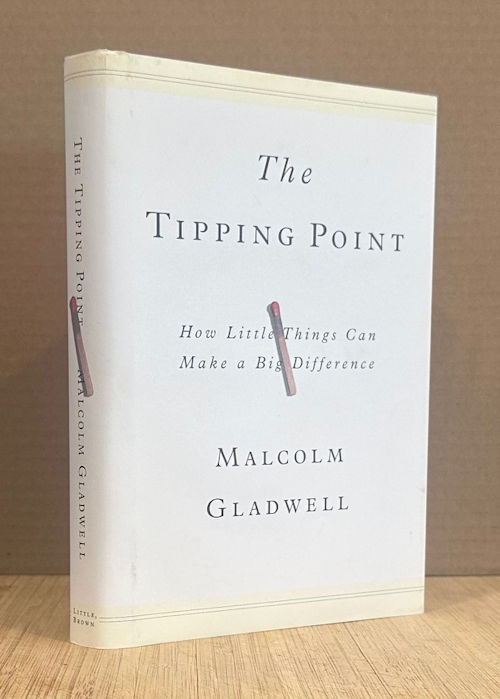
This was a popular and well-received book when published back in 2000, and launched Gladwell‘s book career. Most of his books follow a similar pattern: identifying counter-intuitive things about how the world works. In this book, the theme is in the subtitle. In BLINK, it was about the power of snap judgments (contradicting considered wisdom *not* to rely on intuition); OUTLIERS explores the role of environment (and by extension, chance) in success stories. I read those too. Next was WHAT THE DOG SAW, a collection of essays, which I haven’t read, then three others, which I didn’t even buy. Most recent is REVENGE OF THE TIPPING POINT, in 2024, which revisits some of the themes of the first book, from different perspectives.
Gladwell has been criticized on a couple grounds, one for oversimplifying complex ideas, two for relying too heavily on anecdotes. But he inspired many other writers, who were often more rigorous than he was in analyzing data, since they were scientists and he was not; one that comes to mind is Jesse Bering’s THE BELIEF INSTINCT (reviewed last year here).
This book and his others came to mind recently what with a couple of my running themes.
First, the world is complex, in contrast to the simplistic takes of many conservatives. This is because our “common sense” and intuition (like Trump’s gut feelings) are evolved responses to living in the ancestral environment that humanity moved away from only about 12,000 years ago, and so don’t necessarily apply in the modern environment (which is far more complex).
Second, because I now perceive several parallel trends in book publishing and ideas of the past thirty or more years. One are the similar books on parallel themes, as with Levitt & Dubner’s FREAKONOMICS in 2005, that also uncovered non-intuitive truths behind things everyone thought they understood, in economic terms. (That book had several sequels and inspired a long-running NPR radio show, running to this day.) Second is the theme of psychological biases that lead people to believe “weird” things, as Ariely and Shermer and many others have written about. And another are the discoveries of physics, going back at least to the 1980s, that reveal how reality does not work in predictable manners, and in fact can exhibit amazing complexity as a result of some basic concepts: recursion, fractals, chaos, complexity, emergence, and of course evolution. The big picture writers, like Deutsch and Carroll, show how they fit together. (And all of their insights constitute the “literacy” about the real world I’ve mentioned recently; one could contrast that with the “demon-haunted” world of the intuitivists and the gullicists.)
And so for example Gladwell’s idea of a tipping point is analogous to the notion in chaos theory that a single event, like the fluttering of a butterfly, can trigger enormous, unpredictable events, like hurricanes. That’s the way of the world, at multiple levels.
So here are the notes I took on this book, even though the general principles just outlined are my point today, more than the particulars of Gladwell’s examples.
*
Introduction
- Author recalls how Hush Puppies [a kind of shoe] suddenly became popular again, after a few people in downtown Manhattan nightclubs starting wearing them to be retro; or how crime in NY went down after several decades, for no obvious reason.
- Such changes resemble the way epidemics occur, characterized by three elements: a phenomenon that’s contagious (that spreads without being planned); that little changes have big effects; and that the effects occur within a short span of time. When these conditions occur it’s a ‘tipping point’, which is like a critical mass, a threshold, a boiling point; as when rain turns to snow.
- But why do certain ideas start such epidemics and others don’t? That’s the topic of this book.
Ch1—The Three Rules of Epidemics
- In Baltimore syphilis rates jumped, and various explanations were offered: the prevalence of crack cocaine; increased police action; cutbacks in city health services.
- Whatever the ‘true’ reason, such shifts are characterized by three laws of change:
- The Law of the Few: it takes only a few people to shift the tide, as in the so-called 80-20 rules (80% of traffic accidents are caused by 20% of drivers, etc.)
- The Stickiness Factor: something happens that makes a small change ‘stick’, as when a single person spreads a disease, e.g. Patient Zero in the spread of HIV, or the fact that HIV itself changed at some point (cf. evidence that an early form of HIV spread early in the 20th century)
- The Power of Context: the spread of disease is influenced by the seasons, with transmission greater during winter months when people are in closer contact; or the way people react to public emergencies—the more witnesses, the less likely any one will react (cf Kitty Genovese)
Ch 2—The Law of the Few (p30-88)
- The classic word-of-mouth epidemic was Paul Revere’s ride. Yet another rider took a similar trip, but no one remembers him. Why are only certain people effective?
- Three kinds of people facilitate such epidemics—
- CONNECTORS are those few people who know lots of other people, by virtue of their personality. E.g. the six degrees of separate experiment; the 250 names experiment; Kevin Bacon and other actors; people the author cites Roger Horchow and Lois Weisberg. Ironically it’s the ‘strength of weak ties’ that’s effective—the many people they know aren’t friends, they’re acquaintances.
- MAVENS are information specialists, market mavens, those who obsess about finding the best deals and offers and passing along tips to everyone they know. Zagat volunteers are an example. But these are teachers, not necessarily persuaders.
- SALESMEN are those who do persuade, sometimes unconsciously, e.g. news anchormen who expressions vary depending on which candidate they’re talking about. Or students told to nod their heads while listening to an editorial introduces a bias into their reaction to the editorial. A little bias can have a big effect. Studies show subtle effects such as micro-movements of two people in conversation, they way they move or react, affects whether one person finds the other persuasive.
Ch 3—The Stickiness Factor
- Why are some things more effective than others? In the late ‘60s the children’s tv show Sesame Street was created; despite conventional wisdom that TV entertained but wasn’t involving, the show was a great success, in terms of teaching children.
- Other examples: a direct marketing campaign for Columbia Record Club was improved greatly by the simple addition of a ‘gold box’ game on the form. And a study on warning college students of the danger of tetanus weren’t affected by whether ‘scare’ tactics were used—the benefit occurred [more students got inoculated] by the simple measure of including a map to the student health center on the flyer.
- Sesame Street was rigorously tested with real children, and violated various kinds of conventional wisdom. It turned out children watched more intently not when they were ‘stimulated’, but when they *understood* what they were watching. They were told not to mix reality and fantasy, but tests showed greater attention when they were mixed. (p105b). They did eye-tracking tests..
- In the ‘90s, another TV show was even more successful—was even stickier—by changing some of the SS formula. Blue’s Clues. It was slow and deliberate, literal rather than clever, and each episode was repeated 5 times a week—because kids were confused by SS’s wordplay, responded better to overall narrative arcs rather than commercial bite-sized 3 minute episodes; and like repetition, at least up to age 5 or so.
- It’s all about packaging the same information in slightly different ways; little changes in packaging greatly improve how well the message is conveyed.
Ch 4—The Power of Context (Part One)—Bernie Goetz
- In 1984 Bernhard Goetz got on the subway (at 14th St & 7th Ave) and was accosted by several black men, whom he shot…
- Crime in NY was epidemic; it had tipped. The key to reversing it was the ‘Broken Windows’ theory—that small expressions of disorder in a neighborhood, such as graffiti or broken windows, would invite more serious crimes. Clean up the graffiti and windows and the context is changed.
- So the subway was rebuilt and cleaned up, each car being reclaimed one by one.
- The principle is contrary to traditional theories of inherent/genetic predisposition for criminal behavior.
- Other examples—
- The notorious Stanford ‘prison experiment’ in the 1970s, which was called off when those assigned to be ‘guards’ became too abusive.
- Surveys in the 1920s about whether students cheat. People over-estimate fundamental traits of a person, without taking the situation into account. The effect of birth-order is apparent only when people are around their families—otherwise it doesn’t matter.
- Another example—Good Samaritans who do, or do not, stop to help someone depending on how much of a rush they are in.
Ch 5—The Power of Context (Part Two)—The Magic Number 150
- Case study Rebecca Wells’ The Divine Secrets of the Ya-Ya Sisterhood, which sold only meekly before taking off in paperback sales, an effect attributed to various reading groups, especially on the west coast. The key is that these groups are relatively small, and that the groups reinforce the message…
- The way a movie plays in a theater with other people; religious messages spread; book groups.
- Humans have a limited ‘channel capacity’ – people tend to sort things into not more than about 7 categories.
- Findings show brain size of primates correlates with the group size they tend to congregate in.
- For humans the limit is about 150. Military units, colonies, etc., tend to splinter whenever the size grows to exceed this number. Behavior changes; it’s no longer possible to know everyone in a larger group.
- Lesson: keep the groups small. Gore Associates (maker of GoreTex etc) keeps each plant to 150 employees, even if several plants are located right next to one another.
- They employ the principle of ‘transactive memory’—one person doesn’t have to know everything, if he knows where to find what he needs to know. This operates between married couples and families, with different members ‘specializing’ is certain tasks or kinds of knowledge.
Ch 6—Case Study: Rumors, Sneakers, and the Power of Translation
- Airwalk shoes, originally marketed to hardcore skateboarders. Their advertising followed the classic diffusion model—Innovators, early adopters, early majority, late majority, laggards. There’s a chasm between the early adopters and early majority—this is where the connectors, mavens, and salesmen are needed. They ‘translate’ the message to the masses in the same way rumors are spread – by taking a specific case and changing it through leveling, sharpening, and assimilating the message.
- Airwalk’s ad agency used DeeDee Gordon, a ‘maven’ who sought out innovators and queried them regularly about new trends. [she’s a ‘coolhunter’ in later parlance] She applied those trends to the Airwalk advertising.
- But it didn’t last—Airwalk went so mainstream it turned off the specialty crowd.
Ch 7—Case Study: Suicide, Smoking, and the Search for the Unsticky Cigarette
- In Micronesia in the late 60s there was an epidemic of suicides, mostly among teenage boys, who would hang themselves over seemingly trivial matters—being yelled at by their parents, or unable to decide between two girlfriends. Once started, other followed, being imitative as a sort of self-expression.
- Similar to the epidemic of teenage smoking in the west.
- Teens know that smoking is dangerous; yet anti-smoking campaigns backfire.
- The suicides were contagious because news of one in effect gave people ‘permission’ to do the same—created a context for that kind of behavior.
- With smoking, there’s a strong correlation with feeling ‘sophisticated’. Smokers trend toward a specific, extrovert personality type. They don’t smoke to become cool; they smoke because they’re cool.
- The environmental influence is about peers, not parents. So trying to control the ‘salesman’ won’t work.
- The way to control the episode is to address the ‘stickiness’—the addictive quality of nicotine. Not all kids who try smoking stay with it—depending on varying tolerances to nicotine, perhaps. There’s also a link between depression and heavy smoking; treat the former, and the latter becomes easier to control.
- Hardcore drugs, for example, are not actually very sticky—only a small percent of those who try become regular users.
- Remove the absolutist implication that exposure => addiction. Make it ok for kids to experiment.
Conclusion
- A final example: San Diego found that the place to spread awareness of diabetes and breast cancer in the black community was in—beauty parlors. Captive audiences where people had time to receive new information.
- Lessons:
- First, starting an epidemic requires putting resources to a few key individuals—even if they seem like ‘band-aid’ solutions.
- Second, the world doesn’t accord with our intuitions—what we do must be tested.
- And finally—things can be changed.
\\
Comments from 2005:
Interesting to consider anti-gay efforts in this context. The motivation of those who would ban books, etc., relates to the ‘power of context’; it presumes that the mere mention of the existence of gays will sway children into that lifestyle—giving them ‘permission’ to engage in a possible kind of behavior. This is the same notion that violence on TV and in movies is unhealthy because it could result in real violence…
There’s a certain validity in this, but the anti-gays also presume great ‘stickiness’, that is, if their kids try it once, they’ll like it and never have kids of their own, propagating the species and family name. This might well be true in some cases—the cases where a person would remain an unhappy heterosexual in a more repressive society. Yet the fears of the anti-gays seem excessive—do they really believe the allure of gay sex is so great as to be such a threat?